Sometimes we need to be provoked into thinking things through more thoroughly and deeply. The enemy is so clever at interleaving error quite subtly into everything we think and do, even in meetings we believe to be fully devoted to following Jesus.
I want to point you to two excellent items posted on the website, Life with CD. I’ll give a short taster to both with links to the originals, I urge you to read them both in full (they are not long, but they are very thought-provoking).
Sometimes we need to be provoked into thinking things through more thoroughly and deeply. The enemy is so clever at interleaving error quite subtly into everything we think and do, even in meetings we believe to be fully devoted to following Jesus. We can easily swallow what is wrong and believe it to be right. That’s why I’m adding this post to my series Activating the church.
In part one we read about Eli, a young man who is challenged by a conversation with an older man. He loved the Lord, or at least he truly meant to. He read devotionals in the morning when he remembered. He played worship music in the car. He posted verses online. He served at church once a month, sometimes twice when his schedule allowed. He wanted to be known as faithful. He wanted to be useful. He wanted, if he was honest, to matter.
And that is where the trouble began.
For Meridian was a city ruled by two kingdoms.
The first kingdom was loud and dazzling. It did not always look evil. In fact, it often looked admirable. Its banners read words like success, influence, visibility, control, relevance, security, platform, and image. Its citizens woke early and slept late. They measured life in numbers: followers, income, invitations, accomplishments, upgrades, applause.
He noticed them when he was ignored and felt a surge of resentment. One kingdom whispered, “Make them regret overlooking you.” The other whispered, “You are already seen by your Father.”
He noticed them in ministry meetings. One kingdom wanted credit, subtle control, and the final word. The other was content to serve, listen, and decrease.
He noticed them in suffering. One kingdom demanded immediate explanation and escape. The other invited trust, even in darkness.
Christopher Dryden is right; when we look at church life we can see the two kingdoms battling it out between them. It’s so important that we learn to distinguish the voices, honouring the one and rejecting the other. So many of the things we do and say are serving ourselves, or even serving the enemy. But we’re not here to do that, we’re here to hear the Spirit of Christ as he guides us daily so that we begin to reflect his gentle presence and his patient grace into a world that needs him so much more than it realises.
And Jesus himself told his followers to be as wise as serpents but as innocent as doves (Matthew 10:16). He said he was sending them out like sheep among wolves. It’s a dangerous world.
This dangerous world crucified Jesus (the wolves got him). Sheep stay in groups, if the wolf takes one the others may escape. Our purpose here in this dangerous world is not to stay safe, but to spread Jesus’ message further and wider. We must do that by taking risks when necessary, but most of the time focusing on blessing those around us by kind and considerate words and actions whenever and however we can.
It has nothing to do with rank or position. I can wince at the erratic words and actions of a president while admiring the good words from the pen or keyboard of lesser, humbler people with hearts to speak the truth in love. And that truth will win out in the end because of its source: Papa, the Son and their Spirit, all poured out for us.
If you enjoyed this or found it useful, please like, comment, and share below. (If you don’t see those links, click the article’s title above the main photo and they will appear.) Send a link to friends who might enjoy the article or benefit from it – Thanks! My material is free to reuse (see conditions), but a coffee is always welcome and encourages me to write more often!
All that is required to restore native woodland in Scotland is to remove or significantly reduce the presence of Red Deer and sheep … Where deer-fencing is erected to protect an area the tree seedlings survive and soon grow too high for sheep (or even deer) to reach. Birch, rowan, willow, Scots pine and juniper rapidly recolonise in fenced areas.
What’s in an image? Sometimes quite a lot, more than meets the eye. I’m posting an image whenever I can.
Reflections on Barton Mill Pond
This is one of my favourite places in Cirencester; on a calm, sunny day wind doesn’t ruffle the surface of the old mill pond and the reflections are correspondingly bright and still. A bridge crosses the water here and crouching down it’s difficult to take a bad photo, or easy to take a good one. (Depends on your mode of thinking.)
The mill burned down in an unfortunate fire in 1926 and was never rebuilt. Watermills (and windmills) were going out of business at that time as most industries were running on steam power generated by burning coal, or by electrical energy, also usually from coal-fired power stations. Water power and wind power, now seen as green and therefore desirable, were seen in 1926 as ineffective and unable to compete with the more efficient alternatives. This was long before the downsides of fossil fuels were understood.
A place for wildlife
100 years after the fire, in 2026, the mill pond still exists, fed by a sluice gate taking water from the River Churn. The part of the pond in the photo is usually in water all year round, though other parts dry up in many summers, partly because of some silting up near the sluice and partly because the bed of the pond has silted up too, so now the water is shallow enough for yellow flag Iris and other plants to flourish.
There are many birds to be seen in this area too. Mallard ducks breed every spring, there are minnows and probably stickleback in the water and from time to time a kingfisher hunts along the water channels and the pond. Often all you see of the kingfisher is a darting flash of vivid blue. There used to be (and may still be) a pike. A single but very shy little egret hunted around here for the last few years, but this year I’ve seen two of them, probably a breeding pair. And their larger cousin, the grey heron also puts in an appearance now and then.
All life needs is an opportunity
Take any piece of ground, anywhere on Earth, and just leave it alone, life will move in, even if you choose a patch in the Sahara or Antarctica. If you clear a piece of ground somewhere with a reasonable climate and leave it alone, in just a human lifetime you’ll have thriving woodland with a full selection of insects, birds and mammals, and probably reptiles and amphibians too. The experiment has been made many times, sometimes deliberately, sometimes accidentally. If you choose the Sahara or Antarctica you might have to wait a bit longer, but the life forms that are adapted to those extreme conditions will move in eventually. Let’s look at some examples.
Broadbalk wilderness (UK)
A wheat field was deliberately left to revert to a natural state at Rothamsted Research Station in 1882. The land was left unmanaged where before it would have been ploughed and harrowed after harvesting the wheat in late summer and drilled with seed again in the autumn. This field had produced winter wheat every year since 1843, but now the scientists wanted to see what would happen if it was left uncultivated; for the first four years volunteer wheat grew, sparser and weaker year on year and after four years completely choked by weeds.
In 1900 the site was divided into three. One part was left deliberately untouched and gradually reverted to natural woodland; another third was mown annually and maintained as grassland; while the third section had all woody plants removed annually so the land became a natural, open mix of herbaceous plants.
The results have been very interesting and the experiment continues today. Levels of captured carbon are still rising in the soils of the site, nitrogen levels have risen as well. The samples and data are available for study and reanalysis.
Chornobyl (Ukraine)
The Chornobyl nuclear power station accident in 1986 rendered the city and a large area around it unusable. People were evacuated and the most contaminated areas became a restricted zone. Since the accident, time and rainfall have reduced the surface radioactivity considerably and it’s now possible to visit the area. In fact, wildlife has moved into the area from the very beginning and the changing conditions and environment have been studied in depth.
Almost 120 000 people were evacuated following the accident, so activities like farming, hunting, logging, and development ceased over an area of 4,200 km². Forests, wetlands and grasslands have reclaimed abandoned farms and villages; and vegetation grows freely through derelict buildings and former settlements. The pine woodland killed outright by the initial high-dose fallout remains one of the most nuclear-contaminated places on Earth, but even there substantial regrowth has happened. The loss of managed agriculture actually increased habitat diversity, reconnecting landscapes previously fragmented by farmland.
Large mammals rebounded strongly. Long-term census data show abundances of deer, elk, roe deer and wild boar comparable to those in uncontaminated regional nature reserves. Wolves are notably abundant, roughly seven times as common as in comparable reserves. Reintroductions have taken hold including endangered Przewalski’s horses, released in the late 1990s and now ranging freely and breeding. European bison have also been established, while beavers have recolonised rivers, canals and the cooling ponds, in places reversing Soviet-era drainage systems. Lynx, foxes and hundreds of bird species are present too.
However, there’s a mixed message – the abundant populations are due to the absence of humans, yet there remains clear evidence of radiation-induced harm to individuals. Some species are adapting and changing, showing signs of radiation resistance, for example.
Returning woodland (Scotland)
It seems that all that is required to restore native woodland in Scotland is to remove or significantly reduce the presence of Red Deer and sheep. Grazing species eat the young seedlings of trees and strip leaves from saplings. Where deer-fencing is erected to protect an area the tree seedlings survive and soon grow too high for sheep (or even deer) to reach. Birch, rowan, willow, Scots pine and juniper rapidly recolonise in fenced areas.
Other cases are numerous
Similar cases of large scale change include:
The reintroduction of wolves to Yellowstone Park in 1995 suppressed the elk population, allowing willow and aspen to return to riverbanks bringing back beavers and many other species including fish, moose and songbirds.
Oostvaardersplassen in the Netherlands where introducing large grazing animals brought back white-tailed eagles and other species.
Marine protected zones where closing areas to commercial fishing have seen biomass rebound. Examples include cod recovery on the Grand Banks off the east coast of Canada.
Reintroducing pine martens in parts of England shows promise in allowing native red squirrel populations to recover as the introduced grey squirrel population is suppressed.
Identifying common factors
A rule to cover all these examples will be useful. If the limiting, interfering factor(s) can be identified and removed life will usually return naturally – in any situation. Identifying the limiting factor(s) is the key to success. Reintroduction of missing species can also be a helpful part of the process but is often not necessary.
If you enjoyed this or found it useful, please like, comment, and share below. (If you don’t see those links, click the article’s title above the main photo and they will appear.) Send a link to friends who might enjoy the article or benefit from it – Thanks! My material is free to reuse (see conditions), but a coffee is always welcome and encourages me to write more often!
There are to be no debts amongst us, not only because we pay them off but because we forgive them. When I lack the means to pay I become dependent on your willingness to forgive. Jesus is our example in this. He is the ultimate debt payer and forgiver.
Money
This is a copy of an article I wrote back in October 2012, you can still see the original if you like.
Money (click images to enlarge)
We’re going to see how much we can draw from a single occurrence of the phrase ‘one another’. I think Romans 13:8 is the particular example I should take.
Here it is in context, verse eight is picked out in the centre…
This is also why you pay taxes, for the authorities are God’s servants, who give their full time to governing. Give to everyone what you owe them: if you owe taxes, pay taxes; if revenue, then revenue; if respect, then respect; if honour, then honour.
8 – Let no debt remain outstanding, except the continuing debt to love one another, for whoever loves others has fulfilled the law.
The commandments, ‘You shall not commit adultery,’ ‘You shall not murder,’ ‘You shall not steal,’ ‘You shall not covet,’ and whatever other command there may be, are summed up in this one command: ‘Love your neighbour as yourself.’ Love does no harm to a neighbour. Therefore love is the fulfilment of the law.
There’s a wider context too, that we need to bear in mind. Paul first writes about civil government, making it clear that goverments are there because the One who is Authority puts them there. They have a function and a purpose, we must submit to them.
Then come the verses above.
And finally Paul writes that time is short, we need to act now while we still can. Jesus is returning – soon! We need to be found ready and obedient and already covered by him. Romans 13 is relevant in its entirety. We should read this chapter often and let it sink deep into our hearts and minds!
But in verse eight, Paul makes three statements.
Don’t let any debt remain.
Continue to love one another
This fulfils the Law
What does he mean? He is not simply saying that I should pay off any debts I owe. He is saying that I should allow no debt to stand. He is saying I should pay my own debts but I should also, if necessary, pay yours. The important thing about debt is that it is paid, the effect is the same no matter who pays.
Jesus paid my debt so if I want to be like him I will pay yours. And Paul is not writing merely about money, he has just explicitly used the words respect and honour as well. These things apply to one another as much as (or more than) they do to governments.
There are to be no debts amongst us, not only because we pay them off but because we forgive them. When I lack the means to pay I become dependent on your willingness to forgive. Jesus is our example in this. He is the ultimate debt payer and forgiver. We are called to be like him in our dealings with one another.
Will I pay my monetary debt to you? Will I forgive your debt of money to me? But also (and often harder) will I pay the respect and honour I owe to you? And will I forgive you if you disrespect and dishonour me? This is the nitty-gritty of not allowing any debt to remain.
If I continue to love you I will indeed pay and forgive in all situations where debt might remain. Love will cause me, compel me to cover every kind of debt. If not, do I have love at all?
And it goes further yet! Paul writes that there is one debt that should stand, the ‘continuing debt to love one another’. Love is not just for today but also for tomorrow and for tomorrow’s tomorrow. I owe you love and that is a debt I cannot pay off. Love goes forward without ceasing. ‘Faith, hope and love remain’, writes Paul, ‘And the greatest of these is love’. Love remains, even in the kingdom of heaven, especially in the kingdom of heaven.
So, just as love is the fulfilment of Torah, so love is the fulfilment of civil law and indeed every kind of law. If I truly love I will not be able to commit any sin at all. The fact that sin remains is just a clear sign that love is not yet complete in me.
Let’s go forward in our lives understanding that love remains and is greater than anything else. And let’s remember who ‘one another’ means. It’s not limited to the church.
Jesus made it pretty inclusive. What begins with brothers and sisters becomes all encompassing. Love the Father, love one another, love your neighbour, love your enemy. My love is to extend out and become fully inclusive, not in any way for club members only. ‘One another’ is just a starting point, the nursery slopes of loving.
If you enjoyed this or found it useful, please like, comment, and share below. (If you don’t see those links, click the article’s title above the main photo and they will appear.) Send a link to friends who might enjoy the article or benefit from it – Thanks! My material is free to reuse (see conditions), but a coffee is always welcome and encourages me to write more often!
Since Jesus is the best example of all five APEST gifts, it makes good sense to look to him for guidance in using them. I’d say read the gospels and notice the things he did and the things he said. Pay particular attention to the way people responded and try to work out in each case which of the five gifts were active.
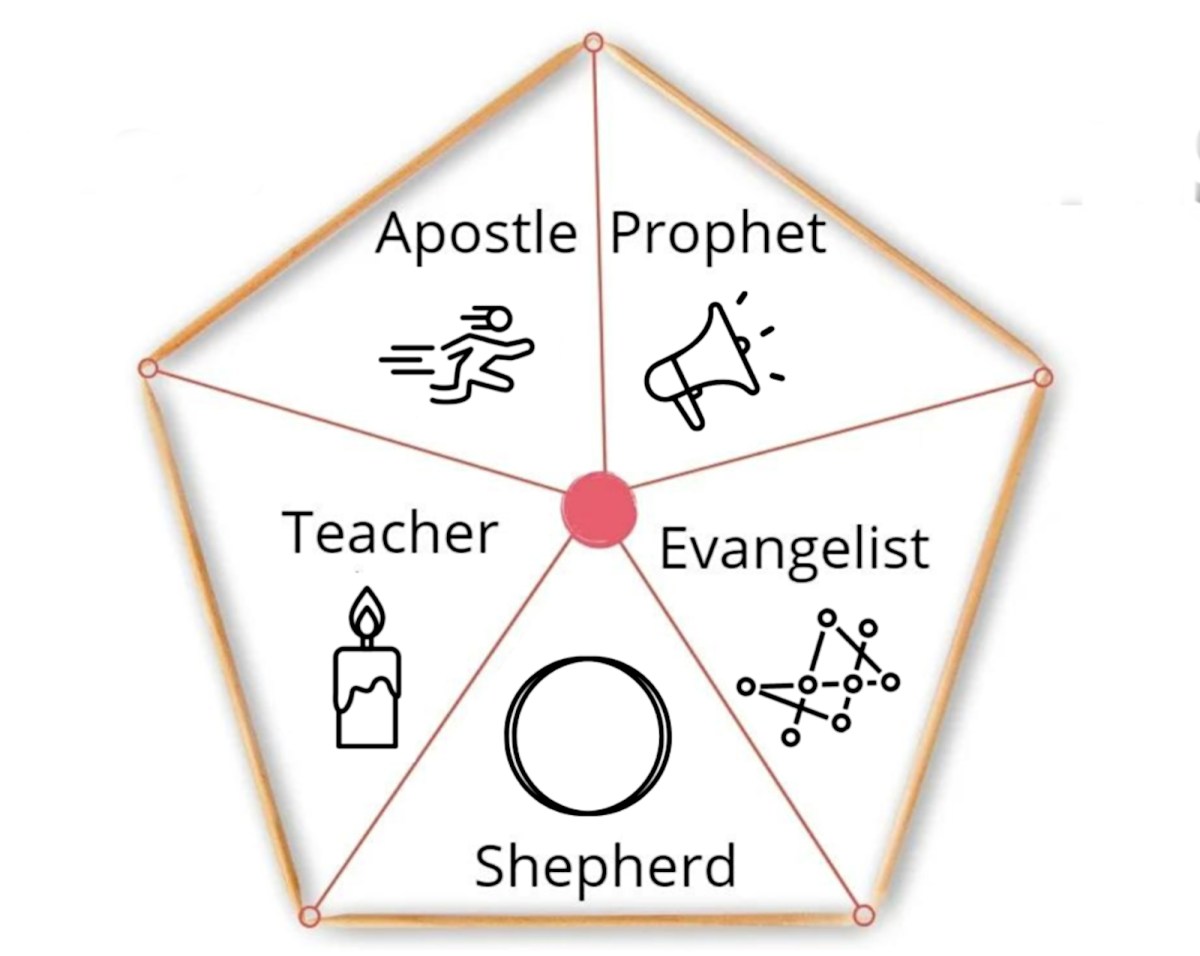
APEST (Diagram from What is APEST) – Click images to enlarge
Having looked at each of the gifts of service individually, we’ll check them one by one to see if we can find them active in the life of Yahshua (Jesus). Does Jesus himself demonstrate these gifts, and if so how? Let’s also bear in mind that if he worked through these special gifts 2000 years ago, we can be quite confident that he still does today. His character doesn’t change; he is the same yesterday, today and forever (Hebrews 13:8).
Each section begins with an Alan Hirsch quote which we then examine in the light of the character and nature of Christ himself. But before we do that, I want you to understand that all these gifts are equally important and equally valuable. There’s no hierarchy here, though there is a sequence. Apostles prepare the ground for prophets, who prepare the ground for evangelists, who prepare the ground for shepherds, who finally prepare the ground for teachers. At this point, the young gathering (or church) will be ready to begin sending out apostles and the cycle repeats.
You’ll find the quotes on Alan’s What is APEST? page. The tests are not expensive and I recommend them for both leaders and anyone with an interest in the topic.
Apostle
APOSTLES extend the gospel. As the “sent ones,” they ensure that the faith is transmitted from one context to another and from one generation to the next. They are always thinking about the future, bridging barriers, establishing the church in new contexts, developing leaders, networking trans-locally. Yes, if you focus solely on initiating new ideas and rapid expansion, you can leave people and organizations wounded. The shepherding and teaching functions are needed to ensure people are cared for rather than simply used.
Is Jesus an Apostle? He did not merely extend the gospel; he originated it! Was he a ‘sent one’? He was and remains the Sent One, bringing faith and truth from the presence of the Father sharing it freely here in the physical realm of Earth. If that is not transmitting faith from one context to another, I don’t know what is! Did he think about the future and bridge barriers? Just think of the old picture of Jesus as a bridge or plank crossing the gap between heaven and earth.
Did he establish the church? (I will build my church). He developed leaders (his disciples) and he networked trans-locally (the Samaritan woman at the well, healing the Centurion’s servant, raising Jairus’ daughter, calling Lazarus out from the tomb, and discussing truth with the Roman Governor, Pontius Pilatus). It would be really hard to argue that Jesus is not apostolic!
Prophet
PROPHETS know God’s will. They are particularly attuned to God and his truth for today. They bring correction and challenge the dominant assumptions we inherit from the culture. They insist that the community obey what God has commanded. They question the status quo. Without the other types of leaders in place, prophets can become belligerent activists or, paradoxically, disengage from the imperfection of reality and become other-worldly.
So, is Jesus also a prophet? Most certainly! Does he know the will of the Father? Way better than anyone else in history (you’d better believe it.) Is he particularly attuned to Yahweh and his truth for today? Most emphatically! Does he bring correction and challenge the dominant assumptions of his culture and of our own? He insisted (and still insists) that we obey what the Father commands. When did he not challenge the status quo? Certainly he does these things fully, wholeheartedly, and tirelessly. Jesus is, indeed, the greatest prophet of all time – by far.
Towards the end of his ministry, Jesus is clear that the temple will be destroyed and he foretells the misery and horror of those days, this done privately, just speaking with the disciples, but when these events unfolded in 70 AD under the Roman commander Titus they would have remembered his description and would have been confirmed and encouraged that he had the same prophetic spirit as the old testament prophets themselves. (Luke 21)
And Jesus had the same upward connection to the mind of the Father as well as the horizontal concerns about justice in the world that the old testament prophets regularly displayed.
Evangelist
EVANGELISTS recruit. These infectious communicators of the gospel message recruit others to the cause. They call for a personal response to God’s redemption in Christ, and also draw believers to engage the wider mission, growing the church. Evangelists can be so focused on reaching those outside the church that maturing and strengthening those inside is neglected.
Jesus is a recruiter par excellence. He called and worked intensely with a small group of close followers, he spoke to multitudes, but closely taught just a few. He is the evangelist, calling for a personal response from many individuals and not merely growing the church, but founding it in every sense worth considering. If you want to know what an evangelist is like, check out Jesus!
By the time Jesus teaching was complete and the time came for his death, resurrection, and a return to the Father’s presence, his disciples had understood him clearly and fully enough that the four gospel accounts could be written from what had lodged in their memories. They may not agree in every detail or always have precisely the same sequence, but that makes the four accounts more real and no less believable.
Shepherd
SHEPHERDS nurture and protect. Caregivers of the community, they focus on the protection and spiritual maturity of God’s flock, cultivating a loving and spiritually mature network of relationships, making and developing disciples. Shepherds can value stability to the detriment of the mission. They may also foster an unhealthy dependence between the church and themselves.
In what sense is Jesus a shepherd? He’s rightly described as ‘the great Shepherd of the sheep’. He is strong on nurturing and protecting; that was true as he moved among the people in first century Israel, Galilee and Samaria, healing the sick, feeding hungry crowds with abundant fish and bread from almost nothing (making very little stretch a very, very long way). He cared about wine running short at a wedding. He was the greatest of caregivers for his community.
He protected his followers, shielding them by giving everything he had, even his life. And he taught them to bring them to spiritual maturity so that after he returned to the Father, they’d be able to carry on his work once they had received his Spirit from above.
Jesus had a wide network of followers well beyond the eleven men that he closely trained. There were so many that he touched and discipled amongst Samaritans, Romans, Greeks, even members of the Sanhedrin. He valued stability, but not to the detriment of his mission.
Teacher
TEACHERS understand and explain. Communicators of God’s truth and wisdom, they help others remain biblically grounded to better discern God’s will, guiding others toward wisdom, helping the community remain faithful to Christ’s word, and constructing a transferable doctrine. Without the input of the other functions, teachers can fall into dogmatism or dry intellectualism. They may fail to see the personal or missional aspects of the church’s ministry.
And it’s not just a matter of explaining things more clearly or studying the meaning of Hebrew or Greek terms. It’s much more helping people through those ‘I just don’t get it’ moments until they suddenly cry out, ‘Oh, now I see!’ The teaching gift sparks revelation. It’s very clear in the gospels that his disciples had these moments of revelation, over and over again as Jesus taught them. He understood the truth and he understood their difficulties in grasping it. He communicated truth and wisdom more fully than anyone else could ever do. He is the teacher of teachers – quite literally. He did it by explaining, by asking difficult questions, by highlighting mistakes as they occurred, and by telling good stories. He also taught without words, by setting good examples.
Jesus taught his disciples, but he also taught the crowds. Here too his teaching went way beyond words and ideas, often he’d share a parable like the Good Samaritan that reached directly into minds where words alone failed to penetrate. This kind of teaching gift cuts through misconceptions and breaks into parts of our being that seem to be based somewhere other than the grey matter in our brains. There are facts and there is understanding; they’re two different things. Jesus cared deeply about both.
And when the wealthy, or the Pharisees, or the Temple priests needed a bit more than a word to pitch them over the edge from not comprehending to fully understanding, Jesus would show them what the Father’s heart was like – ‘Don’t stand on street corners praying where everyone can see you, go quietly into your own room where only the Father sees you and pray there.’ And sometimes there’d be a spark of comprehension. It might only be one person amongst a group of proud scoffers, but it’s so worth it when even one person sees the light and understands a previously hidden truth for the first time.
In the round
Since Jesus is the best example of all five APEST gifts, it makes good sense to look to him for guidance in using them. I’d say read the gospels and notice the things he did and the things he said. Pay particular attention to the way people responded and try to work out in each case which of the five gifts were active, sometimes it may be more than one. Sometimes it’s obvious, sometimes harder to discern.
You’ll see the gifts working (and described) in the New Testament letters as well, look out for them there as well.
If you enjoyed this or found it useful, please like, comment, and share below. (If you don’t see those links, click the article’s title above the main photo and they will appear.) Send a link to friends who might enjoy the article or benefit from it – Thanks! My material is free to reuse (see conditions), but a coffee is always welcome and encourages me to write more often!
Jesus taught his disciples, but he also taught the crowds. Sometimes his teaching went way beyond words and ideas, often he’d share a parable like the Good Samaritan that reached directly into minds where words alone failed to penetrate.
Students and teacher (Wikimedia) -Click images to enlarge
The final APEST gift we need to consider is the gift of teacher. Just like the other gifts, the teaching gift is there for the building of the church, does not act in a controlling way, but is a life-bringing and helping function in the life of the church and the individual parts of it.
Where a teaching gift is active there will be a clarifying service at work. Confusion and misunderstandings will be swept aside. Decades, even centuries and millenia of mistakes and misunderstandings will be exposed and brought out for fresh examination. Teachers cannot sit still or take a back seat where they detect error of any kind.
What is the most fundamental definition of a teacher? It must be something along the lines of:
A teacher is a person who helps younger or less experienced people to grasp and excel in an idea or a process that they have not previously met or mastered.
The photo at the head of this post, and my words in italic above may make you feel the teaching gift is about extending knowledge. But that’s not quite what the gift of teaching is all about. The distinction is critically important so read this carefully… The spiritual gift of teaching has little to do with imparting knowledge, it has everything to do with growing character.
I just don’t get it!
And it’s not just a matter of explaining things more clearly or studying the meaning of Hebrew or Greek terms. It’s much more helping people through those ‘I just don’t get it’ moments until they suddenly cry out, ‘Oh, now I see!’ The teaching gift sparks revelation. Hold on to that thought as you continue reading.
Jesus taught his disciples, but he also taught the crowds. Sometimes his teaching went way beyond words and ideas, often he’d share a parable like the Good Samaritan that reached directly into minds where words alone failed to penetrate. This kind of teaching gift cuts through misconceptions and breaks into parts of our being that seem to be based somewhere other than the grey matter in our brains. Often, we express this as heart even though that’s biologically incorrect. But our languages are full of heart-based expressions – heartfelt, avoir le cœur sur la main, heart-stopping moment, sich ein herz fassen, good hearted or a heartless act. There are facts and there is understanding; they’re two different things, we tend to think of facts being in our heads and understanding being in our hearts.
When the wealthy, or the Pharisees, or the Temple priests needed a bit more than a word to pitch them over the edge from not comprehending to fully understanding, Jesus would show them what the Father’s heart was like – ‘Don’t stand on street corners praying where everyone can see you, go quietly into your own room where only the Father sees you and pray there.’ And sometimes there’d be a spark of comprehension. It might only be one person amongst a group of proud scoffers, but it’s so worth it when even one person sees the light and understands a previously hidden truth for the first time.
As always, community really matters
It’s still like that in the church today. There are many who don’t see the truth but now and then a light comes on for someone – Ding! Anyone with a teaching gift loves it when that happens. Understanding is like a staircase, each step makes the next one possible when the right time comes. The teaching gift enables the teacher to recognise that right moment and drop in the necessary grain of truth so that it makes a deep and long-lasting difference.
Look again at the photo at the top of this article, these are not strangers interacting, they are people who know one another, a teacher and his pupils, they care about one another, they are engaged in conversation, they are happy and comfortable together, the entire class is a kind of community. In the church environment we should all be learning from one another every time we meet. Some people have a gift for making things clear. Make sure you encourage them as much as possible.
Building the body of Christ
Jesus told his followers, ‘I will build my church’. He doesn’t want you and me to build it, but he does pour out gifts upon us so that we, together, can contribute something essential and useful. There’s an abundance of brotherly/sisterly love amongst us when we all pool our different gifts. And that in itself is a secret that has been lost during church history. We need to fully grasp that secret – we all have gifts and we do far better when we share them, recognising them in one another and encouraging one another by saying what we see. This will never happen if we keep thinking only in terms of individual people and individual gifts. We, together, are the body of Christ.
Don’t think in terms of a tyre here and a seat there. A gear lever and a rear view mirror. Understand that thinking about a car is very different from merely thinking about the different parts of a car. You can travel quickly over long distances if you have a car, but if you have only a tyre and a seat you’ll go nowhere. Building a car means recognising the pieces and putting them together in right relationship. Building community and church needs exactly the same skills and understanding.
A big mistake
There is one big mistake frequently made in mainstream churches today, OK, there are many mistakes made, but I want to highlight this one in particular because it’s very widespread and very harmful. It’s also an easy and natural mistake to make.
Many well-intentioned teachers don’t teach Jesus, instead they teach the Bible. Jesus is very much present throughout the Old and New Testaments. But teaching people to memorise or study verses may do little to help them grow in character or grace. Instead we need to bring Jesus himself into one another’s hearts and minds and be changed by his presence. We need to grow in love and in joyfulness, we need to be rooted in his peace, reflect his patience and great kindness and goodness, become faithful as he is faithful and develop the kind of self-control that never criticises and never directs anger or disappointment at the brothers and sisters.
We simply cannot be built on the foundation of Christ unless we come to know him well, so we’re not looking for technical knowledge of Greek and Hebrew, or deep Bible studies. Instead we need to know Jesus as our dependable, older brother, to recognise that he is always present and how to help one another find him again when we lose sight of him. We need to learn that the fruit of the Spirit is more fundamental than the gifts of the same Spirit, but that we need both to function as Jesus fully intends his church to do. ‘I will build my church’.
That’s it for this part of the series. Next time we’ll consider Jesus, the source of these gifts of service. Can we see all five APEST gifts at work in him? What can we learn from him in this regard?
See also:
I wanted to provide links or articles about the topic, just as I do in most of my posts, I looked at a load of stuff but nothing seemed to jump out for me, I didn’t hear Jesus whispering, ‘Yes, put that item in’. In the end I felt there were two videos I should include. Neither of them is specifically about the gift of teaching (though they both mention this gift in passing. Both of them are about the five APEST gifts as a whole. They are both interviews. Alan Hirsch and Neil Cole have both pretty much dedicated themselves to studying , teaching, and writing about APEST. My feeling is that I should link to these two interviews, so here they are.
I’ve met and spoken briefly with both Alan and Neil, and and I’ve heard them both speak in meetings several times. And I trust them to reveal something useful to you, so have a listen.
APEST, Interview with Alan Hirsch – YouTube (Follow Baptist Church)
APEST, Interview with Neil Cole – YouTube (Cynthia Anderson)
If you enjoyed this or found it useful, please like, comment, and share below. (If you don’t see those links, click the article’s title above the main photo and they will appear.) Send a link to friends who might enjoy the article or benefit from it – Thanks! My material is free to reuse (see conditions), but a coffee is always welcome and encourages me to write more often!