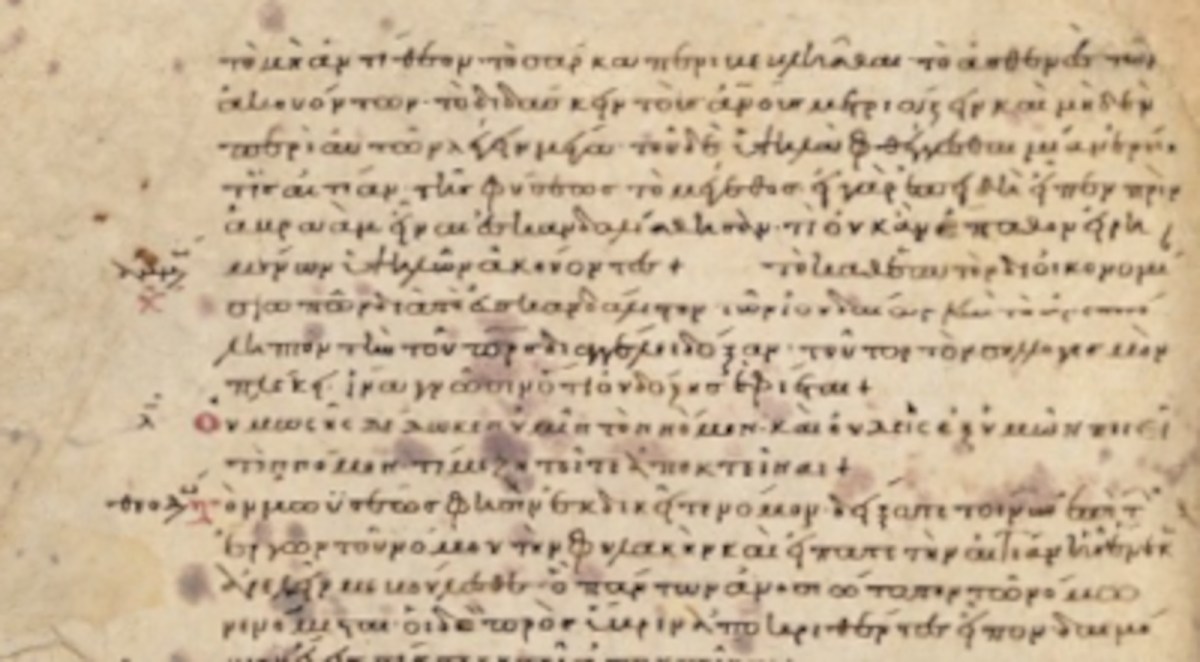
Greek commentary on John’s gospel dated 1190-1200 (Bodleian Library)
< Previous | Index | Next >
Cruising the gospel – John 19:1-24
Bible text – Read it yourself (opens in a new tab)
Arresting Jesus

(Wikimedia)
19:1-7 – The Roman Governor, Pontius Pilatus (Pontius Pilate) perhaps thinking he could get away with a lesser punishment than crucifixion, decided to turn Yahshua (Jesus) over to the Roman troops to be ridiculed and severely beaten. In this he was seriously mistaken, the Jewish authorities were not going to accept anything less than the death penalty. Pilatus twice told them that he could find no cause for any legal charge against Yahshua. There was no breach of Roman law here, but the Jewish religious leaders saw a huge and unsufferable offence against their religious traditions. What was a Roman Governor to do in the face of this? His job was to maintain Roman rule, to put down rebellions, make sure taxes were paid and that peace prevailed in his province.
It’s worth mentioning here that Rome had no problem with local kings and kingdoms. Herod was a king, client tribes and kingdoms throughout the empire were tolerated, even officially encouraged. A claim to be ‘King of the Jews’ or ‘King of Judea’ was not in and of itself an offence against Roman law or government. At the time of Yahshua’s trial and official innocence under Roman law, local kings were widespread in Gaul, in Spain, in Germany and in North Africa and the entirety of what is now Turkey. The Roman Emperor ruled over kings and kingdoms, peace (the Pax Romana) was required everywhere and a Roman Governor in each province was held responsible for keeping that peace. Herod Antipas ruled Samaria, but Judea had no king at this moment. Archelaus had ruled Judea, Samaria, and Idumaea but he’d been deposed by Roman direct rule due to poor government and mismanagement. We can, I think, be sympathetic towards Pilatus, who had to prevent violence and uprisings in his Provinces of Judaea and Samaria. If his verdict of Yahshua’s innocence was going to cause a riot or some kind of violence he would have to make a difficult choice, either calm the protest by crucifying this innocent man who claimed to be the Jewish King, or forcefully put down the growing crowds calling for the death penalty. The Bible passages about these events make his dilemma very clear.
Verse 7 is notable. Romans were religious people with gods of their own and temples in every city. Like the Greeks they had traditions and stories about super powerful men being sons of this or that god. Such lofty characters were dangerous and had unexpected powers over ordinary mortals. You did not want to mess with them. The moment he hears that Yahshua might be the son of the Jewish god he becomes seriously scared. He’s just had the man beaten and mocked.
19:8-16 – In verse 8 he goes back to check, and in verse 12 we’re told he wanted to set Yahshua free. So now Pilatus is afraid of an angry crowd that includes senior Jewish religious leaders, and also terrified that he’s dealing with the son of a powerful god. If he allows a riot to develop he’ll be in trouble with the Emperor, if he executes this man he’ll be in trouble with a god! The only way out is to transfer the responsibility to others; and that’s exactly what he sets out to do.
In the end, the Jewish leaders lie to Pilatus to force him to act. They tell him to his face that he is no friend of Caesar if he allows Yahshua to live since anyone claiming kingship opposes Caesar. As I explained above, this is patently incorrect; there are kings in many if not most Roman provinces, ruling with the local Roman governor on Caesar’s behalf. But the direct threat to Pilatus is being spoken openly and he acts in the clearest way possible. He sits on the judgement seat and tells the Jews plainly, ‘Here’s your King‘. He speaks the truth. Their reply is brutal and final, ‘Take him away. Crucify him‘.
And Pilatus hands him over to the Roman troops.
19:17-24– The Roman troops took charge and Yahshua carried his cross to the nearby Golgotha (Skull Place) where he and two others were crucified, one either side of him.
Pilatus’ notice attached to Yahshua’s cross stated the truth – ‘Jesus of Nazareth, the King of the Jews’. The chief priests grumbled about these words, telling Pilatus, ‘Don’t write “The King of the Jews”, but “he claimed to be King of the Jews”. Responding grumpily, Pilatus told them, ‘I wrote what I wrote’. Pilatus understood who Yahshua was better than the senior Jewish clerics!
The soldiers took Yahshua’s clothes, sharing them out amongst the four of them. It would be a pity to waste them, perks of the job. They drew lots for his undergarment as it was woven as a single piece and they didn’t want to tear it. He hung naked on the cross until he died.
See also:
- Pontius Pilatus – Wikipedia
< Previous | Index | Next >
Useful? Interesting?
If you enjoyed this or found it useful, please like, comment, and share below. (If you don’t see those links, click the article’s title above the main photo and they will appear.) Send a link to friends who might enjoy the article or benefit from it – Thanks! My material is free to reuse (see conditions), but a coffee is always welcome and encourages me to write more often! 
You might also like:
Share this:


