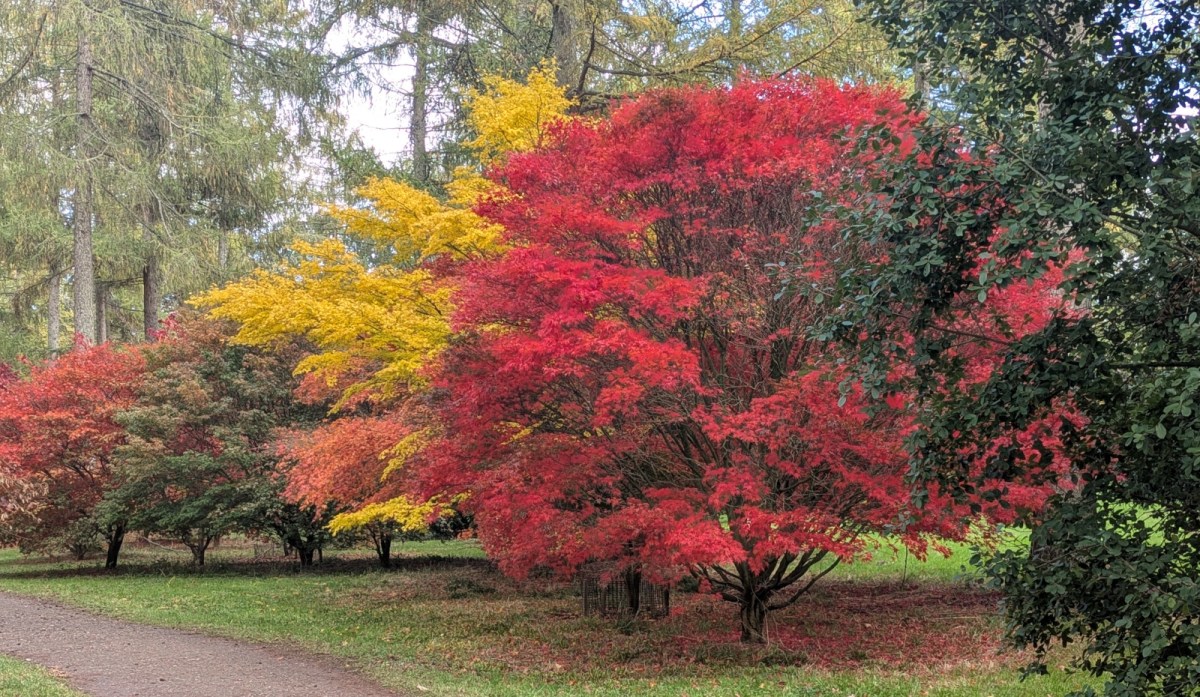
Autumn colours at Westonbirt
< Previous | Index | Next >
Image of the day – 205
What’s in an image? Sometimes quite a lot, more than meets the eye. I’m posting an image whenever I can.
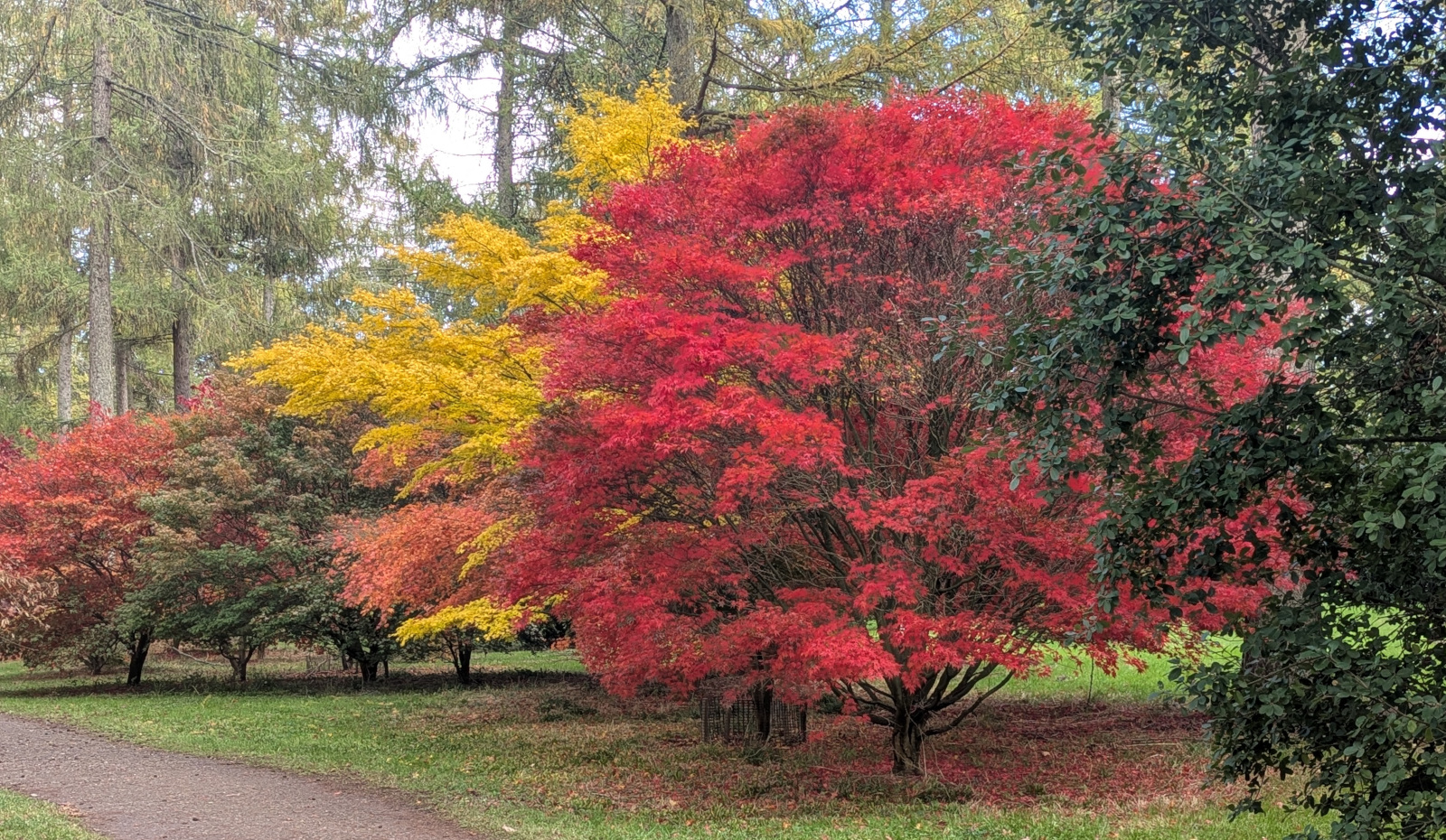
One of our favourite places to visit, at any season of the year, is Westonbirt Arboretum. My Dad used to call it ‘the tree zoo’. It’s only a 30 minute drive along the route of the old Roman road from Cirencester towards Bath. This time of year the autumn colours are fabulous. The photo focuses on some Japanese maples, Acer palmatum. Acer palmatum is one one of the finest species with cultivars in a rich variety of reds, oranges and yellows. Westonbirt has glades of mature specimens and an area of newer planting. Both were looking glorious when we visited.
Why do the leaves become so brightly coloured?
I was hoping you would ask. During the long months of summer the mature leaves on trees produce the green pigment, chlorophyll, that reflects green light and absorbs the rest. That absorbed light contains energy that the leaves use to break apart carbon dioxide from the air, attaching the carbon atoms to hydrogen from water and expelling the oxygen. In a set of chemical steps, the carbon and hydrogen are converted to sugars used as building blocks to build starch as a storage product, and cellulose as a structural material to make wood. That’s a grossly simplified version of the story, but fundamentally it is correct. In biochemistry and in botany the process is called photosynthsis.
The starch in wheat, potatoes, rice and other plants can be used by herbivores and omnivores (for example humans) as food. We combine the starch with oxygen to recreate water and carbon dioxide, releasing the energy we need to walk, breath, pump blood, and think. Human brains consume a lot of energy. This process, the reverse of photosynthesis is call respiration.
So taking plants and animals together there’s a closed loop involving water, carbon dioxide and energy. In addition to the starch we use for energy, the cellulose in wood can also be combined with oxygen to provide energy. That is called ‘fire’, it also releases water and carbon dioxide. So when you relax in January in front of a wood burning stove you’re using the sun’s heat and light trapped by trees perhaps a hundred years earlier! If you burn coal it was trapped millions of years earlier.
So that’s why plants have green leaves.
Autumn
As the days grow shorter and the weather grows colder, trapping energy by means of chlorophyll becomes less and less efficient. The leaves on trees become a liability, being battered by the wind and worth little to a tree until the weather warms again in the spring. But the leaves contain useful materials that can be recovered before the leaves are discarded. There are other coloured substances in leaves, mostly coloured yellow, and as the leaves stop producing green chlorophyll, these are unmasked and the leaves change appearance from greens to yellows.
Nutrients in the leaves are recovered and stored in the main bulk of the tree so that, when the leaves fall, these nutrients can be called upon in the spring when new leaves need to be made. Some of the bright reds and purples in autumn leaves are synthesised as the weeks go by, and they play a protective role enabling the tree to recover greater amounts of the nutrients. (Waste not, want not for trees!) Not all species of tree have this refinement, and in those that don’t the leaves remain yellow. Once the nutrients have been recovered a weak layer develops near the base of each leaf stalk, a point where wind action will cause the leaf to break away cleanly and fall to the ground. You can watch this happen on any windy autumn day, leaves fluttering down with every gust. In natural woodland the fallen leaves decay, acting as a rich mulch and forming compost where seeds can germinate and grow. In parks and gardens they are swept up for tidiness and composted in bins or heaps.
Our eyes can distinguish the changes in leaf colour and we enjoy the spectacle and joy of glorious autumn colour, then we endure winter but look forward to the lovely, fresh greens of spring.
Exceptions
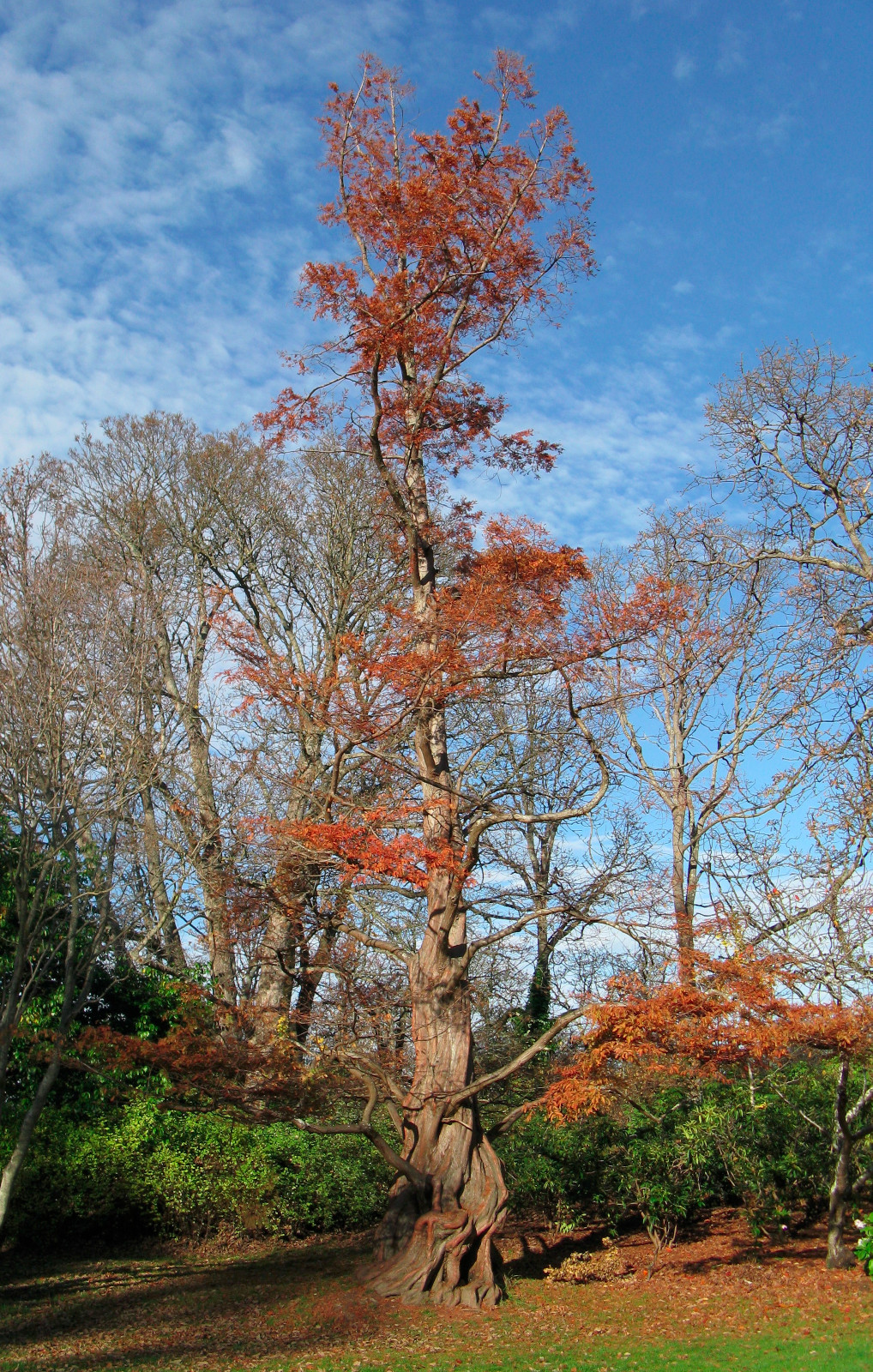
There are exceptions to every rule, and sometimes exceptions to the exceptions. Conifers are an exception here, they stay green all year round. The exceptions to the exceptions include larch (Larix decidua) which shows autumn colour and loses its needles, swamp cypress (Taxodium distichum), and the dawn redwood from China (Metasequoia glyptostroboides), three conifers with autumn colour. Life is indeed a many-varied thing! The image shows a mature dawn redwood in autumn colour.
Closing thoughts
This website covers a range of topics, one of which is faith. I do my best to follow Jesus, not just in his teaching, but in how he lives and thinks and touches people’s hearts and minds. Sometimes people take faith and science as self excluding opposites; you can choose one or the other but you cannot have both.
In fact there are many, many scientists who also have a faith and many followers of Jesus or other teachers of faith (Mohammed, Buddha and more) who accept the process and findings of science. And we all use technology every day, all of it based on scientific foundations and principles. It makes no sense to accept the successful results while rejecting the reasoning behind them. I will throw away neither science nor faith. I need both, and I am far from alone in that. I recommend you explore both. Make a start on my Welcome page, nobody is excluded; all are welcome, all are invited.
See also:
- Dawn Redwood – Wikipedia
- Japanese maple – Wikipedia
- Larch – Wikipedia
- Photosynthesis – Wikipedia
- Respiration – Wikipedia
- Swamp cypress – Wikipedia
< Previous | Index | Next >
You might also like:
Useful? Interesting?
If you enjoyed this or found it useful, please like, comment, and share below. (If you don’t see those links, click the article’s title above the main photo and they will appear.) Send a link to friends who might enjoy the article or benefit from it – Thanks! My material is free to reuse (see conditions), but a coffee is always welcome and encourages me to write more often! 
Share this:


