The Bingham Library

The new library in Dyer Street had a meeting room with seating for 200 people, but it quickly became clear that a larger meeting place was needed. And this is one of the reasons that Bingham decided to fund the Bingham Hall.

The Bingham Library

< Previous | Index | Next >

Image of the day – 193

What’s in an image? Sometimes quite a lot, more than meets the eye. I’m posting an image every week or so.

Bingham Library

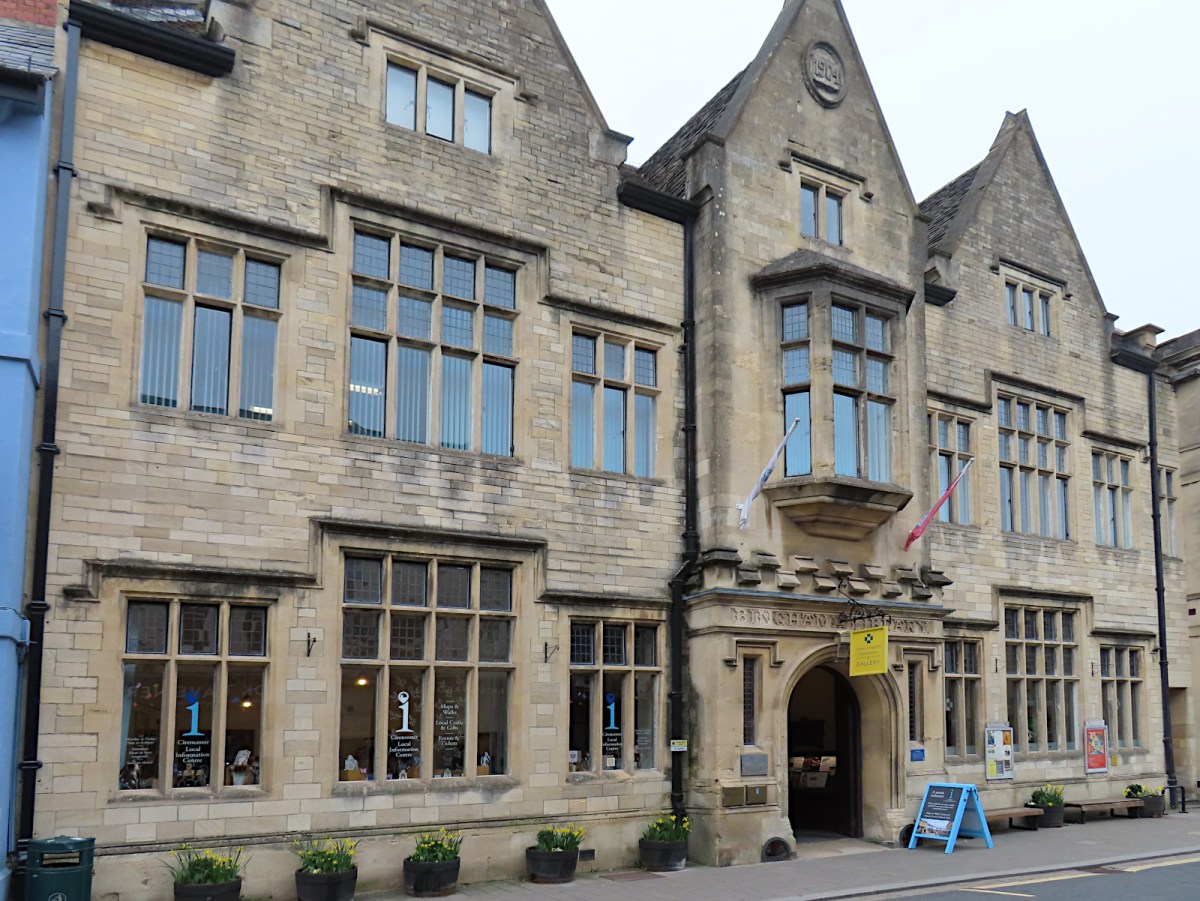
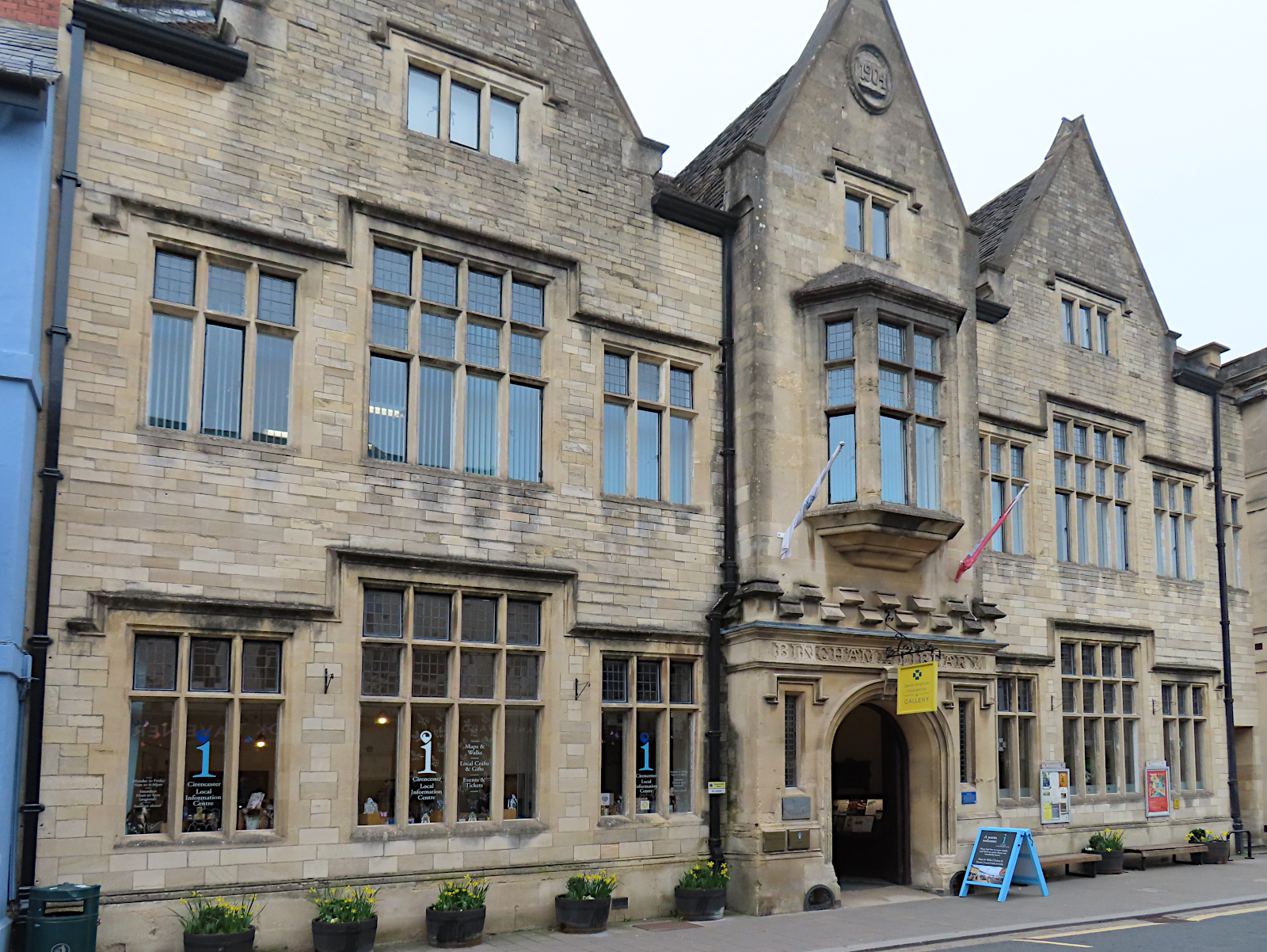
Cirencester’s Bingham Library building is now the Town Council Offices and the Tourist Information Centre. When I was a pupil at Cirencester Grammar School in Victoria Road, this grand old building was still the town’s main library. I remember walking to it from the family home at 37 Victoria Road, often to return books and take out different ones on science fiction, astronomy, or whatever interested me at the time; sometimes to visit the reference library to read articles from Encyclopaedia Britannica and make notes for Geography essays on coffee, rice or tea production in exotic places.

Daniel George Bingham

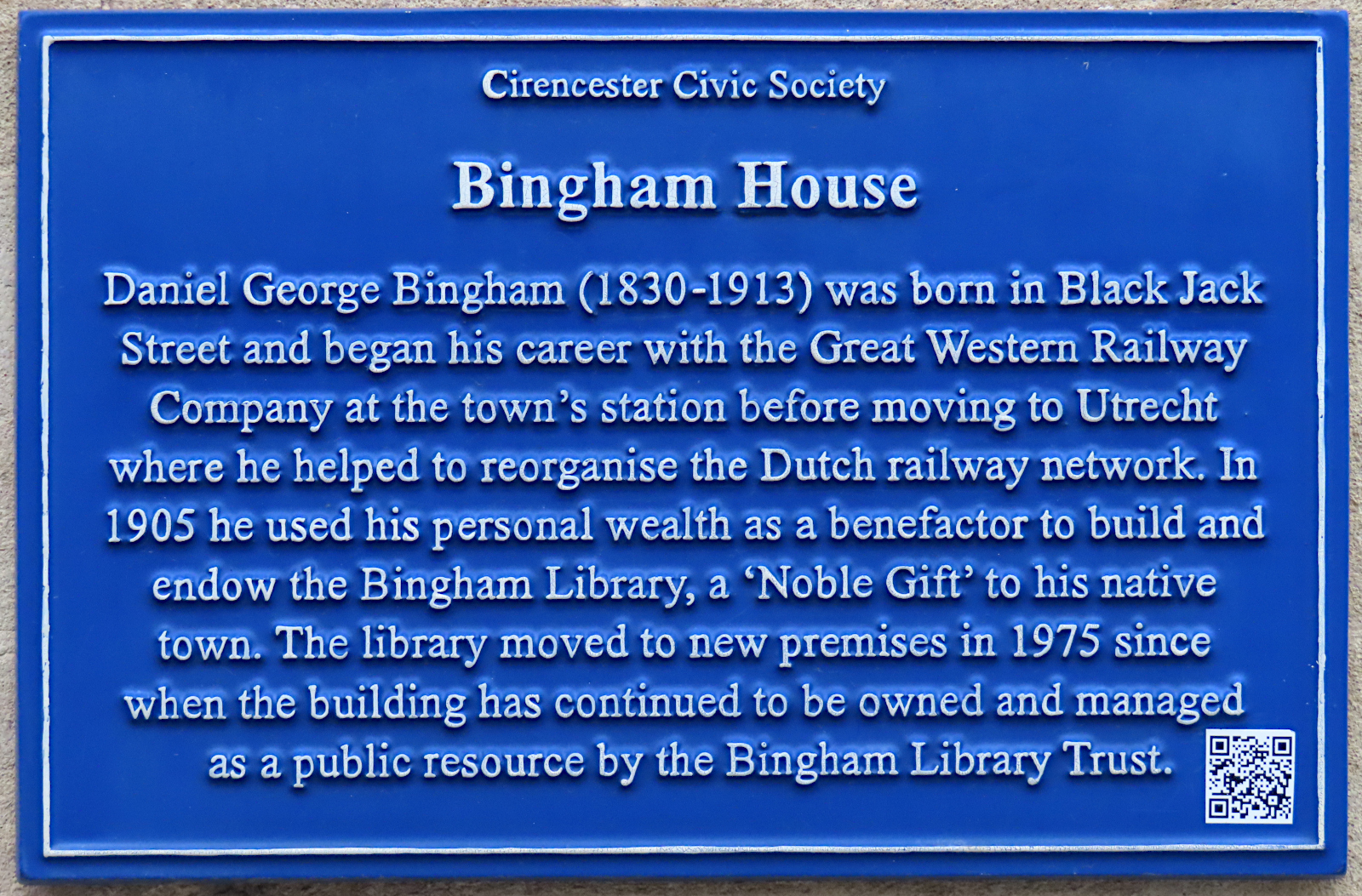
Blue plaque (click to enlarge)

The Bingham Hall in King Street as well as the Bingham Library in Dyer Street were built as town amenities and improvements by Daniel George Bingham. For more details of his life and career, click the blue plaque on the right.

Bingham worked in railway management, first at Cirencester, later at Paddington in London, and finally in Utrecht in the Netherlands where he became wealthy. He visited Cirencester briefly but quite regularly and spent part of his wealth providing the library in 1905 and the Hall in 1908. He and his wife Jane had friends and family in Utrecht so they were always keen to remain living there, though clearly Bingham retained a fondness for his town of birth – Cirencester.

From the beginning, the new library in Dyer Street had a meeting room with seating for 200 people, but it quickly became clear that a larger meeting place was needed. And this is one of the reasons that Bingham decided to fund the Bingham Hall to provide expanded facilities for meetings, dinners, theatre, music, and even a rifle range. I remember being in the Army Cadets in the sixth form at the Grammar School and taking part in target practice with .22 calibre rifles in the Bingham Hall rifle range. Morning assemblies were held in the main hall at the Bingham Hall, also school theatrical productions and musical performances.

What about us?

Few of us will ever have enough money to contribute something major like Bingham did. But most of us can afford to buy a little extra food and put it into the Food Bank receptacle as we leave the supermarket. Or we can join a local organisation helping others in some way, or keeping the local environment tidy. We all have the capability to improve our fellow citizens’ well-being in some way, it may cost no more than a little thought and a simple action.

So why not join in? Bingham did. We all can!

See also:

< Previous | Index | Next >

You might also like:

Useful? Interesting?

If you enjoyed this or found it useful, please like, comment, and share below. (If you don’t see those links, click the article’s title above the main photo and they will appear.) Send a link to friends who might enjoy the article or benefit from it – Thanks! My material is free to reuse (see conditions), but a coffee is always welcome and encourages me to write more often!

A recommended site

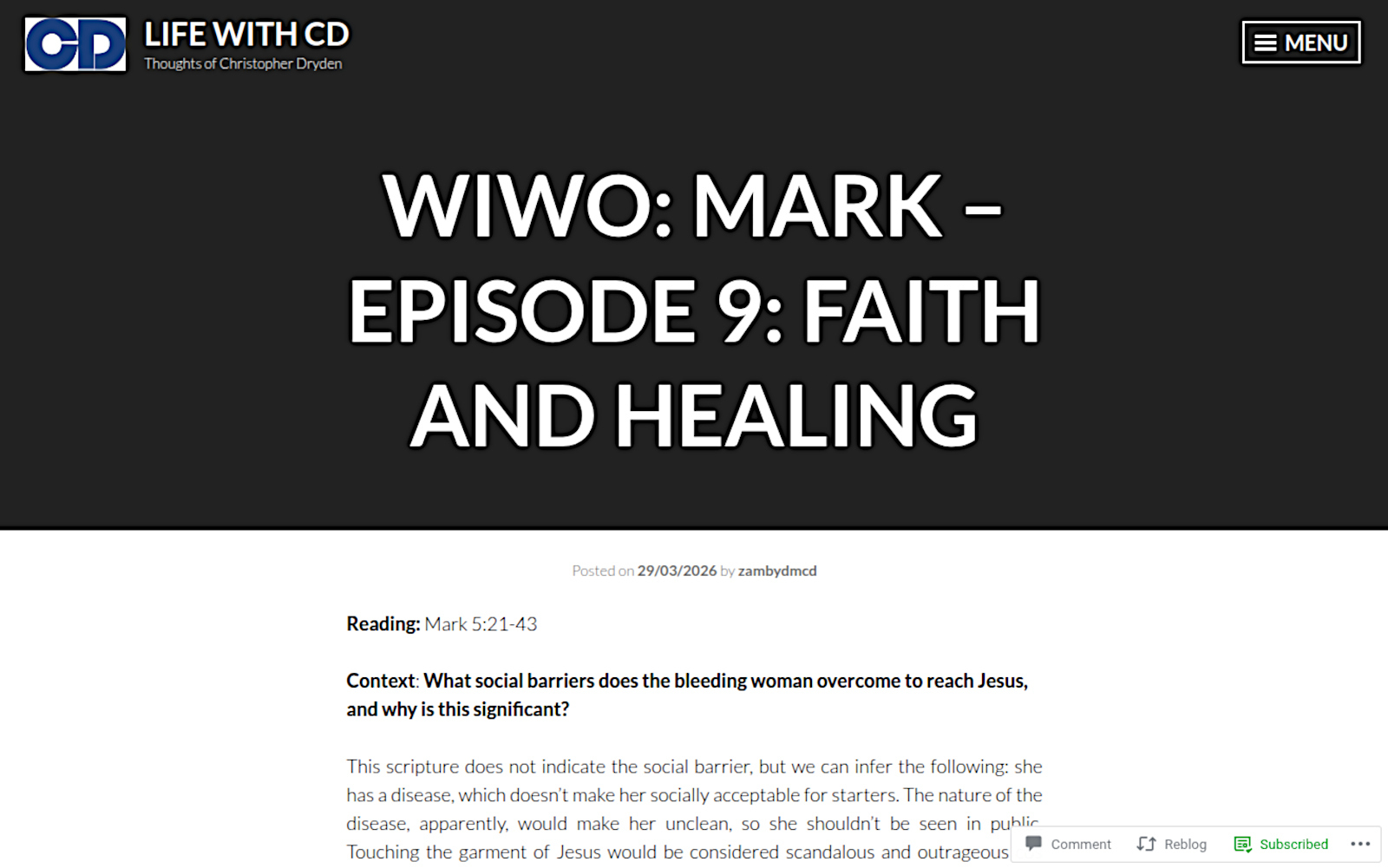
In first-century Jewish society, a woman approaching a rabbi — in public, uninvited, without the mediation of a husband or male relative — was itself an act that would raise eyebrows and clench jaws.

Chris Dryden’s website

< Previous | Index | Next >

On the web – 1

CD’s website

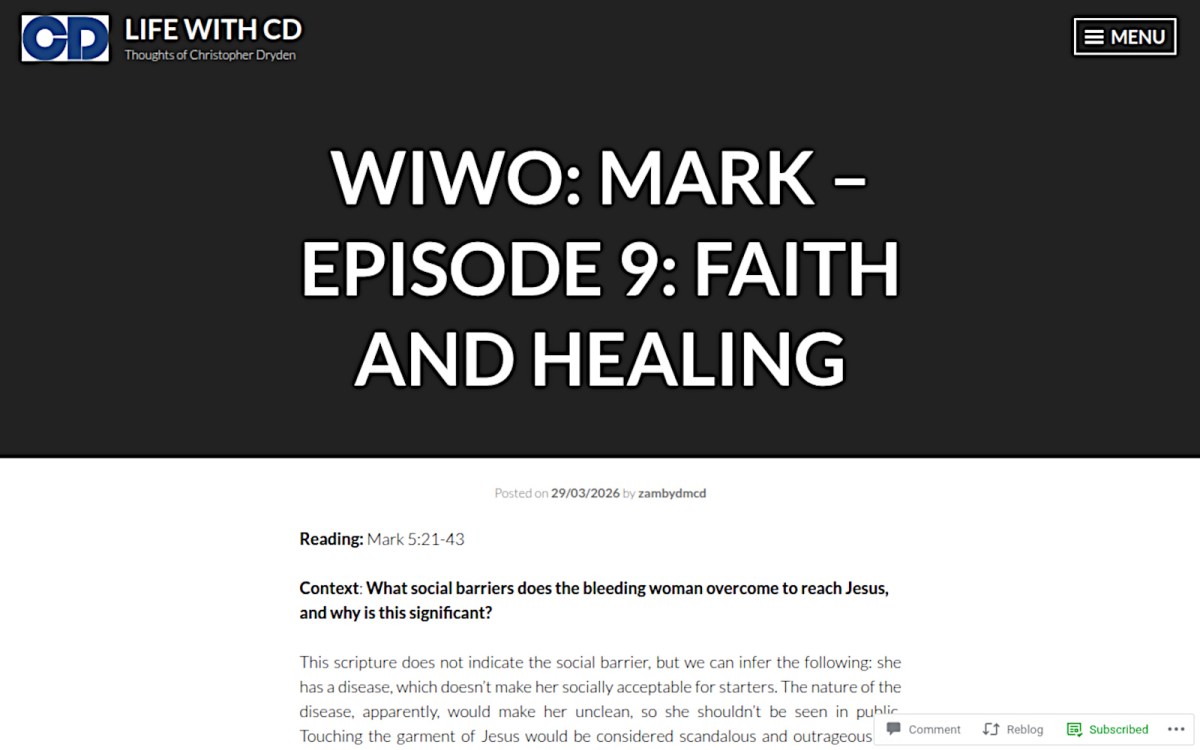
Sometimes I read something so good that I want to share it with my readers. This happened recently with one of Christoper Dryden’s posts. When I asked if I might republish it here, he very generously agreed. But I’m having second thoughts. Not about sharing it, but about sharing it in full. I think it will be better to share enough that my readers will want to go and read the rest on CD’s blog.

The extract

Reading: Mark 5:21-43

ContextWhat social barriers does the bleeding woman overcome to reach Jesus, and why is this significant?

This scripture does not indicate the social barrier, but we can infer the following: she has a disease, which doesn’t make her socially acceptable for starters. The nature of the disease, apparently, would make her unclean, so she shouldn’t be seen in public. Touching the garment of Jesus would be considered scandalous and outrageous cos the belief was that those touched by the unclean would be unclean themselves. She’s a social outcast, and she should know her place and deal with the fact that she’s worse off for looking to get her problem sorted, only for it not to work out. She’s a woman, that also ain’t becoming of someone who wishes to approach this guy. Seen in that light, the amount she’s overcome to reach out speaks volumes about the level of faith she has that one touch could make all the difference. It explains Jesus’ own commentary on the situation, namely that her faith has made her whole. And as I reflect on that, there’s the nudge to consider what level of faith can be exercised to trust Jesus. And also, there’s a challenge of how we can demonstrate and declare, for the benefit of other social outcasts, that their issues can be solved by reaching out to touch Jesus, who is near them?

In first-century Jewish society, a woman approaching a rabbi — in public, uninvited, without the mediation of a husband or male relative — was itself an act that would raise eyebrows and clench jaws. Layer on top of that the twelve years of haemorrhaging, which under the Levitical code rendered her perpetually ritually unclean (Leviticus 15:25-27), and you start to appreciate what she was carrying before she ever took a single step toward Jesus. It wasn’t just a physical condition. It was a sentence. Twelve years of isolation. Twelve years of being untouchable. Twelve years of being told, in effect, that she didn’t qualify.

She had also spent everything she had on physicians who left her worse off, not better. So not only is she socially marginalised, she is financially spent and medically hopeless. She has nothing left to lose. And that, right there, might be the very thing that unlocks her faith. When you’ve exhausted every other option, the audacity to reach for Jesus becomes a lot less surprising.

Seen in that light, the amount she’s overcome to reach out speaks volumes about the faith she has that a single touch could make all the difference. It explains Jesus’ own commentary on the situation: her faith has made her whole. And as I reflect on that, there’s a nudge to consider what level of faith is required to trust Jesus. And also, there’s a challenge of how we can demonstrate and declare, for the benefit of other social outcasts, that their issues can be solved by reaching out to touch Jesus, who is near them?

Someone might feel like they don’t qualify. They feel like they’ve been told — by circumstance, by history, by the voice in their own head — that the door to Jesus isn’t for them. This woman’s story is a loud and clear rebuttal of that lie. She reached, He responded, and the power that went out of Him was not accidental. He knew. He always knows. And He is never contaminated by what comes to Him, broken and desperate. He is only ever transformative.

Content: How does Jesus treat both the synagogue leader and the unclean woman with equal dignity?

What a fascinating word – dignity. Let’s get ourselves a running definition or walking, if we prefer the strolling approach.  Dignity is about worth, value and honour. To treat people with dignity is to confer on them a sense that they are of worth and value and should be duly honoured…

Reading more

My hope is that you’ll want to read the whole thing. Don’t miss the opportunity, you will not regret it! And if you like Dryden’s writing as much as I do, you’ll bookmark his site and keep coming back for more.

< Previous | Index | Next >

You might also like:

Useful? Interesting?

If you enjoyed this or found it useful, please like, comment, and share below. (If you don’t see those links, click the article’s title above the main photo and they will appear.) Send a link to friends who might enjoy the article or benefit from it – Thanks! My material is free to reuse (see conditions), but a coffee is always welcome and encourages me to write more often!
Life always wins out

All forms of life are precious and we depend on many of them to provide food, purify water, generate the oxygen we need to breathe, clean away life forms that have died, and much, much more.

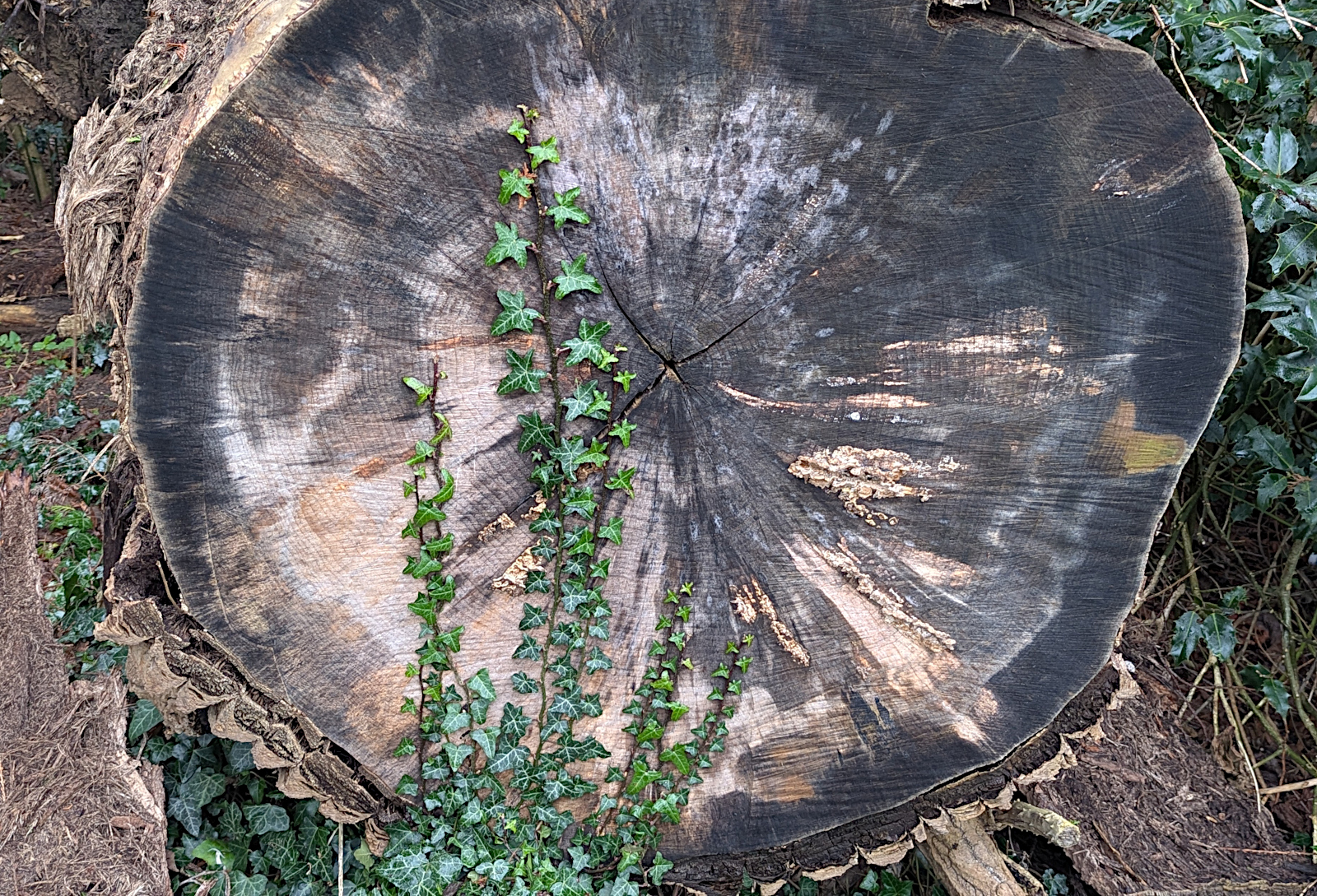
Fallen tree, climbing ivy

< Previous | Index | Next >

Image of the day – 192

What’s in an image? Sometimes quite a lot, more than meets the eye. I’m posting an image every few days.

Fallen tree, climbing ivy

This old tree trunk, clearly felled by chainsaw, is being colonised by ivy. Once the tree stood tall and strong and it’s likely that ivy clung to its trunk and branches. Now the tree lies on the ground, entirely dead, but ivy still uses the trunk as a support to grow upwards to continue to reach the light.

No giving up

Life is not in the habit of giving up, generations come and go, no individual tree, person, or anything else lasts for ever, not even a species. But life itself adapts, changes, and takes advantage of what went before. There has been life on planet Earth for around four billion years, that’s only 500 million years after the planet itself was formed. And it’s developed enormously in variety and complexity since chemistry first gave rise to biology.

We’re still filling in the gaps in what we know, but our knowledge is expanding and the gaps are shrinking. What we do know is that living things are very good at taking advantage of circumstances. That’s what the ivy is doing on the dead tree trunk. The need for sunlight is critically important for plants as the energy from that light allows them to build sugars from water and carbon dioxide. A stock of sugars enables them to survive the nights where the sun is absent, and survive the long, dark, cold, winter months as well.

All forms of life are precious and we depend on many of them to provide food, purify water, generate the oxygen we need to breathe, clean away life forms that have died, and much, much more.

Animals of all kinds and sizes ultimately depend on the sugars made by plants. Many animals feed on plants, stealing their sugars in a variety of forms, some feed on other animals, stealing sugars in secondhand forms; some, like us humans, eat both plants and animals. But almost all life depends ultimately on sunlight for its supply of energy.

That same great source of light also informs us, lets us see. Without light, eyes would be of no value whatsoever. Without light we would all be profoundly blind.

Jesus said, ‘I am the light of the world’. What does he mean by that? Is he saying that he is a light without which we’d be profoundly blind?

I think that’s exactly what he’s saying. Light is essential for vision and vital energy. The sun enables physical vision and energy. Jesus provides another kind of vision and energy. Search it out! It’s not too hard to find.

See also:

< Previous | Index | Next >

You might also like:

Useful? Interesting?

If you enjoyed this or found it useful, please like, comment, and share below. (If you don’t see those links, click the article’s title above the main photo and they will appear.) Send a link to friends who might enjoy the article or benefit from it – Thanks! My material is free to reuse (see conditions), but a coffee is always welcome and encourages me to write more often!
Life, death, resurrection

Unlike life, death is stable. It’s not often that you see a dead body come alive again. That would be resurrection, it’s not something that we expect to see happening regularly (or at all)!

Snowdrops, new every year

ad hoc post – 5

< Previous | Index | Next >

Snowdrops

I’m writing about these three topics in obedience to a prompting from the Holy Spirit. I need to say that at the outset. And I think I’m going to need to create two versions, one for people who are following Jesus, and another for people who have no idea what I’m talking about. I’m going get stuck right in, please bear with me; my hope and prayer is that there’ll be something here for everyone.

For those who have no idea

We all know what life is, or at least, we think we do. Life is a metastable state. Let’s define ‘metastable’ – Imagine a pencil lying near the centre of a table; if you push it a little it will move across the surface but it won’t fall over. It can’t! (unless you push it so far that it reaches beyond the edge of the table it is always fully supported on the table’s surface. That pencil is a stable object.

Now take the pencil and stand it up on it’s point. Let it go and it will fall over. A pencil standing on its point is unstable.

Now take the pencil and stand it on the table with its point uppermost. If the pencil has a good, flat end and the table surface is even and horizontal, you will be able to do this with a little care. Now push the pencil point sideways a tiny amount and then release it, it’ll wobble a bit but then remain standing and settle down. But push it beyond a certain amount and it will fall over. That’s metastable, the pencil can cope with a tiny movement, but push it too far and it’ll fall over.

Life is like that, it’s a metastable condition. Most of the time we live day after day as the weather changes, sometimes warmer, sometimes cooler, sometimes wet, sometimes dry. Put us in a place too hot, too cold, too dry (a desert), or too wet (an ocean) and we will die. Not immediately, perhaps, but push us too far, and like the point-up pencil, we’ll fall. Life is metastable. All of us will die eventually, if not of overheating or drowning, then eventually of old age. It’s not normal to live for ever.

Unlike life, death is stable. It’s not often that you see a dead body come alive again. That would be resurrection, it’s not something that we expect to see happening regularly (or at all)!

That’s about all there is to say to the ‘No idea’ group.

For those following Jesus (or might like to)

Jesus had some really interesting things to say about life. He reminded people that life is metastable, but without using that term. He claimed that there is a different kind of life, a spiritual life parallel to biological life, a life that is stable rather than metastable, a life that has the potential to be stable as either permanent life or permanent death. And he further explained that we can choose either permanent condition.

These claims don’t make sense, do they? I’ve stated them as simply and straightforwardly as I can. I should add that these deep truths cannot be grasped by intellect or understood by logic. They are, I suspect, completely distinct from the physical world and from the rationality of mind and brain. These things are unmeasurable and indescribable, available only through faith, hope, and love.

So if you want to explore further, faith, hope and love are the tools you will need to do so. Faith is a mysterious idea, quite hard to pin down or explain. Hope is something we all have, though perhaps we all hope for slightly different things. But love is the most important and the strongest of the three, it’s the one key you truly need to unlock resurrection (a return to life) and to grasp the enormous benefit of permanent life and the desperate state of permanent death. So take love as the starting point. If you are new to all this, Henry Drummond is a good guide and companion on the exciting journey that lies ahead.

See also:

< Previous | Index | Next >

Useful? Interesting?

If you enjoyed this or found it useful, please like, comment, and share below. (If you don’t see those links, click the article’s title above the main photo and they will appear.) Send a link to friends who might enjoy the article or benefit from it – Thanks! My material is free to reuse (see conditions), but a coffee is always welcome and encourages me to write more often!
You might also like:

Tree shading

Put an upturned bucket over a patch of grass in your garden. Lift the bucket every day and take a look, then re-cover the patch… How long does it take for the grass to die?

< Previous | Index | Next >

Image of the day – 178

What’s in an image? Sometimes quite a lot, more than meets the eye. I’m posting an image every few days.

Click to enlarge

Trees provide shade, most welcome on a hot day, and they provide shelter when it rains (though this may be unwise during thunderstorms).

But notice the absence of grass beneath these conifers. Shade and shelter are exactly what other plants don’t need; they depend on plenty of light and water to enable them to grow. Light is essential as it provides the energy to split water into hydrogen and oxygen, and water is essential as the raw material for this process. The oxygen is released into the atmosphere, while the hydrogen is bonded with carbon dioxide from the atmosphere to make energy-storing sugars for use at night and to build cellulose, the main support molecule that gives stems, branches and tree trunks their strength.

The lack of light and water under tree canopies creates a kind of local desert. You can see this clearly in the photo from the presence and absence of grass. So how do the trees survive? That’s a great question! Their roots spread out widely and deep, far enough to reach moist soil and deep ground water. In persistent rain, water drips from the drenched leaves above. And root, trunk and branch all contain stores of water so a tree can cope with a long, dry summer far better than the grass can.

Light

Here’s an experiment anyone can do. Put an upturned bucket over a patch of grass in your garden. Lift the bucket every day and take a look, then re-cover the patch. See how long it takes for the grass to turn yellow. How long does it take for the grass to die?

For plants, light is essential. There are some animals that live in dark caves or underground, with no light. Earthworms are a good example, but like all animals they get their food by consuming plants and other animals. But for most creatures, including us humans, light is essential nonetheless. Whether we are plant eaters (like cows and sheep) or meat eaters (like lions and wolves) or omnivores eating either or both (like humans and rats) we still need light to see in order to find and identify the things we must eat to stay alive.

Water

For plants, water is part of their ‘food’, it’s needed to make sugars. For animals water is of no value as food, but it’s essential to prevent dangerous dehydration. All animals know when they’re thirsty and they’ll find water and drink to keep themselves alive. Think of a man lost in a desert, the cartoons have him croaking out, ‘Water.. Water..’ Imagine someone unable to find water, they’d die of thirst long, long before they died of hunger. Most of us would be in danger after a few days without drinking, but we could live for several weeks with nothing to eat. And of course, if you are a fish too little water would mean you couldn’t breathe, and if you were a land animal too much would mean you would drown.

Spiritual (not religious)

The idea of essentials has been carried over into spiritual ideas too. Light and water (and food) are so clearly necessary for life that they make good analogies and illustrations. What did Jesus mean when he said, ‘I am the way, the truth and the life’? Or when he explained to the Samaritan woman at the well that he would provide water that never runs out, or when he told his followers, ‘I am the bread of life’ or ‘I am the light of the world’?

He was simply saying, I am essential, you can’t live without me. I’m necessary for life. Just as in the physical world, how would it feel to live in the dark, without water and without sustenance? How long would you last? How long would I last?

Many people today feel sure there is no spiritual aspect to life at all, it’s just about living your life in the here and now and then dying from accident, illness, or just old age. Others think there’s much more to life than that. At the very least there are moral and philosophical truths to consider. We should care for one another, help one another, and cooperate in helpful and kind ways.

Food for thought. Let me know below how you think about the essentials of life. Do you have any thoughts to share on this?

See also:

< Previous | Index | Next >

Useful? Interesting?

If you enjoyed this or found it useful, please like, comment, and share below. (If you don’t see those links, click the article’s title above the main photo and they will appear.) Send a link to friends who might enjoy the article or benefit from it – Thanks! My material is free to reuse (see conditions), but a coffee is always welcome and encourages me to write more often!
You might also like: