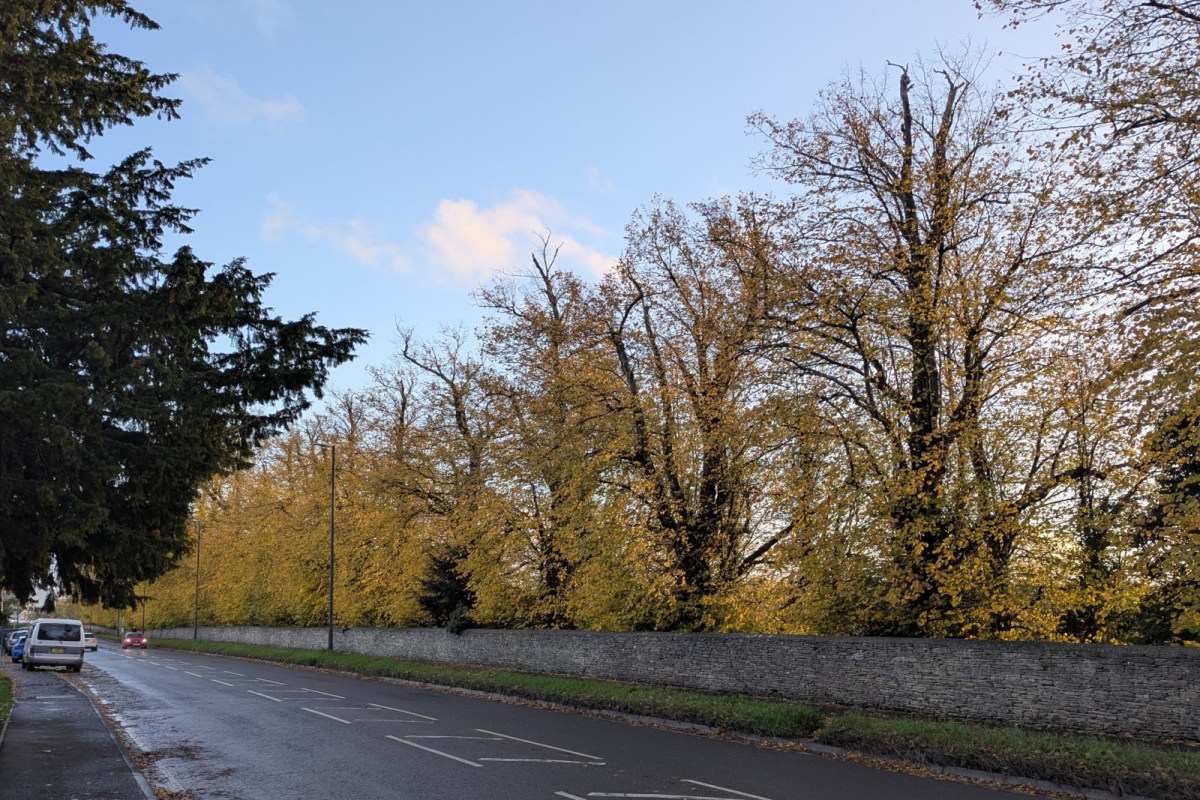
Lime trees on the Gloucester Road
< Previous | Index | Next >
Image of the day – 208
What’s in an image? Sometimes quite a lot, more than meets the eye. I’m posting an image whenever I can.
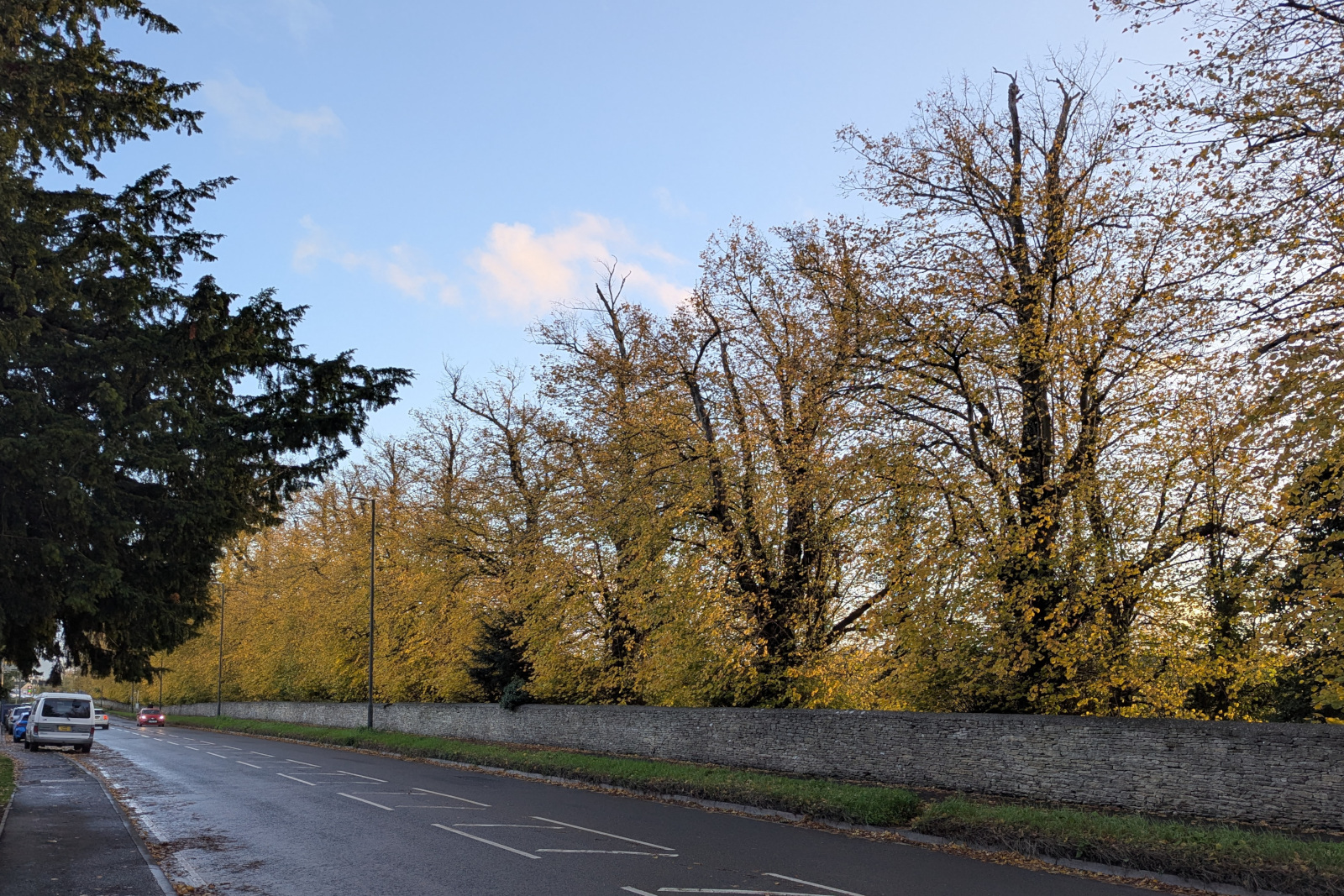
Some more autumn colour for you today. This row of lime trees had turned from green to gold when I took this photo on 20th November this year. One or two of these limes have fallen in autumn or winter storms over the years. Looking at the old Ordnance Survey maps shows there was another row of deciduous trees on the other side of the road in the 1800s, but they were not there when I was young so I imagine the row on the east side were older and were not replaced, or they were removed at some stage to widen the road in the first half of the 20th century. One of the trees in the remaining row fell about two years ago. Take a look at the ‘Fallen tree’ article for the details.
If you look closely at the main photo in the present article you will see some jagged breaks in the uppermost parts of several trees (if necessary click the thumbnail to enlarge it and then click it a second time for the maximum detail). Some of those upper branches are diseased and rotting. Every year a few more branches come down when the wind is strong. Perhaps the solution will be some careful tree surgery to remove damaged and rotting timber to reduce all the trees to about two thirds of their current height, causing them to regrow vigorously at the top. It would be a real shame to take them down entirely as they are a lovely feature and shelter the footpath from south-westerly winds and rain.
What species of tree are they?
So far, I’ve only referred to them as lime trees. These are probably European limes, not be confused with the fruiting limes, close relatives of the grapefruit, lemons and oranges, all of them Citrus species. The small-leaved English lime (or Linden) is Tilia cordata. The large leaved lime is Tilia platyphyllos I’m not sure if the trees along the road are Small-leaved lime, Large-leaved lime, or the hybrid which also grows widely in the British and European countryside. I think most probably they are the hybrid, Tilea x europaea.
Why are we here?
People differ on this point, some believe we were deliberately created, others are convinced that all life on our planet evolved. But whatever your opinion on that, what should our role be?
It’s stated well in Genesis 1:26-31, we are curators, we are to rule over this planet and all it contains. We have certainly done that, but have we done it well? It seems to me we’ve done a pretty poor job; life on Earth is damaged, the climate is out of control, species are going extinct ever faster, our mineral and fuel extraction industries have left large areas scarred, devoid of forest, and often poisoned, there are wars, and in parts of the world people are starving or in poor health.
The lime trees along Cirencester’s Gloucester Road are not in good shape and are becoming hazardous. They are just one example of something we could (and should) manage better.
See also:
- Autumn leaf colour – Wikipedia
- Tilia – Wikipedia
< Previous | Index | Next >
Useful? Interesting?
If you enjoyed this or found it useful, please like, comment, and share below. (If you don’t see those links, click the article’s title above the main photo and they will appear.) Send a link to friends who might enjoy the article or benefit from it – Thanks! My material is free to reuse (see conditions), but a coffee is always welcome and encourages me to write more often! 
Share this:


