The crescent Moon shines out in the evening of 23rd February, but there are three solar system objects in this image. After the Sun, the Moon is the second brightest object in Earth’s night sky.
The third and fourth brightest objects in our sky are present in this image. Can you see them? I doubt it, they are lost in the remaining glow of the sun as it sets. But if you know exactly where to look, you might see them.
The Moon and a couple of other things
Let’s zoom in a little, that always helps…
Can you see them now?
So, did you see them? No? They are there in plain view, but congratulations if you spotted them, it’s still not easy.
The third brightest object in our night sky is Venus, and you can see it near the bottom right corner of the photo – a little white dot. The fourth brightest object is Jupiter. It’s there to see as well, between the Moon and Venus, but a bit closer to Venus than to the Moon. See it now? (If you’re reading this on your phone you will need to enlarge the image.)
Later in the evening they are impossible to miss. The Moon is moving further away from this scene day by day, but Venus and Jupiter are getting closer to one another in the sky and are both very bright in a darker sky. Jupiter is also getting closer to the horizon and setting earlier and earlier as the days pass so if you want to see it, look in the next day or two. In April Jupiter will reappear in the morning sky before sunrise.
See also:
Watch Dr Becky’s Night Sky video segment for more detail (better yet, watch her entire video).
And for more detail on the three objects, take a look at Wikipedia’s articles on The Moon, Venus and Jupiter.
I sum these topics up on my Twitter profile as biology, web, science, technology, family, faith, history, and travel.
Having recently restarted blogging after a long pause, I’ve been thinking through how best to move forward – what should I change, what should I drop, and what should I keep?
Today’s post explains some of this, I’ll share what I’m doing and what I plan to do next. I’ll consider any comments you may leave, either here on the blog, or on Twitter or Facebook. But here’s how I see things right now.
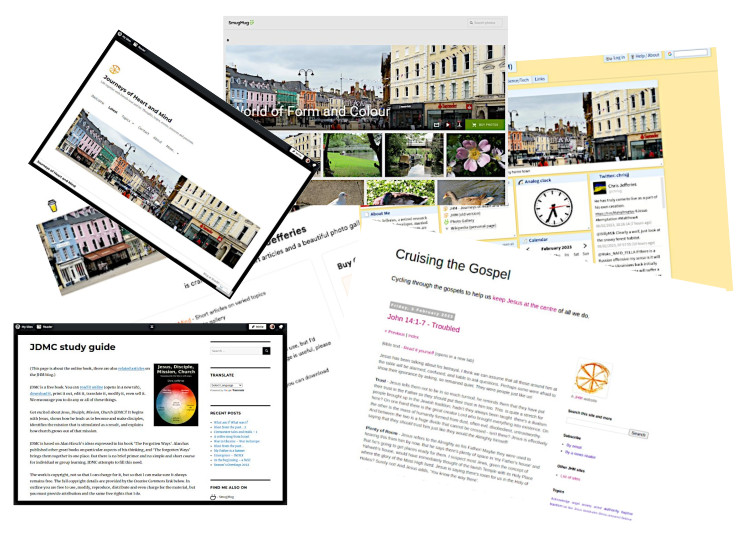
Buy me a coffee
I’m offering everything I publish for free, but will always be delighted to receive a small gift, especially if you have sold or republished something (though even then it’s optional). Details are at coffee.scilla.org.uk .
Cruising the Gospel
This is a moribund blog that I’m in the process of restarting. I’m not sure yet whether to continue it in its present form, or to roll it into Journeys of Heart and Mind (JHM) as a topic in its own right. Currently I’m inclined to keep it as it is, and perhaps generate some PDFs from each book I complete. See it at gospel.scilla.org.uk .
Gateway
My Gateway site is mainly for my own use, but it’s full of links about Cirencester (my home town in England), local time and weather, some Christian links, local and national news, science and technology links and so forth. Some of you might like to take a peek. If so, head to gate.scilla.org.uk .
JDMC
JDMC stands for Jesus, Disciple, Mission, Church and is an introduction to Alan Hirsch’s Forgotten Ways. To learn more and download a copy to print (or read online), visit jdmc.scilla.org.uk . I need to update this booklet and plan to when I have time, unfortunately the web links in the PDF open OK, but using the browser to return take you back to the title page; I’ve been unable to fix this so far. If you open the links in a new tab you’ll be OK, but it’s easy to forget.
Journeys of Heart and mind
I intend to continue with this more or less as it stands. That means a mix of topics will appear here, articles about all of the things that motivate me as they occur to me (so in no particular order). I sum these topics up on my Twitter profile as biology, web, science, technology, family, faith, history, and travel. Others include photography, astronomy, spaceflight, archaeology and a few more. One thing I will add is a way of seeing just posts on one of these topics at a time, I think that will be useful; not everyone wants to see everything. You’re reading on this site at the moment.
Photos
I use Smugmug to display my photos and will continue with this, but I need to rearrange things in topic folders to make it more usable. Visit photos.scilla.org.uk to browse my all time favourites.
Twitter
My main Twitter account is ChrisJJ, but I have a second account, JHM. I haven’t used the JHM account for a long while, but might post tweets about faith topics there, and everything else on ChrisJJ. My mind is far from made up on this as there are quite a few pros and cons.
Emergence is everywhere, and it’s a fundamental process that we see in this universe at every scale, from below atomic and molecular size to clusters of galaxies. Emergence is seen in the evolution of living forms, in landscape features, in the weather, the development of languages, cities, and engineering.
The properties of the universe itself (whatever they may have been) seem to have resulted in the emergence of four fields, each with its own properties.
Fields underlie everything we’re familiar with in the universe in which we live. We know nothing about the universe at the time it began, though we know a surprising amount about the universe just a tiny fraction of a second after that beginning.
No, I’m not writing about a field with hedges around it, but a field as defined and understood by physicists. The first thing to exist in our universe was a field, quite possibly just a single field (or so I like to imagine). This is the second article on the topic of emergence, and you’ll see why later.
So let’s begin by thinking about the nature of a field. Physicists talk about several different fields – a gravitational field for example. In 1865 James Clerk Maxwell published ‘A Dynamical Theory of the Electromagnetic Field’ in which he explained that magnetism, electricity and light are all functions of a field. Fields are not particles, or forces (though they can and do give rise to these). Instead, a field permeates all of space. Right now you are exposed to the gravitational field and you are being acted on by the sun, the moon and the earth (and everything else in the universe). The pull these objects exert on you are in proportion to your mass and the mass of the distant object (let’s say the Sun) and by the distance between you. The strongest pull and the only one you will be aware of is the pull of the Earth, you’ll certainly notice it if you trip and fall over, or if you drop something. The Moon is not as massive as the Earth and is far away, so has much less pull. The Sun is much more massive than the Earth, but it’s also far, far more distant, and therefore pulls on you much less than the Earth does. These rules apply to every object in the universe, there is gravitational attraction between you and your cat (if you have one) also there’s gravitational attraction between you and the Andromeda galaxy. These attractions are very tiny as neither you nor the cat have much mass, and the Andromeda galaxy is exceedingly far away.
All of this can be quantified and a mathematical formula exists so that, given the masses of two objects and the distance between them, it’s easy to calculate the strength of the attraction.
So, where does emergence come in?
We don’t know how the universe began, or why, but we do know more or less when – almost 13.8 billion years ago. When the universe was still very new (if it makes sense to talk about time at all in the first picosecond (a billionth of a second), the still very tiny universe was filled by the gravitational field (as it still is today). This field became distinct from other fields repeatedly as the universe grew, giving rise to the electromagnetic field, then the weak field, and finally the strong field.
This represents the earliest event we might describe as emergence. The properties of the universe itself (whatever they may have been) seem to have resulted in the emergence of four fields, each with its own properties, four things that were not originally present. There’s probably little more to say about any of this, and the way I’ve portrayed it is speculative. But given these four fields, further steps of emergence can be discerned rather more clearly. And that’s something we’ll look at in another part of this series.
Emergence is everywhere, and you would not be here without it! … Emergence matters because it is one of the fundamental processes that we see in this universe at every imaginable scale.
One of my many interests is the way in which everything we’re familiar with in the universe developed out of a previous state, and how new features make further developments possible – over and over and over again.
I’d like to explain how this seems to be an underlying property of our universe. We are surrounded by astonishing levels of complexity and the earlier stages seem to be far simpler than later ones; at the beginning of the process (if there is a clear beginning) everything was simple. So how can the complex arise from the simple?
Ripples in the sand, an example of emergence (from Wikimedia Commons)
In its entirety this story will take us from the big bang, through particles and atoms, to chemistry, onwards to life, intelligence, and beyond. This is far, far too much for a single blog post, so I will choose topics one by one and write about them. I’m not planning to start at the beginning, and the posts won’t be in the order that events took place, but as I write additional articles, I plan to link them into a logical series.
How would I know anything about this topic?
I should explain something about my background and training – I’m not an expert on all of the topics we will be covering, perhaps not really an expert in any of them! I retired in 2010, but the first part of my career was in biology, specifically flower and fruit development in plums, so I do have a science background. My first degree was from Bath University in the UK, an honours degree in Horticulture; then during my research career I wrote an MSc thesis at Bristol University on the plum reproduction work; and later I completed an ordinary degree in mathematics and computing at the Open University as it seemed useful to have a background in methods that were becoming rather more frequently used by biologists. In the mid 90s my research career abruptly ended through unexpected personal circumstances.
But let’s go back to some thoughts on the complex arising from the simple. This is really quite counterintuitive for most people and, as it forms the basis for the story I want to tell, it’s important to think about it clearly at the start. At its heart, emergence is very simple. So simple we often take it for granted.
A few examples will help.
Example 1 – Cities
Where do cities come from? Obviously they’re built by people. Building towns and cities is something that people do, they provide places to live, places to work, shops, schools, hospitals, transport (ranging from footpaths to airports) and much more. Our societies could not exist without cities.
If we could take a few hundred people to a large, uninhabited island, what would they do? They would look for sources of food and water. They’d try to start a fire to keep warm. They’d explore the area. And they’d build shelters of some kind. Given time they might build a village.
Without people there would be no towns. But given a population, villages, towns and cities will eventually begin to appear. One person cannot build a village, let alone a city; it requires cooperation and a lot of resources.
It’s fair to say that cities emerge when large groups of people cooperate. A city and the life of a city are emergent properties of a cooperating group of people.
Example 2 – Murmurations
A murmuration is a flock of birds behaving in a particular way. I wrote about this some time ago in a different context. But take a look, especially at the video link in the article; it’s an amazing and beautiful thing to watch. Without the starlings there could be no murmuration. It’s another example of emergence. Murmuration becomes possible (though not inevitable) when there’s a large group of birds flying together.
Example 3 – The internet
For our final example, lets think about the internet. Something like the internet was bound to arise once computers became plentiful. It was useful to connect computers together so that all the computers in an office could share a single printer or some other resource. And then it became useful to connect up individual offices and companies for email, or file sharing. The details of the protocols that make it all possible don’t matter, it could have been done in a variety of ways; but the principle of world spanning connectivity was bound to develop, one way or another.
Predictability
Emergent behaviour is usually unpredictable. If you studied a single starling, or even a cage containing ten birds, you might learn a great deal about starlings, but nothing you learned would prepare you for the sight of a murmuration. Nor would it enable you to predict murmurations.
Why does emergence matter?
Emergence matters because it is one of the fundamental processes that we see in this universe at every imaginable scale. We see it in the behaviour of the wave functions that underlie elementary particles, and we see it in the formation of galaxies and even clusters of galaxies. We see it in everyday life (think about those cities mentioned above), we see it in the way collections of neurons give rise to complex behaviours in our brains, we see it in political life, in business, and in economics. Emergence is everywhere, and you would not be here without it!
Future articles
I’ll be writing on this topic again, but next time I’ll choose a particular example of emergence. This article acts as an introduction to the topic and will probably be accompanied by an index for this and other articles in the series. Along the way I’ll try to explain emergence in a bit more detail, and to provide links to material out there on the internet that will go far deeper than I plan to (or even could) take you, my readers.
Unexpected results are always disappointing and sometimes very harmful
Let’s talk about truth.
Truth is like the stars in the sky above, sometimes cloudy skies hide the stars from view, but we know they’re still there. And when the clouds move away we see them clearly again, they remain the same, the constellations are still recognisable. It’s possible to navigate by the stars, they are dependable and reliable.
Truth is reliable too; when we navigate according to the truth our decisions and choices will produce the expected results. If we are fed untruth, our choices will produce unexpected results. And unexpected results are always disappointing and sometimes very harmful – to us and to others.
In this world we are surrounded by a great deal of untruth. It puzzles me that so many people assume that misinformation will result in good choices. We see it everywhere – in politics, in business, in warfare, in daily life. Let’s look at a few examples:
Russia’s war in Ukraine – From the very beginning truth has been discarded. Russian leaders have deliberately ‘adjusted’ history, results of battles, and their motives. Perhaps they believe their own claims! So many decisions on goals, strategy and tactics have been based on untruth and the disastrous results are plain to see.
Brexit – From the very beginning truth has been discarded. British leaders have deliberately ‘adjusted’ history, results of policy changes, and their intentions. Perhaps they believe their own claims! So many decisions on goals, legal positions and rule changes have been based on untruth and the disastrous results are plain to see.
Anti-vaccination campaigns – From the very beginning truth has been discarded. Campaigners have deliberately ‘adjusted’ the science, results of trials, and their fears. Perhaps they believe their own claims! So many decisions on messages, responses to other views and serious dangers have been based on untruth and the disastrous results are plain to see.
Climate change denial – From the very beginning truth has been discarded. Deniers have deliberately ‘adjusted’ evidence, results of scientific study, and their arguments. Perhaps they believe their own claims! So many decisions on arguments, scientific reasoning and inferences have been based on untruth and the disastrous results are plain to see.
Do you see a pattern here? You may disagree with me strongly on any or all of my assertions above, but the plain fact remains that if you fail to see the truth about something, deliberately or not, and you base your actions on the flimsy foundations of error, lies, or misinformation (your own or from others), you will fail. Sooner or later bad choices will result in bad outcomes. They always do.
Claiming something to be true when it’s false will never, in the long term, work in your favour or in mine.
Truth matters. Let’s value it, search it out, base our choices on it, and benefit from the best outcomes available to us.
By showering less often I’m cutting my water use to less than half, and turning down the flow rate reduces water use by about half again.
I’ve just watched the latest ‘Just have a think’ video from Dave Borlace. I really enjoy his videos – they are well produced, clear, uncompromising, polite, thorough … well, you get the idea. The latest one asks what we can do individually to help reduce the pace of climate change, and he describes a survey that shows most people are just waiting for someone else to do something about it.
That rings true!
Here’s the video, watch it, then scroll on down and read my personal take on, ‘What can I do?’ I believe we can have a large impact – if we all pull together.
What can I do?
I’m going to share one idea with you, something I’ve been doing for a long time now, and something I’m finding quite easy that also makes a big difference. Just remember though, this one idea is just an example. Maybe you can think of something in your own life that you could change that would also have a useful impact.
I used to shower every day, after all it takes less time, water and energy than having a bath and that has to be a good thing, right? Well, yes.
But for a number of years now, I’ve made a point of showering once every two or three days, turning down the water flow, turning down the temperature, and also minimising my use of shower gel. I still enjoy my showers, the temperature’s warm enough to be pleasant, I’m not advocating cold showers!
So how does this help?
Much more than you might think. By showering less often I’m cutting my water use to less than half, and turning down the flow rate reduces water use by about half again. So I’m using only 25% as much overall. Turning down the temperature a little combined with the reduced water use reduces the heating energy required to perhaps just 20%. I only use shower gel under my arms and around the more personal parts of my body, cutting consumption by 50% or maybe a bit more. Combined with showering less often my use of shower gel is therefore down to 20 or 25% overall.
Bear in mind that shower gel takes energy to manufacture as do the plastic bottles that it comes in, as does disposing of the empties. Add in the energy cost of producing and supplying water, and of removing and treating the waste water, and it all begins to add up.
I hope this illustrates the energy savings that can be achieved by one, small change in one person’s lifestyle. And there are other benefits too. For example, my skin microbiome is probably more healthy for the reduced frequency and coverage of shower gel. If we all did this, and thought of other ways to reduce our individual energy use, we could make a huge difference.
Don’t just leave it to others. Work out what you can do – and make a difference!
I’ve always been interested in their symmetry, their beautiful shapes, and their infinite variety
Since I first saw a photograph of a snowflake under the microscope, I’ve always been interested in their symmetry, their beautiful shapes, and their infinite variety. But never had I imagined that it would be possible to create such snowflakes in the lab or control their growth to order.
Meet Ken Libbrecht, the snowflake guy. He began by investigating how they form, and can now build snowflakes more or less to order. Amazing! Watch this video in which Ken demonstrates his work to Derek Muller on Veritasium.
Ken has discovered so much about the conditions that cause snowflakes to form. He also understands the subtleties of humidity, temperature and so on that produce different kinds of snowflake growth, why they show the six-fold radial symmetry that they do, why they branch at particular places, and why individual ‘arms’ of a snowflake are almost identical to one another while different snowflakes are unique.
The caterpillar did something extraordinary – it mimicked a small snake
Have you ever seen an elephant hawk moth? If you live in Europe or Asia you might have spotted one of these amazing insects. In the United Kingdom they are fairly common, but perhaps not often seen. It’s a real treat to spot an adult or a caterpillar, both are amazing sights.
Walking in the Cotswold Water Park recently, near the Gateway Centre on Lake 6, we spotted an elephant hawk moth caterpiller crossing the footpath (close to the grey circle in the map.
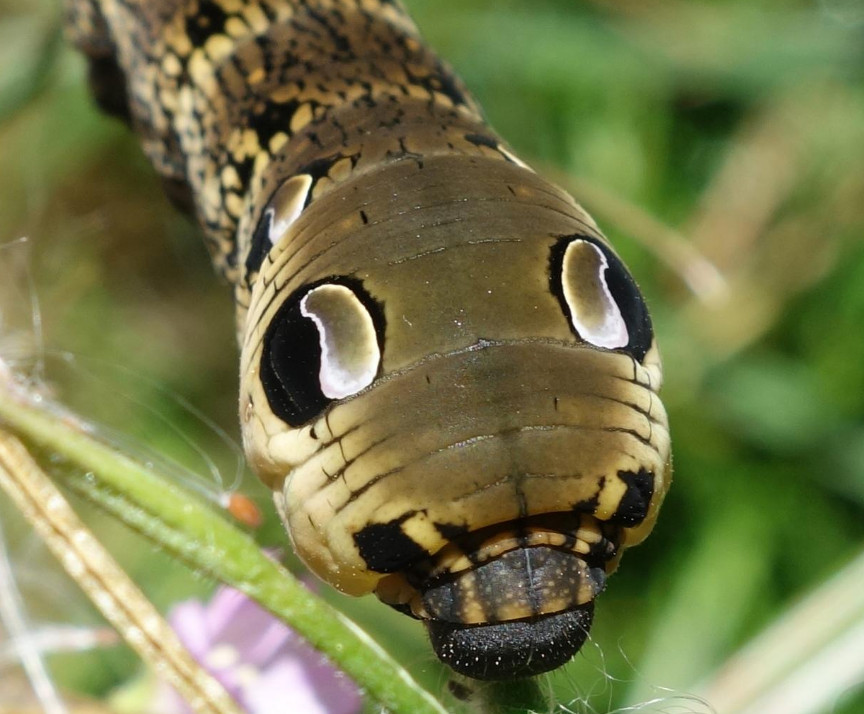
For a short time we just watched as it made its way across the path. But before it made it to the vegetation on the far side, some people appeared with a dog. The dog ran up enthusiastically to greet us and accidentally kicked the caterpiller before running off again. The caterpillar did something extraordinary – it mimicked a small snake.
Am I a caterpillar, or am I a snake?
The caterpillar crossing a stony path
For perhaps 20 seconds or so it writhed its body in a convincingly snakelike movement, and it pumped up several body segments behind the head, tucking its head down at the same time. With eye spot markings on its flanks, a scaly pattern on the entire body, and by raising up the front part of the body, it really did look the part. I wasn’t fast enough to get a photo, but I did get some video of the recovered caterpillar continuing on its way afterwards.
Searching the internet later, I found several good images of the caterpillar mimicking a small snake. Perhaps the best of these is show below.
The caterpillar looking very much like a snake (credit iSpot)
The natural world is so amazing, and so full of surprises, but mimicry is quite a common feature in both plants and animals. The European white dead-nettle has leaves that cannot sting but match the appearance of the unrelated stinging nettle very closely. Some insects look like pieces of wood, or a leaf, or a patch of white lichen, or a bird dropping. Many slugs look very much like animal droppings of various kinds, and as they move so slowly only an alert predator is likely to notice them. Predators, too, use camouflage which is not truly mimicry, but helps them merge into dappled sunshine and shade. Fish are often dark on top and silvery underneath. Sometimes they are patterned and look like the gravel bed of a stream or river.
Way back a thousand million years ago when the super-continent Rodinia existed
Well, OK, it’s not that the canyon itself is partly in Australia, but the rock formations through which the canyon was formed are partly in Australia.
How do we know? Many of those rock layers with their very distinctive and unique sequences and chemical compositions have also now been found in Tasmania, the large island just south of the Australian state of New South Wales. It’s the oldest rocks of the Grand Canyon series that have been discovered in Tasmania. The rocks have always seemed unrelated to other rocks in the same part of the island, but they look like the oldest canyon rocks in many of their details and make-up.
Rodina, a super-continent with Australia adjoining Laurentia.
The solution to this puzzle can only be that part of Australia was once a single piece of continental crust with the rocks of the Grand Canyon. That would have been way back a thousand million years ago when the super-continent Rodinia existed. Since then, the continents have broken apart, moved around, run into one another, and broken apart again. The breakup of Rodinia separated the early rock grouping into pieces that became part of modern North America and Australia.
This is not a new theme in the history of the continents. In a much more recent episode (the opening of the Atlantic Ocean) an ancient mountain chain was torn in two; the parts now form the Appalachians in North America and the Scottish Highlands on the edge of Europe.
But this new discovery helps scientists put more detail into the very early story of continental crustal movement and break up. Thanks to Jack Mulder and others for publishing the discovery and New Scientist for sharing the story more widely.






 Journeys of Heart and Mind