The changing USA

As long as he gets what he wants, he doesn’t seem to care it it’s legal or illegal, innocent or corrupt, good or bad for the American economy, good or bad for the world economy, good or bad for the environment.

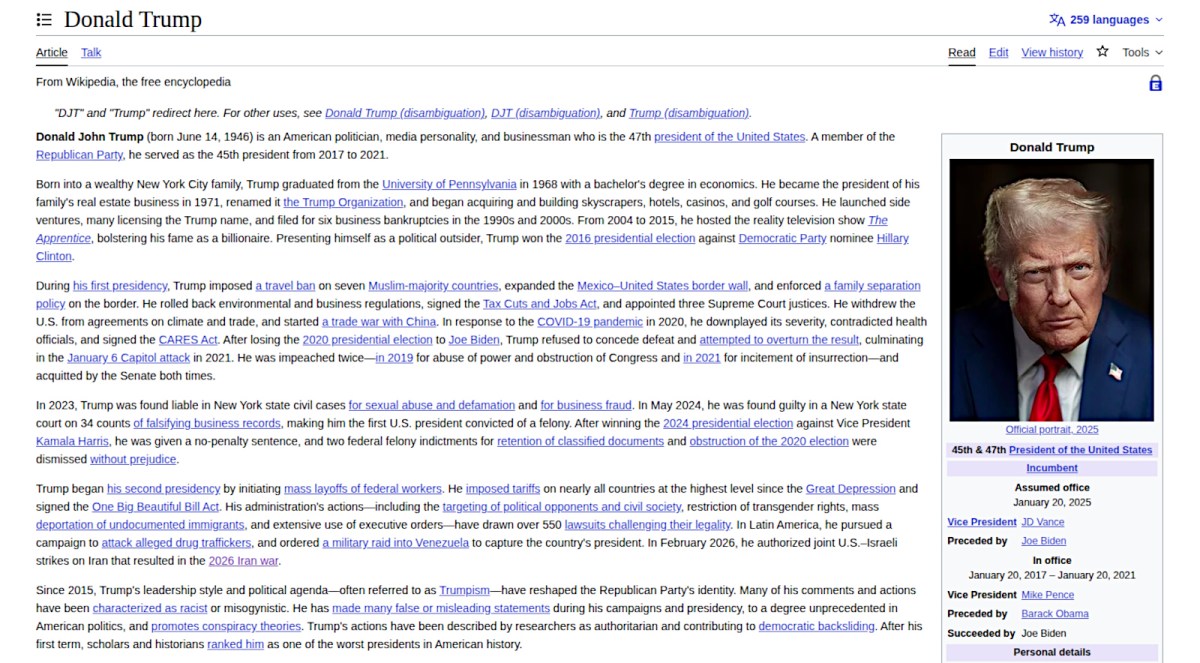
Wikipedia’s entry on Donald Trump

Thinking out loud – 5
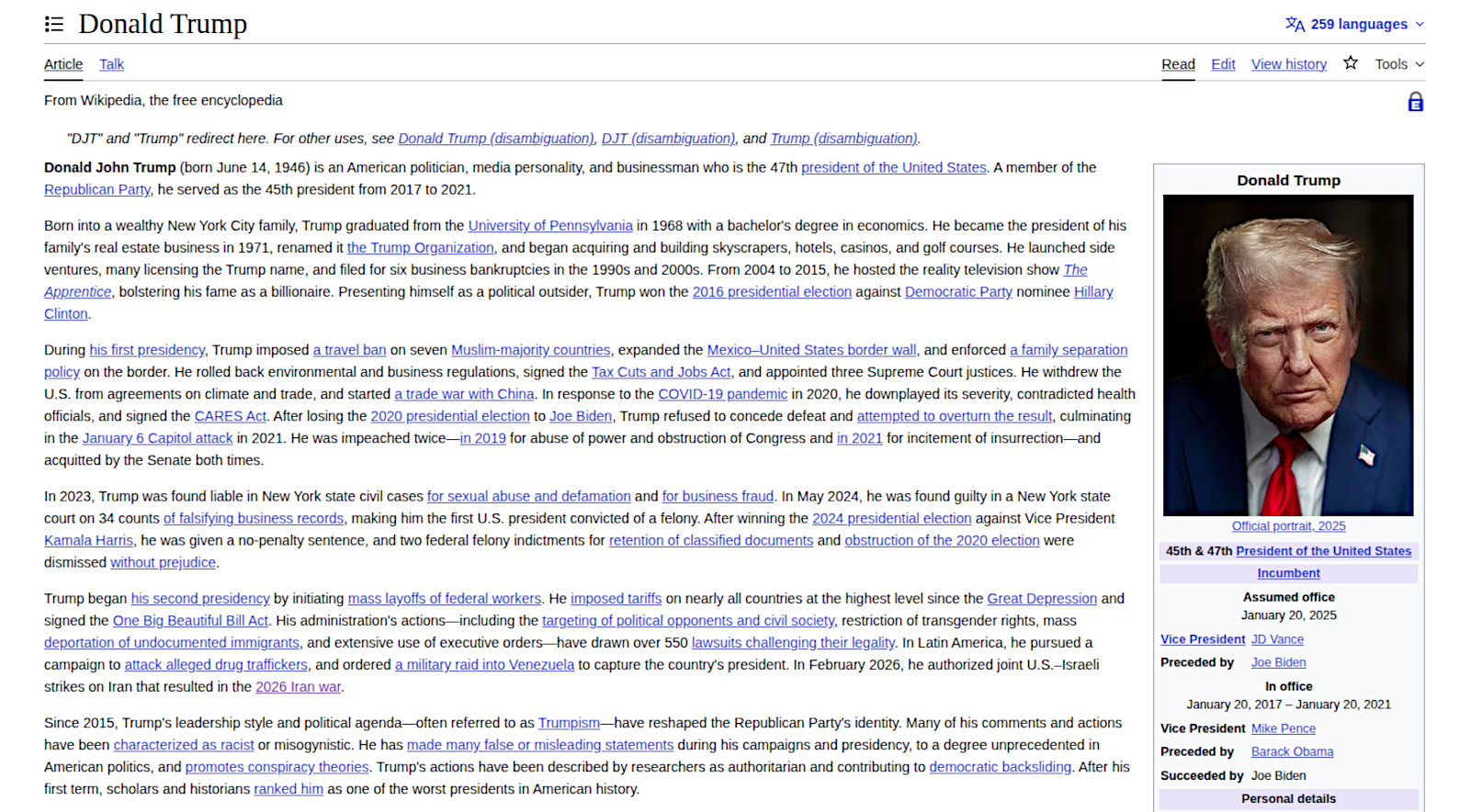
Trump on Wikipedia

I wrote this post originally quite early in Donald Trump’s second presidency. I might write a second version as so many more things have changed since then.

It’s perplexing how much has changed in US domestic politics and international relations since Donald Trump’s second term as president began on 20th January.

I’m not going to try to summarise his actions, analyse his reasons for them or the effect they may have going forward. Instead I’m going to explain how one ordinary British citizen (me) views the underlying reasons for the way Trump behaves and why those around him act the way they do.

Right at the start I must admit that I have little to go on; my knowledge is limited to what he has done and said as reported by the news media, the reactions from the many world leaders and business people who have met him, the outcome (so far as we know them) of his actions, and comment from others on his personality, character and behaviour. But mostly, what I write below will be based on what I’ve observed in interviews and on news broadcasts, articles, and the response of others.

So, if you’re prepared to hear thoughts and opinions from a very ordinary member of the British public – read on.

Intellect

Donald Trump has a BSc in economics (and I have one in horticulture, another in mathematics and computing as well as an MSc by thesis on plant reproductive biology). I appreciate, therefore, that Trump has both the intellect and work ethic required to achieve his degree. It’s a significantly harder challenge than doing well in primary or secondary education.

Legal issues and bankruptcy

Following his university education, Trump found work in the family property business. However, things didn’t always go too well for him, there were legal battles over race discrimination and contempt of court, and six of his businesses have been declared bankrupt. The details are included in the Wikipedia article about him, with references to sources.

How things look

This seems to have set the tone for his current approach to legality and success in politics as well. Winning by whatever means he deems necessary seems to be his normal approach to political life. As long as he gets what he wants, he doesn’t seem to care it it’s legal or illegal, innocent or corrupt, good or bad for the American economy, good or bad for the world economy, good or bad for the environment. Sometimes he may genuinely not understand what he’s dealing with, ‘Drill Baby Drill’ is a dreadful intention to express if you’re a person who understands the damage that will be done to to our very fragile environment and ecosystems. And he clearly had no idea that imposing tariffs on imports was tamtamount to a severe tax on United States Citizens.

Mr Trump has stabbed Ukraine in the back by his unkind and unhelpful remarks to Volodymyr Zelenskyy in the White House combining ignorance and rudeness in an extraordinary way. He tries to be friendly to the some of the world’s worst characters – Vladimir Putin is a prime example, Benjamin Netanyahu is another – while at the same time rudely dismissing and criticising many who would help him if he took a more conciliatory line, people like the leaders of Canada, most European nations, and so forth.

War

Mr Trump has skilled and experienced military analysts and experts ready with good advice and wisdom. He ignores them. Apparently he prefers guesswork, trial and (mostly) error to sound advice, good judgement and deferring to those with experience, an ability to think through the options and war game out the possible and likely outcomes.

See also:

Useful? Interesting?

If you enjoyed this or found it useful, please like, comment, and share below. (If you don’t see those links, click the article’s title above the main photo and they will appear.) Send a link to friends who might enjoy the article or benefit from it – Thanks! My material is free to reuse (see conditions), but a coffee is always welcome and encourages me to write more often!

Time for a new paradigm

Times change and businesses and organisations have to change too. You see the same situation in ecosystems: weather patterns change, or a new species of plant or animal moves in, and the balance shifts.

Wikipedia’s entry on Patreon

Thinking out loud – 4

Patreon on Wikipedia

Times change and businesses and organisations have to change too. You see the same situation in ecosystems: weather patterns change, or a new species of plant or animal moves in, and the balance shifts. Plants and animals that used to thrive begin to struggle or even die out, others prosper.

Internet conditions have been changing, and continue to do so. YouTube, pressured by the popularity of Tik-Tok style short video clips is bringing YouTube ‘shorts’ front and centre, and longer, more serious videos are both more expensive to host (because they are longer, slower to upload, and need more storage), and less popular with younger audiences (a recently growing sector.) Blogs have become less popular for the same reasons. Print media have been suffering too, everyone wants video reports on current events. Even TV channels are suffering, seen as boring and not for the current generation.

So what to do when the old models fail? That was the issue Fraser Cain faced.

Here’s a story of frustration and hard work when a website failed, revenues had been trending downwards for some time and the YouTube part of the operation proved problematic for a different reason. The solution? Patreon, and a new (old) approach to funding. Watch Fraser Cain’s video below where he shares the full story of the website failure and reconstruction, the problem with YouTube, and the new emphasis on Patreon going forward.

Patreon

The answer, as you have seen, was to find a new model; or perhaps it’s just an even older model come back in disguise! Provide material, perhaps in large part for free, but then charge a weekly or monthly subscription for extras. These might be coverage in greater depth, providing additional topics, giving an opportunity to provide feedback, or win prizes, or sell ‘merch’, or whatever other benefits you might think of.

Patreon is becoming more and more popular with creators, and for very good reason – the model is extremely successful. It works well for creators, and it works well for viewers who can enjoy an ad-free experience. Not everyone will be willing to pay for the extras, but that doesn’t matter. As long as the income exceeds the costs of production it’s a success. so the more people a creator can sign up, the lower the fee can become. It’s a great idea, it works for everyone.

See also:

Here are some further links to Fraser’s material, as well as a few other content creators using Patreon very effectively:

Useful? Interesting?

If you enjoyed this or found it useful, please like, comment, and share below. (If you don’t see those links, click the article’s title above the main photo and they will appear.) Send a link to friends who might enjoy the article or benefit from it – Thanks! My material is free to reuse (see conditions), but a coffee is always welcome and encourages me to write more often!

Emergence – an introduction

Emergence is everywhere, and you would not be here without it! … Emergence matters because it is one of the fundamental processes that we see in this universe at every imaginable scale.

Part 1 of a series – Emergence

< No earlier posts | Index | In the beginning – a field >

One of my many interests is the way in which everything we’re familiar with in the universe developed out of a previous state, and how new features make further developments possible – over and over and over again.

I’d like to explain how this seems to be an underlying property of our universe. We are surrounded by astonishing levels of complexity and the earlier stages seem to be far simpler than later ones; at the beginning of the process (if there is a clear beginning) everything was simple. So how can the complex arise from the simple?

Ripples in the sand, an example of emergence (from Wikimedia Commons)

In its entirety this story will take us from the big bang, through particles and atoms, to chemistry, onwards to life, intelligence, and beyond. This is far, far too much for a single blog post, so I will choose topics one by one and write about them. I’m not planning to start at the beginning, and the posts won’t be in the order that events took place, but as I write additional articles, I plan to link them into a logical series.

How would I know anything about this topic?

I should explain something about my background and training – I’m not an expert on all of the topics we will be covering, perhaps not really an expert in any of them! I retired in 2010, but the first part of my career was in biology, specifically flower and fruit development in plums, so I do have a science background. My first degree was from Bath University in the UK, an honours degree in Horticulture; then during my research career I wrote an MSc thesis at Bristol University on the plum reproduction work; and later I completed an ordinary degree in mathematics and computing at the Open University as it seemed useful to have a background in methods that were becoming rather more frequently used by biologists. In the mid 90s my research career abruptly ended through unexpected personal circumstances.

But let’s go back to some thoughts on the complex arising from the simple. This is really quite counterintuitive for most people and, as it forms the basis for the story I want to tell, it’s important to think about it clearly at the start. At its heart, emergence is very simple. So simple we often take it for granted.

A few examples will help.

Example 1 – Cities

Where do cities come from? Obviously they’re built by people. Building towns and cities is something that people do, they provide places to live, places to work, shops, schools, hospitals, transport (ranging from footpaths to airports) and much more. Our societies could not exist without cities.

If we could take a few hundred people to a large, uninhabited island, what would they do? They would look for sources of food and water. They’d try to start a fire to keep warm. They’d explore the area. And they’d build shelters of some kind. Given time they might build a village.

Without people there would be no towns. But given a population, villages, towns and cities will eventually begin to appear. One person cannot build a village, let alone a city; it requires cooperation and a lot of resources.

It’s fair to say that cities emerge when large groups of people cooperate. A city and the life of a city are emergent properties of a cooperating group of people.

Example 2 – Murmurations

A murmuration is a flock of birds behaving in a particular way. I wrote about this some time ago in a different context. But take a look, especially at the video link in the article; it’s an amazing and beautiful thing to watch. Without the starlings there could be no murmuration. It’s another example of emergence. Murmuration becomes possible (though not inevitable) when there’s a large group of birds flying together.

Example 3 – The internet

For our final example, lets think about the internet. Something like the internet was bound to arise once computers became plentiful. It was useful to connect computers together so that all the computers in an office could share a single printer or some other resource. And then it became useful to connect up individual offices and companies for email, or file sharing. The details of the protocols that make it all possible don’t matter, it could have been done in a variety of ways; but the principle of world spanning connectivity was bound to develop, one way or another.

Predictability

Emergent behaviour is usually unpredictable. If you studied a single starling, or even a cage containing ten birds, you might learn a great deal about starlings, but nothing you learned would prepare you for the sight of a murmuration. Nor would it enable you to predict murmurations.

Why does emergence matter?

Emergence matters because it is one of the fundamental processes that we see in this universe at every imaginable scale. We see it in the behaviour of the wave functions that underlie elementary particles, and we see it in the formation of galaxies and even clusters of galaxies. We see it in everyday life (think about those cities mentioned above), we see it in the way collections of neurons give rise to complex behaviours in our brains, we see it in political life, in business, and in economics. Emergence is everywhere, and you would not be here without it!

Future articles

I’ll be writing on this topic again, but next time I’ll choose a particular example of emergence. This article acts as an introduction to the topic and will probably be accompanied by an index for this and other articles in the series. Along the way I’ll try to explain emergence in a bit more detail, and to provide links to material out there on the internet that will go far deeper than I plan to (or even could) take you, my readers.

See also:
Part 1 of a series – Emergence

< No earlier posts | Index | In the beginning – a field >