First generation Star formation

Our Sun is a typical, smallish star, it has been around for some five billion years so far and probably has about another five billion years to go. No need to panic, the Sun is middle aged! Steady as you go.

Artist’s impression of early stars (Wikimedia)

Part 4 of a series – Emergence

< From gas and gravity to galaxies | Index | No later posts >

RequiresExtensive cold gas clouds
Results inStars producing elements up to iron, gas giant planets
EnablesNovae, Supernovae

Two features of the birth of a star system are important here, matter and energy. The first stars formed from the gradual collapse of clouds of cold gas consisting mainly of hydrogen with some helium and a trace of lithium. Gravity slowly pulls a gas cloud into an ever-shrinking volume, and slow, drifting motions lead to increasing rates of rotation as this shrinkage proceeds. Compression of gases always results in heating, so over a long period of time, a diffuse cloud of cold gas becomes a rotating mass of increasingly hot gas.

Sufficient collapse eventually causes the internal pressure and temperature to reach a critical point at which nuclear fusion becomes not just possible, but inevitable, and conditions then settle to a point where the fusion energy dramatically increases the core temperature and pressure, pushing outwards more and more strongly until the the gravitational collapse is stopped. The rotating, hot mass is a young star, converting hydrogen to helium.

Over time it settles down more and more to a stable state, though this lasts for a limited time, basically until no further hydrogen fusion is possible because there is insufficient hydrogen remaining. The length of time of that stable state is related to the mass of the star. Small, light stars process their hydrogen slowly. Large, very massive stars burn through their supply much faster. Although they have a great deal more to begin with, the temperatures and pressures at the centre are much higher so there is a faster reaction in a larger volume of core. That’s why large stars run out of fuel faster than small ones. These earliest stars are called Population III stars by astronomers, it seems they were usually very large and therefore short-lived.

Our Sun is much more recent, a typical, smallish star, it has been around for some five billion years so far and probably has about another five billion years to go. No need to panic, the Sun is middle aged! Steady as you go.

Eventually, as the hydrogen is used up, energy production falls and gravity can no longer be resisted, so the star shrinks and heats up further. As the internal temperatures and pressures increase, the star shrinks until the temperature at the core is sufficient to fuse helium. Once again, further gravitational collapse is halted by increasing core temperatures and this lasts until the helium supply is exhausted. Through a whole series of similar steps the star creates heavier and heavier elements all the way up to iron, but fusing atoms of iron absorbs energy so gravity wins out in the end. Small stars slowly cool and eventually become inactive and unchanging. Particularly large stars have a different fate.

We’ll consider those details in a future article.

See also:

< From gas and gravity to galaxies | Index | No later posts >
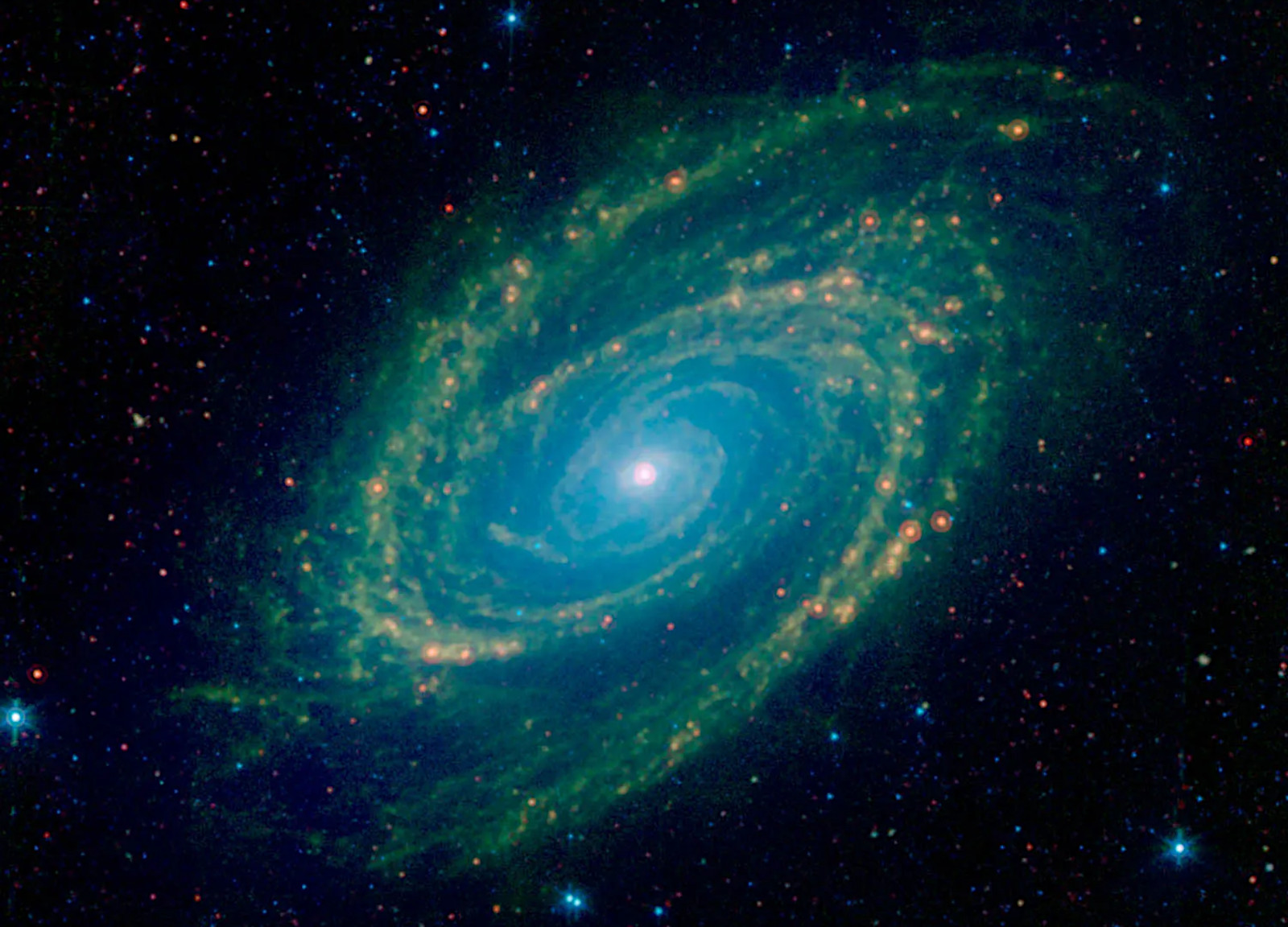
From gas and gravity to galaxies

The tiniest fluctuations in density in the early universe have become the very largest structures we are aware of.

Part 4 of a series – Emergence

< Combining atoms | Index | First generation star formation >

Click for full size
(NASA image)

In the early phase of the young, expanding universe, the primordial atoms of hydrogen, some helium, and traces of lithium were present in strings and clumps. These structures go back to the very earliest times. The cosmic microwave background hints at such structures very early on, and on the most enormous scales of astronomy they also put in an appearance. Strings and clusters of galaxies are visible everywhere, with vast voids between them where there seems to be nothing at all.

Gravity, although it’s by far the weakest of the fundamental fields, acts over enormous distances. Because of this, the tiniest fluctuations in density in the early universe have become the very largest structures we are aware of. Galaxies and clusters of galaxies began as truly enormous volumes of tenuous gas. And just as tiny density fluctuations became concentrations and voids, so imperceptible movements became enormous swirls, rotations and flows under the relentless action of gravity. Loose accumulations became ever tighter concentrations; gentle drifting became powerful vortices.

This happened at every conceivable scale. When a volume of gas is compressed by its own gravity, it doesn’t remain spherical. Rotation of the mass increases as the material is pulled together and the end result is inevitably a disk rotating slowly at the outer edge, but ever faster towards the centre. This is how proto-galaxies formed. And within those proto-galaxies, the same process on a far smaller scale allowed stars to form – but that’s another story.

For now, just ponder the fact that galaxy clusters and galaxies are emergent features given the gravitational field that permeates the universe and sufficiently large amounts of gas.

See also:

< Combining atoms | Index | First generation star formation >

How life begins

The gap has been closing little by little from both the astronomical and biological sides. But though it’s narrower now than ever before, it’s still a gap.

How did life begin? It seems possible, even very likely, that simple chemistry has the potential to generate life given the right conditions and plenty of time.

There’s always been a big puzzle over the origin of life here on Earth. Life is everywhere and in a vast array of forms. From the simplest archaea and bacteria, to the giant redwood and the humble grass in the field, the blue whale down to the smallest mite. So rich in variety, so wide in its presence from the deepest oceans to the highest mountains. Life is amazing!

The processes of evolution are well understood and impossible to deny; so puzzles over the many forms of life, its adaptability, and changes in the forms we see coming and going over deep time are clearly understood and well explained by biologists. (When did you last see a dinosaur?)

But how did it all start?

Ah! That has always been the unexplained mystery. Once we have a simple, replicating form of life on the planet we can see it might thrive, spread and grow in complexity.

There are various proposals. Perhaps it arrived in an asteroid kicked off Mars or somewhere else. But that does no more than move the origin to a different place in the Solar System. Maybe it all began at mid-ocean ridges where hot mineral-laden springs flow from hot rock layers below the surface. Perhaps, yes.

We know that many of the precursors for life exist out among the stars. Here in the Solar System, comets and asteroids are often richly endowed with amino acids, ribonucleotides, and all sorts of smaller precursors. These are the building blocks of proteins, RNA, DNA and so forth. We understand how these precursors can form spontaneously given simpler materials like water, methane, ammonia, compounds including atoms of phosphorus, sulphur and so forth. It just takes chance interactions, time, and a source of energy like ultraviolet light. The basic ingredients are there in the gas clouds that condense to form new stars and the material orbiting in disks around them.

All of these things are fairly well understood, but there’s a gap in our understanding between the presence of the components and the presence of life. The gap has been closing little by little from both the astronomical and biological sides. But though it’s narrower now than ever before, it’s still a gap.

Life in a computer?

Well, yes! And, no.

Some clever work by Blaise Agüera y Arcas, a Google vice-president of engineering, has uncovered an intriguing process. Setting a very simple ‘machine’ running random code (no meaningful program whatsoever) and waiting for something to happen, shows that eventually some very simple self-replicating code will appear in the system, and once it exists it replicates very quickly and then slowly increases in complexity. It’s not biological life of course, but it has all the qualities that we would recognise as lifelike. It replicates itself, different forms of replicating code compete with one another, they evolve, and they grow more and more complex. This doesn’t show us in any detail how biological forms got started, but it demonstrates that self-replication could happen in principle, and given enough time that it’s almost inevitable.

For the detail and background you should listen to Sean Carroll interviewing Blaise, the conversation is absolutely fascinating.

See also:

Useful? Interesting?

If you enjoyed this or found it useful, please like, comment, and share below. (If you don’t see those links, click the article’s title above the main photo and they will appear.) Send a link to friends who might enjoy the article or benefit from it – Thanks! My material is free to reuse (see conditions), but a coffee is always welcome and encourages me to write more often!

Image of the day – 27

In the natural way of things, each Aloe will produce an average of one new plant, and the population will remain in balance.

< Previous | Index | Next >

What’s in an image? Sometimes quite a lot, more than meets the eye.

I’m posting an image every day (or as often as I can). A photo, an image from the internet, a diagram or a map. Whatever takes my fancy.

Aloe aristata

Today’s picture is a close up of an Aloe aristata plant with a developing flower bud. All plants, animals, fungi, bacteria and even viruses have ways of reproducing themselves. That’s one of the defining characters of life of any kind. We can be absolutely confident that the same will be true of any life forms anywhere in the universe.

The Aloe flower bud will develop on a tall stalk and if the flowers that form are pollinated they will produce and release seeds that stand a chance of germinating and growing into new, similar, Aloe plants. In the natural way of things, each Aloe will produce an average of one new plant, and the population will remain in balance.

The only choices available to life are to survive for ever with no reproduction, or to live for a limited time and leave behind new versions to carry on the process. What life cannot do is live forever and reproduce: that would lead to overpopulation and catastrophic failure of resources. Even with reduced family sizes, the planet is no longer capable of supporting the billions of people on our planet. We face catastrophic population collapse due to lack of resources at some point unless we can reduce our population size in some other way first. That’s a matter of simple arithmetic, not a political statement or some kind of guesswork. If we don’t face and fix the issue, something else will sooner or later.

Themed image collections

The links below will take you to the first post in each collection

Cirencester, Favourites, Irish holiday 2024, Roman villa

< Previous | Index | Next >

Useful? Interesting?

If you enjoyed this or found it useful, please like, comment, and share below. (If you don’t see those links, click the article’s title above the main photo and they will appear.) Send a link to friends who might enjoy the article or benefit from it – Thanks! My material is free to reuse (see conditions), but a coffee is always welcome and encourages me to write more often!

Image of the day – 21

The plant, on the other hand, is a living organism. Nobody designed or manufactured it – life is much more wonderful than that!

< Previous | Index | Next >

What’s in an image? Sometimes quite a lot, more than meets the eye.

I’m posting an image every day (or as often as I can). A photo, an image from the internet, a diagram or a map. Whatever takes my fancy.

It’s quite amazing how life clings on, even in the most adverse circumstances. This plant was growing in my front drive, somehow finding a way to get its roots into a narrow gap in the block paving. The blocks were designed by a garden landscaping company and manufactured to particular standards of hardness and resistance to my car rolling over them. They were designed to last.

The plant, on the other hand, is a living organism. Nobody designed or manufactured it – life is much more wonderful than that! The universe we live in is tailored to build ever more complex things from very simple beginnings. A handful of quantum fields is all it takes, and these are exquisitely able to give rise to fundamental subatomic particles. These group together, eventually settling into simple atomic nuclei. As the universe expanded and cooled, atoms of simple elements appeared, almost entirely hydrogen and helium. Stars condensed and formed heavier elements up to iron. I could go on, but it’s a long story! Maybe some other time?

For now, just consider the battle between order (my paving blocks and the urge I have to remove weeds that neither I nor my wife want to see growing there) and disorder (weeds thriving wherever they can, despite my best efforts). Life always wins in the end, it seems!

Themed image collections

The links below will take you to the first post in each collection

Cirencester, Favourites, Irish holiday 2024, Roman villa

< Previous | Index | Next >

Useful? Interesting?

If you enjoyed this or found it useful, please like, comment, and share below. (If you don’t see those links, click the article’s title above the main photo and they will appear.) Send a link to friends who might enjoy the article or benefit from it – Thanks! My material is free to reuse (see conditions), but a coffee is always welcome and encourages me to write more often!