Truth still matters

If I’m given misinformation and base my thoughts, words and actions on that, sooner or later I’ll run into a problem.

Originally posted in December 2020, I’m republishing a revised version of this article in response to (and in agreement with) a new post today by Christopher Dryden, ‘Keep your word‘. His message is well written and well worth reading.

Click to enlarge

Truth matters. It matters because basing our thoughts, words and actions on falsehood is asking for trouble. Truth is like light: it enables us to see clearly, it banishes darkness, but it can be snuffed out and then we’re left in the dark.

Let’s explore the background, why am I writing about truth at this particular time? And why am I writing about it at all? I’m writing about it at this particular time because truth seems to be valued by fewer people than ever before. There have always been those who trample on truth, but we do seem to be living at a time when peddling falsehoods has become pandemic. Perhaps the most obvious examples are in the political sphere, where governments and their opponents have sometimes made claims based on almost anything other than the simple facts. Policies and decisions are being made on the basis of opinion, personal ambition, whim, wishful thinking, and even denial of clear evidence. I’m writing about it because it matters. It really does. We’ll get to that in a minute.

In a time of deceit telling the truth is a revolutionary act

George Orwell

Is this a new phenomenon? No, people have always made things up, sometimes to fill gaps in what is known, sometimes to deny what is known because it’s distasteful or hard to deal with, or for the base motives that are common, if we’re honest, to all of us – greed, self preservation, shame, fear and the rest. Survival, self-respect, money and power are important to us – sometimes important enough that we will cheat, lie, and ignore inconvenient truths that are staring us in the face.

So why does it matter?

(I said we’d get to that.)

The answer is really quite simple. If I’m given misinformation and base my thoughts, words and actions on that, sooner or later I’ll run into a problem. You can’t avoid the truth indefinitely, it will come back and bite you. Misinformation leads inevitably to error and confusion.

Imagine a map that shows a bridge across a river. An ambulance crew see that the bridge provides a valuable short cut to reach a seriously ill patient in half the time. But when they arrive at the river – there is no bridge. They have to retrace their journey and try a different way, but they are too late and the patient dies. Truth matters, and it can be critically important, even to the point of life or death.

Or imagine a general fighting a battle. He is told by his intelligence agents that the enemy is almost out of ammunition; he decides to mount an immediate attack, before new supplies can reach his opponents. If the intelligence report is true, he will win the battle easily. If they made it all up and it’s false, he might be heavily defeated. Does truth make a difference? Yes – because it leads to right action. This is why intelligence and counter intelligence matter.

Unfortunately, a strategy to deceive and confuse is now being applied widely within our society. We should be friends speaking the truth to one another, but much of the untruth flying around these days seems deliberate and causes serious difficulty for all of us. It’s become a bad habit. Who should I believe? Which ‘facts’ can I depend upon? How can I check? How should we deal with this difficulty? Here are some suggestions.

Dealing with it

  • Be sceptical of assertions – in other words, ask people for evidence
  • Don’t accept claims without supporting evidence
  • Remember that lots of people saying something doesn’t make it more true
  • Use fact checking websites
  • Beware of false claims presented as evidence
  • Treat people with respect and kindness even if they are making false claims
  • Avoid shouting matches, loudness doesn’t prove anything.

So what is the take away message here? We can all make a difference for better or worse. Search for the truth in every situation, look for evidence, listen to what people say but don’t accept anything without evidence of some kind (this might be evidence about the claims being made or it might be evidence that the person making the claims is reliable and usually speaks the truth). Then base any decisions or choices on the truth, never on claims you know to be false. Never deliberately mislead others. And always bear in mind that people with an agenda may sometimes behave like an enemy general. They may see you as the enemy and will misinform you if they think it will help them in some way. The world is a wonderful place, but it can also be a deceptive and dangerous place. Go in peace, but go very carefully!

Let’s base our lives on what is true, and not on what is false. Even though it’s sometimes hard to tell what is, or is not, true – it’s always worth making the attempt. And let’s remember that truth will never let us down. Untruth is just as reliable – it will always let us down in the end. No wonder Jesus said. ‘The truth will set you free’ (John 8:32). He was talking particularly about spiritual truth, but it’s a valid statement for truth in general. And let’s also bear in mind that science is a search for truth, and all the technology we depend on every day works only because it stands on that foundation of truth.

Whether we turn to the spiritual or the physical realm, we can only rely upon what is true. Truth is a thing of beauty, but deceit is ugly beyond measure. Choose beauty. Choose the light. Choose truth!

See also:

Useful? Interesting?

If you enjoyed this or found it useful, please like, comment, and share below. (If you don’t see those links, click the article’s title above the main photo and they will appear.) Send a link to friends who might enjoy the article or benefit from it – Thanks! My material is free to reuse (see conditions), but a coffee is always welcome and encourages me to write more often!

John 15:9-17 – Love and fruit

This joyful, loving relationship we have with Jesus is so important. In these verses Jesus stresses it by repetition. He wants to see joyfulness in our lives, he wants his joy to find a welcome in our lives.

< Previous | Index | Next >

Bible text – Read it yourself (opens in a new tab)

A fragment of John’s gospel
(Wikimedia)

At this point Jesus begins talking about love. It always helps, when explaining something, to have an illustration or example; Jesus needs an example of his love for his followers, so he says, ‘I’ve loved you the same way the Father has loved me’. There’s such a lot in that simple statement!

But the disciples had evidence of the Father’s love for the Son going far beyond words alone; the love was affirmed by powerful action. They had seen the sick being healed, the dead raised to life and evil spirits thrown out. Oh yes, he had the affection of the Father, and now Jesus tells them that he loves them like that, too! Notice how remaining in the love depends on obeying the commands. It’s not that the love is taken away in the absence of obedience, but the absence of obedience is the same thing as walking away from the source of the love. So his followers have a part to play as well, they are to ‘Stay in his love’. They are to stay close, not wander off but to stay in that place of affection.

It begins and ends with love

This joyful, loving relationship we have with Jesus is so important. In these verses Jesus stresses it by repetition. He wants to see joyfulness in our lives, he wants his joy to find a welcome in our lives. He’s explained this clearly and now, in verse 12 he shows how simple it is. The command that must be obeyed if we are to remain in him and his joy in us is not hard and it’s not complicated or demanding – just love one another, please!

And the greatest and fullest love imaginable is to be more concerned for one another than for our own existence! In verses 14 and 15 Jesus brings us right back to the need for obedience yet again, and it’s not an obedience like that of servants or slaves. We are fully informed, he calls the disciples (and us) his friends, not his servants. Our place is not to serve Christ, but to be his friends. I’m sure you appreciate the difference. We’re helping out one of our mates, not scraping and bowing to an imperial boss!

Getting the job done

Sometimes we are told that people in the world need to ‘choose Christ’, that they need to ‘make a decision for Christ’. Yet Jesus clearly sees it very differently, he tells us here that he chooses us, not the other way around. We are right to share the good news about Jesus, to explain to people that peace and joy and freedom are found in him. But we don’t need to persuade people to make a choice. Jesus makes the choice. We never, never need to browbeat anyone, our task is just to introduce one of our friends. Hey, this is Jesus, say ‘Hi’ to the best friend I have, he’d like to get to know you better.

We do have a job though, and introducing Jesus might well be an important part of it. We were chosen to bear lasting fruit, and if we ask Papa for something, he’ll provide it. He’s always willing because he sees us as one of his Son’s friends – he loves the Son and he loves his Son’s willing mates and helpers. It’s all about relationship, is it not? What we do counts for little, who we are counts for everything! Without Jesus I can do – nothing! But I can do everything in Christ.

And finally, Jesus reminds them one more time, ‘Love one another’. He knows how easily we forget!

< Previous | Index | Next >

Useful? Interesting?

If you enjoyed this or found it useful, please like, comment, and share below. (If you don’t see those links, click the article’s title above the main photo and they will appear.) Send a link to friends who might enjoy the article or benefit from it – Thanks! My material is free to reuse (see conditions), but a coffee is always welcome and encourages me to write more often!

John 15:1-8 – Vine and branches

If you prune a vine wisely it becomes more vigorous and more fruitful; that’s true of all kinds of fruit tree too.

< Previous | Index | Next >

Bible text – Read it yourself (opens in a new tab)

A fragment of John’s gospel (Wikimedia)

Jesus has been talking to his closest followers, the small group of twelve who were travelling with him. Now he begins to use the idea of a vine. Remember that everyone in Israel would have known what a grapevine is like, they were widely grown and wine was an important item in ceremonies as well as in ordinary life. It was essential in weddings, in the passover meal and so forth.

He now makes a strange claim, he says that he himself is a vine. Not only that, but he is the true vine. And he mentions that his Father is the gardener, though we shouldn’t think in terms of someone who looks after fruit, flowers and vegetables in the way we would today. Israel is the old vineyard, and Father is much more than just an employed labourer, he is the vineyard owner. The old vineyard (Israel) has not been fruitful. Jesus is a new vine and his Father will prune the branches to make him more fruitful. If you prune a vine wisely it becomes more vigorous and more fruitful; that’s true of all kinds of fruit tree too, anyone who manages an orchard will tell you that ageing trees fruit less but can be reinvigorated by good pruning. Old or diseased branches need to be removed and the others cut back to a strong, healthy bud.

And Jesus goes on to tell his followers, ‘You are the branches’! Who are his followers? Two thousand years ago they were the twelve disciples who followed him everywhere and were hungry to hear whatever he had to say. Today the things that he said to them, apply to us also. We are his branches, we are attached to him.

A two-way relationship

Notice that this is a two-way relationship. Jesus says we’ll be very fruitful if we remain in him and he remains in us. And notice too that it’s an all or nothing relationship; we’ll either be very fruitful or we can do nothing. There’s no option that makes us partly fruitful, or reasonably fruitful, fruitful in some things but not in others. We are fully in; or we are fully out. You will be precious and treasured, or you will be trash. So which will you choose? Will you be attached to the one true vine, or will you be disconnected?

And in verse seven we learn that if we remain in him and his words remain in us, we can ask anything we wish and it will be done for us! We need to be careful here, though. Jesus is not telling us that we can ask for things that are not in his will and purpose. He expects us to know we can ask anything in his Name and receive it. There’s no point in asking for something that will harm or destroy your enemies, for example, because Jesus made it clear that we are to love our enemy. If I ask for wrong things, I am not remaining in him and his word is not remaining in me.

While the nails were being driven through him into the cross, Jesus asked for something. He said, ‘Father forgive them, they have no idea what they’re doing’. Was that prayer answered? You bet it was. It’s a tremendous example of loving your enemy, isn’t it! Maybe one of those Romans was the one who later said, ‘Truly this man was the Son of God’.

Glorifying the Father

Finally, in verse eight we see the purpose of it all. It’s not about us at all. It’s not even about Jesus. It’s about the Father! Being very fruitful, and showing ourselves to be followers of Jesus, simply brings glory to the person who truly deserves it and should always receive it – the Father.

Our Father, who is far beyond our reach, let your Name be utterly holy, may Your will and purpose be done here on Earth, just as it is in Your dwelling place.

< Previous | Index | Next >

Useful? Interesting?

If you enjoyed this or found it useful, please like, comment, and share below. (If you don’t see those links, click the article’s title above the main photo and they will appear.) Send a link to friends who might enjoy the article or benefit from it – Thanks! My material is free to reuse (see conditions), but a coffee is always welcome and encourages me to write more often!
John 14:22-31 – Not to the world?

[Jesus] took on our limitations so that he could reach us on our level, in ways we can understand.

< Previous | Index | Next >

Bible text – Read it yourself (opens in a new tab)

A fragment of John’s gospel (Wikimedia)

‘Why are you showing yourself to us, but not to the world?’ This is such an interesting question, it’s also a natural question. Judas (not Iscariot) wants to know why Jesus shows himself to the twelve, but not to the world. The question suggests it’s Jesus’ choice to hide himself from most people but show himself to a few. Judas is right to find this strange! But it’s not what Jesus has in mind.

In verse 23, he responds by saying that for everyone who loves him, he and the Father will come and make their home in that person. In other words, it’s not just for the twelve, but for anyone in the world who loves Jesus. Or to put it another way, the answer is that he will reveal himself to anyone – if they love him. He doesn’t hide from anybody, but those who don’t love him can never truly see him.

Short of time

Jesus needs to wind the conversation up because he knows what will happen next. He reminds them again of the promised Spirit and tells them that he and his Father will live within them; and the Spirit will teach them and remind them of everything they need to know. He also promises to leave his peace with them, and tells them not to worry or be afraid. This seems to me particularly striking when you consider what Jesus is about to go through at the hands of the Sanhedrin and the Roman governor.

And finally, in verses 28 to 31, he reminds them that he’s going to the Father who is greater than he is, and they will be glad (once they understand the significance of this). So, in what way is the Father greater than the Son? Does this idea even make any sense when we know that Father, Son and Spirit are co-equal within the structure we call ‘trinity’, the three in oneness that they share together? Perhaps the answer is simply that Jesus has limited himself within a human body in order to reach us in this world. For more than 30 years he has remained limited, but in returning to the Father he will regain the ability to be present everywhere at every moment of time with all of his people. In his human body he is inevitably less powerful than the Father, only able to act in the one place and time where he finds himself. He took on our limitations so that he could reach us on our level, in ways we can understand. That time is coming to an end as he returns to the Father.

Time’s up

And then they leave, and the final act will open.

< Previous | Index | Next >

Useful? Interesting?

If you enjoyed this or found it useful, please like, comment, and share below. (If you don’t see those links, click the article’s title above the main photo and they will appear.) Send a link to friends who might enjoy the article or benefit from it – Thanks! My material is free to reuse (see conditions), but a coffee is always welcome and encourages me to write more often!

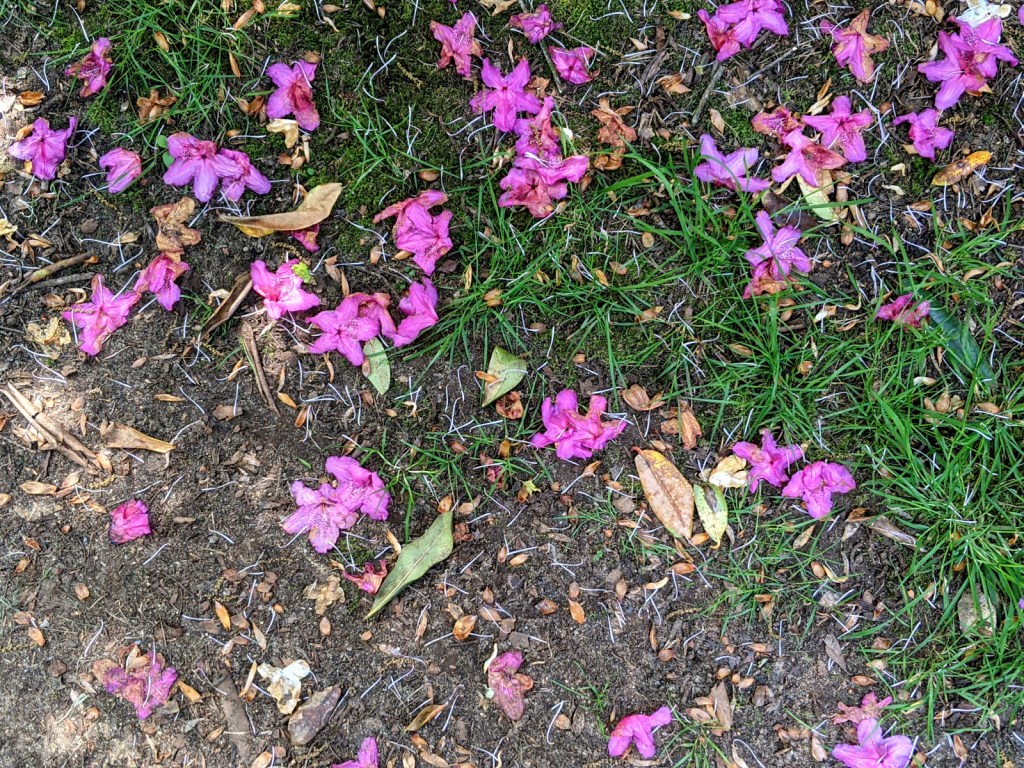
Fallen Rhododendron flowers

He invites us to share in his spiritual life, a gift since we cannot deserve or earn it.

Fallen Rhododendron flowers lie on the ground – they are still beautiful. If you follow Jesus, perhaps you might say the same of fallen people (ie all of us); fallen people are lost but still beautiful too. But unlike the flowers, for fallen people hope remains; there is a Way, a Truth, a Life.

Rhododendron flowers lying on the ground where they fell

Jesus said, ‘I am the Way, the Truth, and the Life

The Way

Jesus is the Way because he is the only road to safety. We are free to follow any route through life that we wish, but the only road that promises and ensures safety is the road that Jesus travelled. Like us, he was born, lived as a child and went through the process of growing up. Unlike us he didn’t mess up.

If I want to walk in safety, I can only do it by walking with Jesus. I need to get to know him better, listen to what he says, say what I hear him say, do what I see him do.

The Truth

Jesus is the truth because he doesn’t hide from us. How can we define truth and falseness? Well, people sometimes say of a person, ‘What you see is what you get’. This is never literally, reliably, always true of any other human being. We hide things for a variety of reasons, even as children. If we’re ashamed of something, we hide it. If we break something, we might say someone else did it, or pretend we weren’t there at the time. Human nature is to turn to what is false when the truth is inconvenient or embarrassing or dangerous. Jesus is the exception that proves this rule of human nature. Not only did he always stick to what is true, he is truth personified.

The Life

We are alive because we are self-sustaining physical systems carrying out physical processes. Anything that destroys the systems or stops the processes causes us to die. If I’m not allowed to breathe, I will die. If I’m not allowed to eat or drink, I will die. Jesus, during his time with us, was just the same. But he was nailed to a cross which made it impossible to breath unless he could support his body weight, and he was not allowed to eat or drink and when, finally, he was offered something, he refused it. As he grew weak, breathing became impossible and he died. Yet he also has a spiritual life, and physical life was restored to him for a time as well (though bodily he was different in some very significant ways).

He invites us to share in his spiritual life, a gift since we cannot deserve or earn it. And he doesn’t want to wait, he chooses to give us spiritual life now, while we are still physically alive. For a time we can have both as he did, and later we retain the spiritual life even after our physical life is over.

Yes, it’s a mystery. No, we can’t explain it. But Jesus is not only the Way, and the Truth, he is also the Life!

If you want to follow the Way, discover the Truth, and live the Life, you really need to get to know Jesus better. One way is to read the book called Luke. It’s in the Bible, and it’s available online for free.