Seeing and believing (2)

Yahshua, coming and standing there amongst them says ‘Shalom alechem’, ‘Peace be with you’. It’s the everyday greeting you’d hear on the streets in any Jewish town but here amongst these frightened men it has a much wider and deeper meaning.

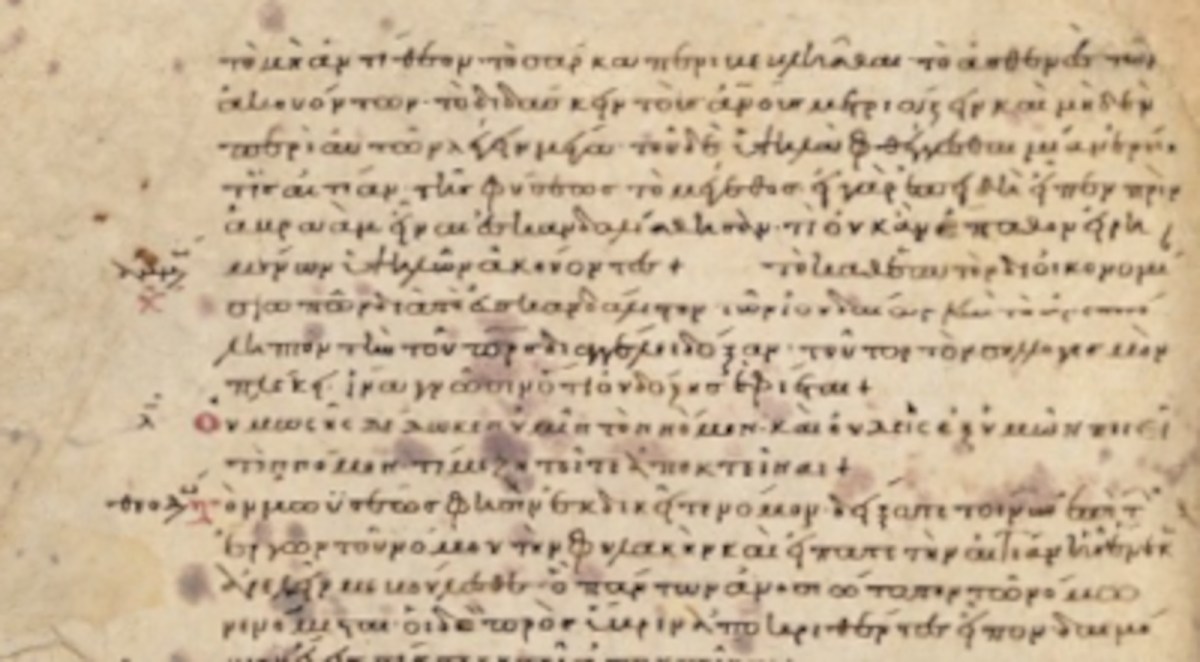
Greek commentary on John’s gospel dated 1190-1200 (Bodleian Library)

< Previous|Index|Next >

Cruising the gospel – John 20:19-31

Bible text –Read it yourself (opens in a new tab)

Brief note:

In the previous installment, I used the Aramaic names for people rather than the modern English equivalents. I’ve done the same again this time because it’s what we normally do with foreign names.

We would not call Jacques Chirac ‘Jack’ and we don’t use an English name in place of Volodymyr Zelenskyy, so why do we call Yohanan ‘John’ and Cephas ‘Peter’? Using the original names reminds us that these people were part of a different culture than our own. From now on I shall continue to take this approach.

An amazing day

A fragment of John’s gospel
(Wikimedia)

20:19-31 – In the first 18 verses of John 20 we saw how Maryam Magdalitha (Mary Magdalene) saw and believed; here in the rest of the same chapter we read about Te’oma (Thomas) and how he came to believe. Te’oma (Aramaic) and Didymus (Greek) both mean ‘twin’; John was writing in Greek so he gives both versions for clarity.

For Maryam, hearing Yahshua’s (Jesus’) voice was enough. but Te’oma needed a clearer hint. Notice the gentleness and understanding of Jesus here. There’s no tone of judgement or disappointment in Jesus’ words or in the way he gives Te’oma time to process things and finally what he needs to spark belief. It’s not at all surprising that someone might struggle to believe that after crucifixion and burial, someone might be alive again. In similar circumstances I might have struggled to believe, and so might you. Things were happening at breath-taking speed; this is the evening of the same day Maryam saw Yahshua outside the tomb at dawn.

Notice how the disciples are afraid of the Jews and therefore had the doors closed, perhaps even bolted. They are Jews themseleves, of course, but the Jews they’re afraid of are the leaders who had Jesus crucified and want to stamp out any hint of people still following him. They are surely right to be afraid of these powerful men.

Yet Yahshua, coming and standing there amongst them says ‘Shalom alechem’, ‘Peace be with you’. It’s the everyday greeting you’d hear on the streets in any Jewish town at that time, but here amongst these frightened men it has a much wider and deeper meaning. It’s not just a wish for physical peace and safety, it means peace and safety in the presence of Yahweh, the almighty Father who will protect them. And Yahshua shows them his hands and the wound in his side. And their fear and anxiety turn to rejoicing. We, too, can rejoice in his presence as he stands amongst us when we meet.

Jesus repeats the warm greeting, it’s also a promise, ‘Shalom alechem’ – ‘Peace be with you’. As the Father sent me, so I’m also sending you. They’re not just being given peace, but also a mission! It’s a message to us, today, as well. ‘Peace be with you and I’m sending you’. We can’t take only the peace, we must accept the being sent as well.

He breathed on them and said, ‘Receive the Holy Spirit’. He breaths on us too and tells us to receive the Holy Spirit. Do we receive him? And do we realise we have the power to forgive sins, or not to forgive? I’m not sure that we are quite so convinced about that! Why did Jesus breathe on them? the word for Spirit is ‘Ruach’ and it it also means ‘breath’. When Jesus fills us with his spirit he is also filling us with his breath. We can see the link in English with words like ‘inspiration’ and ‘respiration’ – both spirit and breath. As followers of Jesus, just as life-giving air flows in and out as we breath, so the eternal life-giving Holy Spirit flows in and out, active and equally life-giving (or even more so!).

But just like you and me, poor old Te’oma wasn’t there when Jesus appeared and said these things. When he does turn up and hears what had happened, he tells the others, ‘I can’t possibly believe that nonsense. I won’t believe such a thing unless I can see his hands and put my finger on the holes where the nails were, and put my hand in the hole in his side. We can’t judge Te’oma for not believing what they had told him. I’m pretty sure we’d be just the same, though possibly less open and honest about it!

But when Jesus does come by again, more than a week later, there’s double proof. Jesus already knows what Te’oma had said, and tells him, ‘Come on then, take a proper look, here are the nail holes and here’s the wound in my side. Put your finger here and take a good look at my hands, and put your hand here in my side and believe! Te’oma said, probably rather tremblingly, ‘My Master and my God’. Notice that this is far more than just believing Jesus died and returned to life. Te’oma knows who Yahshua really is, God himself in a different and unexpected form. I think at this stage Cephas (Peter), Johanan (John) and Maryam Magdalitha understood this, also Yahshua’s mother would have known. But Te’oma fully understands quite early too.

We sometimes think of him as ‘doubting Thomas’, but as soon as he had the evidence there was no room left for doubt!

And Yahshua’s comment right at the end of this gospel is very telling too. You saw and believed, how blessed are those who don’t see yet nevertheless believe. We don’t really need physical evidence, believing happens when something changes in our hearts. This is available to everyone!

See also:

< Previous|Index|Next >

Useful? Interesting?

If you enjoyed this or found it useful, please like, comment, and share below. (If you don’t see those links, click the article’s title above the main photo and they will appear.) Send a link to friends who might enjoy the article or benefit from it – Thanks! My material is free to reuse (see conditions), but a coffee is always welcome and encourages me to write more often!

You might also like:

John 20:1-18 – Cruising the Gospel

Seeing and believing

No gardener would know her name, and in that moment she recognises his voice. She cries out ‘Rabboni!’ (‘Teacher!’) and reaches to grab him, perhaps just an arm, more likely a full hug. Her misery and grief fall away immediately, replaced by astonishment and joy. But Yahshua says, ‘Don’t hang onto me because I have not yet gone up to the Father.’

Greek commentary on John’s gospel dated 1190-1200 (Bodleian Library)

< Previous|Index|Next >

Cruising the gospel – John 20:1-18

Bible text –Read it yourself (opens in a new tab)

An amazing day

A fragment of John’s gospel
(Wikimedia)

20:1-10 – It’s now the day after the Sabbath, and the normal work of the week could begin. But this was not a normal week. Jesus’ disciples, family and friends would have been subdued, grieving, and wondering how things could have gone so wrong, so suddenly. But there were still practicalities to be dealt with and today was the first day when those tasks could be done.

Early, well before sunrise (Sabbath had ended at sunset the day before) Maryam Magdalitha (Mary or Miriam Magdalene) walked to the grave where they had laid Yahshua’s (Jesus’) body, wrapped in strips of cloth with a separate piece of linen for his head. The first thing Maryam noticed, probably from some distance away, was that the heavy stone that closed the grave had been rolled away to one side. Panicking, she didn’t go any closer but must have been horrified; turning round she ran back to Shimon Kepha (Simon Peter) and Johanan (John) and told them the conclusion she must have jumped to, that someone had removed the body and she didn’t know where they’d taken him.

Shimon and Johanan set out running to the tomb and Maryam was right behind them. Johanan ran fastest and bent over and looked in through the low opening and saw the linen strips inside, but didn’t go in. Then Kepha arrived and just went straight into the tomb; he saw the linen strips as well, and also the head cloth. Then Johanan went inside the tomb, saw the same things, and believed.

What’s the significance of this? The author, very likely Johanan himself, explains in verse 9 that they didn’t understand from the Bible that Yashua had to rise again from death. This is not surprising. The Bible mentioned here is what we call ‘The Old Testament’. It was the Hebrew Bible or a Greek translation of it, and the passages that suggested the Son would die and rise again are scattered around in the books of various prophets, the Psalms and elsewhere and are always straightforward (though more so in hindsight). The opportunity for hindsight was only now beginning to open. Yahshua had explained some of this to them. Johanan, who was a close friend of Yahshua and a deep thinker had seen him die and now made the mental leap to understanding that for Yahshua death was a temporary affair. He’d said he’d return from death, and he wasn’t here in the grave anymore, somehow he was alive again! Johanan got it immediately. Kepha, a more down-to-earth and practical person did not, at least, not just yet. The two of them didn’t seem to worry about Maryam in her distress, but no doubt deeply distracted themselves, turned back to the city and the place where they were staying.

10:11-18 – Maryam, still crying in grief, now finally looked inside the tomb herself and saw two people, one sitting where Yahshua’s head had rested and the other at his feet. Seeing the tears rolling down Maryam’s cheeks they asked her why she was crying. The use of the word ‘woman’ here seems to us rather strange, perhaps unkind, perhaps distant and rather aloof. But it was a normal way to address a woman at that time, much as we might still say to a man, ‘What’s the matter, man?’, ‘What’s up, chap?’ or ‘You OK, mate?’ or just ‘What’s the problem? So let’s translate this the way we might say it today. Think in terms of these two angels saying, ‘Why are you crying?’ or ‘Why are you crying, Lady?’ And she tells them, through her sobs, ‘They’ve taken the Master away and I have no idea where they’ve put him.’

Turning round, she saw a figure standing outside the tomb. We know the tomb entrance is low so she’s unlikely to see the person’s face until she is outside, and with tears in her eyes she may not be seeing anything very clearly.

In fact, it’s Yahshua, and he also asks, ‘Why are you crying? Who are you looking for?’ She assumes it’s the gardener who perhaps looks after the nearby olive trees and asks him, ‘If you’ve moved him – tell me where he is and I’ll go and get him’.

Yahshua, seeing how confused she is, says only one word. He appreciates how blurred her vision is so he simply speaks her name.

‘Maryam’.

No gardener would know her name, and in that moment she recognises his voice. She cries out ‘Rabboni!’ (‘Teacher!’) and reaches to grab him, perhaps just an arm, more likely a full hug. Her misery and grief fall away immediately, replaced by astonishment and joy. But Yahshua says, ‘Don’t hang onto me because I have not yet gone up to the Father. Instead, go now to my brothers and tell them that I’m going up to my Father and your Father, to my Elohim (Gods) and your Elohim’. And right away, off she went to tell them.

Why did I write ‘Gods’ in the previous paragraph, not ‘God’? Because ‘Elohim’ is a plural form in Hebrew, the singular is ‘El’ or ‘Eloah’. Plurals are sometimes used to stress importance and power, Queen Victoria used ‘we’ rather than ‘I’ – ‘We are not amused’ instead of ‘I’m not amused’ In the Hebrew Bible ‘Elohim’ is a plural noun but when referring to the Almighty it takes singular verbs, As if Queen Victoria had said, ‘We am not amused’. In Aramaic it is ‘Elah’ or ‘Alaha’ allied to the Arabic ‘Allah’. We shouldn’t miss the significance of this, there’s a hint of threeness here. The Father and the Spirit are ‘up there somewhere’ while Yahshua is still ‘down here’. He plans to return to be with them, and later he will send the Spirit to come to live in and among his followers. Two thousand years later, the Spirit is still here in and among Yahshua’s followers. The Spirit is entirely capable of being ‘up there’ and ‘down here’ simultaneously.

And why did he tell Maryam not to cling to him? Perhaps he’s simply saying that the most urgent thing for him now is to get back to be fully in his Father’s presence because only then can he send the Spirit, someone they need in them as soon as possible. In a hostile and confusing world any delay in the coming of the Spirit will leave the disciples vulnerable and without direction. Maryam can help by taking the news that Yahshua is alive back to them right away. Clinging to Jesus is natural but only benefits one person while leaving the many feeling lost, distressed and confused. I think Maryam understood this right away because she headed back to the city immediately without another word.

It’s also significant that Yahshua appeared to a woman before he appeared to any of the men he’d been teaching for three years. In Jewish tradition scribes taught village boys to read and memorise the Old Testament Law. Girls were not taught these things. And Rabbis (Teachers) would take men as disciples, but not women. Yahshua broke tradition by teaching both men and women, and he now chooses to appear to a woman first. This is a lesson that church understood at the beginning, but forgot for 1900 years and has begun to relearn very slowly over the last seventy or eighty years.

See also:

< Previous|Index|Next >

Useful? Interesting?

If you enjoyed this or found it useful, please like, comment, and share below. (If you don’t see those links, click the article’s title above the main photo and they will appear.) Send a link to friends who might enjoy the article or benefit from it – Thanks! My material is free to reuse (see conditions), but a coffee is always welcome and encourages me to write more often!

You might also like:

Matthew 27:32-66 – Cruising the Gospel

Praying for the glory

If Jesus is in John and is glorified, John shares in that glory too! Even if John doesn’t fully grasp what exactly the glory is, he certainly grasps that through Jesus that glory is already in him.

Greek commentary on John’s gospel dated 1190-1200 (Bodleian Library)

< Previous | Index | Next >

Cruising the gospel – John 17:24-26

Bible text – Read it yourself (opens in a new tab)

Sharing what he wants

A fragment of John’s gospel
(Wikimedia)

17:24-26 – If these verses do not astound you, you need to pay closer attention to what Jesus is saying. Let’s break the material down to consider it carefully. The first thing to note is that Jesus is not conversing with his followers here, he’s speaking with his Father. He’s not asking for strength during his coming ordeal on the cross, instead he’s just telling his heavenly Dad what he wants. And the first thing that comes to mind is that he wants his followers to be with him where he is and to see his glory. Well, they are with him, he’s in the upper room in Jerusalem and so are they.

Seeing the glory

But do they see his glory? No, I don’t think they do – not yet, not fully. Peter, James and John had been with Jesus on the mountain and had seen and heard what happened there. But they didn’t understand what was really going on. Peter, always the practical doer, was going to build three shelters. James might have had more intuition about it, but I imagine John would have got closer than the other two. John was the disciple ‘Jesus loved’, he viewed things from a more spiritual dimension, it was his nature to dwell on spiritual truth and look for hidden depths of meaning.

I think John is already aware that Jesus thinks of himself as Yahweh’s Son, he’s referred to himself as the Son, and he often talks about ‘My Father’. And I suspect John understood that was an eternal relationship. Jesus spells it out again here in the Garden as he prays to his Father. The Father loved him before the world was created and loves him still. And I imagine for John it was not too great a leap to see that this love is eternal and will remain even after the end of time itself. And in verse 26 Jesus says to his Father that he has made his followers aware that the Father has sent him (Jesus), that he’ll continue to show them that so the Father’s love will be in them and so that Jesus himself will be in them too.

Does this take us back to Jesus in glory on the mountain? Yes, I think it does! And John must have understood that if Jesus is in him, that he too must have been gloriously transformed on the mountain, so that he, John, can also talk freely with Moses concerning law and with Elijah concerning prophecy. If Jesus is in John and is glorified, John shares in that glory too! Even if John doesn’t fully grasp what exactly the glory is, he certainly grasps that through Jesus that glory is already in him and raises him to the giddy heights of the law and the prophetic.

And this is where we all stand if Christ is in us. We just need to see, as John did, that the glory arrives when Jesus does, that we share in him and in his glory permanently. So when my body dies (as it must) I continue to live gloriously because Jesus is in me. I’m sure Peter and James came to understand this too, certainly at Pentecost if not before. That was the moment when Jesus’ glory was fully revealed to the entire church, not just in theory but in full experience.

This was a moment they had been told to wait for, but when it came it was far beyond what they had imagined or expected.

See also:

< Previous | Index | Next >

Useful? Interesting?

If you enjoyed this or found it useful, please like, comment, and share below. (If you don’t see those links, click the article’s title above the main photo and they will appear.) Send a link to friends who might enjoy the article or benefit from it – Thanks! My material is free to reuse (see conditions), but a coffee is always welcome and encourages me to write more often!

You might also like:

Cruising the Gospel – Introduction

Cycling through the gospels to keep Jesus at the centre of all we do.

I’m posting notes on short passages from the gospels. Come and join me in reading the passages and leave me some thoughts and comments. The notes can be used individually, or they can be used systematically to work through a whole book, or all four gospels. The most recent notes are on my Journeys of heart and mind site (JHM), and more will follow. Older material is on an older website, some links may need updating but navigational links work seamlessly across old and new.

I’ve made a start in Luke now; Matthew, Mark, and John are complete; it’s been an interesting journey for me. You can start from any point, all the old posts remain and new ones will appear once every week or so.

A note on names

When I began this series I used the conventional names found in most Bible translations (Jesus, Mary, Joseph, Matthew, Mark, Luke, John, Paul, Peter and so forth. More recently I’ve started to use these names in their original form (Jeshua, Miriam, Yousef etc). And usually I write Jeshua as Yahshua – that needs additional explanation, I think. Jeshua is the Aramaic name used by Jesus himself and by his friends and family, the Hebrew is Yahoshua. I use a hybrid version, Yahshua, pronounced the same as Jeshua. The name means ‘Yahweh saves’ which is, of course, very appropriate. Spelling it ‘Yahshua’ reminds me of this critically important fact every time I write it or read it.

Alan Hirsch

Alan Hirsch has developed a model for vibrant, missional church life and at the heart of the model is the idea that Christ should be central in all that we do. Few people would argue with that! One habit that he recommends to help us keep Jesus at the heart of our lives is to cycle through the gospels as part of our Bible reading. Not only that, he recommends reading all of the Bible ‘through the lens of the gospels’.

I agree with that; and it’s where these articles come in.

Latest news:

1st May2026 – I’ve added a banner image to recent posts in John to bring them in line with other posts on JHM. I’ll continue updating all the ‘Cruising the Gospel’ posts as and when I have time.

22nd June 2025 – Today I finished the task of repairing broken links in the old version of these posts. You can now navigate the entire series using the links in each article – Matthew, Mark, and most of John. Next I must complete the last couple of chapters of John; and finally, I propose revising all the material from the old version, moving each item to the current version of Journeys of heart and mind as I go.

See also: 

Index – Cruising the Gospel

You might also like:

Praying for the future

Within the threeness that we refer to as ‘The Trinity’ and sometimes think we understand, there is also a oneness, a complete unity.

Greek commentary on John’s gospel dated 1190-1200 (Bodleian Library)

< Previous | Index | Next >

Cruising the gospel – John 17:20-23

Bible text – Read it yourself (opens in a new tab)

Praying beyond and wider

A fragment of John’s gospel
(Wikimedia)

17:20-23 – These next three verses are amongst the most significant things Jesus ever said. These words are the mission statement for the church. Sometimes it seems to me they’re more of a ‘missing statement’ for us than a ‘mission statement’ because we overlook the implications. There’s great depth here if we will only pay close enough attention, so let’s step through these words in detail.

17:20 – Jesus is very clear that he is not praying only for the twelve followers who were with him as he spoke with his Father. No. He explicitly says, ‘I pray also for those who will believe in me through their message’. Who is that? It’s me. It’s you. You and I believed through the message brought to us in the Bible, written partly by people Jesus knew personally, taught, journeyed with, ate with, people he demonstrated his love to, some of them would soon see him die and later see him again alive. After praying for them he prays also for us!

Oneness every which way!

17:21 – He wants you and me to be one, just as he and the Father are one. There is nothing that you and I might differ over that can stand between us as two of his people. Not doctrine, not denomination, not wealth or poverty, wisdom or foolishness, not gifts or apparent lack of them, not skin colour or attitudes to this or that in church life or beyond it. The goal is not to be right, the goal is to recognise that our reconciliation was very, very costly. Loss of life and separation of Father and Son is what it took to bring peace and oneness to and between you and me. And we, in our shiny new oneness are to be part of the eternal oneness of the Father and the Son. Why? So that the world has a chance to believe that the Father sent the Son. It’s plain in verse 21. Yet there’s still more!

17:22 – Just read verse 22 again. The Father clothed his Son with glory and he passed it on to you and me! What? Why would he do that? So that you and I can be one just as the Father and the Son are one.

17:23 – And in this verse we see that Jesus is in us, and the Father is in Jesus Why is that necessary? It’s because within the threeness that we refer to as ‘The Trinity’ and sometimes think we understand, there is also a oneness, a complete unity. The Father, the Son and the Spirit are not just close friends in some unique way, or close relatives. The Holy Spirit is often described as ‘The Spirit of Christ’, and Jesus said, ‘If you’ve seen me you’ve seen the Father’. So when John tells us that without Jesus, we can do nothing (John 15:5), that implies quite undeniably that without the Spirit we can do nothing and without the Father we can do nothing. The astonishing thing that we rarely notice is that all of us who follow Jesus are now part of the Trinity. If you can’t quite swallow that idea, let me state it slightly differently. In John 15:5 just mentioned, Jesus says we need to remain in him and he in us. Well, Jesus is undeniably in the Trinity, and we are in Jesus – therefore… You fill in the dots.

The need to believe

We’d better start understanding and believing this, because if we don’t we can do – nothing. How amazing is this undeserved gift that we are now one with the Most High, one with Jesus, one with Yahweh, with the Spirit. We can make further supporting arguments for this claim.

  • We are a ‘royal priesthood’ (1 Peter 2:9), royalty is about authority and rule, priesthood is about bridging the gap between earth and heaven, enabling people to come into the Holy Presence. Jesus is King of Kings and he’s also the Great High Priest. We are in him. We do what we see Jesus do (we’re his disciples, or apprentices), just as he did what he saw the Father do.
  • We are ‘filled with the Spirit’ (see this search). Filled (in a different context) doesn’t mean half or three quarters, it means completely full and running over (Luke 6:38). Jesus is our head and we are his body, we are in him and he is in us. We were created a little lower than the angels; but I’d submit that in Christ, we are considerably higher than the angels!

But we should be very careful not to become proud or puffed up. We do not deserve to be one with the Most High, it’s a gift obtained at great cost, our humble gratitude is appropriate and required. And notice too, in verse 23, that the Father loves you just the same way he loved the Son before the foundation of the world. You are loved with the same love Jesus received before the beginning. And Paul wrote to the Galatians that love is greater than faith and it’s greater than hope. It is the greatest thing of all (1 Cor 13:13). This new life we received in Christ enables us to be and do all the things he will lead us into.

Some readers may feel I’ve gone too far in this post. If so, please leave a comment. I can’t guarantee to change my opinion, but I will certainly read all the comments and respond to them.

Next time, we’ll take a look at the final three verses of John 17.

See also:

< Previous | Index | Next >

Useful? Interesting?

If you enjoyed this or found it useful, please like, comment, and share below. (If you don’t see those links, click the article’s title above the main photo and they will appear.) Send a link to friends who might enjoy the article or benefit from it – Thanks! My material is free to reuse (see conditions), but a coffee is always welcome and encourages me to write more often!

You might also like: