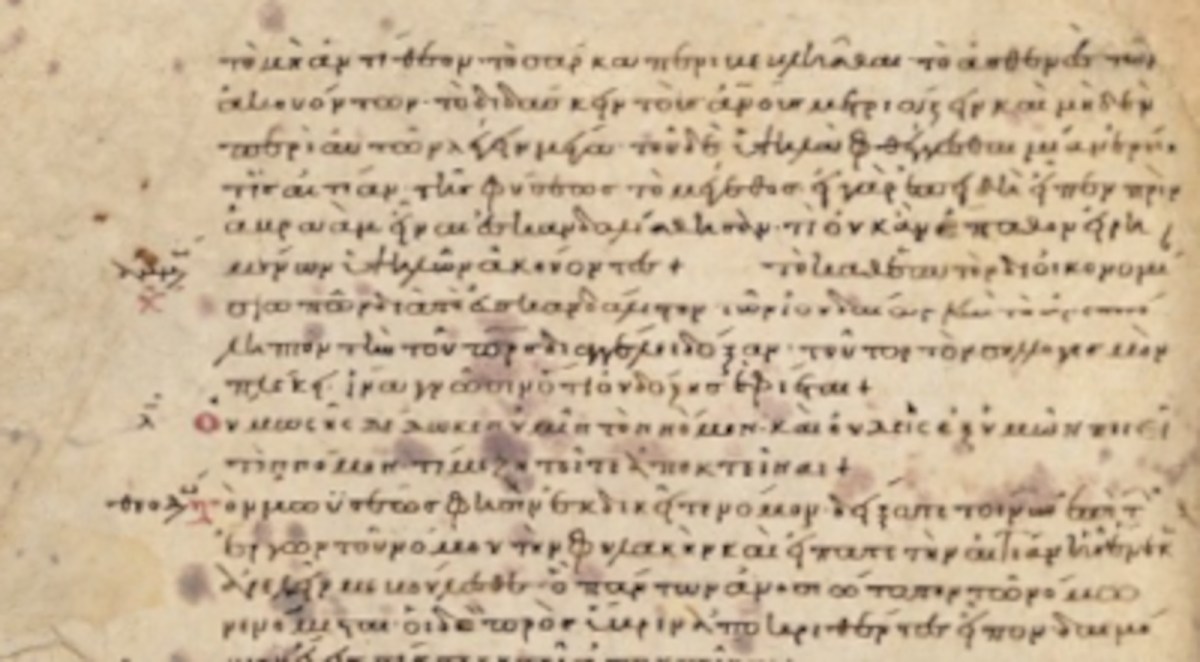
Greek commentary on John’s gospel dated 1190-1200 (Bodleian Library)
Cruising the gospel – John 20:1-18
Bible text –Read it yourself (opens in a new tab)
An amazing day

(Wikimedia)
20:1-10 – It’s now the day after the Sabbath, and the normal work of the week could begin. But this was not a normal week. Jesus’ disciples, family and friends would have been subdued, grieving, and wondering how things could have gone so wrong, so suddenly. But there were still practicalities to be dealt with and today was the first day when those tasks could be done.
Early, well before sunrise (Sabbath had ended at sunset the day before) Maryam Magdalitha (Mary or Miriam Magdalene) walked to the grave where they had laid Yahshua’s (Jesus’) body, wrapped in strips of cloth with a separate piece of linen for his head. The first thing Maryam noticed, probably from some distance away, was that the heavy stone that closed the grave had been rolled away to one side. Panicking, she didn’t go any closer but must have been horrified; turning round she ran back to Shimon Kepha (Simon Peter) and Johanan (John) and told them the conclusion she must have jumped to, that someone had removed the body and she didn’t know where they’d taken him.
Shimon and Johanan set out running to the tomb and Maryam was right behind them. Johanan ran fastest and bent over and looked in through the low opening and saw the linen strips inside, but didn’t go in. Then Kepha arrived and just went straight into the tomb; he saw the linen strips as well, and also the head cloth. Then Johanan went inside the tomb, saw the same things, and believed.
What’s the significance of this? The author, very likely Johanan himself, explains in verse 9 that they didn’t understand from the Bible that Yashua had to rise again from death. This is not surprising. The Bible mentioned here is what we call ‘The Old Testament’. It was the Hebrew Bible or a Greek translation of it, and the passages that suggested the Son would die and rise again are scattered around in the books of various prophets, the Psalms and elsewhere and are always straightforward (though more so in hindsight). The opportunity for hindsight was only now beginning to open. Yahshua had explained some of this to them. Johanan, who was a close friend of Yahshua and a deep thinker had seen him die and now made the mental leap to understanding that for Yahshua death was a temporary affair. He’d said he’d return from death, and he wasn’t here in the grave anymore, somehow he was alive again! Johanan got it immediately. Kepha, a more down-to-earth and practical person did not, at least, not just yet. The two of them didn’t seem to worry about Maryam in her distress, but no doubt deeply distracted themselves, turned back to the city and the place where they were staying.
10:11-18 – Maryam, still crying in grief, now finally looked inside the tomb herself and saw two people, one sitting where Yahshua’s head had rested and the other at his feet. Seeing the tears rolling down Maryam’s cheeks they asked her why she was crying. The use of the word ‘woman’ here seems to us rather strange, perhaps unkind, perhaps distant and rather aloof. But it was a normal way to address a woman at that time, much as we might still say to a man, ‘What’s the matter, man?’, ‘What’s up, chap?’ or ‘You OK, mate?’ or just ‘What’s the problem? So let’s translate this the way we might say it today. Think in terms of these two angels saying, ‘Why are you crying?’ or ‘Why are you crying, Lady?’ And she tells them, through her sobs, ‘They’ve taken the Master away and I have no idea where they’ve put him.’
Turning round, she saw a figure standing outside the tomb. We know the tomb entrance is low so she’s unlikely to see the person’s face until she is outside, and with tears in her eyes she may not be seeing anything very clearly.
In fact, it’s Yahshua, and he also asks, ‘Why are you crying? Who are you looking for?’ She assumes it’s the gardener who perhaps looks after the nearby olive trees and asks him, ‘If you’ve moved him – tell me where he is and I’ll go and get him’.
Yahshua, seeing how confused she is, says only one word. He appreciates how blurred her vision is so he simply speaks her name.
‘Maryam’.
No gardener would know her name, and in that moment she recognises his voice. She cries out ‘Rabboni!’ (‘Teacher!’) and reaches to grab him, perhaps just an arm, more likely a full hug. Her misery and grief fall away immediately, replaced by astonishment and joy. But Yahshua says, ‘Don’t hang onto me because I have not yet gone up to the Father. Instead, go now to my brothers and tell them that I’m going up to my Father and your Father, to my Elohim (Gods) and your Elohim’. And right away, off she went to tell them.
Why did I write ‘Gods’ in the previous paragraph, not ‘God’? Because ‘Elohim’ is a plural form in Hebrew, the singular is ‘El’ or ‘Eloah’. Plurals are sometimes used to stress importance and power, Queen Victoria used ‘we’ rather than ‘I’ – ‘We are not amused’ instead of ‘I’m not amused’ In the Hebrew Bible ‘Elohim’ is a plural noun but when referring to the Almighty it takes singular verbs, As if Queen Victoria had said, ‘We am not amused’. In Aramaic it is ‘Elah’ or ‘Alaha’ allied to the Arabic ‘Allah’. We shouldn’t miss the significance of this, there’s a hint of threeness here. The Father and the Spirit are ‘up there somewhere’ while Yahshua is still ‘down here’. He plans to return to be with them, and later he will send the Spirit to come to live in and among his followers. Two thousand years later, the Spirit is still here in and among Yahshua’s followers. The Spirit is entirely capable of being ‘up there’ and ‘down here’ simultaneously.
And why did he tell Maryam not to cling to him? Perhaps he’s simply saying that the most urgent thing for him now is to get back to be fully in his Father’s presence because only then can he send the Spirit, someone they need in them as soon as possible. In a hostile and confusing world any delay in the coming of the Spirit will leave the disciples vulnerable and without direction. Maryam can help by taking the news that Yahshua is alive back to them right away. Clinging to Jesus is natural but only benefits one person while leaving the many feeling lost, distressed and confused. I think Maryam understood this right away because she headed back to the city immediately without another word.
It’s also significant that Yahshua appeared to a woman before he appeared to any of the men he’d been teaching for three years. In Jewish tradition scribes taught village boys to read and memorise the Old Testament Law. Girls were not taught these things. And Rabbis (Teachers) would take men as disciples, but not women. Yahshua broke tradition by teaching both men and women, and he now chooses to appear to a woman first. This is a lesson that church understood at the beginning, but forgot for 1900 years and has begun to relearn very slowly over the last seventy or eighty years.
See also:
- Elohim – Wikipedia
- Mary Magdalene – Wikipedia
< Previous|Index|Next >
Useful? Interesting?
If you enjoyed this or found it useful, please like, comment, and share below. (If you don’t see those links, click the article’s title above the main photo and they will appear.) Send a link to friends who might enjoy the article or benefit from it – Thanks! My material is free to reuse (see conditions), but a coffee is always welcome and encourages me to write more often! 
You might also like:
Matthew 27:32-66 – Cruising the Gospel
Share this:


