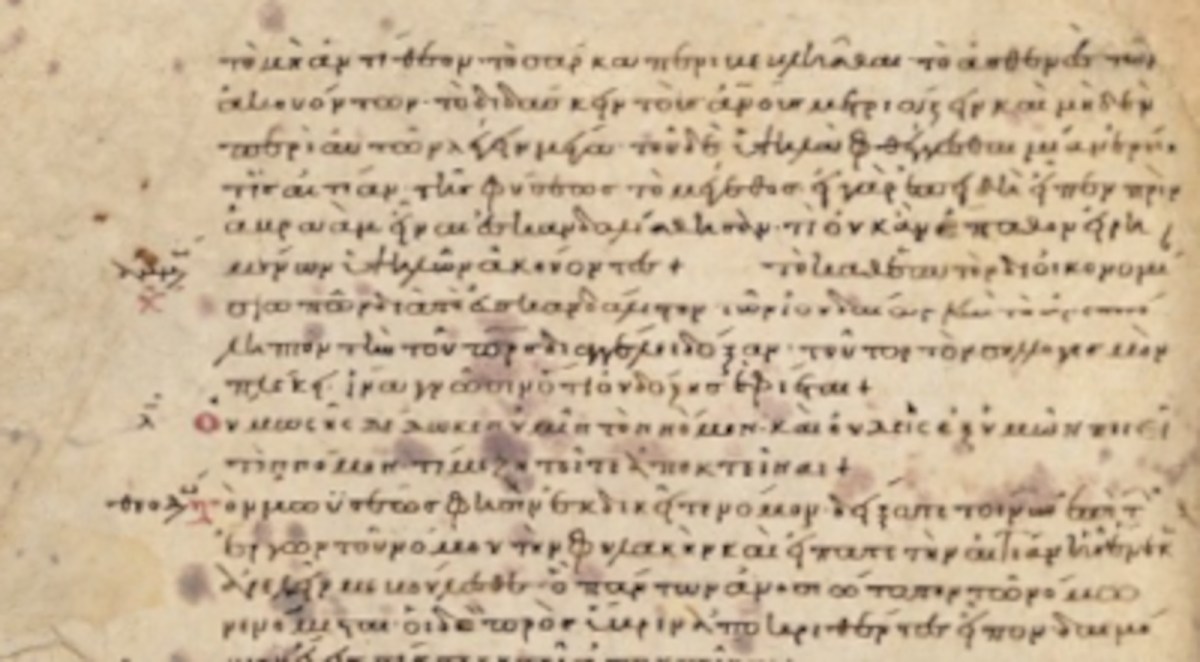
Greek commentary on John’s gospel dated 1190-1200 (Bodleian Library)
Cruising the gospel – John 20:19-31
Bible text –Read it yourself (opens in a new tab)
Brief note:
In the previous installment, I used the Aramaic names for people rather than the modern English equivalents. I’ve done the same again this time because it’s what we normally do with foreign names.
We would not call Jacques Chirac ‘Jack’ and we don’t use an English name in place of Volodymyr Zelenskyy, so why do we call Yohanan ‘John’ and Cephas ‘Peter’? Using the original names reminds us that these people were part of a different culture than our own. From now on I shall continue to take this approach.
An amazing day

(Wikimedia)
20:19-31 – In the first 18 verses of John 20 we saw how Maryam Magdalitha (Mary Magdalene) saw and believed; here in the rest of the same chapter we read about Te’oma (Thomas) and how he came to believe. Te’oma (Aramaic) and Didymus (Greek) both mean ‘twin’; John was writing in Greek so he gives both versions for clarity.
For Maryam, hearing Yahshua’s (Jesus’) voice was enough. but Te’oma needed a clearer hint. Notice the gentleness and understanding of Jesus here. There’s no tone of judgement or disappointment in Jesus’ words or in the way he gives Te’oma time to process things and finally what he needs to spark belief. It’s not at all surprising that someone might struggle to believe that after crucifixion and burial, someone might be alive again. In similar circumstances I might have struggled to believe, and so might you. Things were happening at breath-taking speed; this is the evening of the same day Maryam saw Yahshua outside the tomb at dawn.
Notice how the disciples are afraid of the Jews and therefore had the doors closed, perhaps even bolted. They are Jews themseleves, of course, but the Jews they’re afraid of are the leaders who had Jesus crucified and want to stamp out any hint of people still following him. They are surely right to be afraid of these powerful men.
Yet Yahshua, coming and standing there amongst them says ‘Shalom alechem’, ‘Peace be with you’. It’s the everyday greeting you’d hear on the streets in any Jewish town at that time, but here amongst these frightened men it has a much wider and deeper meaning. It’s not just a wish for physical peace and safety, it means peace and safety in the presence of Yahweh, the almighty Father who will protect them. And Yahshua shows them his hands and the wound in his side. And their fear and anxiety turn to rejoicing. We, too, can rejoice in his presence as he stands amongst us when we meet.
Jesus repeats the warm greeting, it’s also a promise, ‘Shalom alechem’ – ‘Peace be with you’. As the Father sent me, so I’m also sending you. They’re not just being given peace, but also a mission! It’s a message to us, today, as well. ‘Peace be with you and I’m sending you’. We can’t take only the peace, we must accept the being sent as well.
He breathed on them and said, ‘Receive the Holy Spirit’. He breaths on us too and tells us to receive the Holy Spirit. Do we receive him? And do we realise we have the power to forgive sins, or not to forgive? I’m not sure that we are quite so convinced about that! Why did Jesus breathe on them? the word for Spirit is ‘Ruach’ and it it also means ‘breath’. When Jesus fills us with his spirit he is also filling us with his breath. We can see the link in English with words like ‘inspiration’ and ‘respiration’ – both spirit and breath. As followers of Jesus, just as life-giving air flows in and out as we breath, so the eternal life-giving Holy Spirit flows in and out, active and equally life-giving (or even more so!).
But just like you and me, poor old Te’oma wasn’t there when Jesus appeared and said these things. When he does turn up and hears what had happened, he tells the others, ‘I can’t possibly believe that nonsense. I won’t believe such a thing unless I can see his hands and put my finger on the holes where the nails were, and put my hand in the hole in his side. We can’t judge Te’oma for not believing what they had told him. I’m pretty sure we’d be just the same, though possibly less open and honest about it!
But when Jesus does come by again, more than a week later, there’s double proof. Jesus already knows what Te’oma had said, and tells him, ‘Come on then, take a proper look, here are the nail holes and here’s the wound in my side. Put your finger here and take a good look at my hands, and put your hand here in my side and believe! Te’oma said, probably rather tremblingly, ‘My Master and my God’. Notice that this is far more than just believing Jesus died and returned to life. Te’oma knows who Yahshua really is, God himself in a different and unexpected form. I think at this stage Cephas (Peter), Johanan (John) and Maryam Magdalitha understood this, also Yahshua’s mother would have known. But Te’oma fully understands quite early too.
We sometimes think of him as ‘doubting Thomas’, but as soon as he had the evidence there was no room left for doubt!
And Yahshua’s comment right at the end of this gospel is very telling too. You saw and believed, how blessed are those who don’t see yet nevertheless believe. We don’t really need physical evidence, believing happens when something changes in our hearts. This is available to everyone!
See also:
- Doubting Thomas – Wikipedia
Useful? Interesting?
If you enjoyed this or found it useful, please like, comment, and share below. (If you don’t see those links, click the article’s title above the main photo and they will appear.) Send a link to friends who might enjoy the article or benefit from it – Thanks! My material is free to reuse (see conditions), but a coffee is always welcome and encourages me to write more often! 
You might also like:
John 20:1-18 – Cruising the Gospel
Share this:


