Notes from bygone years – March after March after March
Two years ago
There were no posts in March 2021, but I walked a long section of the old Thames and Severn Canal. The photo shows the towpath on the left and the bed of the canal on the right. The canal is being restored, but it will be a long time before this section can carry barges again.
The old canal and towpath
Five years ago
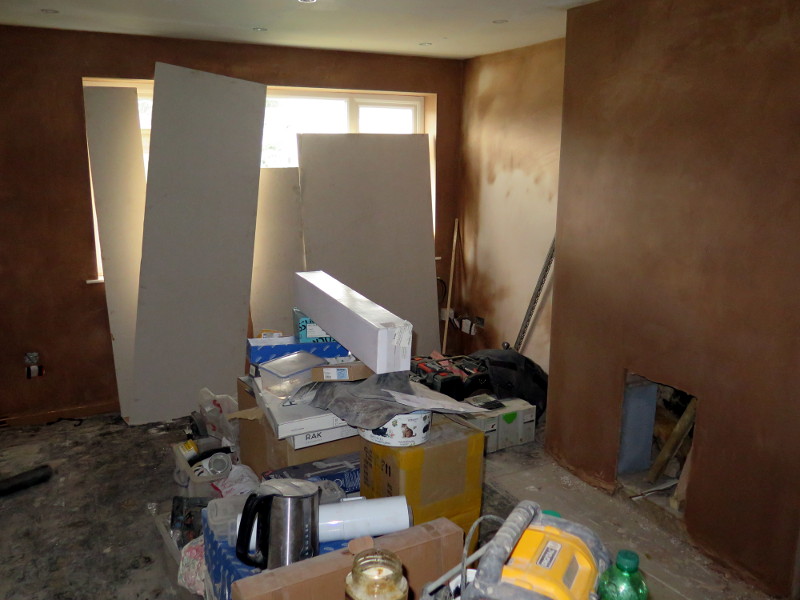
In March 2018 I posted about moving into our new house and adding an extension (‘Our new home in the Cotswolds‘). The building work was disruptive in the extreme, of course. We had to move out for four weeks, and make do with just part of the original space for much longer than that. But it was worth it.
We used to watch TV here!
Ten years ago
Grasshopper landing
In March 2013 I wrote about a TED interview with Elon Musk. Perhaps you haven’t heard of the TED talks, but everybody has heard of Elon. The post is interesting: Musk was already experimentally landing rockets ten years ago, and TED continues to be a great ideas platform. Take a look and explore the links in the original post.
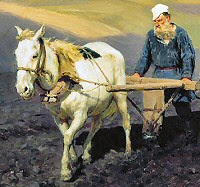
Rachael also shared a picture of an old-fashioned plough making furrows. The soil needs to be churned up and overturned before something new can be grown. There is a necessary process of breaking before the land can be used.
We thought about how Father releases us from ourselves. At the beginning he said, ‘Let there be light’; he still speaks those words into his people today and pours light into the darkest places in our hearts.
Twenty years ago
March 2003, another early blog post about a meeting at home. This time there were only two of us, but we heard such a lot! For example, that the tiny stonecrop, the great cedar, and the mighty oak tree were all planted by Father’s hand. The important thing is not to be big or strong, but to be planted by the master.
Imagine what might happen if we abolished general elections altogether. I invite you to consider the idea of 20% of parliamentary seats coming up for re-election annually, or perhaps 10% every six months.
No system of elections lasts for all time. As society and government change, so too must the system by which members of parliament (MPs) are chosen. There have been many changes over the years, women’s suffrage for example for a large, notable change; alterations to constituency boundaries as an example of minor changes that take place at intervals as thought necessary. And there’s been talk for decades now about proportional representation (PR) of one kind or another. It’s good to talk things over, good to remain open to change.
The House of Commons in division, 2012 – From Wikimedia
There must be a clear reason for any change. Change for change’s sake would be irrational and a waste of resources; change is costly so should come often enough, but not too often. A good place to start thinking about this is to identify issues with the current system and imagine some ways of addressing them. The next step would be to consider the cost effectiveness and drawbacks of those possible approaches.
In this short essay I’d like to think through an alternative to general elections. One disadvantage of a general election is that it may result in no significant change if the existing party and prime minister return to power, or it may cause a huge sea-change of policy and a completely new cabinet when party and prime minister are defeated and a whole, new government comes to power. A by-election, on the other hand, rarely defeats a government, though it may usefully influence policy by making public opinion clearer.
A better approach
Is there some way we could reduce the sometimes damaging flip-flop of U-turn changes of government on the one hand, and the tired persistence of stale policies on the other, while at the same time increasing the effectiveness of public opinion? Yes, I believe there is. It’s been staring us in the face for decades. It’s an idea that deserves attention and some public debate, and now would be as good a time as any to take an initial look.
Just suppose
Imagine what might happen if we abolished general elections altogether. I invite you to consider the idea of 20% of parliamentary seats coming up for re-election annually, or perhaps 10% every six months. MPs would continue to serve a term of five years, as they do at the moment. This would provide local stability in which constituents could become familiar with their local MP just as at present. But it would also provide strong (and useful) public feedback to a sitting government in terms of popularity of policies and personalities.
I favour the 10% every six months approach, or even 5% every three months. It would be a bit like 65 (or 32) by-elections at regular intervals. The period chosen could be still finer at 11 seats per month or, say, 1 or 2 per week. These choices should be debated along with the principle of shifting from the current system to a new method. A system like this could work with or without PR, of course. Personally I favour some form of PR, but it might be wise to keep the debates and the decisions separate from one another, not least to reduce the complexity of any proposed change and to enable a more focussed approach in debate and in any votes taken, either in parliament or by the electorate. There would be many details to be thought through.
Are there any parliaments or similar bodies around the world where a proportion of the seats come up for re-election at intervals? I’m not aware of any, but a system similar to the one I propose here is used for some local authority elections in Britain where a half or one third of the councillors are re-elected each time. So we do have some experience to inform us on how elections of this kind perform and, perhaps, how voter behaviour might change in such a system.
Moving towards a new system
What steps are required and how might this idea be taken forward?
Clearly, there would need to be a good deal of debate first. What would be the best choice of frequency at which a proportion of seats should be re-elected? How might we choose the seats? What advantages and disadvantages might we foresee for the new system, and how would it compare with the current arrangement of General Elections every five years?
My suggestion, already mentioned, would be to go for small changes at frequent intervals. This would involve more modest and less disruptive changes at Cabinet level for example, with just a few members of the cabinet facing an election each time. Sixty-five seats would be up for re-election every six months, or thirty-two every three months. Frequent elections would provide finer-grained but less disruptive changes in Parliament. Voters would be able to apply only gentle pressure to a governing party, but it would be pressure reapplied quite often. The government of the day would need to ensure voters remained content with their policies.
Seats for re-election could be chosen randomly or in some other way that would be easy to decide (but not favour a particular political party or region). So in one tranche, thirty-two seats would be re-elected and six months later a further thirty-two. Five years later the same tranches would come up once again.
Once all the ideas and issues had been carefully considered, recommendations could be made and a bill written and presented for debate. Like any other bill this would need approval from the Commons and the Lords.
How to make the change from the current system of General Elections to the new arrangement would also need a good deal of thought and debate. Many seats would have to come up for re-election earlier or later than normal. It might be possible for an intial batch of seats to be re-elected after four and a half years and another batch after five and a half with the bulk remaining at five years. Then at a later General Election these seats could shift by a further six months and two more tranches brought in so that gradually, General Elections would become smaller and smaller as a larger proportion of seats shifted to the new system.
Initial steps
I think I’ve gone into enough detail for the time being. I’d like to see a wider debate on this with plenty of thoughts and opinions from others. I’ll do what I can to get that started. Meanwhile, if you’d like to comment on this article please do; I’d love to hear what you think.
The crescent Moon shines out in the evening of 23rd February, but there are three solar system objects in this image. After the Sun, the Moon is the second brightest object in Earth’s night sky.
The third and fourth brightest objects in our sky are present in this image. Can you see them? I doubt it, they are lost in the remaining glow of the sun as it sets. But if you know exactly where to look, you might see them.
The Moon and a couple of other things
Let’s zoom in a little, that always helps…
Can you see them now?
So, did you see them? No? They are there in plain view, but congratulations if you spotted them, it’s still not easy.
The third brightest object in our night sky is Venus, and you can see it near the bottom right corner of the photo – a little white dot. The fourth brightest object is Jupiter. It’s there to see as well, between the Moon and Venus, but a bit closer to Venus than to the Moon. See it now? (If you’re reading this on your phone you will need to enlarge the image.)
Later in the evening they are impossible to miss. The Moon is moving further away from this scene day by day, but Venus and Jupiter are getting closer to one another in the sky and are both very bright in a darker sky. Jupiter is also getting closer to the horizon and setting earlier and earlier as the days pass so if you want to see it, look in the next day or two. In April Jupiter will reappear in the morning sky before sunrise.
See also:
Watch Dr Becky’s Night Sky video segment for more detail (better yet, watch her entire video).
And for more detail on the three objects, take a look at Wikipedia’s articles on The Moon, Venus and Jupiter.
Have we come to a time when the church is perfect and is missing nothing? I don’t think so! What fresh revelation will be next?
In a recent, very brief conversation on Twitter I suggested that something was ‘ground breaking’. Specifically it concerned some ideas about following Jesus, and whether one particular idea was ground breaking.
Thinking about this afterwards I realised that a useful conversation requires that we agree on what we mean by ‘ground breaking’ in the context of the lives and activities of believers interacting together in groups.
Arguably, ‘ground breaking’ might originally be a farming or growing term. Before taking a harvest, it’s necessary to plant seeds in fertile soil, get them to germinate, and wait for them to grow. The farmer has much to do during that process, but the very first requirement is to do some ground breaking. Turning the soil with a plough (or a spade) loosens it, damages any weeds growing there, makes it easier to sow seed, and enables water and air to penetrate (both are needed). A bit of ground breaking can work wonders!
Jesus, ground breaker par excellence
In one sense of course, Jesus did all the ground breaking that could possibly be needed in church life. He only did what he saw his Father do, and only said what he heard his Father say. And he told his followers, ‘My Father is a gardener’. He also told a striking parable about seed falling in different places, including well prepared soil as well as several kinds of unprepared, unsuitable, or poorly prepared ground.
His is a foundational kind of ground breaking that we cannot and do not need to repeat. But there’s something else I would call ground breaking; something that happens every time principles, knowledge, or behaviour that the church has forgotten is restored. It’s happened over and over again.
Lesser ground breakings
One relatively recent example would be the spiritual revival that took place in the 1960s and 70s. I’m old enough to remember the excitement of discovering two things in those days. The understanding that the Holy Spirit poured out gifts on his people and wanted us to put them to use, and the idea that small groups meeting outside the denominations were capable of rapid and dynamic growth. They were exciting times. Out of this sprang three phenomena that are still with us today; multiple streams of new organisations like New Frontiers, New Wine, and many more; a re-invigoration of parts of most denominations, Anglican, Baptist, Methodist, Catholic and more; and thirdly the house church movement based around small, intimate groups of friends.
Going back a little we can see that the Azusa Street events were ground breaking in the same sense and resulted in the two main streams of Pentecostal churches.
Before that we might identify the Welsh revival when a new sense of unworthiness and Father’s forgiveness resulted in large numbers of people praising and worshipping, encouraging one another, and preaching to their neighbours in towns and villages. Before that the Wesleys and Methodism flourished and it was understood that small groups can be a powerful way for people to grow and develop together. And there are many more ground breaking events like these right back through the centuries.
When I talk about ground breaking I definitely include developments like these, discoveries that there was, in the earliest state of the church, some other element of following Jesus which has since fallen into disuse or even faded from memory entirely. Rediscovering how things used to be and might be again is ground breaking in this lesser sense.
New, vigorous growth
Such freshly re-broken ground almost always seems to result in new, vigorous growth where previously things had become somewhat tired and wooden. Think in terms of a neglected, weak, dehydrated plant that has just been potted up with fresh compost, is being watered regularly, and now stands in a new spot where there is fresh air, adequate humidity, and plenty of light. A plant like that will put on a sudden spurt of growth, form new shoots and leaves, and perhaps flower for the first time in ages.
We need to see more ground being rebroken and experience that fresh flush of growth and energy again and again. Have we come to a time when the church is perfect and is missing nothing? I don’t think so! What fresh revelation will be next?
Note: Ground breaking can also mean a ceremonial turning of soil at the start of a construction project. It can be instructive to think of Jesus’ work as the start of a building project – the New Jerusalem, which is the church (see Revelation 21:9-10). But that’s a whole topic on its own.
For this first flight both parts of the vehicle will be lost after landing on the sea (but hopefully not before)
Elon Musk’s company, SpaceX, is close to the first launch of their new spacecraft – Starship. This is an exciting step forward in space flight technology as fully reusable Starship versions are planned to return NASA astronauts to the moon, act as orbital fuel tankers, take people and materials to destinations throughout the solar system, and colonise Mars.
The world’s most powerful rocket is likely to make its first orbital flight attempt during March. Whatever happens, the attempt will be spectacular in the extreme! With twice the thrust of NASA’s SLS rocket, SpaceX’s Super Heavy booster will attempt a launch from Starbase on the Texas coast, heading east. The Starship will separate and pass between Florida and Cuba.
The Super Heavy booster will attempt a landing on the surface of the sea, offshore of its launch point. When fully operational, SpaceX intends that Super Heavy boosters will return to the launch site to be caught in mid-air by arms on the launch tower. Starship will attempt a landing, also on the sea surface, north of Hawaii, but again, the intention is to eventually catch Starship at the launch site as well.
For this first flight both parts of the vehicle will be lost after landing on the sea (but hopefully not before). It’s likely they will attempt to hover above the sea surface to practice the manoeuvre they will need to perform for a catch. Once landing precision is good enough, SpaceX will attempt the first catches. But that’s something for future flights and will depend on data returned from this first attempt. You can’t put a note in your diary to watch the launch as we don’t yet know exactly when it will happen. But I’ll keep you posted here on JHM.
The previous step forward for Starship was a static fire by the Super Heavy booster on 9th February. This is worth watching in this video clip from NASA. Thirty-one of the booster’s thirty-three engines fired for the duration of the test, one was not ignited at all, and one shut down early. The engines fired at half thrust during the test, but for the first launch they’ll be run at 90% thrust.
See also:
The SpaceX website carries an introduction to the concept of the Starship system.
The launch is listed on Spaceflight Now’s Launch Schedule page and on Next Spaceflight’s SpaceX Launch Manifest page. You can check those sources for schedule updates as they become available.
Wikipedia has a good article about the Starship vehicle covering details of size, thrust, the development process, purpose, capabilities and so on.