Arresting Jesus

John knew Peter well, they’d been around the entire time of Jesus’ teaching of the twelve, and perhaps they’d known one another for years before Jesus came on the scene, both families lived by fishing on Galilee, they were both called by Jesus to follow.

Greek commentary on John’s gospel dated 1190-1200 (Bodleian Library)

< Previous | Index | Next >

Cruising the gospel – John 18:1-40

Bible text – Read it yourself (opens in a new tab)

Arresting Jesus

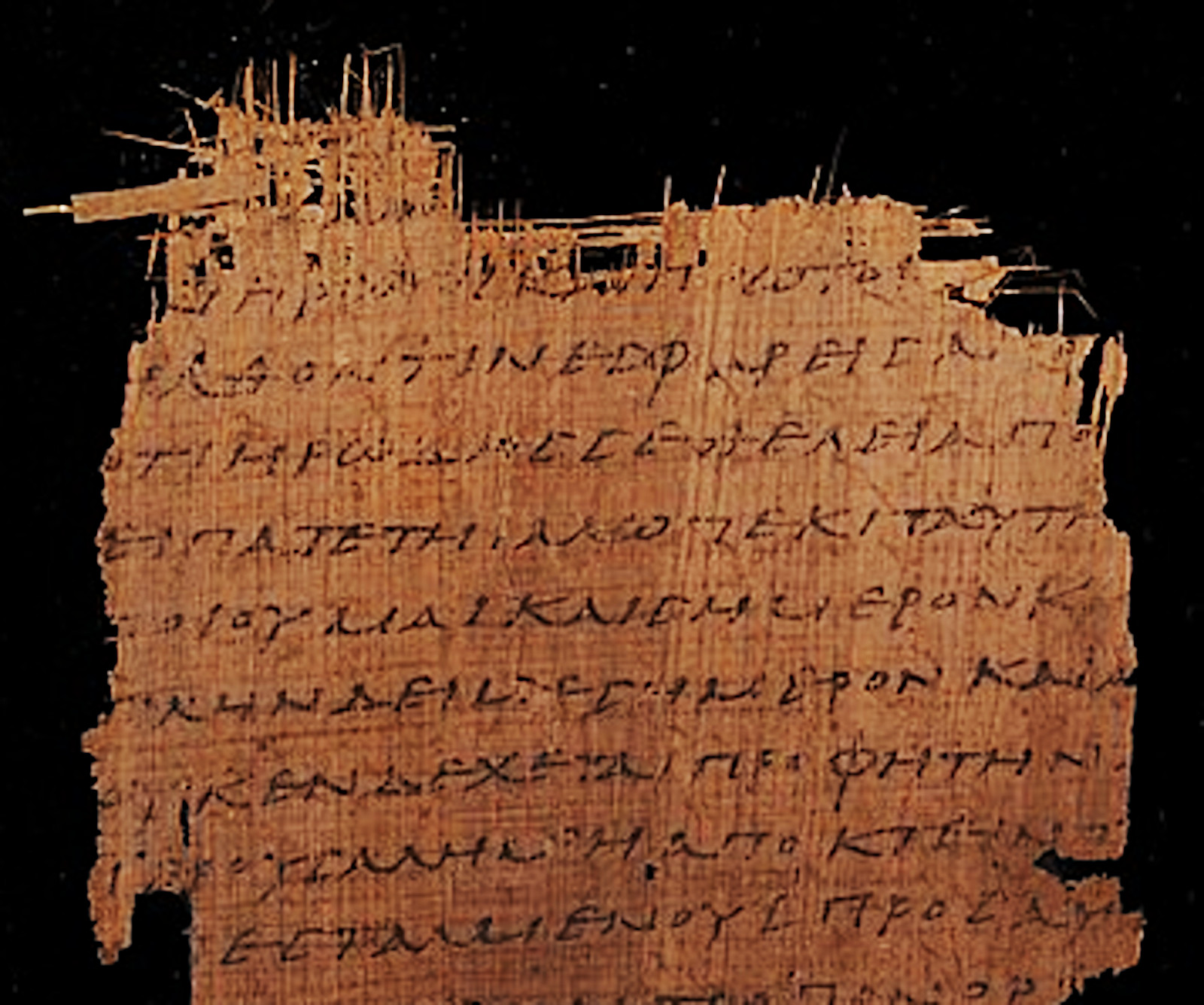
A fragment of John’s gospel
(Wikimedia)

18:1-14 – Jesus and his disciples left the upper room and walked out of the city, presumably by a southern gate. They crossed the Kidron Valley and entered the garden of Gethsemene (from ‘gath’ meaning a press, and ‘Shemanim’ meaning oils). It was a place where olive trees grew and where the harvested olives were pressed to release the oil. ‘Garden’ does not imply decorative plants and flowers as we would think of a garden today. It was just the term for an enclosed agricultural space, a ‘garth’ or ‘gard’ with a wall around it to ‘guard’ it. Jesus and his followers often met here, and Judas was well aware of that fact.

Judas arrived outside the enclosure, followed by a group of soldiers (presumably Romans) as well as a group of Pharisees and some staff of the High Priest. Jesus left the walled enclosure and asked them who they were looking for, and they answered ‘Jesus of Nazareth’.

Jesus told them, ‘I am he’. And they stepped back and fell to the ground. ‘I am’ in Hebrew and in Aramaic sounds rather like ‘Yahweh’, the Holy Name that nobody was allowed to utter. This would have profoundly shocked the Pharisees and the High Priest’s staff. He asked them again, ‘Who are you looking for?’ Again they answered, ‘Jesus of Nazareth’. And he told them again, ‘I am he, so let these others leave’. Peter had a sword and struck out at Malthus, the High Priest’s servant, cutting off his ear lobe. Jesus told Peter to put the sword away. The Roman soldiers under their commander, and the Jewish officials accompanying them, arrested Jesus and tied his arms, probably behind his back, then took him to Annas, once High Priest, father-in-law of Caiaphas, the current High Priest. Annas asked questions about Jesus’ followers and about doctrinal matters and then sent him on to Caiaphas.

Peter’s denials

18:15-26 – Peter and one other disciple followed Jesus and the group who’d arrested him (bravely under the circumstances). There’s been some debate about the ‘other’ disciple. It might have been John, or Nicodemus, or Joseph of Arimathea, or possibly even the traitor, Judas. (Read some aspects of the debate for yourself.)

This other disciple made it possible for Peter to enter the home of Annas where there were some questions being asked of Jesus. So which of those characters mentioned above would most want Peter to hear that questioning and Jesus’ answers? Think about that for a moment. John knew Peter well, they’d been around the entire time of Jesus’ teaching of the twelve, and perhaps they’d known one another for years before Jesus came on the scene, both families lived by fishing on Galilee, they were both called by Jesus to follow. Peter was a man of action, he’d proved it once again by using his sword that very evening!

Annas questioned Jesus about his disciples and about his teaching (verse 19). Jesus often taught to crowds (you can’t get more public than that) and replied that he always taught in public in synagogues, or even the Temple courts. He didn’t teach in secret. Annas could learn about Jesus’ teaching from any of his many listeners. That remark drew an abusive slap in the face from one of the Jewish officials. Peter and the other disciple heard and saw all this. At this point Annas sent Jesus, still tied up, to Caiaphas.

And Peter denied being one of Jesus’ disciples for the second and third times. How did all this affect Peter? I’d suggest seeing and hearing the interrogation and the angry slap and recognising his own failure in denying he was a disciple all helped to stir Peter up and ready him for action. Frustration, helplessness, anger and guilt are a heady mix for anyone with a habit of activity. And I submit that John, knowing Peter as he did, would have expected that. I think John also understood that a time for action was coming very soon.

With Caiaphas

Although John doesn’t record the interaction between Jesus and Caiaphas, we can fill the gap a little from other sources, read Matthew 26 for example.

After the resurrection of Lazarus, Caiaphas had told the Sanhedrin that it would be better for one man to die for the people, than that the whole nation should perish. He was worried that the Romans would lose patience and intervene militarily.

And during Jesus trial before the Sanhedrin, Caiaphas directly questioned Jesus, demanding a clear answer on his identity: ‘I demand you tell us whether you are the Christ, the Son of God’. Jesus did not give a direct answer, but what he said was regarded as blasphemy and the Sanhedrin condemned him.

The Roman governor, Marcus Pontius Pilatus

Caiaphas and the Sanhedrin wanted the death penalty for Jesus, but only the Roman governor could provide such a sentence, so Caiaphas sent him on for a third hearing.

Pilate was not interested in religion, only in politics, so his first question was about Jesus’ kingship. Jesus explained that he hadn’t come to rule, but to testify to the truth. Pilate’s concern was not truth, either, but still only politics, so he went back outside to the waiting Jewish delegation and told them he didn’t find Jesus guilty of anything. But the custom is that at Passover time I release someone from captivity for you. I can release Jesus for you if you wish. ‘No’, they shouted back, ‘Not Jesus, release the agitator and rebel, Bar Abbas. This Aramaic name means, quite literally, ‘Son of the father’. This is striking indeed as Jesus is the true ‘Son of the Father’. Jesus was known in Galilee as ‘Yeshua bar Yoseph’, Jesus son of Joseph, but he was truly ‘Yeshua bar Abba’, Jesus son of the Father. The Jewish leaders were choosing the wrong man, but also the Wrong Father!

See also:

< Previous | Index | Next >

Useful? Interesting?

If you enjoyed this or found it useful, please like, comment, and share below. (If you don’t see those links, click the article’s title above the main photo and they will appear.) Send a link to friends who might enjoy the article or benefit from it – Thanks! My material is free to reuse (see conditions), but a coffee is always welcome and encourages me to write more often!

You might also like:

John 15:9-17 – Love and fruit

This joyful, loving relationship we have with Jesus is so important. In these verses Jesus stresses it by repetition. He wants to see joyfulness in our lives, he wants his joy to find a welcome in our lives.

< Previous | Index | Next >

Bible text – Read it yourself (opens in a new tab)

A fragment of John’s gospel
(Wikimedia)

At this point Jesus begins talking about love. It always helps, when explaining something, to have an illustration or example; Jesus needs an example of his love for his followers, so he says, ‘I’ve loved you the same way the Father has loved me’. There’s such a lot in that simple statement!

But the disciples had evidence of the Father’s love for the Son going far beyond words alone; the love was affirmed by powerful action. They had seen the sick being healed, the dead raised to life and evil spirits thrown out. Oh yes, he had the affection of the Father, and now Jesus tells them that he loves them like that, too! Notice how remaining in the love depends on obeying the commands. It’s not that the love is taken away in the absence of obedience, but the absence of obedience is the same thing as walking away from the source of the love. So his followers have a part to play as well, they are to ‘Stay in his love’. They are to stay close, not wander off but to stay in that place of affection.

It begins and ends with love

This joyful, loving relationship we have with Jesus is so important. In these verses Jesus stresses it by repetition. He wants to see joyfulness in our lives, he wants his joy to find a welcome in our lives. He’s explained this clearly and now, in verse 12 he shows how simple it is. The command that must be obeyed if we are to remain in him and his joy in us is not hard and it’s not complicated or demanding – just love one another, please!

And the greatest and fullest love imaginable is to be more concerned for one another than for our own existence! In verses 14 and 15 Jesus brings us right back to the need for obedience yet again, and it’s not an obedience like that of servants or slaves. We are fully informed, he calls the disciples (and us) his friends, not his servants. Our place is not to serve Christ, but to be his friends. I’m sure you appreciate the difference. We’re helping out one of our mates, not scraping and bowing to an imperial boss!

Getting the job done

Sometimes we are told that people in the world need to ‘choose Christ’, that they need to ‘make a decision for Christ’. Yet Jesus clearly sees it very differently, he tells us here that he chooses us, not the other way around. We are right to share the good news about Jesus, to explain to people that peace and joy and freedom are found in him. But we don’t need to persuade people to make a choice. Jesus makes the choice. We never, never need to browbeat anyone, our task is just to introduce one of our friends. Hey, this is Jesus, say ‘Hi’ to the best friend I have, he’d like to get to know you better.

We do have a job though, and introducing Jesus might well be an important part of it. We were chosen to bear lasting fruit, and if we ask Papa for something, he’ll provide it. He’s always willing because he sees us as one of his Son’s friends – he loves the Son and he loves his Son’s willing mates and helpers. It’s all about relationship, is it not? What we do counts for little, who we are counts for everything! Without Jesus I can do – nothing! But I can do everything in Christ.

And finally, Jesus reminds them one more time, ‘Love one another’. He knows how easily we forget!

< Previous | Index | Next >

Useful? Interesting?

If you enjoyed this or found it useful, please like, comment, and share below. (If you don’t see those links, click the article’s title above the main photo and they will appear.) Send a link to friends who might enjoy the article or benefit from it – Thanks! My material is free to reuse (see conditions), but a coffee is always welcome and encourages me to write more often!

John 15:1-8 – Vine and branches

If you prune a vine wisely it becomes more vigorous and more fruitful; that’s true of all kinds of fruit tree too.

< Previous | Index | Next >

Bible text – Read it yourself (opens in a new tab)

A fragment of John’s gospel (Wikimedia)

Jesus has been talking to his closest followers, the small group of twelve who were travelling with him. Now he begins to use the idea of a vine. Remember that everyone in Israel would have known what a grapevine is like, they were widely grown and wine was an important item in ceremonies as well as in ordinary life. It was essential in weddings, in the passover meal and so forth.

He now makes a strange claim, he says that he himself is a vine. Not only that, but he is the true vine. And he mentions that his Father is the gardener, though we shouldn’t think in terms of someone who looks after fruit, flowers and vegetables in the way we would today. Israel is the old vineyard, and Father is much more than just an employed labourer, he is the vineyard owner. The old vineyard (Israel) has not been fruitful. Jesus is a new vine and his Father will prune the branches to make him more fruitful. If you prune a vine wisely it becomes more vigorous and more fruitful; that’s true of all kinds of fruit tree too, anyone who manages an orchard will tell you that ageing trees fruit less but can be reinvigorated by good pruning. Old or diseased branches need to be removed and the others cut back to a strong, healthy bud.

And Jesus goes on to tell his followers, ‘You are the branches’! Who are his followers? Two thousand years ago they were the twelve disciples who followed him everywhere and were hungry to hear whatever he had to say. Today the things that he said to them, apply to us also. We are his branches, we are attached to him.

A two-way relationship

Notice that this is a two-way relationship. Jesus says we’ll be very fruitful if we remain in him and he remains in us. And notice too that it’s an all or nothing relationship; we’ll either be very fruitful or we can do nothing. There’s no option that makes us partly fruitful, or reasonably fruitful, fruitful in some things but not in others. We are fully in; or we are fully out. You will be precious and treasured, or you will be trash. So which will you choose? Will you be attached to the one true vine, or will you be disconnected?

And in verse seven we learn that if we remain in him and his words remain in us, we can ask anything we wish and it will be done for us! We need to be careful here, though. Jesus is not telling us that we can ask for things that are not in his will and purpose. He expects us to know we can ask anything in his Name and receive it. There’s no point in asking for something that will harm or destroy your enemies, for example, because Jesus made it clear that we are to love our enemy. If I ask for wrong things, I am not remaining in him and his word is not remaining in me.

While the nails were being driven through him into the cross, Jesus asked for something. He said, ‘Father forgive them, they have no idea what they’re doing’. Was that prayer answered? You bet it was. It’s a tremendous example of loving your enemy, isn’t it! Maybe one of those Romans was the one who later said, ‘Truly this man was the Son of God’.

Glorifying the Father

Finally, in verse eight we see the purpose of it all. It’s not about us at all. It’s not even about Jesus. It’s about the Father! Being very fruitful, and showing ourselves to be followers of Jesus, simply brings glory to the person who truly deserves it and should always receive it – the Father.

Our Father, who is far beyond our reach, let your Name be utterly holy, may Your will and purpose be done here on Earth, just as it is in Your dwelling place.

< Previous | Index | Next >

Useful? Interesting?

If you enjoyed this or found it useful, please like, comment, and share below. (If you don’t see those links, click the article’s title above the main photo and they will appear.) Send a link to friends who might enjoy the article or benefit from it – Thanks! My material is free to reuse (see conditions), but a coffee is always welcome and encourages me to write more often!

Revising ‘Cruising the Gospel’

The four gospels are special: they, together with the rest of the New Testament, tell us all we need to know about Jesus

I’ve decided on the future direction of my website, ‘Cruising the Gospel’. I had intended to move the posts to JHM and close the old site; but it still has a useful function so I’ll update it instead and cross post to JHM.

A long time ago (August 2013) I began a new project which I called ‘Cruising the Gospel’ (CTG). I wanted to encourage people to read through the four gospels on a steady, rolling basis. Matthew, Mark, Luke and John are the four New Testament books that record what Jesus did and said during the last few years of his life on earth. We should read every part of the Bible, of course, all of it is useful, informative and helpful although some parts may seem quite difficult too.

But the four gospels are special: they, together with the rest of the New Testament, tell us all we need to know about Jesus – who he is, what he did and said, how we can understand him, how he will influence and shape our own lives if we will allow him, and why we should pay attention to him in the first place.

So my argument, and that of others too, is that we should form a habit of continually reading and re-reading these four books in particular. I call that ‘cruising the gospel’ and began to create a resource to help people do it. The website is still there online, almost three quarters complete. It needs updating, editing and finishing. Take a look at Cruising the Gospel (CTG) for yourself.

Moving it to JHM (or not)

I decided the best thing would be to migrate the material to ‘Journeys of Heart and Mind’ (JHM), and I began that task a while ago. But it quickly became clear this was not the best idea because the convenience and flow of the old site was getting lost as I merged the posts into JHM.

Instead, I’ve migrated the index to JHM and adjusted the links on the old site so everything can be browsed from the new index. That gives readers the opportunity to see each post as an individual article, but also use all existing articles as a reading guide should they wish to do so. I think it’s the best of both worlds.

It took a long time to get this organised and running smoothly, but it’s all running smoothly now. I urge you to try it for yourself, read a little bit each day. Don’t rely on my ideas expressed on CTG, they are intended to get you thinking about it for yourself. And most important of all – wait for the Holy Spirit to guide you personally as you read. Whenever you have useful thoughts or insights, leave them as comments to encourage others.

Here’s a recent post in the series, use the ‘< Previous | Index | Next >’ links in that article to see the rest.

Useful? Interesting?

If you enjoyed this or found it useful, please like, comment, and share below. (If you don’t see those links, click the article’s title above the main photo and they will appear.) Send a link to friends who might enjoy the article or benefit from it – Thanks! My material is free to reuse (see conditions), but a coffee is always welcome and encourages me to write more often!

John 14:22-31 – Not to the world?

[Jesus] took on our limitations so that he could reach us on our level, in ways we can understand.

< Previous | Index | Next >

Bible text – Read it yourself (opens in a new tab)

A fragment of John’s gospel (Wikimedia)

‘Why are you showing yourself to us, but not to the world?’ This is such an interesting question, it’s also a natural question. Judas (not Iscariot) wants to know why Jesus shows himself to the twelve, but not to the world. The question suggests it’s Jesus’ choice to hide himself from most people but show himself to a few. Judas is right to find this strange! But it’s not what Jesus has in mind.

In verse 23, he responds by saying that for everyone who loves him, he and the Father will come and make their home in that person. In other words, it’s not just for the twelve, but for anyone in the world who loves Jesus. Or to put it another way, the answer is that he will reveal himself to anyone – if they love him. He doesn’t hide from anybody, but those who don’t love him can never truly see him.

Short of time

Jesus needs to wind the conversation up because he knows what will happen next. He reminds them again of the promised Spirit and tells them that he and his Father will live within them; and the Spirit will teach them and remind them of everything they need to know. He also promises to leave his peace with them, and tells them not to worry or be afraid. This seems to me particularly striking when you consider what Jesus is about to go through at the hands of the Sanhedrin and the Roman governor.

And finally, in verses 28 to 31, he reminds them that he’s going to the Father who is greater than he is, and they will be glad (once they understand the significance of this). So, in what way is the Father greater than the Son? Does this idea even make any sense when we know that Father, Son and Spirit are co-equal within the structure we call ‘trinity’, the three in oneness that they share together? Perhaps the answer is simply that Jesus has limited himself within a human body in order to reach us in this world. For more than 30 years he has remained limited, but in returning to the Father he will regain the ability to be present everywhere at every moment of time with all of his people. In his human body he is inevitably less powerful than the Father, only able to act in the one place and time where he finds himself. He took on our limitations so that he could reach us on our level, in ways we can understand. That time is coming to an end as he returns to the Father.

Time’s up

And then they leave, and the final act will open.

< Previous | Index | Next >

Useful? Interesting?

If you enjoyed this or found it useful, please like, comment, and share below. (If you don’t see those links, click the article’s title above the main photo and they will appear.) Send a link to friends who might enjoy the article or benefit from it – Thanks! My material is free to reuse (see conditions), but a coffee is always welcome and encourages me to write more often!