What was happening on the blog in past Februaries?
Five years ago
I didn’t write any blog posts in February 2018, so here’s a photo instead. Donna’s father, Tony, was 80 on 1st of the month; we drove down to Broadstone near the south coast of Dorset to meet the rest of the family. He was very pleased with his cake, though there were only eight candles on it. Eighty would have needed ten times the effort to blow out!
How should we manage and govern our meetings? How is church to be led? Everything changed in the 1960s and 70s as the Holy Spirit swept into the denominational church. Existing churches were impacted, the house church movement began, and new streams of church sprang up.
Read it if you’d like to, but also read the comments where some very good points are made.
Twenty years ago
On the 18th February 2003, I met at home with friends and the Holy Spirit spoke to us about walls being broken down. We heard about other related things too. The notes from the meeting outline what happened.
Now Yahweh says something strange to Ezekiel. He tells Ezekiel to speak to the bones, to prophecy to them. Is there any purpose in speaking to what is dead? Let’s look carefully at Ezekiel 37:4.
Then he told me, ‘Prophecy to these bones. Tell them, “Dry bones! Hear Yahweh’s word.”‘
There are several important points to notice. If Ezekiel hadn’t understood these points the amazing things that are about to happen would not have happened. At least, they wouldn’t have happened through Ezekiel. Yahweh would have found another way, another person to serve him; Ezekiel would have missed out. Hearing is important, and the mechanism for hearing is complex.
1 – Listen and speak
Yahweh spoke to Ezekiel. Ezekiel listened so that he could pass on what he had received. This is the place where we often go wrong. We see a need and we act to meet it, we say what we think best, we do what we think best.
It’s good that we want to communicate and act, but it’s not good when we ourselves decide what to say and what to do. Even Yahshua (Jesus) didn’t do this, he set us a good example, he said only what he heard the Father say (John 12:49-50), he did only what he saw the Father do (John 5:19). If we don’t get this first step right we become unusable, no good for the eternal purposes of the Most High. Listen first. That’s what Ezekiel did and so should we.
2 – It may not make much sense
‘Prophecy to these bones’, says Yahweh. Put yourself in Ezekiel’s place, try to imagine it. Bones are not animate objects. At one time they were but now they are not. Here’s a conversation that didn’t take place – but it might have done. If Ezekiel had been like me it probably would have gone something along these lines…
Yahweh: ‘Listen to me carefully.’ – Ezekiel: ‘Yes, Lord. I’m listening.’
Yahweh: ‘I want you to talk to those bones over there, I want you to tell them that..’ – Ezekiel: ‘Wait, wait, wait. I must be hearing wrong, Lord. You want me to talk to who?’
Yahweh: ‘Not who, what. I want you to talk to the bones’. – Ezekiel: ‘No, Lord.’
Yahweh: ‘No? What do you mean – no?’ – Ezekiel: ‘Er.. No ears, Lord. I mean the bones can’t hear, they have no ears. They won’t hear me.’
Yahweh: ‘I’ll deal with that, you just get on and prophecy, OK?’ – Ezekiel: ‘But my friends will think I’m stupid.’ – Yahweh: ‘And your point is?’
Yahweh: ‘You’re wasting time here, Ezekiel. I need a job done and I need it to be done right away. I’ll find someone else.’ – Ezekiel: ‘No, no. I’ll do it. I’ll talk to the bones. Can I use a really quiet voice, Lord?’
Yahweh: ‘I need a very loud voice for this job. If you’re speaking to dry bones you have to speak up.’ – Ezekiel: ‘But, Lord, I have no idea what to say.’
Yahweh: ‘Might that be because I haven’ t told you yet? Hmm? You must command them to hear me, even though they have no ears.’ – Ezekiel: ‘OK-a-a-a-a-y’
Before Ezekiel can give the message to the bones, he must command them to hear. Assuming we can get past steps 1 and 2, this third step is something we often miss out. Before giving the message we need to command the deaf to hear. This is a step of preparation. It may require months or even years of prayer. It may mean demanding to be heard over and over and over again. It may mean criticism and derision and even facing serious abuse. But it needs to be done. There are no short cuts in hearing and speaking, seeing and doing.
Will we be like Ezekiel? Will we be unwavering in our obedience even if we appear foolish or unpopular or at risk? And is it worthwhile speaking to something that’s dead? Yes! Lazarus was dead, Yahshua spoke to him, and he came out of the grave.
I sum these topics up on my Twitter profile as biology, web, science, technology, family, faith, history, and travel.
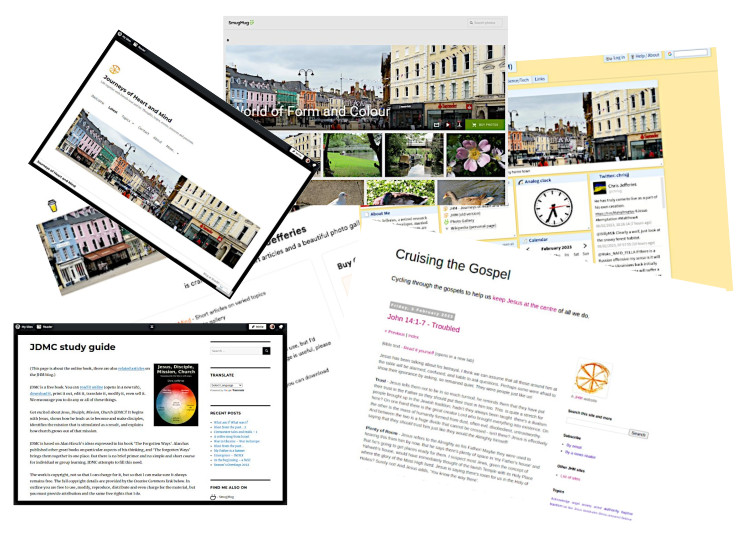
Having recently restarted blogging after a long pause, I’ve been thinking through how best to move forward – what should I change, what should I drop, and what should I keep?
Today’s post explains some of this, I’ll share what I’m doing and what I plan to do next. I’ll consider any comments you may leave, either here on the blog, or on Twitter or Facebook. But here’s how I see things right now.
Buy me a coffee
I’m offering everything I publish for free, but will always be delighted to receive a small gift, especially if you have sold or republished something (though even then it’s optional). Details are at coffee.scilla.org.uk .
Cruising the Gospel
This is a moribund blog that I’m in the process of restarting. I’m not sure yet whether to continue it in its present form, or to roll it into Journeys of Heart and Mind (JHM) as a topic in its own right. Currently I’m inclined to keep it as it is, and perhaps generate some PDFs from each book I complete. See it at gospel.scilla.org.uk .
Gateway
My Gateway site is mainly for my own use, but it’s full of links about Cirencester (my home town in England), local time and weather, some Christian links, local and national news, science and technology links and so forth. Some of you might like to take a peek. If so, head to gate.scilla.org.uk .
JDMC
JDMC stands for Jesus, Disciple, Mission, Church and is an introduction to Alan Hirsch’s Forgotten Ways. To learn more and download a copy to print (or read online), visit jdmc.scilla.org.uk . I need to update this booklet and plan to when I have time, unfortunately the web links in the PDF open OK, but using the browser to return take you back to the title page; I’ve been unable to fix this so far. If you open the links in a new tab you’ll be OK, but it’s easy to forget.
Journeys of Heart and mind
I intend to continue with this more or less as it stands. That means a mix of topics will appear here, articles about all of the things that motivate me as they occur to me (so in no particular order). I sum these topics up on my Twitter profile as biology, web, science, technology, family, faith, history, and travel. Others include photography, astronomy, spaceflight, archaeology and a few more. One thing I will add is a way of seeing just posts on one of these topics at a time, I think that will be useful; not everyone wants to see everything. You’re reading on this site at the moment.
Photos
I use Smugmug to display my photos and will continue with this, but I need to rearrange things in topic folders to make it more usable. Visit photos.scilla.org.uk to browse my all time favourites.
Twitter
My main Twitter account is ChrisJJ, but I have a second account, JHM. I haven’t used the JHM account for a long while, but might post tweets about faith topics there, and everything else on ChrisJJ. My mind is far from made up on this as there are quite a few pros and cons.
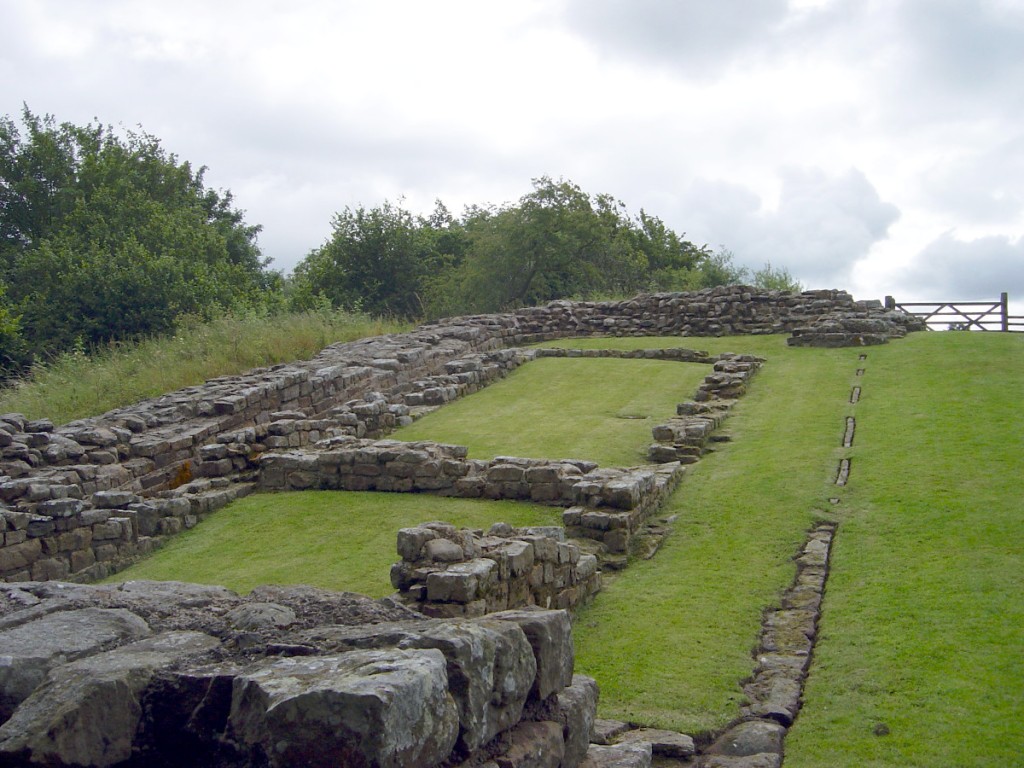
The stonework to turn doorways into windows suggests a change of use at some time after the building was first erected
This dilapidated, old building, of lovely Cotswold limestone (including the roof) stands inside Cirencester Park at the end of Barton Lane. It’s part of The Barton Farm, along with the ancient nearby dovecote and magnificent, old barn.
But what was its original purpose? If it could speak it would no doubt have an interesting tale to tell. What might it say?
A row of cottages
I was row of cottages, full of the sounds of children playing in the sunshine, chopping and stirring sounds from a kitchen table indoors, smoke rising into the air from my chimneys. How many families lived in me? How many were born here, lived and worked here, died here?
Stables
I was a row of stables, my partly built up doorways were once open and inside each one was a stall for a horse. Inside I would have smelled of horses, sweat, droppings, and in a room at the back I would have had the aroma of well cared-for leather – saddles, harness, heavy collars for pulling.
Storage shed
I was a place where valuable implements were stored and cared for. Oiled steel hoes, shovels, spades and rakes with well-worn wooden handles. An old plough, a harrow, scythes. Or perhaps I was used to store fruit from the orchard, and sacks of seed for sowing crops in winter or spring.
A base for farm workers
I was a bothy where the farm workers would gather to eat bread and cheese and perhaps a mug of cider. I’d be used for breakfast, a mid morning break, or a mug of hot tea on a cold afternoon, a shelter from heavy rain. Perhaps there was banter, silly tasks given to the youngest worker, ‘Go and fetch me the glass hammer from the big house, ask the Master for it – politely like’.
There are some clues
The stonework to turn doorways into windows suggests a change of use at some time after the building was first erected. There are two brick chimneys, so clearly there were regular fires. Maybe the far end was a dwelling while the right end was a workshop, or a smithy, or a place for basket-making, or laundry.
If you have other thoughts on what this place might once have been, or you live locally and know for sure, why not leave a comment?
Here’s another blast from the past. What can we find as we look through earlier January posts?
Five years ago
In January 2018 I wrote about eating together and how the early church had no ceremony like our communion service. And I quoted from Victor Choudherie who urges us to ‘promote breaking of bread with simple Agape meals (love feasts) from house to house, that believers take with glad hearts’.
In January 2013 there was a hard frost in St Neots where I lived at the time. Within four days, the ice and snow had gone and early hints of the coming spring had appeared. How fast things can change!