The truth is the truth

Unexpected results are always disappointing and sometimes very harmful

Let’s talk about truth.

Truth is like the stars in the sky above, sometimes cloudy skies hide the stars from view, but we know they’re still there. And when the clouds move away we see them clearly again, they remain the same, the constellations are still recognisable. It’s possible to navigate by the stars, they are dependable and reliable.

Truth is reliable too; when we navigate according to the truth our decisions and choices will produce the expected results. If we are fed untruth, our choices will produce unexpected results. And unexpected results are always disappointing and sometimes very harmful – to us and to others.

In this world we are surrounded by a great deal of untruth. It puzzles me that so many people assume that misinformation will result in good choices. We see it everywhere – in politics, in business, in warfare, in daily life. Let’s look at a few examples:

  • Russia’s war in Ukraine – From the very beginning truth has been discarded. Russian leaders have deliberately ‘adjusted’ history, results of battles, and their motives. Perhaps they believe their own claims! So many decisions on goals, strategy and tactics have been based on untruth and the disastrous results are plain to see.
  • Brexit – From the very beginning truth has been discarded. British leaders have deliberately ‘adjusted’ history, results of policy changes, and their intentions. Perhaps they believe their own claims! So many decisions on goals, legal positions and rule changes have been based on untruth and the disastrous results are plain to see.
  • Anti-vaccination campaigns – From the very beginning truth has been discarded. Campaigners have deliberately ‘adjusted’ the science, results of trials, and their fears. Perhaps they believe their own claims! So many decisions on messages, responses to other views and serious dangers have been based on untruth and the disastrous results are plain to see.
  • Climate change denial – From the very beginning truth has been discarded. Deniers have deliberately ‘adjusted’ evidence, results of scientific study, and their arguments. Perhaps they believe their own claims! So many decisions on arguments, scientific reasoning and inferences have been based on untruth and the disastrous results are plain to see.

Do you see a pattern here? You may disagree with me strongly on any or all of my assertions above, but the plain fact remains that if you fail to see the truth about something, deliberately or not, and you base your actions on the flimsy foundations of error, lies, or misinformation (your own or from others), you will fail. Sooner or later bad choices will result in bad outcomes. They always do.

Claiming something to be true when it’s false will never, in the long term, work in your favour or in mine.

Truth matters. Let’s value it, search it out, base our choices on it, and benefit from the best outcomes available to us.

Climate change – What can I do?

By showering less often I’m cutting my water use to less than half, and turning down the flow rate reduces water use by about half again.

I’ve just watched the latest ‘Just have a think’ video from Dave Borlace. I really enjoy his videos – they are well produced, clear, uncompromising, polite, thorough … well, you get the idea. The latest one asks what we can do individually to help reduce the pace of climate change, and he describes a survey that shows most people are just waiting for someone else to do something about it.

That rings true!

Here’s the video, watch it, then scroll on down and read my personal take on, ‘What can I do?’ I believe we can have a large impact – if we all pull together.

What can I do?

I’m going to share one idea with you, something I’ve been doing for a long time now, and something I’m finding quite easy that also makes a big difference. Just remember though, this one idea is just an example. Maybe you can think of something in your own life that you could change that would also have a useful impact.

I used to shower every day, after all it takes less time, water and energy than having a bath and that has to be a good thing, right? Well, yes.

But for a number of years now, I’ve made a point of showering once every two or three days, turning down the water flow, turning down the temperature, and also minimising my use of shower gel. I still enjoy my showers, the temperature’s warm enough to be pleasant, I’m not advocating cold showers!

So how does this help?

Much more than you might think. By showering less often I’m cutting my water use to less than half, and turning down the flow rate reduces water use by about half again. So I’m using only 25% as much overall. Turning down the temperature a little combined with the reduced water use reduces the heating energy required to perhaps just 20%. I only use shower gel under my arms and around the more personal parts of my body, cutting consumption by 50% or maybe a bit more. Combined with showering less often my use of shower gel is therefore down to 20 or 25% overall.

Bear in mind that shower gel takes energy to manufacture as do the plastic bottles that it comes in, as does disposing of the empties. Add in the energy cost of producing and supplying water, and of removing and treating the waste water, and it all begins to add up.

I hope this illustrates the energy savings that can be achieved by one, small change in one person’s lifestyle. And there are other benefits too. For example, my skin microbiome is probably more healthy for the reduced frequency and coverage of shower gel. If we all did this, and thought of other ways to reduce our individual energy use, we could make a huge difference.

Don’t just leave it to others. Work out what you can do – and make a difference!

See also:

Useful? Interesting?

If you enjoyed this or found it useful, please like, comment, and share below. (If you don’t see those links, click the article’s title above the main photo and they will appear.) Send a link to friends who might enjoy the article or benefit from it – Thanks! My material is free to reuse (see conditions), but a coffee is always welcome and encourages me to write more often!

The snowflake designer

I’ve always been interested in their symmetry, their beautiful shapes, and their infinite variety

Since I first saw a photograph of a snowflake under the microscope, I’ve always been interested in their symmetry, their beautiful shapes, and their infinite variety. But never had I imagined that it would be possible to create such snowflakes in the lab or control their growth to order.

Meet Ken Libbrecht, the snowflake guy. He began by investigating how they form, and can now build snowflakes more or less to order. Amazing! Watch this video in which Ken demonstrates his work to Derek Muller on Veritasium.

Ken has discovered so much about the conditions that cause snowflakes to form. He also understands the subtleties of humidity, temperature and so on that produce different kinds of snowflake growth, why they show the six-fold radial symmetry that they do, why they branch at particular places, and why individual ‘arms’ of a snowflake are almost identical to one another while different snowflakes are unique.

See also

Elephant hawk moth

The caterpillar did something extraordinary – it mimicked a small snake

Have you ever seen an elephant hawk moth? If you live in Europe or Asia you might have spotted one of these amazing insects. In the United Kingdom they are fairly common, but perhaps not often seen. It’s a real treat to spot an adult or a caterpillar, both are amazing sights.

An elephant hawk moth male (credit: Wikipedia)
The circle marks the spot (credit OpenStreetmap)

Walking in the Cotswold Water Park recently, near the Gateway Centre on Lake 6, we spotted an elephant hawk moth caterpiller crossing the footpath (close to the grey circle in the map.

For a short time we just watched as it made its way across the path. But before it made it to the vegetation on the far side, some people appeared with a dog. The dog ran up enthusiastically to greet us and accidentally kicked the caterpiller before running off again. The caterpillar did something extraordinary – it mimicked a small snake.

Am I a caterpillar, or am I a snake?

The caterpillar crossing a stony path

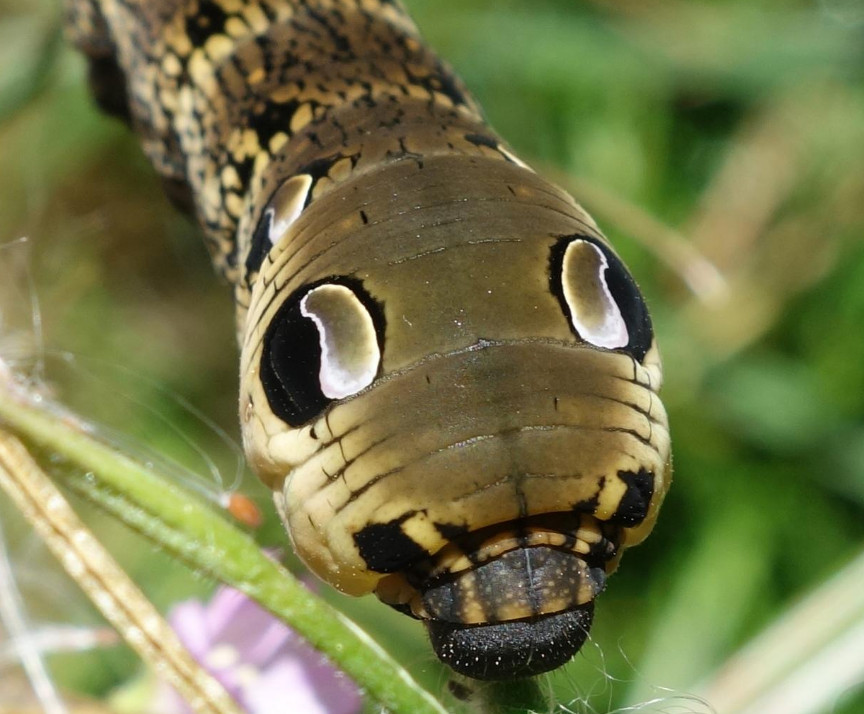
For perhaps 20 seconds or so it writhed its body in a convincingly snakelike movement, and it pumped up several body segments behind the head, tucking its head down at the same time. With eye spot markings on its flanks, a scaly pattern on the entire body, and by raising up the front part of the body, it really did look the part. I wasn’t fast enough to get a photo, but I did get some video of the recovered caterpillar continuing on its way afterwards.

Searching the internet later, I found several good images of the caterpillar mimicking a small snake. Perhaps the best of these is show below.


The caterpillar looking very much like a snake (credit iSpot)

The natural world is so amazing, and so full of surprises, but mimicry is quite a common feature in both plants and animals. The European white dead-nettle has leaves that cannot sting but match the appearance of the unrelated stinging nettle very closely. Some insects look like pieces of wood, or a leaf, or a patch of white lichen, or a bird dropping. Many slugs look very much like animal droppings of various kinds, and as they move so slowly only an alert predator is likely to notice them. Predators, too, use camouflage which is not truly mimicry, but helps them merge into dappled sunshine and shade. Fish are often dark on top and silvery underneath. Sometimes they are patterned and look like the gravel bed of a stream or river.

Amazing!

See also:

Life together

Only living things can form a murmuration. Not only that, the individuals must all be alive with the same kind of life, don’t expect to see seagulls and starlings together in the same formation.

A murmuration of starlings

This morning, swilling out the cafetiere, watching the dark coffee grounds fan out and spiral down the drain, a word popped into my mind – ‘murmuration’. This word is used for a flock of birds flying together, swirling hither and thither, flying together as one yet moving independently and in smaller groups within that one flock. Starlings are particularly known for this behaviour as they go to roost in the evening light, and the dark specks of coffee reminded me of a murmuration of these birds.

Murmuration of starlings

But looking at those coffee grounds made it very clear to me that only living things can form a murmuration. Not only that, the individuals must all be alive with the same kind of life, don’t expect to see seagulls and starlings together in the same formation. The living entities must also be in a fluid environment (air or water, large shoals of fish can exhibit the same phenomenon). And they must be aware of one another and able to respond rapidly to one another’s movements.

Take a look at this video of a starling murmuration. It’s stunning!

So it should be with the church. A formation of individuals all alive with the same life, the life of Christ, all filled with his Spirit. Church should be a fluid environment, the individuals free to move in every dimension, yet always aware of one another and responding to one another.

When the church flows like a murmuration, individually alive with Christ, individually free to move yet mutually aware, responding to one another’s presence and movement, unconstrained except in obedience to Christ, then, my friends, we will see her transcendent glory revealed and the whole world will gasp. People will say, ‘Oh wow, how can this collection of individuals flow together with such transcendent beauty and grace?’

If not, we are little better than coffee grounds swirling into the drain. Not alive at all, merely acted on by random currents as gravity draws us ever downwards. Paul expressed this when he wrote to the church in Ephesus,

We must no longer be children, tossed to and fro and blown about by every wind of doctrine, by people’s trickery, by their craftiness in deceitful scheming. But speaking the truth in love, we must grow up in every way into him who is the head, into Christ, from whom the whole body, joined and knit together by every ligament with which it is equipped, as each part is working properly, promotes the body’s growth in building itself up in love.