War in Ukraine – War in Europe

Despite repeated assurances that no invasion was planned, Russian forces crossed the border into Ukraine on 24th February 2022. As the tanks and support vehicles rolled towards Kyiv, paratroops were dropped to take the city’s Hostomel Airport.

On 24th February, 2022, Russian forces moved into Ukraine, despite Russia’s repeated assurances that they had no such intention. That moment represented a step change in Russian relations, not just with Ukraine, but with the rest of Europe and the entire world. The tanks, personnel carriers, and self-propelled howitzers rolled across the border from Russia and from Belarus, much as the German tanks had rolled across Eastern Poland and into the Soviet Union 80 years earlier.

Informed opinion among Western military and government thinkers was that Ukrainian forces would buckle, the government would fall within a few days, President Zelensky would be captured or would flee, and a new, puppet regime would be set up by the Russians. There would be almost no resistance, defeat would be swift and complete. Everyone was wrong-footed, Ukraine resisted, Zelensky stayed in Kyiv, and the Russian invasion stalled. And here we are ten months after the invasion, and Ukraine’s army has the upper hand having forced three or four major Russian retreats (it depends how you count them).

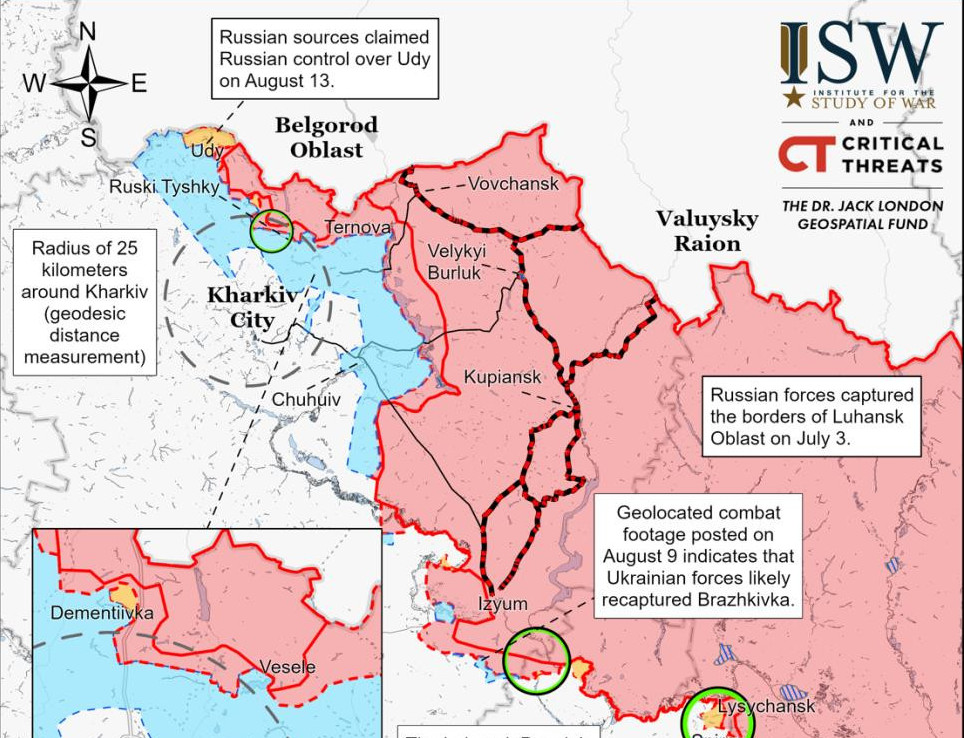
Map of Ukraine before the 2022 Russian invasion (From Wikimedia)
Why did Russia invade?

Logical, reasonable thinking always begins with unbiased observation; but there’s an inbuilt human tendency to instead begin with our own opinions which may or may not be biased, and then to look for things that will back those up. There are plenty of examples all around us: for example the tobacco industry in the 1970’s and 80’s had the opinion that smoking provided them with solid profits and was not harmful to health and looked for ways to argue against any evidence for harm. That’s just human nature.

And that’s exactly how Russia’s invasion of Ukraine began. The Russian government began with assumed opinions about history and about NATO intending to harm Russia. Next, serious attempts to justify these positions were made: Russia was the origin of Ukraine which was therefore no more than a Russian region along with the Baltic states and some other parts of the old Soviet Union; NATO was not a defensive organisation but had expansive territorial ambitions, the West wanted to destroy Russia.

On the basis of these assumptions political arguments were made by Vladimir Putin and his supporters, that bringing Ukraine back into line would return territory that had always been Russian, would expose Ukraine’s military weakness, prevent NATO expansion, be welcomed by the majority of Ukrainian citizens, and be tacitly accepted by a weak-minded West. And on that basis, after building up forces along the Ukrainian borders with Russia and with Belarus, the ‘Special Military Operation’ began. Mr Putin’s miscalculations were exposed very quickly. Ukrainian citizens did not support Russia; the Ukrainian forces were much stronger than expected; the West including the EU and USA supported Ukraine in practical ways and applied sanctions; Sweden and Finland were alarmed and applied to join NATO.

Stages of the war

Despite repeated assurances that no invasion was planned, Russian forces crossed the border into Ukraine on 24th February 2022. As the tanks and support vehicles rolled towards Kyiv, paratroops were dropped to take the city’s Hostomel Airport. The plan was to capture the city quickly, arrest President Zelensky, install a puppet regime, and then mop up the remnants of the fleeing Ukrainian forces. But that didn’t work out well for the Russians.

The paratroops were defeated at the airport and the city of Kyiv did not fall. The armoured columns and their support vehicles and troops were badly mauled by the Ukrainians and were forced to retreat north across the border and east as far as Kharkiv, and something of a stalemate resulted in the north. In the south, Russian forces fanned out from Crimea and took the coastline of the Sea of Azov, capturing Kherson. Ukrainian forces were able to stop the Russian advance before the cities of Mykolaev and Zaporizhzhia. In the east, Russia expanded their hold on Luhansk and eastern Donetsk, and captured the city of Mariupol.

For some time there was a stalemate in terms of territory, with relentless Russian shelling of settlements along the line of control. During this period the Ukrainian forces grew stronger with aid and materiel from the West, particularly the USA but also the UK and other European and some non-European powers. At the same time Russia was weakened by a heavy toll on both troops and equipment.

As a result of astute leadership and good use of Western precision armaments, Ukraine became strong enough to push the Russians back, initially in the north, and then also in the south where Russian forces had to retreat from Kherson. This seems to be a development that is still ongoing as we approach the beginning of 2023. There are signs that Ukraine is growing stronger while Russia continues to grow weaker. It’s likely that we’ll see further Ukrainian military successes and Russian forces holding less and less territory. What is harder to predict is how the Russian government, armed forces, and population will react as these failures become more and more clear for all to see.

An analysis to consider

Here’s a video of Michael McFaul speaking at Stanford University. He is familiar with government figures including presidents Putin, Zelensky, and Biden; he understands their thinking; he presents a shrewd and well considered analysis of the situation – one that is well worth watching. I’m not going to write anything here in the way of conclusions; far better to settle back and listen to McFaul’s thoughts and ponder his arguments and conclusions for yourself. His address therefore forms the conclusion to my article.

The truth is the truth

Unexpected results are always disappointing and sometimes very harmful

Let’s talk about truth.

Truth is like the stars in the sky above, sometimes cloudy skies hide the stars from view, but we know they’re still there. And when the clouds move away we see them clearly again, they remain the same, the constellations are still recognisable. It’s possible to navigate by the stars, they are dependable and reliable.

Truth is reliable too; when we navigate according to the truth our decisions and choices will produce the expected results. If we are fed untruth, our choices will produce unexpected results. And unexpected results are always disappointing and sometimes very harmful – to us and to others.

In this world we are surrounded by a great deal of untruth. It puzzles me that so many people assume that misinformation will result in good choices. We see it everywhere – in politics, in business, in warfare, in daily life. Let’s look at a few examples:

  • Russia’s war in Ukraine – From the very beginning truth has been discarded. Russian leaders have deliberately ‘adjusted’ history, results of battles, and their motives. Perhaps they believe their own claims! So many decisions on goals, strategy and tactics have been based on untruth and the disastrous results are plain to see.
  • Brexit – From the very beginning truth has been discarded. British leaders have deliberately ‘adjusted’ history, results of policy changes, and their intentions. Perhaps they believe their own claims! So many decisions on goals, legal positions and rule changes have been based on untruth and the disastrous results are plain to see.
  • Anti-vaccination campaigns – From the very beginning truth has been discarded. Campaigners have deliberately ‘adjusted’ the science, results of trials, and their fears. Perhaps they believe their own claims! So many decisions on messages, responses to other views and serious dangers have been based on untruth and the disastrous results are plain to see.
  • Climate change denial – From the very beginning truth has been discarded. Deniers have deliberately ‘adjusted’ evidence, results of scientific study, and their arguments. Perhaps they believe their own claims! So many decisions on arguments, scientific reasoning and inferences have been based on untruth and the disastrous results are plain to see.

Do you see a pattern here? You may disagree with me strongly on any or all of my assertions above, but the plain fact remains that if you fail to see the truth about something, deliberately or not, and you base your actions on the flimsy foundations of error, lies, or misinformation (your own or from others), you will fail. Sooner or later bad choices will result in bad outcomes. They always do.

Claiming something to be true when it’s false will never, in the long term, work in your favour or in mine.

Truth matters. Let’s value it, search it out, base our choices on it, and benefit from the best outcomes available to us.

An old castle made new

It feels like being on a castle roof rather than perched uncomfortably on top of a high, stone wall.

I’ve visited York many times in my life, and on several occasions I’ve visited Clifford’s Tower, the ruined remains of a roughly circular stone building on top of a conical grass mound near the centre of the city.

I visited the tower again recently, and was astonished at the work done to improve this venerable structure, work that has utterly changed the place without disturbing any of the old stonework. It will never be the same again – in a good way! Here are some before and after photos:

I took the first image in October 2012 and the second image is from my recent visit almost exactly ten years later. They’re taken from similar angles, and there are recognisable features close to the edges of the photos – a small opening on the extreme left and a doorway and damaged stonework on the extreme right, for example.

I think you’ll agree that the tower looks stark and pretty much ruined in the first photo – almost uncared for (though nothing could be further from the truth). But in the second photo it looks so different. There’s a wooden ceiling and internal structures. The new work is entirely supported from beneath and is not attached to, or supported by, the original stonework.

A new feel, almost a new life

The building is utterly transformed. The moment I stepped inside I felt it was a different place, no longer a ruin but a place for people once again. The wooden ceiling is castle-like and tells visitors they are indoors. Before the new structure was added, visitors definitely felt they were somehow outside. The sky was visible, if it rained you got wet.

The new walkways and stairs make it possible to view the structure from completely new angles, and visualise another floor at a lower level.

There was always access to the top of the walls, but it was cramped and people inevitably got in one another’s way. Now the roof deck makes it easy to walk straight across from one side to the other; it feels like being on a castle roof rather than perched uncomfortably on top of a high, stone wall. Groups can stand together to admire the view and discuss the surroundings.

I’d like to say a big ‘Thank you’ to English Heritage for doing this major work, also to the designers for creating an idea that leaves the old stonework unaffected, yet transforms the feel of the place.

What can we learn?

For me, there’s something here more general than improving an old structure. The work on Clifford’s Tower shows how anything might be improved in radical ways. What about a broken friendship? Or an area of woodland? Or a failing school? Or something much bigger – climate change, or racist attitudes in an entire nation?

Whatever the issue that needs to be tackled, it’s never wrong to consider approaching it in novel and imaginative ways. Clifford’s Tower should spur us on to be more creative and less willing to give up because of restraints and difficulties. Here’s a shining example of a novel solution to a problem that might, at first, have seemed intractable.

Useful links:

Cirencester Wharf

There would have been bargaining and haggling, tobacco smoked and ale downed

Modern residents of Cirencester may not know that the town once had a wharf where canal boats tied up to load and unload goods of all kinds, including coal, manufactured goods, and timber. There were small hand-operated cranes on the quayside to help with handling heavy items.

The canal was a branch from the main Thames & Severn Canal that ran through Siddington and is currently being restored by the Cotswold Canals Trust.

So where was the wharf?

The wharf lay at the bottom of what is now Querns Hill, less than half a mile south of where Cricklade Street meets the Market Place. It was an easy trip by horse and cart for any of the businesses in the town in the late 18th and early 19th centuries, and would have been a bustling hub of activity. The area was large enough to turn arriving barges for the trip back to Siddington; imagine the sounds and smells as horses were harnessed and roped for departure or released to rest and graze after arrival. Money would have changed hands as goods were loaded or unloaded from carts and dreys. There would have been bargaining and haggling, tobacco smoked and ale downed, jokes and banter and laughter, bread, cheese and meat passed around. People would have greeted one another and said their goodbyes because barges were used to carry passengers as well as goods.

Does anything remain?

Surprisingly, yes! Parts of the towpath remain as footpaths and can still be walked, though the canal has been filled in and there’s no sign of it in the area near the wharf. There are dry stone walls that were once the boundary walls of the canal; you can see these when you know what to look for. And it’s not hard to trace the route of the canal on foot.

Begin near the bottom of Querns Hill, where it meets Querns Lane and Sheep Street, find the view in the location photo below.

Location of the wharf

You are now looking at the site of the old wharf. It stretched from close to the building on the left (beyond the parked cars and the wall) across to the right hand edge of the photo. The canal leading from the wharf headed directly through the building in the centre of the photo and on through the trees in the centre.

The trees follow the line of the old canal

The photo above shows the same trees but looks back towards the wharf; the buildings on the left are close to those in the first photo. The canal would have more or less followed the line of trees from the buildings on the left right up to the yellow vehicle, and the course of the towpath remains along the garden boundaries hidden by the parked cars. Turning 180° from this view there is a house built over the route of the canal, but walking around it and crossing the road, the footpath between the houses is again the old towpath. What’s more, a dry stone wall on the left hand side of this path is almost certainly the old boundary wall that ran along both sides of the canal. The wall is high here, about 2 m, but beyond the town and in farmland the wall was only 1 m or so. It’s easy to visualise the canal here, mentally remove the tree, imagine water where the grass is, and you have it!

The old towpath and boundary wall, the canal was where the grass is

I was quite surprised to find so much remaining and still identifiable. Local history can be very fascinating and sometimes the detective work is easier than expected. It would be nice to have some of these remains marked and explained on noticeboards.

If anyone reading this is interested in helping to research the Cirencester Branch of the canal, please leave a comment below and I’ll make contact.

Related material

(Article updated 20th July 2020)