Much time has passed

One surprise in Operation Vivaldi was that Ukraine used heavy cargo drones to transport amphibious drones to areas behind the Russian forces, these were basically tracked land drones modified to be able to cross swamps, rivers and ditches. They came up unexpectedly behind Russian forces.

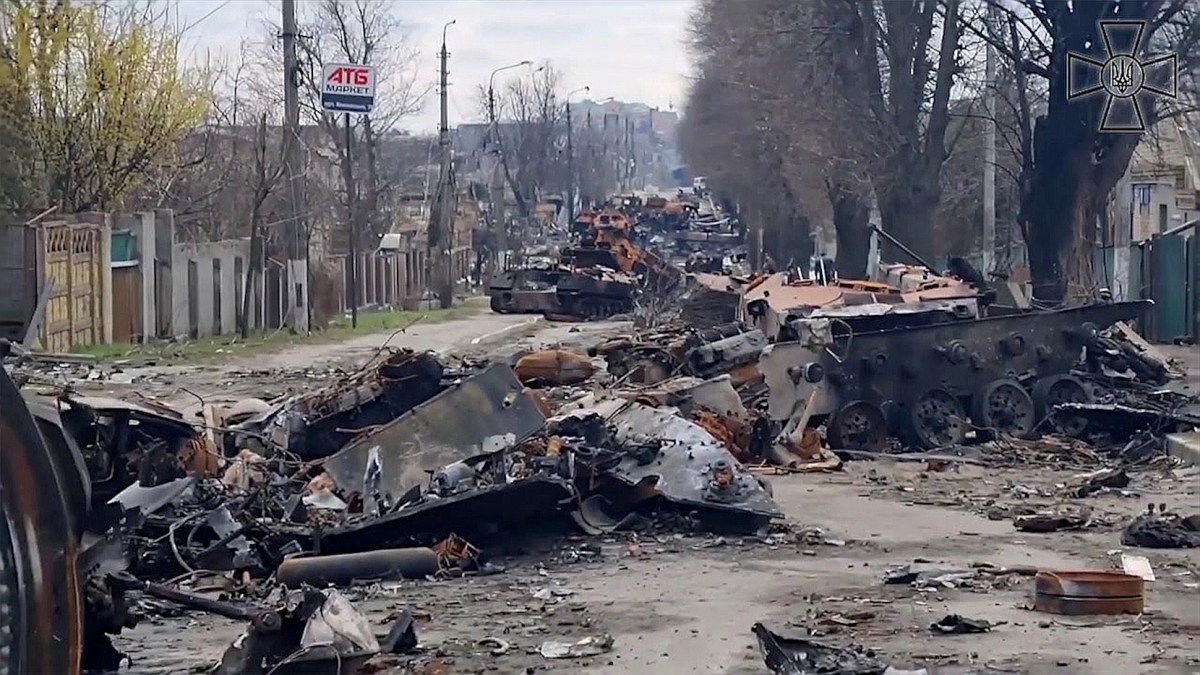
Destroyed Russian tanks (Wikimedia)

Forward look, ukraine – 6

< Previous | Index | Next >

Click to enlarge

A great deal of time has passed since my last post in this series. For a good part of that period, Russia had made slow, steady, but very costly gains. Ukraine has restricted Russian progress to a slow, creeping level. However there have been other, very significant changes during 2026. If you’ve read this article you can jump direct to the list of useful links.

Chain of command

Russia has a very rigid chain of command, and at every level there are extreme pressures to report success rather than failure. Failure is punished, success brings reward or at least fends off punishment. So Putin orders an advance to capture town X, Russian generals command their officers to advance to X, junior officers command two or three soldiers to run to X with a Russian flag, if they fail to make it due to Ukrainian drone activity, two or three more are sent, eventually a photo of Russian soldiers flying a flag at X is returned.

The news of success (often exaggerated on the way) is passed back up the chain of command along with the photographic ‘evidence’, and the maps are changed to show X as captured. The Russian soldiers surrender or die and Putin is shown the ‘success’. And X remains for the time being in Ukrainian hands.

In Ukraine, things are done differently. Plans and objectives are decided by political and military leaders. The results of the planning are sent out in secret to the commanders on the ground. Both the commander and those below them are told what the objectives are but are free to adapt their actions based on what they find during the fight. They can take opportunities where they see them, use a different route or a different method if it’s more likely to succeed. Initiative is rewarded, they can adapt, while the Russian forces cannot.

Operation Vivaldi

Vivaldi has been a successful operation by Ukrainian forces, carefully planned, novel in approach, kept secret before it began, and not announced until objectives had already been reached at every stage. It’s still ongoing but only the military planners know what the next objectives and methods may be. This approach caught Russia totally unprepared and has already resulted in Russian forces retreating and hundreds of square kilometres being recovered by Ukraine.

Ukraine has lost men and equipment too, but on a far smaller scale. Their stubborn resistance along 1200 km of front line has prevented Russian forces from breaking through and although the forward momentum has been in favour of Russian forces it has also been momentum of a very slow, creeping kind. Ukraine has acted entirely within Geneva Convention rules.

On the missile and drone warfare there is a similar difference in approach between the two sides. Russia has targeted residential areas of towns and cities, even hospitals, schools, shopping centres and cultural treasures along with critical infrastructure, especially electricity power stations and local distribution transformers. Again, most of these targets are illegal under international laws and agreements, Russia being a signatory to many of them.

Ukraine has focused on military targets – command and control centres, airfields, naval dockyards and ships, army training camps, troop concentrations, oil production and storage facilities, arms factories, ammunition storage facilities, radar equipment, bridges, railways and roads feeding military traffic to the areas of conflict.

The effects so far

There have been small, creeping movements along the frontline, mostly in Russia’s favour, although the trend has been slower and slower over the past months and now Ukraine is beginning to make small advances as well from time to time, usually by means of well-planned and well-executed actions when good opportunities arise. Vivaldi has greatly increased the pace of advance.

Economic considerations

The Russian economy is showing serious and dangerous strain. The rouble has lost a lot of value against western currencies. Interest rates are high as the central bank has used this as a tool to restrict inflation; but the increased borrowing costs have killed industrial investment. Unemployment is very low and Putin has claimed that as a great success, though the reason for it is that military casualties are excessively high and huge numbers have fled the country.

Strategy and outcomes

During Summer and autumn of 2026 Ukraine has developed new military equipment including more advanced drones and missiles, the FP9 missile carries a moderately powerful warhead so is very hard to shoot down once it’s been launched, it can hit targets up to 300 km or so and hits targets within a minute or two of launch. Using these home-developed tools Ukraine has systematically degraded Russian air defences, fuel supplies, ammunition dumps, communications. All of this has made it easier for Ukraine to strike Russian targets more and more frequently and accurately.

Military production

Russia is still producing new drones, missiles, ammunition, aircraft, tanks and other armoured vehicles, but at a slower rate than the losses inflicted by Ukraine. Stocks of all these essential items have therefore dwindled away and now appear to be in short supply.

Ukraine has also ramped up production of military hardware and consumables and is now in a position to continue fighting even if supplies from the West diminish. Furthermore, Ukraine has continued to develop improved versions of missiles and drones of all kinds.

Innovation

Russia has made progress with drone development, and has makes use of FPV drones controlled via optic cable since this cannot be blocked by radio jamming.

However, Ukrainian production and use of advanced drones outstrips Russian developments. They’re using AI drones that can navigate accurately by machine vision or terrain following so are not dependent on constant control by a human operator. Recently, Ukrainian sea drones have been fitted with both machine guns and ground to air missiles and have downed helicopters sent to destroy them. This is a major new technological achievement.

One surprise in Operation Vivaldi was that Ukraine used heavy cargo drones to transport amphibious drones to areas behind the Russian forces, these were basically tracked land drones modified to be able to cross swamps, rivers and ditches. They came up unexpectedly behind Russian forces and attacked them from the rear enabling Ukrainian forces to take positions more quickly and easily. This was so effective that Ukraine could bring armoured vehicles and tanks into action. In this way Ukraine crossed the Zherebets River and expanded their control into areas considered safe by Russian forces.

And the future?

The balance has been shifting in Ukraine’s favour in so many ways, and the best predictions suggest the Russian economy will collapse, most likely slowly, then suddenly. It’s impossible to know precisely when ‘suddenly’ will come, but it will be devastating when it does and may now be very close. Economic collapse will likely mean military defeat and political upheavals as well.

Russian strategy

Russia continues its effort to kill civilians and destroy civilian infastrucure. They are using glide bombs, jet drones, cruise missiles and ballistic missiles, all hard to destroy or stop. Ukraine is adapting, but civilian losses have increased recently in the face of attacks on high rise apartments, shopping centres, railways, schools and hospitals. All such attacks are illegal in international law of course, but Russia seems not to care. The world must make them care, and surely will do.

In conclusion

Russia thought they could topple the Ukrainian Government within perhaps 10 days. But they failed. It will be a terribly hard winter in both countries, but Russia should remember that it lies further north than Ukraine. Kyiv may face temperatures as low as -20 C, but Moscow could well be -25 to -27 C. If I had to make a prediction it would be that Ukraine will win this war eventually but it’s impossible to judge how much longer it will take. Putin will fall from power, he may be murdered by his own people, military, angry oligarchs, or a popular uprising. If he survives he might end up at the International Court at The Hague. It will be a deservedly ignominious end. Ukraine will rebuild and become prosperous, regaining her currently lost territories in the east. Russia fall apart into a variety of constituent nations. It will be hard to predict it could be as soon as tomorrow or it might take a couple more years.

See also:

The resources below will provide you with up-to-date details of events:

  • Anders Puck Nielsen – Military, political, strategic analysis (YouTube).
  • Denys Davydov – Daily reports on the military aspects (YouTube).
  • Deep State – Military map, updated every day (Website).
  • Frontline – Useful interviews daily with experts (Youtube).
  • Institute for the Study of War (ISW) – Website.
  • Inside Russia, Konstantin Semenov – A Russian living abroad, regular assessments of the political and economical aspects of life in Russia. Often daily reports (YouTube).
  • Jake Broe – A report every day or two (YouTube).
  • Kyiv Independent Report every few days (YouTube).
  • Paul Warburg – Independent geopolitical analysis (YouTube).
  • RFU News – Daily or more often, updates on the war (YouTube).
  • The Global Gambit – Pyotr Kurzin, interviews (YouTube).
  • Times Radio – Frequent reports on various topics, often on aspects of the war in Ukraine (YouTube).
  • Ukraine, the Latest – The Telegraph (YouTube).
  • Yaroslava Antipina – Weekly personal reports from Kyiv on the nation’s culture and history and the effects of the war (Patreon).

< Previous | Index | Next >

Useful? Interesting?

If you enjoyed this or found it useful, please like, comment, and share below. (If you don’t see those links, click the article’s title above the main photo and they will appear.) Send a link to friends who might enjoy the article or benefit from it – Thanks! My material is free to reuse (see conditions), but a coffee is always welcome and encourages me to write more often!

Yara’s letter

Yaroslava Antipina lives in Kyiv, she writes often about Ukrainian culture and art, about the war, and always illustrates her letters with some great photography.

One of Yara’s photos

Verbatim – 1

A short introduction from me first, and then the text and images from Yara’s letter. I rarely post other people’s material verbatim, but this is an exception as Yara writes that it can be shared freely. If I can bring her even one more regular follower it will be worth sharing her letter here.

One of Yara’s photos

Yaroslava Antipina lives in Kyiv, she writes often about Ukrainian culture and art, about the war, and always illustrates her letters with some great photography. Her writing style is engaging and her objective is to help her readers understand what’s happening, how beautiful her country is, and give them some idea of how it feels to live through these events. She has a lot of loyal readers and followers.

Yara is the short form of her name; the name you’d use if you joined her for a coffee in Kyiv. Find her on Patreon, and see another recent letter with some photos of amazing dresses.

The full letter…

Friday Letter from Ukraine. Peace without security guarantees

Hi!

I didn’t plan to write today, but yesterday, while reading a magazine, I came across an article about the Kellogg–Briand Pact. Perhaps you know about it, but let me quickly summarise it, and then I will explain why I mentioned it. I promise this letter will be short.

On August 27, 1928, fifteen nations signed the Kellogg–Briand Pact at Paris; later, forty-seven more joined. France and the United States, represented by the Foreign Minister of France, Aristide Briand, and the Secretary of State of the United States, Frank Kellogg, were the leading initiators of the development and adoption of this document.

The signatories renounced war as a means of national policy towards other countries and pledged to settle disputes peacefully.

Frank Kellogg earned the Nobel Peace Prize in 1929 for his work on the Peace Pact.

In practice, the Pact was ineffective. In 1931, Japan began its occupation of Manchuria. Although Japan had signed the Pact, the combination of the global depression and a limited willingness to engage in war to protect China hindered the League of Nations and the United States from taking any action to enforce it. Later, Italy invaded Ethiopia, and the Soviet Union and Germany started to divide Eastern Europe. The Kellogg–Briand Pact was an example of how wars cannot be prevented by simply prohibiting them and signing a document. 

Ukraine is now forced to make a peace deal with russia. Ukraine demands security guarantees. Without them, I see this peace agreement as a piece of paper where something like, ‘Okay, let’s end this war; enough is enough’ will be written.

Perhaps someone may even be awarded the Nobel Peace Prize for it (and you know who I mean).

Meanwhile, russia will take some time to rearm, revive its economy and become even stronger before it invades again. It may be only Ukraine or other neighbouring countries. That piece of paper with ‘enough is enough’ will greatly help russia as there will be no consequences for the new invasion. A big nothing except for worrying nods: ‘It is so bad’.

I know I am telling you very obvious things, and Ukraine constantly repeats and demands it.

I know I don’t decide anything.

I know that these guys in suits can do everything they want.

I know.

But we need to talk. We need to think critically. We need to reflect on the past and learn from history. We need to do even little something to avoid big nothing. Or this ⬇️

Serhii Kichay, Unchildlike Grief, 1943

Thank you for reading. This letter is public so that you can share it with anyone if you want. Commenting is reserved for my supporters as my gratitude for helping my words reach as many people as possible and my intention to keep at least this place safe (I had issues before).

Military or civilian targets?

The end may come during 2025 or 2026, but it might also happen very much sooner. It’s likely to be a surprise and it will almost certainly end the war, with Ukraine being the survivor.

Forward look, Ukraine – 3

< Previous | Index | Next >

Larger view
(Wikimedia)

It’s time for another look at the war, to see where things stand in January 2025 and where they may go next. Donald Trump has now taken office as President of the USA and the only thing we can be sure about is that his policies for America’s actions will be different from those of his predecessor, Joe Biden.

Meanwhile, in Russia, there are economic, political and military considerations in play and all of them seem problematic for Vladimir Putin (to say the least).

Ukraine continues to take a battering but resistance remains stubborn and determined. For both the population and the armed forces a combination of tiredness, resolve and good morale are all clearly detectable. They are a long way from giving up and a long way from being defeated.

The fighting

Russia and Ukraine have very different approaches to events on the frontline. Putin has demanded a heavy-handed approach, losing an enormous number of troops and huge quantities of equipment, currently throwing wave after wave of infantry at well defended Ukrainian positions (and now some North Korean infantry as well). Russian forces have been ignoring the rules of war, sometimes shooting prisoners, using chemical weapons and so forth.

Ukraine has lost men and equipment too, but on a far smaller scale. Their stubborn resistance along 1200 km of front line has prevented Russian forces from breaking through and although the forward momentum has been in favour of Russian forces it has also been momentum of a very slow, creeping kind. Ukraine has acted entirely within Geneva Convention rules.

On the missile and drone warfare there is a similar difference in approach between the two sides. Russia has targeted residential areas of towns and cities, even hospitals, schools, shopping centres and cultural treasures along with critical infrastructure, especially electricity power stations and local distribution transformers. Again, most of these targets are illegal under international laws and agreements, Russia being a signatory to many of them.

Ukraine has focused on military targets – command and control centres, airfields, naval dockyards and ships, army training camps, troop concentrations, oil production and storage facilities, arms factories, ammunition storage facilities, radar equipment, bridges, railways and roads feeding military traffic to the frontlines.

The effects so far

There have been small, creeping movements along the frontline, mostly in Russia’s favour, although the trend has been slower and slower over the past month and now Ukraine is beginning to make small advances as well from time to time, usually by means of well-planned and well-executed actions when good opportunities arise.

Economic considerations

The Russian economy is showing serious and dangerous strain. The rouble has lost a lot of value against western currencies. Interest rates are high as the central bank has used this as an effective tool to restrict inflation; but the increased borrowing costs have killed industrial investment. Unemployment is very low and Putin has claimed that as a great success, though the reason for it is that military casualties are in excess of 800 000 men and even larger numbers have fled the country to avoid being sent to the frontlines. Most industries are seriously short-staffed; skilled professionals are particularly hard to find.

By defeating Russia in the Black Sea, Ukraine has been able to continue her grain exports whereas Russia’s income from sales of oil and natural gas have fallen due to western sanctions as well as Ukrainian strikes on depots, production and transport facilities.

Military production

Russia is still producing new drones, missiles, ammunition, aircraft, tanks and other armoured vehicles, but at a slower rate than the losses inflicted by Ukraine. Stocks of all these essential items have therefore dwindled away and now appear to be in short supply.

Ukraine has also ramped up production of military hardware and consumables and is now in a position to continue fighting even if supplies from the West diminish.

Innovation

Russia has made progress with drone development, and has recently been making more use of FPV drones controlled via optic cable since this cannot be blocked by radio jamming.

However, Ukrainian production and scale of use of advanced drones far outstrips Russian developments. Recently, Ukrainian sea drones have been fitted with both machine guns and ground to air missiles and have downed helicopters sent to destroy them. This is a major new technological achievement.

And the future?

The balance has been shifting in Ukraine’s favour in so many ways, and the best predictions suggest the Russian economy will collapse, most likely slowly, then suddenly. It’s impossible to know precisely when ‘suddenly’ will come, but it will be devastating when it does. And economic collapse will likely mean military defeat and political upheavals as well.

My opinion based on what I have read and heard, is that the end may come during 2025 or 2026, but it might also happen very much sooner. It’s likely to be a surprise and it will almost certainly end the war, with Ukraine being the survivor.

Militarily too, Ukraine seems to be getting the upper hand. I think it’s very likely that things will go more and more Ukraine’s way in this war in the next few months. There are many unknowns of course, but on balance I expect Russia to eventually lose the war, probably through a combination of economic and military failure, and quite possibly by a Russian decision to withdraw from the conflict altogether. This could happen either as a decision from Putin following pressure internally or by a change of government. These details are not remotely predictable, however.

We in the West should do our part by continuing to apply political and economic pressure, and by continuing and extending our support for Ukraine.

See also:

< Previous | Index | Next >

Useful? Interesting?

If you enjoyed this or found it useful, please like, comment, and share below. (If you don’t see those links, click the article’s title above the main photo and they will appear.) Send a link to friends who might enjoy the article or benefit from it – Thanks! My material is free to reuse (see conditions), but a coffee is always welcome and encourages me to write more often!

War, truth and persuasion

With Western politicians and news sources wavering seemingly randomly due to many other considerations and distractions, and Russian misinformation sometimes hard to detect and assess, we need to look elsewhere.

Enlarge

Claiming that something is true does not make it so, no matter how large the font.

Russia’s invasion of Ukraine was almost three years ago, and so far Russia is no nearer to completing its ‘Special military operation’ than when the first Russian troops and vehicles illegally entered the nation it had promised to protect. But neither has Ukraine managed to drive Russia out of its territory completely. It’s not a ‘stalemate’, those are possible in chess, but not in war: there are too many interacting factors for long term stability in a war. Ukraine struggled to hold on during the long period when USA support was stalled by the Republicans, but since then Ukraine has been getting stronger and Russia weaker as their loss of troops, equipment, and funding have gradually become more and more significant issues.

But one important factor to consider is perceived knowledge about events. With Western politicians and news sources wavering seemingly randomly due to many other considerations and distractions, and Russian misinformation sometimes hard to detect and assess, we need to look elsewhere if we want to be informed by truth and reality.

Places to go for good information include the many commentaries about current events from individuals on YouTube, blogs, podcasts and similar media. It’s true that many of these may be biased one way or another, but on the whole it’s easier to identify these biases than it it with large organisations or sources funded by companies or governments. There are fewer mixed messages; individuals are usually clearly on one side or the other, and after weeding those out, the remainder tend to be more impartial.

Take a look at this YouTube video on Silicon Curtain as an example. See how photos and information about the Russian ‘shadow’ tanker fleet are used to reach and influence the right people. Notice how the international company Unilever was encouraged to pull out of Russian business by evidence-based and well targeted information (11 minutes into the video). How much more effective we can be when we think things through carefully rather than just shouting at one another in anger.

Useful? Interesting?

If you enjoyed this or found it useful, please like, comment, and share below. (If you don’t see those links, click the article’s title above the main photo and they will appear.) Send a link to friends who might enjoy the article or benefit from it – Thanks! My material is free to reuse (see conditions), but a coffee is always welcome and encourages me to write more often!

The Russian people are unhappy

Ukraine continues to devise and manufacture novel equipment including drones that can avoid jamming over the final part of their trajectory by tracking the target and striking it without manual control.

A destroyed Russian column in Bucha (Wikimedia)

forward look, ukraine – 2

< Previous | Index | Next >

Larger view
(Wikimedia)

There are many sources of news, interviews, and comment covering events in Russia and Ukraine. There’s a list of some of these at the end of the article. The history of events so far is also well covered. But here I want to consider the future. What might happen next?

Russian advances on the front line

Russia is still making small gains in the east, but at huge cost in men and materiel. But Ukraine has sometimes been able to make small advances too, and I think there’s a slow trend detectable here. The to and fro actions continue to be small scale, and although the bulk of the movement is still in favour of Russia, my feeling is that it’s getting harder for them and perhaps easier for savvy, well-led and well-equipped Ukrainian forces.

One reason for this, I think, is that Ukrainian drone and missile attacks inside both the occupied territories and into Russia itself, have focused heavily on military targets. Russian ammunition dumps, airfields, critical road and rail links, arms factories, oil refining and storage and so on are seriously disrupting supplies to the Russian army. Also, Ukraine continues to devise and manufacture novel equipment including drones that can avoid jamming over the final part of their trajectory by tracking the target and striking it without manual control; mine laying robots that can destroy Russian tanks in places thought to be mine-free; and the relatively new Peklo long range jet-powered missile-drone (just three examples).

Russian air-power is floundering, Ukraine has forced Russia to move its aircraft further from the conflict zone, reducing their ability to drop glide bombs or support ground operations.

Presence of Korean forces

The Koreans still appear to be fairly ineffective. Perhaps due to a combination of language difficulties, poor training, and unsatisfactory leadership.

Donald Trump as US President Elect

Several things suggest Trump may be less helpful to Russia than we may have expected. Putin might have miscalculated by publishing nude images of Melania on Russian state TV. It’s becoming more likely that Putin will, in the end, lose the war and, indeed, power; and Donald Trump is unlikely to want to be associated with any kind of loser. If Ukraine comes out on top, Trump might like to be seen to have helped . I think this is something to watch closely going forward.

Technology

I mentioned this above. Russian industry is struggling to produce sufficient war materiel, but Ukraine has been ramping up, domestically producing ever larger quantities of shells, drones, missiles and so forth. Some of her European allies have been doing the same (Poland and the Baltic States in particular).

Russian economy

Sanctions continue to throttle Russia’s economy. Manpower shortages, the fall in the Ruble’s value, inflation and high interest rates are seeing accelerating changes. Russian economists cannot fix these issues, and the country is attempting to reduce rampant inflation while increasing the money supply. How far off is disastrous economic collapse?

Unhappy and rebellious populace

It’s quite clear that the Russian people are becoming very unhappy, particularly with the coldest part of the winter coming soon. By contrast, in Ukraine people are weary but morale and determination remain high. I mentioned this in November too, but what I didn’t mention then is the restlessness and churn amongst the wealthy business owners, politicians, and the top people in the military. We saw with Prigozhin how frustration and dissatisfaction can lead to revolt. Challenges like this will surely happen again. They will not always fail.

The assassination in Moscow

The remotely controlled explosion in Moscow that killed a Russian general and a member of his staff will have caused some anxiety among Russian leaders, both military and political. And it’s yet another blow to Putin’s prestige following the loss of control in Syria. It also makes it clear that Ukraine will not tolerate war crimes committed against their forces and are capable of acting in the very heart of Russia.

< Previous | Index | Next >

See also:

Useful? Interesting?

If you enjoyed this or found it useful, please like, comment, and share below. (If you don’t see those links, click the article’s title above the main photo and they will appear.) Send a link to friends who might enjoy the article or benefit from it – Thanks! My material is free to reuse (see conditions), but a coffee is always welcome and encourages me to write more often!