Emergence – an introduction

Emergence is everywhere, and you would not be here without it! … Emergence matters because it is one of the fundamental processes that we see in this universe at every imaginable scale.

Part 1 of a series – Emergence

< No earlier posts | Index | In the beginning – a field >

One of my many interests is the way in which everything we’re familiar with in the universe developed out of a previous state, and how new features make further developments possible – over and over and over again.

I’d like to explain how this seems to be an underlying property of our universe. We are surrounded by astonishing levels of complexity and the earlier stages seem to be far simpler than later ones; at the beginning of the process (if there is a clear beginning) everything was simple. So how can the complex arise from the simple?

Ripples in the sand, an example of emergence (from Wikimedia Commons)

In its entirety this story will take us from the big bang, through particles and atoms, to chemistry, onwards to life, intelligence, and beyond. This is far, far too much for a single blog post, so I will choose topics one by one and write about them. I’m not planning to start at the beginning, and the posts won’t be in the order that events took place, but as I write additional articles, I plan to link them into a logical series.

How would I know anything about this topic?

I should explain something about my background and training – I’m not an expert on all of the topics we will be covering, perhaps not really an expert in any of them! I retired in 2010, but the first part of my career was in biology, specifically flower and fruit development in plums, so I do have a science background. My first degree was from Bath University in the UK, an honours degree in Horticulture; then during my research career I wrote an MSc thesis at Bristol University on the plum reproduction work; and later I completed an ordinary degree in mathematics and computing at the Open University as it seemed useful to have a background in methods that were becoming rather more frequently used by biologists. In the mid 90s my research career abruptly ended through unexpected personal circumstances.

But let’s go back to some thoughts on the complex arising from the simple. This is really quite counterintuitive for most people and, as it forms the basis for the story I want to tell, it’s important to think about it clearly at the start. At its heart, emergence is very simple. So simple we often take it for granted.

A few examples will help.

Example 1 – Cities

Where do cities come from? Obviously they’re built by people. Building towns and cities is something that people do, they provide places to live, places to work, shops, schools, hospitals, transport (ranging from footpaths to airports) and much more. Our societies could not exist without cities.

If we could take a few hundred people to a large, uninhabited island, what would they do? They would look for sources of food and water. They’d try to start a fire to keep warm. They’d explore the area. And they’d build shelters of some kind. Given time they might build a village.

Without people there would be no towns. But given a population, villages, towns and cities will eventually begin to appear. One person cannot build a village, let alone a city; it requires cooperation and a lot of resources.

It’s fair to say that cities emerge when large groups of people cooperate. A city and the life of a city are emergent properties of a cooperating group of people.

Example 2 – Murmurations

A murmuration is a flock of birds behaving in a particular way. I wrote about this some time ago in a different context. But take a look, especially at the video link in the article; it’s an amazing and beautiful thing to watch. Without the starlings there could be no murmuration. It’s another example of emergence. Murmuration becomes possible (though not inevitable) when there’s a large group of birds flying together.

Example 3 – The internet

For our final example, lets think about the internet. Something like the internet was bound to arise once computers became plentiful. It was useful to connect computers together so that all the computers in an office could share a single printer or some other resource. And then it became useful to connect up individual offices and companies for email, or file sharing. The details of the protocols that make it all possible don’t matter, it could have been done in a variety of ways; but the principle of world spanning connectivity was bound to develop, one way or another.

Predictability

Emergent behaviour is usually unpredictable. If you studied a single starling, or even a cage containing ten birds, you might learn a great deal about starlings, but nothing you learned would prepare you for the sight of a murmuration. Nor would it enable you to predict murmurations.

Why does emergence matter?

Emergence matters because it is one of the fundamental processes that we see in this universe at every imaginable scale. We see it in the behaviour of the wave functions that underlie elementary particles, and we see it in the formation of galaxies and even clusters of galaxies. We see it in everyday life (think about those cities mentioned above), we see it in the way collections of neurons give rise to complex behaviours in our brains, we see it in political life, in business, and in economics. Emergence is everywhere, and you would not be here without it!

Future articles

I’ll be writing on this topic again, but next time I’ll choose a particular example of emergence. This article acts as an introduction to the topic and will probably be accompanied by an index for this and other articles in the series. Along the way I’ll try to explain emergence in a bit more detail, and to provide links to material out there on the internet that will go far deeper than I plan to (or even could) take you, my readers.

See also:
Part 1 of a series – Emergence

< No earlier posts | Index | In the beginning – a field >

The truth is the truth

Unexpected results are always disappointing and sometimes very harmful

Let’s talk about truth.

Truth is like the stars in the sky above, sometimes cloudy skies hide the stars from view, but we know they’re still there. And when the clouds move away we see them clearly again, they remain the same, the constellations are still recognisable. It’s possible to navigate by the stars, they are dependable and reliable.

Truth is reliable too; when we navigate according to the truth our decisions and choices will produce the expected results. If we are fed untruth, our choices will produce unexpected results. And unexpected results are always disappointing and sometimes very harmful – to us and to others.

In this world we are surrounded by a great deal of untruth. It puzzles me that so many people assume that misinformation will result in good choices. We see it everywhere – in politics, in business, in warfare, in daily life. Let’s look at a few examples:

  • Russia’s war in Ukraine – From the very beginning truth has been discarded. Russian leaders have deliberately ‘adjusted’ history, results of battles, and their motives. Perhaps they believe their own claims! So many decisions on goals, strategy and tactics have been based on untruth and the disastrous results are plain to see.
  • Brexit – From the very beginning truth has been discarded. British leaders have deliberately ‘adjusted’ history, results of policy changes, and their intentions. Perhaps they believe their own claims! So many decisions on goals, legal positions and rule changes have been based on untruth and the disastrous results are plain to see.
  • Anti-vaccination campaigns – From the very beginning truth has been discarded. Campaigners have deliberately ‘adjusted’ the science, results of trials, and their fears. Perhaps they believe their own claims! So many decisions on messages, responses to other views and serious dangers have been based on untruth and the disastrous results are plain to see.
  • Climate change denial – From the very beginning truth has been discarded. Deniers have deliberately ‘adjusted’ evidence, results of scientific study, and their arguments. Perhaps they believe their own claims! So many decisions on arguments, scientific reasoning and inferences have been based on untruth and the disastrous results are plain to see.

Do you see a pattern here? You may disagree with me strongly on any or all of my assertions above, but the plain fact remains that if you fail to see the truth about something, deliberately or not, and you base your actions on the flimsy foundations of error, lies, or misinformation (your own or from others), you will fail. Sooner or later bad choices will result in bad outcomes. They always do.

Claiming something to be true when it’s false will never, in the long term, work in your favour or in mine.

Truth matters. Let’s value it, search it out, base our choices on it, and benefit from the best outcomes available to us.

An old castle made new

It feels like being on a castle roof rather than perched uncomfortably on top of a high, stone wall.

I’ve visited York many times in my life, and on several occasions I’ve visited Clifford’s Tower, the ruined remains of a roughly circular stone building on top of a conical grass mound near the centre of the city.

I visited the tower again recently, and was astonished at the work done to improve this venerable structure, work that has utterly changed the place without disturbing any of the old stonework. It will never be the same again – in a good way! Here are some before and after photos:

I took the first image in October 2012 and the second image is from my recent visit almost exactly ten years later. They’re taken from similar angles, and there are recognisable features close to the edges of the photos – a small opening on the extreme left and a doorway and damaged stonework on the extreme right, for example.

I think you’ll agree that the tower looks stark and pretty much ruined in the first photo – almost uncared for (though nothing could be further from the truth). But in the second photo it looks so different. There’s a wooden ceiling and internal structures. The new work is entirely supported from beneath and is not attached to, or supported by, the original stonework.

A new feel, almost a new life

The building is utterly transformed. The moment I stepped inside I felt it was a different place, no longer a ruin but a place for people once again. The wooden ceiling is castle-like and tells visitors they are indoors. Before the new structure was added, visitors definitely felt they were somehow outside. The sky was visible, if it rained you got wet.

The new walkways and stairs make it possible to view the structure from completely new angles, and visualise another floor at a lower level.

There was always access to the top of the walls, but it was cramped and people inevitably got in one another’s way. Now the roof deck makes it easy to walk straight across from one side to the other; it feels like being on a castle roof rather than perched uncomfortably on top of a high, stone wall. Groups can stand together to admire the view and discuss the surroundings.

I’d like to say a big ‘Thank you’ to English Heritage for doing this major work, also to the designers for creating an idea that leaves the old stonework unaffected, yet transforms the feel of the place.

What can we learn?

For me, there’s something here more general than improving an old structure. The work on Clifford’s Tower shows how anything might be improved in radical ways. What about a broken friendship? Or an area of woodland? Or a failing school? Or something much bigger – climate change, or racist attitudes in an entire nation?

Whatever the issue that needs to be tackled, it’s never wrong to consider approaching it in novel and imaginative ways. Clifford’s Tower should spur us on to be more creative and less willing to give up because of restraints and difficulties. Here’s a shining example of a novel solution to a problem that might, at first, have seemed intractable.

Useful links:

Reflections from way back when

The weak are doubly rewarded, they’re glad to do the easy things and by their childlike faith and trust achieve the hard things too

This is an edited repost of one of my earliest blog messages, originally from 18th December 2002, so almost twenty years ago! In fact, it was my first serious post.

Back in those days I’d been meeting with my sister, Rachael, and some local friends. Sometimes we met in Rugby, at Rachael’s house, sometimes near Wellingborough where one of our friends lived, and sometimes at my home or others in St Neots.

The meetings were always full of spiritual life; we would sit together, share coffee, do a bit of a catch up chat, and then fall into a comfortable silence – waiting, and expecting the Holy Spirit to guide us. These were very fruitful times for all of us. Out of the quietness would come a mental picture, a thought, some Bible verses, a prayer, words in an unknown language, an interpretation, a song, some prophecy. Usually everyone would contribute something, and always by the end of the meeting we would see a clear thread running through the whole, something we could remember that would encourage us or bless us in some way.

The following is what I wrote twenty years ago:

Our meeting reminded me of the seventh day of creation, when He rested. Even God desires quiet times!

The other bit I particularly remembered was, ‘It’s not for us to do, but for Him to do in us’ (RK)

Four of us met and the Holy Spirit led us very gently. We felt encouraged and uplifted, it was a peaceful and quiet time with a variety of words and pictures.

There was a wonderful picture of still water, with a reflection of the Almighty’s glory clearly visible in it; the water also reflected images of us towards him. Our feet were in the water; and he said that we should be careful not to make disturbances as this would spoil the reflection, only if we stayed quiet and very still would we be able to see his reflected glory.

We also had a word that the easy things he wants done are overlooked by the great and the learned, while the difficult things are only ever attempted by the weak and foolish.

Thinking about this afterwards I realised that the great doubly miss out, they miss the easy things because they think they’re not worth doing, and they miss the hard things because they realise they’re too difficult to attempt. But the weak are doubly rewarded, they’re glad to do the easy things and by their childlike faith and trust achieve the hard things too!

We came away encouraged and strengthened – it was a great evening!

See the original post

(Note: RK is my sister, Rachael.)

A reflection of what is not directly visible – Image from Wikimedia Commons

My thought after the meeting is what I want to emphasise here in 2022. Perhaps we are much too easily impressed by the people in society who are thought to be great in wisdom, or wealth, or skill. Great leaders, great speakers, powerful company bosses. Reputation can be overvalued.

Perhaps we should be more willing to also value weakness, and to notice how the weak are doubly blessed. They achieve this by doing the easy things that the great may overlook or regard of little value, and they achieve the hard things by just doing them, often without recognising the difficulties.

So let’s value the weak and the humble. Let’s notice them, and learn from them. At the same time we can (and should) appreciate the people around us who achieve so much through skill, learning, persuasive speaking, and sheer hard work and persistence. The great are good, providing they are also humble and gentle. Indeed, good motives are fundamental, for both the strong and the weak.

And if you think you are weak – rejoice! Savour the double blessing.

Some questions

  • If you follow Jesus, could you meet like this? Have you tried?
  • What advantages are there in preparing the content, structure, and leadership of a meeting in advance?
  • Are there any disadvantages?
  • What does Paul mean when he says that all should contribute? (1 Corinthians 14:26) – For more on this question, see my subsequent tweet.

Where have I been?

Looking back I see that this is only the third blog post I have made in 2022; I have been almost entirely absent. Why? I’m not sure. I’ve been busy with all sorts of other things, but that didn’t stop me from posting in the past.

It’s not possible to engage in blog posting – or any other kind of writing – without having a real urge to do it. People are driven to write, or create music, or art, or any other creative thing. When there is some burning issue to be addressed, or an idea that wants to get out, then writing is easy. Sometimes it’s harder not to write because something is buzzing in your mind, jumping up and down and demanding to be expressed. My mind has not been empty of ideas, but somehow the will to express these ideas as blog posts has dwindled.

The last two posts were failed attempts to make a fresh start. Well, I’m going to try again, hopefully more effectively than before. This present item is more of a meta-post, a blog post about posting on a blog if you will. I’m going to keep it quite brief.

I find the best thing is just to begin writing, either a list of topics I want to cover, or the first paragraph. If I start to struggle, or there are other jobs needing attention, I stop and take a break. A partly written post is usually easy to return to, and will almost always need some improvements and corrections. When there’s nothing more to add – it’s time to post.

So wish me well, I hope to write more soon…

Down, or down and out?

It’s a ship that will continue to take on water and is likely to founder and disappear for ever

I rarely make any political comment here on JHM, largely because I don’t want to annoy or alienate a significant fraction of my readers. This blog is about other aspects of life.

But sometimes events demand some sort of response. This is such a time.

The Conservative party is in a state of confusion right now. The parliamentary party is clearly rejecting Boris Johnson as leader and Prime Minister, and the electorate is hugely critical of the party (recent byelection results illustrate that).

I believe two things need to happen as soon as possible.

First, the party must find a way to remove Johnson from his leadership position in the next few days or weeks, and they must elect a new leader and form a new cabinet and all the government machinery that goes along with that. So much is self-evident.

Secondly, they must call a general election as soon as possible.

They will need to do that because giving senior cabinet positions to people who supported Johnnson’s leadership for such a long time, knowing that he was – well, let’s say ‘a bit dodgy’ – is not going to pass muster with the general public. And it’s hard to see how a new government can be formed without including a significant number of tainted heavyweights.

Johnson has tarred himself with his own brush, but in the process he’s managed to splash quite a few of those around him with black marks. Not that they didn’t object to his behaviour, but that they supported him as Prime Minister for such a long time. I understand the difficulty, nobody wants to be the first to climb, suicidally, out of the trenches.

Somebody wrote recently that the sinking ship has abandoned the rat. Very witty, but it’s still a sinking ship. It’s a ship that will continue to take on water and is likely to founder and disappear for ever.

We need a new government, whether Conservative or otherwise. The electorate needs an opportunity to replace any MP they regard as tainted and untrustworthy. Two years is too long for a seriously damaged party to continue in power. Only a general election as soon as possible can remove the remaining spots and streaks of tar.

Most, including the crew, agree that we need a new captain, but we also need a new ship.

Climate change – What can I do?

By showering less often I’m cutting my water use to less than half, and turning down the flow rate reduces water use by about half again.

I’ve just watched the latest ‘Just have a think’ video from Dave Borlace. I really enjoy his videos – they are well produced, clear, uncompromising, polite, thorough … well, you get the idea. The latest one asks what we can do individually to help reduce the pace of climate change, and he describes a survey that shows most people are just waiting for someone else to do something about it.

That rings true!

Here’s the video, watch it, then scroll on down and read my personal take on, ‘What can I do?’ I believe we can have a large impact – if we all pull together.

What can I do?

I’m going to share one idea with you, something I’ve been doing for a long time now, and something I’m finding quite easy that also makes a big difference. Just remember though, this one idea is just an example. Maybe you can think of something in your own life that you could change that would also have a useful impact.

I used to shower every day, after all it takes less time, water and energy than having a bath and that has to be a good thing, right? Well, yes.

But for a number of years now, I’ve made a point of showering once every two or three days, turning down the water flow, turning down the temperature, and also minimising my use of shower gel. I still enjoy my showers, the temperature’s warm enough to be pleasant, I’m not advocating cold showers!

So how does this help?

Much more than you might think. By showering less often I’m cutting my water use to less than half, and turning down the flow rate reduces water use by about half again. So I’m using only 25% as much overall. Turning down the temperature a little combined with the reduced water use reduces the heating energy required to perhaps just 20%. I only use shower gel under my arms and around the more personal parts of my body, cutting consumption by 50% or maybe a bit more. Combined with showering less often my use of shower gel is therefore down to 20 or 25% overall.

Bear in mind that shower gel takes energy to manufacture as do the plastic bottles that it comes in, as does disposing of the empties. Add in the energy cost of producing and supplying water, and of removing and treating the waste water, and it all begins to add up.

I hope this illustrates the energy savings that can be achieved by one, small change in one person’s lifestyle. And there are other benefits too. For example, my skin microbiome is probably more healthy for the reduced frequency and coverage of shower gel. If we all did this, and thought of other ways to reduce our individual energy use, we could make a huge difference.

Don’t just leave it to others. Work out what you can do – and make a difference!

See also

Why did I leave the Anglican Church?

The message from the New Testament seemed clear to me, there was supposed to be just one church, not a multiplicity of flavours brought about through a long series of historical disagreements and splits.

1 – Developing faith

< Previous | Index | Next >

I was asked this question some time ago, and at first I felt that it somehow missed the point because I tend to feel that I never was an Anglican. But it’s true that in my mid to late teens I would have called myself Anglican – perhaps.

My parents were Anglicans in the limited sense that they were not Methodists, Baptists, Presbyterians, Salvation Army or anything else. Dad was quite dedicated, jotting brief prayers in his diary and during parts of his life often attending communion at the parish church. I doubt that he made a conscious decision on this, it was just taken for granted, it had been the family tradition as far back as anyone knew. Mum was different, she was used to village life in Northern Ireland and taught Sunday school at the tiny village church, a simple and plain structure. She was uncomfortable with anything remotely high church, but if you’d asked her what she was she might have said Anglican, or Church of Ireland, or just Christian.

I was Christened when I was little and was encouraged to read the Bible as a child, at home, but more so at junior school and later in RE lessons at secondary school. By the age of 13 I was familiar with the outline contents of the Old and New Testaments, and with many of the stories recorded there. In my teens I was expected to attend confirmation classes and went along out of obedience rather than a desire to be there. In due course I was confirmed, though it didn’t mean much to me and life continued as before. I had not yet begun to grapple with what I did and did not believe.

As I went through the processes of sitting my O levels and A levels and applying for a place at university, I began to form my own ideas about faith. For a time I rejected faith of any kind, thinking that science would eventually explain everything. Yet I was intrigued by the Bible and began to take what I read there quite seriously. And I didn’t see much there to support Anglicanism or, indeed, denominations of any kind. The message from the New Testament seemed clear to me, there was supposed to be just one church, not a multiplicity of flavours brought about through a long series of historical disagreements and splits. And what about the many stories of healings, and the parables about how we should live, and the Pauline teachings about gifts of the Spirit, and the letters to churches in the Greek world of the time? I was taking all of this seriously, but saw little evidence that the denominations were doing the same. I explored more widely, visiting the Jehovah’s Witnesses, signing up for a Christadelphian magazine, reading books about the Mormons and Christian Science, but none of these avenues seemed to make much sense to me.

After graduating from university, getting married, and starting full time jobs, Judy and I spent our Sundays in Bristol doing some serious denominational exploration. We went to Sunday services at every church we could find, and never once had a sense of, ‘This is the one!’. We were searching, but not finding.

Zetland Evangelical Church in 2002

In the end, in utter desperation, we tried a weird place just down the road from our flat. In some ways it seemed more odd than any of the other places we’d tried. It had a large sign above the door in blue and gold reading ‘God is Love’, and didn’t look like a church building, more like a large house. This was Zetland Evangelical Church in Bristol, near the railway arches over the Cheltenham Road. We found to our surprise that we were instantly at home! The people there wanted to talk with us, and they shared some of our own thoughts about what we’d been reading in the Bible. We felt welcomed – as if by a large family. We’d found a real community, which is what we’d long hoped for. Not only that, when I went to a mid-week evening meeting I was blown away by teaching about David, perhaps from 2 Samuel, and a section I was familiar with. The fresh insights and explanations were very striking, here were people who knew their topic – and it all made perfect sense.

We still felt there was more, and we were joining one of those denominational ‘splinter groups’ that so perplexed us. But this was by far the best thing yet. At this point in our lives we would not have settled for Anglican or any other church tradition. We were particularly encouraged by the fact that there was no hierarchy at Zetland, there was no single leader, we were all equal, or so it appeared. There was no liturgy, no pastor, and once a month there was a delightful Sunday morning Open Meeting with nobody at the front and where all could contribute a prayer, a hymn, or some teaching. All, that is, except women and children. This was one of several niggling issues that we put to the back of our minds for the time being.

Eventually we discovered much more – but that’s another story.

Explanatory note – Please don’t think that I’m judging or disapproving of denominations and those who are involved with them. In this short article I’m describing how a much younger Chris Jefferies understood things. I have many non-denominational friends, but also friends from New Frontiers, Anglican, and particularly Baptist traditions. Particularly Baptist simply because at the time of writing I take part in a small home group that meets weekly and is part of Cirencester Baptist Church. I’m not a Baptist, I will not (cannot) become a church member. We are all part of one family, the family of those who follow Jesus. We are all brothers and sisters and we have individual perspectives and expressions of what that means. I honour and love each one as part of an undivided whole.

(This article has been cross-posted to Anglicanism.org)

< Previous | Index | Next >

A new Christmas song

This is a family song, it’s about gathering round and spending time with the people we love most. Enjoy it!

A still from Sarah’s YouTube video

While we’re on the Christmas theme I thought I’d post another song from Sarah Reynolds. It’s quite delightful and, in a lovely way, rather old fashioned. Scroll down, have a listen, and see what you think.

This song is quite different from Sarah’s other material, I suspect it was far more spontaneous. It’s a thoughtful song. She doesn’t accompany the words with one of her usual, excellent, multi-track compositions but with a pretty melody on the piano, and there’s a gentle, relaxed rhythm throughout. The video doesn’t provide the lyrics, but Sarah’s voice is clear enough and written words are not neccesary. The graphic is suggestive of a Christmas card from past decades, well-matched to the music and the choice of piano. The whole thing breathes close family enjoying the season together, burning logs in the grate, home made mince pies, warmth indoors with cold weather outside the house.

This is a family song, it’s about gathering round and spending time with the people we love most. Enjoy it, give it a like on YouTube, Spotify, and Facebook. Go on… you know you want to!

And wherever you may be, gather with your family and friends if you can, and enjoy Christmas and New Year together.

Christmas and New Year 2021

It’s good to be out and about to see it all and just as good to get back to a warm house.

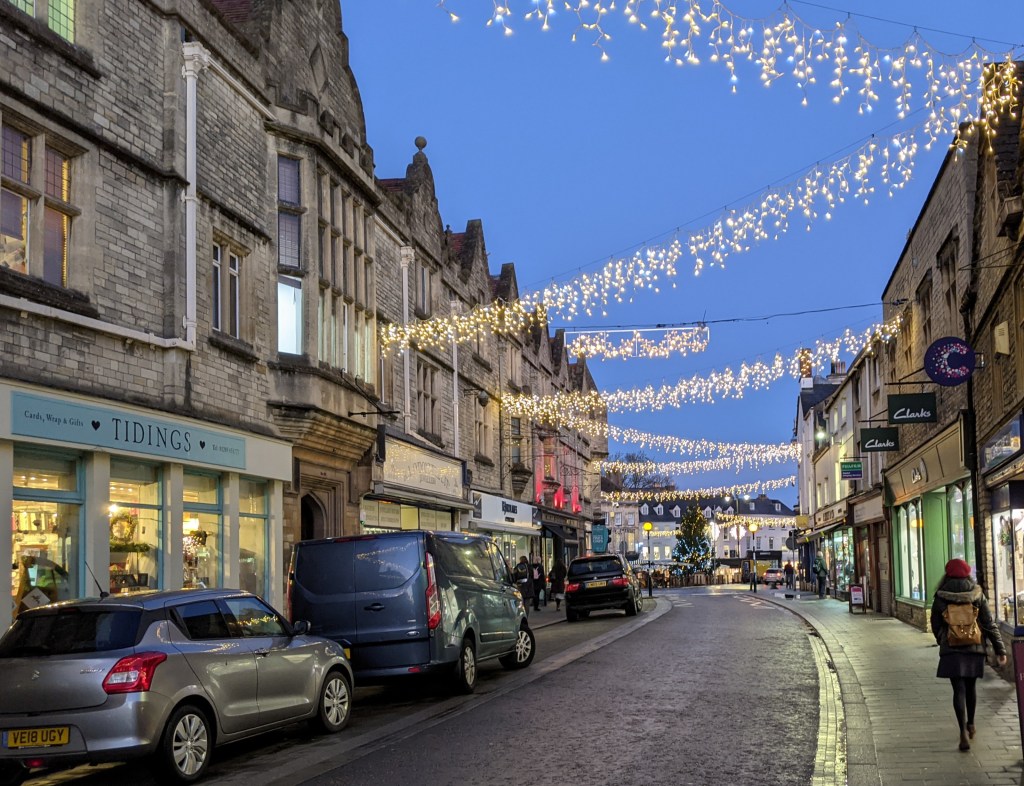
Castle Street in Cirencester

Season’s greetings to all my readers! Cirencester is showing off its tasteful street decorations once again, the days are short, the nights are long, and it’s good to be out and about to see it all and just as good to get back to a warm house afterwards.

My thoughts are especially with those who have no warm house to come back to this year, there are so many – the homeless sleeping alone in shop doorways, refugees desperately crossing the sea and hoping for asylum, and people who do have a roof over their heads but lack money for presents for the children or depend on food banks for their next meal.

Life can be wonderful, fun, exciting. It can also be tough, exhausting, and depressing. Whoever you are, whatever your circumstances, my prayer and hope is that people will be kind to you, there will be new opportunities in your life, and that there’ll be reasons to hope and overcome the difficulties.

And if your life is comfortable and you have more than enough, my prayer and hope is that you will be kind to others, search out new opportunities for them, and provide reasons for hope and ways to overcome difficulties.

None of us can solve all of the problems; but all of us can solve some of the problems.

Some ideas:

And don’t forget to enjoy Christmas with your friends and family. Grace and peace to you all.

PS – As a reward for reading to the end, here’s a bonus – A Christmas Song!

Other years

2025, 2024, 2023202220212020
2019201820172016