It’s likely the cracking will have been caused by differential thermal expansion and contraction with the iron changing its dimenions rather more than the ceramic glaze.
What’s in an image? Sometimes quite a lot, more than meets the eye. I’m posting an image every few days.
Click images to enlarge
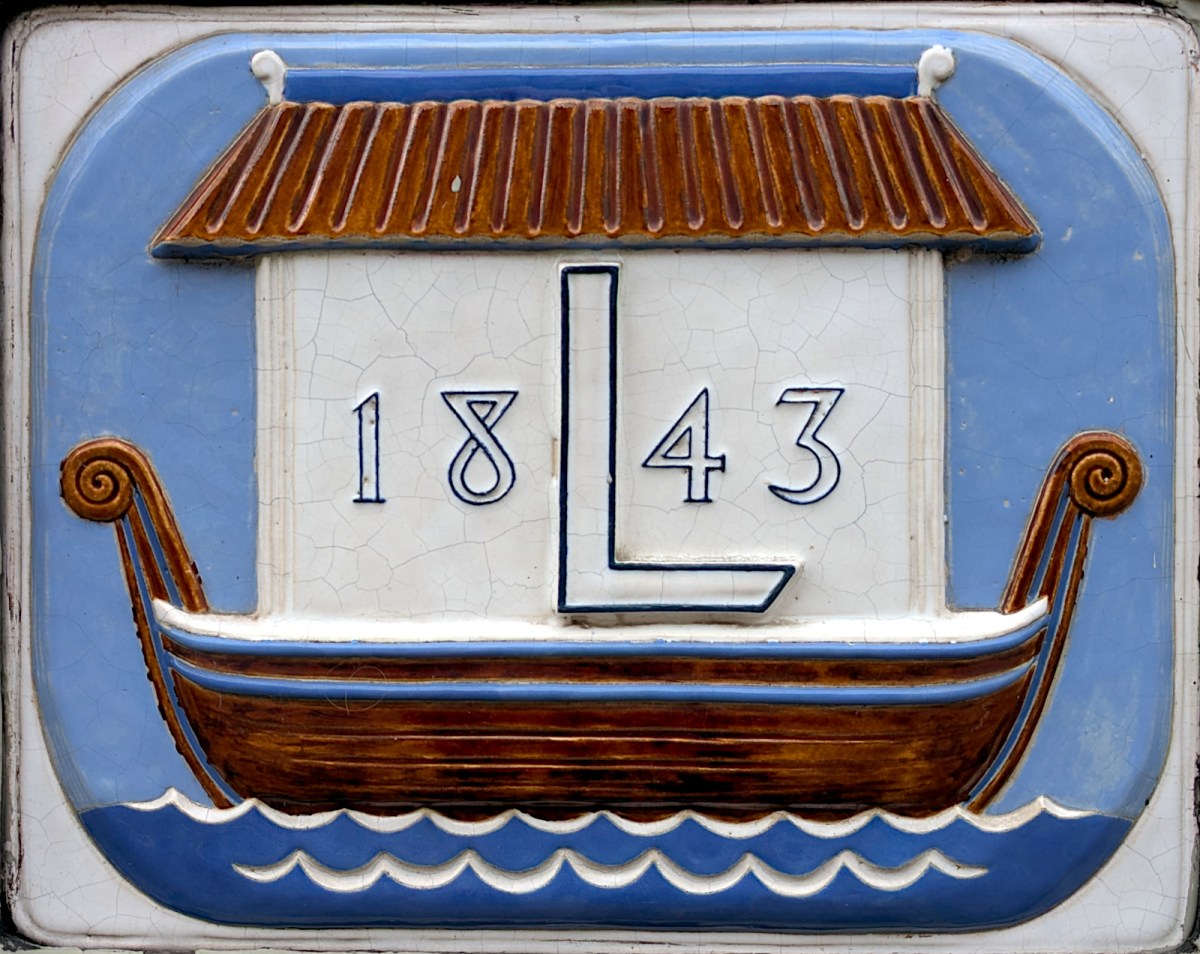
This is one of the old brewery plaques, once numerous across Britain. This example is in Castle Street, outside The Brewers Arms, not far from the junction with Querns Lane and Lewis Lane.
Arkell’s Brewery
The brewery originated in 1843, the year on the plaque. It was founded in Swindon by John Arkell, remains family-owned and operates as one of the oldest remaining brewery companies in Britain.
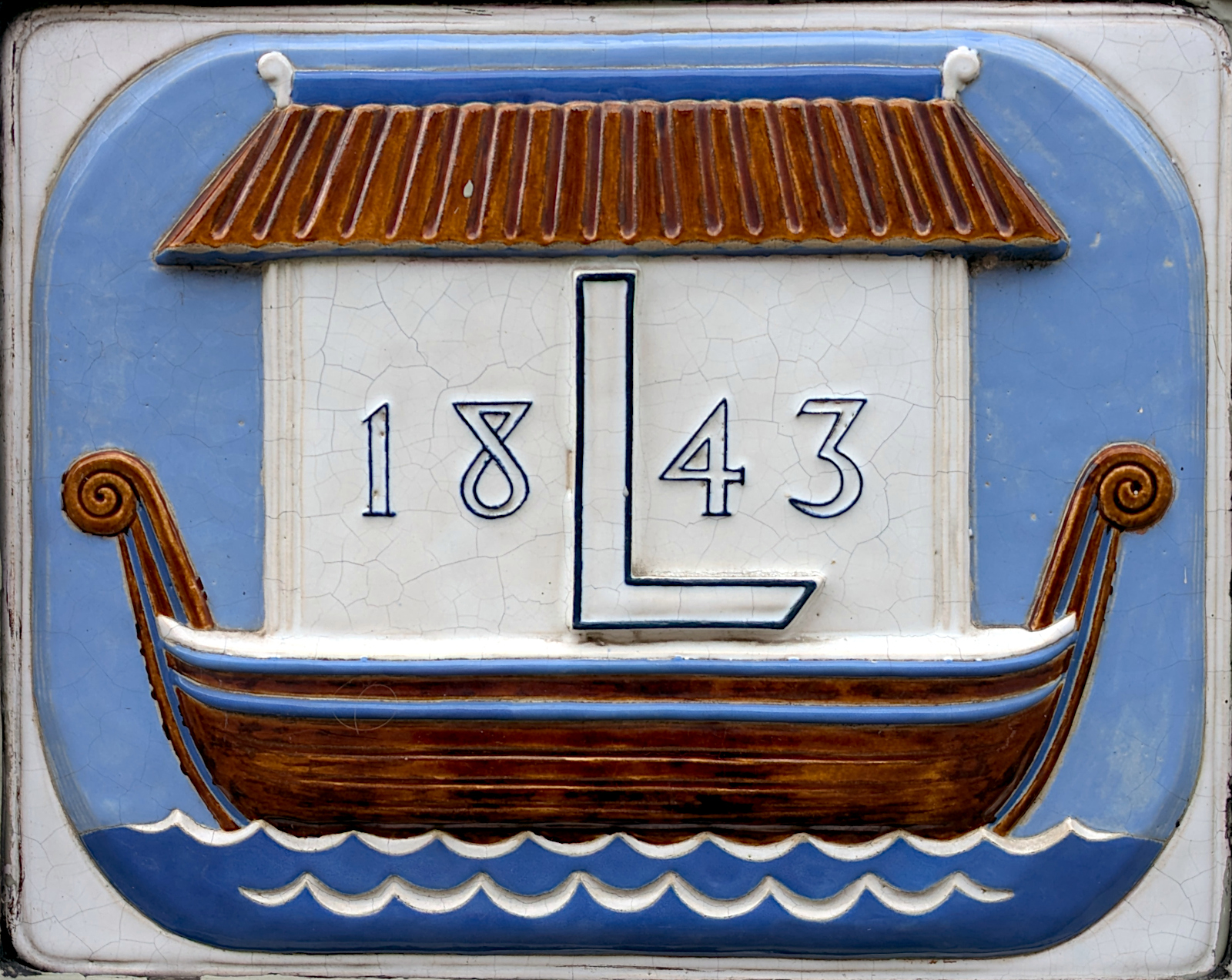
The plaque is probably of cast iron with enamel decoration and apart from some cracks seems to be in almost perfect condition. It’s likely the cracking will have been caused by differential thermal expansion and contraction with the iron changing its dimenions rather more than the ceramic glaze. The plaque has seen more than 180 day/night cycles in its time!
Brasso
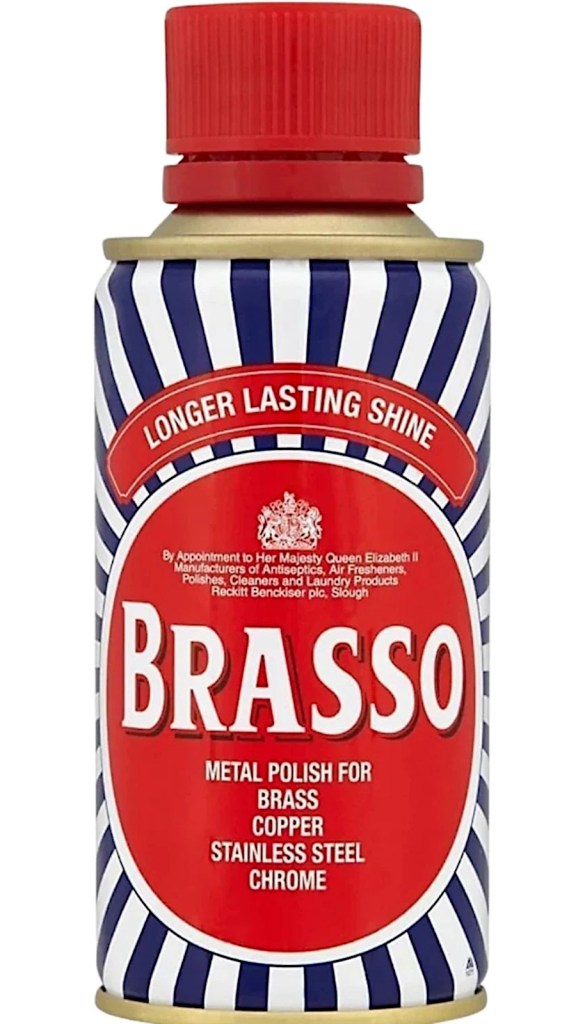
The image is of Noah’s ark with a large capital letter ‘L’, so a play on Arkell (‘arkL’). There’s a long history of businesses advertising their presence with logos and other illustrations, it happens in all nations and cultures, sometimes the themes, names and images employed can become quite famous and long-lived. When I was a young child, Brasso (a British brass polish) was sold in steel containers with blue and white rays coming out in all directions. It’s still available today in cans with the same design. And it probably looked just the same in Victorian times as well! When I was young it was fitted with a low-profile, steel screw-cap, today it has a much larger, plastic cap. Otherwise, it looks identical to me.
If you enjoyed this or found it useful, please like, comment, and share below. (If you don’t see those links, click the article’s title above the main photo and they will appear.) Send a link to friends who might enjoy the article or benefit from it – Thanks! My material is free to reuse (see conditions), but a coffee is always welcome and encourages me to write more often!
The simplest and cheapest way to travel would have been to walk, and people often did exactly that. For an example look no further than the old story of Dick Whittington.
What’s in an image? Sometimes quite a lot, more than meets the eye. I’m posting an image every few days.
Click images to enlarge
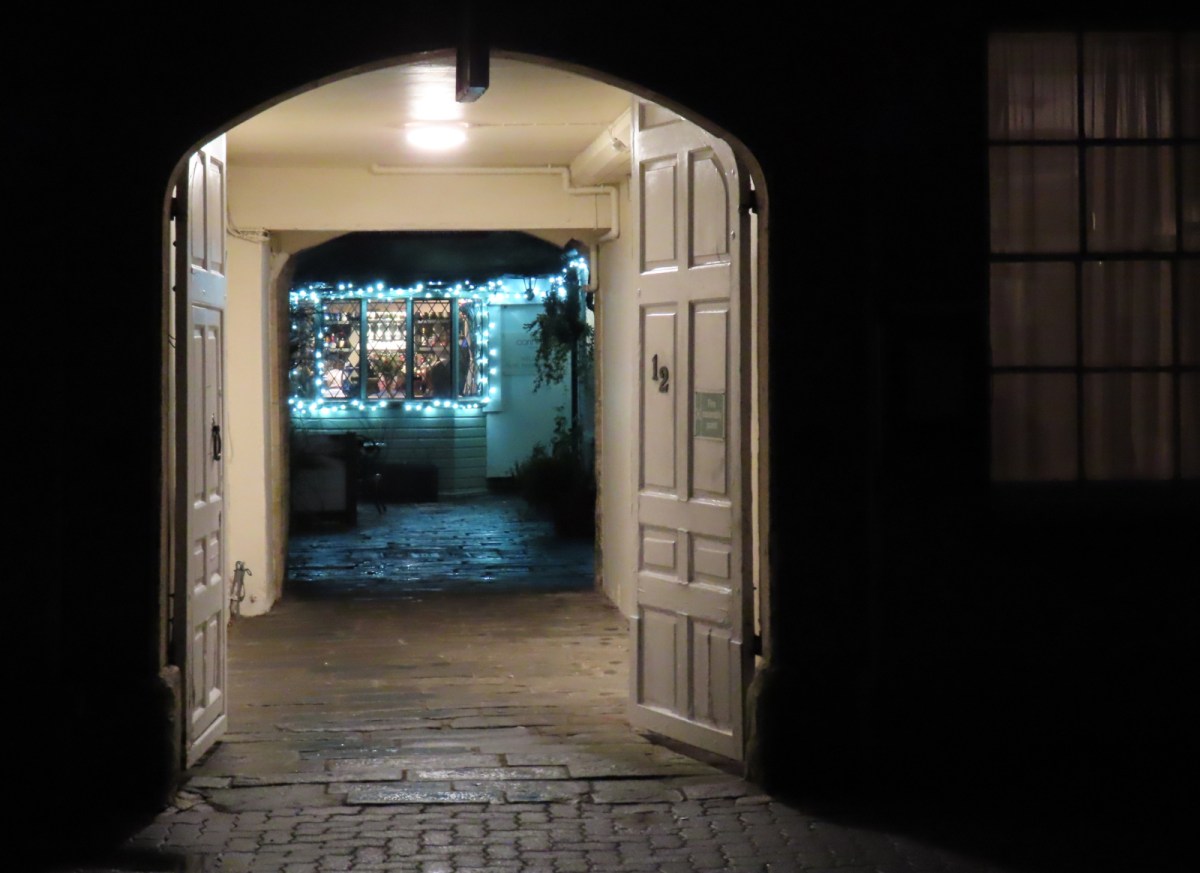
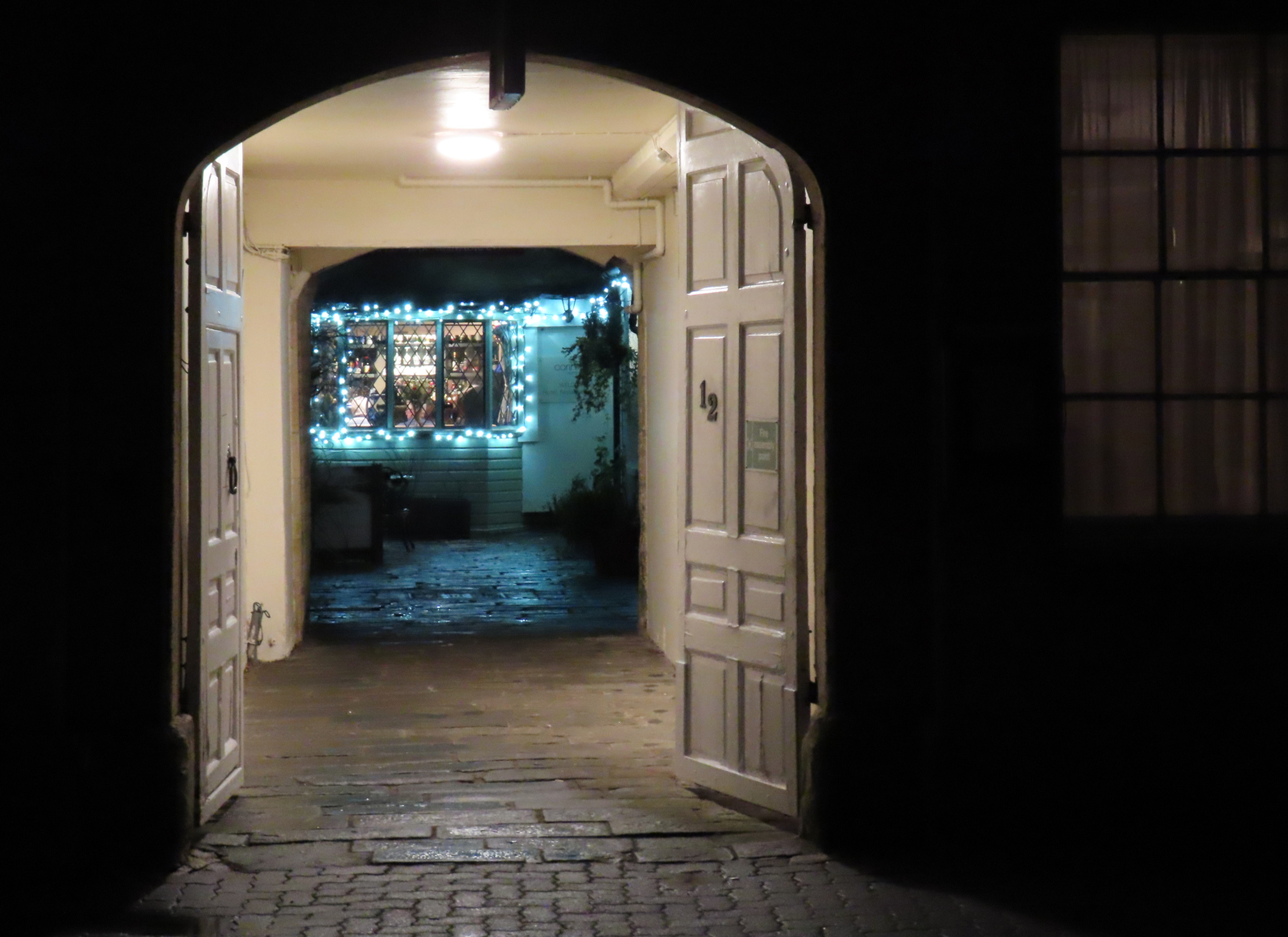
This photo was taken in Cirencester, peering in through an entrance to a courtyard beyond. If you are familiar with the town, I wonder if you know where this is? *The answer is at the bottom of the post.
There’s an invitation in this photo
That’s why I called it ‘Come right in!’ There seems to be an unspoken welcome here. What appeals to you most in this picture? Is it the warmth of the light? Or perhaps the sparkle of the decorative lights at the far end? Or the open doors beckoning you to enter? In days of yore, this double doorway might have allowed a horse to be brought inside for stabling, feeding, watering and grooming to recover for use the following day. The carriage would have remained on the street outside.
‘Days of yore’, this funny old expression is a poetical way of saying long ago. ‘yore’ is an Old English word closely related to the modern word ‘year’. So the sense is ‘in the days of years ago’. There’s a large garden at the back of the hotel, with a lawn scattered with tables and chairs, a lovely place to eat and drink with friends or family in the summer months. I imagine the horses sometimes being turned out to graze in a grassy field here, what a treat for them!
Shelter for travellers
Travelling on horseback or by horse and carriage was a slow affair, requiring regular stops for meals or to shelter for the night, and that’s why the old routes between towns in Britain are liberally scattered with pubs, inns and hostels. Practically every village of hamlet would have had one and towns would have had many more. They’re not hard to spot, although these days many have been converted to other uses.
It wouldn’t always have been necessary to pay for accommodation, friends or family along or near the route would have made travellers welcome and on dry, warm, summer nights it would have been possible to pull off the main roads and sleep outside or in the carriage. The simplest and cheapest way to travel would have been to walk, and people often did exactly that. For an example look no further than the old story of Dick Whittington. In Roman times there were parallel systems for official/military and public use. Every 30 to 50 km (a day’s journey) there were mansiones or official stops with good accomodation, fresh horses, dining areas, and perhaps even baths. And between these were mutationes, (literally ‘changes’) for a brief stop, a fresh horse, and perhaps some refreshments but without overnight facilities. Non-official, privately run facilities included cauponae and tabernae, some of these were a bit rough and disreputable, some were well appointed with courtyards, kitchens, and decorated dining rooms. Several modern English terms come from these words – mansion, mutation, and tavern are notable.
The Bible is usually regarded as a religious book, but it’s also a good historical source as well. Read the book of Acts, for example, to get a good idea of what travel by land and sea was like 2000 years ago. See for example Acts 28:11-16 where a place near Rome called ‘Three Taverns’ is mentioned (Tres Tabernae).
* It’s the Corinium Hotel in Gloucester Street, once the Corinium Court Hotel.
If you enjoyed this or found it useful, please like, comment, and share below. (If you don’t see those links, click the article’s title above the main photo and they will appear.) Send a link to friends who might enjoy the article or benefit from it – Thanks! My material is free to reuse (see conditions), but a coffee is always welcome and encourages me to write more often!
The idea of a wool market is an appropriate one for the town; in medieval times the wool trade was of high importance in the Cotswolds where a series of wool towns developed, of which Cirencester was the largest.
What’s in an image? Sometimes quite a lot, more than meets the eye. I’m posting an image every few days.
Woolmarket (click images to enlarge)
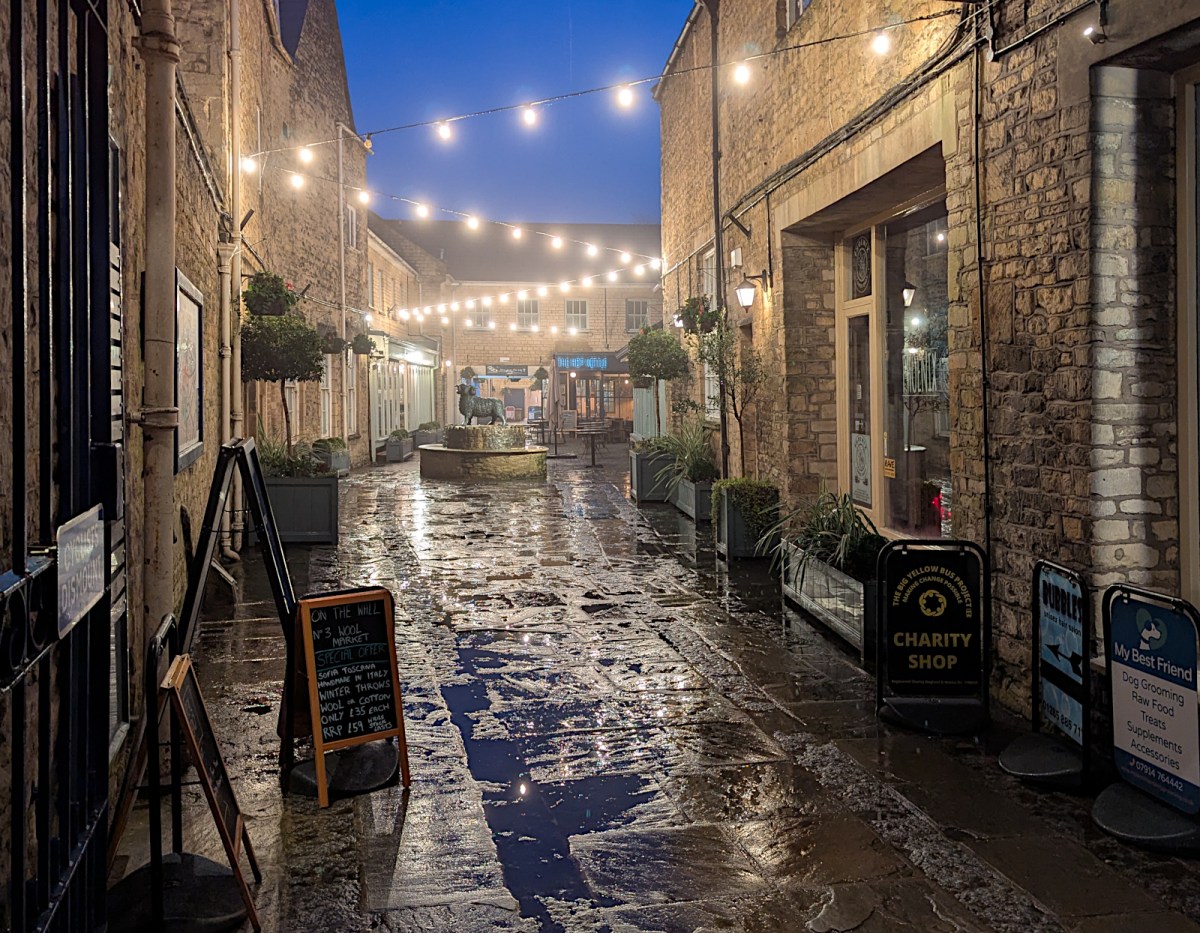
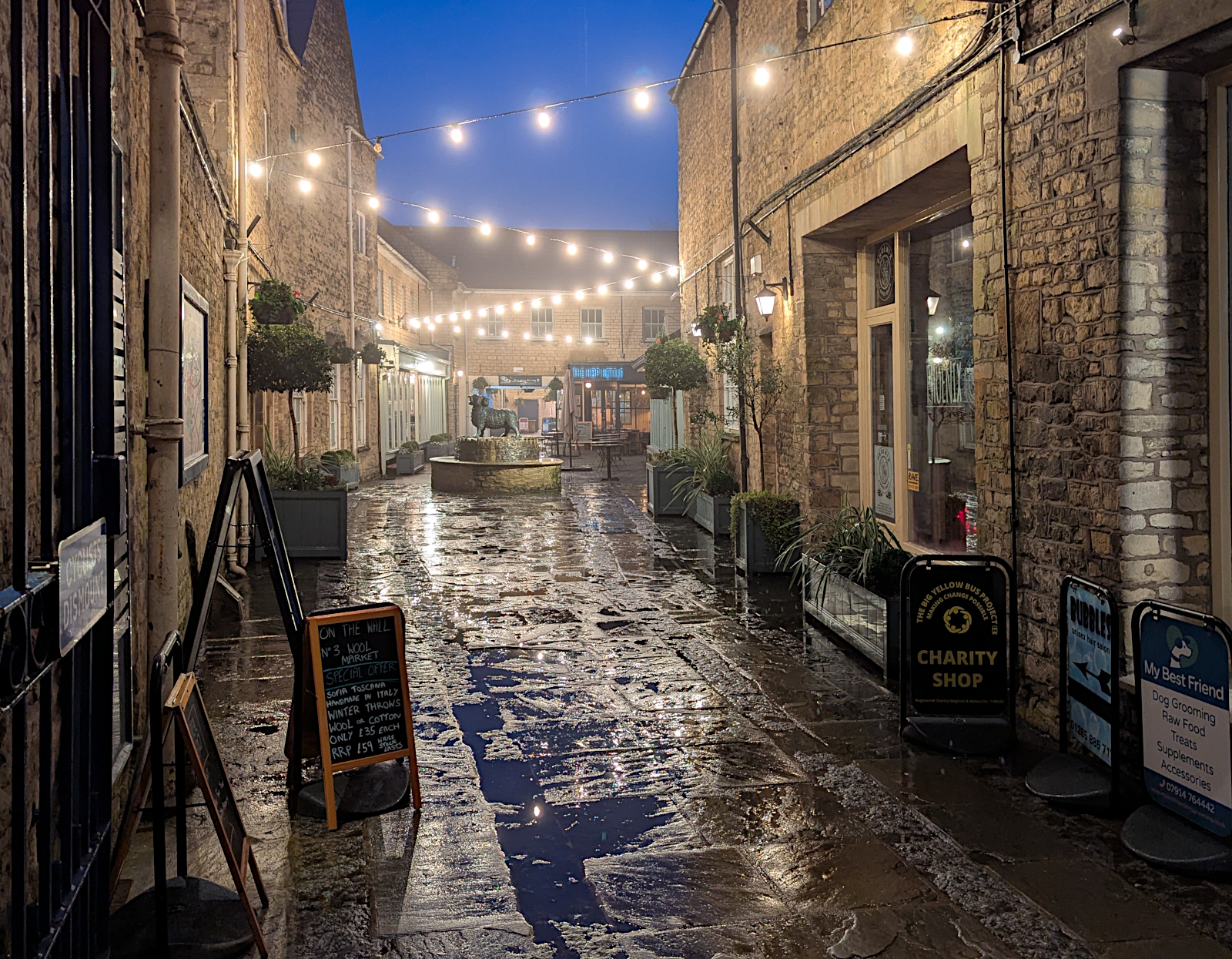
The Woolmarket is a small shopping area between Dyer Street and The Waterloo in Cirencester. It looks old, it’s presented as old, but in fact it’s a relatively recent development, created in the 1980s and further improved in 1996. The idea of a wool market is an appropriate one for the town; in medieval times the wool trade was of high importance in the Cotswolds where a series of wool towns developed, of which Cirencester was the largest. The town’s Parish Church of John Baptist was built and extended in part with money from the wool trade as was the old Abbey before it.
Many of the Georgian frontages around the centre of the town began their lives as the homes of wealthy wool merchants. They are now mostly offices or flats, and sometimes have the ground floors replaced by retail businesses with large windows for display. But look up and you’ll see right away two or three floors of Georgian architecture above those ground floors.
The photo
I took this photo on a wet evening on 18th January 2026, the paving slabs of natural stone glistening in the overhead lighting and the more distant buildings softened by descending mist as the damp atmosphere cooled down following sunset. It’s very typical of January in the Cotswolds. Sometimes we get snow, and heavy frosts are possible, but often it’s just a chill damp with muddy fields and foggy mornings.
The sheep statue
In the middle of the photo, look into the middle distance and you may spot the statue of a traditional Cotswold Lion sheep. This famous old breed was once widespread across a huge expanse of the Cotswolds, though now it is a rarity.
If you enjoyed this or found it useful, please like, comment, and share below. (If you don’t see those links, click the article’s title above the main photo and they will appear.) Send a link to friends who might enjoy the article or benefit from it – Thanks! My material is free to reuse (see conditions), but a coffee is always welcome and encourages me to write more often!
You see the lights and you might hear the engine or the sound of the tyres on the road surface. But there’s no way you could tell the make and model of the car. The details are hidden.
What’s in an image? Sometimes quite a lot, more than meets the eye. I’m posting an image every few days.
Click images to enlarge
Sometimes it’s foggy in Cirencester. The Cotswolds is in the south-west of England and the prevailing winds come from the south-west and are laden with water vapour after crossing the Atlantic. As the air rises over the Cotswolds and other hilly country, some of that water vapour condenses as rain and some as fog. Once the sun appears, any mist or fog clears away with the rising temperature.
It’s all in the detail
As you look at the scene in the photo, you’ll notice right away that the fog obscures details on the church tower while the details on the nearer, and much less tall buildings in the foreground are quite sharp. This is always the way of things in foggy conditions. Nearby objects reveal more detail than those further away. If you stood near the base of the tower and looked towards the top you’d see the same thing. Stonework at the same level as your head would be clear, but raise your gaze to the top of the tower and you’d see few details. In heavy fog you might not see the top of the tower at all.
This is a great illustrative parallel of our ability to see spiritual details too. Look at the people around you and you see a lot of detail – hair colour, eye colour, style of hair, details of clothing , now look up and the detail seems to vanish. The Bible tells us that the Creator is hidden in dark clouds. The English words dark and darkness didn’t traditionally mean an absence of light, the sense was of something hidden from view. When you look into the headlights of a car coming towards you at night you see the lights and you might hear the engine or the sound of the tyres on the road surface. But there’s no way you could tell the make and model of the car. The details are hidden although (or even because) there’s so much light.
Yahweh (God) is like that too, as you get to know him the first thing you’ll understand is the simplest thing of all – he is there! Just an indistinct outline in the distance. As you draw closer, gradually you’ll begin to see how brightly he shines, but spend some time with him and more detail will appear, not what he looks like because he’s not a physical object in our universe, but you’ll start to see that he consists of a pure love, you’ll notice that he cares deeply about everyone, not just his followers, that he is the source of such things as peace, and grace, and joy, and that he knows you better than you know yourself. This experience feels very like walking towards an object almost invisible in the fog and discovering it to be a beautiful tree or an an amazing building. And the closer you get, the more detail you can distinguish – the veins on the leaves or the surface details in the stone.
Making a start
But how can you begin to know him? Where do you start? The answer is simple, begin right where you are right now. Start by noticing that the people you know (and you yourself) have a threefold nature. You are physical, like a stone or a puddle of water, but you also have a mind – utterly unlike a stone or a puddle! Is it so surprising, then, that there’s a third dimension to your existence and nature? These dimensions overlap yet they are distinct.
Your physical presence can be measured just like that of a stone, you have a certain size, shape, and mass, if you’re in motion you have measurable velocity, direction of movement, momentum and so forth. You possess colour and reflectivity. But overlapping with this physical presence are your senses of touch, sight, hearing and the rest.
The stone lacks these abilities. You have a brain that constantly evaluates the information coming from your senses and combines them into knowledge of your environment. This makes you aware of other objects (don’t trip over that stone, don’t step in that puddle), other lifeforms (chase away the fly that has landed on your arm, don’t step on that frog on the footpath), other people (talk to your neighbour, pay for the item you just bought, wave to your friend across the road, ask for directions).
Pushing through the fog
And that third dimension? Most of the overlap here is with your emotions, the love you feel for family and close friends, the fears you entertain (fear of death, fear of injury, fear of loss). There’s a spiritual element to your nature that overlaps mere emotion and goes way beyond feelings. This is another dimension that you can explore and it’s part of our nature that we sometimes fail to consider and rarely, if ever, visit.
So go there, move towards that somewhat foggy zone and the further you go, the more you will see. And I can assure you, the more you see the more you’ll be drawn along to explore further because what you find will be delightful, encouraging and fulfilling. And remember, in the fog, the further and higher you look the less you will see. But go closer and the details will become clearer. Drawing close is the only way to deal with fog.
And there’s a huge additional advantage, the physical and the mental aspects of your existence will pass away, the atoms of your body will be recycled, dispersed, and used to construct other things. But the overlapping spiritual aspects remain, because they are not dependent on the physical world in any way, they remain.
If you enjoyed this or found it useful, please like, comment, and share below. (If you don’t see those links, click the article’s title above the main photo and they will appear.) Send a link to friends who might enjoy the article or benefit from it – Thanks! My material is free to reuse (see conditions), but a coffee is always welcome and encourages me to write more often!
Put an upturned bucket over a patch of grass in your garden. Lift the bucket every day and take a look, then re-cover the patch… How long does it take for the grass to die?
What’s in an image? Sometimes quite a lot, more than meets the eye. I’m posting an image every few days.
Click to enlarge
Trees provide shade, most welcome on a hot day, and they provide shelter when it rains (though this may be unwise during thunderstorms).
But notice the absence of grass beneath these conifers. Shade and shelter are exactly what other plants don’t need; they depend on plenty of light and water to enable them to grow. Light is essential as it provides the energy to split water into hydrogen and oxygen, and water is essential as the raw material for this process. The oxygen is released into the atmosphere, while the hydrogen is bonded with carbon dioxide from the atmosphere to make energy-storing sugars for use at night and to build cellulose, the main support molecule that gives stems, branches and tree trunks their strength.
The lack of light and water under tree canopies creates a kind of local desert. You can see this clearly in the photo from the presence and absence of grass. So how do the trees survive? That’s a great question! Their roots spread out widely and deep, far enough to reach moist soil and deep ground water. In persistent rain, water drips from the drenched leaves above. And root, trunk and branch all contain stores of water so a tree can cope with a long, dry summer far better than the grass can.
Light
Here’s an experiment anyone can do. Put an upturned bucket over a patch of grass in your garden. Lift the bucket every day and take a look, then re-cover the patch. See how long it takes for the grass to turn yellow. How long does it take for the grass to die?
For plants, light is essential. There are some animals that live in dark caves or underground, with no light. Earthworms are a good example, but like all animals they get their food by consuming plants and other animals. But for most creatures, including us humans, light is essential nonetheless. Whether we are plant eaters (like cows and sheep) or meat eaters (like lions and wolves) or omnivores eating either or both (like humans and rats) we still need light to see in order to find and identify the things we must eat to stay alive.
Water
For plants, water is part of their ‘food’, it’s needed to make sugars. For animals water is of no value as food, but it’s essential to prevent dangerous dehydration. All animals know when they’re thirsty and they’ll find water and drink to keep themselves alive. Think of a man lost in a desert, the cartoons have him croaking out, ‘Water.. Water..’ Imagine someone unable to find water, they’d die of thirst long, long before they died of hunger. Most of us would be in danger after a few days without drinking, but we could live for several weeks with nothing to eat. And of course, if you are a fish too little water would mean you couldn’t breathe, and if you were a land animal too much would mean you would drown.
Spiritual (not religious)
The idea of essentials has been carried over into spiritual ideas too. Light and water (and food) are so clearly necessary for life that they make good analogies and illustrations. What did Jesus mean when he said, ‘I am the way, the truth and the life’? Or when he explained to the Samaritan woman at the well that he would provide water that never runs out, or when he told his followers, ‘I am the bread of life’ or ‘I am the light of the world’?
He was simply saying, I am essential, you can’t live without me. I’m necessary for life. Just as in the physical world, how would it feel to live in the dark, without water and without sustenance? How long would you last? How long would I last?
Many people today feel sure there is no spiritual aspect to life at all, it’s just about living your life in the here and now and then dying from accident, illness, or just old age. Others think there’s much more to life than that. At the very least there are moral and philosophical truths to consider. We should care for one another, help one another, and cooperate in helpful and kind ways.
Food for thought. Let me know below how you think about the essentials of life. Do you have any thoughts to share on this?
If you enjoyed this or found it useful, please like, comment, and share below. (If you don’t see those links, click the article’s title above the main photo and they will appear.) Send a link to friends who might enjoy the article or benefit from it – Thanks! My material is free to reuse (see conditions), but a coffee is always welcome and encourages me to write more often!