Cease fires and talks

Effectively, action in the Black Sea is practically over anyway. Ukraine has sunk half of Russia’s Black Sea Fleet and the survivors have fled to the Caspian Sea. (Ukraine 1, Russia 0.)

Forward look, ukraine – 6

< Previous | Index | Next >

Larger view
(Wikimedia)

March 2025

Representatives of the American president, Donald Trump, have been talking with both Russian and Ukrainian representatives in an attempt to end the war. Trump repeatedly claims, ‘This war would never have happened if I’d been president’, and further claimed that he’d be able to end it in 24 hours once he was in office. The first claim cannot be tested, but no evidence has been presented as to how the war might have been averted. And the second claim was, at best, wishful thinking; Trump has had a lot longer than 24 hours but there’s still no sign of the war ending any time soon.

What is being discussed between the USA and Russia and between the USA and Ukraine is still only partly clear, but the best we can hope for in the near-term is some kind of Black Sea ceasefire and a 30-day stoppage of attacks on energy systems. It’s hardly the kind of complete ceasefire (‘end the killing’) that Donald Trump promised us!

But when you look a little deeper there are issues that would be obvious to anyone who is a good negotiator. Effectively, action in the Black Sea is practically over anyway. Ukraine has sunk half of Russia’s Black Sea Fleet and the survivors have fled to the Caspian Sea. (Ukraine 1, Russia 0.) And Russia will wriggle and squirm endlessly to avoid an energy ceasefire. Putin wants to seem agreeable to the ceasefire to appease Trump, but he doesn’t want to actually sign on the dotted line because he thinks he’s winning the energy battle. (He’s not.) Nor are Trump’s offers to Putin entirely within his gift. No NATO countries involved? No Western troops in Ukraine? No more weapons or ammunition for Ukraine? Sorry Mr Trump, Europe will not necessarily do your bidding over this. French and British forces might be there sooner than you think. Macron is making announcements as I write; you cannot make a gift unless you’re holding it in your hand. (And you’re not holding it.)

What will happen next?

That is, of course, the big question. I can give my thoughts, but nothing is certain.

Let’s start with what we know.

  • If Putin is winning this war, he doing it in a very curious way. So far, his initial take-over bid was stopped and then substantially pushed back by Ukraine. He’s lost 900 000 troops, killed or seriously wounded. He’s lost the vast bulk of his armoured vehicles, tanks, trucks, ships in the Black Sea, artillery, radar equipment, anti aircraft missiles, and many aircraft and helicopters.
  • Energy infrastructure has been severely damaged in both countries, particularly electrical systems in Ukraine; and oil and gas production, transport, refining and storage facilities in Russia.
  • Militarily, Russia has been seriously weakened while Ukraine has become stronger. Ukraine develops and manufactures cruise missiles and drones that are flying further and further into Russian territory.
  • Ukraine is innovating rapidly, and faster than Russia. This is noticeable in the first person view (FPV) drone technology, but also in the longer distance technologies and in sea-drones.
  • Ukraine has focused on specific kinds of target to great effect, taking out much of Russia’s air defence, enabling a greater proportion of attacks to get through undetected.
  • There are clear signs that Ukraine is getting the upper hand along the lines of contact. For a long time, Russia has been making very slow, but continuous progress (though at very great cost). Recently there have been signs that Ukraine might get the upper hand, Russian progress has slowed almost everywhere, stalled in some places, and Ukraine has been able to take back some ground in several areas. This gadual reversal of Russian success will likely become faster as the summer proceeds.
  • The Russian economy is in a really poor state and slowly getting worse, not better. This too could well be a trend that will become a fatal crash within the next twelve months or so.

In terms of Trump’s efforts to curry favour with Russia and crush Ukraine – because that is how I interpret what is going on – there is an elephant in the room. It may not be a truly heavyweight elephant, but Europe (and I include the UK here, as well as other allies like Canada, Japan, Australia, South Korea) has no wish to stop supporting Ukraine. Continued supply of weapons, ammunition, electricity and financial help from Europe and her friends may just be something Trump cannot influence very much. He can make offers and promises to Putin, but can he force the rest of us into line? I have no doubt he’ll try, but at the same time I very much doubt he’ll succeed.

In summary

The short term prospects for Ukraine are more pain, more suffering, and significant struggles to deal with both Russia (miltarily) and America (politically).

But I do believe the longer term prospects are much brighter. Ukraine can become an important part of Europe, a member of the EU, with a strong economy and strong armed forces, contributing culturally, economically and acting in concert with other states bordering Russia as a bulwark against Russian expansionism.

Slava Ukraini! Heroyam slava!

See also:

Here are just three of the many sources of information out there.

< Previous | Index | Next >

Useful? Interesting?

If you enjoyed this or found it useful, please like, comment, and share below. My material is free to reuse (see conditions), but a coffee is always welcome!

Political turmoil in the USA

[A] wider war is possible. There’s a real possibility of a European conflict between Russia and the rest of Europe. There’s a chance of civil war between opposing groups within the Russian Federation.

Forward look, ukraine – 5

< Previous | Index | Next >

Larger view
(Wikimedia)

Feb 2025

So much has changed since our last Forward Look.

The world has seen political turmoil in the USA where President Trump has taken over from Biden. When you stick a spade into an ant’s nest and turn the soil over, there’s a period of frantic activity while the ants go into emergency mode, assess the damage, and begin to rescue whatever they can from the mayhem. That is the USA in February 2025.

And make no mistake, a frantic USA spells trouble for Ukraine, for the whole of Europe (I include the UK here), and perhaps for Russia and China as well. Predicting anything at this stage is about as useful as predicting the result of a horse race without knowing the length or nature of the course or the form of any of the horses.

But what I can say, is that wider war is possible. There’s a real danger of a European conflict between Russia and the rest of Europe. There’s a chance of civil war between opposing groups within the Russian Federation, and there are also possibilities of a second civil war in the USA and/or a third world war. I fervently hope that none of these things will happen, but events rarely take account of our hopes.

We’re going take a wider look at things here because so much has changed in such a short period of time.

First, let’s just catch up on the current state of the war between the invading Russians and the defending Ukrainians.

Russian and Ukrainian war efforts

Russia is finding it more and more difficult to continue the war. Russian casualties (dead and seriously wounded) are growing close to a million. The Russian economy is in an awful state, 40% of the state budget is being spent on the war. Inflation is rampant, interest rates are extremely high, many professional people have fled the country and Ukraine is systematically destroying Russian oil pipelines, distilleries, fuel storage installations and transport infrastructure, military air bases, radar systems, training facilities and military headquarters.

The much touted Russian ‘advance’ in Ukraine has all but stalled and, in some places, has reversed to retreat. The once feared ‘second most powerful army in the world’ has been fighting against a much smaller neighbour for three years and has failed to win. Hardly an impressive display of military might! Russia has lost most of its huge military power at sea, in the air, and on land. They continue to lose between 1000 and 2000 troops every single day. They have lost almost all their tanks and armed personnel carriers and are unable to replace them as fast as they are losing them.

Ukraine on the other hand has been getting better and better at defeating Russian attacks using a combination of high tech drones, great planning and anticipation, nimble action, good training, surprise, and constant technical innovation.

They continue to defend successfully against most incoming drones and missiles. As long as they continue to receive sufficient support, they will, I believe, continue to succeed and will eventually defeat Russia. In their favour is the fact that they and some of their European allies continue to ramp up the production of both weapons and ammunition to levels sufficient to defeat demoralised Russian forces – themselves facing more and more serious shortages of such materiel.

The political climate in February/March 2025

Now we have to pause. At the end of February the situation is changing daily, even hourly at times. Rather than try to make any predictions, I think it’s better to point you to some online resources that you can check daily or weekly to keep yourselves informed in such dynamic times.

I’ve mentioned both these sources previously, but here they are again.

  • Jake Broe – Jake posts a video every day or two. He’s a retired US Air Force pilot, so he knows what he’s talking about in military matters, but he is also an astute political observer and commentator. His videos are closely packed with the latest updates, and he provides links with the evidence needed to back up the things he says. There are no wild claims here, just good reporting, intelligent comment and useful material. Jake is well worth hearing and following.
  • Silicon Curtain – Jonathan Fink posts on Silicon Curtain as well as the shorter-form Silicon Bites. Here you’ll find great comment, opinion, and some penetrating, in-depth interviews with other key players and commentators. Every single video is well worth watching.

You will learn so much from these two excellent channels, but there’s a great deal more good material online. Try this YouTube search for recent material, but don’t believe everything you see and hear. The material turned up by the search may be true or false, checked or unchecked. Use your own judgement.

If you prefer the written form, use the same search in Google or another search engine. (Copy and paste this search or a similar one… war in ukraine 2025 latest news …into any search engine.)

See also:

< Previous | Index | Next >

Useful? Interesting?

If you enjoyed this or found it useful, please like, comment, and share below. My material is free to reuse (see conditions), but a coffee is always welcome!

Another message from Yara

Sometimes the worst things are done when the perpetrators are most afraid; and right now I think Putin is very much afraid.

This is a message of despair from a brave Ukrainian lady who deserves so much better. All Ukrainians deserve so much better. Yet I know the despair will be temporary.

A photo from Yara’s message

Yara has an irrepressible nature and despite the terrible circumstances I know she will regain a measure of hope and want to share Ukrainian culture and art with her readers again quite soon.

Please do read her message for today. Below I’ve copied a reply to it that I posted there a few minutes ago. I think there is growing cause for hope, and that’s what I wrote about and want to emphasise.

But before I share that reply: What can you do to help? Visit Yara’s site and take a good look around, read some of her other, more upbeat, messages. Consider becoming a supporting member, buy her a coffee, leave her a reply to one or more of her posts. Contact your government representative asking them to do more. In the UK write to your MP. Hint: Write again after our upcoming elections, you might find you have a different MP.

My reply

Wanting better for you, Yara. Wanting better for Kharkiv. Wanting better for every part of Ukraine.

Sometimes the worst things are done when the perpetrators are most afraid; and right now I think Putin is very much afraid.

Everything in Russia is beginning to fall apart – in fact, more than ‘beginning’. The evidence is everywhere.

  • There is a big shake up in the Russian Army, many senior officers are being arrested, perhaps because Putin fears a coup. Shaking things up does not make an army more effective. Just the opposite.
  • Inflation is ‘under control’ according to Putin. He is ignoring something like 8% inflation per month. How long can he pretend?
  • Crime rates are spiralling out of control.
  • Buildings are collapsing (not bombed, just badly built and lacking maintenance).
  • Roads and railways are broken, water supplies are broken, power supplies are broken, Ukraine is destroying oil refineries. Nothing is being repaired because so many skilled people either left Russia, or have been sent to die in Ukraine.
  • Nearly half the Black Sea Fleet is on holiday, resting peacefully on the sea bed.
  • Aircraft, air defence, airfields are being destroyed daily.
  • The war is going badly, very badly in fact.

What will happen next?

Putin’s time is probably short now, everything is going wrong for him.

Ukraine’s nightmare might end very suddenly, though nobody knows when. It could be in a year’s time, or just a month, or a week, or it might be tomorrow.

None of this affects how you feel right now, so you (like so many in Ukraine) will have to suffer longer. But feelings change day by day, One day, hope will grow like a tree in the springtime. Hope will blossom and flourish. But perhaps not today.

I know you, like all Ukrainians, will cling to hope until it’s no longer needed. Then you will all be able to sing, and dance, and have parties in the street, and then start on the huge task of rebuilding your shattered lives and towns and cities.

Slava Ukraini! Heroyam slava! 🇺🇦 🇺🇦 🇺🇦 🇺🇦 🇺🇦

Complete clarity on Ukraine

The Russian official line is certain to be rejected and disregarded by most governments, by NATO, by the UN, and by people of goodwill

Just take a look at Russia’s current demands for peace with Ukraine, expressed by Dmitry Medvedev. I’m sure you’ll agree that he puts it rather clearly; does this seem reasonable and fair to you?

How Russia treated Mariupol (Wikimedia)

The text below is an extract from today’s ISW report on the war in Ukraine. These are the Russian conditions for peace. It’s the official line, published by Dmitry Medvedev, currently Deputy Chairman of the Russian Security Council. This is what he calls a ‘peace formula’, it does have the merit of leaving us in no doubt about what Russia wants.

Medvedev begins the “peace plan” by rhetorically stripping Ukraine of its sovereignty, referring to it as a “former” country and placing the name Ukraine in quotation marks. Medvedev laid out the points of his “peace formula”, which he sardonically described as “calm”, “realistic”, “humane” and “soft.”

The demands are:

  • Ukraine’s recognition of its military defeat
  • Complete and unconditional Ukrainian surrender
  • Full “demilitarization”
  • Recognition by the entire international community of Ukraine’s “Nazi character”
  • The “denazification” of Ukraine’s government
  • A United Nations (UN) statement stripping Ukraine of its status as a sovereign state under international law
  • A declaration that any successor states to Ukraine will be forbidden to join any military alliances without Russian consent
  • The resignation of all Ukrainian authorities and immediate provisional parliamentary elections
  • Ukrainian reparations to be paid to Russia
  • Official recognition by the interim parliament to be elected following the resignation of Ukraine’s current government that all Ukrainian territory is part of Russia
  • The adoption of a “reunification” act bringing Ukrainian territory into the Russian Federation
  • The dissolution of the provisional parliament
  • UN acceptance of Ukraine’s “reunification” with Russia
Reformatted, extracted from the ISW report for 14th March 2024.

In a sense, this can be taken as a reply to the Pope’s recent statement about Ukraine ‘raising the white flag’. The Pope has since backtracked and clarified his statement, but Medvedev is most unlikely to backtrack his response.

The Russian official line is certain to be rejected and disregarded by most governments, by NATO, by the UN, and by people of goodwill throughout most of the globe. It is not acceptable as a starting point for negotiations of any kind, more a vain wish-list that very few can accept. Why, exactly, would Ukraine ‘recognise its military defeat’ when it is very clearly not defeated? And why does Medvedev think the entire world would ‘recognise’ that Ukraine has a ‘Nazi character’? Most of the world would be more likely to perceive such a character in the Russian government’s imperialist ambitions.

Dmitry Medvedev, and more to the point Vladimir Putin, seem to think they can get away with rewriting history, disregarding truth, invading an internationally recognised member state of the UN, breaking international law, and have the entire world let them get away with it. They are deluded. We will not and must not allow it.

What’s going on in Russia?

How can we get to the reality of life in Russia, when news channels just repeat what the leadership orders or allows?

We are all aware, of course, that there is a war going on between Russia and Ukraine. Russia staged an unprovoked invasion of Ukraine in February 2022; and news of events as they unfold have been presented on TV, radio, newspapers, magazines, and online channels.

We know something about Ukraine, but what do we know about events inside Russia itself? People are aware that Vladimir Putin rules with almost absolute power. He controls the government, the armed forces, and the security organisations. The police and the FSB (just like the Soviet Union’s KGB before them) control almost every aspect of society. Faced with this situation, how can we get to the reality of life in Russia, when news channels just repeat what the leadership orders or allows?

I invite you to look at the Silicon Curtain video below. This particular interview with a Russian expat living in Uzbekistan uncovers some of the internal difficulties currently faced by the Russian people and their government.

Silicon Curtain provides interviews that go deeper than most Western news sources, investigating topics that are not always available by other means. The channel is run by Jonathan Fink who lives in Oxford and read Russian Studies at Edinburgh University. If you find this interview informative and interesting, take a look at the other videos on the Silicon Curtain channel.

Blast from the past… 10

Dad had just bought Mum a battery-powered cat that ‘purred’ when you stroked it.

< Previous | Index | Next >

Notes from bygone years – Lots of past Septembers
Hint: Click on the thumbnails for larger images.

A year ago

I didn’t post to my blog in September 2022, so here’s an extract from my journal for 8th instead. We were on holiday in Wales along with Donna’s Mum, brother Paul and his wife Vanessa. It was an eventful day.

Queen Elizabeth II (Image from Wikimedia)

We drove into Tenby and unexpectedly bumped into our friends Simon and Carol! None of us had any idea we would be in Tenby that day, our friends live in Yorkshire!

At lunchtime I saw reports on my phone mentioning that the Queen’s doctors were concerned about her health. Later in the day her death was announced and it seemed very strange that Prince Charles was now King Charles III. I wrote in my journal:

[Elizabeth II] had such a long reign (the longest of any British Monarch) and she leaves King Charles III as the most aged new Monarch ever. She did her job extraordinarily well. It comes as something of a shock to be writing these words on this day in my journal. It’s a day that seemed always to be delayed and would never actually arrive – yet here it is.

Back in our holiday home in Llantissilio, we watched the news and caught up with some of the details of the day. There was also startling news from Ukraine with Russian forces abandoning a large region in Kherson and retreating in disorder in an even larger region near Kharkiv.

< Aug22Oct22 >

Two years ago

In September 2021 I wrote about a new song from a musician I know, Sarah Reynolds. The theme of the song is that when we seem to be facing defeat and are struggling just to hang on, hope may not be as far off as we imagine.

Take a look at the original post and listen to the song, ‘Wilderness’.

< Aug21Oct21>

Five years ago
Looking at a bisse
Looking at a bisse

In September 2018 we were on holiday with the family in Switzerland. I wrote a blog post about walking the bisses (irrigation streams). It was a fascinating day. Here’s a link to my post.

< Aug18Oct18 >

Ten years ago
An image of the article

In September 2013 I wrote about my project ‘Cruising the Gospel’.

The idea was to help and encourage people to read through the biblical books of Matthew, Mark, Luke and John, considering what we can learn about Jesus and about ourselves as we read. Anyone can follow along, reading and pondering small, manageable chunks along the way. (Read the original article)

< Aug13Oct13 >

Fifteen years ago
Falcon 1 launch (Wikimedia)

On 29th September 2008 I wrote to Elon Musk and SpaceX to congratulate them. Why? Because the previous day had seen them launch their Falcon I rocket successfully – after three consecutive failures! Read my blog post and message.

< Aug08Oct08 >

Twenty years ago
The electric ‘cat’

In September 2003 we visited my parents in Cirencester. Dad had just bought Mum a battery-powered cat that ‘purred’ when you stroked it. Mum loved having a cat, but Dad felt that at their age they shouldn’t have another one after the previous cat died. The pretend ‘cat’ was an amusing compensation, but I don’t think Mum was very convinced!

< Aug03Oct03 >

Twenty-five years ago

In September 1998 we were looking forward a few weeks to a relaxing holiday in Fetiye, Turkey. I’d been to Istanbul briefly on a school trip in December 1964, but I had never been to any other part of the country. A week on the Mediterranean coast sounded great and we hoped the weather would be kind.

< Aug98Oct98 >

Thirty years ago
An email from 1993

In September 1993 I was working as the Microcomputing Manager at Long Ashton Research Station near Bristol. Part of my job involved networking PCs, here’s a message I sent asking for help. Click the image for a larger view.

Notice the ASCII art (text characters used to make larger ‘text’ or images, and the way a reply uses > characters to mark quoted text. All very primitive, all time consuming, and none of it necessary any more.

< Aug93Oct93 >

Thirty-five years ago
Judy’s birthday

The 10th September was Judy’s birthday, and in 1988 Debbie and Beth made her a birthday meal in the evening. It was quite a spread as you can see if you click on the thumbnail.

< Aug88Oct88 >

Forty years ago

In September 1983 we drove over to Cirencester on 17th for Cindy and Paul’s wedding.

< Aug83Oct83 >

Forty-five years ago

The family records are blank in September 1978, the month that Debbie turned 3½. But on the world scene there were some significant events. Menachem Begin and Anwar Sadat discussed peace and signed the Camp David Accords, and 122 rioters died in Tehran when the Shah’s troops opened fire.

< Aug78Oct78 >

Fifty years ago
Jefferies bulb brochure

In late 1973 John Jefferies & Son in Cirencester were preparing their Christmas hyacinth brochure, perhaps in September.

This would be issued later, mailed out to regular customers and available in their shop (now Vodafone) in the Market Place. The bulbs were grown in the dark in the basement of the Tower Street warehouse; the building still exists, converted into flats next to Minerva Court.

< Aug73Oct73 >

Fifty-five years ago

In September 1968 I was about to begin my third year as a student at the University of Bath. It was a sandwich course so required four years to allow for industrial placements.

< Aug68Oct68 >

Sixty years ago

In September 1963 I began my 5th year at Cirencester Grammar School. This was an important year for me and my school friends, with O level mock exams after Christmas and the real O levels to face in June.

< Aug63Sep63 >

Sixty-five years ago

In September 1958 I began my final year at Junior School. This would be the year of the important 11-plus exams that would decide whether we would go to the Grammar School in Victoria Road or to the Secondary Modern at Deerpark.

< Aug58Sep58 >

Seventy years ago
Side entrance to the school

In September 1953 I’d been five for a month or so and I it was time to began my first ever school term. I went to Querns School, and was unhappy when my Mum left me on the first day. I cried later when the teacher told us that we would stop to eat elevenses. This was not a word I knew, and I heard it as ‘lemonses’. What I did know was that lemons are very sharp and I did not want to eat one!

The pupil’s entrance was along the little lane at the side of the school, shown in the photo. I remember walking up and down that lane very clearly indeed.

< Aug53Oct48 >

Seventy-five years ago

In September 1948 I was in my second month of life, and Mum and Dad celebrated their first wedding anniversary. It seems they didn’t waste a whole lot of time! I would have been getting my arms and eyes under better control by this time. Dad was busy with C&DMAC (a model aircraft club). His maternal grandmother’s second husband died on 19th, Dad always knew him as ‘Gramp’.

< Aug48Oct48 >

Eighty years ago

In September 1943 Dad shot a lot of starlings, apparently. He heard that he’d passed his School Certificate successfully, was active in the ATC, and had a busy social life.

< Aug43Oct43 >

< Previous | Index | Next >

Blast from the past… 9

Judy had a job at Bristol University in the Biochemistry Department, while I was working at Long Ashton Research Station on pollination.

< Previous | Index | Next >

Notes from bygone years – Augusts one after another
Hint: Click on the thumbnails for larger images.

A year ago

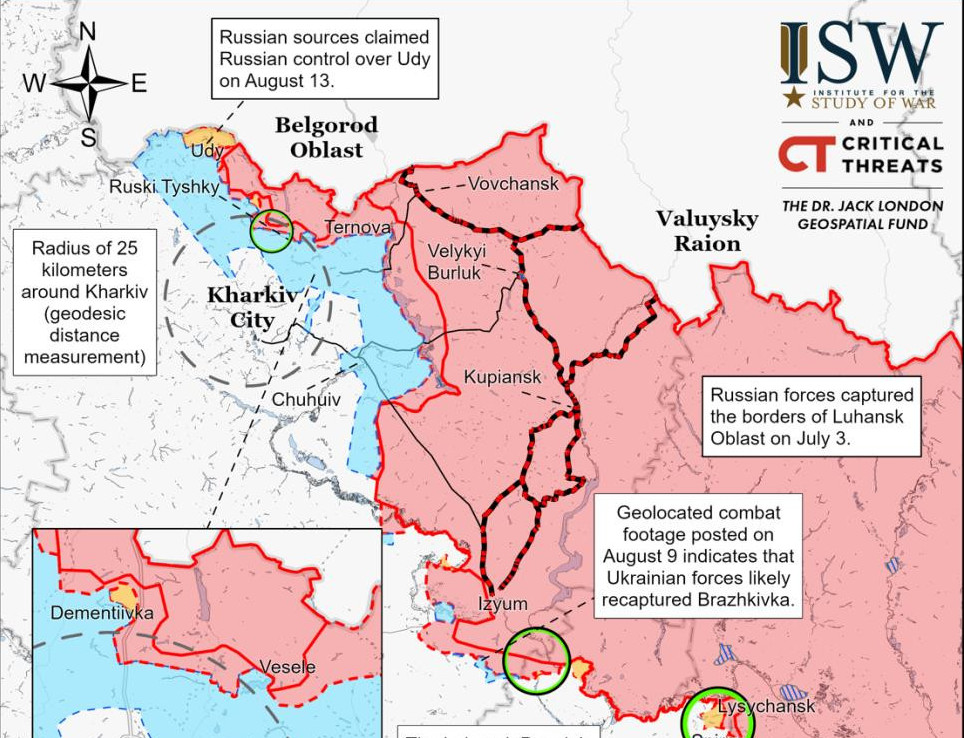
Ukraine was making exceptional progress against the Russian Army’s invasion in August 2022. I was encouraged to see this and wrote in my journal:

‘Ukraine is making serious inroads into the Russian held parts of Kherson and Zaporizhzhia and Russian forces are redeploying from the Luhansk/Donetsk region, and I suspect they’re more vulnerable while moving than they are when dug in. Perhaps Ukraine can keep them shuttling back and forth between the regions, nibbling away at them all the time. But other reports suggest the Russian economy is in serious trouble too, unemployment is severe now and despite higher prices for oil and gas, the profits are down because of reduced sales.’

The map was provided by ISW

A year on, all that remains true, and the Russian economy, army, and politics continue in (probably terminal) decline.

<Jul 2022 Sep 2022>

Two years ago
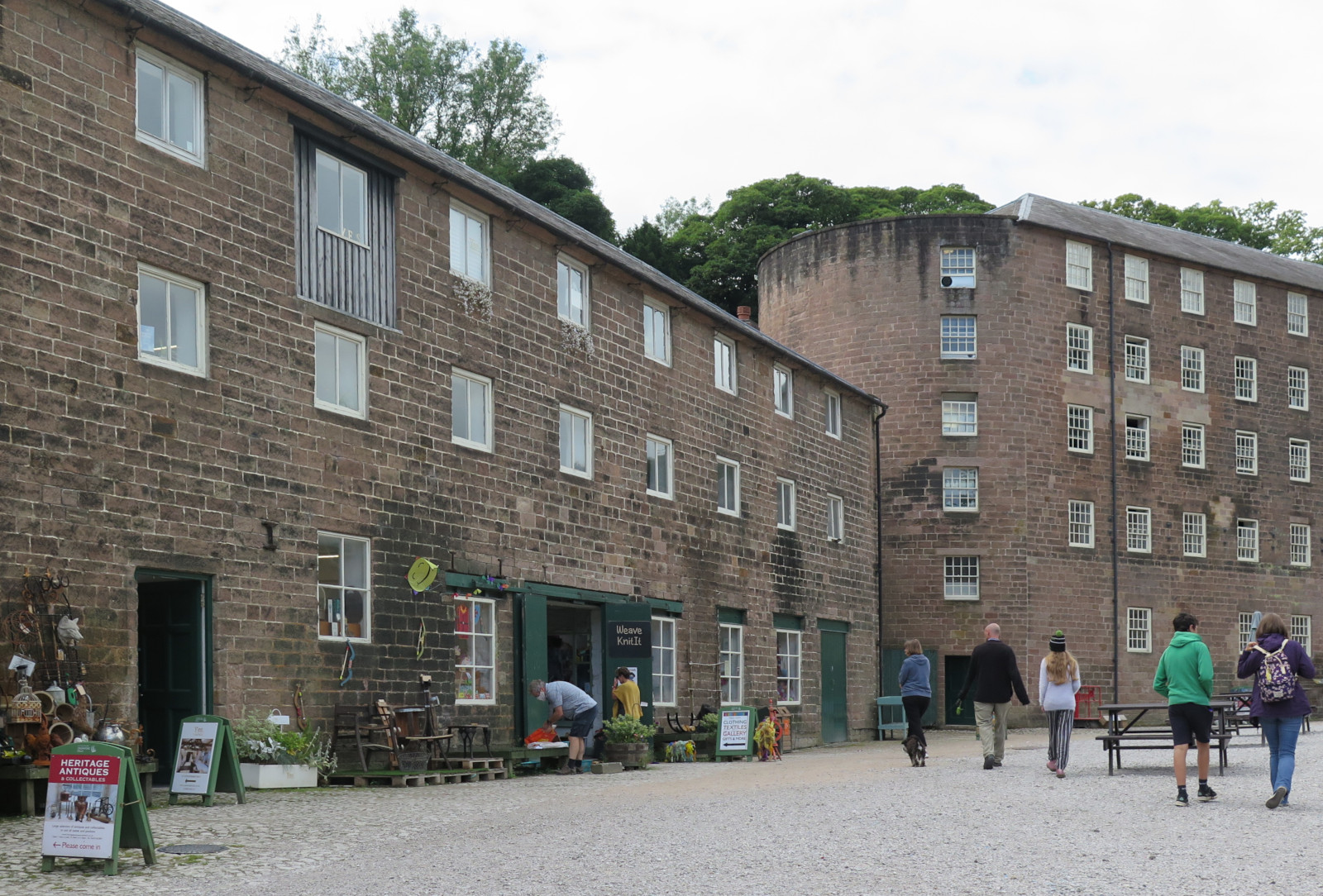
Cromford Mills, partly restored

On 5th August 2021 we were on holiday with the family and visited Cromford Mills where Richard Arkwright built the world’s first water-powered factory to manufacture cotton thread.

It was fascinating to see the buildings and surroundings and to think about the industrial revolution.

<Jul 2021Sep 2021>

Five years ago
The cable car at Tracouet

In August 2018, as in 2021 (above) we were on holiday with the family, this time in Switzerland. Some of us took a cable-car to Tracouet, 850 m above the little town of Nendaz. We walked back down, enjoying some beautiful views; it took around three hours.


<Jul 2018 – Sep 2018>

Ten years ago
Sharing bread

In August 2013 I wrote about the way in which all followers of Jesus are called to be leaders – but perhaps not in quite the way we usually think. (Read the original article)


<Jul 2013 – Sep 2013>

Fifteen years ago
Dan and Kerry

In August 2008 – Dan and Kerry were married and there was a big family party. Fifteen years on Dan and Kerry are going strong, and everyone is that much older. Some of those present on the day are no longer with us, sadly.


<Jul 2008 – Sep 2008>

Twenty years ago
Valleys and mountains

In August 2003 – We met in Eaton Ford and what we were shown has remained with me ever since. The Holy Spirit told us to ‘look out and look up’, and that has turned out to be the best possible advice and guidance in every situation.


<Jul 2003 – Sep 2003>

Twenty-five years ago

In August 1998 – My daughter Beth married Paz (clearly August is a good month for weddings).

Reception in a quarry

The ceremony was held at the register office in Bristol, everyone gathered in Quaker’s Friars and then made our way to the Registry Office together. After the official parts and signing the register, we all left for photos outside.

Then we all drove to Axbridge where the reception was held in a nearby quarry, a delightful setting (though unusual) and the weather was (mostly) kind. There were showers around, but there was also quite a bit of sunshine. Dad had a ‘head-umbrella’ which he enjoyed using when it rained, and eventually we all gave up and made our way to the village hall backup location.


<Jul 1998 – Sep 1998>

Thirty years ago

In August 1993 we spent our family holiday in North Wales.

The family in Llangollen

We walked over the canal bridge near Llangollen, took a ride on a steam train, travelled in a canal barge pulled by a horse, visited museums, gardens, a castle and a lot more. All the usual holiday things people do. (See a video clip)


<Jul 1993 – Sep 1993>

Thirty-five years ago
Beth and Grandpa

In August 1988 we visited my parents in Cirencester. The photo shows Beth and her Grandpa, they’re chuckling about a giant snail Grandpa has in a glass tank. There was often something interesting to see on these visits!


<Jul 1988 – Sep 1998>

Forty years ago

In August 1983 Debbie and Beth were enjoying the school holiday, Judy was enjoying a break from teaching Biology at Cotham Grammar School, and I was continuing research into pollen tube growth at Long Ashton Research Station. We probably went on holiday for a couple of weeks, most likely in North Wales.


<Jul 1983 – Sep 1983>

Forty-five years ago

In August 1978 Debbie and Beth were both three; three years old in Debbie’s case, and Beth was just three months.

<Jul 1978 – Sep 1978>

Fifty years ago

In August 1973 Judy and I had been married less than three years and were living in a flat in Belmont Road, Bristol. Judy had a job at Bristol University as a research assistant at the University Biochemistry Department in Woodland Road, while I was working at Long Ashton Research Station on apple and pear pollination.

<Jul 1973 – Sep 1973>

Fifty-five years ago
A commercial glasshouse

In August 1968 I was a student at the University of Bath, studying for my first degree in Horticulture. The photo is a commercial glasshouse seen on one of our visits.


<Jul 1968 – Sep 1968>

Sixty years ago

In August 1963 I had quite a surprise. The family were on holiday at Aberporth on Cardigan Bay and we’d gone to Pembroke for the day. We saw one of the last RAF Short Sunderland flying boats retired at Pembroke Dock. We also took a look at Pembroke Castle and imagine my shock when walking round the outside of one of the towers, who should I almost bump into but my physics teacher from school!

<Jul 1963 – Sep 1963>

Sixty-five years ago

In August 1958 the US nuclear submarine, ‘Nautilus‘ became the first vessel to pass underneath the ice at the North Pole. Meanwhile it was my school holidays, between the fifth and sixth years at Querns School (a junior school in Querns Lane, Cirencester).

<Jul 1958 – Sep 1958>

Seventy years ago

In August 1953 I’d just turned five and was learning that I’d be starting school in September. That seemed like a lifetime away so I probably gave it very little thought, but it was going to be a major point of change in my life.

<Jul 1953 – Sep 1953>

Seventy-five years ago

In August 1948 I was in my first month of life. I don’t remember it of course! We were living with my grandparents in Victoria Road, Cirencester while Mum and Dad waited to reach the top of the waiting list for a newly built council house on the Beeches Estate.

<Jul 1948 – Sep 1948>

Eighty years ago

In August 1943 Dad wrote in his diary for Saturday 7th, ‘Our American soldier billitee (sic) arrived though I didn’t see him’. I didn’t know my grandparents had hosted a USA serviceman until I read that diary entry just a moment ago!

<Jul 1943 – Sep 1943>

< Previous | Index | Next >

Meet two of my online friends

They are both unusual people, have rather special ways of looking at the world, and comment from opposite sides of the war in Ukraine.

Yaroslava (Yara) is Ukrainian, she lives in Kyiv with her son and her cat; she writes and photographs what she sees around her and posts news and thoughts. Konstantin is Russian, but left in 2022 and now lives in Uzbekistan; he gives 30-minute live YouTubes about life and events in Russia followed by open discussions online, and he runs a breakfast club for Ukrainians and Russians in Tashkent.

I’m exaggerating when I say they are my friends. I exchange messages with Yara occasionally and follow her on Twitter, but I’ve never had a reply from Konstantin. But to me they feel like friends. They are both unusual people, have rather special ways of looking at the world, and comment from opposite sides of the war in Ukraine. I think they would agree with one another on many things, both oppose the invasion and the war, and both feel compelled to communicate these things to the world.

I’d like to introduce you to them.

Yara

The two best places to look for Yara are on BuyMeACoffee and on Twitter. Click through and read some of her posts. Yara is artistic and expresses herself poetically, what comes through most clearly are her heart and her feelings in the moment. She writes about the war (of course) and she uses imagined dialogues quite often. On Twitter she sometimes tells us how she is feeling, shares photos (most of them very, very good) and makes delightful short videos as she walks around Kyiv. Yara is proud of her city, and rightly so.

Konstantin

Find Konstantin on YouTube (Inside Russia), I recommend his daily live videos. He thinks things through very thoroughly before starting a session, and usually he sets out his points carefully and convincingly. Sometimes his emotions show through a little of course, but logical thinking, business experience, and planning ahead are his strengths. He has a relaxed pace in his livestreams and this can make him seem slow to develop an argument, but it also make it easier to follow the underlying logic.

Summary

Yara and Konstantin are two very different people. What they have in common is that through no choice of their own they have been deeply affected by the war – as have their friends, families and neighbours.

Both have had their working lives interrupted, and both have embarked on new and perhaps unexpected projects. Both are worth listening to if you want to better understand this terrible conflict and how it’s disrupting life on both sides.

I’ll say no more about them, they will both speak for themselves.

Nova Khakovka

Under the appalling circumstances of the breach of the Nova Khakovka dam a few days ago, I can’t publish this post without mentioning it. But words fail me. There are none that fit. ‘Tragic’ barely scratches the surface. And if it was a deliberate act, ‘evil’ and ‘heinous’ are utterly inadequate.

Yara and Konstantin have both responded to the breach in their different ways and I’m sure they will mention it again as the details and the terrible after-effects become clearer. The world will not forget this event. If it was due to poor maintenance or improper management (this seems rather unlikely but is conceivable) then Russia must take responsibility because they invaded Ukraine, captured the dam, and were in control at the time of failure. If it was deliberately breached following a political or military order to do so, that is even worse and the world will not forgive those responsible. In time there will be clarity on the cause of the dam failure, currently there is a great deal of circumstantial evidence pointing to a deliberate act on the part of Russia.

War in Ukraine – War in Europe

Despite repeated assurances that no invasion was planned, Russian forces crossed the border into Ukraine on 24th February 2022. As the tanks and support vehicles rolled towards Kyiv, paratroops were dropped to take the city’s Hostomel Airport.

On 24th February, 2022, Russian forces moved into Ukraine, despite Russia’s repeated assurances that they had no such intention. That moment represented a step change in Russian relations, not just with Ukraine, but with the rest of Europe and the entire world. The tanks, personnel carriers, and self-propelled howitzers rolled across the border from Russia and from Belarus, much as the German tanks had rolled across Eastern Poland and into the Soviet Union 80 years earlier.

Informed opinion among Western military and government thinkers was that Ukrainian forces would buckle, the government would fall within a few days, President Zelensky would be captured or would flee, and a new, puppet regime would be set up by the Russians. There would be almost no resistance, defeat would be swift and complete. Everyone was wrong-footed, Ukraine resisted, Zelensky stayed in Kyiv, and the Russian invasion stalled. And here we are ten months after the invasion, and Ukraine’s army has the upper hand having forced three or four major Russian retreats (it depends how you count them).

Map of Ukraine before the 2022 Russian invasion (From Wikimedia)
Why did Russia invade?

Logical, reasonable thinking always begins with unbiased observation; but there’s an inbuilt human tendency to instead begin with our own opinions which may or may not be biased, and then to look for things that will back those up. There are plenty of examples all around us: for example the tobacco industry in the 1970’s and 80’s had the opinion that smoking provided them with solid profits and was not harmful to health and looked for ways to argue against any evidence for harm. That’s just human nature.

And that’s exactly how Russia’s invasion of Ukraine began. The Russian government began with assumed opinions about history and about NATO intending to harm Russia. Next, serious attempts to justify these positions were made: Russia was the origin of Ukraine which was therefore no more than a Russian region along with the Baltic states and some other parts of the old Soviet Union; NATO was not a defensive organisation but had expansive territorial ambitions, the West wanted to destroy Russia.

On the basis of these assumptions political arguments were made by Vladimir Putin and his supporters, that bringing Ukraine back into line would return territory that had always been Russian, would expose Ukraine’s military weakness, prevent NATO expansion, be welcomed by the majority of Ukrainian citizens, and be tacitly accepted by a weak-minded West. And on that basis, after building up forces along the Ukrainian borders with Russia and with Belarus, the ‘Special Military Operation’ began. Mr Putin’s miscalculations were exposed very quickly. Ukrainian citizens did not support Russia; the Ukrainian forces were much stronger than expected; the West including the EU and USA supported Ukraine in practical ways and applied sanctions; Sweden and Finland were alarmed and applied to join NATO.

Stages of the war

Despite repeated assurances that no invasion was planned, Russian forces crossed the border into Ukraine on 24th February 2022. As the tanks and support vehicles rolled towards Kyiv, paratroops were dropped to take the city’s Hostomel Airport. The plan was to capture the city quickly, arrest President Zelensky, install a puppet regime, and then mop up the remnants of the fleeing Ukrainian forces. But that didn’t work out well for the Russians.

The paratroops were defeated at the airport and the city of Kyiv did not fall. The armoured columns and their support vehicles and troops were badly mauled by the Ukrainians and were forced to retreat north across the border and east as far as Kharkiv, and something of a stalemate resulted in the north. In the south, Russian forces fanned out from Crimea and took the coastline of the Sea of Azov, capturing Kherson. Ukrainian forces were able to stop the Russian advance before the cities of Mykolaev and Zaporizhzhia. In the east, Russia expanded their hold on Luhansk and eastern Donetsk, and captured the city of Mariupol.

For some time there was a stalemate in terms of territory, with relentless Russian shelling of settlements along the line of control. During this period the Ukrainian forces grew stronger with aid and materiel from the West, particularly the USA but also the UK and other European and some non-European powers. At the same time Russia was weakened by a heavy toll on both troops and equipment.

As a result of astute leadership and good use of Western precision armaments, Ukraine became strong enough to push the Russians back, initially in the north, and then also in the south where Russian forces had to retreat from Kherson. This seems to be a development that is still ongoing as we approach the beginning of 2023. There are signs that Ukraine is growing stronger while Russia continues to grow weaker. It’s likely that we’ll see further Ukrainian military successes and Russian forces holding less and less territory. What is harder to predict is how the Russian government, armed forces, and population will react as these failures become more and more clear for all to see.

An analysis to consider

Here’s a video of Michael McFaul speaking at Stanford University. He is familiar with government figures including presidents Putin, Zelensky, and Biden; he understands their thinking; he presents a shrewd and well considered analysis of the situation – one that is well worth watching. I’m not going to write anything here in the way of conclusions; far better to settle back and listen to McFaul’s thoughts and ponder his arguments and conclusions for yourself. His address therefore forms the conclusion to my article.

The truth is the truth

Unexpected results are always disappointing and sometimes very harmful

Let’s talk about truth.

Truth is like the stars in the sky above, sometimes cloudy skies hide the stars from view, but we know they’re still there. And when the clouds move away we see them clearly again, they remain the same, the constellations are still recognisable. It’s possible to navigate by the stars, they are dependable and reliable.

Truth is reliable too; when we navigate according to the truth our decisions and choices will produce the expected results. If we are fed untruth, our choices will produce unexpected results. And unexpected results are always disappointing and sometimes very harmful – to us and to others.

In this world we are surrounded by a great deal of untruth. It puzzles me that so many people assume that misinformation will result in good choices. We see it everywhere – in politics, in business, in warfare, in daily life. Let’s look at a few examples:

  • Russia’s war in Ukraine – From the very beginning truth has been discarded. Russian leaders have deliberately ‘adjusted’ history, results of battles, and their motives. Perhaps they believe their own claims! So many decisions on goals, strategy and tactics have been based on untruth and the disastrous results are plain to see.
  • Brexit – From the very beginning truth has been discarded. British leaders have deliberately ‘adjusted’ history, results of policy changes, and their intentions. Perhaps they believe their own claims! So many decisions on goals, legal positions and rule changes have been based on untruth and the disastrous results are plain to see.
  • Anti-vaccination campaigns – From the very beginning truth has been discarded. Campaigners have deliberately ‘adjusted’ the science, results of trials, and their fears. Perhaps they believe their own claims! So many decisions on messages, responses to other views and serious dangers have been based on untruth and the disastrous results are plain to see.
  • Climate change denial – From the very beginning truth has been discarded. Deniers have deliberately ‘adjusted’ evidence, results of scientific study, and their arguments. Perhaps they believe their own claims! So many decisions on arguments, scientific reasoning and inferences have been based on untruth and the disastrous results are plain to see.

Do you see a pattern here? You may disagree with me strongly on any or all of my assertions above, but the plain fact remains that if you fail to see the truth about something, deliberately or not, and you base your actions on the flimsy foundations of error, lies, or misinformation (your own or from others), you will fail. Sooner or later bad choices will result in bad outcomes. They always do.

Claiming something to be true when it’s false will never, in the long term, work in your favour or in mine.

Truth matters. Let’s value it, search it out, base our choices on it, and benefit from the best outcomes available to us.