Theorists can move forward again – and the picture seems a little more complicated than we thought.
Where did we come from, and how? We’ve long thought in terms of an evolutionary ‘tree’, but our origins in Africa are more like a braided channel. This idea provides a better fit to the data.
Based on fossil evidence alone, studies of human evolution have long agreed that modern humans evolved in east Africa and radiated out from there. But with the development of cheap, fast and reliable DNA evidence from modern populations, and DNA from fossil teeth and bone samples, it’s becoming clear that theorists can move forward again – and the picture seems a little more complicated than we thought.
Human dispersion, events described in the article all took place in Africa – Image from Wikimedia
On 17th May, Ragsdale and others published a research paper in Nature; ‘A weakly structured stem for human origins in Africa’; their evidence suggests evolutionary connections in populations that were separated for a while before recombining. So instead of an evolutionary tree (which most people were expecting) it seems that our human past is more like a set of braided channels.
Previous views on human evolution proposed a tree structure (branching but not recombining). However, the new ‘weakly structured stem’ model fits the data better than a tree model. It also explains the diversity of genetic forms in modern human populations, and shows that there is no single place in Africa where humans ‘originated’. After this process within Africa, humans spread out as show in the map.
Notes from bygone years – March after March after March
Two years ago
There were no posts in March 2021, but I walked a long section of the old Thames and Severn Canal. The photo shows the towpath on the left and the bed of the canal on the right. The canal is being restored, but it will be a long time before this section can carry barges again.
The old canal and towpath
Five years ago
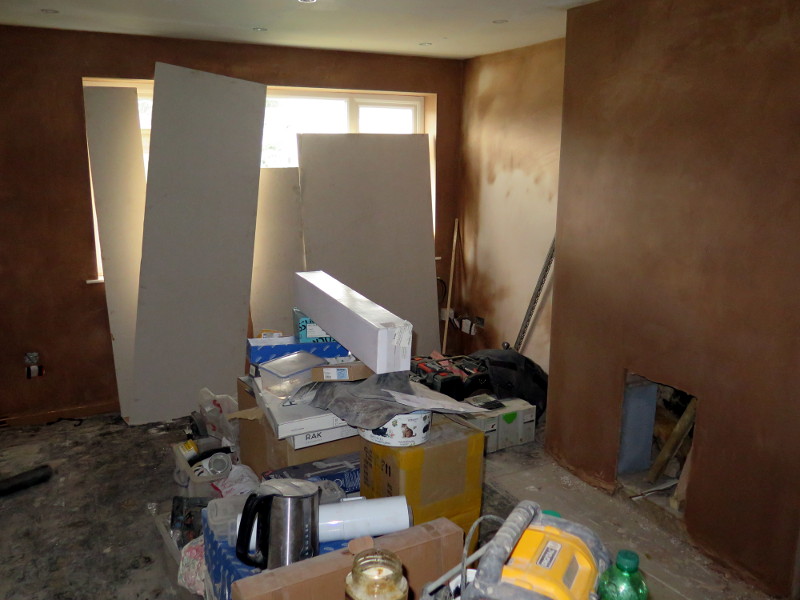
In March 2018 I posted about moving into our new house and adding an extension (‘Our new home in the Cotswolds‘). The building work was disruptive in the extreme, of course. We had to move out for four weeks, and make do with just part of the original space for much longer than that. But it was worth it.
We used to watch TV here!
Ten years ago
Grasshopper landing
In March 2013 I wrote about a TED interview with Elon Musk. Perhaps you haven’t heard of the TED talks, but everybody has heard of Elon. The post is interesting: Musk was already experimentally landing rockets ten years ago, and TED continues to be a great ideas platform. Take a look and explore the links in the original post.
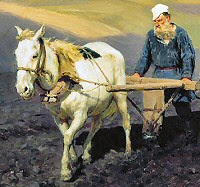
Rachael also shared a picture of an old-fashioned plough making furrows. The soil needs to be churned up and overturned before something new can be grown. There is a necessary process of breaking before the land can be used.
We thought about how Father releases us from ourselves. At the beginning he said, ‘Let there be light’; he still speaks those words into his people today and pours light into the darkest places in our hearts.
Twenty years ago
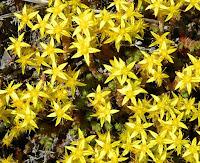
March 2003, another early blog post about a meeting at home. This time there were only two of us, but we heard such a lot! For example, that the tiny stonecrop, the great cedar, and the mighty oak tree were all planted by Father’s hand. The important thing is not to be big or strong, but to be planted by the master.
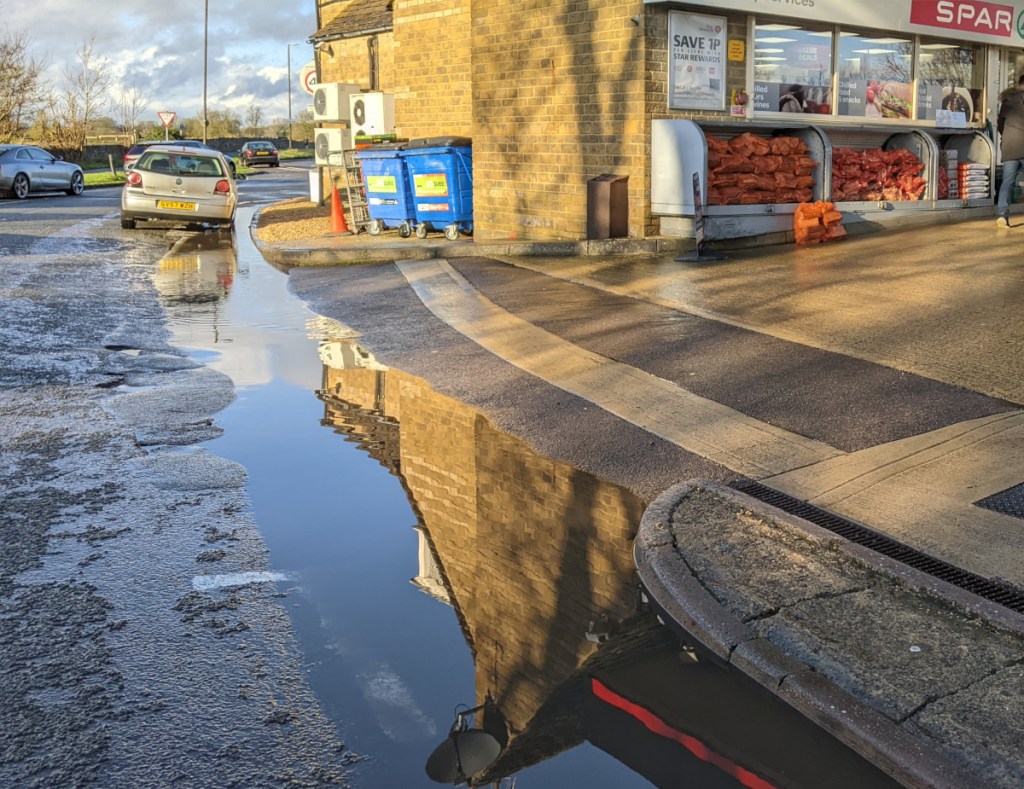
The sun came out and brightened everything up, even the puddles seemed more cheerful
I spend quite a bit of time in Cirencester so sometimes there are short stories to tell (tales), and I walk a lot in and around the local area (trails). Some of these might be interesting, fun, or even useful.
Puddles in the sunshine
Today the weather has been quite mixed, a sort of shall I/shan’t I go out. There was a good deal of rain in the morning, but it cleared a bit by mid morning and I decided to dodge the showers and walk down from Stratton where I live; I got a bit damp on the way, but not really wet. I had a couple of items of food shopping to do, so visited Tesco for those, then it began to rain again and I popped into Fora for coffee and to stay dry.
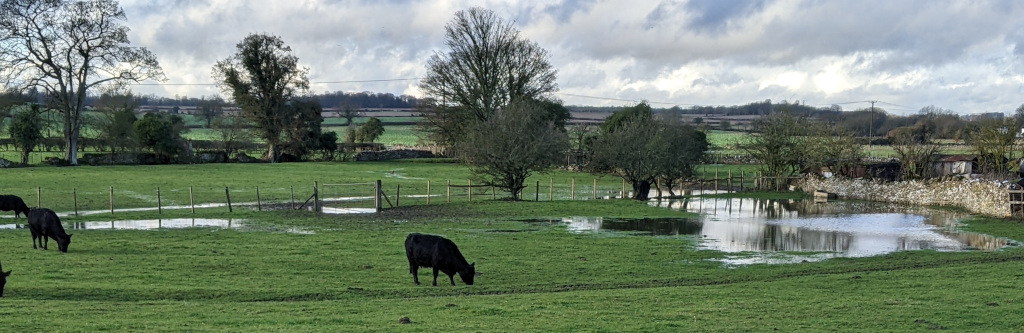
Walking home afterwards, the sun came out and brightened everything up, even the puddles seemed more cheerful. The Dexter cattle in the field west of the Gloucester Road didn’t apparently care about the weather, they didn’t even mind the fact that parts of their field have now become ponds, or even small lakes!
Shalom is not just peace as in absence of war, quietness, or a chance to think. It means much more than that.
Back in 2007, Donna and I visited Israel. The day we arrived it rained torrentially and our plane had to circle while water was removed from the runway at Tel Aviv airport. But the weather quickly improved and we had a very interesting trip. Much of it I still remember vividly, and the notes I made and the photos I took fill in much more detail.
While we were there, we bought a coffee mug at a tourist site. We still have it, and I enjoy using it now and then. The vivid colours remind me of the bright sunshine and friendly people we met, the colours of items in the market in Jerusalem, the colours of the clothes of the people in the streets.
This mug is special, it carries the word ‘Shalom’ in Hebrew and in English, it means ‘peace’. How I wish for peace in 2023 in Ukraine and around the world. Shalom is not just peace as in absence of war, quietness, or a chance to think. It means much more than that. It means joy, completeness, health in body, mind, and spirit. It means prosperity and a fragrant life.
(I was prompted to write this by Yaroslava Antipina, perhaps to use on her Twitter feed or her blog. Please click the links and leave her some kind thoughts. Thanks!)
Despite repeated assurances that no invasion was planned, Russian forces crossed the border into Ukraine on 24th February 2022. As the tanks and support vehicles rolled towards Kyiv, paratroops were dropped to take the city’s Hostomel Airport.
On 24th February, 2022, Russian forces moved into Ukraine, despite Russia’s repeated assurances that they had no such intention. That moment represented a step change in Russian relations, not just with Ukraine, but with the rest of Europe and the entire world. The tanks, personnel carriers, and self-propelled howitzers rolled across the border from Russia and from Belarus, much as the German tanks had rolled across Eastern Poland and into the Soviet Union 80 years earlier.
Informed opinion among Western military and government thinkers was that Ukrainian forces would buckle, the government would fall within a few days, President Zelensky would be captured or would flee, and a new, puppet regime would be set up by the Russians. There would be almost no resistance, defeat would be swift and complete. Everyone was wrong-footed, Ukraine resisted, Zelensky stayed in Kyiv, and the Russian invasion stalled. And here we are ten months after the invasion, and Ukraine’s army has the upper hand having forced three or four major Russian retreats (it depends how you count them).
Map of Ukraine before the 2022 Russian invasion (From Wikimedia)
Why did Russia invade?
Logical, reasonable thinking always begins with unbiased observation; but there’s an inbuilt human tendency to instead begin with our own opinions which may or may not be biased, and then to look for things that will back those up. There are plenty of examples all around us: for example the tobacco industry in the 1970’s and 80’s had the opinion that smoking provided them with solid profits and was not harmful to health and looked for ways to argue against any evidence for harm. That’s just human nature.
And that’s exactly how Russia’s invasion of Ukraine began. The Russian government began with assumed opinions about history and about NATO intending to harm Russia. Next, serious attempts to justify these positions were made: Russia was the origin of Ukraine which was therefore no more than a Russian region along with the Baltic states and some other parts of the old Soviet Union; NATO was not a defensive organisation but had expansive territorial ambitions, the West wanted to destroy Russia.
On the basis of these assumptions political arguments were made by Vladimir Putin and his supporters, that bringing Ukraine back into line would return territory that had always been Russian, would expose Ukraine’s military weakness, prevent NATO expansion, be welcomed by the majority of Ukrainian citizens, and be tacitly accepted by a weak-minded West. And on that basis, after building up forces along the Ukrainian borders with Russia and with Belarus, the ‘Special Military Operation’ began. Mr Putin’s miscalculations were exposed very quickly. Ukrainian citizens did not support Russia; the Ukrainian forces were much stronger than expected; the West including the EU and USA supported Ukraine in practical ways and applied sanctions; Sweden and Finland were alarmed and applied to join NATO.
Stages of the war
Despite repeated assurances that no invasion was planned, Russian forces crossed the border into Ukraine on 24th February 2022. As the tanks and support vehicles rolled towards Kyiv, paratroops were dropped to take the city’s Hostomel Airport. The plan was to capture the city quickly, arrest President Zelensky, install a puppet regime, and then mop up the remnants of the fleeing Ukrainian forces. But that didn’t work out well for the Russians.
The paratroops were defeated at the airport and the city of Kyiv did not fall. The armoured columns and their support vehicles and troops were badly mauled by the Ukrainians and were forced to retreat north across the border and east as far as Kharkiv, and something of a stalemate resulted in the north. In the south, Russian forces fanned out from Crimea and took the coastline of the Sea of Azov, capturing Kherson. Ukrainian forces were able to stop the Russian advance before the cities of Mykolaev and Zaporizhzhia. In the east, Russia expanded their hold on Luhansk and eastern Donetsk, and captured the city of Mariupol.
For some time there was a stalemate in terms of territory, with relentless Russian shelling of settlements along the line of control. During this period the Ukrainian forces grew stronger with aid and materiel from the West, particularly the USA but also the UK and other European and some non-European powers. At the same time Russia was weakened by a heavy toll on both troops and equipment.
As a result of astute leadership and good use of Western precision armaments, Ukraine became strong enough to push the Russians back, initially in the north, and then also in the south where Russian forces had to retreat from Kherson. This seems to be a development that is still ongoing as we approach the beginning of 2023. There are signs that Ukraine is growing stronger while Russia continues to grow weaker. It’s likely that we’ll see further Ukrainian military successes and Russian forces holding less and less territory. What is harder to predict is how the Russian government, armed forces, and population will react as these failures become more and more clear for all to see.
An analysis to consider
Here’s a video of Michael McFaul speaking at Stanford University. He is familiar with government figures including presidents Putin, Zelensky, and Biden; he understands their thinking; he presents a shrewd and well considered analysis of the situation – one that is well worth watching. I’m not going to write anything here in the way of conclusions; far better to settle back and listen to McFaul’s thoughts and ponder his arguments and conclusions for yourself. His address therefore forms the conclusion to my article.
It’s good to be out and about to see it all and just as good to get back to a warm house.
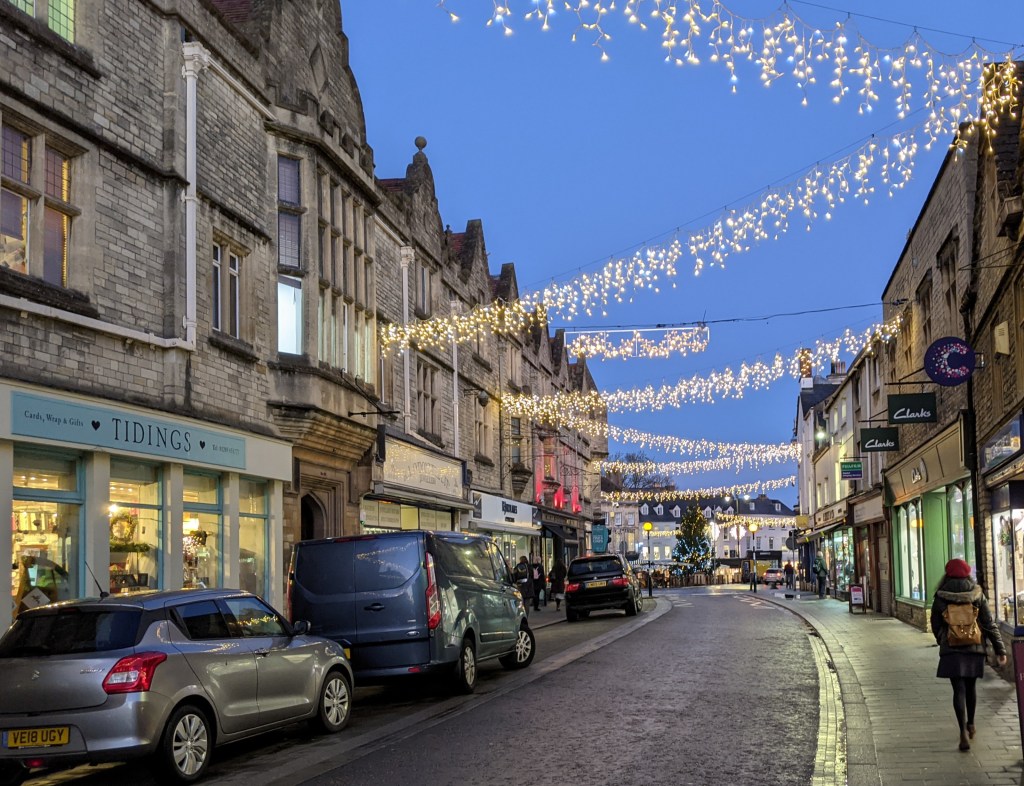
Castle Street in Cirencester
Season’s greetings to all my readers! Cirencester is showing off its tasteful street decorations once again, the days are short, the nights are long, and it’s good to be out and about to see it all and just as good to get back to a warm house afterwards.
My thoughts are especially with those who have no warm house to come back to this year, there are so many – the homeless sleeping alone in shop doorways, refugees desperately crossing the sea and hoping for asylum, and people who do have a roof over their heads but lack money for presents for the children or depend on food banks for their next meal.
Life can be wonderful, fun, exciting. It can also be tough, exhausting, and depressing. Whoever you are, whatever your circumstances, my prayer and hope is that people will be kind to you, there will be new opportunities in your life, and that there’ll be reasons to hope and overcome the difficulties.
And if your life is comfortable and you have more than enough, my prayer and hope is that you will be kind to others, search out new opportunities for them, and provide reasons for hope and ways to overcome difficulties.
None of us can solve all of the problems; but all of us can solve some of the problems.
The caterpillar did something extraordinary – it mimicked a small snake
Have you ever seen an elephant hawk moth? If you live in Europe or Asia you might have spotted one of these amazing insects. In the United Kingdom they are fairly common, but perhaps not often seen. It’s a real treat to spot an adult or a caterpillar, both are amazing sights.
Walking in the Cotswold Water Park recently, near the Gateway Centre on Lake 6, we spotted an elephant hawk moth caterpiller crossing the footpath (close to the grey circle in the map.
For a short time we just watched as it made its way across the path. But before it made it to the vegetation on the far side, some people appeared with a dog. The dog ran up enthusiastically to greet us and accidentally kicked the caterpiller before running off again. The caterpillar did something extraordinary – it mimicked a small snake.
Am I a caterpillar, or am I a snake?
The caterpillar crossing a stony path
For perhaps 20 seconds or so it writhed its body in a convincingly snakelike movement, and it pumped up several body segments behind the head, tucking its head down at the same time. With eye spot markings on its flanks, a scaly pattern on the entire body, and by raising up the front part of the body, it really did look the part. I wasn’t fast enough to get a photo, but I did get some video of the recovered caterpillar continuing on its way afterwards.
Searching the internet later, I found several good images of the caterpillar mimicking a small snake. Perhaps the best of these is show below.
The caterpillar looking very much like a snake (credit iSpot)
The natural world is so amazing, and so full of surprises, but mimicry is quite a common feature in both plants and animals. The European white dead-nettle has leaves that cannot sting but match the appearance of the unrelated stinging nettle very closely. Some insects look like pieces of wood, or a leaf, or a patch of white lichen, or a bird dropping. Many slugs look very much like animal droppings of various kinds, and as they move so slowly only an alert predator is likely to notice them. Predators, too, use camouflage which is not truly mimicry, but helps them merge into dappled sunshine and shade. Fish are often dark on top and silvery underneath. Sometimes they are patterned and look like the gravel bed of a stream or river.
I’d better begin by explaining the title – ‘New situation, new (old) ways’. We are certainly in a new situation! Covid-19 requires us to avoid large gatherings of people in close proximity, whether at the beach, in the supermarket, at sports events, or in church. It may be a long time before the situation will ease, so this could become the new normal for most of us. In terms of church meetings, many of us have been learning to make do with internet services and small group meetings using Zoom or some other form of online discussion. These are stop-gap measures.
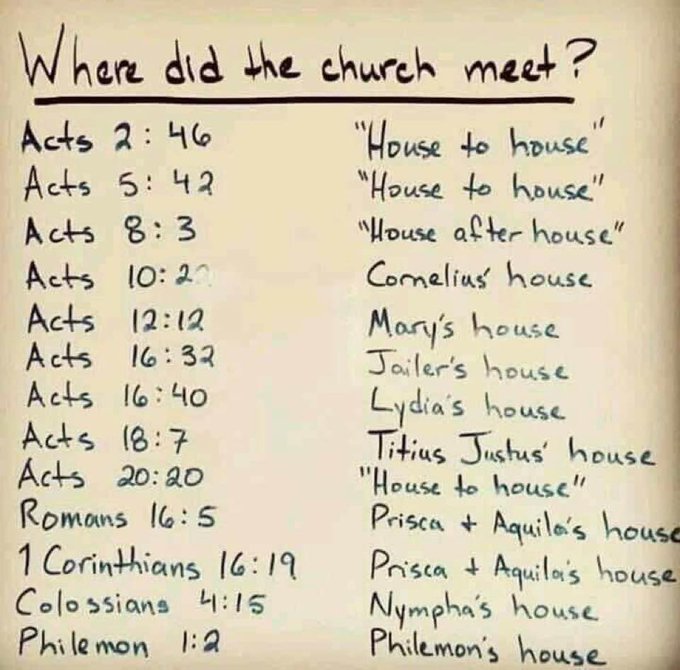
So what do I mean by ‘New (old) ways’? The original form of church meeting is described very clearly in the New Testament (see this tweet from Michael Frost – I borrowed his image for the article). It was based in people’s homes. What is preventing us making this old form of church life into our ‘new’ form in response to our current circumstances? I suggest two answers – habit and prejudice – or to roll them into one, familiarity. More about that in a moment, but first I’d like to suggest reading through some of the replies to Michael’s tweet. All sides of the debate are pretty well covered.
Familiarity
For most believers in Western and some other contexts, church meetings normally take place in church buildings and have done so for many generations. Closely allied to the church building experience come other expectations, among them a worship band, rituals, a minister or pastor, sitting in rows, a liturgy, hierarchical leadership, and limited participation. Not all of these factors are found in every church, but some mix of them is normal. The danger is that familiarity gives us expectations and blinkers us to alternatives.
Not only does the New Testament remind us that people often met in homes, it also describes what these meetings were like (1 Cor 14:26-40, for example). They were informal, everyone was encouraged to contribute, spiritual gifts were exercised freely, there was a shared meal, and sometimes things got a bit out of hand. So if meetings back then were small, informal, and participatory, could that become the norm again for us?
House church in our time
House church meetings do exist today, they are common in places and times of persecution – China, Iran, India, Pakistan, North Korea to name a few examples. But they are also quite widespread in the USA, the UK, and the Western world in general. Try a Google search for ‘house church uk‘ and you’ll be surprised at what pops up. Bear in mind that most groups of this kind don’t have an internet presence so the hits you see are the tip of a considerable iceberg. Some of the websites represent wide groups or networks of home churches.
Is this ‘the new (old)’? I think it could be, in part. One way of dealing with Covid-19, would be meeting in limited groups in homes or, indeed, in the open air. It’s important to respect government guidelines on gatherings, but even a few people face to face might be better than trying to get by online. Jesus said, ‘Where one or two are gathered in my name, I’ll be right there with them.’
You do not need permission to start a home meeting in the UK. So if anyone in or near Cirencester wants to meet like this or is already doing so, I’d be very interested in exploring the possibilities. Please leave a comment and I’ll be in touch.
Sarah has focussed on collaborating with producers, writing, tracking and editing vocals, and releasing some songs
Sarah Reynolds is a talented song writer, composer and music producer who also has considerable ability as a singer. Her most recent release is ‘Covers Me’; she wrote the lyrics, composed the music, and sings the track too.
I was impressed when I first heard this song and liked it more and more on listening again – see what you think…
This particular song fits right into the genre of Christian music, but Sarah’s musical tastes are far more wide ranging than that. She’d like to develop her work in a variety of ways, writing music for TV and film for example; she has abilities and skills in recording, mixing, and production as well. That adds up to an unusual and valuable breadth in understanding and communication across the whole spectrum of roles in the music business.
Bio in a nutshell
Sarah was brought up in the Cotswolds in a house that was full of music. She learned piano and flute during her school years, at ten she was performing the lead role of Joseph in the school production of ‘The Techicolour Dreamcoat’, and she has a Music A level. Sarah achieved Grade 8 on the piano and then began improvising, taking a keen interest in the music of Alicia Keys’ early albums. She taught herself guitar while at university.
Sarah began writing songs as a teenager, and played in a songwriting competition at ‘The Cavern’ – Yes, that Cavern! She also began working with sound engineers, producers and other musicians, recording some of her songs, performing gigs around London, and learning more about production, recording, sound engineering and mixing.
Going forward
Recently, Sarah has focussed on collaborating with producers, writing, tracking and editing vocals, and releasing some songs. She works with others online a good deal, quite an advantage in these days of Covid-19. She’s always looking for talented writers, producers and artists to co-operate with, and to learn from. Here are some examples of her work with others:











 Journeys of Heart and Mind