Links- Russian invasion of Ukraine

Some of the sources include analysis and comment, others do not. Read widely; be aware.

Finding out what is happening on a day-to-day basis isn’t always easy. Many ordinary news sources have biases of one kind or another based on who owns them, funds them, or reads them. This is true for newspapers, TV, and internet sources alike.

The list below is not exhaustive. It contains people and organisations I trust to tell me the truth to the best of their ability, to describe the events and facts as they see them and the consequences that may flow from those events and facts. Some of the sources include analysis and comment, others do not. Read widely; be aware.

The list of links follows, with more explanation at the bottom of the page.

Articles:
Military and meta-military sources:
News sources:
Podcasts:

Ukraine: The Latest

Searches:
Social websites:
Sources from Russians:

Note: These are not ‘official’ sites, I will not include those as I judge them to be biased and unreliable. The links here are to Russian expatriot sources. People and organisations unable to share truth from within the country.

Videos:
Further explanation

I’ve started by providing some bare links, when I can I’ll add details about each source.

If the Russian invasion and its consequences are topics you’re interested in, you may find the list helpful. As time allows, for each person or organisation I’ll explain some of the features and advantages as I see them. I’ll add more items as I discover them and will remove any that I feel are no longer useful. If you are aware of other sources that I should consider, let me know in the comments or via my contact form.

Why am I publishing this list of links? And why now, in late 2023? There are two main factors. First, I believe that this war is a pivotal event historically; future historians will recognise this very clearly. What Ukraine is fighting for is freedom and the right to determine it’s own future. Ukraine is internationally recognised as an independent nation with well-defined borders, has a seat at the UN, enjoys a democratically elected government, and has no ambitions to encroach on its neighbours’ rights or territory. Russia, on the other hand, has shown an aggressive attitude towards its neighbours (not just Ukraine). It holds elections in a mockery of democracy, and its leaders seem to think threats, cheating and lies are acceptable ways to govern and conduct international diplomacy. Russia is the playground bully, pushing around the weaker kids and screaming in rage when opposed. (Russia is not alone in this approach, but is certainly the primary example.)

The second factor is that interest in the war has been fading. Public interest in long term situations is fickle, we focus more on new and recent events. That’s to be expected, it’s human nature. The easier it is to find fresh, up-to-date information, the better. This list is my way of encouraging readers to remember, to remain involved and interested. It’s also an attempt to make the information more accessible.

What is being done to Ukraine by Russia is wrong. What happens next is of critical importance to the entire world. Why? Simply because it will set the course of events going forward.

What can you do?

Do you want to live in the freest possible world where individuals and nations are kind to one another? Or do you prefer to live in a dark and fearful world where individuals and nations harm one another to achieve their aims and objectives? You must choose. The real world is forever a mix of light and dark, good and evil, kindness and cruelty. But all of us can affect the balance just a little by our own voices and actions, and even more by our collective voices and actions.

Be kind, and encourage kindness in others. Resist cruelty whenever you see it. Remain informed and stay alert. Do not be silent, share your thoughts with all who will listen.
North Coast 500 – Day 1

The tidal range is enormous, exceeded only by the Bay of Fundy in North America, and the beach is gently shelving here so the tide goes out several miles.

Part 1 of a series – North Coast 500

< No earlier posts | Index | Day 2 >

Cirencester to Weston-super-Mare – 16th June

We had decided to fly to Inverness and pick up a hire car there, mainly because we had limited time with Donna’s work and other commitments and we wanted to spend our time on the NC500 route, not driving to Inverness and back.

Perhaps the title is incorrect as the day was spent hundreds of miles from the North Coast 500 (NC500), but it was the first day of our holiday. Our nearest airport is Lulsgate, south-west of Bristol; and Donna’s brother Paul and his wife, Vanessa, live in Weston-super-Mare, which is very close; we drove down on Friday evening, 16th June, and spent the night with them ready to catch our flight the following morning.

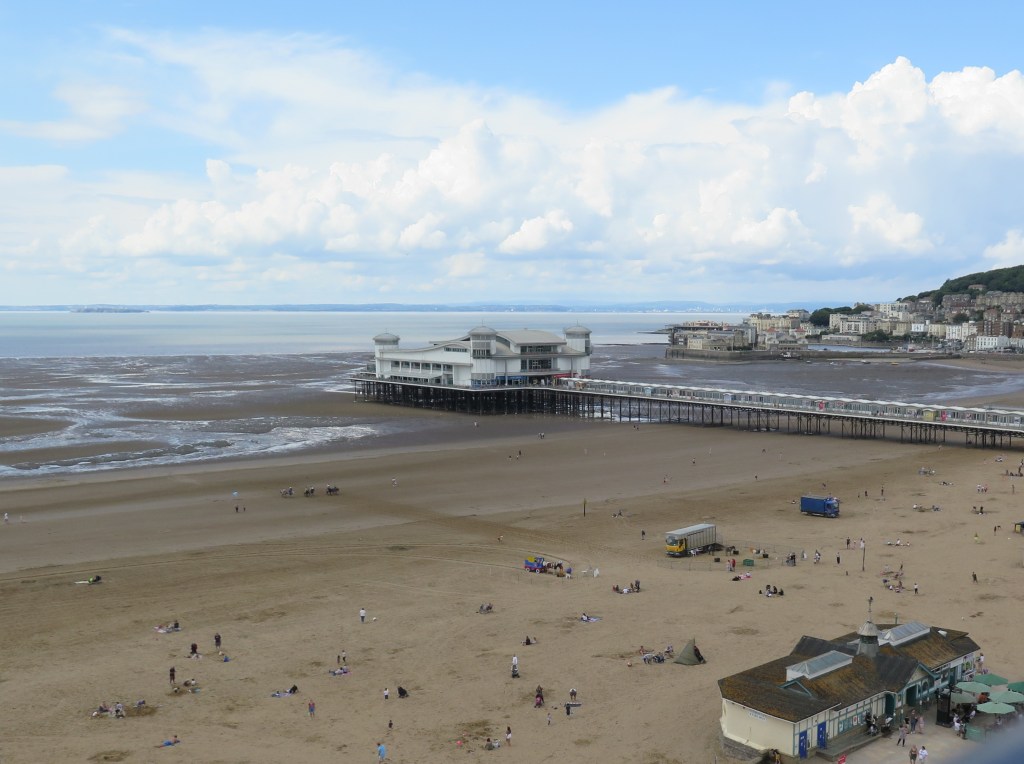
Weston-super-Mare beach and pier with the Welsh coast in the distance

It was good to spend the evening chatting over coffee, having a bit of a catch up. We like Weston, the photo shows the beach and the pier. In addition to those, notice the land on the horizon which is part of South Wales, the Bristol Channel which is very wide at this point, and the mud between the sea and the sand. The tidal range is enormous, exceeded only by the Bay of Fundy in North America, and the beach is gently shelving here so the tide goes out several miles. This photo shows Weston closer to high tide than low tide!

We brought our bags into the house and gave Paul the keys as we won’t be needing them and it would be good if he was able to move the car if a need arose.

We slept well, knowing we had a long journey in the morning. It would be the first day travelling north from Inverness.

What is the North Coast 500?

This name, often abbreviated to just NC500, is a famous touring route along the north coast of the mainland of Scotland. You can follow the route in either direction, starting from Inverness Castle. We chose the anti-clockwise version, making the fabulous Highlands scenery a grand finale to our journey.

Which part of a holiday is best in your view? Is it setting out on a new adventure, being away and exploring, or returning home?

See also:

A coffee mug from Israel

Shalom is not just peace as in absence of war, quietness, or a chance to think. It means much more than that.

Back in 2007, Donna and I visited Israel. The day we arrived it rained torrentially and our plane had to circle while water was removed from the runway at Tel Aviv airport. But the weather quickly improved and we had a very interesting trip. Much of it I still remember vividly, and the notes I made and the photos I took fill in much more detail.

While we were there, we bought a coffee mug at a tourist site. We still have it, and I enjoy using it now and then. The vivid colours remind me of the bright sunshine and friendly people we met, the colours of items in the market in Jerusalem, the colours of the clothes of the people in the streets.

This mug is special, it carries the word ‘Shalom’ in Hebrew and in English, it means ‘peace’. How I wish for peace in 2023 in Ukraine and around the world. Shalom is not just peace as in absence of war, quietness, or a chance to think. It means much more than that. It means joy, completeness, health in body, mind, and spirit. It means prosperity and a fragrant life.

(I was prompted to write this by Yaroslava Antipina, perhaps to use on her Twitter feed or her blog. Please click the links and leave her some kind thoughts. Thanks!)

War in Ukraine – War in Europe

Despite repeated assurances that no invasion was planned, Russian forces crossed the border into Ukraine on 24th February 2022. As the tanks and support vehicles rolled towards Kyiv, paratroops were dropped to take the city’s Hostomel Airport.

On 24th February, 2022, Russian forces moved into Ukraine, despite Russia’s repeated assurances that they had no such intention. That moment represented a step change in Russian relations, not just with Ukraine, but with the rest of Europe and the entire world. The tanks, personnel carriers, and self-propelled howitzers rolled across the border from Russia and from Belarus, much as the German tanks had rolled across Eastern Poland and into the Soviet Union 80 years earlier.

Informed opinion among Western military and government thinkers was that Ukrainian forces would buckle, the government would fall within a few days, President Zelensky would be captured or would flee, and a new, puppet regime would be set up by the Russians. There would be almost no resistance, defeat would be swift and complete. Everyone was wrong-footed, Ukraine resisted, Zelensky stayed in Kyiv, and the Russian invasion stalled. And here we are ten months after the invasion, and Ukraine’s army has the upper hand having forced three or four major Russian retreats (it depends how you count them).

Map of Ukraine before the 2022 Russian invasion (From Wikimedia)
Why did Russia invade?

Logical, reasonable thinking always begins with unbiased observation; but there’s an inbuilt human tendency to instead begin with our own opinions which may or may not be biased, and then to look for things that will back those up. There are plenty of examples all around us: for example the tobacco industry in the 1970’s and 80’s had the opinion that smoking provided them with solid profits and was not harmful to health and looked for ways to argue against any evidence for harm. That’s just human nature.

And that’s exactly how Russia’s invasion of Ukraine began. The Russian government began with assumed opinions about history and about NATO intending to harm Russia. Next, serious attempts to justify these positions were made: Russia was the origin of Ukraine which was therefore no more than a Russian region along with the Baltic states and some other parts of the old Soviet Union; NATO was not a defensive organisation but had expansive territorial ambitions, the West wanted to destroy Russia.

On the basis of these assumptions political arguments were made by Vladimir Putin and his supporters, that bringing Ukraine back into line would return territory that had always been Russian, would expose Ukraine’s military weakness, prevent NATO expansion, be welcomed by the majority of Ukrainian citizens, and be tacitly accepted by a weak-minded West. And on that basis, after building up forces along the Ukrainian borders with Russia and with Belarus, the ‘Special Military Operation’ began. Mr Putin’s miscalculations were exposed very quickly. Ukrainian citizens did not support Russia; the Ukrainian forces were much stronger than expected; the West including the EU and USA supported Ukraine in practical ways and applied sanctions; Sweden and Finland were alarmed and applied to join NATO.

Stages of the war

Despite repeated assurances that no invasion was planned, Russian forces crossed the border into Ukraine on 24th February 2022. As the tanks and support vehicles rolled towards Kyiv, paratroops were dropped to take the city’s Hostomel Airport. The plan was to capture the city quickly, arrest President Zelensky, install a puppet regime, and then mop up the remnants of the fleeing Ukrainian forces. But that didn’t work out well for the Russians.

The paratroops were defeated at the airport and the city of Kyiv did not fall. The armoured columns and their support vehicles and troops were badly mauled by the Ukrainians and were forced to retreat north across the border and east as far as Kharkiv, and something of a stalemate resulted in the north. In the south, Russian forces fanned out from Crimea and took the coastline of the Sea of Azov, capturing Kherson. Ukrainian forces were able to stop the Russian advance before the cities of Mykolaev and Zaporizhzhia. In the east, Russia expanded their hold on Luhansk and eastern Donetsk, and captured the city of Mariupol.

For some time there was a stalemate in terms of territory, with relentless Russian shelling of settlements along the line of control. During this period the Ukrainian forces grew stronger with aid and materiel from the West, particularly the USA but also the UK and other European and some non-European powers. At the same time Russia was weakened by a heavy toll on both troops and equipment.

As a result of astute leadership and good use of Western precision armaments, Ukraine became strong enough to push the Russians back, initially in the north, and then also in the south where Russian forces had to retreat from Kherson. This seems to be a development that is still ongoing as we approach the beginning of 2023. There are signs that Ukraine is growing stronger while Russia continues to grow weaker. It’s likely that we’ll see further Ukrainian military successes and Russian forces holding less and less territory. What is harder to predict is how the Russian government, armed forces, and population will react as these failures become more and more clear for all to see.

An analysis to consider

Here’s a video of Michael McFaul speaking at Stanford University. He is familiar with government figures including presidents Putin, Zelensky, and Biden; he understands their thinking; he presents a shrewd and well considered analysis of the situation – one that is well worth watching. I’m not going to write anything here in the way of conclusions; far better to settle back and listen to McFaul’s thoughts and ponder his arguments and conclusions for yourself. His address therefore forms the conclusion to my article.

My Father is a farmer

Human society seems to bring a certain amount of order to the scene, but it’s a deceptive kind of order. Anyone who has a garden will know that order demands great effort to achieve and continuous effort to maintain.

Some have argued that living things depend on structure and order. And of course, there is some truth in that; but it’s a limited kind of truth. Look at a forest, a coral reef (or any ecosystem) and you will see the most amazing and thriving mess. Colours and shapes intermingled haphazardly, lots of competition for space and light. Every single organism doing its own thing.

Coral reef, a rich mix of species (Image from Wikimedia)

Human society seems to bring a certain amount of order to the scene, but it’s a deceptive kind of order. Anyone who has a garden will know that order demands great effort to achieve and continuous effort to maintain. And much of that effort will involve destruction – rooting out things that grow where you don’t want them, trimming hedges to keep them straight, cutting grass to maintain a smooth lawn, poisoning unwanted insects and fungi. A garden has structure and looks nice, but that structure comes at great cost to nature and requires constant effort from the gardener. Jesus said his Father is a gardener.

Farmer is really a more appropriate English word. And not ‘farmer’ as in a modern monocrop system of extensive wheat or mile after mile of beans or peanuts. Papa isn’t bothered about measured lines and neat grass; his interests are more to do with fruitfulness than with structure. He is not a park attendant, he is a grower of vines and olives in the way they were grown 2000 years ago in Israel, sympathetically and naturally. Farmers in those days were helpers and encouragers of the abundance of the natural, not at all like today’s farmers who are more like dictators armed with diesel fuel, big machines, and farm chemicals.

For those who want to function in a structured environment with clear and appointed leadership roles and a liturgy – be my guest, feel free. Sometimes Papa calls me to be involved in those situations too. But mostly he calls me to the freedom, glory, and abundant life of his original garden. This is a place where you will rarely see a straight line, where men and women do not control the show, where there is no architecture and there are no roads. It’s a place where he invites his children to come and run free and shout with joy in his presence. There is no liturgy, just an outpouring of praise and worship from rejoicing hearts.

And out of the ‘disorder’ of this garden comes a deeper knowledge of the heart of the Most High and a richer walk with him. And the life I experience there in his presence with my brothers and sisters, that life is something I can take into this struggling world. Truly he is the way, the truth, and the life. HalleluYah!

Truth matters

If I’m given misinformation and base my thoughts, words and actions on that, sooner or later I’ll run into a problem

In a time of deceit telling the truth is a revolutionary act

George Orwell

Truth matters. It matters because basing our thoughts, words and actions on falsehood is asking for trouble. Truth is like light: it enables us to see clearly, it banishes darkness, but it can be snuffed out and then we’re left in the dark.

Light banishes darkness as truth banishes deceit

Let’s explore the background, why am I writing about truth at this particular time? And why am I writing about it at all? I’m writing about it at this particular time because truth seems to be valued by fewer people than ever before. There have always been those who trample on truth, but we do seem to be living at a time when peddling falsehoods has become pandemic. Perhaps the most obvious examples are in the political sphere, where governments and their opponents have sometimes made claims based on almost anything other than the simple facts. Policies and decisions are being made on the basis of opinion, personal ambition, whim, wishful thinking, and even denial of clear evidence. I’m writing about it because it matters. It really does. We’ll get to that in a minute.

Is this a new phenomenon? No, people have always made things up, sometimes to fill gaps in what is known, sometimes to deny what is known because it’s distasteful or hard to deal with, or for the base motives that are common, if we’re honest, to all of us – greed, self preservation, shame, fear and the rest. Survival, self-respect, money and power are important to us – sometimes important enough that we will cheat, lie, and ignore inconvenient truths that are staring us in the face.

So why does it matter?

(I said we’d get to that.)

The answer is really quite simple. If I’m given misinformation and base my thoughts, words and actions on that, sooner or later I’ll run into a problem. You can’t avoid the truth indefinitely, it will come back and bite you. Misinformation leads inevitably to error and confusion.

Truth matters, and it can be critically important, even to the point of life or death.

Imagine a map that shows a bridge across a river. An ambulance crew see that the bridge provides a valuable short cut to reach a seriously ill patient in half the time. But when they arrive at the river – there is no bridge. They have to retrace their journey and try a different way, but they are too late and the patient dies. Truth matters, and it can be critically important, even to the point of life or death.

Or imagine a general fighting a battle. He is told by his spies that the enemy is almost out of ammunition; he decides to mount an immediate attack, before new supplies can reach his opponents. If the spies’ report is true, he will win the battle easily. If they made it all up and it’s false, he might be heavily defeated. Does truth make a difference? Yes – because it leads to right action. This is why intelligence and counter intelligence matter; if you can feed falsehoods to your enemy and they believe them, they may well make a serious blunder.

Unfortunately, this strategy to deceive and confuse is now being applied, not to the enemy, but within our society. We should be friends speaking the truth to one another, but much of the untruth flying around these days seems deliberate and causes serious difficulty for all of us. It’s become a bad habit. Who should I believe? Which ‘facts’ can I depend upon? How can I check? How should we deal with this difficulty? Here are some suggestions.

Dealing with it

  • Be sceptical of assertions – in other words, ask people for evidence
  • Don’t accept claims without supporting evidence
  • Remember that lots of people saying something doesn’t make it more true
  • Use fact checking websites
  • Beware of false claims presented as evidence
  • Treat people with respect and kindness even if they are making false claims
  • Avoid shouting matches, loudness doesn’t prove anything.

So what is the take away message here? We can all make a difference for better or worse. Search for the truth in every situation, look for evidence, listen to what people say but don’t accept anything without evidence of some kind (this might be evidence about the claims being made or it might be evidence that the person making the claims is reliable and usually speaks the truth). Then base any decisions or choices on the truth, never on claims you know to be false. Never deliberately mislead others (unless you are a general fighting a war). And always bear in mind that people with an agenda may sometimes behave like an enemy general. They may see you as the enemy and will misinform you if they think it will help them in some way. The world is a wonderful place, but it can also be a deceptive and dangerous place. Go in peace, but go very carefully!

Let’s base our lives on what is true, and not on what is false. Even though it’s sometimes hard to tell what is, or is not, true – it’s always worth making the attempt. And let’s remember that truth will never let us down. Untruth is just as reliable – it will always let us down in the end. No wonder Jesus said. ‘The truth will set you free’ (John 8:32). He was talking particularly about spiritual truth, but it’s a valid statement for truth in general. And let’s also bear in mind that science is a search for truth, and all the technology we depend on every day works only because it stands on that foundation of truth.

Whether we turn to the spiritual or the physical realm, we can only rely upon what is true. Truth is a thing of beauty, but deceit is ugly beyond measure. Choose beauty. Choose the light. Choose truth!

See also

Does the Truth Matter – Psychology Today
Fact checking websites – Wikipedia
Truth – Bible Gateway
Truth – Wikipedia

Another way – write.as

The focus moves from advertising, costly payments and central control to an absence of these things

There’s more than one way of doing most things, and write.as is an alternative way of writing stuff online. Whether you want to create a blog, a story, or just private notes, write.as is well worth a look.

It’s part of a long standing move by some web users away from the commercial world of Google, Facebook, Twitter and so on, towards a very different model of which Wikipedia is the best known example. The focus moves from advertising, costly payments and central control to an absence of these things.

If you like freedom, privacy and simplicity, you’ll find all three at write.as . I suggest you take a quick look around, you can begin with a simple page I put together in less than five minutes – write.as/chrisjj