What’s in an image? Sometimes quite a lot, more than meets the eye. I’m posting an image every few days.
Click to enlarge
This boat, seen here on the Gloucester and Sharpness Canal, is based at Saul Junction in Frampton on Severn. It might look like a tourist boat available for hire by the public, but it serves a different and entirely charitable purpose. Two similar (but not identical) special boats were built to provide opportunities for disabled or seriously ill people to experience a day on the canal for free. And for those that want to, they are also given the chance to explore the boat, see how it all works, hold the steering gear and so forth. The boats are designed for wheelchair access too. Check the See also link below for details and photos from the Willow Trust website.
I love to see examples of effort and resources being expended by enthusastic teams to greatly benefit those who need and deserve help. Every one of us can see the need for support of this sort, though not all are able or willing to provide it. But every single person in the world can do something positive to help others one way or another. It might be as simple as a kind word at the right moment, or a helping hand to steady someone losing their balance, or even just a smile. All it takes is an open eye, an attentive ear, and a willing mind.
If you are a wealthy person you might give thousands of pounds towards maintenance and fuel costs for these boats; if you have some spare time but no money, you might give time and energy to help with tidying and cleaning a boat between trips or helping in other practical ways. No matter what we do or do not possess, there’s always something we can offer.
It’s about contributing something, anything, in a world that’s not always fair or kind. And there are so many considerate, helpful organisations out there – everyone can find worthy opportunities in every town and most villages around the globe; even where there’s no local group or organisation, there will be many local opportunities to find and fill a need of some kind.
If you enjoyed this or found it useful, please like, comment, and share below. (If you don’t see those links, click the article’s title above the main photo and they will appear.) Send a link to friends who might enjoy the article or benefit from it – Thanks! My material is free to reuse (see conditions), but a coffee is always welcome and encourages me to write more often!
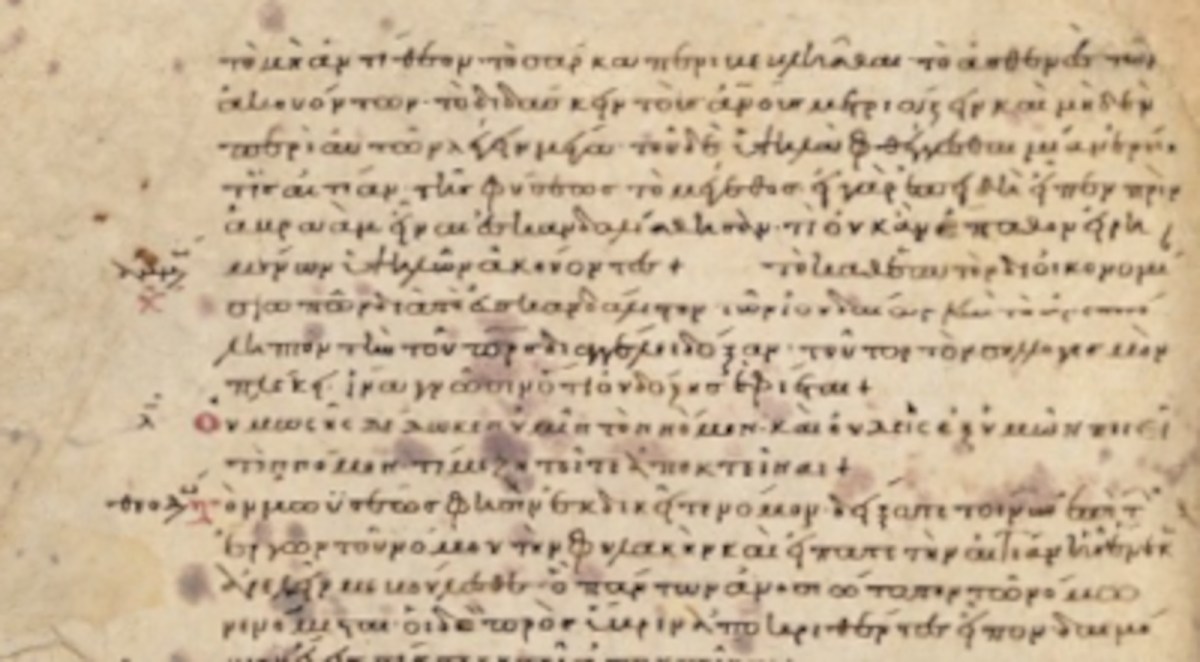
What we can say with some certainty is that the Gospel of Matthew was written by a person with a good knowledge of Judaism and was complete in its current form within 70 years of Jesus’ death.
Before starting to read and discuss Matthew, here’s an overview of the book and its author.
Matthew’s gospel was written by a well-educated Jew, probably between 60 and 90 CE (thirty to fifty years after the events he describes), but some scholars think it was written as early as 40 to 50 CE. It seems likely the author drew from Mark’s gospel (which was written earlier); possibly also from the text of a different early account, now lost (referred to as Q); and perhaps from material written by the disciple Matthew. The facts are lost in the past, and Bible scholars continue to change their views based on the material available and their opinions about it. Some argue that the disciple Matthew was the author, others believe this is unlikely.
The author
The book may have been written by Matthew the tax collector (also called Levi), one of the twelve apostles. Certainly this is what the second century church fathers thought. The text itself suggests that the author was fluent in Greek with a good knowledge of either Aramaic or Hebrew (or indeed both).
The debate will continue, but what we can say with some certainty is that the Gospel of Matthew was written by a person with a good knowledge of Judaism and was complete in its current form within 70 years of Jesus’ death. The structure of Matthew closely follows that of Mark with the addition of extra material at the beginning (the genealogy and stories of Jesus’ birth) and at the end (events after the resurrection).
Purpose
This gospel is focused on Jewish traditions and people, and generally draws on a broad and deep understanding of Jewish society and customs at the time of Jesus. It was probably written for the Jewish diaspora living in Alexandria, Antioch and elsewhere, Jews who would have spoken Greek in everyday life.
The purpose of the book is to reveal Jesus as the Messiah, of the royal lineage of David, and as fulfilling the Jewish Bible (the Old Testament). The author of Matthew is also clear that Gentiles are included with Jews in everything Jesus did and promised.
The Wikipedia article on the book gives a lot of useful information all backed up by detailed references. If you want to understand the background in further detail it’s a good place to start. The article about the author is also useful and provides ample references.
If you enjoyed this or found it useful, please like, comment, and share below. (If you don’t see those links, click the article’s title above the main photo and they will appear.) Send a link to friends who might enjoy the article or benefit from it – Thanks! My material is free to reuse (see conditions), but a coffee is always welcome and encourages me to write more often!
Cycling through the gospels to keep Jesus at the centre of all we do.
I’m posting notes on short passages from the gospels. Come and join me in reading the passages and leave me some thoughts and comments. The notes can be used individually, or they can be used systematically to work through a whole book, or all four gospels. The most recent notes are on my Journeys of heart and mind site (JHM), and more will follow. Older material is on an older website, some links may need updating but navigational links work seamlessly across old and new.
I’ve made a start in Luke now; Matthew, Mark, and John are complete; it’s been an interesting journey for me. You can start from any point, all the old posts remain and new ones will appear once every week or so.
A note on names
When I began this series I used the conventional names found in most Bible translations (Jesus, Mary, Joseph, Matthew, Mark, Luke, John, Paul, Peter and so forth. More recently I’ve started to use these names in their original form (Jeshua, Miriam, Yousef etc). And usually I write Jeshua as Yahshua – that needs additional explanation, I think. Jeshua is the Aramaic name used by Jesus himself and by his friends and family, the Hebrew is Yahoshua. I use a hybrid version, Yahshua, pronounced the same as Jeshua. The name means ‘Yahweh saves’ which is, of course, very appropriate. Spelling it ‘Yahshua’ reminds me of this critically important fact every time I write it or read it.
Alan Hirsch
Alan Hirsch has developed a model for vibrant, missional church life and at the heart of the model is the idea that Christ should be central in all that we do. Few people would argue with that! One habit that he recommends to help us keep Jesus at the heart of our lives is to cycle through the gospels as part of our Bible reading. Not only that, he recommends reading all of the Bible ‘through the lens of the gospels’.
I agree with that; and it’s where these articles come in.
Latest news:
1st May2026 – I’ve added a banner image to recent posts in John to bring them in line with other posts on JHM. I’ll continue updating all the ‘Cruising the Gospel’ posts as and when I have time.
22nd June 2025 – Today I finished the task of repairing broken links in the old version of these posts. You can now navigate the entire series using the links in each article – Matthew, Mark, and most of John. Next I must complete the last couple of chapters of John; and finally, I propose revising all the material from the old version, moving each item to the current version of Journeys of heart and mind as I go.
17:20-23 – These next three verses are amongst the most significant things Jesus ever said. These words are the mission statement for the church. Sometimes it seems to me they’re more of a ‘missing statement’ for us than a ‘mission statement’ because we overlook the implications. There’s great depth here if we will only pay close enough attention, so let’s step through these words in detail.
17:20 – Jesus is very clear that he is not praying only for the twelve followers who were with him as he spoke with his Father. No. He explicitly says, ‘I pray also for those who will believe in me through their message’. Who is that? It’s me. It’s you. You and I believed through the message brought to us in the Bible, written partly by people Jesus knew personally, taught, journeyed with, ate with, people he demonstrated his love to, some of them would soon see him die and later see him again alive. After praying for them he prays also for us!
Oneness every which way!
17:21 – He wants you and me to be one, just as he and the Father are one. There is nothing that you and I might differ over that can stand between us as two of his people. Not doctrine, not denomination, not wealth or poverty, wisdom or foolishness, not gifts or apparent lack of them, not skin colour or attitudes to this or that in church life or beyond it. The goal is not to be right, the goal is to recognise that our reconciliation was very, very costly. Loss of life and separation of Father and Son is what it took to bring peace and oneness to and between you and me. And we, in our shiny new oneness are to be part of the eternal oneness of the Father and the Son. Why? So that the world has a chance to believe that the Father sent the Son. It’s plain in verse 21. Yet there’s still more!
17:22 – Just read verse 22 again. The Father clothed his Son with glory and he passed it on to you and me! What? Why would he do that? So that you and I can be one just as the Father and the Son are one.
17:23 – And in this verse we see that Jesus is in us, and the Father is in Jesus Why is that necessary? It’s because within the threeness that we refer to as ‘The Trinity’ and sometimes think we understand, there is also a oneness, a complete unity. The Father, the Son and the Spirit are not just close friends in some unique way, or close relatives. The Holy Spirit is often described as ‘The Spirit of Christ’, and Jesus said, ‘If you’ve seen me you’ve seen the Father’. So when John tells us that without Jesus, we can do nothing (John 15:5), that implies quite undeniably that without the Spirit we can do nothing and without the Father we can do nothing. The astonishing thing that we rarely notice is that all of us who follow Jesus are now part of the Trinity. If you can’t quite swallow that idea, let me state it slightly differently. In John 15:5 just mentioned, Jesus says we need to remain in him and he in us. Well, Jesus is undeniably in the Trinity, and we are in Jesus – therefore… You fill in the dots.
The need to believe
We’d better start understanding and believing this, because if we don’t we can do – nothing. How amazing is this undeserved gift that we are now one with the Most High, one with Jesus, one with Yahweh, with the Spirit. We can make further supporting arguments for this claim.
We are a ‘royal priesthood’ (1 Peter 2:9), royalty is about authority and rule, priesthood is about bridging the gap between earth and heaven, enabling people to come into the Holy Presence. Jesus is King of Kings and he’s also the Great High Priest. We are in him. We do what we see Jesus do (we’re his disciples, or apprentices), just as he did what he saw the Father do.
We are ‘filled with the Spirit’ (see this search). Filled (in a different context) doesn’t mean half or three quarters, it means completely full and running over (Luke 6:38). Jesus is our head and we are his body, we are in him and he is in us. We were created a little lower than the angels; but I’d submit that in Christ, we are considerably higher than the angels!
But we should be very careful not to become proud or puffed up. We do not deserve to be one with the Most High, it’s a gift obtained at great cost, our humble gratitude is appropriate and required. And notice too, in verse 23, that the Father loves you just the same way he loved the Son before the foundation of the world. You are loved with the same love Jesus received before the beginning. And Paul wrote to the Galatians that love is greater than faith and it’s greater than hope. It is the greatest thing of all (1 Cor 13:13). This new life we received in Christ enables us to be and do all the things he will lead us into.
Some readers may feel I’ve gone too far in this post. If so, please leave a comment. I can’t guarantee to change my opinion, but I will certainly read all the comments and respond to them.
Next time, we’ll take a look at the final three verses of John 17.
If you enjoyed this or found it useful, please like, comment, and share below. (If you don’t see those links, click the article’s title above the main photo and they will appear.) Send a link to friends who might enjoy the article or benefit from it – Thanks! My material is free to reuse (see conditions), but a coffee is always welcome and encourages me to write more often!
Judy and I were hooked, more and more so as we spent further time with the lovely people at Zetland Road. We discovered that the origins of Zetland were with the Brethren as that movement spread from the south-west peninsula of Cornwall and Devon.
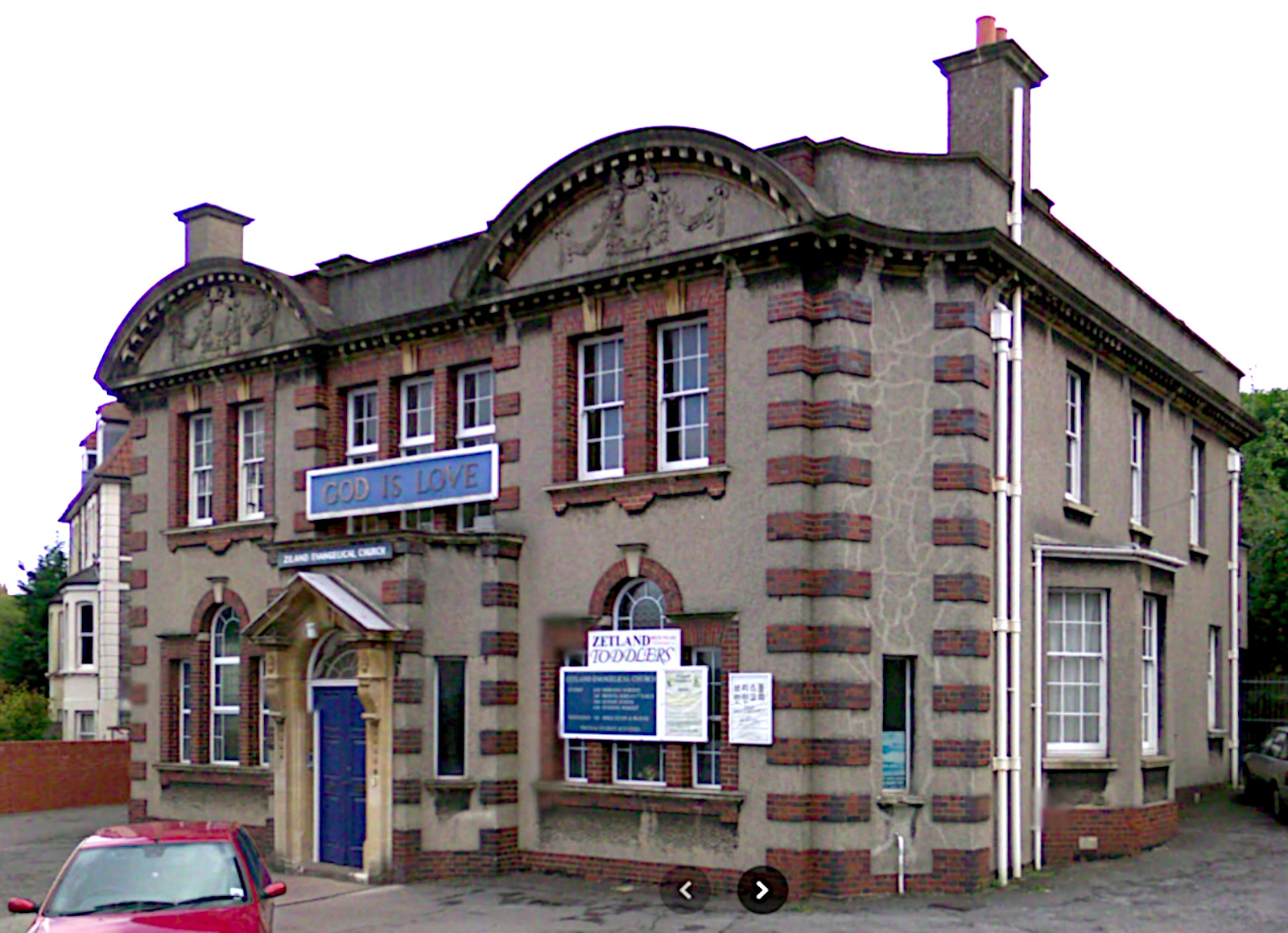
Zetland Road Church – (Both images in this article are from Google maps)
We left part one of this series with our discovery that the weird-looking place near our flat in St Andrews in Bristol, was in fact Zetland Road Fellowship (now Zetland Evangelical Church) – and not weird at all. Judy and I had hunted high and low, all over the city, and not found what we were looking for. Somehow, we had known all along that we would know the right place when we found it. And so it turned out to be.
Zetland Road Fellowship
The first thing we noticed on walking into Zetland was that several people took the trouble to talk to us. There were smiles and we felt welcome amongst these people. This in itself was a novelty, different from everywhere else we had tried. When the meeting began things were pretty much as expected; there was a welcome, a mix of prayers and hymns, some notices, a Bible reading, thoughts and teaching on topics from the reading, and after the closing prayer an invitation to remain for tea or coffee, a biscuit, and a chat.
The conversation over a drink and biscuit was good too, welcoming, not pushy, but friendly and we had a chance to speak with several different people before we left.
After going along to Zetland for several Sundays, I decided to try an evening meeting on, I think, a Wednesday. I was blown away by what I found there! The text was from one of the books of Samuel and concerned King David, though I no longer remember the details. What I do remember is that it was a passage that I had read for myself in the past and that the way it was explained in the meeting was very striking. I remember being greatly impressed at the convincing thoughts expressed, the fact that there was more to know than I had seen for myself, that what was being said acted like a telescope, helping me see further and in more detail than before. I wanted to hear more – and more was being offered the following week.
Judy and I were hooked, more and more so as we spent further time with the lovely people at Zetland Road. They felt like a welcoming family. We discovered that the origins of Zetland were with the Brethren as that movement spread from the south-west peninsula of Cornwall and Devon. Both Zetland and (later) Horsecastle were Open Brethren assemblies. A lot of small, independent chapels were built in the Bristol area during Victorian times. There were a few things that we questioned privately – the insistence that women should wear hats for example, and the irritating fact that they were not permitted to speak in meetings. To some degree this spoiled the lovely Open Meetings they held once a month. And the belief they had that the spiritual gifts were no longer present in church life was also a problem for us, but they had so much clearly right that we were happy to ignore these niggles. We were not entirely happy, but more than happy enough to stay. Our spiritual and social lives benefitted enormously from being part of the Zetland fellowship. We particularly cherished the experience of each assembly governing itself. There was absolutely no higher level of authority apart from the Bible – no hierarchy whatsoever, no bishops, no pastor, no circuits, no rules, no limitations. From what Judy and I had read in the New Testament this seemed right to us.
We were only with the Zetland Road church for about two years because we wanted to move up the housing ladder from our unfurnished flat in St Andrews, Bristol, to a small mid-terrace 1960’s house in Yatton, twelve or so miles west of the city. Our first daughter, Debbie, was born shortly before the move and was dedicated at Zetland Road Chapel, a simple expression of gratitude not involving water or godparents. We’d already planned to share a caravan in Ilfracombe for a late summer holiday with Cliff and Ginnie, another young couple from the Zetland fellowship, and although we moved to Yatton before that holiday, we were still able to get away with them later. Cliff and Ginnie collected us from Yatton on their way to Ilfracombe (they had a car, we did not), but for the return journey they dropped us off at Barnstaple Railway Station and we caught the train back part way, but the Barnstaple train was delayed and we missed our connection to Yatton, the last one of the day. We had to ask a friend to rescue us from Bridgewater Station.
Horsecastle Chapel
Horsecastle Church
We were absolutely up against the financial buffers when we made our bid for our first house in Yatton. We were only able to offer £7000 and it was a time of rapid inflation which made saving very hard. The asking price was higher than we could afford: quite a lot higher (perhaps £7500 or so, I don’t recall the exact figure). So when we put in our offer of £7000 we expected it to be rejected. Much to our surprise it was accepted straight away without discussion or argument. This seemed strange, but it was exactly what we needed and so we were relieved and excited as well as a little puzzled. But you don’t look a gift-horse in the mouth, so we just said thank you and the paperwork went through.
Two of my friends from work, Ruth and Peter helped us move. We hired a self-drive van and filled it with our hand-me-down three piece suite; our double bed funded by my grandmother, Nor; all our clothes, books, LPs etc; our cheap second hand dining table and four chairs; cooker and more. We set off for Yatton and and then discovered at the first right hand bend that a rear tyre was rubbing under the wheel arch and making a terrible noise. We had to take all right handers as slowly as possible, and with great relief arrived outside our new home.
With Ruth and Peter’s help we soon had everything indoors or stashed in the garage, and Ruth and Peter left us to it. By now it was late on Saturday and the shops had closed. As the evening light began to fail we turned on the light in the lounge only to find there was no bulb! We looked round the entire house and found all the bulbs removed and of course the shops would remain closed all day on Sunday. Finally, I checked the garage and found a bulb in the light fitting there, took it up to the house and fitted it so we had light at last, at least in one room.
Much later, we learned that the previous owners of our new home were Mark and Jean, members of the local Evangelical Chapel (Horsecastle). They had prayed about selling their home and moving to a bigger house in the village, and felt quite certain that they were supposed to accept whatever price we offered them!
What wonderful ways our heavenly Father has, working unexpectedly and often leaving us in ignorance until the time is right for us to know. He really is amazing!
Of course, one of our first thoughts was finding another gathering of people like those we’d been so delighted to find at Zetland. When they knew we were going to live in Yatton, the Zetland folk had told us about Horsecastle Chapel near the railway station in Yatton, and Claverham Chapel in the nearby village of Claverham. They recommended we take a look at these two places. We found we liked both, but Horsecastle was closer and larger so that’s where we ended up (a second welcoming family).
Our time at Horsecastle was good, we were both baptised while we were there, in a small pool underneath the raised dais at the front of the main meeting room. This was an exciting time and an important step in our journeys. For both of us it felt like a time of triumph and of belonging. We learned a lot at Horsecastle, we grew in faith and in knowledge, and we became deeply involved in the church community at a time when our young family was thriving . When our second child (Beth) was born she was duly dedicated at Horsecastle. But not everything was good.
Horsecastle held quarterly meetings when the entire church would meet to discuss planning for the future. We would talk about what had gone well, any issues that needed attention, that sort of thing. There was no single person in charge, no minister, no lead elder or pastor or anything like that. There was a small group of elders, all older men, but their role was informal, limited to providing advice, and perhaps speaking from the front a little more often than others.
At one of these quarterly meetings we discussed the idea of finding and employing someone to lead the church on a full time basis. Judy and I thought this would be an unwise move, and I expressed this as clearly as I could. I suggested that we already had a full-time leader whose name is Jesus, and pointed out that Israel had demanded a king ‘like all the other nations’ and Saul had been chosen, undermining Israel’s reliance on Yahweh alone. It had not worked out well for ancient Israel and it would not work out well for us, either.
In the end, as you might guess, a pastor was appointed. It was a factor that, over time, led Judy and me to feel a little less comfortable at Horsecastle. There were undeniably some good things about the move; the new pastor, Peter Cresswell, initiated an annual Holiday Club for children from the village with fun and exciting Bible-based crafts and activities, sports events in a local field, and these proved very successful. Judy and I helped with the first two of these events.
But more and more we felt sure that the teaching about spiritual gifts having been present in the early church but now no longer active was incorrect, as was the choice of employing a pastor. These niggles turned into something stronger as we began to experience the gifts for ourselves. And it seemed to us that if you are given something, you should also be using it. But that could not be part of our journey with the good folk at Horsecastle. For that we would need a different environment, with different friends, people open to receive, rejoice in and benefit from the presence of the Spirit of Jesus in our meetings and beyond.
How we found those friends, and what happened next will have to wait for the next part of this series.
If you enjoyed this or found it useful, please like, comment, and share below. (If you don’t see those links, click the article’s title above the main photo and they will appear.) Send a link to friends who might enjoy the article or benefit from it – Thanks! My material is free to reuse (see conditions), but a coffee is always welcome and encourages me to write more often!