Articles that dig deep into where we are going, why, and how, what is expected of us, our fears, hopes, failures, successes.
This is a quick heads up for my readers, a mention of another website you might like to take a look at.
Chris Dryden’s website
There are a multitude of websites out there, often on very specific topics, so many that there’s something for absolutely everyone. So many that it can be hard to find what you need. My online friend DaManCD (aka Christopher Dryden) runs one of them, and I run another. We’ve been aware of one another since we both contributed a chapter in a collaborative book, and we’ve interacted from time to time over the years, especially recently (though we’ve never actually met).
Chris’s website is called Life with CD and it’s well worth a visit. CD draws on his life experience as a follower of Jesus to produce articles that dig deep into where we are going, why, and how, what is expected of us, our fears, hopes, failures, successes. His focus is always on the King who leads us. Why not take a look at a recent article starting a great series on the theme of 40 days?
Useful? Interesting?
If you enjoyed this or found it useful, please like, comment, and share below. (If you don’t see those links, click the article’s title above the main photo and they will appear.) Send a link to friends who might enjoy the article or benefit from it – Thanks! My material is free to reuse (see conditions), but a coffee is always welcome and encourages me to write more often!
If Jesus builds something, then he may ask us to help – but he will be in charge. He will teach us how to build, he will give us tasks he knows we can do.
What did Jesus mean when he said, ‘I will build my church’? And what are the implications for us in our attempts to follow him? Here are some thoughts on the word ‘church’ and the action of building.
Aramaic is similar to Hebrew and was probably spoken at home and in the villages in Galilee in Jesus’ day, it was a widely used language in the region and even today is still used in a few areas of, for example, Syria. Jesus would have been taught Hebrew, as all Jewish boys were; this was the language of the Old Testament and was used in the Synagogues. There were some Greek towns and villages in the region, as there were throughout the Mediterranean more generally, so Jesus likely understood Greek. He might have known some Latin as well because that would have been spoken in imperial government and military circles.
In a conversation with his follower, Peter, he may have used an Aramaic word or possibly the Greek equivalent, ekklesia (church); and that’s how it’s recorded in the New Testament (Matthew 16:13-20). As a word it seems to have its roots in daily life; the village or town elders would have gathered as a local council to discuss and manage local affairs. As people meeting together more or less regularly, groups of people following Jesus may have been been given the same label – a gathering, therefore an ekklesia.
In the conversation described by Matthew, Jesus asks his followers, ‘Who do people say the Son of Man is?’ Of all of them, Peter was the most outspoken and would offer an opinion when the more cautious held back. Peter didn’t seem to worry about the risk of giving a wrong answer and looking foolish. So several of them gave the answer to the easy question – ‘Who do people say I am?’. But it was Peter who responded to the much more tricky question – ‘Who do you say I am?’
What Jesus says next seems ambiguous, at any rate the way Matthew describes it is ambiguous. Some people think he’s saying that Peter is the rock that he’ll build his church on. Others think the rock is the truth Peter expressed, the truth that Jesus is the Messiah, the Son of the Most High. Personally, I take the second view.
Jesus says that he will build his ekklesia, his church.
If Jesus builds something, then he may ask us to help – but he will be in charge. He will teach us how to build, he will give us tasks he knows we can do, but he remains the top man, the boss, the giver of instructions. We can’t just build what we want in the way that we want, call it church, and expect him to approve!
So let’s start by asking Jesus to show us what he wants us to do. And then when we each do our part, let’s keep checking with him that what we’re doing or saying is in line with his design. And then, as the job progresses, we’ll be able to gasp with astonishment saying, ‘Wow! This is far more amazing than anything I’d dreamed or imagined!’
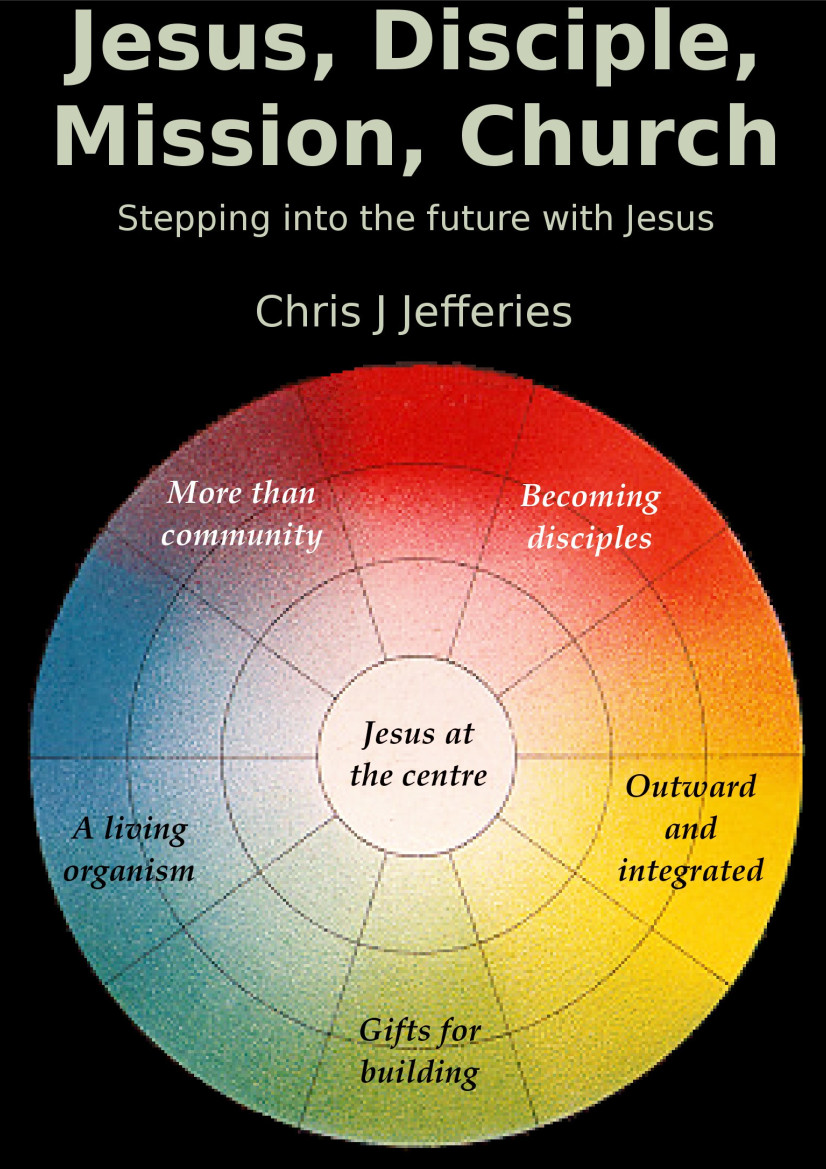
It all starts with Jesus. The next step is that we have to learn to follow, to be Disciples. That will will steer us into Mission. And out of the results of mission we will see Church appear and grow.
If you enjoyed this or found it useful, please like, comment, and share below. (If you don’t see those links, click the article’s title above the main photo and they will appear.) Send a link to friends who might enjoy the article or benefit from it – Thanks! My material is free to reuse (see conditions), but a coffee is always welcome and encourages me to write more often!
This article is an extract from my short book, Jesus, Disciple, Mission, Church (JDMC). The bite-sized piece below is roughly two percent of the book. Now we begin the first chapter entitled Working together in six ways.
2 – Becoming disciples
This second forgotten way is about revealing Jesus to the people around us by becoming more and more like him. (John 13:34-35) It demands a lifetime of challenge and we must grapple with it every single day.
Followers of Jesus are always growing in the fruit of the Spirit (Galatians 5:22-23) and encouraging one another. We learn to become more and more like him in what we say and do. The word ‘Christian’ began as a scornful nickname used by the Romans and Greeks and just means ‘Little Christ’. These ‘Christ-ians’ were obviously different from other people in society. (Acts 2:44-47) When Jesus was in a town in Galilee or Judea he was surrounded by stunned and fascinated people watching his every move. Do we have this effect in our society? We need to do more than declare good news, we need to be good news as well, touching people in practical ways.
Discuss – Are you following Jesus’ example? Take a look at Ephesians 5:8-13, or even the entire chapter. What’s the principal here? Does being a disciple mean being perfect or does it mean growing to be more like Jesus?
3 – Outward and integrated
People who follow Jesus will be driven to go out into the world and will also feel the need to be deeply present in the surrounding culture and society.
Think about seeds, they need to be spread out far and wide but they should also be pressed in and covered over if they are to grow. Jesus went wide and deep, setting us an example. He was sent by his Father and lived among us in our world as one of us. He travelled the length and breadth of the land, and even into Greek areas like the Decapolis. And he met people in their particular circumstances, identifying with them to make his words and actions meaningful. For example, see him at work in John 2:1-11, John 4:4-26, and Luke 19:1-10.
Discuss – What did coming into the world involve for Jesus? Where did he come from? What did he leave behind? Think about the ways he embedded himself in our broken world and became like us – list as many as you can.
4 – Gifts for building
The fourth forgotten way involves the gifts of service identified by Paul in Ephesians 4:11-16. The gifts of apostle, prophet, evangelist, shepherd and teacher work together. Do we recognise these gifts in our brothers and sisters? The apostolic gift lays foundations and releases and stirs up the other gifts. All of them are there in every one of us, but we tend to be strongest in one or two.
This form of guiding church life is so completely forgotten that it may seem strange to most of us, yet without it we tend to go in several unhelpful directions. Our spiritual ears and eyes must be wide open even to see this, let alone walk in it.
Discuss – Think about the different ways we run church, can you list some of them? Read Acts 14:14, in what sense were Paul and Barnabas apostles? (Hint: you might need to read a big chunk of Acts to find the answer, and it may remain hidden from you even then.)
This was extracted from Jesus, Disciple, Mission, Church (JDMC), pages 10 and 11. Download the whole thing or read it online – GetJDMC.scilla.org.uk
Useful? Interesting?
If you enjoyed this or found it useful, please like, comment, and share below. (If you don’t see those links, click the article’s title above the main photo and they will appear.) Send a link to friends who might enjoy the article or benefit from it – Thanks! My material is free to reuse (see conditions), but a coffee is always welcome and encourages me to write more often!
Jesus has been talking to his closest followers, the small group of twelve who were travelling with him. Now he begins to use the idea of a vine. Remember that everyone in Israel would have known what a grapevine is like, they were widely grown and wine was an important item in ceremonies as well as in ordinary life. It was essential in weddings, in the passover meal and so forth.
He now makes a strange claim, he says that he himself is a vine. Not only that, but he is the true vine. And he mentions that his Father is the gardener, though we shouldn’t think in terms of someone who looks after fruit, flowers and vegetables in the way we would today. Israel is the old vineyard, and Father is much more than just an employed labourer, he is the vineyard owner. The old vineyard (Israel) has not been fruitful. Jesus is a new vine and his Father will prune the branches to make him more fruitful. If you prune a vine wisely it becomes more vigorous and more fruitful; that’s true of all kinds of fruit tree too, anyone who manages an orchard will tell you that ageing trees fruit less but can be reinvigorated by good pruning. Old or diseased branches need to be removed and the others cut back to a strong, healthy bud.
And Jesus goes on to tell his followers, ‘You are the branches’! Who are his followers? Two thousand years ago they were the twelve disciples who followed him everywhere and were hungry to hear whatever he had to say. Today the things that he said to them, apply to us also. We are his branches, we are attached to him.
A two-way relationship
Notice that this is a two-way relationship. Jesus says we’ll be very fruitful if we remain in him and he remains in us. And notice too that it’s an all or nothing relationship; we’ll either be very fruitful or we can do nothing. There’s no option that makes us partly fruitful, or reasonably fruitful, fruitful in some things but not in others. We are fully in; or we are fully out. You will be precious and treasured, or you will be trash. So which will you choose? Will you be attached to the one true vine, or will you be disconnected?
And in verse seven we learn that if we remain in him and his words remain in us, we can ask anything we wish and it will be done for us! We need to be careful here, though. Jesus is not telling us that we can ask for things that are not in his will and purpose. He expects us to know we can ask anything in his Name and receive it. There’s no point in asking for something that will harm or destroy your enemies, for example, because Jesus made it clear that we are to love our enemy. If I ask for wrong things, I am not remaining in him and his word is not remaining in me.
While the nails were being driven through him into the cross, Jesus asked for something. He said, ‘Father forgive them, they have no idea what they’re doing’. Was that prayer answered? You bet it was. It’s a tremendous example of loving your enemy, isn’t it! Maybe one of those Romans was the one who later said, ‘Truly this man was the Son of God’.
Glorifying the Father
Finally, in verse eight we see the purpose of it all. It’s not about us at all. It’s not even about Jesus. It’s about the Father! Being very fruitful, and showing ourselves to be followers of Jesus, simply brings glory to the person who truly deserves it and should always receive it – the Father.
Our Father, who is far beyond our reach, let your Name be utterly holy, may Your will and purpose be done here on Earth, just as it is in Your dwelling place.
If you enjoyed this or found it useful, please like, comment, and share below. (If you don’t see those links, click the article’s title above the main photo and they will appear.) Send a link to friends who might enjoy the article or benefit from it – Thanks! My material is free to reuse (see conditions), but a coffee is always welcome and encourages me to write more often!
‘Why are you showing yourself to us, but not to the world?’ This is such an interesting question, it’s also a natural question. Judas (not Iscariot) wants to know why Jesus shows himself to the twelve, but not to the world. The question suggests it’s Jesus’ choice to hide himself from most people but show himself to a few. Judas is right to find this strange! But it’s not what Jesus has in mind.
In verse 23, he responds by saying that for everyone who loves him, he and the Father will come and make their home in that person. In other words, it’s not just for the twelve, but for anyone in the world who loves Jesus. Or to put it another way, the answer is that he will reveal himself to anyone – if they love him. He doesn’t hide from anybody, but those who don’t love him can never truly see him.
Short of time
Jesus needs to wind the conversation up because he knows what will happen next. He reminds them again of the promised Spirit and tells them that he and his Father will live within them; and the Spirit will teach them and remind them of everything they need to know. He also promises to leave his peace with them, and tells them not to worry or be afraid. This seems to me particularly striking when you consider what Jesus is about to go through at the hands of the Sanhedrin and the Roman governor.
And finally, in verses 28 to 31, he reminds them that he’s going to the Father who is greater than he is, and they will be glad (once they understand the significance of this). So, in what way is the Father greater than the Son? Does this idea even make any sense when we know that Father, Son and Spirit are co-equal within the structure we call ‘trinity’, the three in oneness that they share together? Perhaps the answer is simply that Jesus has limited himself within a human body in order to reach us in this world. For more than 30 years he has remained limited, but in returning to the Father he will regain the ability to be present everywhere at every moment of time with all of his people. In his human body he is inevitably less powerful than the Father, only able to act in the one place and time where he finds himself. He took on our limitations so that he could reach us on our level, in ways we can understand. That time is coming to an end as he returns to the Father.
If you enjoyed this or found it useful, please like, comment, and share below. (If you don’t see those links, click the article’s title above the main photo and they will appear.) Send a link to friends who might enjoy the article or benefit from it – Thanks! My material is free to reuse (see conditions), but a coffee is always welcome and encourages me to write more often!