Speaking in Jesus’ place

We do not get to choose which parts of his work we are to do. We are to do all of it! We absolutely need one another in this task, when we stand alone we are weak, but together we are strong.

< Previous | Index | Next >

Cruising the gospel – John 16:25-33

Bible text – Read it yourself (opens in a new tab)

They will ask the Father
A fragment of John’s gospel
(Wikimedia)

Now we come to something extraordinary, and it’s something we need to take on board very personally. Every single follower of Jesus must grasp this for themselves. Don’t miss it! Seize it, hold this truth in your own understanding, feel it to be the deep truth that it actually is.

16:25-26 – So far, Jesus’ language has been figurative as he helps his followers grapple with things that are, frankly, too hard for them to comprehend. Now he says that a time is coming when he’ll communicate plainly with them, there’ll be no need to use figures of speech any more. Surely that time is the period after they receive the fullness of the Spirit of Christ? It will happen in the upper room at the soon-to-arrive Pentecost. From then on, Jesus says ‘they will ask in my name‘.

We (and they) are to stand in Jesus’ place and ask the Father as if we (they) are the Son! How many times must he tell us – we are his body walking this Earth! Collectively, we are intended and expected to carry on his work. We do not get to choose which parts of his work we are to do. We are to do all of it! We absolutely need one another in this task, when we stand alone we are weak, but together we are strong. Jointly and in concert we are Jesus’ body, walking this Earth.

So we no longer say, ‘Jesus, please ask the Father to do this and that’. Now we must say, ‘Father, we’re here in Jesus’ name asking you to do this and that.’ We must not feel how weak and small we are – and we are weak and small individually. Instead together, as the church, because we are Christ’s body, we have his strength and greatness!

Me – weak and small. Us – strong and great.

16:27-28 – Do we have the Father’s love? We do! Why? Because we love Jesus and know who sent him! Jesus explains that there’s a symmetry here. He came from the Father into the world. Now he will leave the world and go back to the Father. His physical presence in the world was a temporary exception.

Clarity and faith

16:29-30 – And Jesus’ followers get it. They tell him that he’s speaking clearly now, that they can see he knows everything, and that he doesn’t need anyone to ask him questions. Does that seem a little odd to you? It seemed odd to me at first.

Perhaps it’s simply that this was a method other Jewish Rabbis habitually used, encouraging their followers to ask questions to find out where they lacked knowledge and to then guide the teaching to address those gaps. Instead, Jesus already seems to know where the gaps are and he is well able to address gaps in their understanding without waiting to hear their questions.

Might it be this uncanny ability of Jesus that persuades them he really has been sent by the Most High?

What will they do next?

16:31-33 – Now Jesus asks them a question. You just told me you believe I came from the Almighty, but do you really believe? Truly? And he tells them they’ll all run away, back home, leaving him alone. These followers, the disciples learning to be like their Master, his trainees, his apprentices – they’re going to run off and leave him? Remember that they’d been treading the highways and byways of Judea and Samaria and Galilee, and even the ten Greek cities (The Decapolis) for three long, dusty, weary, yet exciting years. Are they going to abandon him now?

Jesus tells them they will, but he also says he won’t actually be alone because the Father will be with him. And he explains that he has shared all this with them so that in him they can have peaceful hearts. He’s told them what will happen, and he is not fazed by it, and neither should they be! They might feel they’ve let him down in his time of great need, he anticipates this and wants to let them know in advance that it’s OK. They shouldn’t be disheartened.

The world will throw more than enough trouble at them, but he wants their hearts to remain peaceful because he, Jesus, has already overcome the world.

< Previous | Index | Next >

Useful? Interesting?

If you enjoyed this or found it useful, please like, comment, and share below. My material is free to reuse (see conditions), but a coffee is always welcome!

John 16:16-24 – Sadness and joy

Questions and enigmas make us think harder, and discuss the possibilities amongst ourselves, while the observing teacher gets a clear sense of whether the students are understanding the important principles.

< Previous | Index | Next >

Bible text – Read it yourself (opens in a new tab)

Not seeing, then seeing
A fragment of John’s gospel
(Wikimedia)

What Jesus says next is a complete riddle for his followers. ‘Soon you won’t see me, but soon after that you will see me.’ They discussed this amongst themselves, over and over it seems; but they didn’t ask the Master to explain what he meant. Perhaps they were embarrassed because they couldn’t work it out. In verse 10, Jesus had mentioned he would be ‘going to the Father’ and they were puzzled about that as well. And what did ‘soon’ imply?

Jesus understood perfectly what was going on in their minds and that they’d like to ask him about it, but were not going to. And this is typical of him in his dealings with all his followers, not just then, but now as well. He asks questions and he makes enigmatic remarks. The reactions of his followers inform him more than a straightforward conversation would and, more to the point, they help his followers learn.

How we learn

Any teacher knows how to use this method whether the subject is art, maths, science, history – whatever. Questions and enigmas make us think harder, and discuss the possibilities amongst ourselves, while the observing teacher gets a clear sense of whether the students are understanding the important principles. It’s likely this was a method used by any Jewish rabbi. Ask a tricky question, then let the learners wrestle with it and observe their level of understanding.

So remember, when Jesus gives you a question or a problem to resolve, it’s most likely just a way of helping you go deeper or further. And if necessary, don’t be afraid to ask him! He knows your difficulties but he wants you to make the effort and, if necessary, he will help you out. Even if he needs to explain, the fact that you wrestled with it first will help his explanation stick.

So what did he mean?

First he lets them know that he understands their struggles and need to ask, and then he adds a little more information – that they will cry in deep sadness while the world rejoices. And here comes another standard teaching idea, use an illustration, something quite different, something familiar, but something with important similarities. Jesus tells them it will be like a woman giving birth – lots of pain and anguish but with relief and great joy when accomplished.

And now they understand the principle, he adds more detail for them. Their time of grief is now, but he’ll see them again and they’ll rejoice. Nobody will be able to steal that joy from them and they won’t need to ask him any more questions. In fact, they’ll be able to ask his Father (in Jesus’ name) for anything. So far they have not done this – ask, receive, and rejoice!

And what about us?

Can we expect the same? Should we, too, expect to ask in Jesus’ name, receive, and rejoice? Yes! Indeed we should! Does Jesus say to us, ‘So far you have not done this’? Perhaps he does for some of his people and for some of the time. Often we think in terms of faith – ‘Do I have too little faith?’. Frankly, it’s a bad question.

Faith is important, of course. Faith is one of the three things that Paul tells us will remain. The other two are hope and love. And Paul is very, very clear about it, the greatest of the three is not faith, but love! (1 Corinthians 13:1-2) Do you love Jesus? Does he love you? Do you have the Father’s love?

Let me remind you, that yes you do! And this love is greater than faith. Faith is required, but it’s not the measure of the answer. Father’s love is always the measure of the answer.

When you ask for something in Jesus’ name, you may or may not see the answer you expect. Anyone moved a mountain recently? Faith expects that you will trust the answer to Father’s wisdom and love. We don’t always see what we expect. We don’t always immediately receive what we ask. We need to be wise, recognise his love, remain patient and not give up.

And another thing to remember, sometimes we ask in hope, not faith. That’s OK too. There’s nothing wrong with the prayer of hope; there’s no shame in it. Sometimes there is a gift of faith, received in the moment, and we feel certain that what we ask will be done. If so, go ahead and use it! If not, pray anyway, Father listens, he does not turn away. He loves you! We all know what that’s like, we have all been children and some of us have been parents.

< Previous | Index | Next >

Useful? Interesting?

If you enjoyed this or found it useful, please like, comment, and share below. My material is free to reuse (see conditions), but a coffee is always welcome!

John 16:12-15 – The Spirit

This is fully mature fruit seen at its most complete in the heart of the One who will send the Spirit. This is the source of the spiritual fruit talking.

< Previous | Index | Next >

Bible text – Read it yourself (opens in a new tab)

Getting the whole story
A fragment of John’s gospel
(Wikimedia)

Just four verses this time. Why so few? It’s because these verses are so heavily loaded with deep truth. There’s a lot here that we need to consider and absorb.

Jesus simply can’t tell them everything he wants them to know; he’s well aware they wouldn’t be able to deal with. It would, he says, ‘be more they they could bear’. It says a very great deal about his nature that he holds back for their sakes, so they won’t be overwhelmed. This is caring, this is gentleness, this is concern for the other, this is understanding.

Cast your mind forward to Paul writing to the Galatians about the fruit of the Spirit – love, patience, kindness, gentleness, self control (Galatians 5:22-23). This is fully mature fruit seen at its most complete in the heart of the One who will send the Spirit. This is the source of the spiritual fruit talking. Interrupting his precious narrative because he respects his followers’ weakness. It would destroy them so he holds back. We can learn so much from him about spiritual fruit.

Jesus is also the author and source of faith, he knows he can leave essential things unsaid because he knows in all certainty that the Spirit he will later send will explain these things to them, when they are able to cope with the hard, difficult truth. He doesn’t worry, or think, ‘What if they just don’t get it later?’ He knows it’s safe to wait. He doesn’t just have faith, he is faith incarnate! We can learn so much from him about faith.

A trustworthy Spirit

In verse 13, Jesus explains how they will know later what he cannot share with them right now. He needs to explain that the Spirit (who they have not yet experienced) will ‘guide them into all the truth’.

The Spirit will not speak ‘on his own’ – He will, in fact, speak with the Father and with the Son, so his words will be of them and from them, and will carry their full authority.

He will speak only ‘what he hears’. – The Spirit is privy to what the Father and the Son say to one another.

He will ‘tell you what is yet to come’. – In other words the Spirit is prophetic, he will share with them whatever they need to know, even if it’s about things that have not yet happened.

The disciples would not have missed the connection with the Jesus they already know and love. He has claimed to be one with the Father and to say only what he hears the Father say. And isn’t Jesus, here in this conversation, telling them about ‘things that are to come’? That is to say, the Holy Spirit.

And then finally, in verses 14 and 15, Jesus repeats what he’s already told them. He wants to be absolutely sure they understand! The links in the chain are as clear as they could possibly be; what belongs to the Father (Yahweh, the one who just IS) has been given to Jesus. Next, these things are given by Jesus to the Spirit, and then, finally, the Spirit will pass it all on to his followers.

Simple, straightworward, but oh how awesome!

And if you are following Jesus, then it is all your inheritance too. You don’t need to do a thing to inherit something, you just need a family member who has decided to pass it on. Jesus is handing all the richness of heaven and of the Father to you on a plate! The least you can do is receive it and be grateful!

< Previous | Index | Next >

Useful? Interesting?

If you enjoyed this or found it useful, please like, comment, and share below. My material is free to reuse (see conditions), but a coffee is always welcome!

John 16:1-11 – Warnings and leaving

If his apprentices had been given a vote, they would all have called for Jesus to stay with them. Of course from our perspective it’s clear that the sending of the Holy Spirit was the necessary next step in the life of the church. But that’s very much the benefit of hindsight!

< Previous | Index | Next >

Bible text – Read it yourself (opens in a new tab)

Dangers ahead
A fragment of John’s gospel
(Wikimedia)

From what Jesus tells them next, the future sounds pretty dreadful; but there’s purpose in the telling. What he has already told them was to prevent them from giving up. There’s nothing like hard times to discourage us, and Jesus is well aware of that. But now, knowing time is short, he explains how bad it will get and the great hope that remains.

Jesus explains that people who know neither him nor his Father will reject his followers and even murder them, thinking they are serving Yahweh in doing so. Now that Jesus is leaving the disciples he’s telling them things he’d shielded them from previously.

Where next?

Jesus has told them several times before that he is leaving them, he’s well aware that they haven’t asked where he plans to go and are already feeling sad and downcast (even abandoned) at losing him. It’s easy to imagine them thinking they’ve failed in some way, that he’s going to look for better followers somewhere else. So he explains that his departure will be good for them because if he stays the ‘Advocate’ won’t come. They won’t understand what this means until Pentecost when the Holy Spirit will fill them and a lot of mysteries will begin to be answered in their minds and hearts. For some reason he says that unless he leaves them, he won’t be able to send this ‘Advocate’.

If his apprentices had been given a vote, they would all have called for Jesus to stay with them. Of course from our perspective it’s clear that the sending of the Holy Spirit was the necessary next step in the life of the church. But that’s very much the benefit of hindsight!

Sin, righteousness, and judgement

The world (and especially the Jewish world in which the disciples lived) knew that sin, righteousness and judgement were important things. The Law and the Prophets were full of these three ideas – from Genesis right through to Malachi. Mankind is sinful because of disobedience, sinful people cannot claim any sort of righteousness, and without sacrifice for sin all are judged and found wanting.

Jesus now tells them that the world has all three of these important things wrong – completely wrong!

In the case of sin, people are wrong because they don’t believe in Jesus, He came to deal with sin once and for all, but many of the learned people saw Jesus himself as sinful, a blasphemer, misinformed, deserving of arrest and punishment – even a death sentence!

In the case of righteousness, people were wrong because Jesus was now returning to the Father where he could no longer be seen. Jesus himself is our righteousness and he represents us in the Father’s presence.

And in the case of judgement, people were wrong because they’d backed the wrong horse. They’d chosen ‘The Prince of this World’ who was now condemned. And who might that be? Not Jesus, clearly, but the Evil One, the opposer of everything good, who tried to condemn Yahweh but is now himself condemned.

Get sin, righteousness and judgement wrong and you have no hope! Get these right, follow Jesus, and it will all become clear. What a revelation!

< Previous | Index | Next >

Useful? Interesting?

If you enjoyed this or found it useful, please like, comment, and share below. My material is free to reuse (see conditions), but a coffee is always welcome!

John 15:22-27 – Guilt and testimony

They understood that some things are good and others are evil, but their thinking was confused. So, very often, is ours. The creator can see into the hearts of the created.

< Previous | Index | Next >

Bible text – Read it yourself (opens in a new tab)

What is good? What is evil?
A fragment of John’s gospel
(Wikimedia)

Jesus begins here by saying something extraordinary, he tells his followers that people are only guilty of sin because he has spoken to them. This is just how it was at the beginning; in Eden there was no possibility of guilt until the man and woman had eaten the fruit of the knowledge of good and evil. We need to dig deep here to understand more clearly.

They were created naked, they walked in the garden with Yahweh naked, and he said that everything he had made was good (Genesis 1:26-31, specifically v 31). So we cannot claim it is bad, or wrong, or evil to be naked in the presence of others. That idea, which is very commonly held, perhaps especially by those who call themselves Christians, is simply wrong. There is no evidence to support it!

But when they gained the knowledge of good and evil, they were ashamed in his presence and hid themselves when he came to walk and talk with them. Yahweh didn’t come to look at their bodies, he came to look at their hearts! They understood that some things are good and others are evil, but their thinking was confused. So, very often, is ours. The creator can see into the hearts of the created. They wanted to hide their disobedient hearts from him, but that is impossible; instead the best they could manage was to hide their bodies and ignore their disobedience. It’s a form of ‘making an excuse’, hiding what Yahweh pronounced good, because of their feelings of shame. Let’s hide whatever we can in the hope that the things we can’t hide will be overlooked – sorry, it won’t work, it’s never worked.

If I’m not able to see the reality of good and evil in my heart, that does not permit me to pretend to fix it by cloaking the reality with a more comfortable and palatable alternative. The guiltiness of a sinful heart runs deep and cannot just be covered over. Because Jesus did things that no mere, guilty human being could do (healing a Jewish leper for example, or casting out a dumb demon, or healing a person born blind*), they turned against both Jesus and his Father. Even this fulfilled the law! And notice that Jesus says, ‘Their law’, he does not say ‘My law’ or ‘My Father’s Law’ (v 25). That too is significant!

A reminder

Jesus reminds them that a master is greater than his servants. We’ll be treated as he was if we are his followers. He’s reminded them of this before – more than once. John just mentioned it. But Jesus’ preference is to call us, not servants, but his friends (John 15:15).

The coming Spirit

The chapter ends with Jesus announcing that the Spirit will come. Jesus calls his Spirit ‘the Advocate’, someone who will argue the case for us, someone who will remind us of everything we need to know and remember and do and be. And we must do what the Spirit does – testify about Jesus. Remember what he says elsewhere, ‘Without me you can do … nothing.’ But if we have the Spirit of Christ living in us, we can do anything he calls us to!

See also:

< Previous | Index | Next >

Useful? Interesting?

If you enjoyed this or found it useful, please like, comment, and share below. My material is free to reuse (see conditions), but a coffee is always welcome!

John 15:18-21 – Hatred

A master issues instructions, a servant follows instructions. Jesus teaches, his chosen apprentices learn; and it follows that if Jesus is persecuted they will be too.

< Previous | Index | Next >

Bible text – Read it yourself (opens in a new tab)

Meaning of the word
A fragment of John’s gospel
(Wikimedia)

The subject of hatred can be difficult, hating someone is not just a matter of disliking them, maybe we need to look at a dictionary definition.

The Greek word used here (μισέω – miseo) literally means to ‘detest’ (See the Bible Hub definition for details). In the Graeco-Roman world of the time it implied a strong emotional response of enmity and hostility. In Hebrew thought it was a little different, hatred was seen as being the opposite of love, but also as a righteous attitude to sin and idols. This can lead to misunderstanding in English translations when we read, for example, that we should ‘hate’ our father and mother. A better translation might be that we should love our father and mother less than we love Jesus.

We are Christ’s

In the previous section Jesus was talking about love; in verse 17 we read, ‘This is my command: love each other.’ And immediately afterwards he says, ‘If the world hates you, remember that it hated me first’. In other words, the world sees Jesus as sinful and idolatrous, and sees us in the same way because we follow him. We see this most clearly when we consider the approach of the Priests, the Pharisees, and the Saducees. They really did see Jesus and his followers as teaching dangerous and abhorrent errors.

He tells his apprentices (disciples) that the world would love them if they were themselves worldly. But we, too, are his disciples so let’s make this more direct and personal – the world would love you and me if we were worldly. Are we worldly? I hope not! And why are we not worldly? Because Jesus has chosen us out of the world. If you’re popular in the world you should be alarmed! Jesus is the head, not us. We are merely the body of Christ. Or more encouragingly, we are amazingly the body of Christ. So when the vicar offers you a wafer and tells you, ‘This is the body of Christ, broken for you’; you might retort, ‘No it’s not, I am part of the body of Christ, as are you’. But I’m not sure how well that would go down!

Master and servant

Jesus reminds them of something he told them previously, namely that masters are greater than their servants. A master issues instructions, a servant follows instructions. Jesus teaches, his chosen apprentices learn; and it follows that if Jesus is persecuted they will be too. And those who follow Jesus’ teaching will also follow theirs. They are going to share in more than his life, for elsewhere he clearly states that they have become his friends (no longer servants), so they (and we) become teachers like him and will be persecuted by some, followed by others.

The abuse will come because of his name, because they don’t know the Father. Jesus came as a servant, a messenger, in his Father’s name. We go as servants, as messengers, in Jesus’ name. And we go to those who don’t know his name, his mission or his character. Jesus came to reveal the truth to an ignorant world, to bring life to a dying world. So should we – but if we do not, can we really claim to be his followers at all?

< Previous | Index | Next >

Useful? Interesting?

If you enjoyed this or found it useful, please like, comment, and share below. My material is free to reuse (see conditions), but a coffee is always welcome!

Is the West fumbling security?

I urge you to watch the video below, in which Jonathan Fink interviews … Dr Benjamin Tallis. It’s a fascinating, and I think important, conversation.

Image from Wikimedia

I never thought I would say this. But I approve of some of Boris Johnson’s actions. But let me be a bit more specific; I disapprove strongly of almost everything he did as Prime Minister, but there is one exception:

I like the way he stood up to Russia and clearly understood that enabling Ukraine to win and standing firm against Russia’s objectives and actions was necessary to Europe’s (and the UK’s) long term safety. Although that is all in the past now, we should still be analysing the European situation as it is today, and facing it by planning and acting wisely in our own and our neighbour’s best interests.

With that in mind, I urge you to watch the video below, in which Jonathan Fink interviews the researcher, political analyst, member of the RUSI think tank and author, Dr Benjamin Tallis. It’s a fascinating, and I think important, conversation. The thinking exposed by the interview is crucial to the survival of our way of life in a very dangerous world.

See also:

Useful? Interesting?

If you enjoyed this or found it useful, please like, comment, and share below. My material is free to reuse (see conditions), but a coffee is always welcome!

John 15:9-17 – Love and fruit

This joyful, loving relationship we have with Jesus is so important. In these verses Jesus stresses it by repetition. He wants to see joyfulness in our lives, he wants his joy to find a welcome in our lives.

< Previous | Index | Next >

Bible text – Read it yourself (opens in a new tab)

A fragment of John’s gospel
(Wikimedia)

At this point Jesus begins talking about love. It always helps, when explaining something, to have an illustration or example; Jesus needs an example of his love for his followers, so he says, ‘I’ve loved you the same way the Father has loved me’. There’s such a lot in that simple statement!

But the disciples had evidence of the Father’s love for the Son going far beyond words alone; the love was affirmed by powerful action. They had seen the sick being healed, the dead raised to life and evil spirits thrown out. Oh yes, he had the affection of the Father, and now Jesus tells them that he loves them like that, too! Notice how remaining in the love depends on obeying the commands. It’s not that the love is taken away in the absence of obedience, but the absence of obedience is the same thing as walking away from the source of the love. So his followers have a part to play as well, they are to ‘Stay in his love’. They are to stay close, not wander off but to stay in that place of affection.

It begins and ends with love

This joyful, loving relationship we have with Jesus is so important. In these verses Jesus stresses it by repetition. He wants to see joyfulness in our lives, he wants his joy to find a welcome in our lives. He’s explained this clearly and now, in verse 12 he shows how simple it is. The command that must be obeyed if we are to remain in him and his joy in us is not hard and it’s not complicated or demanding – just love one another, please!

And the greatest and fullest love imaginable is to be more concerned for one another than for our own existence! In verses 14 and 15 Jesus brings us right back to the need for obedience yet again, and it’s not an obedience like that of servants or slaves. We are fully informed, he calls the disciples (and us) his friends, not his servants. Our place is not to serve Christ, but to be his friends. I’m sure you appreciate the difference. We’re helping out one of our mates, not scraping and bowing to an imperial boss!

Getting the job done

Sometimes we are told that people in the world need to ‘choose Christ’, that they need to ‘make a decision for Christ’. Yet Jesus clearly sees it very differently, he tells us here that he chooses us, not the other way around. We are right to share the good news about Jesus, to explain to people that peace and joy and freedom are found in him. But we don’t need to persuade people to make a choice. Jesus makes the choice. We never, never need to browbeat anyone, our task is just to introduce one of our friends. Hey, this is Jesus, say ‘Hi’ to the best friend I have, he’d like to get to know you better.

We do have a job though, and introducing Jesus might well be an important part of it. We were chosen to bear lasting fruit, and if we ask Papa for something, he’ll provide it. He’s always willing because he sees us as one of his Son’s friends – he loves the Son and he loves his Son’s willing mates and helpers. It’s all about relationship, is it not? What we do counts for little, who we are counts for everything! Without Jesus I can do – nothing! But I can do everything in Christ.

And finally, Jesus reminds them one more time, ‘Love one another’. He knows how easily we forget!

< Previous | Index | Next >

Useful? Interesting?

If you enjoyed this or found it useful, please like, comment, and share below. My material is free to reuse (see conditions), but a coffee is always welcome!

Living in the presence

To come away with a shining face you must first go into the place where the glory is, you must stand face-to-face with the One who is the Presence.

Reading Chris Dryden’s ‘Concepts’ post, I was aware that I should write about how Father deals with me face to face. He always does this when I’m least expecting it, but I always know it’s him.

When I was a child, back in the 1950s and early ’60s, I had one or two luminous toys, and later a luminous watch. I never tired of holding these up to the light at night time and then turning the light off and watching the weird, greenish glow fade slowly over the next few minutes.

Some background
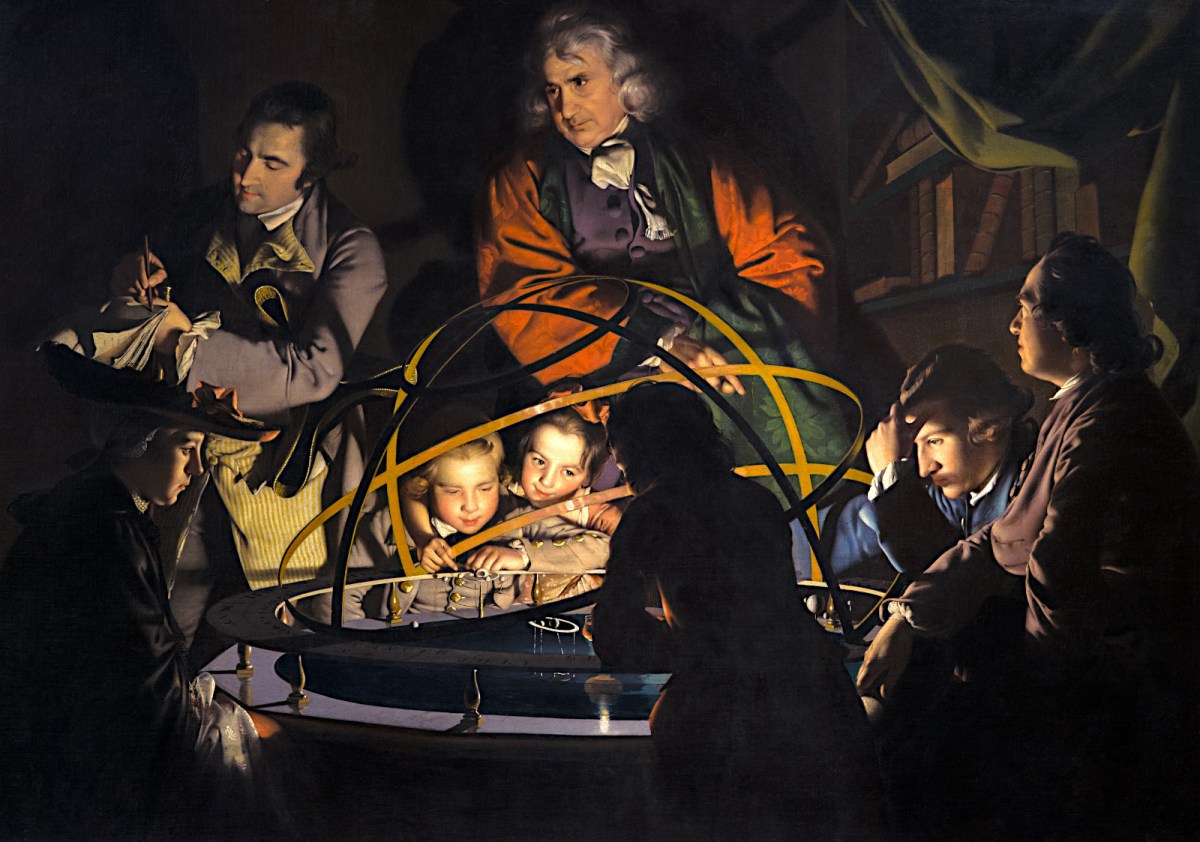
The Orrery
(Wikimedia)

Let’s begin by setting the scene. Here I was, married and with an infant daughter, living in a very modest house in a very modest street, Judy and I had to be careful with the little money we had. Second hand everything, no car, riding my bike to work. A very typical story in the early years of married life. We were friends with another couple just a street away and had been meeting with them to read the Bible, pray together, and explore what the Holy Spirit was doing at that time in our area. They were Anglicans, we were from the Evangelical chapel at the far end of the village, but differences like that seemed utterly irrelevant.

On one particular evening as we were praying, a picture came into my mind. We were children, playing with bricks from large piles stacked on the ground. We were making little houses with them, walls of a few bricks with a gap for a doorway, another gap for a window and a few more bricks balanced on the top for a roof. We’d made several of these tiny ‘houses’ when the builder arrived on the scene.

He strode towards us through the mud and puddles and looked down at us. We thought he’d be cross so we jumped up to run away; if we ran in different directions we might all get away! But he smiled down at us and said,

‘I’m here to build a real house. If you scatter the bricks around, it’ll slow down my work, but if you bring the bricks to where I’m working, you’ll save me time and the house will be finished sooner’. So we did exactly that, we ran around collecting bricks and stacking them at his feet, while he got on with the work of building the house. And up it went, it was magnificent.

What we understood from this

I shared this ‘picture’ with my friends, Tony and Faith. And we could all see what it meant right away. The house is the church – not Anglican, not Evangelical, just the church. And the bricks were people – us, our friends, anyone we could bring into the builder’s presence. And the builder, of course, was Jesus. He is the one who said, ‘I will build my church’. And what resulted over the next few years was that a number of people including us (the living stones) were built into something very special indeed. It was a body pulsing with spiritual life and energy, especially when we met, but overflowing into the world around us too. I can say that for me, having this foundation and experience changed how I viewed my life more generally – at work, at home, with my parents, with friends, with family.

So don’t build structures with the people who belong to Jesus, but assist him as he directs and builds. Chris Dryden, writing on his site Life with CD, wrote recently about Moses speaking face-to-face with Yahweh. Maybe you should read his post and then come back here afterwards…

For 40 days – Day 8: Covenant Renewed: Concepts

…Reading the concepts article sparked a new thought in my mind. All those years ago in the mid 1970s I’d had face-to-face conversations with Father through the presence of his Spirit! That describes the way it felt (and still does).

Moses in the Presence

Chris Dryden wrote about Moses and the conversations he had with Yahweh, face-to-face, created-to-creator, follower-to-leader. That was a mighty privilege; it still is! And it left Moses with a glow on his face (and I imagine, a glow in his heart as well). Do I have a glow on my face after conversing with Jesus through the power and presence of his Spirit? Yes, I think I do. The connection and the conversation leave me changed in a way that people can see. Not a visible glowing, but a glowing heart and a face that relaxes and smiles in a new way as I describe the revelation to those around me. Really, I suppose, an awestruck and amazed face!

Have you witnessed the glowing hearts and faces of people who’ve been in the Presence, in conversation with the King of Kings? If you’ve spent time in meetings when the Holy Spirit is allowed in and there are prophesies and pictures and singing and dancing and arms raised – then yes, I bet you’ve seen those shining faces! There is nothing to beat face-to-face time. That’s true with family, with friends, and it’s true with Jesus as well. We come away encouraged, lifted up, newly informed – there is nothing like being in the Presence. We all come away with shining faces, you bet we do!

But, just like Moses, to come away with a shining face you must first go into the place where the glory is, you must stand face-to-face with the One who is the Presence. The Shekinah Glory is his and his alone. Our faces shine with an absorbed light, just like those luminous toys.

But what is even more precious is that going about, living my ordinary life, the Spirit often surprises me. I see something, hear something, think something, and suddenly in that moment I realise there’s a spark from him. He speaks face-to-face with me without any effort on my part. He lives within me even when I’m unaware!

Useful? Interesting?

If you enjoyed this or found it useful, please like, comment, and share below. My material is free to reuse (see conditions), but a coffee is always welcome!

A moving story

After finishing her education and working in management roles at a number of major companies in Pakistan, Sabeeta still had the continual feeling of background obstacles and pressures because of her faith.

Here, in brief, is the story of Sabeeta, beginning in Pakistan as a child with an awareness that she and her family were not entirely acceptable and eventually moving to the UK with her husband.

From Qayyumabad
Pakistan to UK

Sabeeta Mushtaq writes about her life in Pakistan where she lived in constant awareness that as a Christian in a Muslim culture, she was seen as a misfit in her country of birth. It’s difficult for many of us here in the UK to imagine what this must be like. Though regrettably, some people living in Britain with non-UK backgrounds might feel related tensions and anxieties.

After finishing her education and working in management roles at a number of major companies in Pakistan, Sabeeta still had the continual feeling of background obstacles and pressures because of her faith. Later still she married a British citizen and after a few more years they made the decision to move to the UK…

To London

…arriving in the difficult early days of COVID.

Eventually she found friends and a spiritual home in a London Anglican congregation and has now become a Lay Deacon. I like her closing sentence and quote it here in full:

My journey, though filled with obstacles, has strengthened my belief that God’s plan for us unfolds in ways we cannot always foresee, but in the end, it is always for a greater purpose.

All of us are on our own, individual journeys, with or without Jesus. And in my opinion, far better with than without! Read Sabeeta’s full story at Anglicanism.org.

Useful? Interesting?

If you enjoyed this or found it useful, please like, comment, and share below. My material is free to reuse (see conditions), but a coffee is always welcome!