What’s in an image? Sometimes quite a lot, more than meets the eye.
I’m posting an image every day (or as often as I can). A photo, an image from the internet, a diagram or a map. Whatever takes my fancy.
A juvenile robin
This young robin perched on the back of a chair at our table in the cafe of the Great Glasshouse. Clearly hoping for some dropped particles of food, but disappointed as we only had coffees at the time.
Is it good to feed wild birds? Sometimes this is a no-brainer. In the short, cold days of winter when food may be hard to come by, a bowl of tepid water and some fruit, seeds, fat balls or dried insect larvae may be just the thing they need to avoid dehydration, starvation or hypothermia. But when natural food supplies are plentiful, it may be better to let them find their own. Here’s some good advice from the RSPB.
If you enjoyed this or found it useful, please like, comment, and share below. (If you don’t see those links, click the article’s title above the main photo and they will appear.) Send a link to friends who might enjoy the article or benefit from it – Thanks! My material is free to reuse (see conditions), but a coffee is always welcome and encourages me to write more often!
There is a synergy, a sparking of abundant life that comes from the interdependence of the parts.
A page from the book
This is a slightly modified copy of an article I wrote in 2014. I’m republishing it because I think it is still useful and deserves another airing. Perhaps it hints at some things we are liable to forget.
The book, Simple Church: Unity Within Diversity, contains twenty-four chapters. Each one discusses a positive aspect of church, something that is an essential part of the whole. Reading from the book I was deeply impacted by Chapter 22 from Kathy Escobar; the chapter is entitled A church that restores dignity where it’s been lost.
She writes:
Jesus calls [Lazarus] out of the tomb, but then he looks to the people around him – his community, friends, and advocates – and says to them ‘unbind him’. Unbind him. Unwrap him. Take off his graveclothes.
I think God calls us to participate in this uncovering-unwrapping-unbinding with each other through healing community.
And it struck me that although church is much more than the sum of its parts, all of the parts need to be actively present. There is a synergy, a sparking of abundant life that comes from the interdependence of the parts. Church is a person, the Bride of Christ.
Like all people, you and I are much more than the sum of hands, ears, spleen, heart, lungs and all the rest. But if any of these were missing we would either die or be unable to fully function. And it’s just the same with the church.
Just consider some of the other chapter themes. The church cherishes Jesus Christ, exhibits personal holiness, counts every member as key, assembles for mutual edification, and knows eternal life is free. Imagine all of those being true in a church that fails to restore dignity where it’s been lost. It would be a church without the active compassion necessary to unbind those who so desperately need it.
Or consider a church that clings to scriptural truth, is most notable for its love and is united in Christ but doesn’t follow the lead of the Holy Spirit. This would be a church that failed to hear where to go and what to do and did everything in its own strength.
Or what about a church that was composed of peacemakers, viewed itself as a people, restored dignity but failed to proclaim the gospel clearly?
The chapters of this book all stand alone and can be read alone. But they often overlap so that there are echoes and glimpses of them in one another. Yet taken together, with no part missing or inactive, they describe a holistic church, a wholesome church and a church that is alive and active and effective in the world. There are other aspects that are not explicitly covered in the book, prayer for example. But these are implied throughout in a variety of ways.
Church is as complex as any living organism, and just like a living organism it is not only complex but also multi-faceted, and astonishingly well constructed. The church is also alive with the life of Christ. And every part contributes!
If you enjoyed this or found it useful, please like, comment, and share below. (If you don’t see those links, click the article’s title above the main photo and they will appear.) Send a link to friends who might enjoy the article or benefit from it – Thanks! My material is free to reuse (see conditions), but a coffee is always welcome and encourages me to write more often!
What’s in an image? Sometimes quite a lot, more than meets the eye.
I’m posting an image every day (or as often as I can). A photo, an image from the internet, a diagram or a map. Whatever takes my fancy.
Welsh National Botanic Garden
We enjoyed a holiday in Ireland from 28th July to 12th August and I’ll share some photos from our trip. I’ll return to more Roman villa photos later.
This first photo is from our journey out from Cirencester where we live. We took the M5 down to the Second Severn Crossing and then the M4 to its end in South Wales, stopping later at the National Botanic Garden of Wales for a light lunch and a break from driving.
The photo shows a view inside their amazing ‘Great Glasshouse’, the world’s largest single-span glasshouse. With its protection, it’s been possible to nurture not just some tropical and semi-tropical plants, but entire biomes. The exprience reminded us of Cornwall’s Eden Project. Although the Great Glasshouse is smaller, it is still very, very impressive.
If you had a greenhouse this big, what would you like to grow in it?
Images from our Irish holiday 2024
For convenience, here’s a list of all the Irish holiday images:
If you enjoyed this or found it useful, please like, comment, and share below. (If you don’t see those links, click the article’s title above the main photo and they will appear.) Send a link to friends who might enjoy the article or benefit from it – Thanks! My material is free to reuse (see conditions), but a coffee is always welcome and encourages me to write more often!
What’s in an image? Sometimes quite a lot, more than meets the eye.
I’m posting an image every day (or as often as I can). A photo, an image from the internet, a diagram or a map. Whatever takes my fancy.
At the back of the villa was a garden area. In the reconstruction it’s been planted with both decorative plants as well as dual purpose plants like rosemary with value in the kitchen as well as looking and smelling good in the garden.
The villa was built in a position where it is surrounded by hilly ground with a longer view in one direction. A great choice then as now. And on a clear night, with none of the light pollution we’re used to these days, the sky would have been a glorious sight, sprinkled liberally with stars and a stunning vista of the Milky Way spread out across it.
Imagine, if you will, a sunny day with the slaves tending the garden and the cook hunting for the right combination of herbs for the evening dining in the villa. There would have been the sounds of birds and fragrance from the garden, but no distant traffic sounds or planes passing overhead. This would have been a beautiful and peaceful place for the wealthy, but a place of daily duties and hard work for the ever-present slaves who kept the place clean, tidy, and working well.
Images of the Roman villa
For convenience, here’s a list of all the Roman villa images:
If you enjoyed this or found it useful, please like, comment, and share below. (If you don’t see those links, click the article’s title above the main photo and they will appear.) Send a link to friends who might enjoy the article or benefit from it – Thanks! My material is free to reuse (see conditions), but a coffee is always welcome and encourages me to write more often!
What’s in an image? Sometimes quite a lot, more than meets the eye.
I’m posting an image every day (or as often as I can). A photo, an image from the internet, a diagram or a map. Whatever takes my fancy.
A room for relaxed conversation
We’re back inside the villa now. A comfortable space, a nice place to sit, a small table to put down a cup. Notice how Roman walls were painted to simulate architectural features; there’s less structure here than at first appears, plain flat walls are made to look like carved pillars, a border at the top and elaborate skirting boards. Instead of hanging pictures, these were usually painted directly onto the wall plaster as well.
After nightfall, the only light available would have been small lamps burning oil, normally olive oil. A stand for two pendant lamps stands conveniently between the ‘sofa’ and the little table. There are two more lampstands in the dining room.
There was no TV to watch, but conversations would have covered all sorts of topics, no doubt – from household issues, to travel plans, how best to manage a difficult child, the weather, the state of farm crops, planning for an expected guest’s arrival, or the coming journey back to Corinium or Londinium.
Images of the Roman villa
For convenience, here’s a list of all the Roman villa images:
If you enjoyed this or found it useful, please like, comment, and share below. (If you don’t see those links, click the article’s title above the main photo and they will appear.) Send a link to friends who might enjoy the article or benefit from it – Thanks! My material is free to reuse (see conditions), but a coffee is always welcome and encourages me to write more often!
The videos are by turn funny, gripping, informative, and very, very useful.
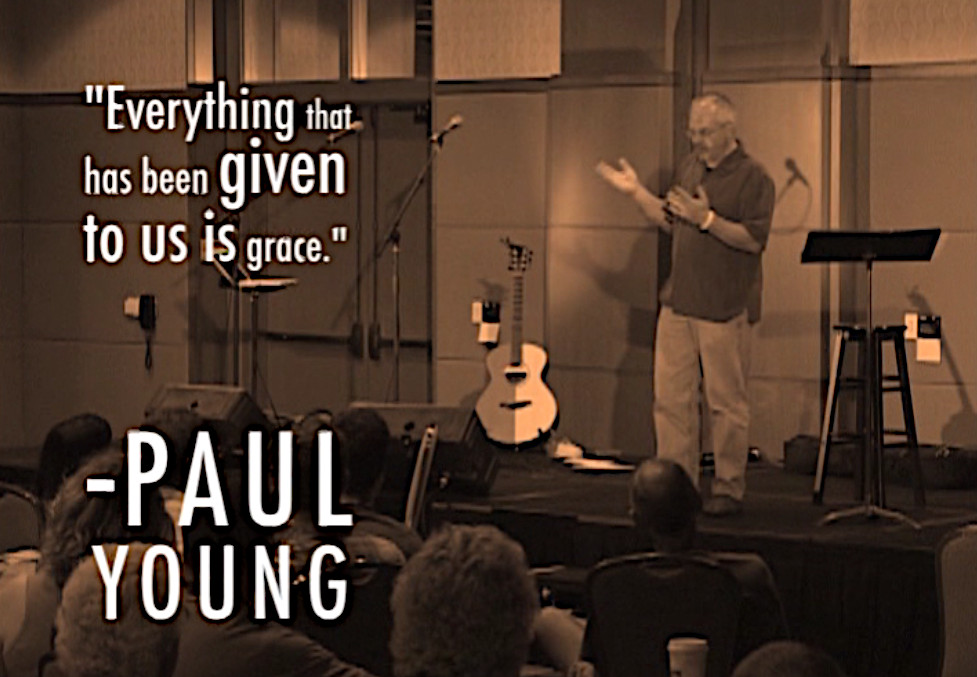
Paul Young (sometimes William P Young) wrote The Shack for his children and it unexpectedly became a very famous best-seller and much later a movie.
Here he speaks to a House2House (H2H) conference in 2008, explaining how our traditions can trip us up and mislead us, how he came to write the book, and how Father’s grace can take any one of us and make the impossible possible.
Paul Young, speaking on the topic ‘Grace’
I’ve put the three YouTube videos into a playlist. The video is low quality as it was recorded in 2008 using the standards available at the time, but the sound is clear enough. Copyright for all three videos is with House2House and I have their permission to share the videos here.
Click the playlist link and watch away. These videos have, I suspect, changed many people’s lives – in a good way. They open up truths that have been hidden for some, for others they will confirm what they already thought. The videos are by turn funny, gripping, informative, and very, very useful today just as much as in 2008. Truth doesn’t change.
So for you, and your friends, it may be transformational or it may be confirming. Either way, my prayer for you is that you will be blessed and encouraged by listening.
Some background
The conference was over three days, the first day was for leaders; Paul spoke on Grace and covers how and why The Shack came to be written. In his opening remarks he notes that he’s in an environment that he’s not familiar with. However, he was very well received.
The second topic, Tradition, was presented to the full conference. In it, Paul discusses the fall and the interactions between Yawheh, Ish, Isha, and Lucifer. (We often think of Ish as ‘Adam’ and Ishah as ‘Eve’, Paul explains the distinction.)
The third topic, Soul, was again to the full conference. This time Paul explains his background and life story very frankly.
Useful? Interesting?
If you enjoyed this or found it useful, please like, comment, and share below. (If you don’t see those links, click the article’s title above the main photo and they will appear.) Send a link to friends who might enjoy the article or benefit from it – Thanks! My material is free to reuse (see conditions), but a coffee is always welcome and encourages me to write more often!
it’s easy to imagine activities going on, a ploughman with oxen turning over the soil for planting a new crop, a household slave emerging from the house.
What’s in an image? Sometimes quite a lot, more than meets the eye.
I’m posting an image every day (or as often as I can). A photo, an image from the internet, a diagram or a map. Whatever takes my fancy.
The villa and its surroundings
This is an external view of the Villa at The Newt with its agricultural outbuildings, some of the cultivated land, and woodland in the background. The remains of the original, Roman villa have been covered over for protection and are slightly beyond and to the right of this view.
There are no fireplaces inside the villa and no chimneys externally. A furnace slightly below floor level and fed with timber from outside the building generated hot smoke and air that circulated under the floors and up through channels in the walls, exiting below the eaves of the roof.
Looking at this view, it’s easy to imagine activities going on, a ploughman with oxen turning over the soil for planting a new crop, a household slave emerging from the house to shake out crumbs from the dining room couch covers, a dog barking somewhere, the family chatting as they come back from a walk, or the sound of the children playing outside in the sunshine.
Roman Britain, beginning half way through the 1st century CE and finally petering out in the early to mid 5th century, involved a built infrastructure that would have seemed quite familiar to us in some ways. The Saxon times that followed involved structures quite similar to those of the pre-Roman Iron Age and particularly the rectangular structures of the Bronze Age. Most buildings had wooden frameworks with the use of wattle and daub infill and thatch, though the Saxons built in stone for important structures like churches. A good place to see these varying styles is Butser Ancient Farm in Hampshire.
See the previous Image of the day for an interior view of the dining room.
Images of the Roman villa
For convenience, here’s a list of all the Roman villa images:
If you enjoyed this or found it useful, please like, comment, and share below. (If you don’t see those links, click the article’s title above the main photo and they will appear.) Send a link to friends who might enjoy the article or benefit from it – Thanks! My material is free to reuse (see conditions), but a coffee is always welcome and encourages me to write more often!
What’s in an image? Sometimes quite a lot, more than meets the eye.
I’m posting an image every day (or as often as I can). A photo, an image from the internet, a diagram or a map. Whatever takes my fancy.
A Roman dining room, ready for guests
This is fine dining, Roman-style! What you see here is the triclinium (dining-room) of a modern reconstruction of a small Roman villa. I took the photo at The Newt in Somerset where the reconstruction stands close to the site of the original villa and reproduces its ground plan.
The rooms are decorated in Late Romano-British style as the original was built towards the end of the Roman period here in the UK. It’s a small villa as the family lived in Londinium (London) or Corinium Dobbunorum (Cirencester) much of the time. The villa was a country retreat.
It’s a real treat to see this place, if you ever have a chance to visit – take it! It’s only open to members of The Newt and their guests, unfortunately, apart from school trips and other organised events. Because the Villa and its farming outbuildings are equipped and furnished much as they would have been in Roman times, there’s a real feeling that the family has gone out for a country walk and might be back at any moment.
I might share some more of my photos from the villa in coming days, giving my readers a chance to see the rooms and furnishings in context with one another. Here in the triclinium, notice the mosaic on the floor and the beautifully painted wall plaster. The furniture looks quite modern, built of finely polished timber and using pleasant fabrics, even scattered with cushions just like a modern home. Roman dining involved relaxing on couches, so there are no chairs. There was glass in the windows, a very expensive, top-end feature for a Roman home. And the villa had underfloor heating for the winter, with heated flues warming the walls as well.
Images of the Roman villa
For convenience, here’s a list of all the Roman villa images:
If you enjoyed this or found it useful, please like, comment, and share below. (If you don’t see those links, click the article’s title above the main photo and they will appear.) Send a link to friends who might enjoy the article or benefit from it – Thanks! My material is free to reuse (see conditions), but a coffee is always welcome and encourages me to write more often!
If only the government had stood firm on the lines it was starting to follow! Instead of succumbing to creatures who were not seeking its reform at all, but its total obliteration.
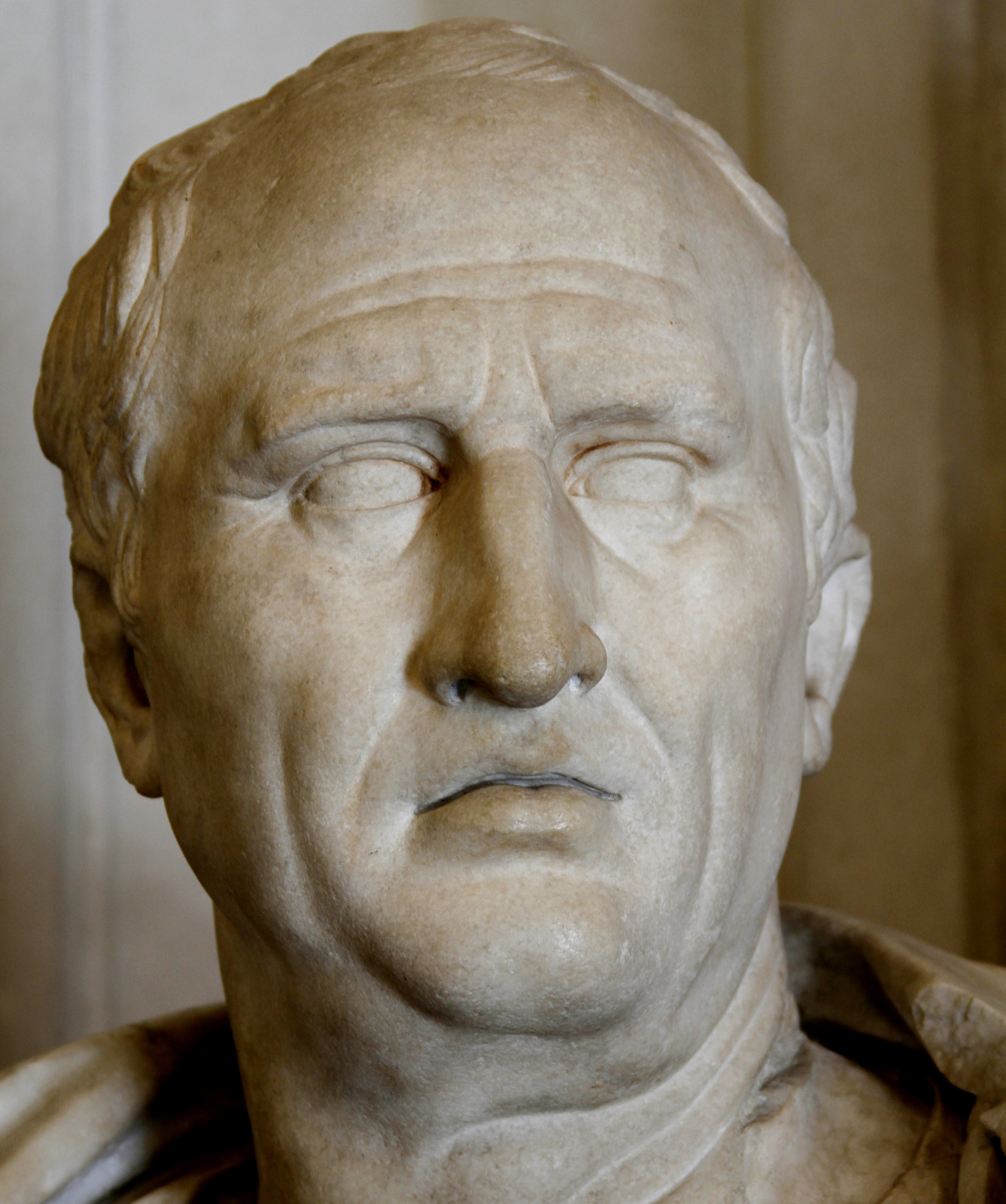
Below is a passage from Cicero’s work ‘On Duties’. We need a bit of background before I quote him. Cicero had been a lawyer, arguing cases for prosecution or defence, and he had a good deal of success in these endeavours. After a successful legal career he went into politics, working his way into the Senate, and then eventually being elected Consul.
But now the political process in Rome has changed, and instead of the Senate and other elected offices of state ruling Rome, the democratic element such as it was has been swept aside, first by a group of three and finally by the Dictatorship of Julius Caesar. Prior to this, a Dictator would be appointed for a limited time in case of great need. But now Caesar has taken the temporary role and made it permanent. (This brief summary leaves out a great deal, for more detail read the Wikipedia articles on Cicero and Caesar.)
The democracy of Senatorial Rome has ended. The dictatorship of Imperial Rome has begun. Cicero clearly understands the danger, and warns against it. Here is what he writes:
As long as our country was still governed by men it had voluntarily elected as its rulers, I was delighted to dedicate all my efforts and thoughts to national affairs. But when the entire government lay under the domination of a single individual, no one else but he any longer had the slightest opportunity to exert statesmanlike influence in any way whatever. Besides, I had lost the friends who had worked with me in the service of the State; and great men they were. When they were gone, I refused to give way to my distress – if I had not resisted by every possible means it would have overwhelmed me. Nor, on the other hand, did I just abandon myself to a life of pleasure; to do that would have been unworthy of an educated man.
If only the government had stood firm on the lines it was starting to follow! Instead of succumbing to creatures who were not seeking its reform at all, but its total obliteration. If things had gone better I should never have been devoting my attention to writing, as I am now. No, I would have been delivering public addresses, as I used to in the days when we still had a government: and if I wrote anything it would have been those speeches – just as I always wrote down and published my speeches after I had delivered them – it would not have been these essays I am engaged in now. Every scrap of my energy, attention and care used to go to politics. So when there was no such thing as politics any more, it was inevitable that my voice should be heard in the Forum and Senate no longer.
Does this sounds a little bit familiar? It should! We can identify democracies in our own times. Germany was a democracy before Adolf Hitler and the National Socialist Party seized power. Russia was a democracy under Boris Yeltsin until the presidency was transferred to a younger Vladimir Putin.
And what about the democracies of the USA and the UK today? They are still democracies for the time being, but how long will they last?
Adolf Hitler and Vladimir Putin came to power in democracies, but then tweaked the rules to give themselves additional powers and longer terms in office. Do we see the same kinds of manoeuvring by Donald Trump and the extreme right in the USA and by right wing politicians like Boris Johnson and Nigel Farage in the UK? So far, people like these have not been able to change electoral processes, but Trump has tried and so far failed, while Johnson and others may have used distortion and misrepresentation.
Intimidation and violence were used as levers of political change in Rome, and those methods are also being employed in our own day. Look at the words and actions of the far right across the world in recent years. We should all be concerned, some of today’s best and most moderate politicians have been elbowed aside – notably in USA’s Republican Party and the UK’s Conservative Party. And the same trend seems to exist everywhere in the wider West.
Just like Cicero, we should be alarmed, and careful, and work against the slide towards authoritarianism and power in the hands of individuals. A very great deal depends on the survival and flourishing of democratic government or we risk sliding into a new dark age of untempered authoritarianism.
Useful? Interesting?
If you enjoyed this or found it useful, please like, comment, and share below. (If you don’t see those links, click the article’s title above the main photo and they will appear.) Send a link to friends who might enjoy the article or benefit from it – Thanks! My material is free to reuse (see conditions), but a coffee is always welcome and encourages me to write more often!
Notes from bygone years – Some of the most august months of August Hint: Click on the thumbnails for larger images.
August 2023 (1 year before publishing this article)
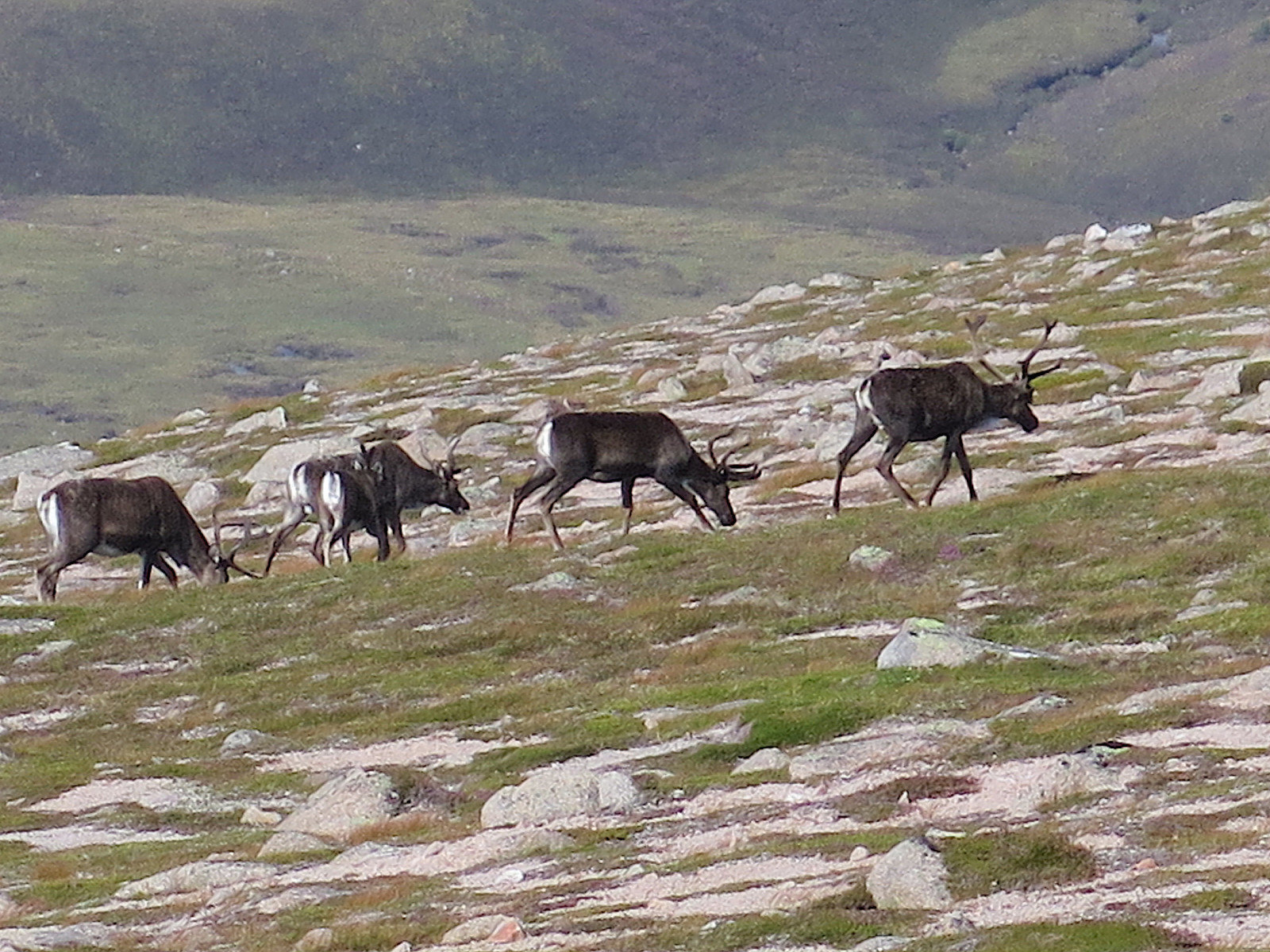
Reindeer on Cairn Gorm
For our family holiday this year we had decided to book a big house in Scotland (there were ten of us, me and Donna, my two daughters and their husbands, and four grandchildren) so we needed a lot of space! We did many interesting trips and walks, and some of us decided to attempt the summit of Cairn Gorm. We saw a herd of reindeer on the way up, and the summit was in the clouds. If it had been clear, we might have gone further south-west for the views, but we really enjoyed our walk, even so.
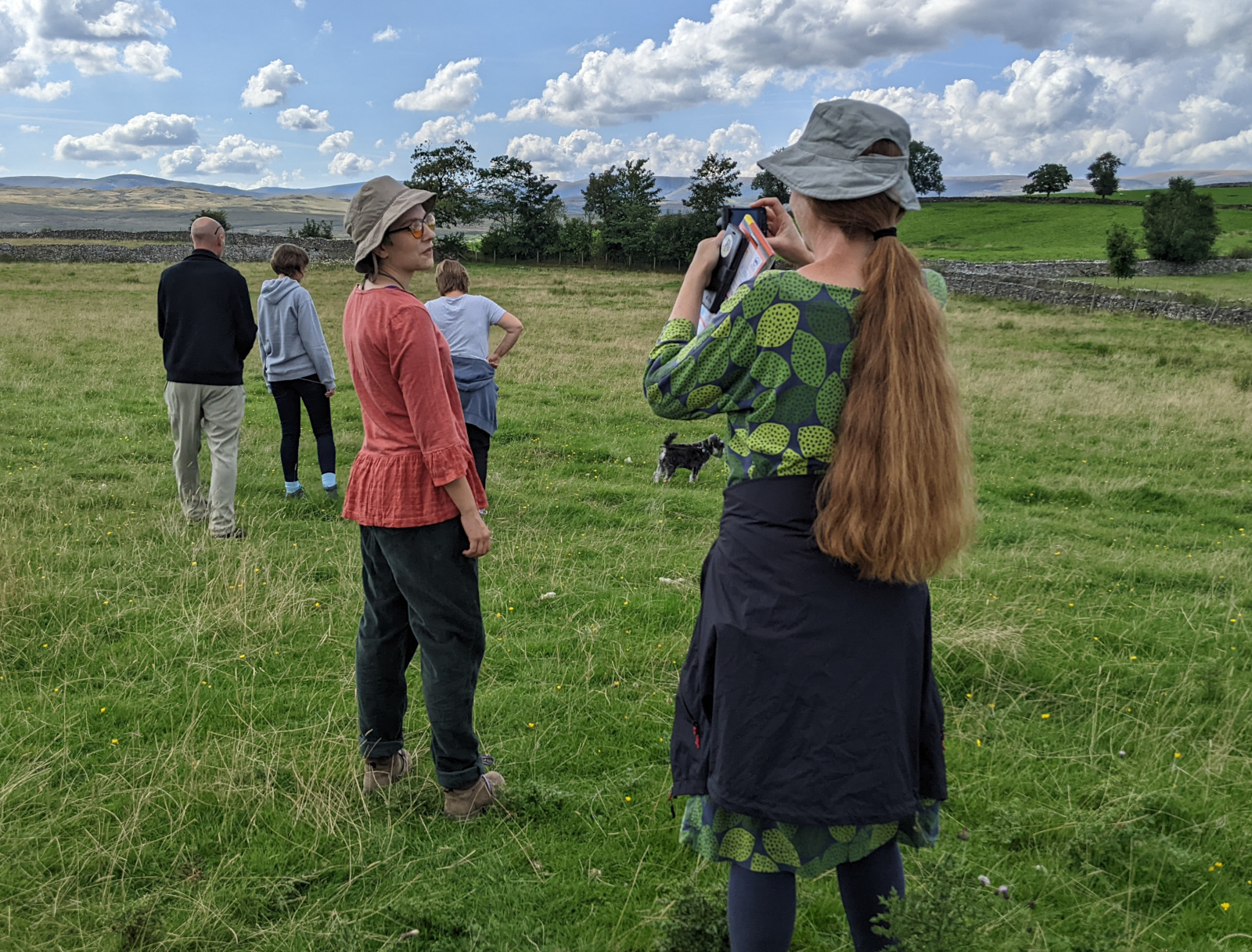
This year’s family holiday was at Shap in the Pennines. In the photo, part of the family was out for a walk in the lovely countryside around the holiday house.
As usual, there was a lot to see and do, the Lake District is not far from here and the Pennines are full of interest too.
Some of us walked from Keswick to the top of Skiddaw one day. There were good local walks from our house in Shap, too. Donna and I spent a day exploring Haweswater Reservoir and other parts of the Lake District. We usually do a jigsaw while on holiday – this time it was a picture of Cirencester Market Place.
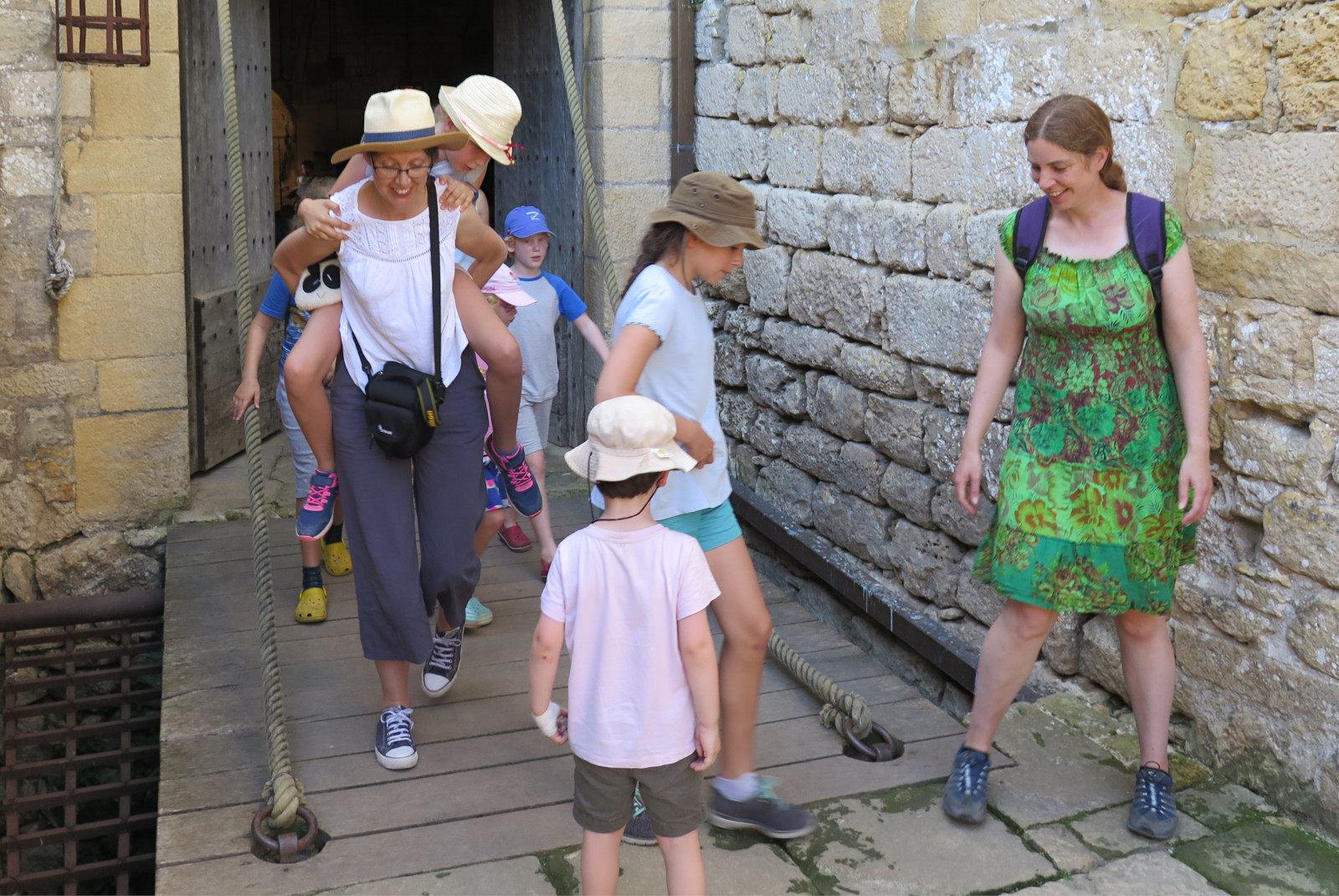
This year’s family holiday was in the Dordogne; in the photo, some of us are crossing the drawbridge of the lovely medieval castle, ‘Château de Beynac‘. Visiting this place was a fairy tale experience, we have nothing of this age and completeness in England apart from Dover Castle, perhaps. The château was just one of many interesting visits, and the holiday home was perfect for us, with a pool for the children and room for us all to spread out.
World events: 11 billion tons of Greenland ice melted in a single day; in Iceland, a funeral was held for the lost Okjökull glacier.
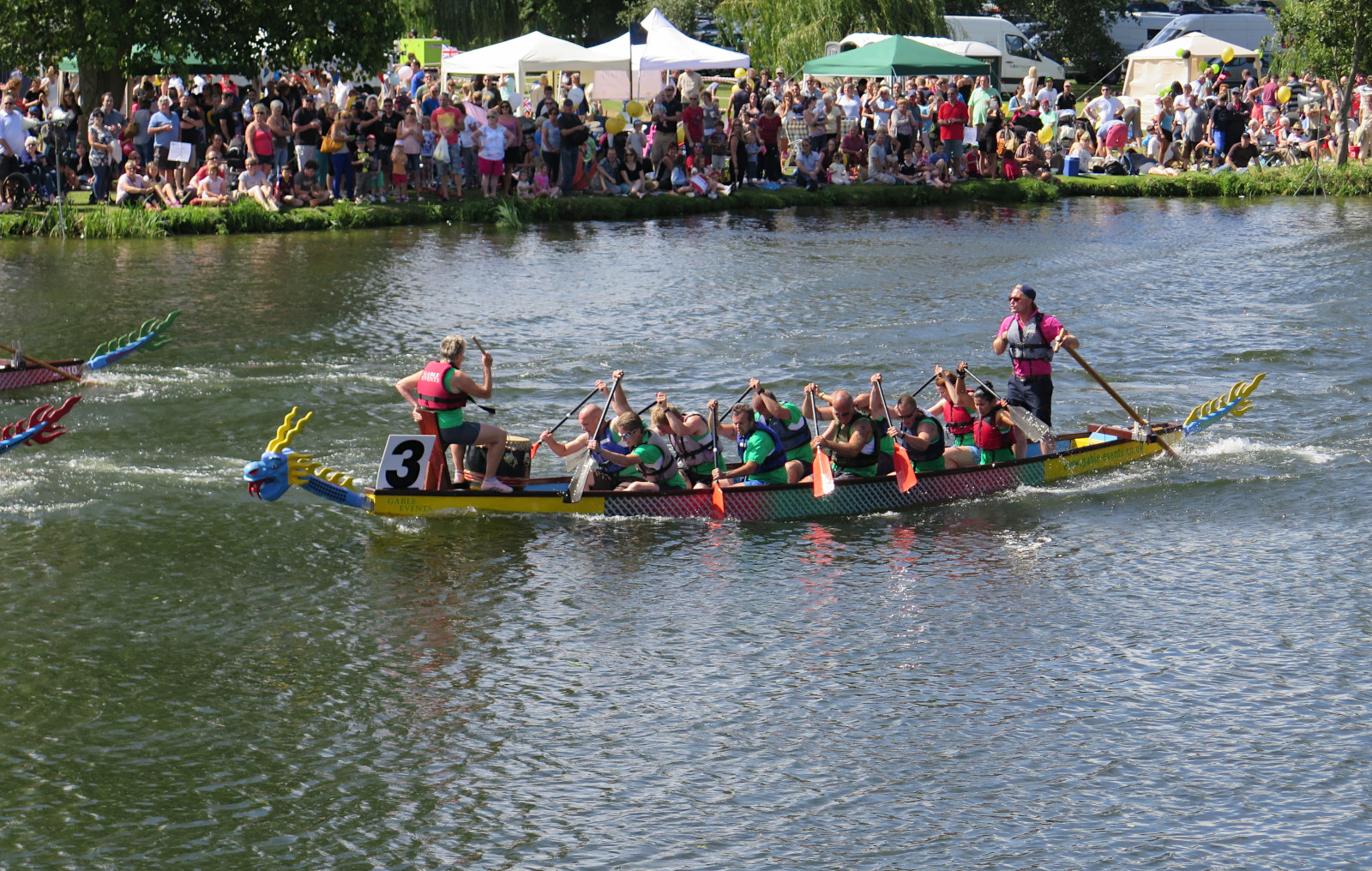
We returned from our family holiday in Lyme Regis on 1st August, and visited Donna’s Mum and Dad in Broadstone on our way home. Two of our friends were ill, one was in hospital after heart surgery and was recovering slowly and getting out of danger, the other had hepatitis and had been in and out of hospital. Both were improving. On the fun side, we watched dragon boat racing on the river in St Neots (photo).
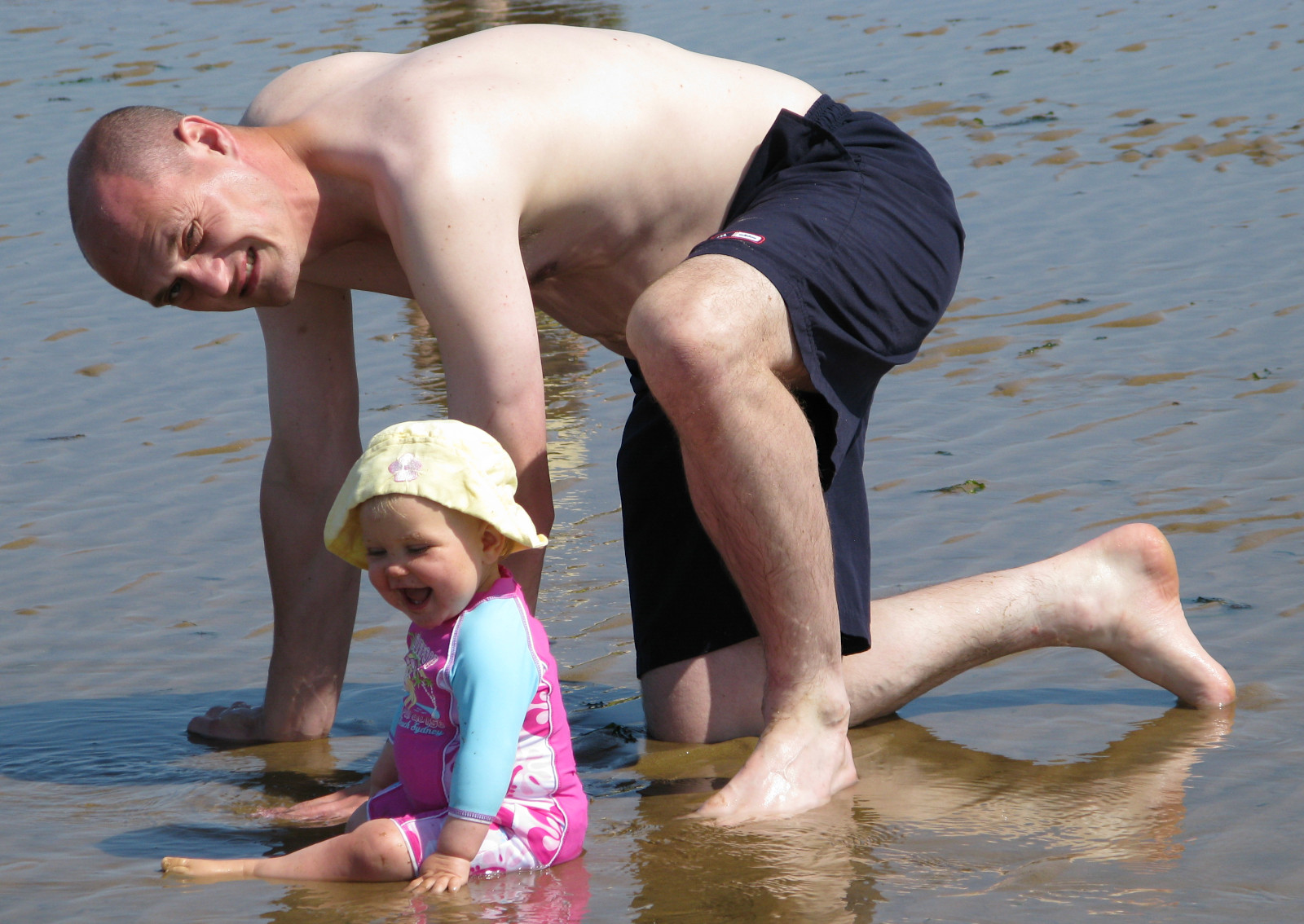
August is certainly the month for holidays in the UK. In 2009 we rented a large house in Aldeburgh and of course, the beach was high on everyone’s list of things to do. The photo shows Sara and her Dad, Steve, on Hunstanton Beach.
I imagine the conversation going something like this… Sara: ‘Come on Daddy, sitting in the water is great!’ Steve: ‘Hmm.. Nah, I’d rather not, thanks.’
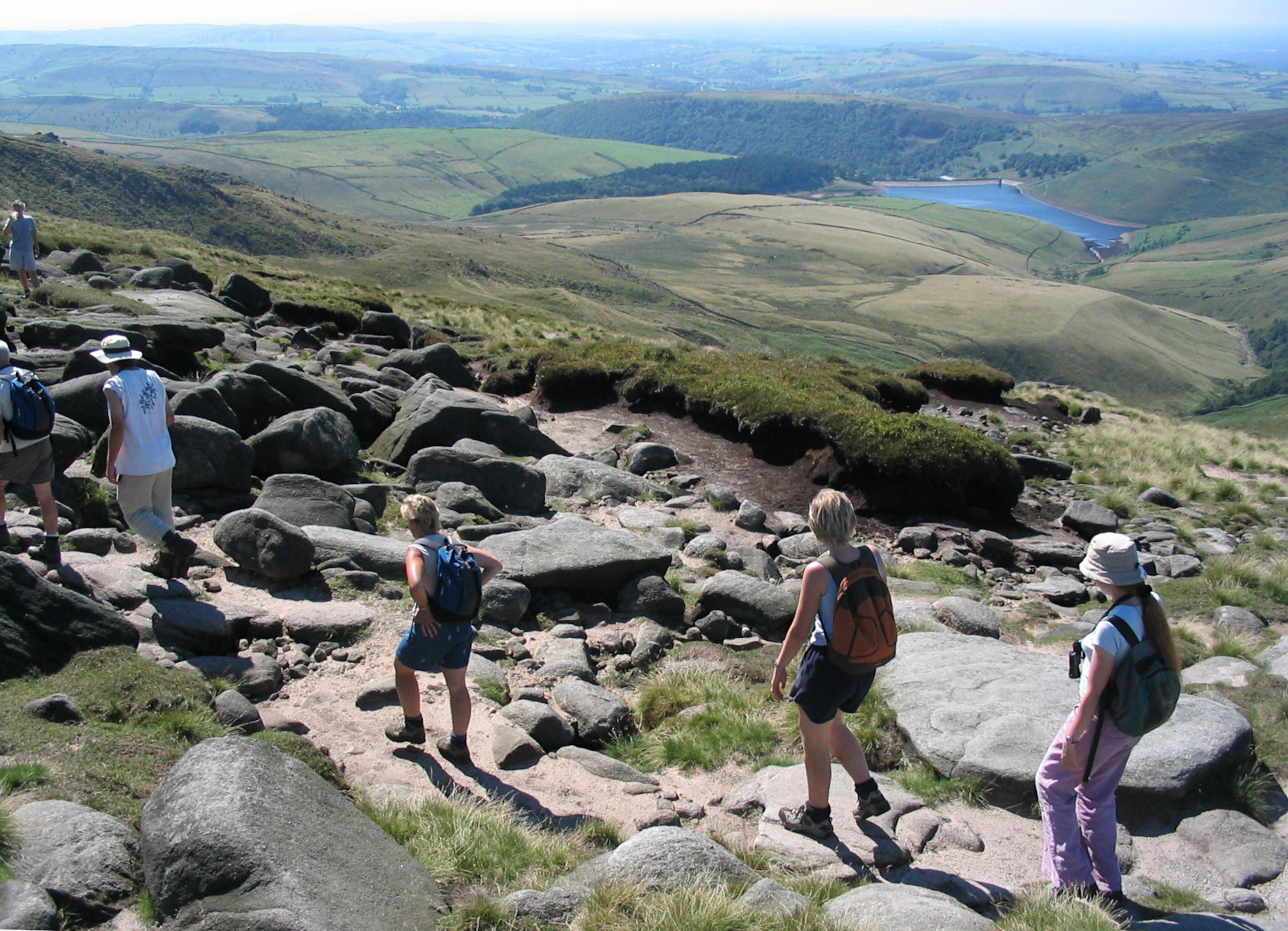
We made a day trip to walk on Kinder Scout with Beth and Paz from their home in Disley, and met up with friends from St Neots that we knew through Open Door Church.
It was a great walk on a fine, sunny day, heading up Grinds Brook from Edale, then over the top to Kinder Downfall, back along some of the edges and down Jacob’s Ladder.
World events: NASA’s MESSENGER spacecraft was launched to visit Mercury; and the Summer Olympics were held in Athens.
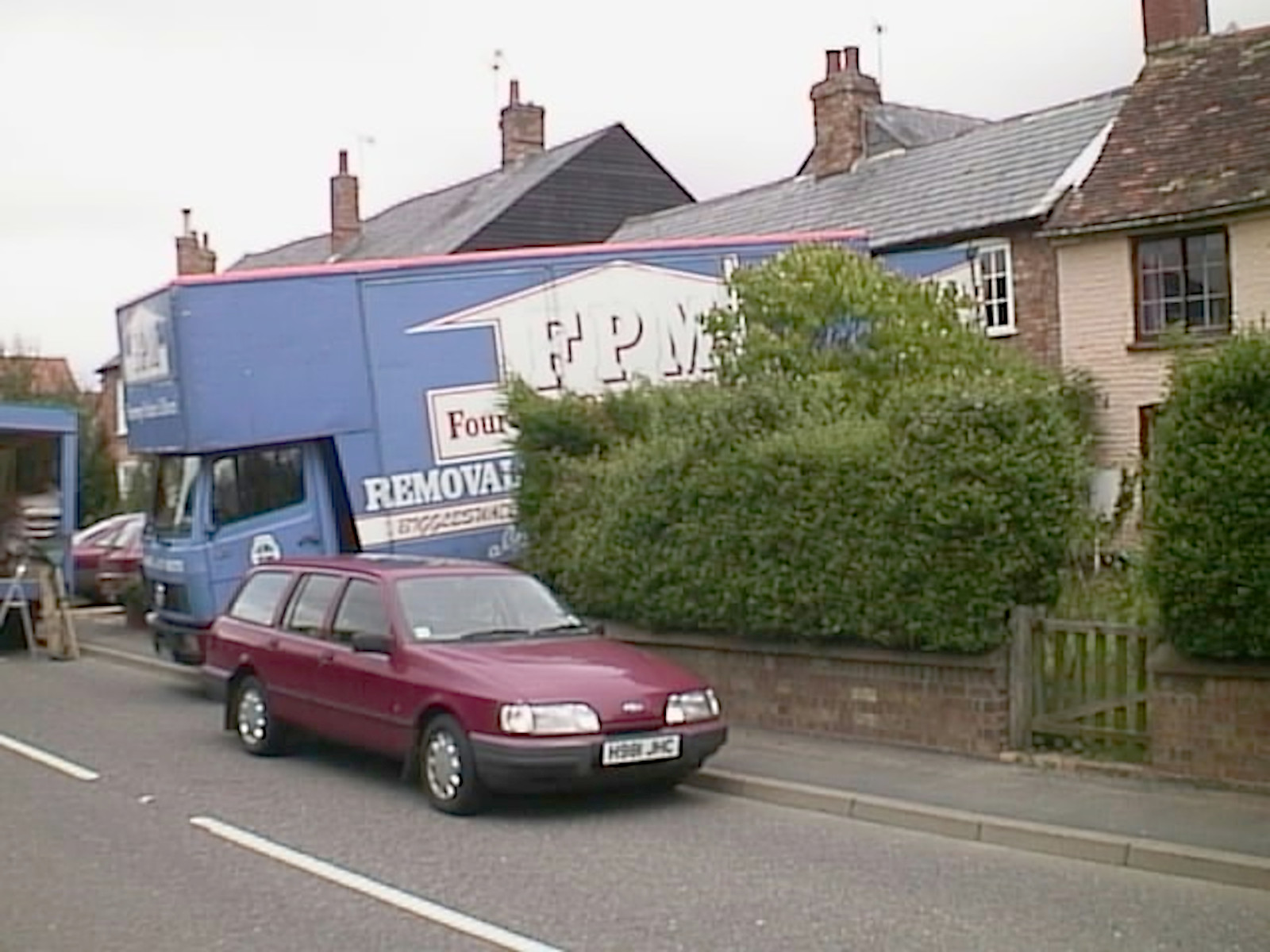
We moved house on 20th August, from Tilbrook to St Neots, from a two-bedroom cottage to a four-bedroom detached house. Our furniture looked very sparse in the new, larger space!
We’d enjoyed living in a village, but looked forward to walking to the shops and only needing the car for longer trips.
World events: There was a total solar eclipse in Europe; and East Timor regained independence from Indonesia.
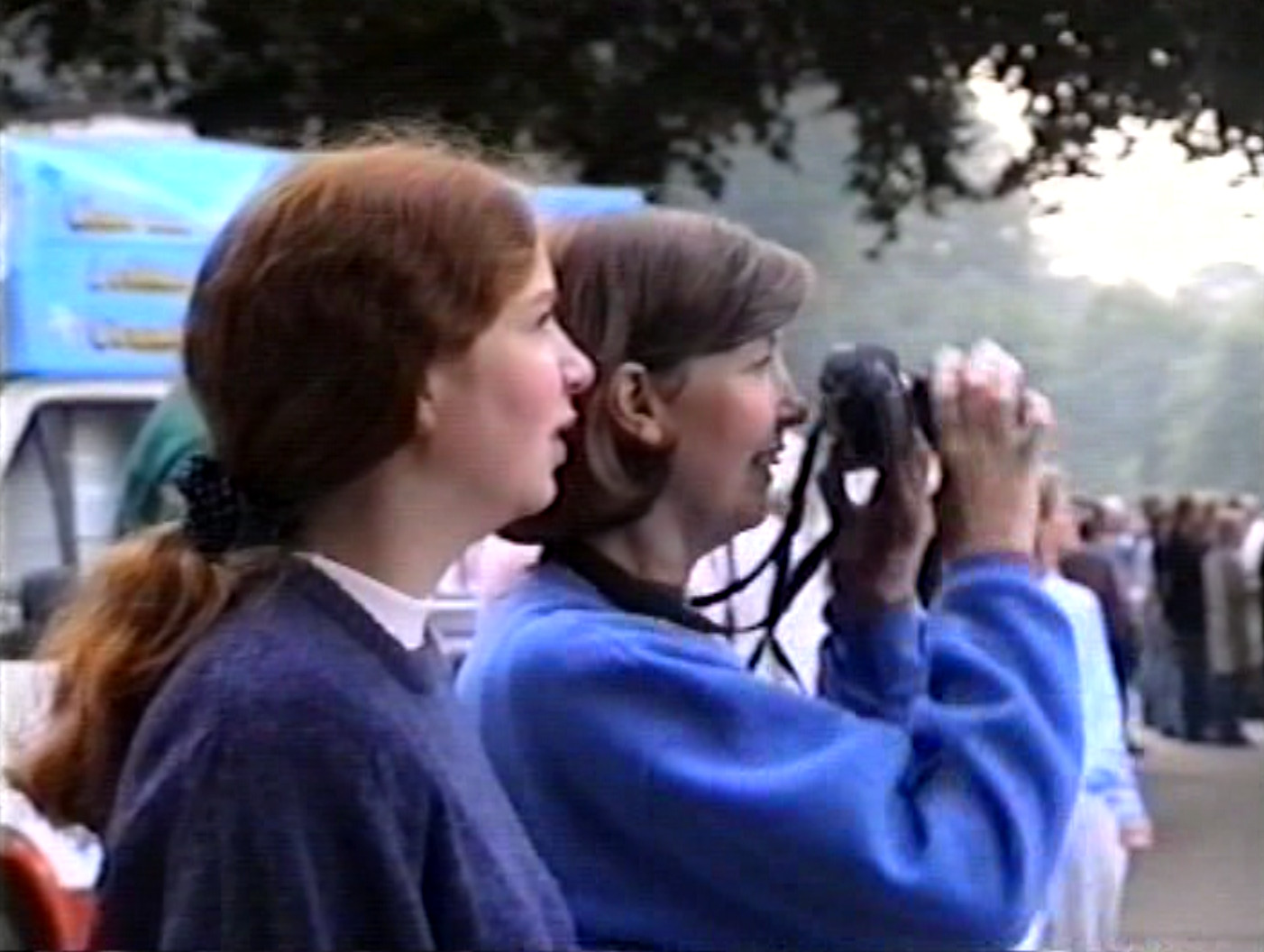
August was a difficult month. We went to the Bristol Balloon Fiesta on 6th, great fun as always! The photo shows Beth and Judy at the event. Judy was diagnosed with bowel cancer, though it seemed likely surgery would successfully remove it.
Judy, Beth and I had a holiday at Janzé in Normandy and the surgery was to be performed on our return, probably early in September but it might have been late August.
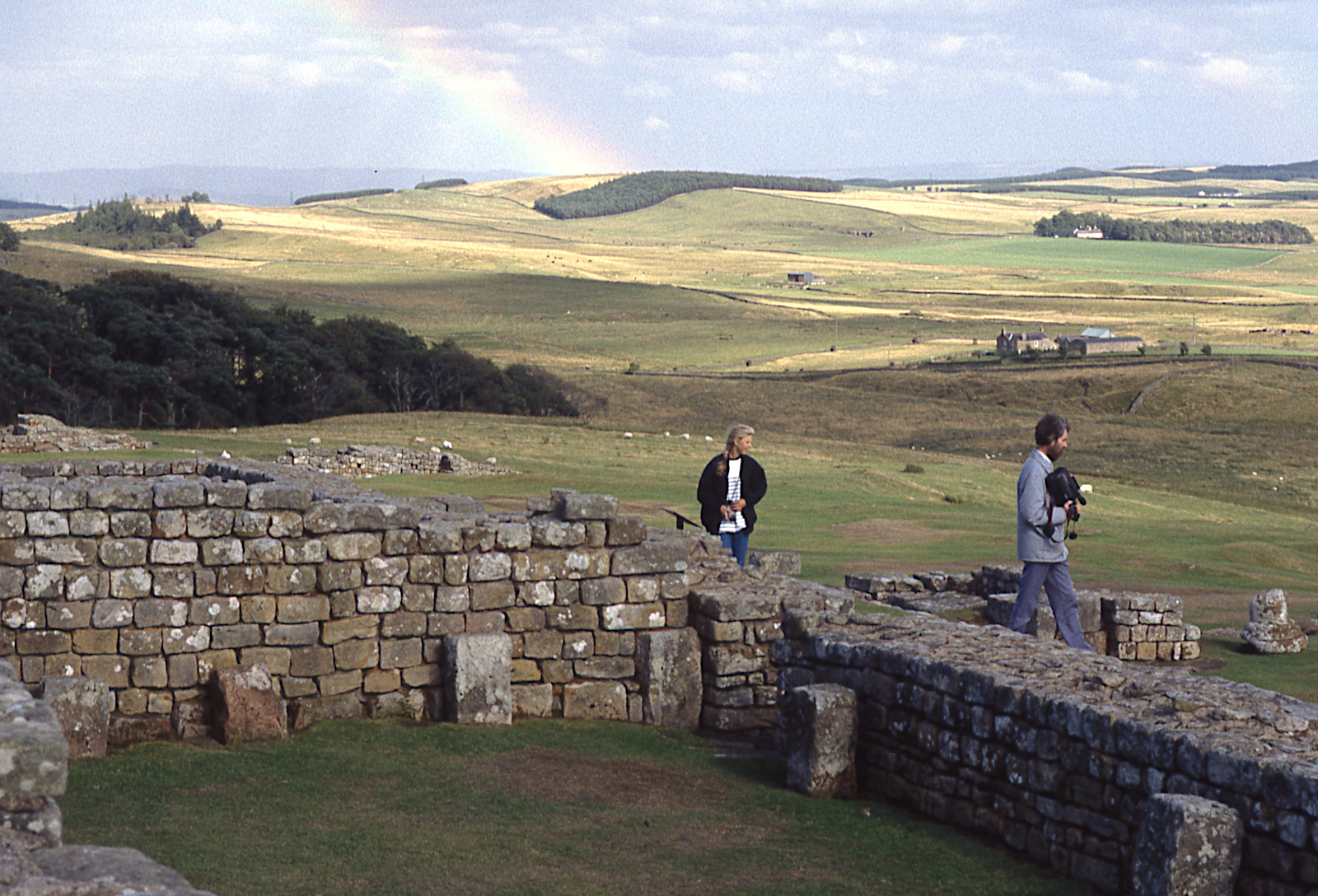
This year’s holiday was on the northern coast of the Lake District at Silloth, we were able to visit Hadrian’s Wall, Wordsworth’s house, Edinburgh, Carlisle and more.
In this photo taken by Judy you can see part of the Roman Wall fortress of Housesteads, with Debbie and me just beyond the building.
World events: The Singing Revolution in the Baltic States demanded independence from the Soviet Union; and NASA’s Voyager 2 captured images and data at Neptune.
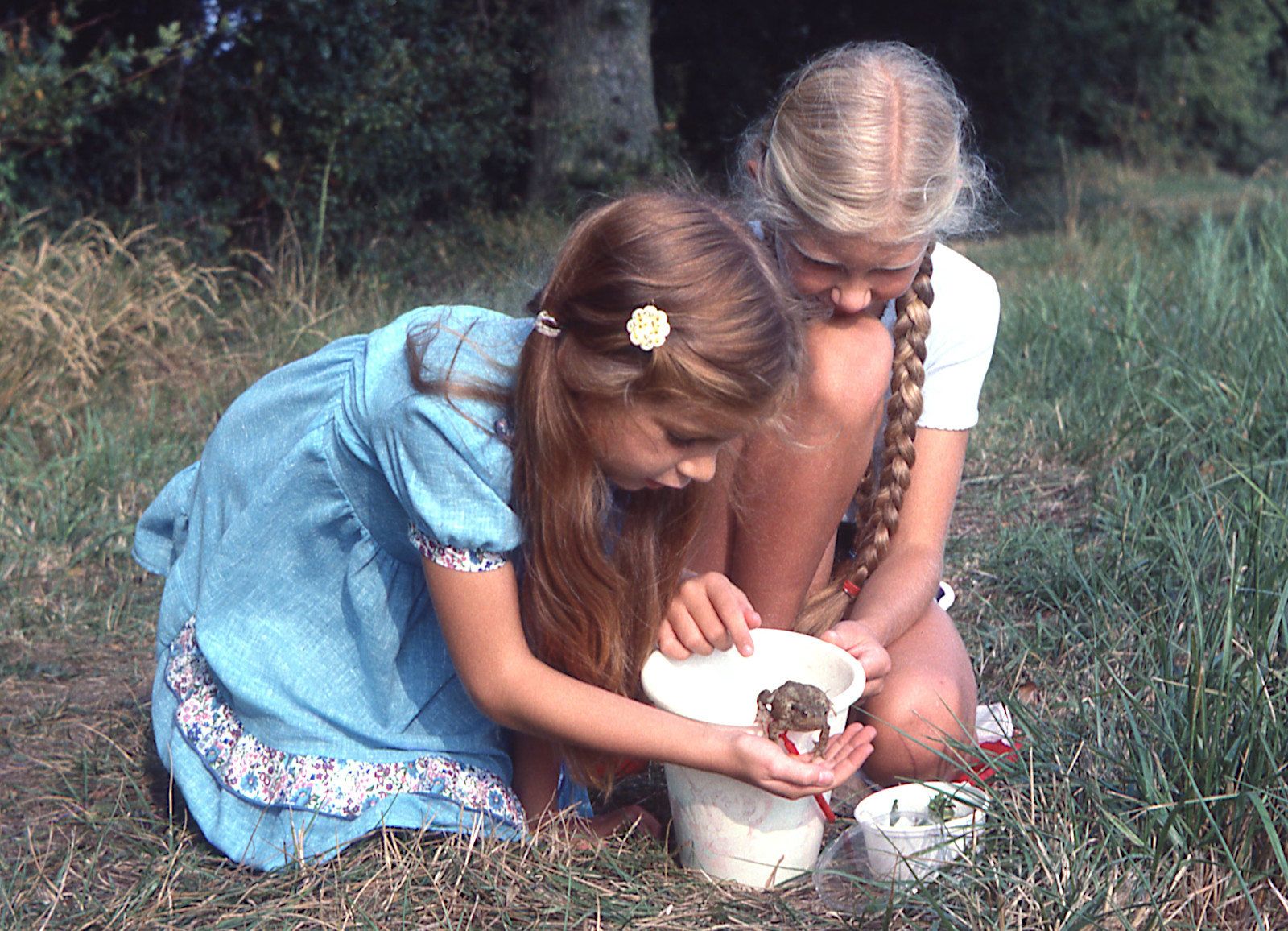
Soon after our holiday, we found a toad in our garden, trapped it in a plastic bucket, and took it to a nearby field to release it. In the photo, Beth has the toad moving onto her hand with help from Debbie, and soon afterwards it was free, hopefully in a toad friendly environment.
It wasn’t unusual in Yatton to find wildlife in the house or garden – a field mouse, a bird, a frog or whatever.
There’s remarkably little to say about this month, I’ve failed to locate any photos, cine film, documents or other physical evidence.
We were living at 22 Rectory Drive, in Yatton; Judy was being a full time Mum with Debbie aged four and Beth just one and a quarter. I was working on fruit tree pollination at Long Ashton Research Station.
By this time Judy would have been four months pregnant and we were well aware of it. We were living in an unfurnished flat in Belmont Road, Bristol, and trying to buy a house. Judy was aware of the years ticking by and wanted to start a family, while I was hoping we could sort the house while on two salaries.
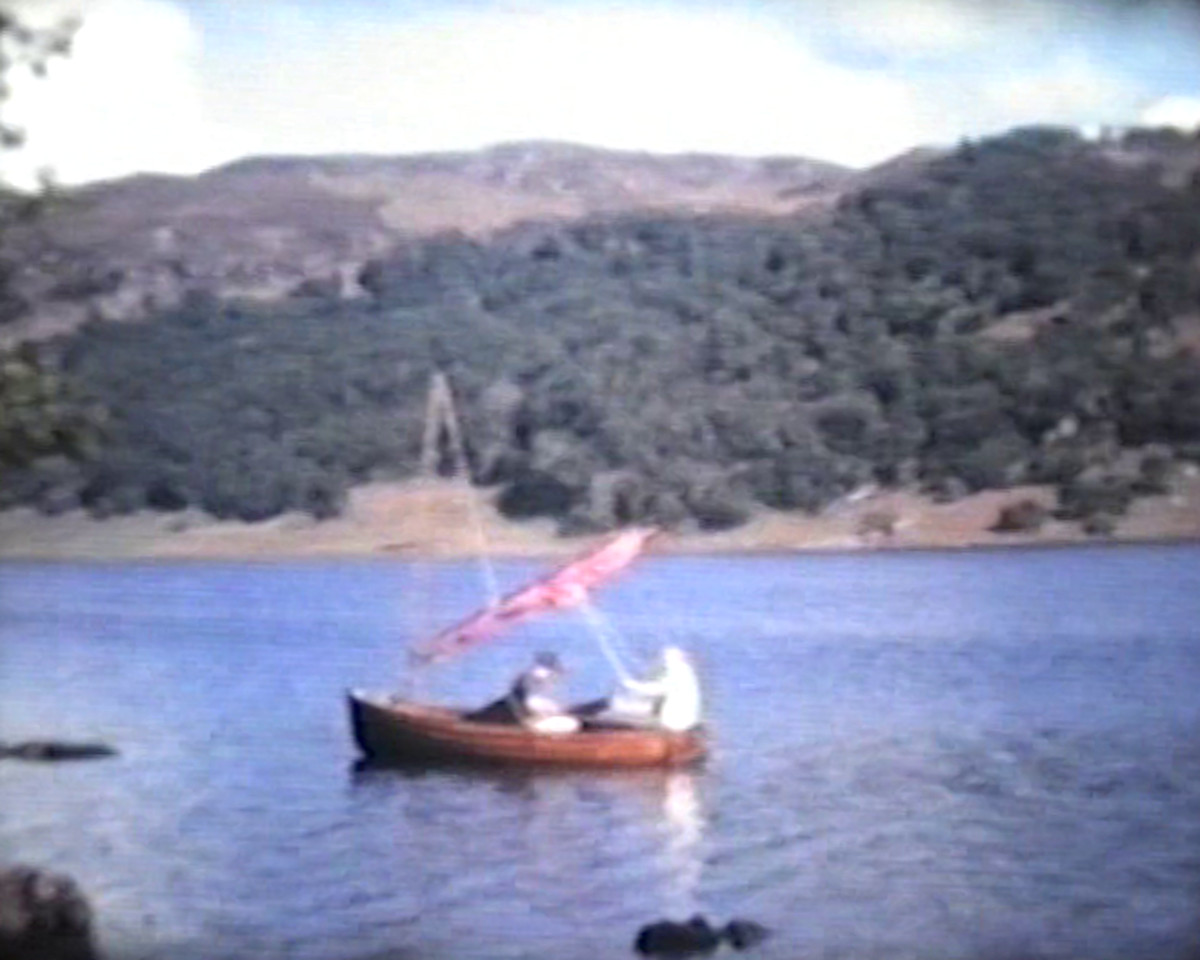
The still from Dad’s cine camera shows Cindy’s husband Peter boating on Loch Nell near Oban. Mum and Dad had driven up to visit them, and Pete’s Mum and twin brother were there as well.
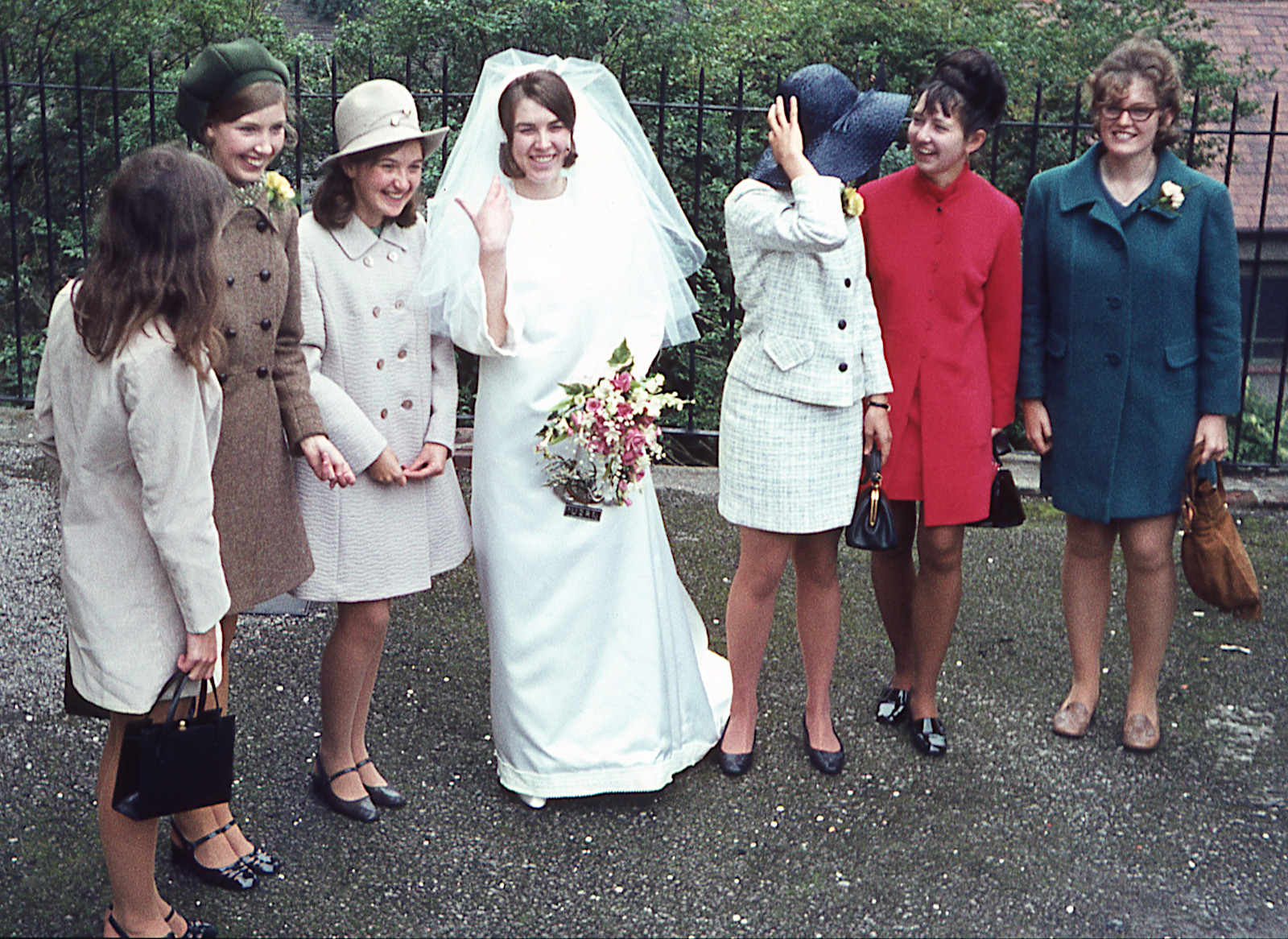
The summer of 1969 saw Judy’s friend Big Mary marry her PhD fiance Malcolm. They were both Welsh speakers, as many of the Aberystwyth students were. The photo shows Maggs (Judy’s closest friend at Aber), Judy, Little Mary, Big Mary and Jan (I think) in red. The other two I recognise but can’t put names to.
I took the photo after the Welsh chapel ceremony, but before the reception. It was a valleys wedding, I think in Cwmbran.
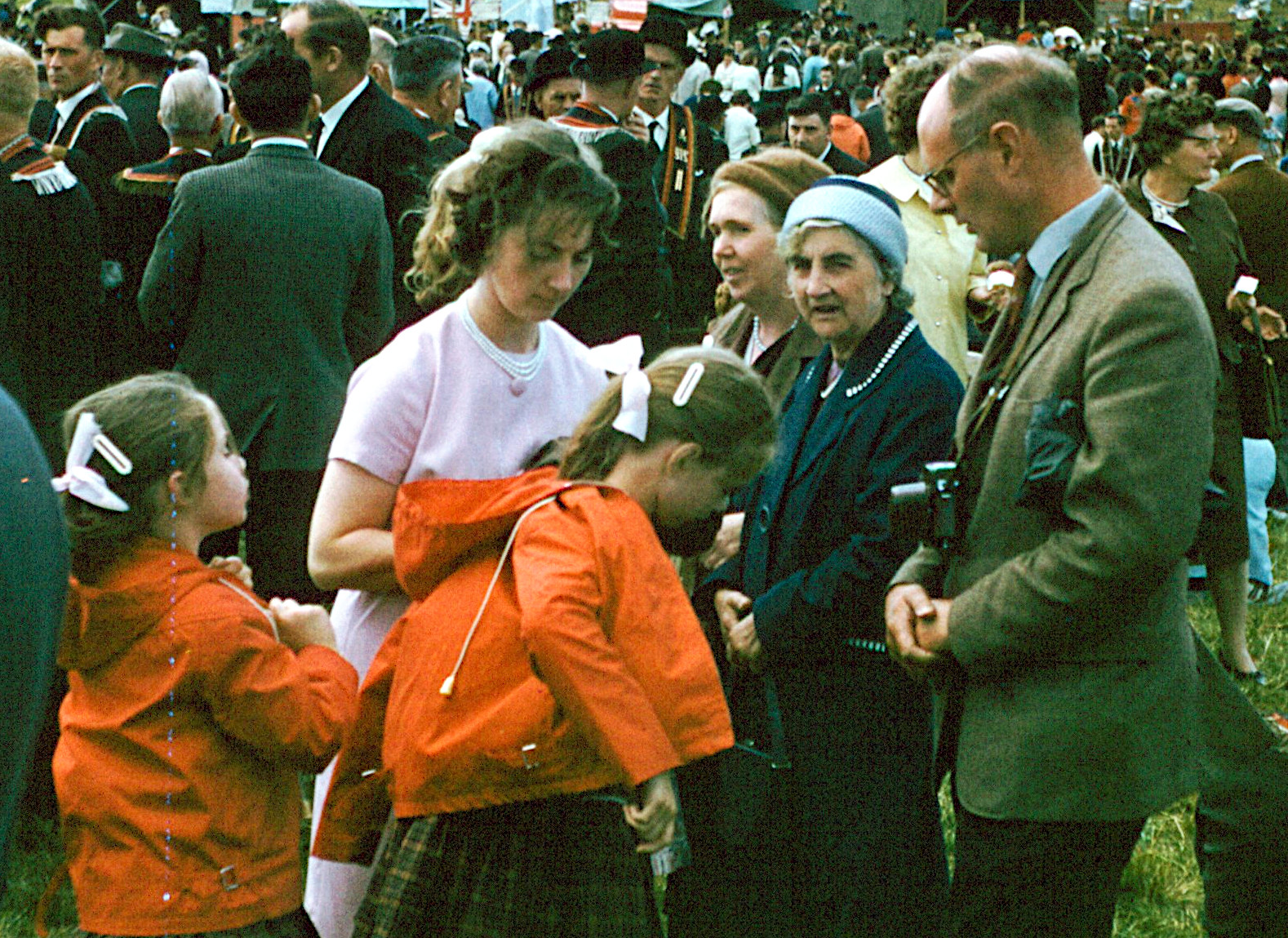
We were on holiday in Coagh, Northern Ireland and visited the Black Saturday parade in nearby Cookstown. Here we are at the Assembly Field after the parade.
In the photo you can see Rachael, Lilias, Ruth, Jane (my great-aunt), Selina (my grandmother) and Mike. We always knew our Irish grandmother as ‘Granny-in-Ireland’ to distinguish her from our English grandmother, Nor.
World events: The last executions took place in the UK; Mary Poppins had its world premiere in Los Angeles.
The 11+ exam results came in, I think while we were on holiday at Burnham-on-Sea, I had passed and would start at Cirencester Grammar School in September. During the same holiday, we heard that my Grandpa had died on 22nd and Dad had to drive home for a couple of days leaving Mum, me and Cindy in the holiday caravan.
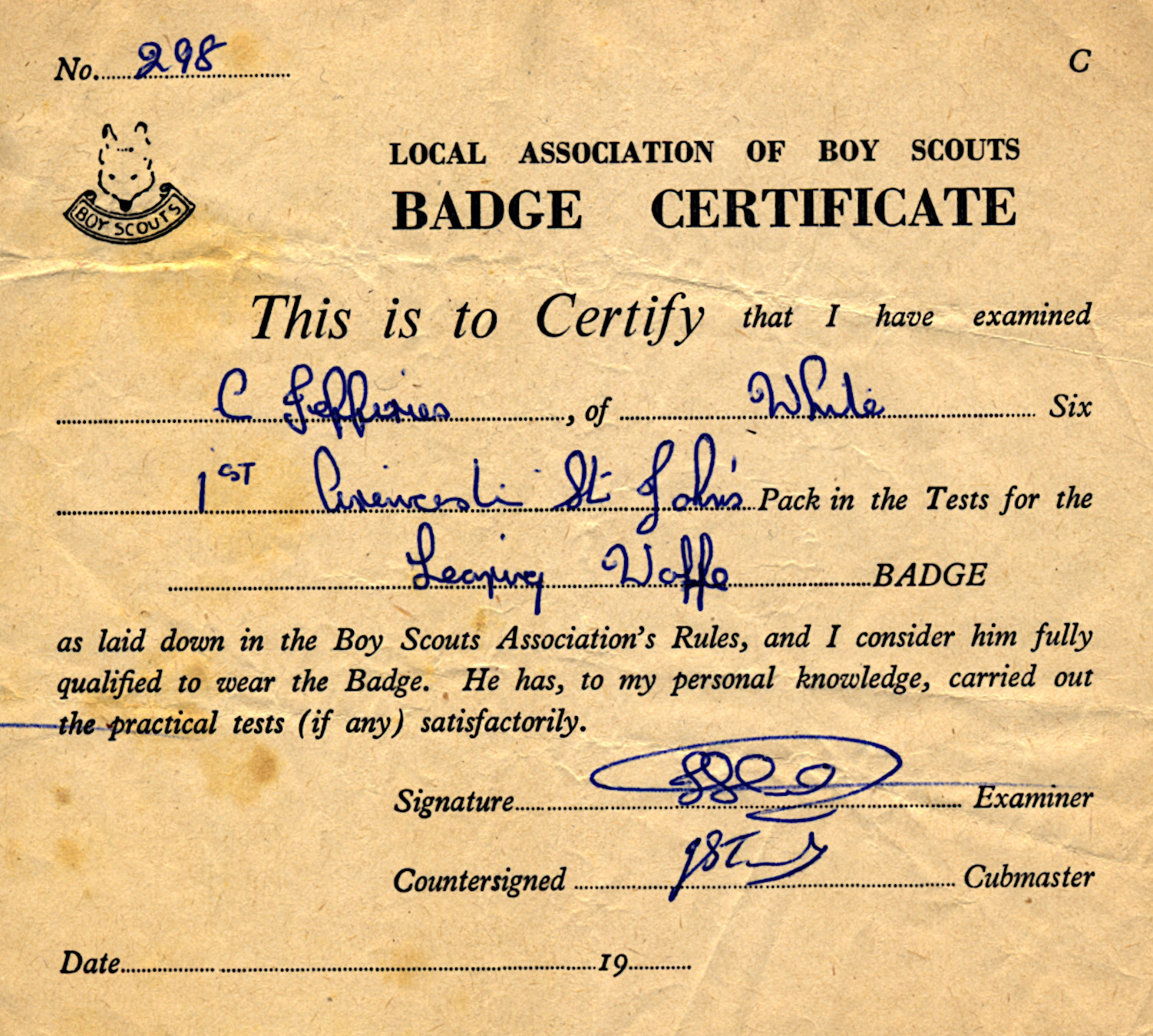
Also in August, I passed my Leaping Wolf badge before moving from Cubs to Scouts.
World events: NASA’s Explorer 6 satellite returned the first images of Earth from space; and the Mini car went on sale in the UK.
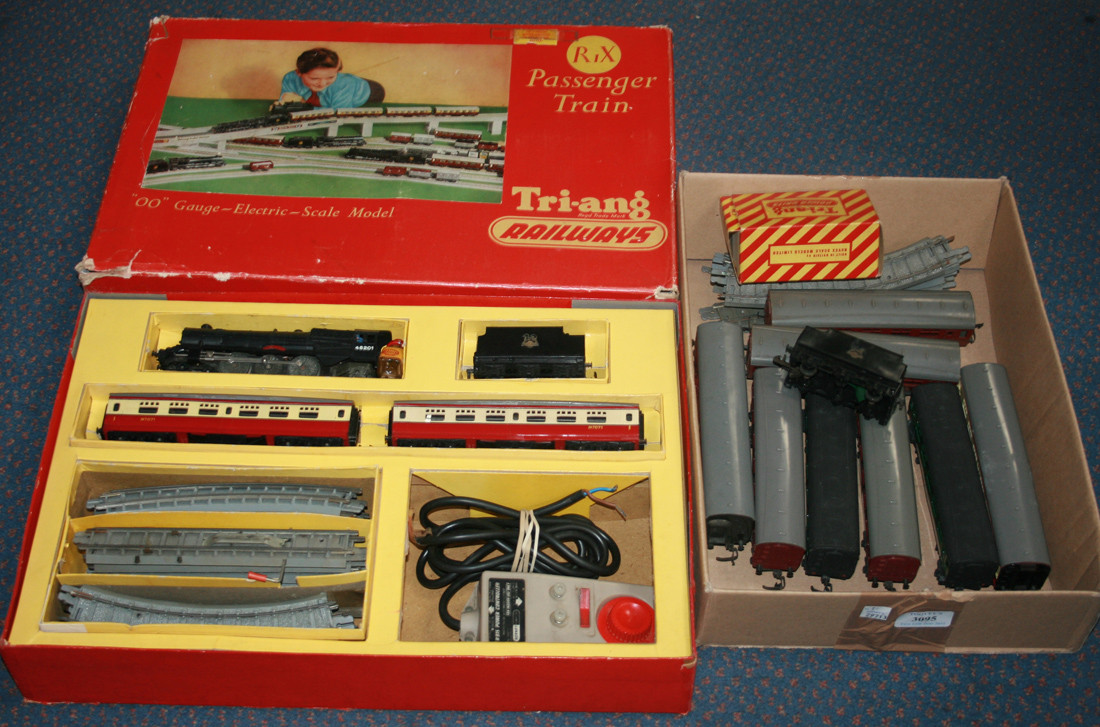
I had just turned six-years-old and I remember playing with my electric train set that I was given, either for my birthday or perhaps the previous Christmas.
It was similar to the set on the left of the photo. I well remember the picture on the box lid.
Now starting my second year of life (my first birthday was in late July), we were still living with my grandparents, I think.
I might have started saying one or two words at this stage, I was probably able to stand with perhaps a wobble or two and a sudden sit-down now and then. And maybe I could walk short distances by this time too. I remember a blue harness with three or four silver bells on the front and this was used when we walked outside on the pavement, but that memory almost certainly comes from the age of two or three.
Dad took his final radar exam on 14th and found out on 15th that he’d passed and was being posted to Inverness. He was also troubled that his girlfriend at the time, Libby, was not as interested in him as he’d assumed.
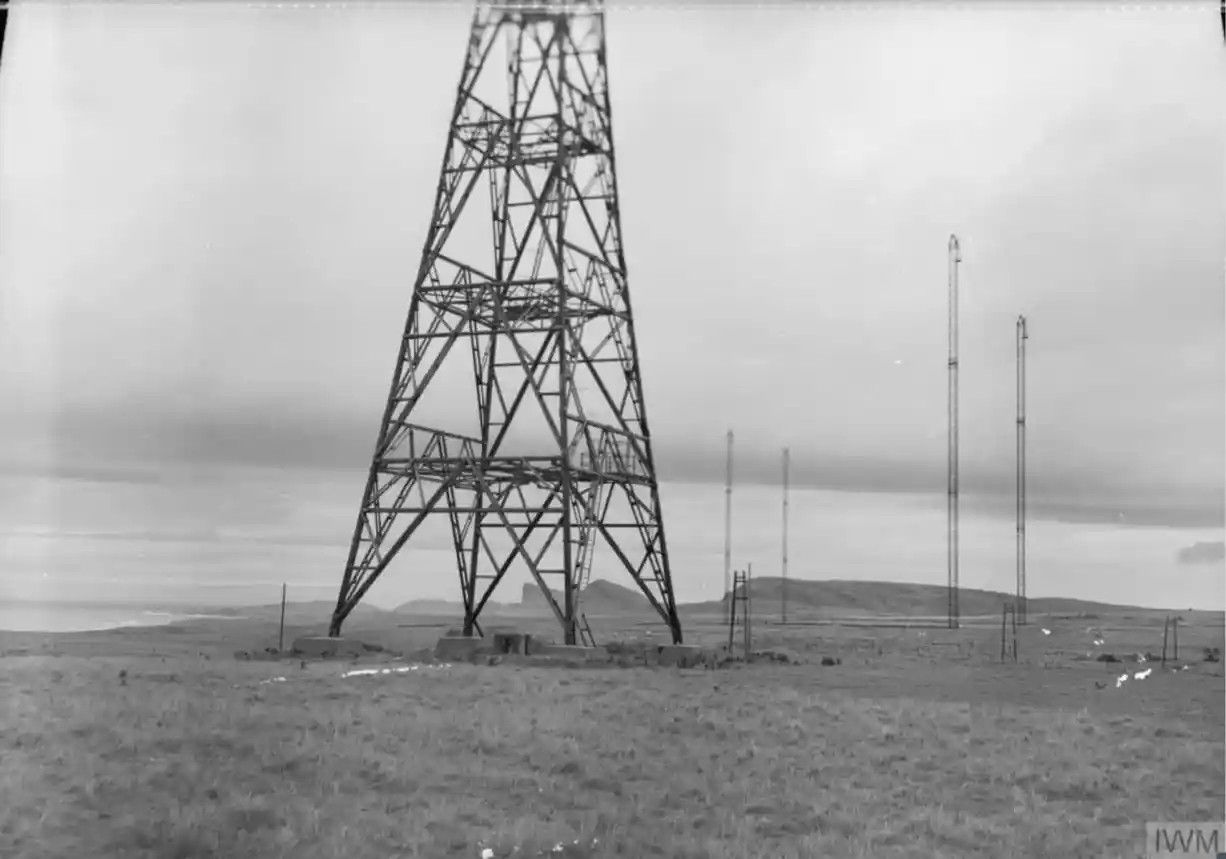
After leave in Cirencester from 16th he left for Inverness on 22nd via Paddington, Kings Cross, and overnight to Edinburgh, then via Perth to Inverness on 23rd. He was then told he was being posted to Northern Ireland instead! On 25th it was another rail journey via Perth and Glasgow to Dumfries and on 26th to Stranraer for the boat to Larne and then Belfast. With his friends Joe and Tony he caught a ‘funny’ train to Cookstown and then RAF transport to Ballinderry radar station. The photo shows part of a Chain Home radar site, similar to Ballinderry.
On the 31st Dad went to the village shop in Coagh and wrote in his diary ‘talked to girl for long time’. That girl, four years later, became my Mum!
World events: The Warsaw uprising began; and the world’s first undersea oil pipeline was laid between England and France (to supply fuel to the advancing allied forces).
If you enjoyed this or found it useful, please like, comment, and share below. (If you don’t see those links, click the article’s title above the main photo and they will appear.) Send a link to friends who might enjoy the article or benefit from it – Thanks! My material is free to reuse (see conditions), but a coffee is always welcome and encourages me to write more often!





 Journeys of Heart and Mind
_-_Palazzo_Nuovo_-_Musei_Capitolini_-_Rome_2016.jpg)
