If I tell someone that I follow Jesus they will expect him to be like me. If I am mean, greedy, selfish and easily angered people will pick up the notion that Jesus might be like that too.
A few days ago I posted Butterfly dead or alive? I considered the difference between a dead butterfly and a living one. I thought about this in biological terms, suggesting I’d write again soon on the spiritual aspects for people following Jesus. This is that second article.
I’ll go through each of the main points from that earlier article to draw spiritual truth out for anyone who believes they are alive in Christ. So here goes…
Ability to move
If I’m spiritually dead, then like the dead butterfly I will be unable to move. But what is spiritually equivalent to the physical ability to move? There may be more than one way of looking at this. Read Acts 17:1-8. What does this mean, in real, practical terms? Try reading the entire chapter, Acts 17, and it will become clear. Paul was explaining to Greek philosophers in Athens that the ‘Lord of Heaven and Earth’ is not served by humans because there’s nothing we can provide that he doesn’t already have. Instead he’s the One who gives us life and breath and everything else we might need. You’re not spiritually alive until you start paying attention to Jesus and agree to let him work in you and through you. He will change you in so many ways, all of them good. But if you’ve never met him before and never spent time with him you will not become alive spiritually. When you allow him to touch you in this way you will become alive and aware and, like the living butterfly, you’ll be able to move with energy that is within you, the essential energy Jesus has placed in you. The dead butterfly would be dried up and provide food for the ants. The living butterfly can detect predators, move to safety, and gather energy from floral nectar.
When we’re spiritually dead we can do nothing to help ourselves, but when Jesus has made us alive we can move freely, and not just in this physical world for we can now move spiritually too. It’s difficult to describe this to someone who has not yet experienced it. But come on in! You will never regret it.
Appearance, colour, lustre
As you continue to learn from Jesus you will become a thing of beauty and fragrance, well maintained spiritually, colourful, clean and cared for. The body ages and deteriorates over the years, but the spiritual heart and life will never age or fade.
Ability to sense danger
There are forces of spiritual evil in the world, as well as the more obvious physical dangers we face from falling rocks, dangerous drivers, illnesses of many kinds, or the occasional thunderstorm, earthquake, or volcano. Jesus does not give us any guarantee of safety from the physical world, but he will alert us to and protect us from spiritual danger and damage – if we pay more attention to him and his Holy Spirit than we do to our own ideas and preferences. Often, sadly, we do not.
Reproduction
This is an important one.
Spiritual reproduction is not like biological reproduction, although both result in growing numbers. In the case of spiritual reproduction it’s mostly a matter of living lives that will make people ask themselves, What’s different about them? People tend to know a good thing when they see it. If I tell someone that I follow Jesus they will expect him to be like me. If I am mean, greedy, selfish and easily angered people will pick up the notion that Jesus might be like that too. So I’d better become kinder, more gentle and helpful and generous, more loving towards the people around me.
Metabolism
Living creatures of all kinds, including people, have an active metabolism, it begins in humans and other animals when a sperm fertilises an egg cell, generating the very beginning of a new organism. And that metabolism continues all day and all night, year in and year out, until that new organism dies through accident, illness, or old age. There is a spiritual analogue for metabolism too. There are complex actions and interactions going on in the life of the church. A church can be healthy or sick, it can be hungry or fat, it can be happy or truly miserable. There are spiritual gifts poured out over people who follow Jesus and gather as church. These gifts are crucial in forming and sustaining church growth in helpful and useful ways.
I’ll finish by mentioning two phrases that are sometimes used in church circles; they both come from Romans chapter 6 and verse 11.
The first one is ‘Dead to sin’
The second is ‘Alive in Christ’.
Would you rather be dead, or alive? That, my friends, is the choice before us.
If you enjoyed this or found it useful, please like, comment, and share below. (If you don’t see those links, click the article’s title above the main photo and they will appear.) Send a link to friends who might enjoy the article or benefit from it – Thanks! My material is free to reuse (see conditions), but a coffee is always welcome and encourages me to write more often!
There are to be no debts amongst us, not only because we pay them off but because we forgive them. When I lack the means to pay I become dependent on your willingness to forgive. Jesus is our example in this. He is the ultimate debt payer and forgiver.
Money
This is a copy of an article I wrote back in October 2012, you can still see the original if you like.
Money (click images to enlarge)
We’re going to see how much we can draw from a single occurrence of the phrase ‘one another’. I think Romans 13:8 is the particular example I should take.
Here it is in context, verse eight is picked out in the centre…
This is also why you pay taxes, for the authorities are God’s servants, who give their full time to governing. Give to everyone what you owe them: if you owe taxes, pay taxes; if revenue, then revenue; if respect, then respect; if honour, then honour.
8 – Let no debt remain outstanding, except the continuing debt to love one another, for whoever loves others has fulfilled the law.
The commandments, ‘You shall not commit adultery,’ ‘You shall not murder,’ ‘You shall not steal,’ ‘You shall not covet,’ and whatever other command there may be, are summed up in this one command: ‘Love your neighbour as yourself.’ Love does no harm to a neighbour. Therefore love is the fulfilment of the law.
There’s a wider context too, that we need to bear in mind. Paul first writes about civil government, making it clear that goverments are there because the One who is Authority puts them there. They have a function and a purpose, we must submit to them.
Then come the verses above.
And finally Paul writes that time is short, we need to act now while we still can. Jesus is returning – soon! We need to be found ready and obedient and already covered by him. Romans 13 is relevant in its entirety. We should read this chapter often and let it sink deep into our hearts and minds!
But in verse eight, Paul makes three statements.
Don’t let any debt remain.
Continue to love one another
This fulfils the Law
What does he mean? He is not simply saying that I should pay off any debts I owe. He is saying that I should allow no debt to stand. He is saying I should pay my own debts but I should also, if necessary, pay yours. The important thing about debt is that it is paid, the effect is the same no matter who pays.
Jesus paid my debt so if I want to be like him I will pay yours. And Paul is not writing merely about money, he has just explicitly used the words respect and honour as well. These things apply to one another as much as (or more than) they do to governments.
There are to be no debts amongst us, not only because we pay them off but because we forgive them. When I lack the means to pay I become dependent on your willingness to forgive. Jesus is our example in this. He is the ultimate debt payer and forgiver. We are called to be like him in our dealings with one another.
Will I pay my monetary debt to you? Will I forgive your debt of money to me? But also (and often harder) will I pay the respect and honour I owe to you? And will I forgive you if you disrespect and dishonour me? This is the nitty-gritty of not allowing any debt to remain.
If I continue to love you I will indeed pay and forgive in all situations where debt might remain. Love will cause me, compel me to cover every kind of debt. If not, do I have love at all?
And it goes further yet! Paul writes that there is one debt that should stand, the ‘continuing debt to love one another’. Love is not just for today but also for tomorrow and for tomorrow’s tomorrow. I owe you love and that is a debt I cannot pay off. Love goes forward without ceasing. ‘Faith, hope and love remain’, writes Paul, ‘And the greatest of these is love’. Love remains, even in the kingdom of heaven, especially in the kingdom of heaven.
So, just as love is the fulfilment of Torah, so love is the fulfilment of civil law and indeed every kind of law. If I truly love I will not be able to commit any sin at all. The fact that sin remains is just a clear sign that love is not yet complete in me.
Let’s go forward in our lives understanding that love remains and is greater than anything else. And let’s remember who ‘one another’ means. It’s not limited to the church.
Jesus made it pretty inclusive. What begins with brothers and sisters becomes all encompassing. Love the Father, love one another, love your neighbour, love your enemy. My love is to extend out and become fully inclusive, not in any way for club members only. ‘One another’ is just a starting point, the nursery slopes of loving.
If you enjoyed this or found it useful, please like, comment, and share below. (If you don’t see those links, click the article’s title above the main photo and they will appear.) Send a link to friends who might enjoy the article or benefit from it – Thanks! My material is free to reuse (see conditions), but a coffee is always welcome and encourages me to write more often!
The UK is a rich mix of people from many cultural backgrounds. That’s why the title is not ‘Christmas Greetings’. Please accept the greetings and replace the word ‘Season’ with whatever you like.
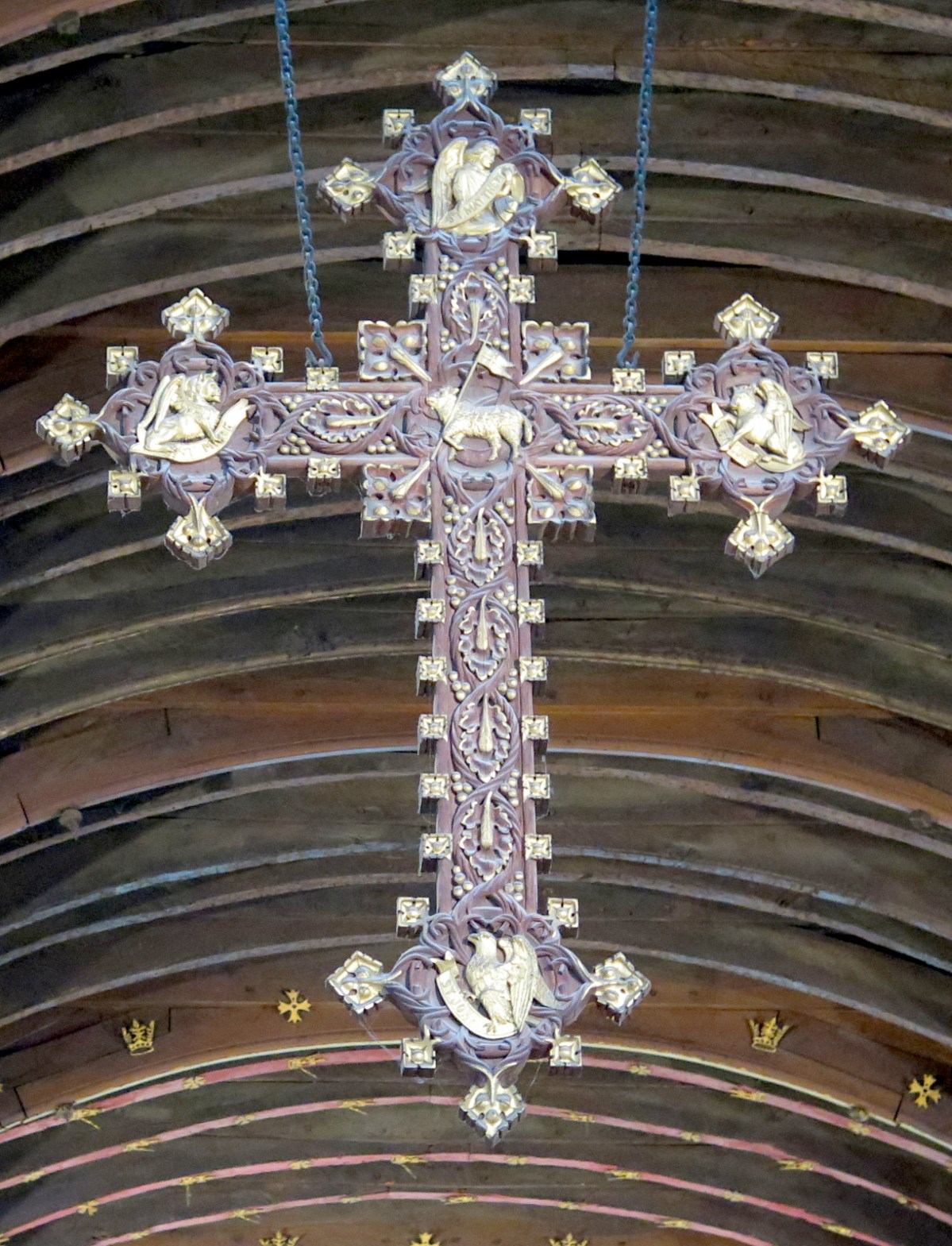
This great cross hangs from the high ceiling between the nave and the chancel of Cirencester Parish Church of St John Baptist.
Click to enlarge
This cross was carved and carefully gilded by craftsmen from Cirencester’s past. It hangs on stout iron chains from the heavy timbers of the chancel roof and for centuries has been the focal point for worshippers sitting in the pews of the nave. At first glance it almost seems to have been studded with jewels, but in fact it’s plain wood with gilded ornamentation.
In the centre of the cross is a lamb carrying a banner marked with the cross of St George. This lamb represents Jesus, the sacrificial ‘lamb of God’. At the top of the upright timber is a winged St Matthew, author of Matthew’s Gospel, at the extreme left of the cross beam is St Mark portrayed as a winged lion and at the right hand end St Luke as a winged ox wearing a crown. Right at the bottom of the upright timber is St John, shown here as an eagle.
More about those images
The lamb with the banner of St. George represents the Agnus Dei (the Lamb of God), symbolising Jesus Christ, and later iconography mixes symbols of sacrifice and victory. Jesus Christ was seen as both sacrificial (the lamb) and a victorious king (the banner).
The winged man represents St. Matthew because his gospel emphasises Christ’s human nature. His account begins with a genealogy of Jesus’ descent from Abraham highlighting his human, earthly origins. The winged aspect signifies divine inspiration of the gospel message and the angelic wings refer to Matthew’s task as a messenger of God’s word.
St. Mark is shown as a winged lion because his gospel starts with the roaring voice of John the Baptist in the wilderness, (roaring like a lion) while the wings refer to the four winged creatures described in the books of Ezekiel and Revelation. The lion represents the strength of Mark’s message and the resurrection of Christ, the wings speak of the four evangelists being guardians of the throne of God.
St. Luke the Evangelist is traditionally symbolized by a winged ox (or bull or calf). The symbol is derived from the four living creatures in the Book of Ezekiel and Revelation, which early Christian tradition associated with the four Gospel writers. The ox was chosen for St. Luke because it was an animal of sacrifice in the Old Testament, representing the sacrificial aspect of Jesus’ ministry, which Luke emphasizes in his Gospel by beginning with the priestly duties of Zechariah. The wings signify that the Gospel message is to be spread throughout the world.
St. John is shown as an eagle because it’s his symbol as one of the four evangelists. His gospel is seen as soaring into theological heights, also true of his visionary writings in the Book of Revelation. And the eagle is associated with divine power, heavenly vision, and spiritual insight as seen in the book of Revelation.
These medieval traditions are all very well, but the carved, gilded cross is also a distraction from the dreadful truth that a wooden cross was an instrument of torture and death. It’s easy to get wrapped up in traditions and forget that Jesus died to provide the opportunity for us to turn back from the brink. The heavy timbers to which Jesus was nailed to die were not ornate or gilded, and there were no traditions portrayed on them. Jesus (Yeshua, Isa) came in simplicity offering a simple opportunity and sharing simple truth. You don’t need a degree in history or theology to follow him, just an open, willing mind and a light touch from his spirit of love and truth.
In that vein, here’s something I add every year, I’ll offer it up to you again now. The UK is a rich mix of people from many cultural backgrounds. That’s why the title is not ‘Christmas Greetings’. Please accept the greetings and replace the word ‘Season’ with whatever you like. If you’re Hindu you could choose Pancha Ganapati, or Jewish friends might go with Hannukah in December, if you’re Muslim you might look forward to the start of the holy month of Rajab; Buddhists might consider Bodhi Day, and there are more groups of people I haven’t mentioned specifically. But whatever you celebrate, please take my greetings as a blessing for the whole of next year – spring, summer, autumn and winter. I’m not here to press you into a new and different tradition. I’m here to dismiss tradition in its entirety and offer love, peace and grace in its place. The teachings of Jesus are simple and there are thoughts about them throughout the articles on this website.
PS – If you like the photo, click the thumbnail for the full size version. Print it out, put it in a frame and hang it on the wall. Give a copy to friends if you think they’d like it; or send them a link to this message.
Teaching is not a bad thing, it’s an essential thing. A well-balanced community living in Jesus’ presence needs to receive truth from apostolic, prophetic, evangelistic, pastoral and teaching gifts.
A new family moved into the village and began to advise and work with Tony, Faith, Paul, Jenny and some of our friends from the next village, Claverham. During this time Judy and I began to feel that things were going a bit off-track. Judy actually wanted nothing to do with the new situation, I decided to go along to the meetings fairly often to keep in touch with our friends. I should add, right at the outset, that I don’t think there was any intention to derail the work that Father was doing amongst us, but rather to enrich it and bring additional knowledge and experience to the mix. But unintentionally this had the effect of changing track with a new focus on teaching that had not been there before. Teaching had never been a notable part of our meetings, we had always been guided mainly by prophecy, and by what we read in the Bible. We were exposed to teaching when we went to larger meetings (the pre-crusade rallies in Portishead for example and visits to Pip’n’Jay in Bristol or the meetings at Post Green), and from the popular books that were doing the rounds (books by Graham Pulkinhgham, Michael Harper, Colin Urquhart, David Watson and others) and we did a small amount of teaching when we were invited to visit local churches as ‘Fountain’. But in our own weekly and daily meetings there was little to no teaching. We were growing and learning together in our exciting faith journey. It was wonderful and extraordinary while it lasted.
But now Alan and Dorothy provided new songs (some of them truly excellent) and Alan taught regularly about how and when and where the meetings should take place as well as material about Jewish customs, feasts and celebrations. Alan and Dorothy came from a background of small gatherings in a different part of the UK (Blyth). So the Spirit-guided growth we had experienced gradually gave way to ideas and processes managed mainly by Alan. Something similar to this has happened over and over again throughout church history. Personally I learned a good deal by seeing it happen both from the outside (because I wasn’t directly involved in the events) and also from the inside (because I was at many of the meetings and had a ringside seat, so to speak). Sometimes I feel I should have shared my thoughts and feelings clearly, but Alan was experienced in meetings of this kind and I was not. I didn’t feel it was my place to interfere, nor was I part of what was happening. When I went along to a meeting I always felt I was accepted partly because I didn’t stir up trouble, but somehow seen as not quite making the grade. Everyone must have been aware that I had some doubts though I was careful not to express them too often or too forcefully. I was, however, grieving about the loss of the sense of direction we’d had together and the subtle shifts in emphasis.
A bad thing can sometimes spark good outcomes
What a strange heading, but it’s true! A few years later my wife Judy was diagnosed with bowel cancer and everything changed. Your friends are always your friends, through good times and bad, so at some point in late spring or early summer 1995 I think, I approached Tony and Faith with this really bad news and invited them to visit and pray with us. And because your friends are always your friends, they were not slow to respond. This coincided with a time when the meetings with Alan and Dorothy were proving rather difficult though I didn’t know that at the time.
Before long Tony and Faith, and Paul and Jenny were coming round for an evening visit at least once a week, and eventually two or even three times a week as Judy’s illness progressed. But what happened during those meetings was astounding and utterly unexpected. Jesus was palpably present every single time we met, and his Spirit was so active amongst us. We experienced prophecy, interpreted tongues, and deep coincidences between songs we were singing, what we were thinking and Bible readings that popped out in the moment. We knew we were right in Father’s presence every time we met. This was holy ground. None of us had experienced anything like it before. The cancer spread and I, for one, had no expectation of physical healing, but Judy and I were both blessed deeply by the renewed presence of our friends and by the experiences in the meetings. It’s fair to say we were all changed by these times together and I know that all of us who remain will never forget it. Judy died on 28th December 1995 and Paul is now no longer with us either. I’m sure all of us learned a lot through the shared experience of those times. Looking back from the perspective I have now, it seems that the change in the meetings following Alan and Dorothy’s arrival combined with the astounding times and experiences as we met again during Judy’s illness, starkly illuminated the difference between living and meeting in our own human wisdom and strength and the freedom we had in the pure presence of Jesus and his Spirit. There’s something further to say about this.
Teaching is not a bad thing, it’s an essential thing. A well-balanced community living in Jesus’ presence needs to receive truth from apostolic, prophetic, evangelistic, pastoral and teaching gifts. If any are missing or if there is an imbalance, any group, no matter how well-meaning, risks derailment in one form or another.
Winding down
After Judy’s death, the five of us continued to meet for a while, and sometimes we were joined by a couple from Clevedon, members of a new local church, and also by Donna (now my second wife) who was a work colleague from Long Ashton Research Station.
These meetings, too, were good but things were still changing. I remain in touch with Tony and Faith occasionally, though less so with Jenny. Donna and I were married a few years later and left the south-west for the east of England, but that’s another story and I’ll share my personal journey of faith there in the next part of this series. Paul and Jenny moved east as well to be closer to more of her family. Tony and Faith still live in the village of Yatton. Donna and I moved west again ten years ago and now live in Cirencester, Gloucestershire.
If you enjoyed this or found it useful, please like, comment, and share below. (If you don’t see those links, click the article’s title above the main photo and they will appear.) Send a link to friends who might enjoy the article or benefit from it – Thanks! My material is free to reuse (see conditions), but a coffee is always welcome and encourages me to write more often!
We didn’t see ourselves as a house church, more as a group of local believers from a range of denominations all wanting to be part of the exciting revival going on in the UK at the time, open to the gifts of the Spirit, but not wanting to become yet another splinter group.
Yatton, the village in Somerset where it all happened
Things were changing. We’d been fairly comfortable at Horsecastle Chapel in Yatton, and we’d learned a great deal and felt loved and made very welcome by the people there. But there were one or two niggles already mentioned in part two of this series. We felt it was not right, and rather unfortunate, that women were not able to take leading roles in meetings, that it was required that women wear hats (a minor thing, but an irritant nonetheless). It began to seem that some of these rules were made by people, not by our Father in heaven, and certainly not by his Son, Jesus. But the greater niggle was that we were not able to move in spiritual ways that were being revealed to us more and more as time went by.
An Anglican home group
For me it came into sharper focus when I went to an Anglican study group. Judy might have come to the same ideas in a different way, but she died in 1995 so I can’t check! I’m not sure we discussed it at the time, but we were moving on closely parallel paths, that I can say with certainty. I wanted to meet some of the Anglicans because I had the feeling there was supposed to be a single church, not a plurality of them. I couldn’t see any way that they could all be brought together, but I wanted to at least get to know some people of other denominations. Going along to the study group seemed a good way to approach this. I soon came to understand that the Holy Spirit was nudging me to go along, and rather quickly I discovered what he had in mind!
Friends and allies
The Anglican study group was held in the home of one of the St Mary’s congregation and was led by the Vicar, Revd Richard Acworth. I don’t remember what was discussed, but I very clearly remember the topic of humility coming up. There was a man in the group who protested, quite strongly, that he was not humble and didn’t intend to become so. I had the impression that he equated ‘humble’ with ‘impoverished’ or ‘weak’ or ‘demeaning’ or some other utterly unattractive idea. I think I was also a bit disappointed by the Vicar’s response.
Also in the group was a woman about my age and as we were leaving I mentioned the humility issue. She agreed quite enthusiastically and we had a brief conversation on the way home; her name was Faith. Judy and I would soon become good friends of Faith and her husband Tony. We shared a lot of views in common concerning Jesus, the Bible, and Church – and this excited me because we were from such different church traditions.
Meeting often
We began meeting quite regularly with Tony and Faith. We were like-minded on so many church matters, and some other things too. We both had young families so most often one of us would walk down to Tony and Faith’s house in Court Avenue in the evening while next time one of them would walk up to our house in Rectory Drive. We would do some Bible study, perhaps sing some of the Christian songs that were so common in those days, and we would pray together. But by far the most important thing we did was to listen to one another and to what the Holy Spirit seemed to be saying to us, sometimes in a whisper, sometimes rather loudly! We invited other people we knew to come and join us, especially Paul and Jenny who lived close as well, so four became six; and there were many other local people with us. On a weekly basis we took turns to host these larger meetings. Sometimes there’d be 20 people in our sitting room, on our sofa and armchairs or sitting on the floor. These were great times of blessing when all of us would feel the presence of the Holy Spirit right with us in every word read or spoken and in every song we sang. We were warned of the dangers we were facing by some of the elders at Horsecastle Chapel, we knew their hearts were in the right place and that the warnings were well-meant; but we knew we were following Jesus so we ignored the advice and warnings and carried on.
Music
Fountain at St Barnabas
Tony is a skilled bass guitarist, Paul was good on a steel-strung 12-string he had, And I would plonk along on a nylon-strung Spanish style acoustic guitar Judy and I had bought at a music shop in Park Street, Bristol while we lived in our flat in Belmont Road. This was an expensive instrument – I think it cost us £27 in 1970 or 1971 (around £540 today) and it replaced the two cheap, second-hand guitars we bought while at university. It seemed better to share one good guitar than to persevere with two older ones that were difficult to tune. Rather later, we were joined quite often by David and Mary Bolster, another couple living nearby. David worked for Scripture Union, and was usually busy with youth work of one kind or another. Judy and I went on a youth retreat with them one year at Wroughton near Swindon to help as assistant leaders, and visited them at a camp at Great Wood in the Quantock Hills, Somerset. The photo shows Fountain in the Church Hall at St Barnabas in Claverham (from left you can see Paul, Faith, me, Ian on flute, Jenny, Judy and Tony on bass). Ian joined us a little later but was a very useful addition providing a higher pitch in the mix and helping strengthen the melody line.
Tongues
One evening after walking down to Tony and Faith’s, Tony mentioned that he’d received the gift of tongues. We’d read about this in Acts and in some of Paul’s letters to the Greek churches. and we’d read about it in modern times too in books by Colin Urquhart, David Watson, Graham and Betty Pulkingham and others. On hearing this news from Tony I felt mild surprise, delight, frustration and envy all at the same time. So, of course I asked about how it had happened and what it was like. Tony told me he’d been having a bath so was very relaxed and he just started talking scribble. He felt warm and encouraged. As I walked home after that evening at Tony and Faith’s. I gave it a try – I talked some scribble words myself. I learned a valuable lesson right at that point. Was this a gift from the Holy Spirit or was it just me talking scribble and being really foolish. I realised right away that there was no way to tell. And I understood something that I’ve never forgotten since that evening. It’s not about me doing something or not doing something. Specifically, it’s all about Jesus doing something in me, and the only skill needed for that is the simple ability to listen to him and do what he wants, not what I want. This tiny revelation changed my entire life. Everything became real in that moment. In this journey with Jesus it’s not for us to do anything more than rest in his presence. If I do that one thing, consistently, he will do anything else that is necessary. My effort is not required, and life is often far better if I keep well out of the way, especially at moments when he’s touching someone else. My surprise and delight are in order, but never frustration or envy.
As the weeks and months went by, our home meetings grew in numbers, but more importantly in depth and in our appreciation of receiving gifts. We were being invited to bring music and teaching to local churches around the county of Avon and the northern areas of Somerset. We called ourselves ‘Fountain’, played all the latest choruses and songs, as well as some of our own songs and acted out little sketches to help people understand the charismatic revival that was taking hold all around us. Tongues and interpretation became normal for us in meetings, as did prophecy, but the most important things for me were the spirit of caring for one another that grew in our hearts and minds and the determination we all had to follow Jesus in everything.
Jesus provides gifts, but will we open them?
One of those sketches sticks in my mind so I’ll share it with you, Tony played the part of Jesus, and Paul was a typical church member. Tony had a cardboard box wrapped in colourful paper, perhaps with a ribbon tied in a bow. He gave the box to Paul, saying I have a special gift for you. Paul took it and made a point of thanking Tony several times, saying, ‘Oh it’s really lovely, thank you so much, but I don’t think I really deserve it’. He put it down on the table, walked round it, looked at it from all angles and carried on saying how lovely it was. Tony (Jesus) asked, ‘Aren’t you going to open it?’ I chose it specially for you, it’s just what you need, you know.’ Oh no, I couldn’t possibly open it,’ said Paul, ‘That would spoil it, it’s so beautifully wrapped, it would crumple that lovely paper. Jesus responded, but if you don’t open it you won’t find out what it is and you won’t be able to use it. I want you to open it’. And this went on for a while. Then we explained that Jesus has gifts for all of us, but we do need to open them and start using them. And without the gifts being unwrapped and used as intended, Jesus will find it a problem to help us do the work he has in mind for us. His work, building his church, growing his people involves him pouring his grace and love into us so that we can share those things with those around us. He does not want us to be timid. We must gratefully receive everything he has for us. It’s for his glory, not ours and we shouldn’t stand in his way.
Good News Crusade
Another thing we did around the same time was print a monthly local newsletter called ‘Community Spirit’ with details of forthcoming meetings at churches around the area, and any special events in the pipeline too. One of these was a Good News Crusade with a series of pre-Crusade rallies beforehand at a church in Portishead. I recorded many of these meetings on a portable stereo cassette machine, and I produced copies from the originals so they could be passed around the community as widely as necessary.
Not a house church
Eventually we would be hosting home meetings of up to twenty people once a week at our house, Tony and Faith’s, or Paul and Jenny’s and one or two other homes in the nearby village of Claverham. There were other similar house meetings going on (for example the Bank House Fellowship in Clevedon). We didn’t see ourselves as a house church, more as a group of local believers from a range of denominations all wanting to be part of the exciting revival going on in the UK at the time, open to the gifts of the Spirit, but not wanting to become yet another splinter group. Much of the leadership effort at the time was spent on starting new streams of churches, New Frontiers for example or Vineyard, or on the other hand bringing spiritual gifts into the established denominations – Anglican, Catholic, Methodist, Baptist and so on. Both of these efforts became successful and widespread, but from my perspective today I can see very clearly that we made by far the better, and perhaps more obedient choice. We thought the way forward was more about bringing people together in freedom to follow Jesus in flexible ways, while providing information, help and encouragement both in the established churches and chapels in our area, and amongst Jesus followers with no connections to established churches. We were also keen to encourage new and deeper spiritual growth in all the local churches, though our links with some of the larger places were more tenuous than those with the smaller and self-governing groups. I still feel privileged to see things this way – as if I had a narrow escape from taking a wrong path. I think we all had a narrow escape, Jesus was protecting us and whispering to us, ‘Not that way, this way, just follow me!’ Many of the churches and chapels we encouraged still exist and remain active, some of their websites are listed below under the See also: heading.
Prophecy
It wasn’t just Tony, as time went by we all found ourselves receiving spiritual gifts in a variety of ways. For me, visions and prophecy became the main gifts and I well remember the first time I became aware of it.
I was sitting on the floor in Tony and Faith’s front room, it was just the three of us. (so before Paul and Jenny became involved). In my mind I saw us as children playing on a building site. There were muddy puddles and stacks of bricks all around. We took some of the bricks and stacked them up to make little ‘houses’, four bricks for walls and another balanced on top to make a roof. We were happy playing with the bricks together, but just then the builder arrived and spotted us. He walked over and smiled, though we thought he’d be cross with us. Somehow I knew the the builder was a representation of Jesus. And he said to us, don’t play with the bricks but bring them to me because I know how to use them to build real houses. If you bring them to me you’ll save me time and I’ll be able to build faster.
So that’s what we did, and the first real house started to rise! It wasn’t much of a stretch to see that the real house represented the church, and our job was not to build something ourselves but to bring people into Jesus’ presence and watch while he builds the church.
It was an important lesson and a growth point for me personally and perhaps for all of us as a group. And I’ve been used that way in meetings ever since. Sometimes it’s been well received, sometimes not.
The Fisherfolk/Community of Celebration
Around this time we became aware of the Fisherfolk, a music ministry that wrote and recorded many new Christian choruses focusing on spiritual growth, and particularly the receiving and use of spiritual gifts. This was right up our street! We bought the music books with words and, most helpfully with keyboard score and guitar chords as well, we bought the LP recordings and avidly absorbed it all, practicing Fisherfolk and other songs as well as creating some of our own.
But then a special opportunity came up. We learned that a weekend of music, praise and worship was planned at a site in Dorset – Lytchett Minster. There was a field for camping, the Fisherfolk would be playing and there’d be a lot of like-minded people to discuss things with. We booked space for three tents and went along. It turned out to be a time of growth and learning, just as we’d hoped – hugely beneficial, confirming much that we were already doing and encouraging us to continue.
Impressed as we were by the community style of living demonstrated by the Community of Celebration, we briefly toyed with the idea of selling our three homes and buying an old farmhouse with some land around it, Faith, Paul and I thought this would be a great idea, but Judy, Tony and Jenny disagreed and we didn’t follow through on the plan. It was only an idea in the back of our minds, we didn’t even start to look into the practicalities. but without unanimity, it couldn’t get off the ground.
If you enjoyed this or found it useful, please like, comment, and share below. (If you don’t see those links, click the article’s title above the main photo and they will appear.) Send a link to friends who might enjoy the article or benefit from it – Thanks! My material is free to reuse (see conditions), but a coffee is always welcome and encourages me to write more often!