Attic staircase

Perspective changes how we see things generally … Whether you’re considering a person, or an opinion, or solving a practical problem, the way you look at things can change everything.

Donna and I visited William and Jane Morris’ home, Kelmscott Manor, in the little, Oxfordshire village of Kelmscott. They lived here from 1871 until 1896. It was a warm, sunny day and we enjoyed lunch in the garden as well as exploring the house.

The attic staircase

Kelmscott Manor is full of furniture from the Jacobean to Victorian periods, and of course it’s also full of William Morris designs in the form of wallpapers, fabrics, and tapestries. An amazing place and well worth a visit.

Yet something that stood out for me was this staircase connecting the attic space in the roof with the the lower floors of the house proper. What I like about the photo is the effect of light from the window, and the various textures: the sturdy, wrought iron handrail, which crosses oddly and uncompromisingly in front of the window; the wood of the stair treads; the polished timber of the railing at the top; the mix of reflected colours on what is actually a plain, white wall; and the odd angles created by variations in perspective – it’s quite magical!

Maybe I’ll post again about this lovely old house and its fabulous contents, but for now I’ll leave you with the interesting composition of light playing on an ordinary, day-to-day, attic staircase.

And there’s a life lesson here for us if we think a little deeper. Perspective changes how we see things generally, not just staircases. Whether you’re considering a person, or an opinion, or solving a practical problem, the way you look at things can change everything. Maybe you’re better at this than me, but I need to learn to alter my perspective more willingly when necessary.

See also:

A coffee is always welcome!

A hedge of dead and dying beech?

Rose breeders … grow thousands of seeds and select those few with outstanding colour, fragrance, [or] disease resistance

It’s springtime, mid-April. and this hedge looks mostly dead. Just one of the beech trees making up the hedge is producing fresh, green leaves. All the rest are covered with dried-up, brown leaves left over from last year. What’s going on?

This hedge consists of seedling beech, they are all different in many ways. They grow at different speeds, some slower, some faster. Their leaves will vary from one plant to the next, some will be paler, some darker. Some will be hairy, others may be smooth and glossy. The bark will vary in roughness and colour.

When you grow seedlings, whether beech or any other plant, every individual will be unique, for uniformity you must use cuttings or grafts so that each plant is genetically the same.

What you are seeing in this hedge is variation in timing; the beech closest to the camera comes into leaf earlier than the others, but in a few weeks from now they will all have green leaves. Garden and commercial plants are often identical to one another and are given names to distinguish them. Rose breeders, for example, grow thousands of seeds and select those few with outstanding colour, fragrance, disease resistance or any other desirable characteristic. The best of the best are bulked up by grafting, given a name like ‘Yorkshire Prince’ or ‘Summer Festival’, and then sold on to garden centres. Grow roses from seed to plant in your garden and you are likely to be badly disappointed (though you might get lucky and produce a winner).

The term ‘plant breeding’ includes breeding for seed production, for example to produce wheat or bean or squash seeds of a named type. This is a different (though allied) process from breeding for vegetative propagation as with roses.

See also

A coffee is always welcome!

The brain, astonishingly clever

The photo shows a peaceful scene along a stretch of water, this is Barton Mill Pound in Cirencester. Two mallard ducks swim past. What do you see?

Mallards that you can see on the water and reflections of things on the far bank that you can’t see. Light carries information to our eyes, but the brain has to interpret it. A clever thing, the brain!

You just know, without giving it a single deliberate thought, that there’s a stone-built house on the far bank, and there are bare trees so it’s not summer time. And even the little brains of the mallards can process information in the same way. We (and they) do this all day long, every day we live, without having to take any trouble to process the information. We don’t even know how we do it! The brain has multiple layers of neurons, brightness and colour information in from the eyes to the top layer, understanding of what we see out from the bottom layer.

If you are not amazed; you should be!

A coffee is always welcome!

Everyone should see this

If you want to face down the playground bully you need more friends than he has, and preferably a larger, heavier stick to fight with.

Here’s a Times Radio interview of General Sir Richard Shirreff, sharing his thoughts on events in Ukraine, recorded on 9th April.

Times Radio interviews General Sir Richard Shirreff

Why do I think everyone should see it? Britain has done more to help Ukraine than many Western nations. So have Poland, France, Germany, Canada, the Baltic States, Finland, Norway and Sweden.

But we need to do so much more. If we do not, we are risking a future war between Russia and NATO. That, of course, is the last thing we want to happen, but if we don’t prepare for the worst case now, it may happen anyway, and partly (even largely) because of our lack of preparedness.

If you want to face down the playground bully you need more friends than he has, and preferably a larger, heavier stick to fight with. We have friends, but right now we are brandishing a twig and hoping the bully will turn away in fear.

He will not.

Sir Richard makes this very clear. That’s why we all need the chance to hear and evaluate what he has to say.

A coffee is always welcome!

The exact representation

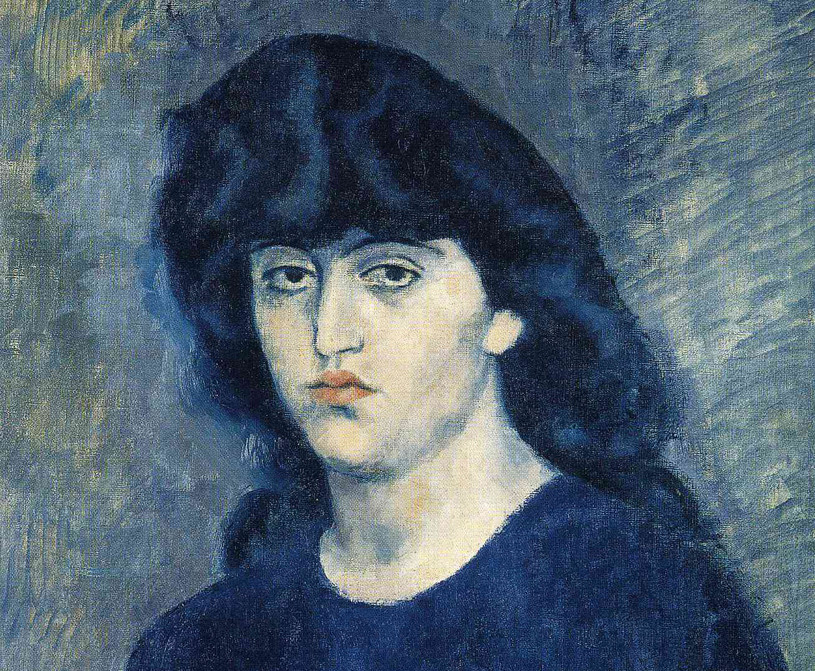
For a person, a colour photo is a pretty accurate representation – at least for appearance. A half hour video interview would be even better.

Picasso in 1904 (Blue period) – (Wikipedia)

What is an exact representation? It’s a fully accurate impression of something, but still not the thing itself. For a paragraph of text it might be a carefully checked typescript or handwritten copy. It’s not the original, but it carries the essence of the original. If a single character is incorrect, the sense may still be clear, or guessable, or might become misleading. ‘If a single character his incorrect’ could still be clear though an obvious typo. ‘If a shingle character is incorrect’, might be slightly more confusing. ‘It’s now the original’, completely messes with the correct text, ‘It’s not the original’.

Picasso in 1910 (Cubism) – (Wikipedia)

For a person, a colour photo is a pretty accurate representation – at least for appearance. A half hour video interview would be even better. An oil painting might give a recognisable impression, unless it was a later Picasso.

What about Jesus?

Yahshua (Jesus) is an interesting case of representation. We don’t have pictures of his appearance, though we do know quite a lot about his character and behaviour. However, he himself is a representation.

The Son is the radiance of God’s glory and the exact representation of his being, sustaining all things by his powerful word. After he had provided purification for sins, he sat down at the right hand of the Majesty in heaven.

Hebrews 1:3 (New International Version)

The sun on a clear day is very bright indeed, so bright it’s dangerous to stare at it directly (don’t try, your eyesight might be permanently damaged). But that powerful light is responsible for making everything else in our daytime world visible to us. This is one of the ways in which Jesus represents the nature of his ancestry. The Father is sometimes described as dangerous to behold, yet he makes everything in the spiritual world visible to us. But it is safe to look directly into Jesus’ face – his twelve closest followers did that, so did the seventy-two, so did the mass of the people from the towns and villages all around Galilee.

Not only is he safe but he sustains everything there is, and he has provided a purity that we could never earn for ourselves. And it works both ways in a sense. Not only does he represent the Father’s glory for us to see, but he represents us in his Father’s holy presence, sitting at his right hand!

What about the Greek?

Let’s look at some of the Greek words here, what can they add for us?

ἀπαύγασμα – apaugasma – ‘the radiance of his glory’ – This has the sense of a gleam flashing out, a flash of reflected light, as from polished metal moving in the sunlight. The Son is a dazzling flash shining out, hinting at the Father’s brightness.

χαρακτὴρ – charaktēr – ‘the exact expression‘ – From which we get the similar sounding English noun ‘character’. The Greek word has a core meaning of accuracy of expression, ‘precisely like’. Jesus is not just a bit like the Father, they are one! So what we see in him really does show us exactly what the Father is like.

ὑποστάσεως- hypostaseōs – ‘of his being’ – substance, or nature – This word is also used in Hebrews 3:14 where the NIV translators chose the word ‘conviction’ in the sense of certainty. Jesus represents the Father’s sustaining essence. What more could we ask? What more could we need?

Final thought

What a good thing that the writer of Hebrews wasn’t a cubist!

A coffee is always welcome!