The English word ‘disciple’ is rather old-fashioned these days, but it has more or less the same meaning as ‘apprentice’.
If you want to learn, here’s one way get started. Or if you are already a follower, it might be a way to go deeper – or even an aid for helping other people to do the same. Don’t worry, I’m not selling anything, and I’m not trying to get you to do anything Jesus didn’t do or anything he wouldn’t want you to do.
JDMC
I’m going to show you part of a short book I wrote some years ago, with a link to the book itself as a free download. The extract follows below, and the entire thing can be read online, printed out, or downloaded as a PDF.
The extract (from page 17)
Becoming disciples
Becoming disciples is important because it’s the main way believers grow to be more like Jesus. It’s not a process with a beginning and an end; it’s ongoing throughout our lives. And we’re not automatically disciples simply because we have believed. Not all of the crowds who listened to Jesus or were healed by him were disciples. Only those who followed him and were greatly changed could claim to be disciples. (Matthew 4:19, Matthew 10:38)
The English word ‘disciple’ is rather old-fashioned these days, but it has more or less the same meaning as ‘apprentice’. In particular it’s all about learning to do the things that the expert is already doing, and Jesus is the expert here. Apprentices don’t just learn from books; this is a hands-on experience. At first, things will often go wrong, but apprentices get better and better by repeatedly doing something under supervision. Expect that to happen to you as Jesus’ apprentice.
Because this change is hard and takes time, Jesus put most of his effort into three years of living closely with a small band of men and women who were prepared to do much more than simply be amazed. They were utterly transformed in those three years. The fact that Jesus worked this way reveals how important making disciples was and is. He put everything he had into those few, and when he returned to the Father they were the ones he continued to work with to reach the nations and build his church. (John 17:6-23) Jesus needs men and women who will become conformed to his image. They are his disciples.
The challenges for us include rejecting false gods such as consumerism, becoming more and more like Jesus, and understanding that we most effectively change by doing, not merely by thinking. Imagine an apprentice plumber who had studied all the books on plumbing but had never bent a pipe or soldered a joint.
To think about
‘We most effectively change by doing, not merely by thinking.’ Is this true in your experience? List some examples. Think about the skills involved in sport, work, music, art. Are there any areas of life in which regular practice doesn’t help?
Useful? Interesting?
If you enjoyed this or found it useful, please like, comment, and share below. (If you don’t see those links, click the article’s title above the main photo and they will appear.) Send a link to friends who might enjoy the article or benefit from it – Thanks! My material is free to reuse (see conditions), but a coffee is always welcome and encourages me to write more often!
The four gospels are special: they, together with the rest of the New Testament, tell us all we need to know about Jesus
I’ve decided on the future direction of my website, ‘Cruising the Gospel’. I had intended to move the posts to JHM and close the old site; but it still has a useful function so I’ll update it instead and cross post to JHM.
A long time ago (August 2013) I began a new project which I called ‘Cruising the Gospel’ (CTG). I wanted to encourage people to read through the four gospels on a steady, rolling basis. Matthew, Mark, Luke and John are the four New Testament books that record what Jesus did and said during the last few years of his life on earth. We should read every part of the Bible, of course, all of it is useful, informative and helpful although some parts may seem quite difficult too.
But the four gospels are special: they, together with the rest of the New Testament, tell us all we need to know about Jesus – who he is, what he did and said, how we can understand him, how he will influence and shape our own lives if we will allow him, and why we should pay attention to him in the first place.
So my argument, and that of others too, is that we should form a habit of continually reading and re-reading these four books in particular. I call that ‘cruising the gospel’ and began to create a resource to help people do it. The website is still there online, almost three quarters complete. It needs updating, editing and finishing. Take a look at Cruising the Gospel (CTG) for yourself.
Moving it to JHM (or not)
I decided the best thing would be to migrate the material to ‘Journeys of Heart and Mind’ (JHM), and I began that task a while ago. But it quickly became clear this was not the best idea because the convenience and flow of the old site was getting lost as I merged the posts into JHM.
Instead, I now intend to keep the original website going while I complete it and update it, but every time I post a new item there I’ll cross-post here to JHM as well. That will give my readers the opportunity to see each post as an individual article, but also use the original CTG site as a reading guide should they wish to do so. I think it’s the best of both worlds.
It will take me a little while to get this organised and running smoothly, so please bear with me. But right now you can read the most recent posts here on JHM and all the older ones on CTG. I urge you to try it for yourself, try to read a little bit each day. Don’t rely on my ideas expressed on CTG, they are intended to get you thinking about it for yourself. And most important of all – wait for the Holy Spirit to guide you personally as you read. When you have useful thoughts or insights, leave them as comments to encourage others.
Here’s a recent post in the series, use the ‘< Previous | Index | Next >’ links in that article to see the rest.
Useful? Interesting?
If you enjoyed this or found it useful, please like, comment, and share below. (If you don’t see those links, click the article’s title above the main photo and they will appear.) Send a link to friends who might enjoy the article or benefit from it – Thanks! My material is free to reuse (see conditions), but a coffee is always welcome and encourages me to write more often!
‘Why are you showing yourself to us, but not to the world?’ This is such an interesting question, it’s also a natural question. Judas (not Iscariot) wants to know why Jesus shows himself to the twelve, but not to the world. The question suggests it’s Jesus’ choice to hide himself from most people but show himself to a few. Judas is right to find this strange! But it’s not what Jesus has in mind.
In verse 23, he responds by saying that for everyone who loves him, he and the Father will come and make their home in that person. In other words, it’s not just for the twelve, but for anyone in the world who loves Jesus. Or to put it another way, the answer is that he will reveal himself to anyone – if they love him. He doesn’t hide from anybody, but those who don’t love him can never truly see him.
Short of time
Jesus needs to wind the conversation up because he knows what will happen next. He reminds them again of the promised Spirit and tells them that he and his Father will live within them; and the Spirit will teach them and remind them of everything they need to know. He also promises to leave his peace with them, and tells them not to worry or be afraid. This seems to me particularly striking when you consider what Jesus is about to go through at the hands of the Sanhedrin and the Roman governor.
And finally, in verses 28 to 31, he reminds them that he’s going to the Father who is greater than he is, and they will be glad (once they understand the significance of this). So, in what way is the Father greater than the Son? Does this idea even make any sense when we know that Father, Son and Spirit are co-equal within the structure we call ‘trinity’, the three in oneness that they share together? Perhaps the answer is simply that Jesus has limited himself within a human body in order to reach us in this world. For more than 30 years he has remained limited, but in returning to the Father he will regain the ability to be present everywhere at every moment of time with all of his people. In his human body he is inevitably less powerful than the Father, only able to act in the one place and time where he finds himself. He took on our limitations so that he could reach us on our level, in ways we can understand. That time is coming to an end as he returns to the Father.
If you enjoyed this or found it useful, please like, comment, and share below. (If you don’t see those links, click the article’s title above the main photo and they will appear.) Send a link to friends who might enjoy the article or benefit from it – Thanks! My material is free to reuse (see conditions), but a coffee is always welcome and encourages me to write more often!
Topic-focused blogs tend to get large readerships. But I’ve always expressed whatever takes my fancy here on JHM.
I’ve been writing posts on ‘Journeys of Heart and Mind’ (JHM) for twenty-two years now. Sometimes I’ve written daily, or even more often than that, sometimes I’ve gone for months without posting at all, but recently I decided to deliberately write more frequently. But what I’m considering right now is not the frequency of posts, but the range of topics I cover.
The most successful blogs specialise on a topic, often quite a narrow topic – for example ‘Infra-red astronomy’, or ‘greenhouse gardening’; poetry or photography or evolution or Bronte or Paris. These topic-focused blogs tend to get large readerships. But I’ve always expressed whatever takes my fancy here on JHM; I’m not interested in audience size, more on variety and sharing an insight here or an opinion there.
My favourite topics include spaceflight, history, following Jesus, science, technology, astronomy, photography, world events and more. I’ve decided to continue posting an any topic that grabs my attention.
I spend £100 a year or so on the blog, about £2 a week. This is what it costs to keep and manage the domain name scilla.org.uk (though this covers my email address and Donna’s too and allows me to set up and manage subdomains like jhm.scilla.org.uk as well. And it also covers the cost of web hosting and a Word Press account to manage the blog, cover data storage, editing facilities and the rest. I could return to using Google’s Blogger platform which is free of charge; that’s what I used until July 2016. But it’s more limited and doesn’t provide such flexible formatting as Word Press.
All of this to say I shall probably leave things as they are, post a little more than I’ve managed for the last few years, and try to keep posting on a range of topics that interest me.
But it would be good if you, my readers, gave me some feedback. What do you like or dislike? Are there other topics you’d like me to write about? Are there things you wish I would not write about? If you have anything to say about this, do please leave me a reply. I don’t guarantee to follow your advice, but I promise I will consider it carefully. Thank you! And thank you also for reading JHM.
Useful? Interesting?
If you enjoyed this or found it useful, please like, comment, and share below. (If you don’t see those links, click the article’s title above the main photo and they will appear.) Send a link to friends who might enjoy the article or benefit from it – Thanks! My material is free to reuse (see conditions), but a coffee is always welcome and encourages me to write more often!
What will persuade me to do more? What will persuade you? And what form might ‘doing more’ take? It’s easy to feel helpless as an individual. What can one person do? Here are some simple, effective suggestions.
We all know what an amplifier does. It takes a signal from a microphone or a musical instrument and increases the power dramatically so that a relatively quiet sound can be sent to a loudspeaker and become very loud.
And we know what a broadcast is. It takes sounds and pictures and sends them to many different places, often very far away. So a TV broadcast will appear in many homes across an entire nation.
Sometimes it’s necessary and important to amplify and broadcast ideas – make them louder and spread them more widely. That’s what I want to do here. Please read this message from Yaroslava Antipina (Yara), writing from Kyiv, Ukraine. Here’s an extract to pique your interest.
Hi!
It’s a bit gloomy headline today. But it describes the reality we have in Ukraine now. russians kill children (adults as well, of course) and destroy our energy infrastructure. Often, homes without children and power don’t have walls, either.
I am writing to you surrounded by generous spring sun rays. It is warm and green outside. But these bright colours cannot hide our current reality.
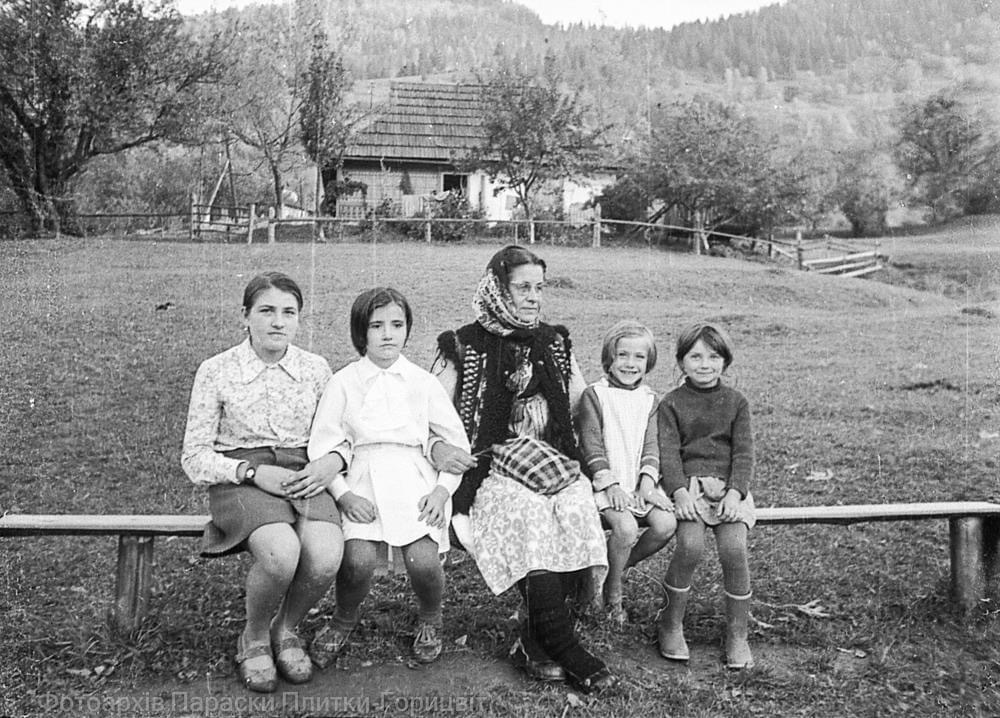
A few words about the photos you will see in this letter. I will show you the pictures of a Ukrainian photographer, ethnographer, folk writer and artist, Paraska Plytka-Horytsvit (1927-1998). She is called Homer Hutsul. What is Hutsul? It is an East Slavic ethnic group spanning parts of western Ukraine (mainly the Carpathian Mountains). I will tell you shortly about Paraska in the second part of the letter.
Here’s something I wrote in reply, a comment at the bottom of Yara’s message:
‘It amazes me how people survive through the worst nightmares. Paraska is one example and you, Yara, are another. But you are both just examples of the determination of thousands, millions of ‘ordinary’ people. Actually nobody is ordinary, every living person is extraordinary. Every last one. It’s not just that people survive, it’s that despite the circumstances people actually thrive. We, in our comfortable countries, want all Ukrainians to survive and to thrive; but do we want it enough to make it happen? That is the big question.‘
And it’s a question I want to put to all my readers. What will persuade me to do more? What will persuade you? And what form might ‘doing more’ take? It’s easy to feel helpless as an individual. What can one person do? Here are some simple, effective suggestions:
Read about events in Ukraine. One good place to start is with Yara’s posts. But also read the news and dig deeper than just TV and news channels. Listen to blogs, watch video interviews. (You may need to scroll around to find the stories about Ukraine and the war, there’s world news here.)
Reply to some of the people out there, people like Yara. There are many of them, all with good perspectives, all worth your attention, all deserving and benefitting from friendly interest from beyond the borders of Ukraine.
Consider buying Ukrainian goods, hunt around on the internet, there are many outlets. This is one practical way to help Ukrainians directly. If you want advice, ask around. People like Yara who are posting articles regularly will be able to answer practical questions like this.
Lobby your government representatives, in the UK write to your MP asking them and their party to do more.
Donate to good causes in Ukraine or to organisations supporting Ukraine in your own country.
Here’s a little more from Yara’s Sunday letter:
Paraska Plytka-Horytsvit’s literary heritage includes 46 books, 500 pages each, mostly handwritten, and dozens of smaller ones. Thirty of them are spiritual works, and sixteen are philosophical reflections. There is also poetry and works on Hutsul folklore.
I do like her personality. To see more of her photos, please visit the Facebook page.
I almost finished the letter. At the moment, I am in the cafe, having a cup of warcoffee and enjoying the calm Sunday. People are passing by; children are laughing, and some may think that it is a perfectly normal life. But it is not. We became masters of pretending.
Okay, it’s time for me to go. Thank you for reading my letter, leaving a comment, and possibly even buying me a warcoffee. Your support is what helps me continue writing these letters and my war diary, as well as sharing my love for Ukraine with the world.
So be an amplifier and a broadcaster for Ukraine, we can all help in this way. Learn more about Ukraine, speak out (or write), tell your friends, share some of Yara’s letters.
Useful? Interesting?
If you enjoyed this or found it useful, please like, comment, and share below. (If you don’t see those links, click the article’s title above the main photo and they will appear.) Send a link to friends who might enjoy the article or benefit from it – Thanks! My material is free to reuse (see conditions), but a coffee is always welcome and encourages me to write more often!
Notes from bygone years – Aprils springing up everywhere Hint: Click on the thumbnails for larger images.
April 2023 (1 year before publishing this article)
Will it move or won’t it?
Donna and I spent a week in Weston-super-Mare while her brother and sister-in-law were on holiday walking on Dartmoor. We stayed in their flat and combined looking after their two, black Labradors (Marple and Maizi) with an enjoyable week away ourselves.
The photo shows Maizi holding a stick while watching another one on the beach, clearly hoping I’ll pick it up and throw it; she is ultra-focused on this possibility! They’re senior dogs now, when Maizi was young it would have been a much larger stick!
I’ve always enjoyed walking, and I also like taking photos. On April 26th 2022 I walked along the field margins from Stratton to the polo grounds outside Cirencester Park, then down through woodland paths into town. The wild garlic was in full flower in the woods so I took a photo of it, growing here amongst sparse stinging nettle. The flowers look like snow from a distance, but close up they are exquisite.
We visited London for two days, here we’re visiting a tropical jungle at the very top of one of the city’s tallest buildings, the ‘Walkie-Talkie’ building at 20 Fenchurch Street. It’s really strange to visit a hilly area with mature trees on the top three floors of a 38-storey building!
On 16th Donna and I visited Burwash Manor, near Cambridge, where there were a number of small shops and businesses to explore as well as a place for coffee and refreshments. We very much enjoyed looking around and had lunch while we were there.
Donna’s birthday is in April, and in 2009 she was forty-years-old. She had a party with family, friends, work colleagues from Unilever at Colworth, and Open Door Church members all present. As you can see in the photo (click to enlarge it), the cake was a Noah’s Ark and was really beautifully and elaborately iced. There was an evening meal and dance at a nearby village hall.
We flew to Cyprus for a holiday at a hotel in Paphos. Cyprus is a fascinating place in so many ways: archaeology, landscape, biology, society – there was a lot to see. The photo shows ‘The Tombs of the Kings‘ near Paphos. It’ not a built structure, but cut out of the solid rock.
JHM: We had some thoughts about being in the King’s presence. – World events: A referendum failed to reunite Cyprus.
We were living in Tilbrook, Bedfordshire, and had a visit from friends on 5th April, Jacob is playing with a woodpecker toy. My job at Unilever was extended for a second year, good news as it gave me access to the company’s superannuation scheme.
Around this time, Judy was having slightly odd bowel symptoms and arranged an appointment with her GP who listened, examined her, but found nothing wrong and suggested there was no cause for anxiety and it might sort itself out . We were living in Stowey Road, Yatton.
We discovered a field mouse in the house, cowering in a corner. We caught it by putting food in a tall bucket and building a way for it to climb up the outside of the bucket. The mouse jumped in during the night but couldn’t jump out again. Debbie and Beth released it in a field; in the photo it’s about to jump to freedom.
This is a draft for the opening of John Jefferies & Sons new Forum Garden Centre in Cirencester. As you can see, it was to be a grand event with Lord and Lady Bathurst taking a leading role in the opening. There was a barbecue, several talks and films, and the Town Crier would announce it in the Market Place.
I was busy working at Long Ashton Research Station (LARS) with experiments on temperature effects of plum pollen tube growth rate. I used growth cabinets at a range of temperatures and plum flowers supported in wet florist’s foam. After some microscope work, the data had to be fitted to mathematical growth models (for which I collaborated with a statistician).
I was at Bath University in my third year of their four-year Horticulture degree course. Judy visited Cambridge on a biochemistry trip. Dad went to Fairford Airfield and filmed Concorde on an early test flight. The image is a still frame from his 8 mm movie camera.
World events:Concorde arrived at Fairford for testing; Richard Nixon was sworn in as President of the United States.
I was in the 5th year at Cirencester Grammar School. Here’s a photo I took of my sister Cindy in Girl Guides uniform outside the family home in Victoria Road. It was always a happy home, Mum and Dad were great parents and we had opportunities to do so many interesting things.
World events: Sentences were passed in the Great Train Robbery trial; and BBC Two television began broadcasting.
I was now in my final term at Junior school (Querns School), the photo is from 2023, but it looks much as it did in 1959. We were spending some of our time practising the sorts of logical problems we’d meet in the 11+ exam and pupils who passed would go to Cirencester Grammar School. About one in three would typically succeed, and although Mum and Dad didn’t make a big deal of it, I think they knew I was marginal and could go either way.
The Easter holidays meant that Querns School was closed and I could revert to spending the entire time playing at home or with local friends from Queen Anne’s Road where we lived. Linda next door was probably 6 and I was in the last few months of being 5. Our parents were friends too, so we spent a lot of time in and out of one another’s homes and gardens. The photo shows a building on the corner of London Road and Beeches Road. Both directions were good for the walk home.
I was nine months old at the end of the month, and was probably able to pick items up and transfer them from one hand to the other. I might also have looked for objects that had been moved out of sight. I’m glad to report that I can still do those things 75 years later!
Dad was now in Skegness (Skeggie) for basic RAF training. This involved marching and parade practice, rifle shooting and bayonet work, fieldcraft, watching training films, aircraft recognition and more. Sometimes there were fatigues to be done, in the cookhouse, for example.
There was also time off when they could visit the town, play football, write letters and generally do whatever they wanted. One highlight was an inspection by an Air Chief Marshal.
World events: The US Air Force accidentally bombed a Swiss city; and a large scale D-Day practice on Slapton Sands was attacked by German U-boats.
If you enjoyed this or found it useful, please like, comment, and share below. (If you don’t see those links, click the article’s title above the main photo and they will appear.) Send a link to friends who might enjoy the article or benefit from it – Thanks! My material is free to reuse (see conditions), but a coffee is always welcome and encourages me to write more often!
Perspective changes how we see things generally … Whether you’re considering a person, or an opinion, or solving a practical problem, the way you look at things can change everything.
Donna and I visited William and Jane Morris’ home, Kelmscott Manor, in the little, Oxfordshire village of Kelmscott. They lived here from 1871 until 1896. It was a warm, sunny day and we enjoyed lunch in the garden as well as exploring the house.
The attic staircase
Kelmscott Manor is full of furniture from the Jacobean to Victorian periods, and of course it’s also full of William Morris designs in the form of wallpapers, fabrics, and tapestries. An amazing place and well worth a visit.
Yet something that stood out for me was this staircase connecting the attic space in the roof with the the lower floors of the house proper. What I like about the photo is the effect of light from the window, and the various textures: the sturdy, wrought iron handrail, which crosses oddly and uncompromisingly in front of the window; the wood of the stair treads; the polished timber of the railing at the top; the mix of reflected colours on what is actually a plain, white wall; and the odd angles created by variations in perspective – it’s quite magical!
Maybe I’ll post again about this lovely old house and its fabulous contents, but for now I’ll leave you with the interesting composition of light playing on an ordinary, day-to-day, attic staircase.
And there’s a life lesson here for us if we think a little deeper. Perspective changes how we see things generally, not just staircases. Whether you’re considering a person, or an opinion, or solving a practical problem, the way you look at things can change everything. Maybe you’re better at this than me, but I need to learn to alter my perspective more willingly when necessary.
Rose breeders … grow thousands of seeds and select those few with outstanding colour, fragrance, [or] disease resistance
It’s springtime, mid-April. and this hedge looks mostly dead. Just one of the beech trees making up the hedge is producing fresh, green leaves. All the rest are covered with dried-up, brown leaves left over from last year. What’s going on?
This hedge consists of seedling beech, they are all different in many ways. They grow at different speeds, some slower, some faster. Their leaves will vary from one plant to the next, some will be paler, some darker. Some will be hairy, others may be smooth and glossy. The bark will vary in roughness and colour.
When you grow seedlings, whether beech or any other plant, every individual will be unique, for uniformity you must use cuttings or grafts so that each plant is genetically the same.
What you are seeing in this hedge is variation in timing; the beech closest to the camera comes into leaf earlier than the others, but in a few weeks from now they will all have green leaves. Garden and commercial plants are often identical to one another and are given names to distinguish them. Rose breeders, for example, grow thousands of seeds and select those few with outstanding colour, fragrance, disease resistance or any other desirable characteristic. The best of the best are bulked up by grafting, given a name like ‘Yorkshire Prince’ or ‘Summer Festival’, and then sold on to garden centres. Grow roses from seed to plant in your garden and you are likely to be badly disappointed (though you might get lucky and produce a winner).
The term ‘plant breeding’ includes breeding for seed production, for example to produce wheat or bean or squash seeds of a named type. This is a different (though allied) process from breeding for vegetative propagation as with roses.
The photo shows a peaceful scene along a stretch of water, this is Barton Mill Pound in Cirencester. Two mallard ducks swim past. What do you see?
Mallards that you can see on the water and reflections of things on the far bank that you can’t see. Light carries information to our eyes, but the brain has to interpret it. A clever thing, the brain!
You just know, without giving it a single deliberate thought, that there’s a stone-built house on the far bank, and there are bare trees so it’s not summer time. And even the little brains of the mallards can process information in the same way. We (and they) do this all day long, every day we live, without having to take any trouble to process the information. We don’t even know how we do it! The brain has multiple layers of neurons, brightness and colour information in from the eyes to the top layer, understanding of what we see out from the bottom layer.
Times Radio interviews General Sir Richard Shirreff
Why do I think everyone should see it? Britain has done more to help Ukraine than many Western nations. So have Poland, France, Germany, Canada, the Baltic States, Finland, Norway and Sweden.
But we need to do so much more. If we do not, we are risking a future war between Russia and NATO. That, of course, is the last thing we want to happen, but if we don’t prepare for the worst case now, it may happen anyway, and partly (even largely) because of our lack of preparedness.
If you want to face down the playground bully you need more friends than he has, and preferably a larger, heavier stick to fight with. We have friends, but right now we are brandishing a twig and hoping the bully will turn away in fear.
He will not.
Sir Richard makes this very clear. That’s why we all need the chance to hear and evaluate what he has to say.






 Journeys of Heart and Mind


