Image of the day – 28

Similar tank traps have been used along the front lines by both sides in the ongoing Russian invasion of Ukraine.

< Previous | Index | Next >

What’s in an image? Sometimes quite a lot, more than meets the eye.

I’m posting an image every day (or as often as I can). A photo, an image from the internet, a diagram or a map. Whatever takes my fancy.
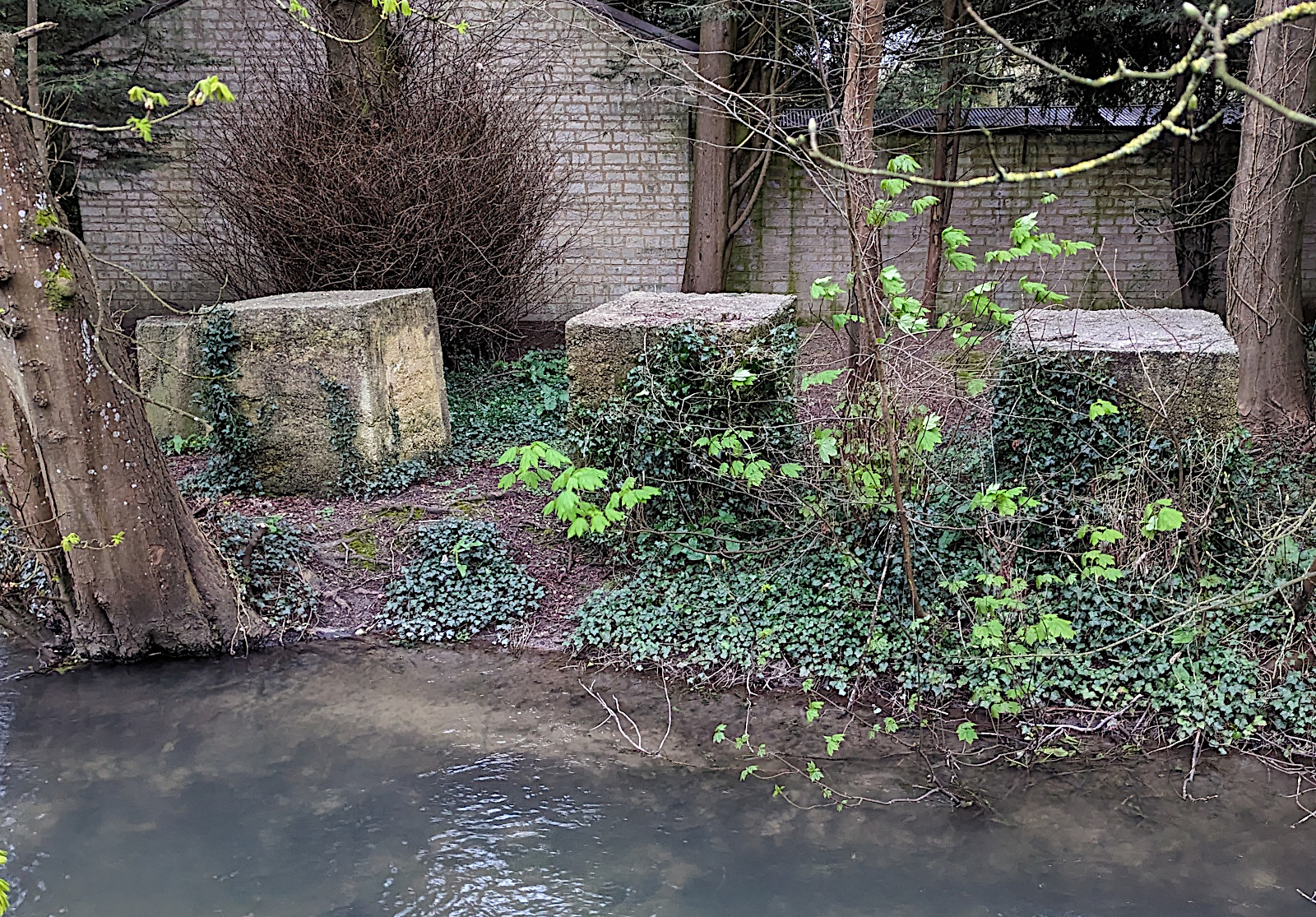
Tank traps

We have some history today. The river is the Churn and it runs in several different channels through the Cotswold town of Cirencester. On the bank you will notice three, large, concrete blocks; there’s also a fourth, partly hidden by the block on the left. The blocks were placed here during the Second World War to slow down German armour in the event that Britain was invaded. German failure to win the Battle of Britain in the air war prevented the invasion, but at the time the blocks were cast and put in place invasion remained a real threat.

The trees in the photo and the wall in the background are more recent than the blocks. The river bank led to an open field with the grounds and gardens of Abbey House beyond at that time, with the centre of the town on the other side of the gardens. The town would have been very vulnerable to attack from this direction.

Similar tank traps have been used along the front lines by both sides in the ongoing Russian invasion of Ukraine. The main difference is that modern, concrete traps are pyramidal (‘Dragon’s Teeth‘, not cubic. The sloping sides use less concrete and are more effective against tanks, but concrete cubes were also commonly used in the 1940s.

It pays to anticipate problems. But wars are rarely anticipated years in advance; political differences can boil over into actual conflict quite suddenly. And once they have started it can be very difficult to bring them to an end.

NOTE: These blocks can be seen from Grove Lane in Cirencester, quite close to the Norman Arch. From inside the Abbey Grounds, walk through the arch and turn right along the footpath for just a few yards. Look across the river, and there they are! A piece of Cirencester history that you can see for free.

< Previous | Index | Next >

Cirencester

For convenience, here’s a list of all the Cirencester area images:

A417 roadworks, Advent Market, Bishops Walk, Baunton, Canal 1, 2, Castle Street, Christmas lights 1, 2, Church 1, 2, 3, 4, 5, 6, Churn flood, Countryside, Fallen tree, Fleece, Gasworks, Gloucester Street, Hare 1, 2, Hospital, Market Place 1, Phoenix Fest, Riverside Walk, Stone plaque, Stratton Meadow, Tank traps, View, Wonky 1, 2, Yellow Iris

Themed image collections

The links below will take you to the first post in each collection

Cirencester, Favourites, Irish holiday 2024, Roman villa

Useful? Interesting?

If you enjoyed this or found it useful, please like, comment, and share below. (If you don’t see those links, click the article’s title above the main photo and they will appear.) Send a link to friends who might enjoy the article or benefit from it – Thanks! My material is free to reuse (see conditions), but a coffee is always welcome and encourages me to write more often!

Last words from JDMC

You will only grow and progress if you do the work yourselves daily, weekly, and on into the extraordinary future that Father already has planned for you.

< Previous | Index | Next >

This article is an extract from my short book, Jesus, Disciple, Mission, Church (JDMC). The bite-sized piece below is roughly two percent of the book. It’s the very last section so is a bit different from the rest: there are no questions for readers to ponder, just a blessing at the end.

I suggest reading the blessing and making it your own. And why not see if any of your friends are interested too? Share the link with them, or meet over a coffee to chat about it. Alternatively you could return to the beginning of this series and get them started that way.

Not the end, just the beginning
JDMC cover

Please don’t think that because you have reached the end of the guide, you have also reached the end of the journey. I hope you’ll explore the more detailed books on ‘The Forgotten Ways’ as well.

The various parts of this JDMC guide are just that – a guide. You will only grow and progress if you do the work yourselves daily, weekly, and on into the extraordinary future that Father already has planned for you. He will show you and lead you but you must take the steps one by one. As you live and work and discover new things together you can expect to grow significantly and have an impact on those around you.

An intricate fabric

Remember that the six forgotten ways are woven together to form a rich and intricate fabric. Although I’ve presented them here individually and in a linear form, they are not like that in reality. Each depends on the others, all are needed in our lives together. They don’t begin with knowing Jesus and end with doing stretching things together, they are more like a grand party where the participants, the music, the lighting, the flowers, the food, and the decorations create an unparalleled overall experience.

Take one of them away and the party will be much the poorer.

However, each way does depend on the previous one and provoke the next in significant ways. People who put Jesus first will find themselves becoming disciples. If we truly follow him and love him, we’ll do what he says by going out and deep. Amongst groups of new believers who are open, the APEST gifts will find an opportunity. Where apostolic foundations take root, organic forms of church life will develop. And where church is active, stretching challenges are inevitable.

Just do it!

So make a start in your own lives and your own situation. Listen to what the Spirit says and do what he tells you. Keep Jesus at the centre. Make disciples and grow as disciples yourselves. Make sure to go out but also embed yourselves deep in the local culture. Explore your gifts and encourage one another in using them. Don’t over-organise but be ever more fully alive as parts of one living body. And face some stretching challenges together.

A blessing

I bless you in the name of Jesus, that you may you find yourselves at the heart of revolutionary and explosive growth. It might seem to begin ever so slowly, but stick with it and see what it will become! You’ll find your deepest peace, not by resting, but by being fully active children of the Father and walking daily with the Son.

More sections of JDMC

IntroductionJDMC, what does it contain?Using JDMC – how to approach it

Working together in six waysIntro and Way 1Ways 2, 3 and 4Ways 5 and 6, six ways

Way One, Jesus at the centreJesus at centre 1Jesus at centre 2Jesus at centre 3

Way Two, Becoming disciplesDisciples 1Disciples 2Disciples 3

Way Three, Outward and integratedOutAndInt1, OutAndInt2

Way Four, Gifts for buildingGiftsForBuilding1, GiftsForBuilding2

Way Five, A living organismLivingOrg1, LivingOrg2

More sections will appear here…

The work of the SpiritIntroJesus, disciples, outwardGifts, living, community, help

Other church leadersIntro, bishops, eldersDeacons, pastors, priests

Last wordsThe end can also be the beginning

< Previous | Index | Next >

Read the book

This was extracted from Jesus, Disciple, Mission, Church (JDMC), page 49. Download the whole thing or read it online – GetJDMC.scilla.org.uk

Useful? Interesting?

If you enjoyed this or found it useful, please like, comment, and share below. (If you don’t see those links, click the article’s title above the main photo and they will appear.) Send a link to friends who might enjoy the article or benefit from it – Thanks! My material is free to reuse (see conditions), but a coffee is always welcome and encourages me to write more often!
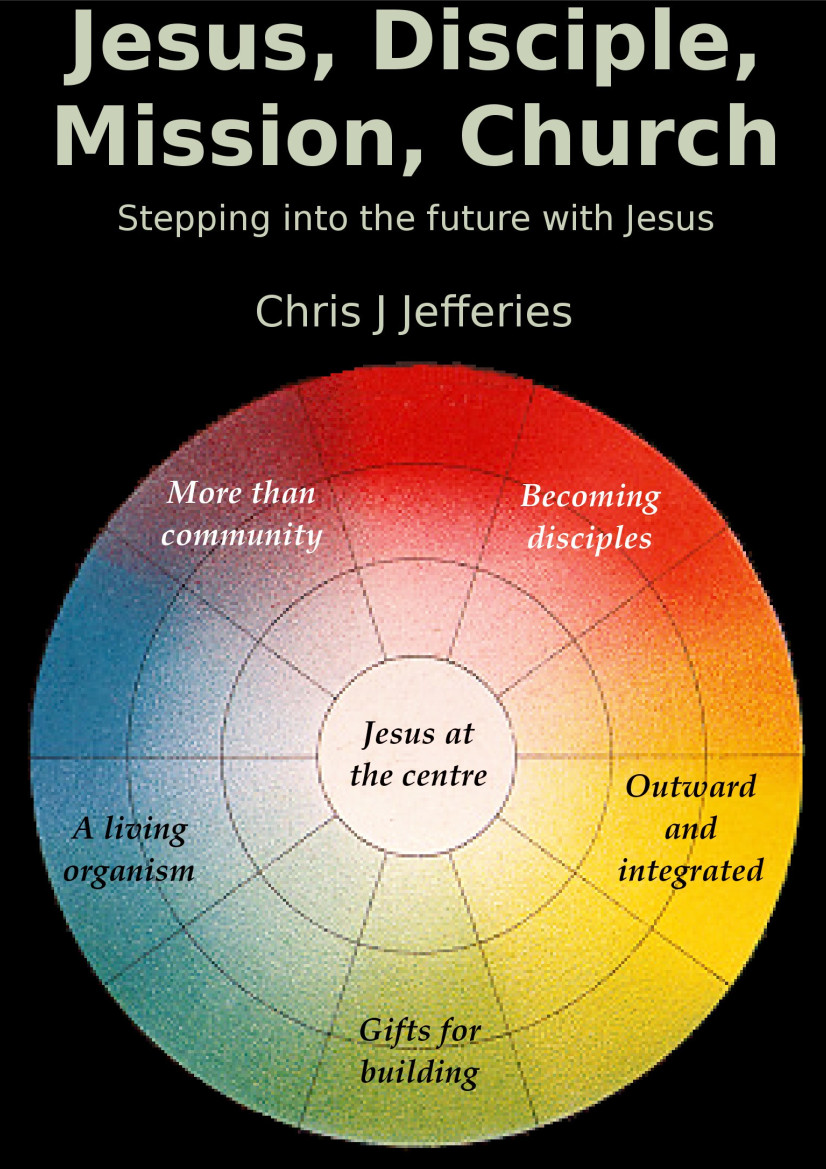
Image of the day – 27

In the natural way of things, each Aloe will produce an average of one new plant, and the population will remain in balance.

< Previous | Index | Next >

What’s in an image? Sometimes quite a lot, more than meets the eye.

I’m posting an image every day (or as often as I can). A photo, an image from the internet, a diagram or a map. Whatever takes my fancy.

Aloe aristata

Today’s picture is a close up of an Aloe aristata plant with a developing flower bud. All plants, animals, fungi, bacteria and even viruses have ways of reproducing themselves. That’s one of the defining characters of life of any kind. We can be absolutely confident that the same will be true of any life forms anywhere in the universe.

The Aloe flower bud will develop on a tall stalk and if the flowers that form are pollinated they will produce and release seeds that stand a chance of germinating and growing into new, similar, Aloe plants. In the natural way of things, each Aloe will produce an average of one new plant, and the population will remain in balance.

The only choices available to life are to survive for ever with no reproduction, or to live for a limited time and leave behind new versions to carry on the process. What life cannot do is live forever and reproduce: that would lead to overpopulation and catastrophic failure of resources. Even with reduced family sizes, the planet is no longer capable of supporting the billions of people on our planet. We face catastrophic population collapse due to lack of resources at some point unless we can reduce our population size in some other way first. That’s a matter of simple arithmetic, not a political statement or some kind of guesswork. If we don’t face and fix the issue, something else will sooner or later.

Themed image collections

The links below will take you to the first post in each collection

Cirencester, Favourites, Irish holiday 2024, Roman villa

< Previous | Index | Next >

Useful? Interesting?

If you enjoyed this or found it useful, please like, comment, and share below. (If you don’t see those links, click the article’s title above the main photo and they will appear.) Send a link to friends who might enjoy the article or benefit from it – Thanks! My material is free to reuse (see conditions), but a coffee is always welcome and encourages me to write more often!

Image of the day – 26

The wallpaper in the image is from Kelmscott Manor in Oxfordshire, once the home of William and Jane Morris.

< Previous | Index | Next >

What’s in an image? Sometimes quite a lot, more than meets the eye.

I’m posting an image every day (or as often as I can). A photo, an image from the internet, a diagram or a map. Whatever takes my fancy.

Wallpaper

Wallpaper – This old-fashioned wallpaper clearly shows how the pattern repeats both vertically and horizontally. You can find repeats like this in vinyl floor coverings, fabrics, wipe-clean tablecloths and more. Materials that look like natural stone or wood can make the repeats harder to spot, but they’re still there.

There’s a trade-off between the cost of producing a larger scale of repeat (to make it harder to detect) and using a small scale of repeat (to minimise the cost).

The wallpaper in the image is from Kelmscott Manor in Oxfordshire, once the home of William and Jane Morris. They both worked on projects connected with the Arts and Crafts movement, and this pattern is an example of some of the designs created by them.

Themed image collections

The links below will take you to the first post in each collection

Cirencester, Favourites, Irish holiday 2024, Roman villa

< Previous | Index | Next >

Useful? Interesting?

If you enjoyed this or found it useful, please like, comment, and share below. (If you don’t see those links, click the article’s title above the main photo and they will appear.) Send a link to friends who might enjoy the article or benefit from it – Thanks! My material is free to reuse (see conditions), but a coffee is always welcome and encourages me to write more often!

Image of the day – 25

Even today…a wooden roof frame is constructed and then covered to form a roof. Good ideas tend to last a long time!

< Previous | Index | Next >

What’s in an image? Sometimes quite a lot, more than meets the eye.

I’m posting an image every day (or as often as I can). A photo, an image from the internet, a diagram or a map. Whatever takes my fancy.

Roof timbers

How would we manage without roof timbers? They are by far the most common form of support for tiles, slates, thatch, or any other waterproof roof covering. The roof timbers in the photo are a couple of hundred years old, but they’re not significantly different from Medieval or even Roman roof timbers. Even today, although the timbers are much slimmer and are pre-manufactured as truss structures, the principle remains that a wooden roof frame is constructed and then covered to form a roof. Good ideas tend to last a long time!

Is the same true for some of our institutions? From parliaments to town councils, from universities to infant schools, and from multinational corporations to village shops, many of the fundamental patterns are inherited from past generations. If it works well, why change it?

What other examples can you think of? But if you don’t want to ponder that question, just click on the image and enjoy those amazing roof timbers in more detail.

Themed image collections

The links below will take you to the first post in each collection

Cirencester, Favourites, Irish holiday 2024, Roman villa

< Previous | Index | Next >

Useful? Interesting?

If you enjoyed this or found it useful, please like, comment, and share below. (If you don’t see those links, click the article’s title above the main photo and they will appear.) Send a link to friends who might enjoy the article or benefit from it – Thanks! My material is free to reuse (see conditions), but a coffee is always welcome and encourages me to write more often!
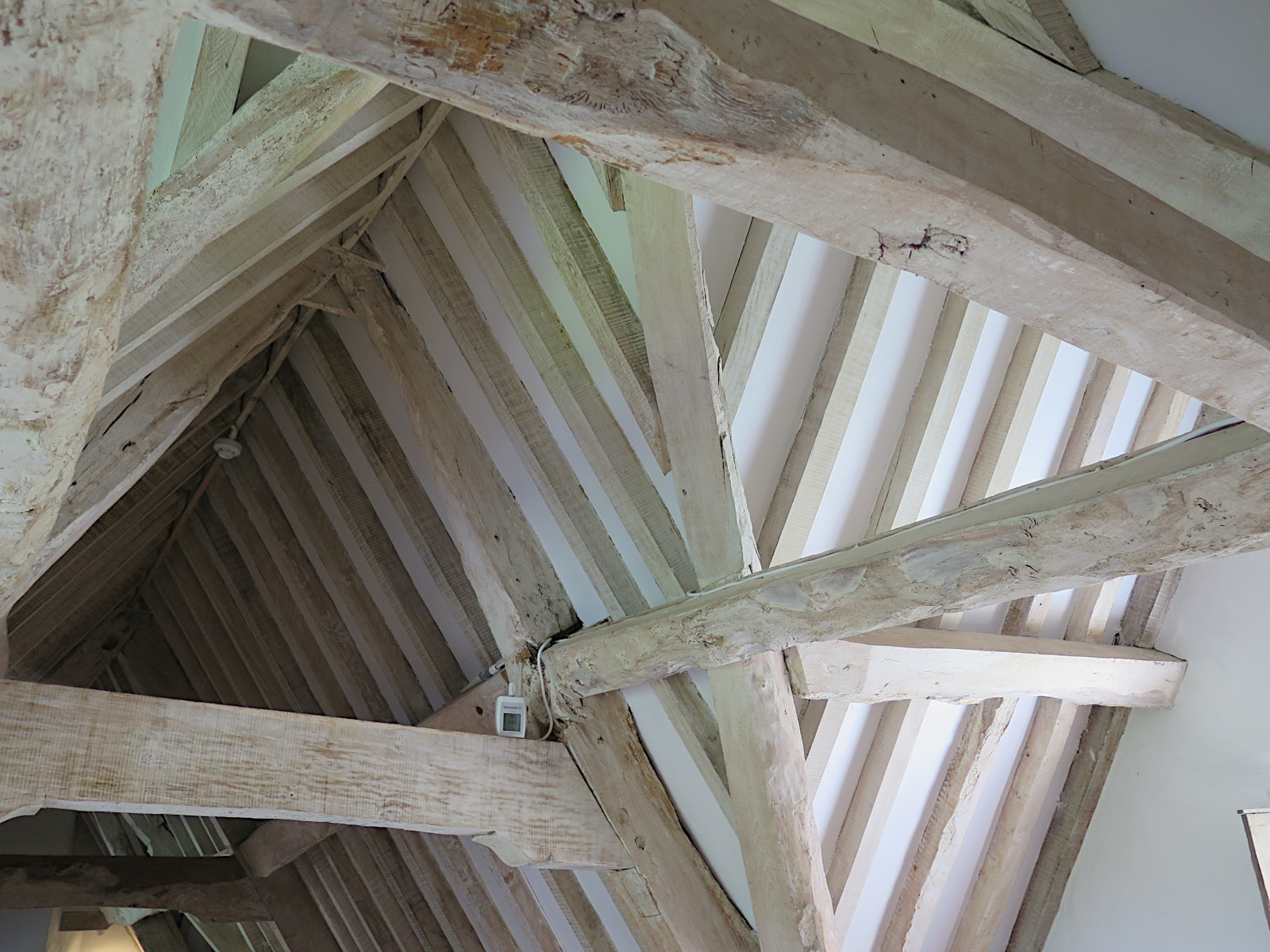
Image of the day – 24

Windows have been around almost as long as houses. At first the only opening was the way in and out of the building – think of a tent or an igloo.

< Previous | Index | Next >

What’s in an image? Sometimes quite a lot, more than meets the eye.

I’m posting an image every day (or as often as I can). A photo, an image from the internet, a diagram or a map. Whatever takes my fancy.

Windows have multiple functions, they let in light and they provide a view, if they can be opened they provide fresh air and allow a room to cool down, when they’re closed they prevent rain from entering and enable sunshine to warm the room.

Windows have been around almost as long as houses. At first the only opening was the way in and out of the building – think of a tent or an igloo, or an Iron-Age thatched hut. Later, other openings, too small and high to walk through, took over the functions of letting in light and so forth, and the doorway could then be closed off with a curtain or a wooden door.

Today we take all of this for granted, of course. As you know, I like to find parallels between the objects in the images and anything else that comes to mind. So today, I’d like to point out the parallel between a window allowing light and fresh air into a room and whatever it is that lets thoughts and fresh ideas into our minds. Some people are more observant than others, some of us have minds that are closed to certain ideas but open to others.

This time I’ll avoid drawing conclusions, but I invite you to give it some thought and share your own ideas and ponderings below.

Themed image collections

The links below will take you to the first post in each collection

Cirencester, Favourites, Irish holiday 2024, Roman villa

< Previous | Index | Next >

Useful? Interesting?

If you enjoyed this or found it useful, please like, comment, and share below. (If you don’t see those links, click the article’s title above the main photo and they will appear.) Send a link to friends who might enjoy the article or benefit from it – Thanks! My material is free to reuse (see conditions), but a coffee is always welcome and encourages me to write more often!

Image of the day – 23

By cooperation and coordination they manage all the behaviours and activities that we see on the larger scale. 

< Previous | Index | Next >

What’s in an image? Sometimes quite a lot, more than meets the eye.

I’m posting an image every day (or as often as I can). A photo, an image from the internet, a diagram or a map. Whatever takes my fancy.

The fresh green of spring

There are few things as amazing as life. Perhaps there’s literally nothing as amazing as life in the entire universe! The photo shows the young, expanding leaves of a small-leaved lime tree (Tilia cordata).

Like all deciduous, temperate trees, leaf buds are formed the previous summer and over-winter after the old, mature leaves fall in late autumn. As temperatures increase in springtime, these buds swell and grow and the young leaves appear and expand. At first they’re a beautiful, pale green (lime green) but become a darker and duller shade as the days lengthen and they mature.

These processes all take place naturally in ways that are more complex than most of us might expect. Both plants and animal bodies are composed of countless tiny cells in much the same way that a large building might be made of bricks. Each cell is alive, contains a full copy of the organism’s DNA, and many of them have specialised roles to play. By cooperation and coordination they manage all the behaviours and activities that we see on the larger scale. So in some respects an expanding leaf is a lot like a growing community of people working together as a village or business. Having specialists makes it possible to do so much more, but cooperation becomes essential, not merely optional.

The rioting we’ve seen in some British cities in recent days has been disruptive and damaging to society as a whole. When the cells of an organism behave in uncoordinated and uncontrolled ways we call it a cancer. Rioting is a kind of cancer in a human society. We all know what happens when cancer becomes so widespread that the organism can no longer function. But organisms have ways of dealing with errant cells before they become overwhelming, and so do societies. Both police action and peaceful counter-demonstrations have been effective in controlling the UK riots in recent days.

Themed image collections

The links below will take you to the first post in each collection

Cirencester, Favourites, Irish holiday 2024, Roman villa

< Previous | Index | Next >

Useful? Interesting?

If you enjoyed this or found it useful, please like, comment, and share below. (If you don’t see those links, click the article’s title above the main photo and they will appear.) Send a link to friends who might enjoy the article or benefit from it – Thanks! My material is free to reuse (see conditions), but a coffee is always welcome and encourages me to write more often!

Image of the day – 22

Actions are driven by temperament and thought. Habits are formed by actions frequently repeated.

< Previous | Index | Next >

What’s in an image? Sometimes quite a lot, more than meets the eye.

I’m posting an image every day (or as often as I can). A photo, an image from the internet, a diagram or a map. Whatever takes my fancy.

The pretty village of Chalford

Chalford is a pretty Cotswold village set in a beautiful valley east of Stroud, Gloucestershire. The valley carries a road, a river, a canal and a railway along its length at this point. It’s simply the most obvious route.

The village accommodates these four features with complete ease. The road is quite high up one side and is not visible from the bottom of the valley. The river is, of course, a natural feature; it belongs here in a way that the other three don’t. It’s a delight to see and hear, in some sections constrained by walls and crossed by foot bridges, in other places with natural banks full of plant and animal life. The canal is derelict, but due to be repaired again one day, the railway is barely visible because, like the road, it’s well above the bottom of the valley.

It strikes me that people are rather like the valley in the sense that they carry channels of temperament, thought, action and habit. A person’s temperament is natural, like the river, already present if you will. Thought is a linear process that begins before birth and continues until death, so like a river it has a beginning and an end. Actions are driven by temperament and thought. Habits are formed by actions frequently repeated.

Looking at the news stories in recent days, with wars and riots causing so much pain, anxiety and death in so many places around the world, differing opinions being expressed and denounced, so much trouble everywhere, my hopes and prayers are that the channels of temperament, thought, action and habit in the great majority of people will remain predominantly peaceful and kind, and that life might be as beautiful as the prettiest of valleys, and the places where we all live return to the peaceful life of a village like Chalford.

Themed image collections

The links below will take you to the first post in each collection

Cirencester, Favourites, Irish holiday 2024, Roman villa

< Previous | Index | Next >

Useful? Interesting?

If you enjoyed this or found it useful, please like, comment, and share below. (If you don’t see those links, click the article’s title above the main photo and they will appear.) Send a link to friends who might enjoy the article or benefit from it – Thanks! My material is free to reuse (see conditions), but a coffee is always welcome and encourages me to write more often!

Image of the day – 21

The plant, on the other hand, is a living organism. Nobody designed or manufactured it – life is much more wonderful than that!

< Previous | Index | Next >

What’s in an image? Sometimes quite a lot, more than meets the eye.

I’m posting an image every day (or as often as I can). A photo, an image from the internet, a diagram or a map. Whatever takes my fancy.

It’s quite amazing how life clings on, even in the most adverse circumstances. This plant was growing in my front drive, somehow finding a way to get its roots into a narrow gap in the block paving. The blocks were designed by a garden landscaping company and manufactured to particular standards of hardness and resistance to my car rolling over them. They were designed to last.

The plant, on the other hand, is a living organism. Nobody designed or manufactured it – life is much more wonderful than that! The universe we live in is tailored to build ever more complex things from very simple beginnings. A handful of quantum fields is all it takes, and these are exquisitely able to give rise to fundamental subatomic particles. These group together, eventually settling into simple atomic nuclei. As the universe expanded and cooled, atoms of simple elements appeared, almost entirely hydrogen and helium. Stars condensed and formed heavier elements up to iron. I could go on, but it’s a long story! Maybe some other time?

For now, just consider the battle between order (my paving blocks and the urge I have to remove weeds that neither I nor my wife want to see growing there) and disorder (weeds thriving wherever they can, despite my best efforts). Life always wins in the end, it seems!

Themed image collections

The links below will take you to the first post in each collection

Cirencester, Favourites, Irish holiday 2024, Roman villa

< Previous | Index | Next >

Useful? Interesting?

If you enjoyed this or found it useful, please like, comment, and share below. (If you don’t see those links, click the article’s title above the main photo and they will appear.) Send a link to friends who might enjoy the article or benefit from it – Thanks! My material is free to reuse (see conditions), but a coffee is always welcome and encourages me to write more often!

Image of the day – 20

In ancient Jewish thinking, flowing water was considered living water, but stationary water in a cup, basin, pond or lake was not living.

< Previous | Index | Next >

What’s in an image? Sometimes quite a lot, more than meets the eye.

I’m posting an image every day (or as often as I can). A photo, an image from the internet, a diagram or a map. Whatever takes my fancy.

The River Churrn in Stratton

This photo shows the River Churn flowing through Stratton Meadow on the northern edge of Cirencester, with the old Stratton Mill in the background. As you can see, the Churn is only a small river, but like the Thames its name is very ancient, going back at least to Iron Age times. In Roman Britain the Thames was Thamesis and Churn is the Corin in Corinium (the Roman name for Cirencester). It’s also the Ciren in Cirencester and the Cerney in several villages north and south of the town.

Rivers are intriguing things, the water contained in them is flowing so the water you see now is different from the water that you saw five minutes ago. Yet the river usually changes its course very little in a human lifetime, so there’s a sense of constancy about it. The water is here for moments only, but the river is here for generations.

In ancient Jewish thinking, flowing water was considered living water, but stationary water in a cup, basin, pond or lake was not living and was therefore of less value and significance. A mikvah was a special bath with water flowing in and water running out at all times, bathing in this living water would make a person ritually clean. Taking a dip in the pond had no such effect!

Cirencester

For convenience, here’s a list of all the Cirencester area images:

A417 roadworks, Advent Market, Bishops Walk, Baunton, Canal 1, 2, Castle Street, Christmas lights 1, 2, Church 1, 2, 3, 4, 5, 6, Churn flood, Countryside, Fallen tree, Fleece, Gasworks, Gloucester Street, Hare 1, 2, Hospital, Market Place 1, Phoenix Fest, Riverside Walk, Stone plaque, Stratton Meadow, Tank traps, View, Wonky 1, 2, Yellow Iris

Themed image collections

The links below will take you to the first post in each collection

Cirencester, Favourites, Irish holiday 2024, Roman villa

< Previous | Index | Next >

Useful? Interesting?

If you enjoyed this or found it useful, please like, comment, and share below. (If you don’t see those links, click the article’s title above the main photo and they will appear.) Send a link to friends who might enjoy the article or benefit from it – Thanks! My material is free to reuse (see conditions), but a coffee is always welcome and encourages me to write more often!