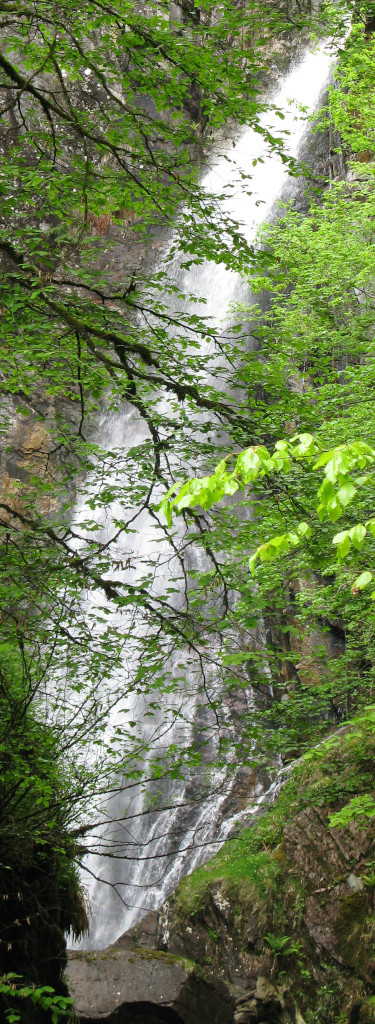
Tree shading

Put an upturned bucket over a patch of grass in your garden. Lift the bucket every day and take a look, then re-cover the patch… How long does it take for the grass to die?

< Previous | Index | Next >

Image of the day – 178

What’s in an image? Sometimes quite a lot, more than meets the eye. I’m posting an image every few days.

Click to enlarge

Trees provide shade, most welcome on a hot day, and they provide shelter when it rains (though this may be unwise during thunderstorms).

But notice the absence of grass beneath these conifers. Shade and shelter are exactly what other plants don’t need; they depend on plenty of light and water to enable them to grow. Light is essential as it provides the energy to split water into hydrogen and oxygen, and water is essential as the raw material for this process. The oxygen is released into the atmosphere, while the hydrogen is bonded with carbon dioxide from the atmosphere to make energy-storing sugars for use at night and to build cellulose, the main support molecule that gives stems, branches and tree trunks their strength.

The lack of light and water under tree canopies creates a kind of local desert. You can see this clearly in the photo from the presence and absence of grass. So how do the trees survive? That’s a great question! Their roots spread out widely and deep, far enough to reach moist soil and deep ground water. In persistent rain, water drips from the drenched leaves above. And root, trunk and branch all contain stores of water so a tree can cope with a long, dry summer far better than the grass can.

Light

Here’s an experiment anyone can do. Put an upturned bucket over a patch of grass in your garden. Lift the bucket every day and take a look, then re-cover the patch. See how long it takes for the grass to turn yellow. How long does it take for the grass to die?

For plants, light is essential. There are some animals that live in dark caves or underground, with no light. Earthworms are a good example, but like all animals they get their food by consuming plants and other animals. But for most creatures, including us humans, light is essential nonetheless. Whether we are plant eaters (like cows and sheep) or meat eaters (like lions and wolves) or omnivores eating either or both (like humans and rats) we still need light to see in order to find and identify the things we must eat to stay alive.

Water

For plants, water is part of their ‘food’, it’s needed to make sugars. For animals water is of no value as food, but it’s essential to prevent dangerous dehydration. All animals know when they’re thirsty and they’ll find water and drink to keep themselves alive. Think of a man lost in a desert, the cartoons have him croaking out, ‘Water.. Water..’ Imagine someone unable to find water, they’d die of thirst long, long before they died of hunger. Most of us would be in danger after a few days without drinking, but we could live for several weeks with nothing to eat. And of course, if you are a fish too little water would mean you couldn’t breathe, and if you were a land animal too much would mean you would drown.

Spiritual (not religious)

The idea of essentials has been carried over into spiritual ideas too. Light and water (and food) are so clearly necessary for life that they make good analogies and illustrations. What did Jesus mean when he said, ‘I am the way, the truth and the life’? Or when he explained to the Samaritan woman at the well that he would provide water that never runs out, or when he told his followers, ‘I am the bread of life’ or ‘I am the light of the world’?

He was simply saying, I am essential, you can’t live without me. I’m necessary for life. Just as in the physical world, how would it feel to live in the dark, without water and without sustenance? How long would you last? How long would I last?

Many people today feel sure there is no spiritual aspect to life at all, it’s just about living your life in the here and now and then dying from accident, illness, or just old age. Others think there’s much more to life than that. At the very least there are moral and philosophical truths to consider. We should care for one another, help one another, and cooperate in helpful and kind ways.

Food for thought. Let me know below how you think about the essentials of life. Do you have any thoughts to share on this?

See also:

< Previous | Index | Next >

Useful? Interesting?

If you enjoyed this or found it useful, please like, comment, and share below. My material is free to reuse (see conditions), but a coffee is always welcome!

You might also like:

John 15:1-8 – Vine and branches

If you prune a vine wisely it becomes more vigorous and more fruitful; that’s true of all kinds of fruit tree too.

< Previous | Index | Next >

Bible text – Read it yourself (opens in a new tab)

A fragment of John’s gospel (Wikimedia)

Jesus has been talking to his closest followers, the small group of twelve who were travelling with him. Now he begins to use the idea of a vine. Remember that everyone in Israel would have known what a grapevine is like, they were widely grown and wine was an important item in ceremonies as well as in ordinary life. It was essential in weddings, in the passover meal and so forth.

He now makes a strange claim, he says that he himself is a vine. Not only that, but he is the true vine. And he mentions that his Father is the gardener, though we shouldn’t think in terms of someone who looks after fruit, flowers and vegetables in the way we would today. Israel is the old vineyard, and Father is much more than just an employed labourer, he is the vineyard owner. The old vineyard (Israel) has not been fruitful. Jesus is a new vine and his Father will prune the branches to make him more fruitful. If you prune a vine wisely it becomes more vigorous and more fruitful; that’s true of all kinds of fruit tree too, anyone who manages an orchard will tell you that ageing trees fruit less but can be reinvigorated by good pruning. Old or diseased branches need to be removed and the others cut back to a strong, healthy bud.

And Jesus goes on to tell his followers, ‘You are the branches’! Who are his followers? Two thousand years ago they were the twelve disciples who followed him everywhere and were hungry to hear whatever he had to say. Today the things that he said to them, apply to us also. We are his branches, we are attached to him.

A two-way relationship

Notice that this is a two-way relationship. Jesus says we’ll be very fruitful if we remain in him and he remains in us. And notice too that it’s an all or nothing relationship; we’ll either be very fruitful or we can do nothing. There’s no option that makes us partly fruitful, or reasonably fruitful, fruitful in some things but not in others. We are fully in; or we are fully out. You will be precious and treasured, or you will be trash. So which will you choose? Will you be attached to the one true vine, or will you be disconnected?

And in verse seven we learn that if we remain in him and his words remain in us, we can ask anything we wish and it will be done for us! We need to be careful here, though. Jesus is not telling us that we can ask for things that are not in his will and purpose. He expects us to know we can ask anything in his Name and receive it. There’s no point in asking for something that will harm or destroy your enemies, for example, because Jesus made it clear that we are to love our enemy. If I ask for wrong things, I am not remaining in him and his word is not remaining in me.

While the nails were being driven through him into the cross, Jesus asked for something. He said, ‘Father forgive them, they have no idea what they’re doing’. Was that prayer answered? You bet it was. It’s a tremendous example of loving your enemy, isn’t it! Maybe one of those Romans was the one who later said, ‘Truly this man was the Son of God’.

Glorifying the Father

Finally, in verse eight we see the purpose of it all. It’s not about us at all. It’s not even about Jesus. It’s about the Father! Being very fruitful, and showing ourselves to be followers of Jesus, simply brings glory to the person who truly deserves it and should always receive it – the Father.

Our Father, who is far beyond our reach, let your Name be utterly holy, may Your will and purpose be done here on Earth, just as it is in Your dwelling place.

< Previous | Index | Next >

Useful? Interesting?

If you enjoyed this or found it useful, please like, comment, and share below. My material is free to reuse (see conditions), but a coffee is always welcome!

John 14:22-31 – Not to the world?

[Jesus] took on our limitations so that he could reach us on our level, in ways we can understand.

< Previous | Index | Next >

Bible text – Read it yourself (opens in a new tab)

A fragment of John’s gospel (Wikimedia)

‘Why are you showing yourself to us, but not to the world?’ This is such an interesting question, it’s also a natural question. Judas (not Iscariot) wants to know why Jesus shows himself to the twelve, but not to the world. The question suggests it’s Jesus’ choice to hide himself from most people but show himself to a few. Judas is right to find this strange! But it’s not what Jesus has in mind.

In verse 23, he responds by saying that for everyone who loves him, he and the Father will come and make their home in that person. In other words, it’s not just for the twelve, but for anyone in the world who loves Jesus. Or to put it another way, the answer is that he will reveal himself to anyone – if they love him. He doesn’t hide from anybody, but those who don’t love him can never truly see him.

Short of time

Jesus needs to wind the conversation up because he knows what will happen next. He reminds them again of the promised Spirit and tells them that he and his Father will live within them; and the Spirit will teach them and remind them of everything they need to know. He also promises to leave his peace with them, and tells them not to worry or be afraid. This seems to me particularly striking when you consider what Jesus is about to go through at the hands of the Sanhedrin and the Roman governor.

And finally, in verses 28 to 31, he reminds them that he’s going to the Father who is greater than he is, and they will be glad (once they understand the significance of this). So, in what way is the Father greater than the Son? Does this idea even make any sense when we know that Father, Son and Spirit are co-equal within the structure we call ‘trinity’, the three in oneness that they share together? Perhaps the answer is simply that Jesus has limited himself within a human body in order to reach us in this world. For more than 30 years he has remained limited, but in returning to the Father he will regain the ability to be present everywhere at every moment of time with all of his people. In his human body he is inevitably less powerful than the Father, only able to act in the one place and time where he finds himself. He took on our limitations so that he could reach us on our level, in ways we can understand. That time is coming to an end as he returns to the Father.

Time’s up

And then they leave, and the final act will open.

< Previous | Index | Next >

Useful? Interesting?

If you enjoyed this or found it useful, please like, comment, and share below. My material is free to reuse (see conditions), but a coffee is always welcome!

John 14:15-21 – Promising the Spirit

If Jesus is in us and he is also in the Father, then we too are somehow part of their oneness!

< Previous | Index | Next >

Bible text – Read it yourself (opens in a new tab)

Verse 15 is a big ‘if’. Jesus doesn’t ask us to do what he tells us; he simply points out that, if we love him, we will do what he says. So we are faced with the reality of what is in our hearts where Jesus is concerned. Do I love him, or don’t I? How far will I go in following him? Some of the way? All of the way?

The Spirit of Truth

The Holy Spirit comes as a gift from the Father in answer to a request from Jesus. And the Spirit is pretty special because he speaks for us, helps us, and will always stay with us. Read this personally – The Spirit of Christ, sent by the Father, speaks for you, helps you, and will always stay with you. Has this been your experience? If not, perhaps you need to get to know Jesus even better and make sure that you truly love him and therefore keep his commands. Look deeper into your own heart and pay more attention to your daily experience on this journey with Jesus. (If you’re still in doubt, press the ‘Previous’ link twice and re-read the notes on verses 1-7.) The Spirit of Christ cannot be anything but the Spirit of Truth, because Jesus declared himself to be ‘the Way, the Truth, and the Life’.

Pity the poor world!

‘The world’ is a way of saying ‘worldly people’ – in other words people who know the world, but have little or no clue about Jesus. Knowing the world is our default position, as we grow and experience life, we get to know the world and its ways better and better. That’s life! But this knowing provides no way to become familiar with the Spirit of Truth.

But if you are following Jesus, you will see and know his Spirit because the Spirit lives with you – inside you.

Leaving us?

The disciples didn’t yet fully understand what was happening. Jesus is going to leave them, but not like children without parents. Verse 18 is very clear, Jesus absolutely and explicitly tells them that he, the Son, and the Spirit (his Spirit) are one. They are not quite the same, but they cannot be separated. Jesus has a human bodily form and therefore lives with, but outside, the disciples; the Spirit has no bodily form and will live inside the disciples. Not only that: they will realise that Jesus is in his Father, and he is also in them. If Jesus is in us and he is also in the Father, then we too are somehow part of their oneness!

Back to verse 15

Verse 15 is reiterated in verse 21. If we have and keep Jesus’ commands, then we love him. And if we love Jesus, the Father will love us, Jesus will love us, and he’ll show himself to us. We are in such a safe place! All our lives we existed in a physical reality, but now we live in a spiritual reality as well!

< Previous | Index | Next >

The good and bad of services

A meeting that is not managed by us has the opportunity of being managed by the Holy Spirit.

Part 5 of a series – What are we doing?

Message to a friend | Index | Is church unbalanced? >

In part 3 of this series, ‘Like a waterfall’, I shared a vision and some words from the Spirit about how the water in a river is constrained by the banks and bed of the river, and how a waterfall allows complete freedom for the water to respond to the attractive force of gravity. In this post I’d like to share some thoughts about church services and how they affect church life.

A photo showing people in a typical church service
A typical church service (image from Wikipedia)

Pretty well all denominations hold regular services, usually on Sunday mornings and often Sunday evenings and a weekday evening as well. They are called services because they serve someone. You could argue that their function is to serve the Father and/or Jesus through corporate worship and praise, or you could take the view that they are occasions where a minister serves teaching and guidance to the congregation who act as a (mostly) passive audience. Services follow set patterns, from a loosely defined prayer/hymn sandwich, to a set of rituals, and traditional and familiar practices like preaching or singing, prayer from the front and so forth. But if we turn to the New Testament we find nothing like this.

It’s true that Jesus and his disciples met together a lot, they travelled the road as a group with many other followers and hangers on, and they ate together and talked a good deal. Sometimes Jesus spoke with the inner twelve alone – often asking them questions, so it was conversational teaching. At other times he spoke to larger crowds. He provided wine when it ran out at an embarrassing moment, he healed sick people, spoke to people, sometimes he touched people physically, and yes – occasionally he went to the Synagogue. But there’s very little here that looks like a 21st century church service.

There are more clues in Acts and Paul’s letters. People did meet together, but the descriptions we get are of participatory meetings with no particular person making decisions about timing and no discernable programme. Certainly, if there was a visitor like Paul present, he might share news or even teach, but this seems to have been done on an ad-hoc basis as and when it seemed useful. We read of people praying, prophesying, teaching, singing, worshipping, speaking in unintelligible languages, interpreting what was said, praising, giving way to one another and so forth. There’s nothing here we’d recognise as a service. People were sharing whatever the Holy Spirit urged them to say at that moment.

So let’s think about the benefits and issues of church services on the one hand, and on the other, meetings with no agenda where people listen to the Spirit and share freely whatever he provides. Which seems most like a waterfall? Which seems most like a fixed channel? If the Spirit urged you to pray, or share a vision, or begin a song, or start to teach – which kind of meeting would offer the most comfortable opportunity? Paul wrote that we should do things decently and not in disorder. But he didn’t write that we should decide the pattern, sequence, songs and speaker beforehand! Somewhere between 100 AD and the Middle Ages, dynamic church life in the Spirit was replaced with restrictive and pre-set formats and traditions. The waterfall became a river!

What are the benefits of a ‘waterfall’ meeting? Simply this: a meeting that is not managed by us has the opportunity of being managed by the Holy Spirit. I say ‘opportunity’ because it’s also possible for us to have an unruly free-for-all in which we all do what we think best without waiting for the Spirit to guide us. Paul warns against this. But if a group of his people agree to be silent together and listen and then express whatever they are given, there will be a sharing of spiritual life with a focus and purpose that is astonishing. We have to trust one another to act gently and kindly, to see, hear and share what we are given moment by moment, to give way to one another, to wait for one another, and to focus on the Master, not on ourselves. And then there is the potential for a meeting in which he speaks and we listen in awe and amazement. Pictures and words, Bible verses and songs, unknown languages and their interpretation, prayer, prophetic words and teaching, worship and praise will merge as he leads us and guides us. We will know when he has finished, the end of the meeting will come naturally and with a sense of fulfillment and purpose. All of us will know that something special has happened and we will go away deeply encouraged, with a sense of direction, and the knowledge that this was another special time in the presence of the King. And yes, it will have been a ‘service’ in the deepest sense of that word, for he has served us and we have served him and his presence was clearly evident and amazing.

Will this fruitful kind of meeting come easily? No it won’t. It will take practice, and it may be difficult at first. GK Chesterton famously said, ‘The Christian ideal has not been tried and found wanting. It has been found difficult; and left untried’. The same might be said of ‘waterfall’ meetings – we need to be willing to try and try again until we learn how to let the Spirit lead us together in this way; but we do need to try! The benefits will far outweigh the difficulties. I’ve been in many meetings of this kind over the years, from tiny groups of just two or three people, up to gatherings of more than a hundred.

Here are a few hints that may help if you want to try this with friends.

  • Don’t sit in rows, sit in a circle; if there are many people you might need several concentric circles, but you need to see one another. Don’t have a ‘front’, have a centre.
  • Give Jesus your full attention, and examine the things that just pop into your mind – thoughts, words and phrases, emotions, images.
  • Don’t be afraid of silence. Use these times to focus on Jesus and his presence in the meeting.
  • Give way to one another. Many short contributions will be better than one or two long ones.
  • Don’t have a leader. Somebody might begin with a welcome and to point out the emergency exits or share other important practical details, but then they should sit down and become part of the corporate process, listening and sharing like everyone else.
  • Allow plenty of space, have a gap in the circle so people can come and go – several gaps if the circle is large. Have space for people to stand, walk about a little, or dance.
  • If possible, don’t set a time to end the meeting. Everyone will know when it’s finished.
  • Allow time at the beginning for people to mingle and chat. Consider eating and drinking together, anything from tea and coffee to a pot luck meal. And allow time to mingle and chat again at the end if you can.
  • There is no ‘right’ format. The purpose of meeting is to be one in Christ, to hear from his Spirit, and to share what each is hearing or seeing. Be open, be flexible.
  • If you haven’t met like this before, it may be best to begin with smaller numbers, perhaps twelve to fifteen at most.
  • Don’t prepare what to do or say in advance. Instead come with nothing and be prepared to see and hear and share moment by moment while you are together.

Message to a friend | Index | Is church unbalanced? >

Like a waterfall

A waterfall breaks the pattern of a river’s flow

Part 3 of a series – What are we doing?

Upside-down? | IndexMessage to a friend >

I’m sharing a vision and message I received recently because, although it was primarily for a small group I meet with weekly, I think it has a much wider application as well. Sometimes Father shows me things when I am not particularly trying to listen to him. But on this occasion I was prompted by something a friend had said and I’d set aside some time to deliberately look and listen to the Spirit. So without more ado, here is what I saw:

Father showed me a waterfall, there was quite a big drop and the water was crashing onto rocks at the bottom. It was not huge like Niagara, but high enough that you wouldn’t want to take a boat over it!

And I sensed the Spirit saying the following words which I wrote down at the time:

A waterfall breaks the pattern of a river’s flow. The water always responds to gravity, but rarely flows freely towards the source of attraction (the centre of the Earth), normally it’s constrained by the river bed and the banks on either side, and only makes very slow progress downwards. But just now and then it gets the chance to flow freely towards the centre of attraction. I am that centre for my people, I want you to flow freely towards me, unrestricted by the channels you normally occupy.

But those channels are comfortable and seem safe, when they are taken away you feel in danger and vulnerable. This is not just true for my people, it’s true for everyone. You can see how the normal and comfortable has been taken away during the current Covid-19 crisis. Jobs, family contacts, high street shopping, watching a film, education, visiting friends – all these things have changed. And the normal patterns of church have changed too. So what remains? Ask yourselves what remains. Ask yourselves what is important.

The water flows differently when there’s no channel and it has complete freedom. That’s true for living water too. The loss of a channel is not a disaster, it’s an opportunity – think about that too.

I called you to be part of my waterfall, not part of a constrained river.

Do you see church as a channel you flow along, something that contains you and controls your flow? Do you see the value of complete freedom to rush headlong towards Jesus like a waterfall, with no channel to contain and direct your flow?

He is our Master, our Teacher, our Shepherd, the King of Kings, the Lord of Lords. He gave us life by breathing his breath into us, and he has given us new, spiritual life in the same way. He is the Way, the Truth, and the Life, he is Living Water, he is the Light by which we see. He gives us gifts including the gifts of apostle, prophet, evangelist, shepherd, and teacher. He calls us to follow him, to say what we hear him say, and do what we see him do. Given all of that, how can we possibly allow ourselves to be channelled by anyone or anything else but him?

He said, ‘Ask yourselves what remains [when the normal channels of church have changed]. Ask yourselves what is important’. And he said, ‘The loss of a channel is not a disaster, it’s an opportunity – think about that too.’

Perhaps we should take him at his word. What remains of normal church life? What is important? What are the opportunities?

Should we go back to the old channels as soon as that becomes possible? Should we cling to church, or should we cling to Jesus? Should we follow habit and tradition, or should we follow Jesus? Will we turn to church to disciple us or will we turn to Jesus to do that? Is there a difference? I think there is an enormous difference. What do you think?

Upside-down? | IndexMessage to a friend >

Gentleness takes courage and strength

You are precious to me, every single one of you. So live as if you believe that you are precious! Stand tall in the world. The things I want to see grow in you are not hard or complicated.

RiverOuse
River Great Ouse, St Neots

Last Sunday morning I was sitting in a lobby area in the community centre in Eaton Ford, part of the market town of St Neots between Bedford and Cambridge. River Church meets here and I was visiting, staying with a friend who plays in the church’s worship band. The band was setting up and getting themselves ready for the meeting, so I had half an hour to spare before people would be arriving. I sat, stilled my mind, and spent some time listening to what the Holy Spirit might say to me.

And this is what I received:

Speak out, but look up. Look out and speak up. See with your eyes, hear with your ears, speak with your mouth, but always let the Spirit live in your heart.

Welcome my Spirit and bear fruit in your lives; are you not my people? Let my love, joy and peace rise up. Don’t follow one another, but follow me. Don’t follow convention, but follow Truth. Don’t follow directions but follow the Way. You are precious to me, every single one of you. So live as if you believe that you are precious! Stand tall in the world. The things I want to see grow in you are not hard or complicated, they are the simplest of things – gentleness towards the people in your lives – peace in your hearts – gracious and loving attitudes – a deep hope rooted in my presence, not in your circumstances – a humbleness that shuns position and fame – joyful hearts dancing freely in my presence – relentless patience – kindness that looks for no reward – innocent hearts.

Become empty of what you are and do and I will inhabit you. Haven’t you heard me knocking? I don’t want your abilities – I want you!

Thinking about this afterwards, I was intrigued that what had started out feeling like a word to me alone had, very quickly, become something spoken to others too. I wondered if these were words I should share during the meeting. I have many friends at River Church and some of them might need to hear this message. And as people began to arrive for the meeting and greet one another and find their seats I carried that idea with me as I joined them. But though I was ready and willing to share, and there were opportunities, it didn’t seem the right time.

So I’ve come to the conclusion that these words are for all my friends, near and far. That I should share them here and those that need to see them will  be guided to read them. So that’s what I’m doing.

If these words bless you in some way that would be great. But I think there is also a challenge in the words. I believe Papa is calling me to move ever more gently through this world; and perhaps he’s calling you to do that too. Don’t be misled into thinking that gentle is the same as weak: it is not! Sometimes it takes enormous courage and strength to be gentle. Sometimes the only way to reach a person is through gentleness, humility, and patience.

But if you have read as far as this, please ask yourself how you should respond. Is the Spirit speaking to you also through the words he gave me?

Watch the video below to see how Jorge Pina ‘operates from a place of rest’ in meeting people. There’s real wisdom here.

Dry bones in the valley

Before Ezekiel sees the bones or even goes to the valley, Yahweh’s hand is on him. This is the touch that says, ‘I am going to use you’.

Part 2 of a series – ‘The valley of dry bones’

< Ezekiel in exile | Index | Taking a good look >

This time we’re going to take a look at the first verse of Ezekiel 37; the start of the section on the valley of dry bones. Let’s see what Father has for us in this verse.

‘Yahweh’s hand was on me and he brought me out by the Spirit of Yahweh and set me in the middle of a valley. It was full of bones.’ (Ezekiel 37:1)

We can’t tell whether Ezekiel visited a real valley or whether the entire section from verse one to verse fourteen is a vision. Perhaps it’s most likely to have been a vision. But it doesn’t really matter, it’s far from being the most important thing.

A desert scene
A dry and dusty desert (Image from Wikipedia – original and copyright details)

‘Yahweh’s hand was on me…’ – That’s what Ezekiel says. And this is always Papa’s heart toward us; unless his hand is on us we cannot move except by our own efforts. This is fundamental to everything the Almighty does. He speaks, he moves, he demonstrates, he heals, he forgives – and in all these ways he touches us.

Have you noticed how often Jesus touched people? He touched their eyes and mouths and ears when he healed. He touched what was ritually unclean – a leper, a dead girl. The most intimate thing we can do is to touch someone. Touch brings us closer than words ever can. What do we do when a child is afraid, or anxious, or hurt? We pick them up or hug them or kiss them better. We need to touch and be touched. So Yahweh’s hand was on Ezekiel.

And notice that this is the first thing that happens, before Ezekiel sees the bones or even goes to the valley, Yahweh’s hand is on him. This is the touch that says, ‘I am going to use you’. The Almighty lays hold of us because we are his instruments and he plans to use us in some way.

Have you felt his hand on you in your life? I hope so! But if not, pray that he will touch you and use you in whatever way he chooses. If he knows you are truly willing he will use you. That’s what he longs to do with all his people. He has chosen to use us to do his work in this world today. We are to go in his name (Matthew 28:18-20); we are his body; we are his hands, his feet, his eyes and ears and mouth (1 Corinthians 12). Isn’t that extraordinary?

‘…and he brought me out by the Spirit of Yahweh…’ – He brings us out and he does it by his own Spirit. Out from what? Out from the place where we currently are! See how he is one with himself in doing this? It’s explicit in the Hebrew, the name is used twice. Yahweh uses the Spirit of Yahweh. He chooses what he wants us to do, and then he uses his own Spirit (the Holy Spirit, the Spirit of Christ) to guide us. If necessary he will nudge us.

Sometimes we get stuck in a place. I don’t mean physically, I mean a place in our lives from which we are unable or unwilling to move on. Sometimes we are simply waiting for direction. It might be something we’re doing or a thought pattern we return to or just that he has finished using us in one situation and now wants us in a different one. Whether we are stuck or not – he brings us out, he draws us on, he sends his own Spirit to lead us into the next thing, the next place. For an example read about Roy Godwin. If you want the full story you can buy his book.

And notice this, if Ezekiel had not moved he would not have come to the valley. We have a propensity to cling to what we know and to keep doing what is already familiar. But we need to be ready to allow the Spirit to move us at any time so that we can receive something new, Father’s next thing for you, for me.

‘…and set me in the middle of a valley.’ – And so Yahweh sets Ezekiel in the valley. Now a valley is a low point and must be surrounded by higher ground. Ezekiel is placed ‘in the middle’ of this valley, right at the lowest point. He is as far from the surrounding hills and mountains as it is possible to be.

We know this feeling don’t we? Life is hard and promising to get harder yet. There are low points in our lives and there are also low points in the life of the church. Such valleys are places of defeat where there seems no hope or joy or victory; these are assuredly not ‘mountain-top’ experiences. We’ve all been there. Ezekiel was aware of the state of Israel in captivity under Babylon, but Yahweh’s Spirit brought him here so there must surely be a reason for it. Does it sometimes seem as if church is in a valley? A slough of despond? At times like these we need to remember that Papa has something in mind to show us. Jesus didn’t just come to redeem people, he came to redeem situations too.

‘It was full of bones.’ – What do bones usually signify to you? Are they always just the dusty remnants following final and permanent defeat? Or might they suggest that what was once alive might yet be restored? More on this next time.

< Ezekiel in exile | Index | Taking a good look >