I fell through my deck chair, mended it, and Faulks fell through it again later!
My father was given a pocket diary for Christmas 1942; he was sixteen at the time. This seems to have spurred him into writing short notes in very small, cramped handwriting; four days to a page and rather small pages made this essential. These diaries are an absolute treasure-trove.
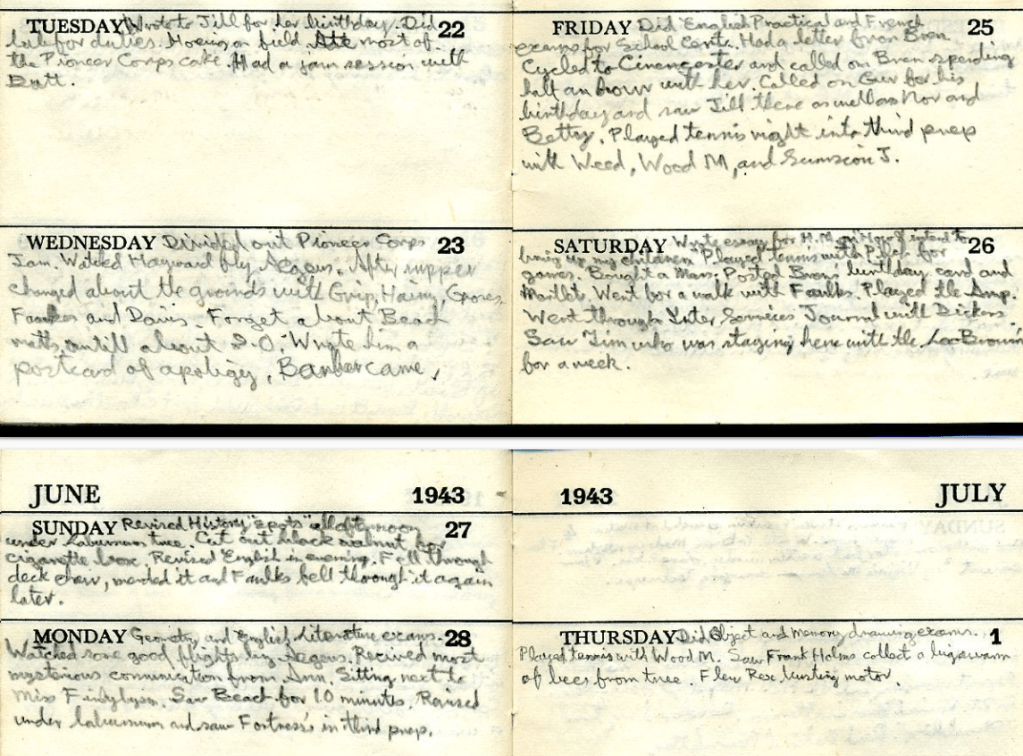
The image below includes the dates 25th to 28th June 1943, and these form the basis of this short article.
An extract from Dad’s 1943 diary
Dad kept up his journal notes for about six years and the diaries are a fascinating glimpse into his life at the time, covering his last terms at school, his career in the wartime RAF and his posting to the Far East, followed by his marriage to my mother and my birth.
I wish there was more, but the record of those six years is a treasure in itself. I’ve been transcribing the entries as they are sometimes difficult to read.
Explanatory notes
Dad was in the process of taking his School Certificate exams at this time, more or less equivalent to today’s GCSEs. He had many friends, male and female, from school, family and others. Brenda (Bren) was a particularly close friend, perhaps we should say she was his girlfriend.
Guv and Nor are his parents, living in Cirencester some five miles from Rendcomb College where he was a boarder. Jill was his niece (therefore my cousin), Tim was Jill’s brother.
It’s amusing that he was asked to write an essay on bringing up children. It’s a good exercise for any pupil as it demands thinking around topics like discipline, appropriate punishments and so forth. A tricky task to write about this for a head master! The ‘small Martlet model’ mentioned is a miniature aircraft, carved from wood and painted. Lee-Browne was the Head Master at Rendcomb School.
The cigarette box also became a gift for Brenda, and the deck chair incident is very amusing – it seems the repair was not entirely satisfactory! We shall never know what was so mysterious about Ann’s ‘communication’ or why sitting next to Miss Finlayson was notable. Beach was my Dad’s maths teacher, and the B-17s were American bombers.
Day by day
Here’s the extract from 1943, slightly edited and expanded for clarity and readability:
Friday 25th June – I did my English Practical and French exams for School Certificate. I had a letter from Bren, and cycled to Cirencester to visit her, spending half an hour there. I called on Guv for his birthday and saw Jill there as well as Nor and Betty. Back at school I played tennis right into third prep with Weed, M. Wood, and J. Sumsion.
Saturday 26th June – I wrote an essay for the Head Master on, “How I intend to bring up my children”. Pilch and I played tennis for the games period. I bought a Mars bar and posted Bren’s birthday card and a small Martlet model, then went for a walk with Faulks. I played the Amp and went through the Inter Services Journal with Dickers. I also saw Tim who was staying here with the Lee-Brownes for a week.
Sunday 27th June – I revised History “spots” all afternoon under the Laburnum tree, and cut out black walnut to make into a cigarette box. I revised English in the evening. I fell through my deck chair, mended it, and Faulks fell through it again later!
Monday 28th June – We had Geometry and English Literature exams this morning. I watched some good flights by the Aegeus model and received a most mysterious communication from Ann. I sat next to Miss Finlayson, and saw Beach for ten minutes, then revised under the Laburnum and saw B-17 Fortresses fly over during third prep.
Notes from bygone years – Lots of past Septembers Hint: Click on the thumbnails for larger images.
A year ago
I didn’t post to my blog in September 2022, so here’s an extract from my journal for 8th instead. We were on holiday in Wales along with Donna’s Mum, brother Paul and his wife Vanessa. It was an eventful day.
We drove into Tenby and unexpectedly bumped into our friends Simon and Carol! None of us had any idea we would be in Tenby that day, our friends live in Yorkshire!
At lunchtime I saw reports on my phone mentioning that the Queen’s doctors were concerned about her health. Later in the day her death was announced and it seemed very strange that Prince Charles was now King Charles III. I wrote in my journal:
[Elizabeth II] had such a long reign (the longest of any British Monarch) and she leaves King Charles III as the most aged new Monarch ever. She did her job extraordinarily well. It comes as something of a shock to be writing these words on this day in my journal. It’s a day that seemed always to be delayed and would never actually arrive – yet here it is.
Back in our holiday home in Llantissilio, we watched the news and caught up with some of the details of the day. There was also startling news from Ukraine with Russian forces abandoning a large region in Kherson and retreating in disorder in an even larger region near Kharkiv.
In September 2021 I wrote about a new song from a musician I know, Sarah Reynolds. The theme of the song is that when we seem to be facing defeat and are struggling just to hang on, hope may not be as far off as we imagine.
Take a look at the original post and listen to the song, ‘Wilderness’.
In September 2018 we were on holiday with the family in Switzerland. I wrote a blog post about walking the bisses (irrigation streams). It was a fascinating day. Here’s a link to my post.
In September 2013 I wrote about my project ‘Cruising the Gospel’.
The idea was to help and encourage people to read through the biblical books of Matthew, Mark, Luke and John, considering what we can learn about Jesus and about ourselves as we read. Anyone can follow along, reading and pondering small, manageable chunks along the way. (Read the original article)
On 29th September 2008 I wrote to Elon Musk and SpaceX to congratulate them. Why? Because the previous day had seen them launch their Falcon I rocket successfully – after three consecutive failures! Read my blog post and message.
In September 2003 we visited my parents in Cirencester. Dad had just bought Mum a battery-powered cat that ‘purred’ when you stroked it. Mum loved having a cat, but Dad felt that at their age they shouldn’t have another one after the previous cat died. The pretend ‘cat’ was an amusing compensation, but I don’t think Mum was very convinced!
In September 1998 we were looking forward a few weeks to a relaxing holiday in Fetiye, Turkey. I’d been to Istanbul briefly on a school trip in December 1964, but I had never been to any other part of the country. A week on the Mediterranean coast sounded great and we hoped the weather would be kind.
In September 1993 I was working as the Microcomputing Manager at Long Ashton Research Station near Bristol. Part of my job involved networking PCs, here’s a message I sent asking for help. Click the image for a larger view.
Notice the ASCII art (text characters used to make larger ‘text’ or images, and the way a reply uses > characters to mark quoted text. All very primitive, all time consuming, and none of it necessary any more.
The 10th September was Judy’s birthday, and in 1988 Debbie and Beth made her a birthday meal in the evening. It was quite a spread as you can see if you click on the thumbnail.
The family records are blank in September 1978, the month that Debbie turned 3½. But on the world scene there were some significant events. Menachem Begin and Anwar Sadat discussed peace and signed the Camp David Accords, and 122 rioters died in Tehran when the Shah’s troops opened fire.
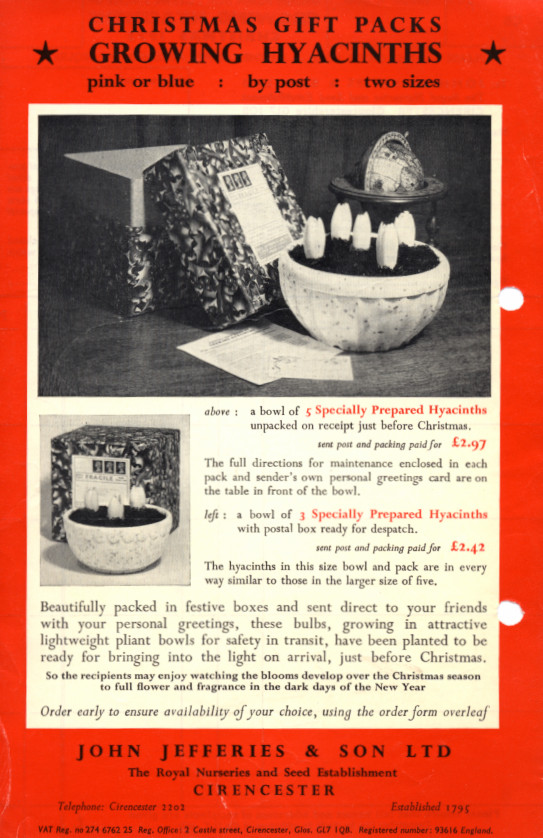
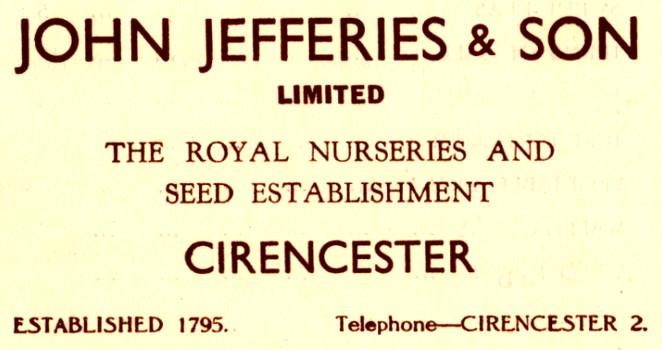
In late 1973 John Jefferies & Son in Cirencester were preparing their Christmas hyacinth brochure, perhaps in September.
This would be issued later, mailed out to regular customers and available in their shop (now Vodafone) in the Market Place. The bulbs were grown in the dark in the basement of the Tower Street warehouse; the building still exists, converted into flats next to Minerva Court.
In September 1968 I was about to begin my third year as a student at the University of Bath. It was a sandwich course so required four years to allow for industrial placements.
In September 1963 I began my 5th year at Cirencester Grammar School. This was an important year for me and my school friends, with O level mock exams after Christmas and the real O levels to face in June.
In September 1958 I began my final year at Junior School. This would be the year of the important 11-plus exams that would decide whether we would go to the Grammar School in Victoria Road or to the Secondary Modern at Deerpark.
In September 1953 I’d been five for a month or so and I it was time to began my first ever school term. I went to Querns School, and was unhappy when my Mum left me on the first day. I cried later when the teacher told us that we would stop to eat elevenses. This was not a word I knew, and I heard it as ‘lemonses’. What I did know was that lemons are very sharp and I did not want to eat one!
The pupil’s entrance was along the little lane at the side of the school, shown in the photo. I remember walking up and down that lane very clearly indeed.
In September 1948 I was in my second month of life, and Mum and Dad celebrated their first wedding anniversary. It seems they didn’t waste a whole lot of time! I would have been getting my arms and eyes under better control by this time. Dad was busy with C&DMAC (a model aircraft club). His maternal grandmother’s second husband died on 19th, Dad always knew him as ‘Gramp’.
In September 1943 Dad shot a lot of starlings, apparently. He heard that he’d passed his School Certificate successfully, was active in the ATC, and had a busy social life.
The tidal range is enormous, exceeded only by the Bay of Fundy in North America, and the beach is gently shelving here so the tide goes out several miles.
We had decided to fly to Inverness and pick up a hire car there, mainly because we had limited time with Donna’s work and other commitments and we wanted to spend our time on the NC500 route, not driving to Inverness and back.
Perhaps the title is incorrect as the day was spent hundreds of miles from the North Coast 500 (NC500), but it was the first day of our holiday. Our nearest airport is Lulsgate, south-west of Bristol; and Donna’s brother Paul and his wife, Vanessa, live in Weston-super-Mare, which is very close; we drove down on Friday evening, 16th June, and spent the night with them ready to catch our flight the following morning.
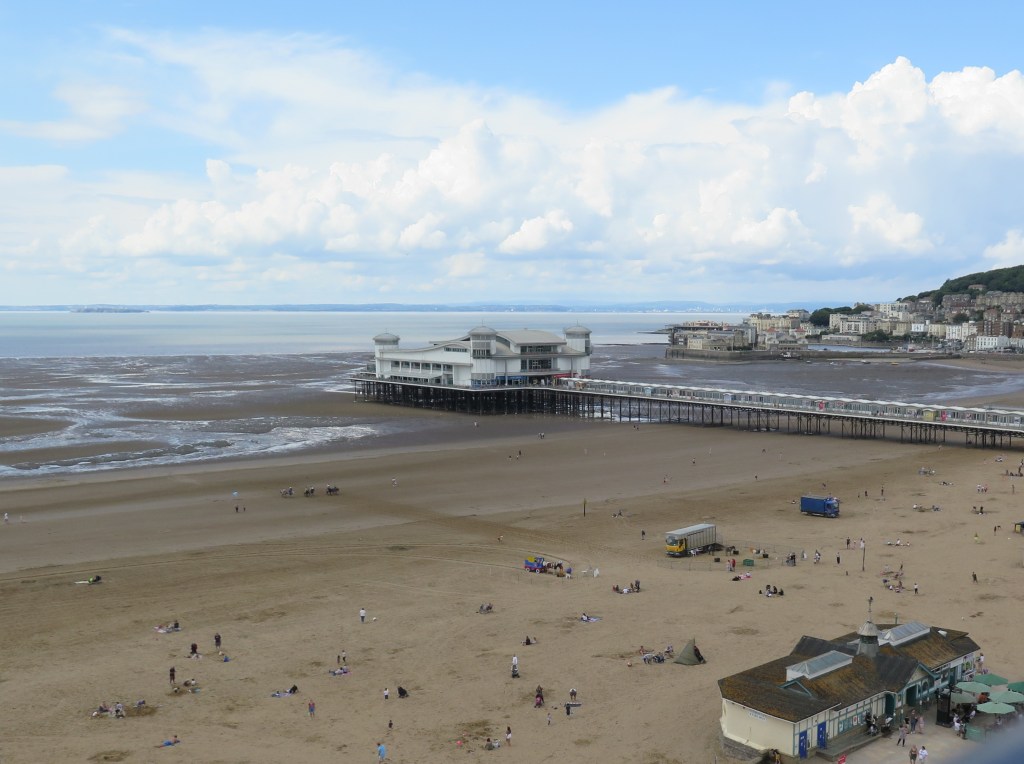
Weston-super-Mare beach and pier with the Welsh coast in the distance
It was good to spend the evening chatting over coffee, having a bit of a catch up. We like Weston, the photo shows the beach and the pier. In addition to those, notice the land on the horizon which is part of South Wales, the Bristol Channel which is very wide at this point, and the mud between the sea and the sand. The tidal range is enormous, exceeded only by the Bay of Fundy in North America, and the beach is gently shelving here so the tide goes out several miles. This photo shows Weston closer to high tide than low tide!
We brought our bags into the house and gave Paul the keys as we won’t be needing them and it would be good if he was able to move the car if a need arose.
We slept well, knowing we had a long journey in the morning. It would be the first day travelling north from Inverness.
What is the North Coast 500?
This name, often abbreviated to just NC500, is a famous touring route along the north coast of the mainland of Scotland. You can follow the route in either direction, starting from Inverness Castle. We chose the anti-clockwise version, making the fabulous Highlands scenery a grand finale to our journey.
Which part of a holiday is best in your view? Is it setting out on a new adventure, being away and exploring, or returning home?
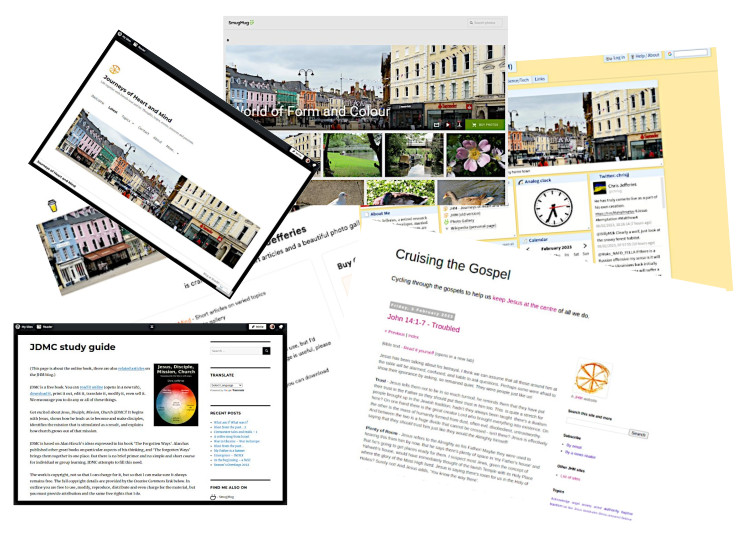
I sum these topics up on my Twitter profile as biology, web, science, technology, family, faith, history, and travel.
Having recently restarted blogging after a long pause, I’ve been thinking through how best to move forward – what should I change, what should I drop, and what should I keep?
Today’s post explains some of this, I’ll share what I’m doing and what I plan to do next. I’ll consider any comments you may leave, either here on the blog, or on Twitter or Facebook. But here’s how I see things right now.
Buy me a coffee
I’m offering everything I publish for free, but will always be delighted to receive a small gift, especially if you have sold or republished something (though even then it’s optional). Details are at coffee.scilla.org.uk .
Cruising the Gospel
This is a moribund blog that I’m in the process of restarting. I’m not sure yet whether to continue it in its present form, or to roll it into Journeys of Heart and Mind (JHM) as a topic in its own right. Currently I’m inclined to keep it as it is, and perhaps generate some PDFs from each book I complete. See it at gospel.scilla.org.uk .
Gateway
My Gateway site is mainly for my own use, but it’s full of links about Cirencester (my home town in England), local time and weather, some Christian links, local and national news, science and technology links and so forth. Some of you might like to take a peek. If so, head to gate.scilla.org.uk .
JDMC
JDMC stands for Jesus, Disciple, Mission, Church and is an introduction to Alan Hirsch’s Forgotten Ways. To learn more and download a copy to print (or read online), visit jdmc.scilla.org.uk . I need to update this booklet and plan to when I have time, unfortunately the web links in the PDF open OK, but using the browser to return take you back to the title page; I’ve been unable to fix this so far. If you open the links in a new tab you’ll be OK, but it’s easy to forget.
Journeys of Heart and mind
I intend to continue with this more or less as it stands. That means a mix of topics will appear here, articles about all of the things that motivate me as they occur to me (so in no particular order). I sum these topics up on my Twitter profile as biology, web, science, technology, family, faith, history, and travel. Others include photography, astronomy, spaceflight, archaeology and a few more. One thing I will add is a way of seeing just posts on one of these topics at a time, I think that will be useful; not everyone wants to see everything. You’re reading on this site at the moment.
Photos
I use Smugmug to display my photos and will continue with this, but I need to rearrange things in topic folders to make it more usable. Visit photos.scilla.org.uk to browse my all time favourites.
Twitter
My main Twitter account is ChrisJJ, but I have a second account, JHM. I haven’t used the JHM account for a long while, but might post tweets about faith topics there, and everything else on ChrisJJ. My mind is far from made up on this as there are quite a few pros and cons.
The stonework to turn doorways into windows suggests a change of use at some time after the building was first erected
This dilapidated, old building, of lovely Cotswold limestone (including the roof) stands inside Cirencester Park at the end of Barton Lane. It’s part of The Barton Farm, along with the ancient nearby dovecote and magnificent, old barn.
But what was its original purpose? If it could speak it would no doubt have an interesting tale to tell. What might it say?
A row of cottages
I was row of cottages, full of the sounds of children playing in the sunshine, chopping and stirring sounds from a kitchen table indoors, smoke rising into the air from my chimneys. How many families lived in me? How many were born here, lived and worked here, died here?
Stables
I was a row of stables, my partly built up doorways were once open and inside each one was a stall for a horse. Inside I would have smelled of horses, sweat, droppings, and in a room at the back I would have had the aroma of well cared-for leather – saddles, harness, heavy collars for pulling.
Storage shed
I was a place where valuable implements were stored and cared for. Oiled steel hoes, shovels, spades and rakes with well-worn wooden handles. An old plough, a harrow, scythes. Or perhaps I was used to store fruit from the orchard, and sacks of seed for sowing crops in winter or spring.
A base for farm workers
I was a bothy where the farm workers would gather to eat bread and cheese and perhaps a mug of cider. I’d be used for breakfast, a mid morning break, or a mug of hot tea on a cold afternoon, a shelter from heavy rain. Perhaps there was banter, silly tasks given to the youngest worker, ‘Go and fetch me the glass hammer from the big house, ask the Master for it – politely like’.
There are some clues
The stonework to turn doorways into windows suggests a change of use at some time after the building was first erected. There are two brick chimneys, so clearly there were regular fires. Maybe the far end was a dwelling while the right end was a workshop, or a smithy, or a place for basket-making, or laundry.
If you have other thoughts on what this place might once have been, or you live locally and know for sure, why not leave a comment?
The message from the New Testament seemed clear to me, there was supposed to be just one church, not a multiplicity of flavours brought about through a long series of historical disagreements and splits.
I was asked this question some time ago, and at first I felt that it somehow missed the point because I tend to feel that I never was an Anglican. But it’s true that in my mid to late teens I would have called myself Anglican – perhaps.
My parents were Anglicans in the limited sense that they were not Methodists, Baptists, Presbyterians, Salvation Army or anything else. Dad was quite dedicated, jotting brief prayers in his diary and during parts of his life often attending communion at the parish church. I doubt that he made a conscious decision on this, it was just taken for granted, it had been the family tradition as far back as anyone knew. Mum was different, she was used to village life in Northern Ireland and taught Sunday school at the tiny village church, a simple and plain structure. She was uncomfortable with anything remotely high church, but if you’d asked her what she was she might have said Anglican, or Church of Ireland, or just Christian.
I was Christened when I was little and was encouraged to read the Bible as a child, at home, but more so at junior school and later in RE lessons at secondary school. By the age of 13 I was familiar with the outline contents of the Old and New Testaments, and with many of the stories recorded there. In my teens I was expected to attend confirmation classes and went along out of obedience rather than a desire to be there. In due course I was confirmed, though it didn’t mean much to me and life continued as before. I had not yet begun to grapple with what I did and did not believe.
As I went through the processes of sitting my O levels and A levels and applying for a place at university, I began to form my own ideas about faith. For a time I rejected faith of any kind, thinking that science would eventually explain everything. Yet I was intrigued by the Bible and began to take what I read there quite seriously. And I didn’t see much there to support Anglicanism or, indeed, denominations of any kind. The message from the New Testament seemed clear to me, there was supposed to be just one church, not a multiplicity of flavours brought about through a long series of historical disagreements and splits. And what about the many stories of healings, and the parables about how we should live, and the Pauline teachings about gifts of the Spirit, and the letters to churches in the Greek world of the time? I was taking all of this seriously, but saw little evidence that the denominations were doing the same. I explored more widely, visiting the Jehovah’s Witnesses, signing up for a Christadelphian magazine, reading books about the Mormons and Christian Science, but none of these avenues seemed to make much sense to me.
After graduating from university, getting married, and starting full time jobs, Judy and I spent our Sundays in Bristol doing some serious denominational exploration. We went to Sunday services at every church we could find, and never once had a sense of, ‘This is the one!’. We were searching, but not finding.
Zetland Evangelical Church in 2002
In the end, in utter desperation, we tried a weird place just down the road from our flat. In some ways it seemed more odd than any of the other places we’d tried. It had a large sign above the door in blue and gold reading ‘God is Love’, and didn’t look like a church building, more like a large house. This was Zetland Evangelical Church in Bristol, near the railway arches over the Cheltenham Road. We found to our surprise that we were instantly at home! The people there wanted to talk with us, and they shared some of our own thoughts about what we’d been reading in the Bible. We felt welcomed – as if by a large family. We’d found a real community, which is what we’d long hoped for. Not only that, when I went to a mid-week evening meeting I was blown away by teaching about David, perhaps from 2 Samuel, and a section I was familiar with. The fresh insights and explanations were very striking, here were people who knew their topic – and it all made perfect sense.
We still felt there was more, and we were joining one of those denominational ‘splinter groups’ that so perplexed us. But this was by far the best thing yet. At this point in our lives we would not have settled for Anglican or any other church tradition. We were particularly encouraged by the fact that there was no hierarchy at Zetland, there was no single leader, we were all equal, or so it appeared. There was no liturgy, no pastor, and once a month there was a delightful Sunday morning Open Meeting with nobody at the front and where all could contribute a prayer, a hymn, or some teaching. All, that is, except women and children. This was one of several niggling issues that we put to the back of our minds for the time being.
Eventually we discovered much more – but that’s another story.
Explanatory note – Please don’t think that I’m judging or disapproving of denominations and those who are involved with them. In this short article I’m describing how a much younger Chris Jefferies understood things. I have many non-denominational friends, but also friends from New Frontiers, Anglican, and particularly Baptist traditions. Particularly Baptist simply because at the time of writing I take part in a small home group that meets weekly and is part of Cirencester Baptist Church. I’m not a Baptist, I will not (cannot) become a church member. We are all part of one family, the family of those who follow Jesus. We are all brothers and sisters and we have individual perspectives and expressions of what that means. I honour and love each one as part of an undivided whole.
It’s good to be out and about to see it all and just as good to get back to a warm house.
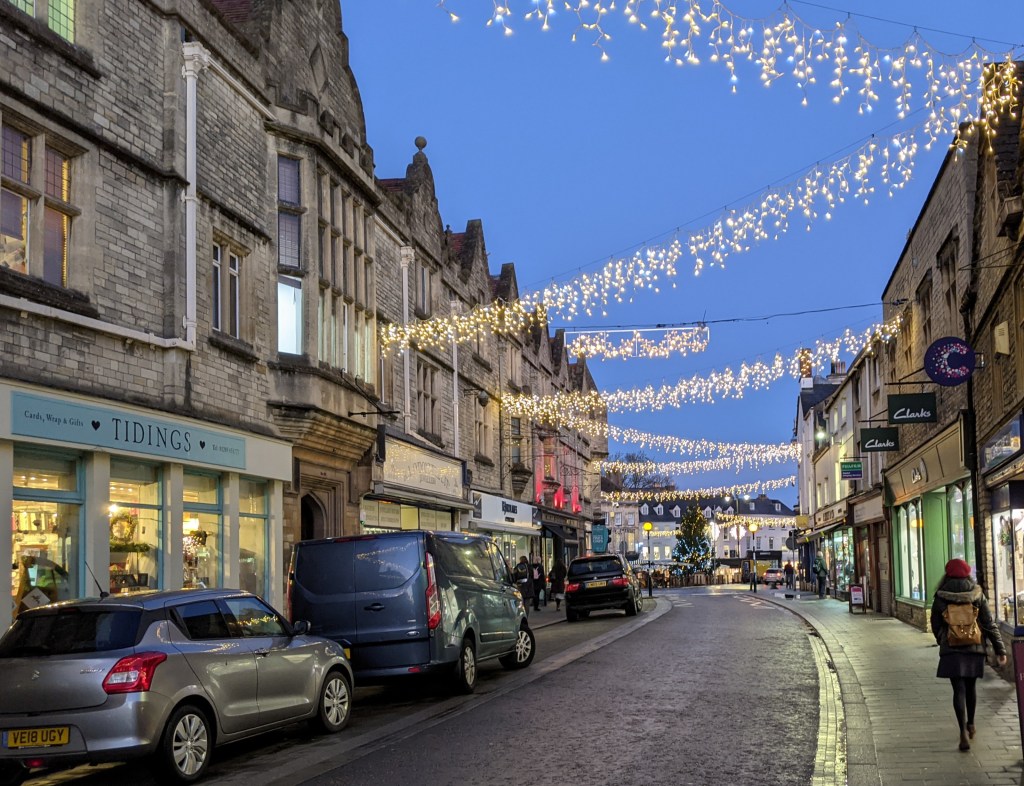
Castle Street in Cirencester
Season’s greetings to all my readers! Cirencester is showing off its tasteful street decorations once again, the days are short, the nights are long, and it’s good to be out and about to see it all and just as good to get back to a warm house afterwards.
My thoughts are especially with those who have no warm house to come back to this year, there are so many – the homeless sleeping alone in shop doorways, refugees desperately crossing the sea and hoping for asylum, and people who do have a roof over their heads but lack money for presents for the children or depend on food banks for their next meal.
Life can be wonderful, fun, exciting. It can also be tough, exhausting, and depressing. Whoever you are, whatever your circumstances, my prayer and hope is that people will be kind to you, there will be new opportunities in your life, and that there’ll be reasons to hope and overcome the difficulties.
And if your life is comfortable and you have more than enough, my prayer and hope is that you will be kind to others, search out new opportunities for them, and provide reasons for hope and ways to overcome difficulties.
None of us can solve all of the problems; but all of us can solve some of the problems.
This was the family business, founded in 1795. It prospered for many years, growing and selling nursery stock to other businesses, the government, and to the general public. It ceased trading in 1984 and the garden centre business was sold to Country Gardens PLC, although the company was not officially dissolved until 1994.
Friends are important, we humans are fundamentally social beings
At my sister’s recent book launch, I was delighted to meet an old friend from school days, Nick Henderson. Although he looks older – as, of course, I do too – his personality is entirely as I remember from the mid 1960s. We agreed to meet again this morning at the Golden Cross in Cirencester, and it was a delight.
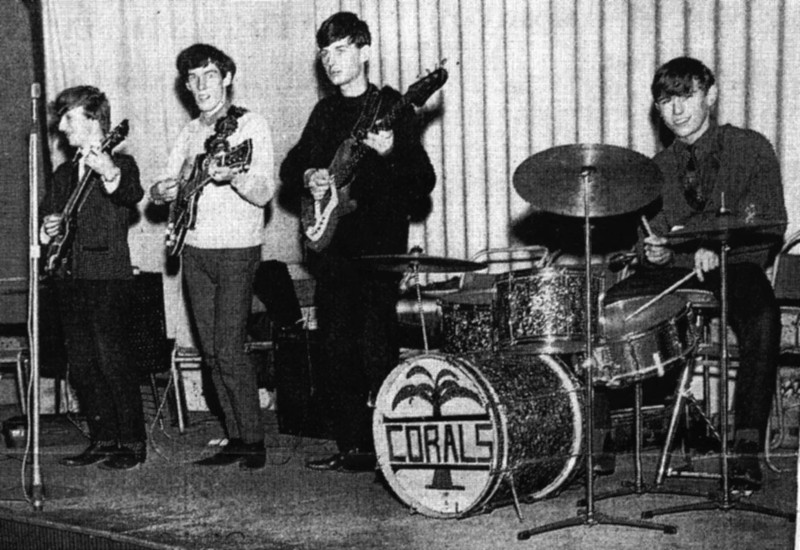
Nick and I last met when we were both living at home and very probably still at school. For a year or two we used to hang out quite a bit. I remember going with Nick to see a local band called The Corals during a record-breaking attempt at playing non-stop without repeating any songs; the drummer, one Colin Flooks, another lad from our school year, later became famous as Cozy Powell. And yes, they did break that record – in fact they smashed it by playing for 11½ hours.
The Corals during their record-breaking session, photo from The Wilts and Glos.
Nick and I talked about many things, catching up on our personal journeys over the last half century, recalling the cross-country runs that were compulsory on Wednesday afternoons at school, and thinking about Daglingworth Brook, the River Churn and how the water is channelled in and around the town. The drainage courses have changed over the years, altered for many reasons, beginning in Roman times when the town was young, and continuing right down to the present.
Friends are important, we humans are fundamentally social beings; renewing a connection after such a long gap has been a very special thing for me. More so than I had expected or imagined.
The centre of Cirencester has buildings of a variety of ages, from the Roman City Wall (a small part of which is visible in the Abbey Park) to Victorian and more recent constructions. Walking in the town with my camera today, I took some shots of a 19th century development.
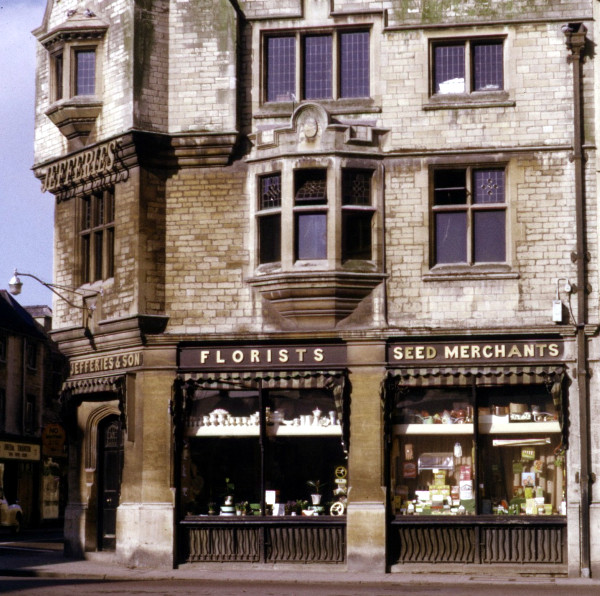
These are the upper floors of a three-storey terrace, a planned development that replaced older properties. The section at the right hand end was used as a florist’s shop for many decades (now Vodafone). I remember it as a child because my father was one of four brothers who owned and ran the shop as part of a larger business with several plant nurseries in the country areas around the town.
The shop had a wonderful cellar, always full of mysterious packages of garden chemicals and other shop stock, and before Christmas there were sometimes hyacinth bulbs being forced for early flowering. There was a marvellous fusty, moist, florist’s aroma in the cellar, but the most exciting thing was the knowledge that the cellar was bigger than the shop floor above. Castle Street was widened when the new development was built, but the cellars of the old buildings were retained. There are stone pillars in the cellar that support the heavy masonry above.
Here’s another view of the same shop from a different angle, the photo was taken by my father in the 1960s. I love the fact that this image includes the shop window displays as these always fascinated me as a young child. I also remember that my grandfather’s office window was above the main door on the corner, and the landscape design office was on the top floor with the small bay window.
And finally, for comparison, here’s another view of the same shop today.







 Journeys of Heart and Mind

