He’s the alpha and omega, first and last, top and bottom; the church begins in him and ends in him. He saves us and now supports us but he also commands us; we are complete in him, but without him we are – nothing.
In the last part, we looked at the foundations of church, and the purpose of those foundations. We paid some attention to Paul’s teaching about Christ himself being the only possible and dependable foundation, this time we’ll look at some alternatives that have been tried over the last couple of thousand years, and why they haven’t worked.
Two thousand years ago
It’s worth noting, in passing, that although we don’t have precise dates, it’s now almost exactly 2000 years since Jesus began calling his first disciples from among the families of fishermen along the shores of Galilee. 2028, 2029 and 2030 will likely be 2000 years since he was walking in Galilee or Judea with his twelve closest followers, healing the sick, teaching the crowds, and dining with tax collectors or pharisees. What a thought!
Six months ago I wrote about the apostolic gift and how one of the main tasks and gifts of an apostle is to go out into the world to tell people about Jesus, explain his nature and character, call them to follow him, and show them how to meet together as a church and how to relate to church in other places. It’s a call to create networks of people following Jesus and communicating from group to group within the network. The foundation and the building standing on it are intimately connected; the church is structurally and functionally part of Christ.
Other possible foundations?
Paul tells us Christ is the only possible foundation, so the foundation can’t be anything that’s not a person. it cannot be faith, for example. it can’t be the bible. it can’t be doctrine, or teaching. Jesus himself is the way, the truth and the life, so these are also attributes of the foundation and therefore of church. Yet faith, doctrine and teaching have often been regarded as foundational. Well, they are not.
Nor can we regard praise or worship or prayer as the foundations of church. they are essential parts of what church does, but they don’t sustain us or provide us with any sort of support. No kind of activity can replace Christ, not bible reading or study, not the apostolic gift, not prophecy, not mission, not the work of a shepherd or of a teacher. All of these are useful, indeed I’d say essential, but they are not the foundation of church, merely useful outcomes and practices that will be found to be present wherever church is standing solidly on Christ.
Love, faith, and hope remain, so these are the only plausible candidates. but the greatest of these is love. Of these, only one is a person. We are told ‘God is love’. But Jesus and the father are one. Jesus said, ‘If you’ve seen me, you’ve seen the father’. so Jesus is the foundation, or Papa is, take your pick. Or the spirit is the foundation because he’s the spirit of Christ. Build on any other foundation at your peril! Anything else is merely shifting sand, not solid, reliable, load-bearing rock.
Think also about the foundation stone, the cornerstone. having laid a foundation first, the corner stone is large, heavy and sets the position and direction of all the other stones or bricks. all of these must sit centrally on the foundation, anything that veers off line will not be supported properly and will fail eventually. The cornerstone marks the position of the corner itself and the direction of two of the sides. It remains visible when the foundations themselves become hidden underground. And the cornerstone may have a carved inscription saying when it was laid and by whom. What are the words on the cornerstone of the church? Probably they would be along the lines of:
This stone was laid at the death and resurrection of Yahshua ha-Mashiach*. It stands upon the corner of the foundation and is the first visible evidence of the church being built from the living stones of his people. It will stand for all time.
*Yahshua ha-Mashiach, usually written Jeshua ha-Mashiach is Hebrew and translates into English as Jesus the Messiah or Jesus Christ or Jesus the Anointed One. The names Yahoshua (Hebrew) or Jeshua (Aramaic) literally mean Yahweh saves or Jehovah saves. Jesus is far more than just the foundation, he’s also the head of the body, head of the church. He’s the alpha and omega, first and last, top and bottom; the church begins in him and ends in him. He saves us and now supports us but he also commands us; we are complete in him, but without him we are – nothing.
Over the two millennia since Jesus’ time in a human body, church has repeatedly turned away from him and attempted to stand on almost anything else. How he must long for us to stop doing that!
Nor is church built on leadership of any kind other than that of Jesus himself. Yes, there have been great leaders in church history, but they have always pointed to Christ first and last; there is no room for emperors or kings, no need for governors or great statesmen.
Truly, as Paul taught, there is only one possible foundation – Jesus the anointed one. The only person who has ever been fully human yet at the same time also fully God.
Please note, I am not suggesting that Bible study or the gift of evangelist or various kinds of leaders are not useful, or unhelpful or wrong; I’m simply arguing that they are not in themselves foundational. If we use these things as foundations, the structure of church will crumble and everything we build will fall. And that is precisely as it ought to be.
Chain blog or a series?
I’m still hoping other writers will join me here in sharing their thoughts on What does Jesus mean to me and how do I respond to him? This is my third contribution and I’m not sure what to do for the best. Perhaps I’ll invite a further batch of possible contributors, perhaps I’ll also spin off my three contributions as a series on the topic Church foundations or something similar. Meanwhile don’t be shy, read the chain blog instructions and just start writing. You’ll help me out enormously! Thanks.
If you enjoyed this or found it useful, please like, comment, and share below. (If you don’t see those links, click the article’s title above the main photo and they will appear.) Send a link to friends who might enjoy the article or benefit from it – Thanks! My material is free to reuse (see conditions), but a coffee is always welcome and encourages me to write more often!
I’m only one person, so my effort will have very little effect. If everyone in the UK, Europe, Canada, Australia, New Zealand and so forth took down their signs in the same way it would have a huge impact, a major, staggering effect.
What’s in an image? Sometimes quite a lot, more than meets the eye. I’m posting an image every few days.
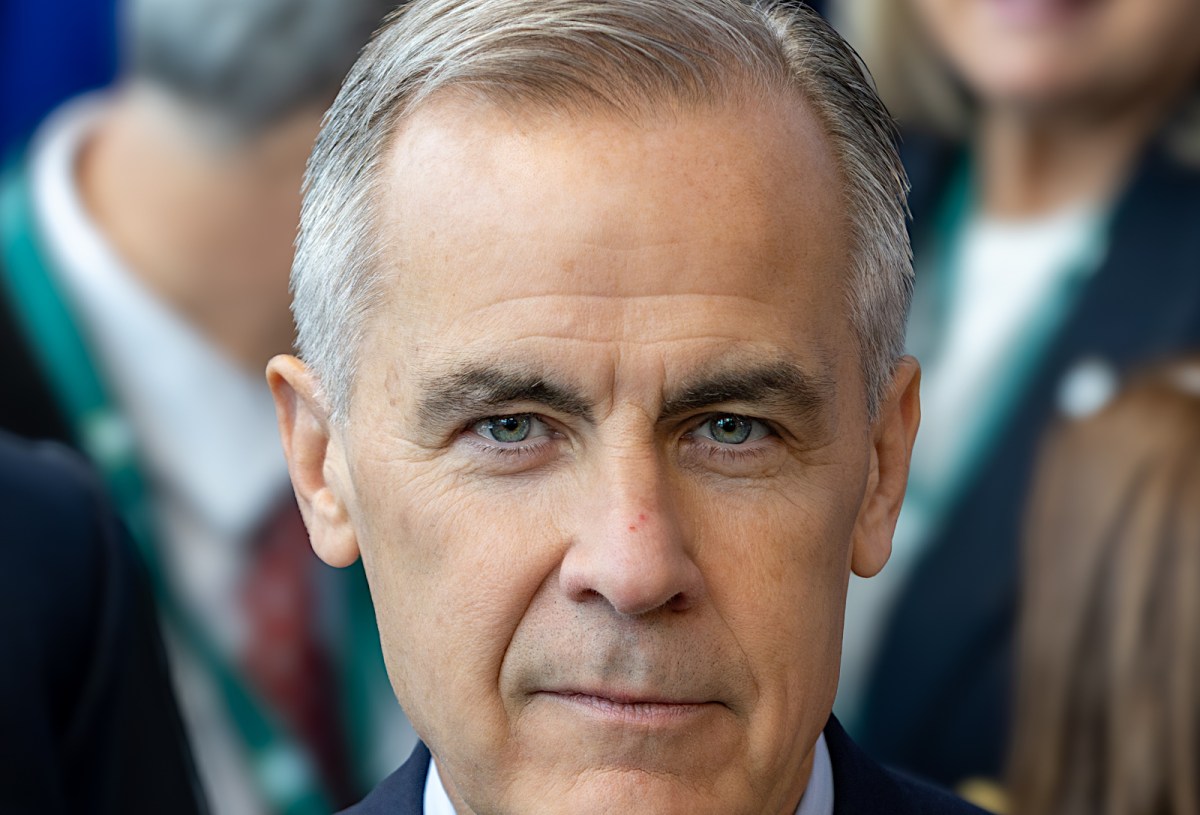
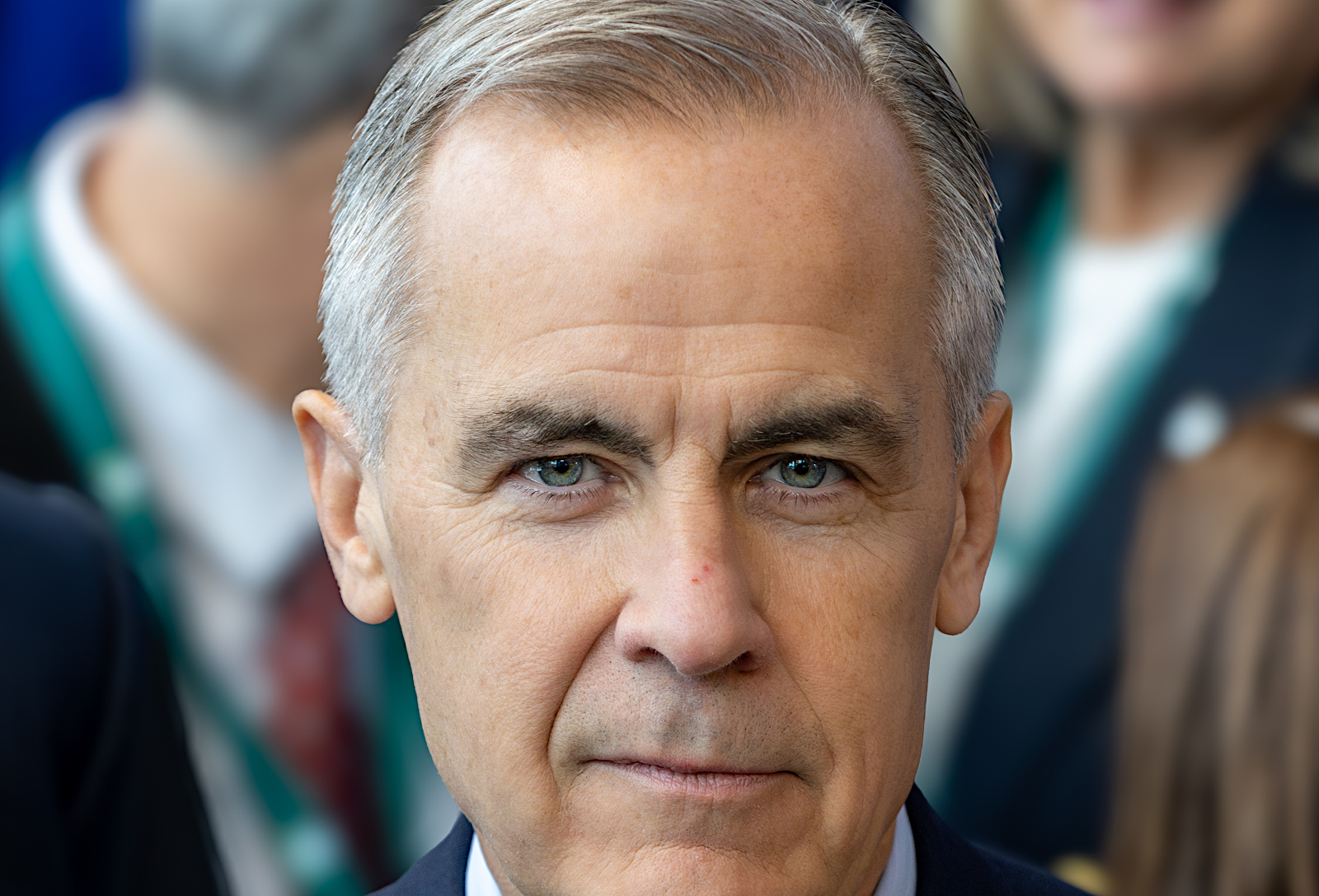
Mark Carney (click images to enlarge)
This is Mark Carney, Prime Minister of Canada and a bit of a hero of mine. Why? Because he stood firm in the face of some dreadful threats and actions from one Donald Trump (not a hero and unlikely to get his image on Journeys of Heart and Mind).
Mark Carney spoke eloquently and with composure and dignity when he addressed the Davos meeting on 20th January. During his speech he mentioned Václav Havel’s essay, The power of the powerless, about the notice in the greengrocer’s shop window. Hear the story in the video below, starting at just 49 seconds in.
This story inspired me greatly, as did Carney’s entire speech. If you have not yet heard it – I encourage you to watch the whole thing at your earliest opportunity! I wondered what I could do as an individual to ‘take the sign out of my window. Very little it seems… unless…
I began to see that there is something I can do, I could try to start a movement and here’s how that would work.
From now on, and until Donald Trump leaves the White House and the USA becomes a rational actor again, I’m taking down my sign. I’m going to make a strong effort to avoid buying goods or services from the USA.
I’m only one person, so my effort will have very little effect. If everyone in the UK, Europe, Canada, Australia, New Zealand and so forth took down their signs in the same way it would have a huge impact, a major, staggering effect. In a sense this has already started, US tourism from Britain and around the world has been collapsing. Flights to the USA are down, beaches in Florida are emptying, people are choosing other destinations as safer and less prone to border difficulties and excessive checks on passports and visas.
Hint: Go to the Google search prompt and type in ‘US tourism trends’. If you’re a US citizen the results make grim reading, with phrases like ‘sharp decline in international arrivals’.
Some people will follow me in a shopping ban, some will not, and the overall effect will be somewhere between negligible and catastrophic. Working together we will have an effect on the profitability of American businesses and the knock-on effects will reach citizens, politicians, decision makers and more.
This won’t affect my secondhand purchases, if I want a phone replacement I’ll choose a locally reconditioned one. Manufacturer’s profits come mainly from the sales of new items, not from second or third owners.
So I’m putting the USA on notice, I’m taking down my sign. Who is with me on this? Take down your sign too, either in this way or in some alternative way of your own devising. I’m not going to take the lies and tantrums any longer, I’m responding to the bully-boy tactics in my own way.
I will do my little bit quietly, peacefully, from now until I believe I can support the USA again as a friend and ally and a nation that is governed well and acts reasonably towards its friends and neighbours.
I’ll be making an exception wherever possible for US states like California, and others with a Democrat Governer or local Democrat state policies.
So no ban on California companies, but I will not buy goods or services from Texas at any price. Hard luck Starlink!
For this to work I need you, my readers to do two simple things:
Stop buying US goods and services, if possible pay special attention to anything from Republican states.
Spread the word
Let’s make this viral – send links to this article to friends and family, share the QR code, print copies off and leave them in public places, deliver them to your neighbours. Send copies to local (and national) newspapers. Just how far it can go? But do be responsible, don’t create unnecessary litter, don’t waste paper, target people wisely, politely and carefully.
And of course you don’t have to be British to take action, to all Europeans, Canadians, and other concerned individuals around the world, you are free to join in. It’s a case of the more the merrier. A lot of tiny actions can build up to something highly significant and impossible to ignore. Coffee shops don’t succeed by selling at high prices, they depend on getting large numbers of customers through the door. So come in, smell the coffee, and make a small but important difference. Just don’t buy your coffee from (or in) the USA!
I don’t hate US citizens, I have friends and relatives there. But nor do I like political pressure from the USA. It’s time to push back.
If you enjoyed this or found it useful, please like, comment, and share below. (If you don’t see those links, click the article’s title above the main photo and they will appear.) Send a link to friends who might enjoy the article or benefit from it – Thanks! My material is free to reuse (see conditions), but a coffee is always welcome and encourages me to write more often!
In the process of standing on Christ we will see a revelation of who we are, because who we are matters far more than we sometimes think … There are no ifs and buts here. We live because he lives, we love because he first loved us.
My previous post was intended to be the first part of a chain blog, but also sparked off this new series. Six months ago I wrote about the apostolic gift and how one of the main giftings of an apostle was to go out into the world to tell people about Jesus, teach them about his nature and character, call them to follow Jesus, and show them how to meet together as a church and how to relate to church in other places. It’s a call to create networks of people following Jesus and communicating from group to group within the network. Paul is one of the finest examples we have of an apostle at work in this way, but the best example of all is, of course, Jesus himself. He travelled much further than Paul to start his building work. He came all the way from sitting beside his Father in heaven, to call, teach and eventually die here on this little planet called Earth. Then he returned in order to send his spirit, his Holy Spirit, back here to be with his followers. The Holy Spirit began working in and through the disciples in Jerusalem, and a little later made himself known to Paul as he was travelling to Damascus. He called Paul as an apostle to go on spreading the message about Jesus further and further around the Mediterranean.
Paul not only took out the message about Jesus, he also understood much about being an apostle and how apostolic people are all called to continue this work. And Paul also understood a lot more about church life and the gifts of prophet, evangelist, shepherd and teacher and how these different giftings work together. He also understood clearly that the first part of building something involves foundations. A lot of his letters are about this work of church building, guiding people in the difficult work of getting along together, discovering their giftings, and allowing the Holy Spirit to draw them deeper and further in works of service. All of this was important then – but it’s just as important today in the places we live our lives.
I want to look at this process in much more detail. We are not Jesus, we are not even Paul, is this something we dare to attempt? Is there any chance of success for you or me if we’re called to embark on this process? If you are called to reveal people to Christ, then yes, there’s every chance of success, if you are called to some other ministry gift then you’d be barking up the wrong tree! We must all do whatever we are called to do. But there is not one single Christian alive today who has no work to do and not a single one of us lacking the gifting with which to do it. Unfortunately, because of the way we tend to build church today, we rarely think about foundations and it’s not hard to find people who do not feel or act as if they have work to do and the gifting necessary to accomplish it. For such people, church may feel like a social group, a place for study, or a weekly sing-along. But it’s not supposed to be like that. It is supposed to be a building site where something very special is being raised up on an even more special foundation. It should be a place busy with cement mixers, cranes for heavy lifting, and skilled workers well practised in all the necessary skills.
I might come back to the topic of callings and giftings later, but I feel I should address the idea of foundations first, so the rest of this post will be devoted to that topic. So what is a foundation for?
The purpose of foundations
When we talk about foundations, we are talking about digging holes in the ground and filling them with somethig solid and capable of bearing a heavy load without shifting or giving way.
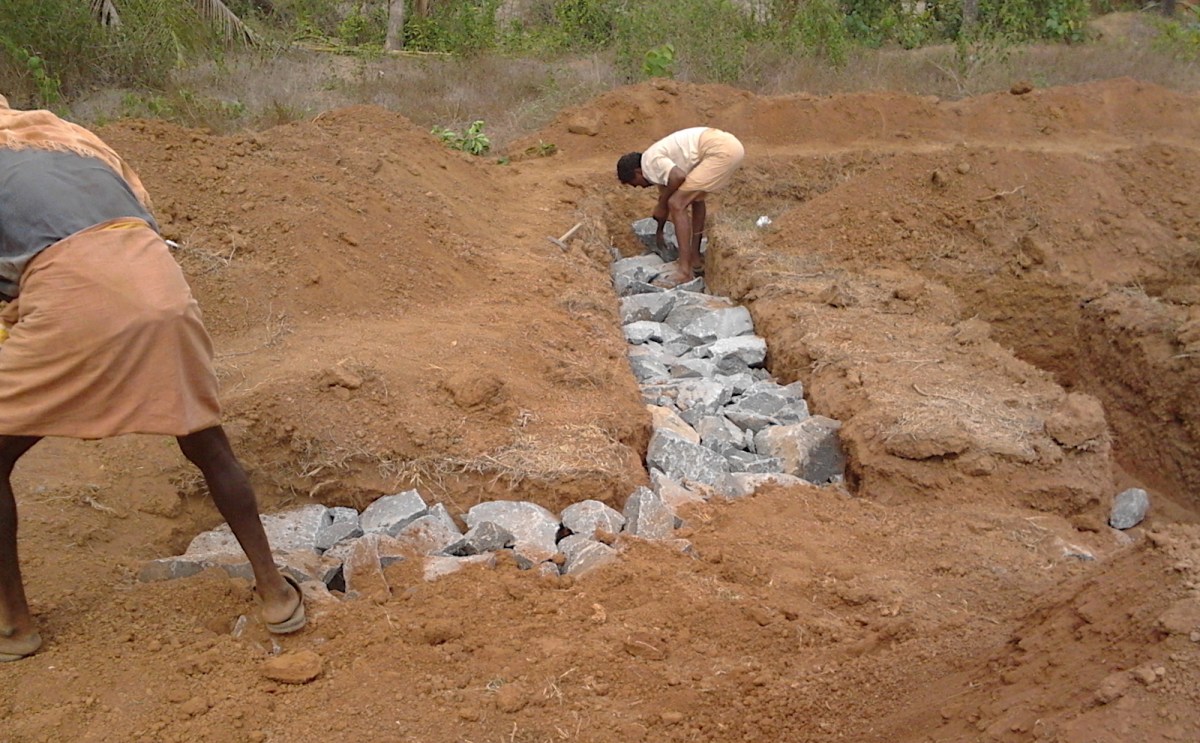
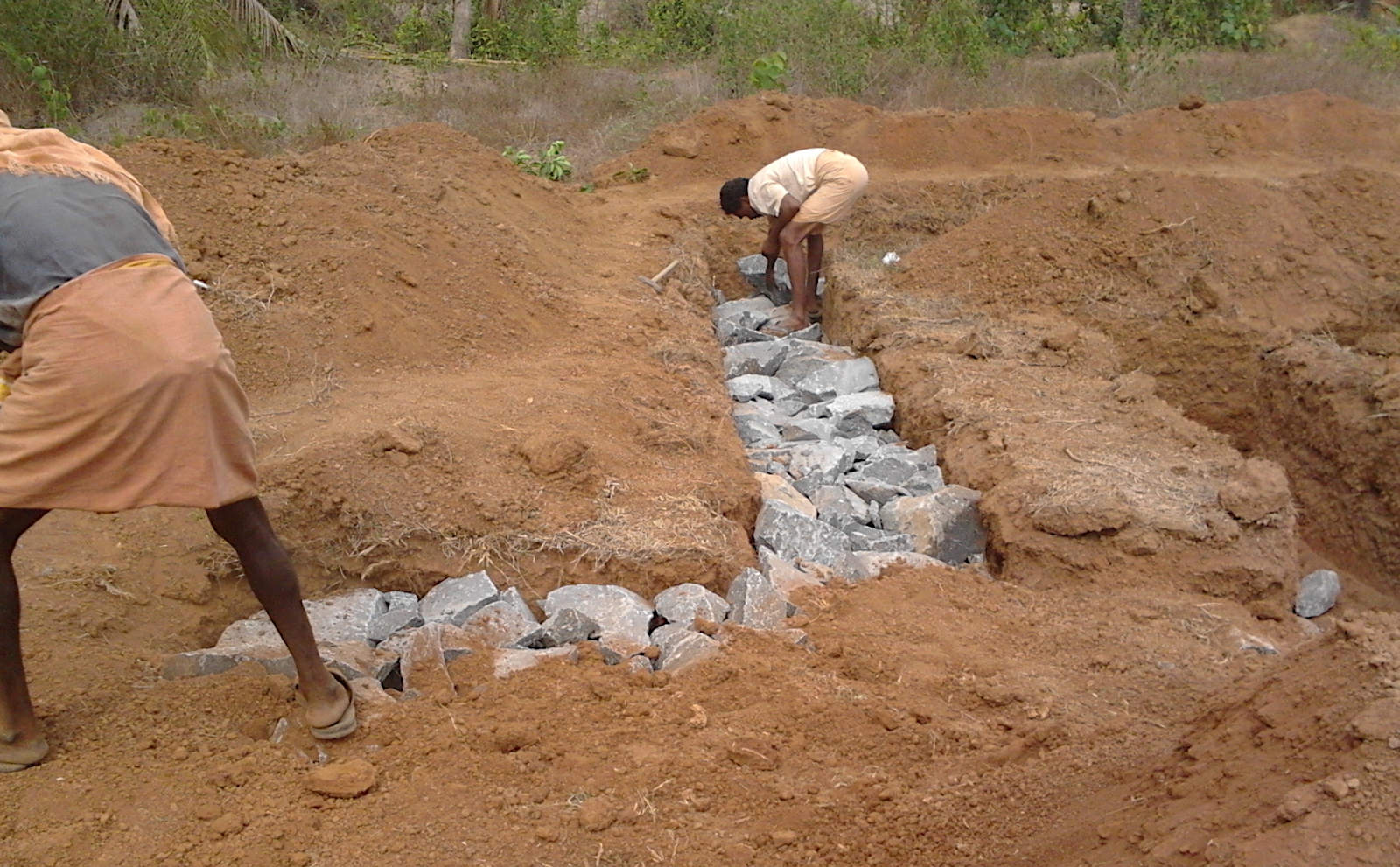
Modern foundations are dug by a powered excavator and filled with freshly mixed concrete. But in Roman times, the trenches were dug by hand and for massive structures like temples and amphitheatres large blocks of stone were placed in the trench to support the structure that would be built on top. For smaller houses and shops, rubble foundations would suffice (like those in the photo). The foundation stones were normally larger than the stones that would be used for the building as it rose above the ground surface. It wasn’t much of an issue if the walls were built of smaller material, but if the foundation layer shifted during or after construction the building might collapse. A foundation needs to be seriously strong, deep and firm – unyielding.
There’s an old hymn that I remember from childhood, it was sometimes used during school assembly, but was also used on Sunday services at church. Here’s the first verse.
The church's one foundation
Is Jesus Christ her Lord;
She is his new creation
By water and the Word:
From heav'n he came and sought her
To be his holy bride;
With his own blood he bought her,
And for her life he died.
You can hear this grand old hymn sung with all the words on YouTube if you wish:
The first two lines are straight from Paul.
In 1 Corinthians 3:10-11 he tells us clearly that the only foundation is Jesus and in verses 12 to 14 he warns us to use only the best materials if we are called to build. The build quality will be tested by fire. And in verses 16 and 17 he says we ourselves are Yahweh’s Temple, a holy place. Another way to put this is that we ourselves are the church, it’s not a structure of mere bricks, but a structure of living stones – his people. We are bonded together like the stonework of any strong building and we stand together on the strong foundation of Christ himself. Read the whole chapter (it’s quite short), try to apply what Paul is saying to your own life, imagine sitting down with him over a coffee and discussing it.
We are to be built up together in love for we are to be like Jesus who is in turn like the Father. What is the substance of the church? It is love. the Father is love at its source, at its root. Jesus is love sent from heaven and expressed in his life. Read any of the gospels and you’ll find him loving his followers and the crowds who gathered in very real and practical ways. We are to continue his work, building in love, loving one another and loving the other people around us in this world. Nothing else matters more than this!
Another way of saying that we are living stones would be to say we are loving stones. We should be fervent lovers of Papa, of Jesus, of one another, of the worldly people around us, and even fervent lovers of our enemies. That is the only way of sharing Jesus; to be taken seriously we must be like him in every way. I, you, we, must all become accurate impersonators of Jesus. If we have no love, we have…nothing!
Until we begin living this new life we’ve been granted, loving everyone we meet, we’ll remain failed imitators of Christ and church will remain just an inorganic structure – rigid, cold, hard, unyielding and utterly unattractive to people in our communities who need to be loved. So let’s get to it! What are we waiting for?
But remember, it starts with the foundation of a loving Saviour, Jesus himself. Let’s stand on him, feel his love for us individually and together, and share his love for the confused, the unloved and the unlovable. Then, and only then, will we begin to see real growth. This will be growth of our own character, growth of the living stones around us, and growth of the church as others are drawn in by a love they have never previously seen or expected.
Do you see why foundations are so important? We become like the foundation we stand upon. If we don’t stand on Jesus we cannot expect to stand at all. In the process of standing on Christ we will see a revelation of who we are, because who we are matters far more than we sometimes think. If you’re a chip off the block of Jesus you’ll find yourself loving as he loves, building as he builds, dying as he died, yet living eternally as he lives. There are no ifs and buts here. We live because he lives, we love because he first loved us.
Who are you? Who am I? We are little pieces of him – that’s what ‘Christian’ means; it was a derogatory term applied to followers of Christ by the Greek and Roman pagans in the early years of the church. We are ‘little Christs’, no more, no less. This is our future, our inheritance, to be like the Master. Everything else comes out of who I am, who you are.
If you enjoyed this or found it useful, please like, comment, and share below. (If you don’t see those links, click the article’s title above the main photo and they will appear.) Send a link to friends who might enjoy the article or benefit from it – Thanks! My material is free to reuse (see conditions), but a coffee is always welcome and encourages me to write more often!
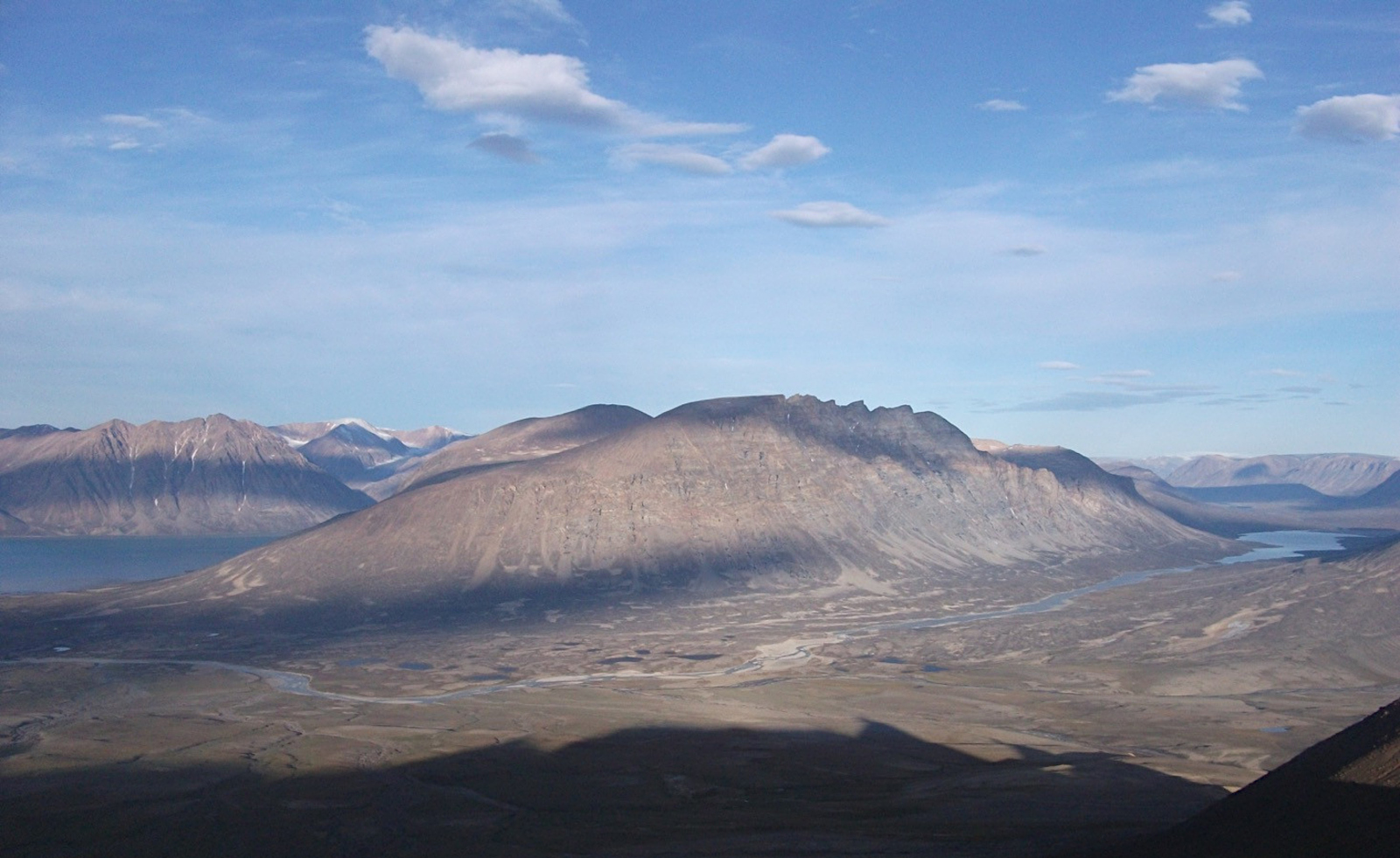
The photo shows a valley in Greenland, a valley is a low point, but Trump’s arrogant rudeness was another kind of low-point, and his falsifications were low-points as well.
What’s in an image? Sometimes quite a lot, more than meets the eye. I’m posting an image every few days.
Greenland (click images to enlarge)
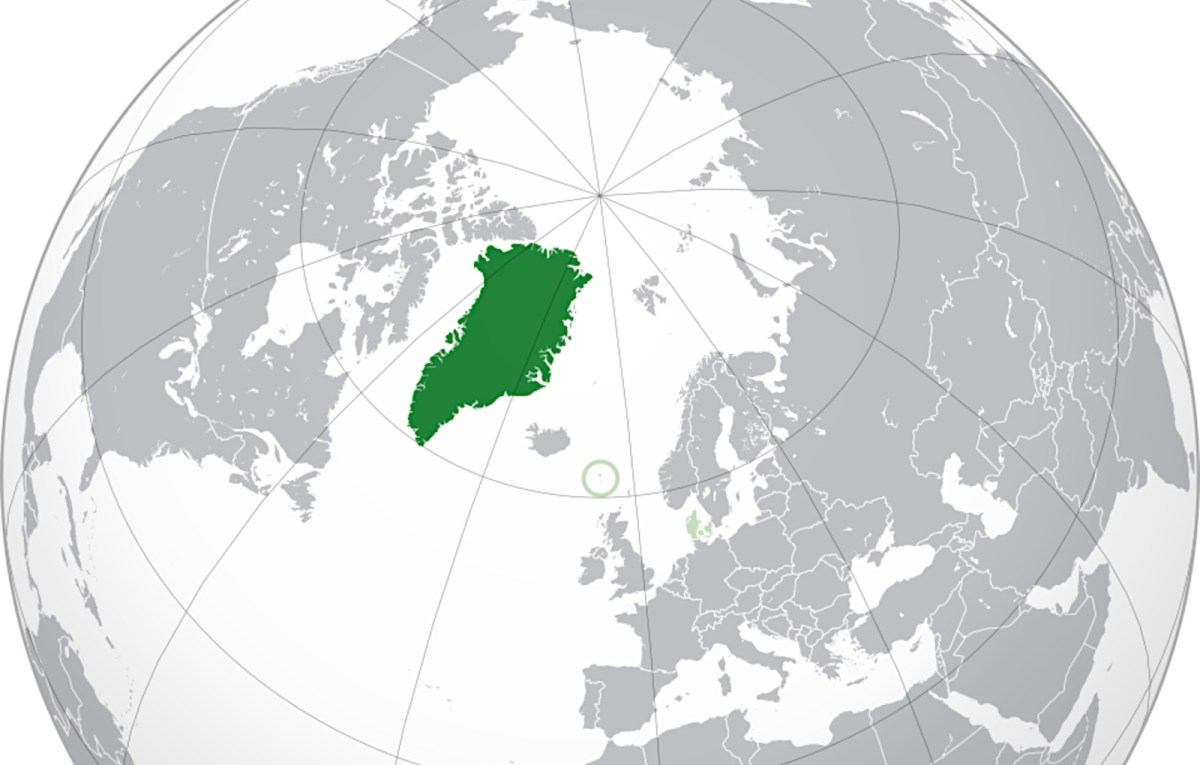
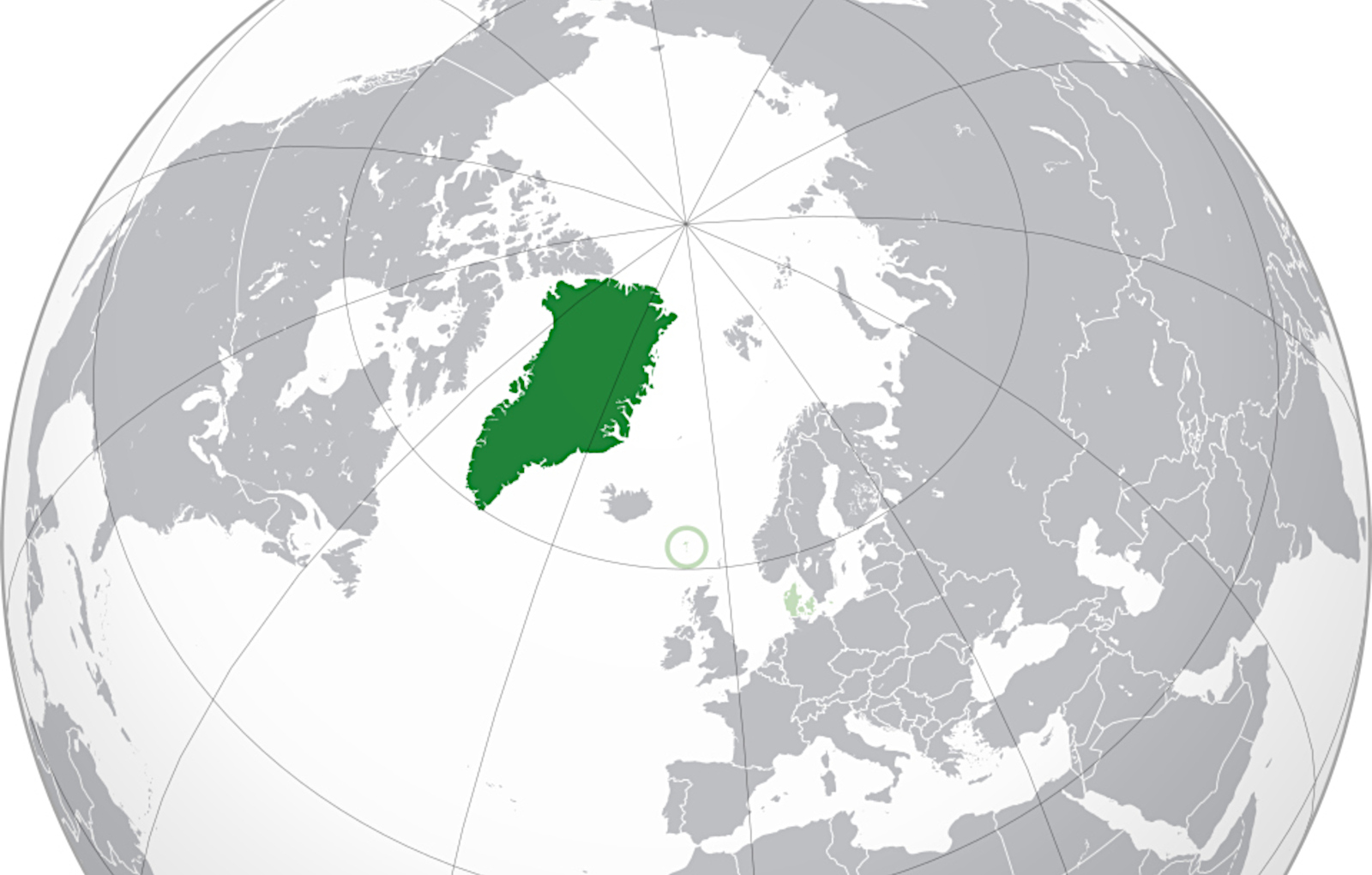
A huge rumpus has developed over Mr Trump’s fixation on owning Greenland. I’ve never been to Greenland, but I’ve seen many photos and read accounts by people who have visited or who live there. It’s a large island with hospitable inhabitants but a very inhospitable climate, mostly covered by an ice cap up to 3 km (2 miles) deep, and peopled by a rich mix of the hardy Inuit natives of the land and Danes. The photo shows a valley in Greenland, a valley is a low point, but Trump’s arrogant rudeness was another kind of low-point, and his falsifications were low-points as well.
The rumpus continued until Trump backed down, but in his Davos address and press conference Trump said many things that did not ring true in my ears and mind so I wanted to see a fact-check.
What follows was not written by me. It’s Chat GPT’s response to my request for the AI to read the transcript, fact-check the claims, and draft a 1000-word essay for me. I planned to edit it into a finished article to publish here, but I decided instead to publish the draft as is.
Read it below: ChatGPT as a guest author on my blog.
Here’s my request to ChatGPT:
Please examine President Trump’s Davos press conference, fact check his claims and draft a 1000 word essay based on your findings.
Feel free to put this prompt into an AI of your choosing, the output will vary between AIs and may change over time as well.
Fact-Checking President Trump’s Davos Speech and Press Conference
Introduction
In January 2026, U.S. President Donald Trump delivered a highly anticipated speech at the World Economic Forum (WEF) in Davos, Switzerland, and later faced questions at a press conference. His address was notable not only for its bold proclamation of U.S. ambitions — especially regarding Greenland — but also for a wide array of controversial and, in many cases, misleading or incorrect claims about international relations, economics, and domestic policy. This essay examines the context of the speech, fact-checks key assertions, and evaluates the broader implications of the rhetoric deployed.
A Controversial Theme: Greenland and U.S. Expansionism
Perhaps the most eye-catching aspect of Trump’s Davos address was his discussion of Greenland, the vast Arctic island that is an autonomous territory of Denmark. Trump reiterated his desire for the United States to acquire Greenland, labeling it “critical” to U.S. and NATO security. He also — for the first time in this campaign — publicly pledged not to use military force to obtain it. – Time
However, this position was controversial for multiple reasons:
International Law and Sovereignty: Greenland is part of the Kingdom of Denmark; any transfer of sovereignty must be voluntary and negotiated. Danish leaders have consistently rejected selling or ceding control of the territory. – AP
Misrepresentation of Defense History: Trump implied that the U.S. “gave Greenland back” after World War II. In reality, the U.S. military presence in Greenland was based on agreements that affirmed Denmark’s sovereignty over the island while allowing the U.S. strategic access — but Greenland was not “returned” in the sense of ending U.S. ownership, because it was never wholly U.S. territory. – MediaITE
Strategic Importance vs. Imperialism: Trump’s framing of Greenland as a necessary bulwark against global threats was criticized as overly nationalistic and potentially destabilizing for NATO unity. European leaders stressed sovereignty and peaceful cooperation. – Guardian
Although Trump’s explicit rejection of military force was welcomed by markets and some commentators, the overall push was seen as a diplomatic provocation rather than constructive strategy. – Time
Misleading and False Claims
Beyond Greenland, Trump’s remarks included a number of statements that were factually inaccurate or misleading. Fact-checkers from multiple outlets documented significant issues:
1. NATO Contributions and Benefits
Trump characterized NATO as a burden on the United States, asserting the U.S. “never got anything” out of the alliance. This framing ignores both measurable benefits and longstanding structural agreements:
The U.S. does bear a large share of NATO defense spending, but it does not pay 100% of it; in 2024, U.S. defense spending comprised roughly 60-plus percent of total NATO expenditure. – NewsChannel3-12
NATO membership delivers both strategic security for the U.S. and economic and political stability among allies, which benefit U.S. interests. – NewsChannel3-12
2. Wind Energy and China
Trump derided renewable energy efforts, particularly wind power, and claimed he couldn’t find evidence of wind farms in China. This is demonstrably false:
China ranks first in the world in installed wind power capacity, with roughly 40–45 percent of global capacity. – Reddit
Such misstatements underscore pervasive misunderstandings about energy infrastructure.
3. Trade and Economic Claims
Trump’s economic narrative included assertions about U.S. trade imbalances and export markets that were incorrect:
He claimed the European Union does not buy American farm products and automobiles, implying that U.S. exports are negligible. In fact, the EU is a major market for U.S. agricultural exports and is among the top vehicle export destinations for U.S. manufacturers. – WRALNews
Additional claims about trade deficits — especially exaggerated figures about China and Canada — were similarly misleading when evaluated against official trade statistics. – WRALNews
4. Election and Historical Falsehoods
During the speech, Trump reiterated the claim that the 2020 U.S. presidential election was “rigged.” This assertion has been conclusively debunked by multiple courts, election officials, and independent fact-checkers. – HindustanTimes
Furthermore, in discussing geopolitical conflicts, Trump mischaracterized some historical events (e.g., conflating diplomatic tensions or border disputes with actual wars). – MediaITE
Economic Performance and Domestic Policy
Trump also touted U.S. economic performance under his administration, claiming low inflation and high growth. While inflation has been reduced from peaks seen earlier in the decade, some of Trump’s accompanying statistics — like headline growth figures and the scale of investment commitments — were overstated compared with independent economic data. – NewsWeek
His framing of U.S. economic strength was intended to contrast with his characterisation of the previous administration, though key metrics show that inflation, growth, and market performance fluctuate due to broader global and domestic conditions, not solely presidential policies. – NewsWeek
Rhetoric, Reactions, and Implications
Trump’s Davos speech was met with a mixture of shock, criticism, and, in some quarters, applause for his combative posture. European leaders, especially from Denmark and the EU, expressed concern about his Greenland remarks and his critiques of European energy and economic policy. – Guardian
Financial markets reacted positively to the pledge not to use force in pursuing Greenland, but broader geopolitical analysts warned that pushing such rhetoric in a forum dedicated to economic cooperation risked undermining U.S. credibility. – Time
Conclusion
President Trump’s appearance at the 2026 World Economic Forum was consequential — not just for its content but for the contradictions and controversies it generated. While his call for U.S. leadership and economic strength resonated with some domestic audiences, the fact-checking analysis reveals that many claims were inaccurate, misrepresented complex facts, or repeated debunked narratives. The emphasis on territorial ambitions like Greenland, along with misstatements about trade, energy, and alliances, highlights the challenges of integrating nationalist and transactional rhetoric into forums predicated on multilateral cooperation.
In sum, the Davos speech stands as a stark example of how high-level international engagement can be shaped as much by political theatre and domestic audience signaling as by policy substance — and the importance of grounding such speeches in verifiable facts if they are to foster trust and constructive global dialogue.
If you enjoyed this or found it useful, please like, comment, and share below. (If you don’t see those links, click the article’s title above the main photo and they will appear.) Send a link to friends who might enjoy the article or benefit from it – Thanks! My material is free to reuse (see conditions), but a coffee is always welcome and encourages me to write more often!
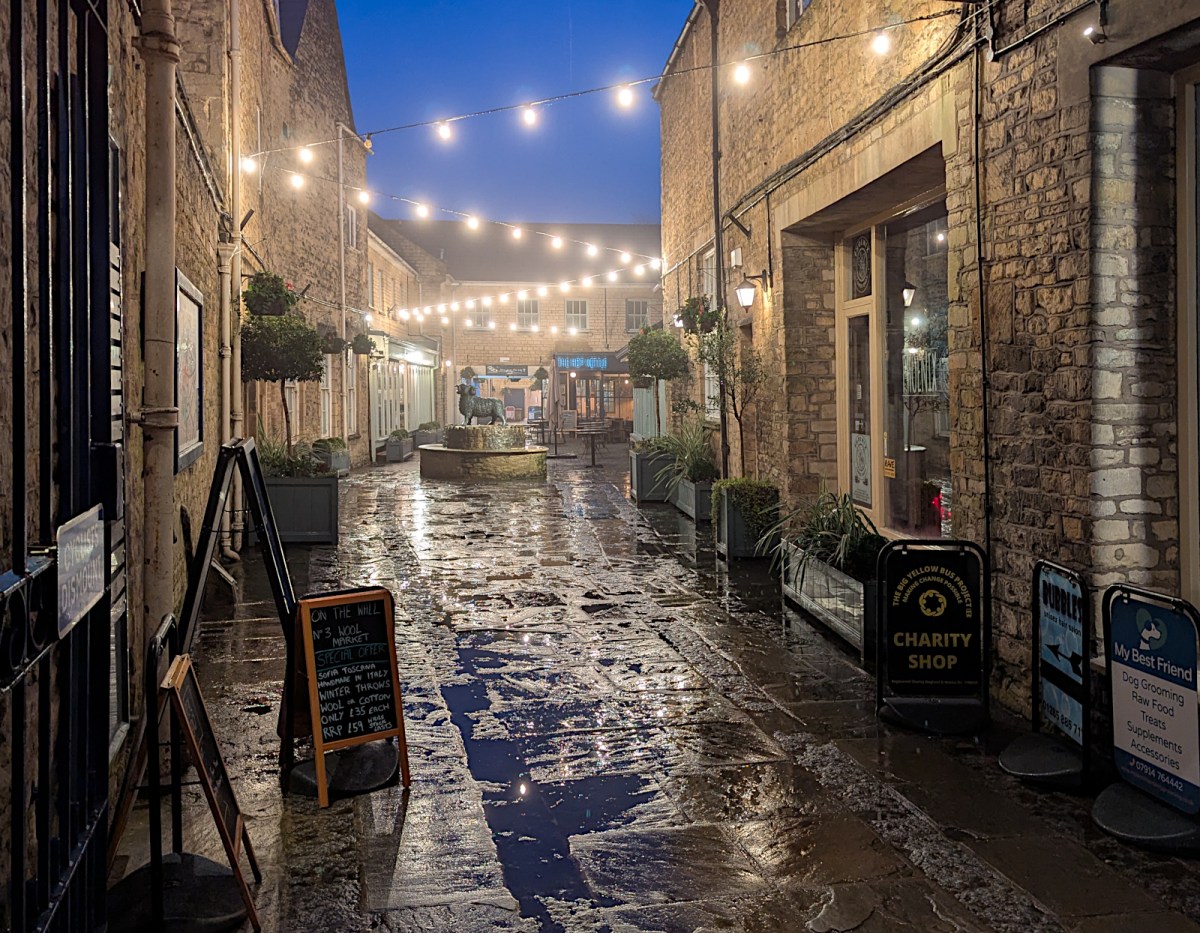
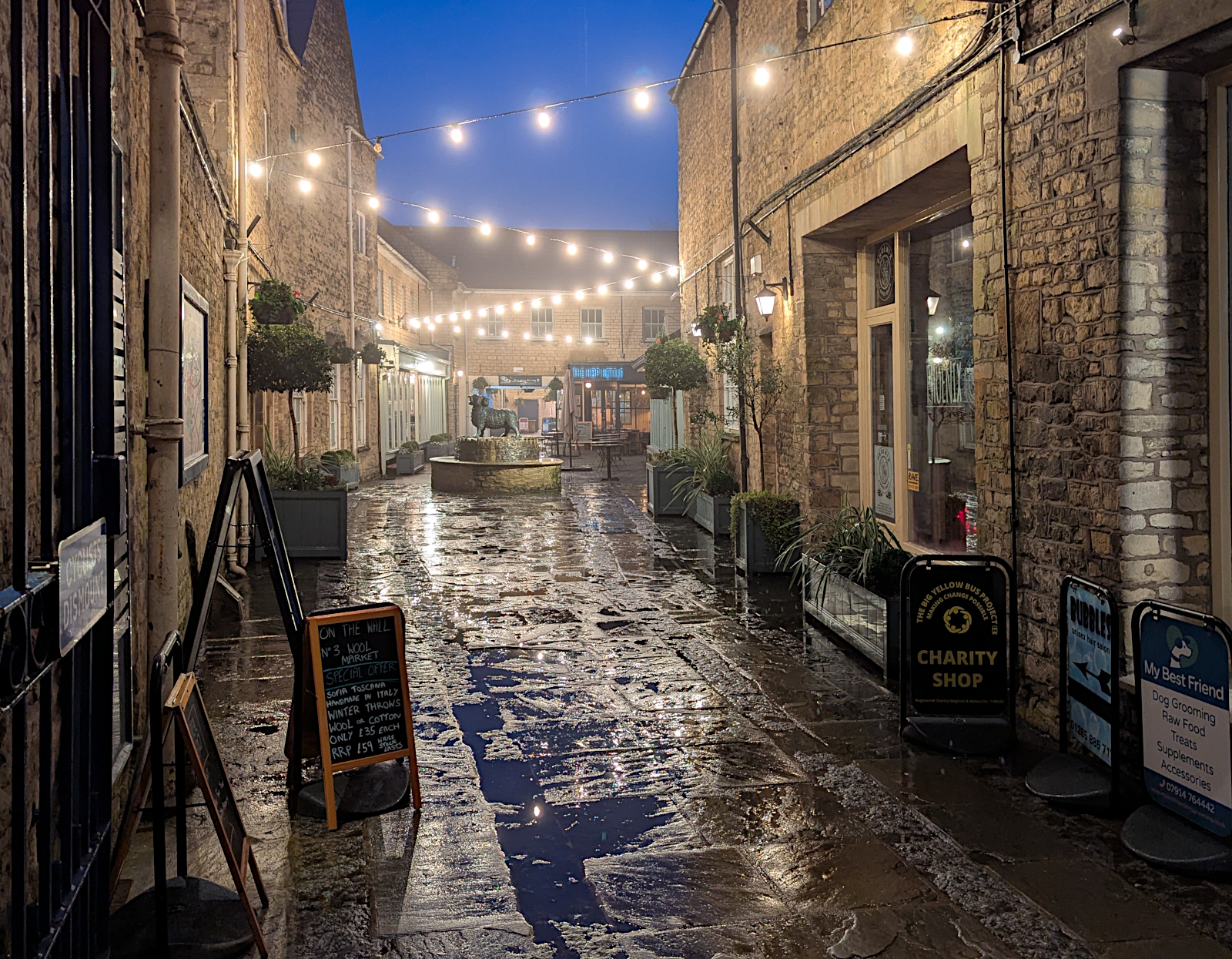
The idea of a wool market is an appropriate one for the town; in medieval times the wool trade was of high importance in the Cotswolds where a series of wool towns developed, of which Cirencester was the largest.
What’s in an image? Sometimes quite a lot, more than meets the eye. I’m posting an image every few days.
Woolmarket (click images to enlarge)
The Woolmarket is a small shopping area between Dyer Street and The Waterloo in Cirencester. It looks old, it’s presented as old, but in fact it’s a relatively recent development, created in the 1980s and further improved in 1996. The idea of a wool market is an appropriate one for the town; in medieval times the wool trade was of high importance in the Cotswolds where a series of wool towns developed, of which Cirencester was the largest. The town’s Parish Church of John Baptist was built and extended in part with money from the wool trade as was the old Abbey before it.
Many of the Georgian frontages around the centre of the town began their lives as the homes of wealthy wool merchants. They are now mostly offices or flats, and sometimes have the ground floors replaced by retail businesses with large windows for display. But look up and you’ll see right away two or three floors of Georgian architecture above those ground floors.
The photo
I took this photo on a wet evening on 18th January 2026, the paving slabs of natural stone glistening in the overhead lighting and the more distant buildings softened by descending mist as the damp atmosphere cooled down following sunset. It’s very typical of January in the Cotswolds. Sometimes we get snow, and heavy frosts are possible, but often it’s just a chill damp with muddy fields and foggy mornings.
The sheep statue
In the middle of the photo, look into the middle distance and you may spot the statue of a traditional Cotswold Lion sheep. This famous old breed was once widespread across a huge expanse of the Cotswolds, though now it is a rarity.
If you enjoyed this or found it useful, please like, comment, and share below. (If you don’t see those links, click the article’s title above the main photo and they will appear.) Send a link to friends who might enjoy the article or benefit from it – Thanks! My material is free to reuse (see conditions), but a coffee is always welcome and encourages me to write more often!
It’s past time to challenge Mr Trump on his outrageous statements of intent. There are so many ways that what he is proposing for Greenland is simply not going to happen. I believe that’s true whether you take an American view, or a Greenlandic view or, indeed any other.
Let’s see this from an American perspective first. My next door neighbour has a larger house than mine, and he also has a bigger and more expensive car than mine. So if I was to follow the Trump approach I might just say, ‘I need my neighbour’s house and car’. Does that justify my actions if I knock down a section of his garden fence and break one of his windows, take his car keys, change the locks on his door, and seize his car and house for my own use?
Clearly it does not. The police would soon be knocking on my door, probably with an arrest warrant. Saying I need something does nothing to make it legally mine. I’d soon find out that the police and the law courts would have a different opinion!
Yet this is effectively what Mr Trump is saying to Greenland. The USA ‘needs’ Greenland. If the USA needs anything, it needs to mind its own business, apply some common sense, and observe international law. We’ve seen countries with overwhelming military power make similar demands in the 20th century. Adolf Hitler argued that Germany needed lebensraum (literally ‘living space’). Poland and Russia had space they did not need (in Hitler’s opinion), so the German army was ordered to take it – first by invading Poland. and later by invading the Soviet Union. In the end that did not work out well for Germany.
Perhaps we should dig into the details and see how Trump might come unstuck.
An invasion of Greenland would involve American forces. There is no land border so troops would have to be taken in by air and/or by sea. The first thing would be for Trump to require the Pentagon to draw up plans for such an invasion. But American forces of all ranks owe allegiance, not to the President of the USA, but to the Constitution. They would be right to refuse orders that were either illegal or immoral. I think Trump would be stuck right there. Orders to invade an allied nation would be seen as neither legal nor moral. About as legal and moral as me taking my neighbour’s car and house!
I believe France, Germany and Norway already have small numbers of troops in Greenland to bolster Danish forces, and I further understand that British troops will join them very soon. I expect them to be joined by Polish, Finnish, Swedish and other forces, also very soon. What will they do? My first task if I was ordered to make it harder for an enemy force to land would be to consider ways to block those landings. Greenland is very inhospitable in the winter months. Even more so for forces unfamiliar with such conditions. And if American forces did arrive, I’d focus on ways to limit or destroy their supplies. But I don’t think Trump will get this far. His foolish bluster will be dealt with long before any invasion of Greenland gets under way. American politicians, both Democrat and Republican will make sure of that. Crowds would be out on the streets demanding he back down. It would be a disaster for Trump, Vance, MAGA, and for the USA as a whole.
Invading Greenland is probably Trump’s worst idea so far. If he persists he will be bought down. And his landing will be very hard indeed. I suggest he learns ice-skating as fast as possible, he’s going be on severely slippery ice soon, with no grip. And even if he becomes a great skater, he’ll be on very thin ice and the heavier you are, the more likely the ice is to break! You don’t live long if you’re plunged into severely cold water (nearly -2 C around Greenland). If you’re unfit and have a dodgy heart, your time would be even more limited. I hope you’re listening, Donald!
A rumpus is brewing
The fourth video above, Trump officials rebuff Greenland, Denmark calls… discusses rare earth minerals, what is being overlooked here is that any resources in the rocks of Greenland are covered by an ice sheet one mile deep. For all the talk of the ice melting due to global warning, no rare earths in Greenland are going to be reachable for many decades to come.
I’ll leave you with a final thought:
Russia believed it was strong, but under Putin’s misguided leadership it has lost much of the strength it once possessed.
The USA believes it is strong, but under Trump’s misguided leadership, it is starting to lose that strength. If he can damage the US this much in one year, what effect will he have over four years? I hope and pray he will not remain President for a full term.
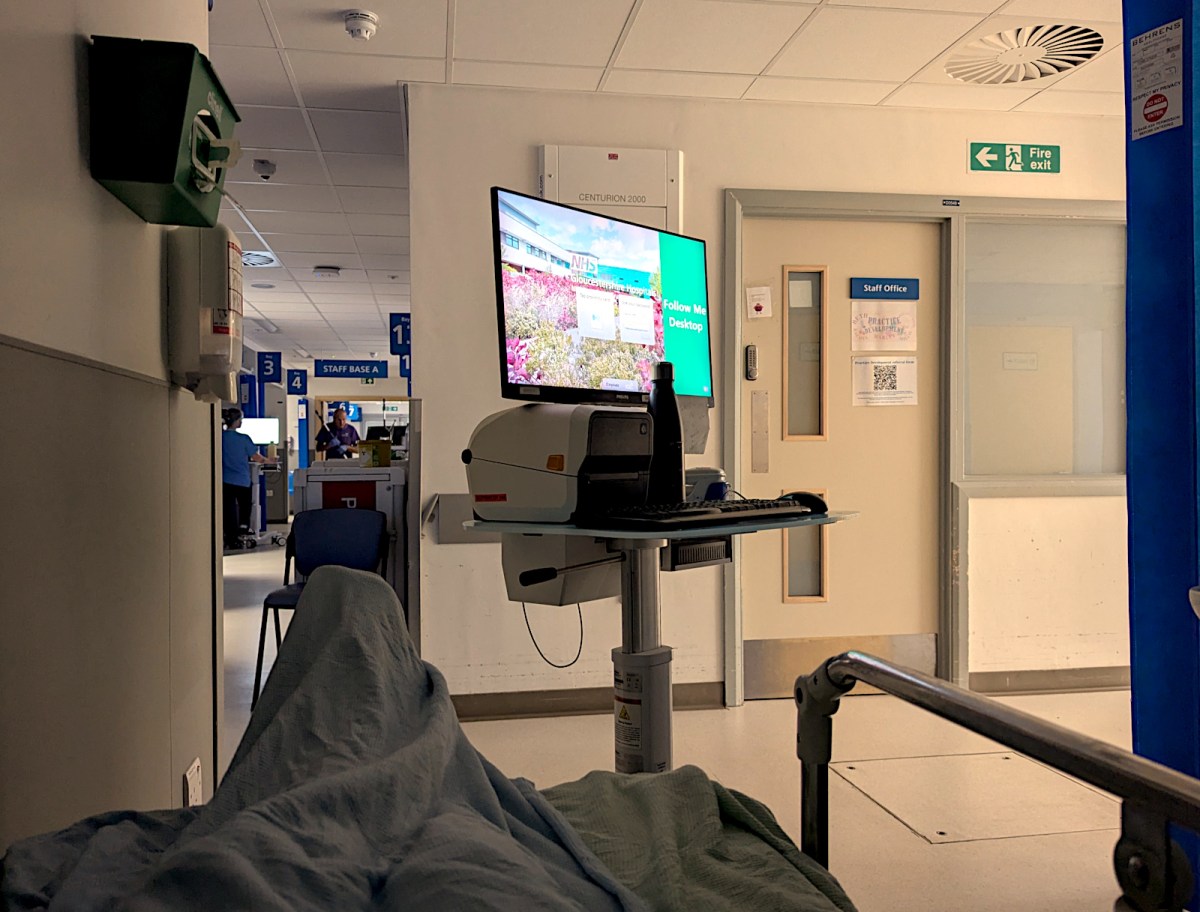
I was admitted to Gloucestershire Royal Hospital (GRH) for six days of investigation including CT and MRI scans. I started off on a trolley in a corner of Acute Medical until they could find space in a ward (2025).
October 2025 (3 months before publishing this article)
Click pics to enlarge
View from my hospital trolley
This was an unusual month during which I suffered a small bleed in my brain (a subarachnoid haemorrhage). The effects were weird and quite sudden, I began having seizures, in my case quite mild symptoms of muscle weakness in my left leg and numbness in parts of my left leg and head; curiously my left arm was not affected. These symptoms lasted for a few minutes and then faded away. This happened three or four times a day to begin with but quickly reduced in frequency.
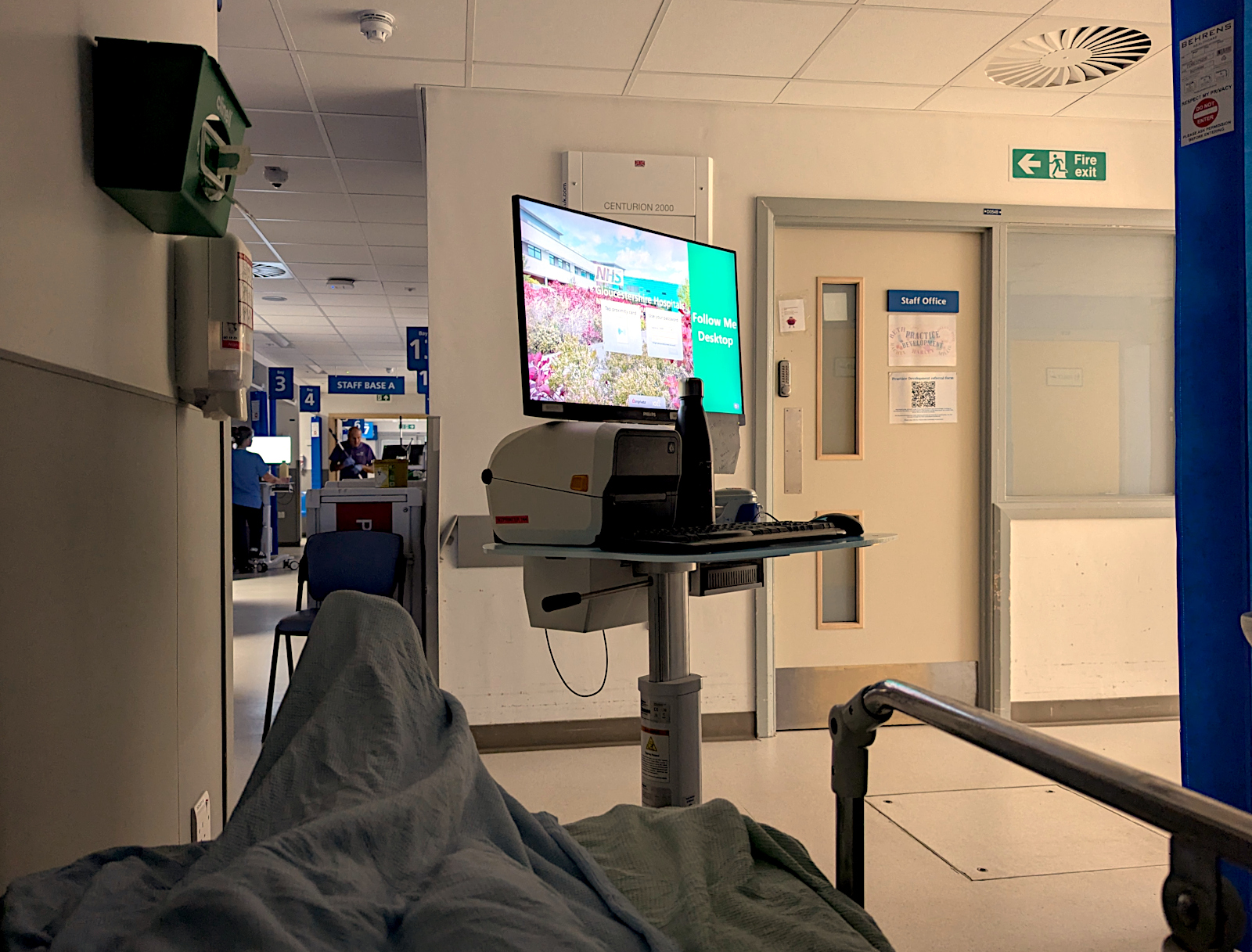
After nine hours in A&E I was admitted to Gloucestershire Royal Hospital (GRH) for six days of investigation including CT and MRI scans. I started off on a trolley in a corner of Acute Medical until they could find space in a ward. And much of my time was spent in Gallery Wing, Ward 1C. I was interested to see that all the medical and ward staff used their staff badges to log in to any hospital computer to see their own desktop with all the icons and applications they needed to do their work. Efficient and well-thought-out. The computer in the photo is displaying the login screen.
My symptoms were mild and were completely suppressed by low doses of Levetiracetam prescribed by my consultant. And my GP here in Cirencester can see the consultant’s notes as well as her own. I’ve had no seizures at all since 1st November. No surgery was required, but until I have six months clear of seizures, I’m not allowed to drive. There are more details in an article I wrote at the time.
From 4th to 7th we took Donna’s Mum, Isobel, for a short holiday at a Warners Hotel near Hereford. We visited Great Malvern and struggled to get the wheelchair up and down some of the very steep footpaths in the town.
The Small Group I meet with on Tuesday evenings gave me an opportunity to work through part of JDMC with them. This was encouraging and successful enough that Al suggested we work through some more of it next week.
In our back garden I added some more turf to a path I’m rerouting. We visited our neighbour George who’s in hospital in Dursley.
JHM: I wrote about the apostolic gift; and about the complex water flows in Cirencester. World events: The International Court of Justice ruled that countries can sue each other over historical emissions of greenhouse gases and the effects of climate change; and clashes erupted in southern Syria between armed Druze and Bedouin groups.
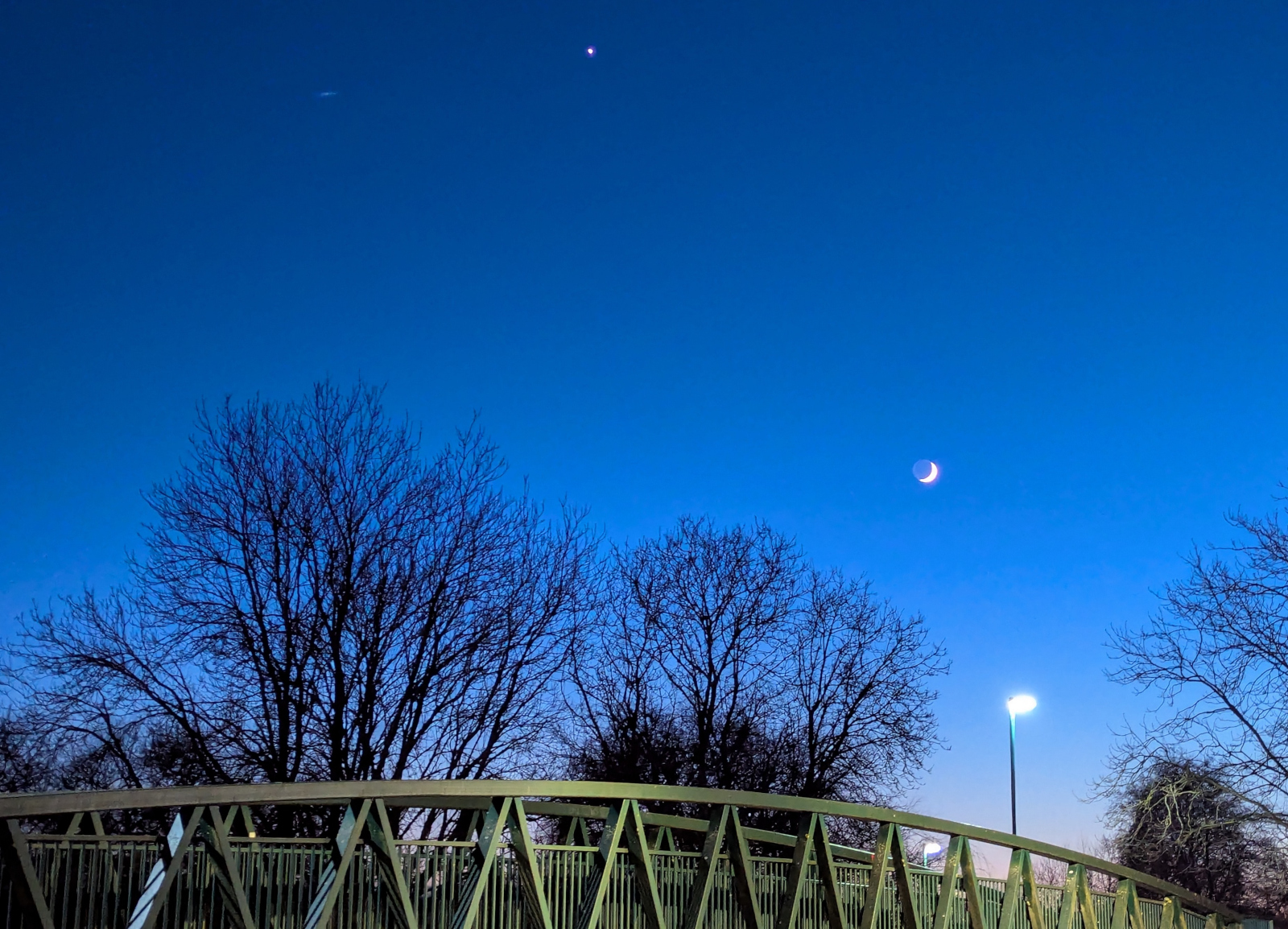
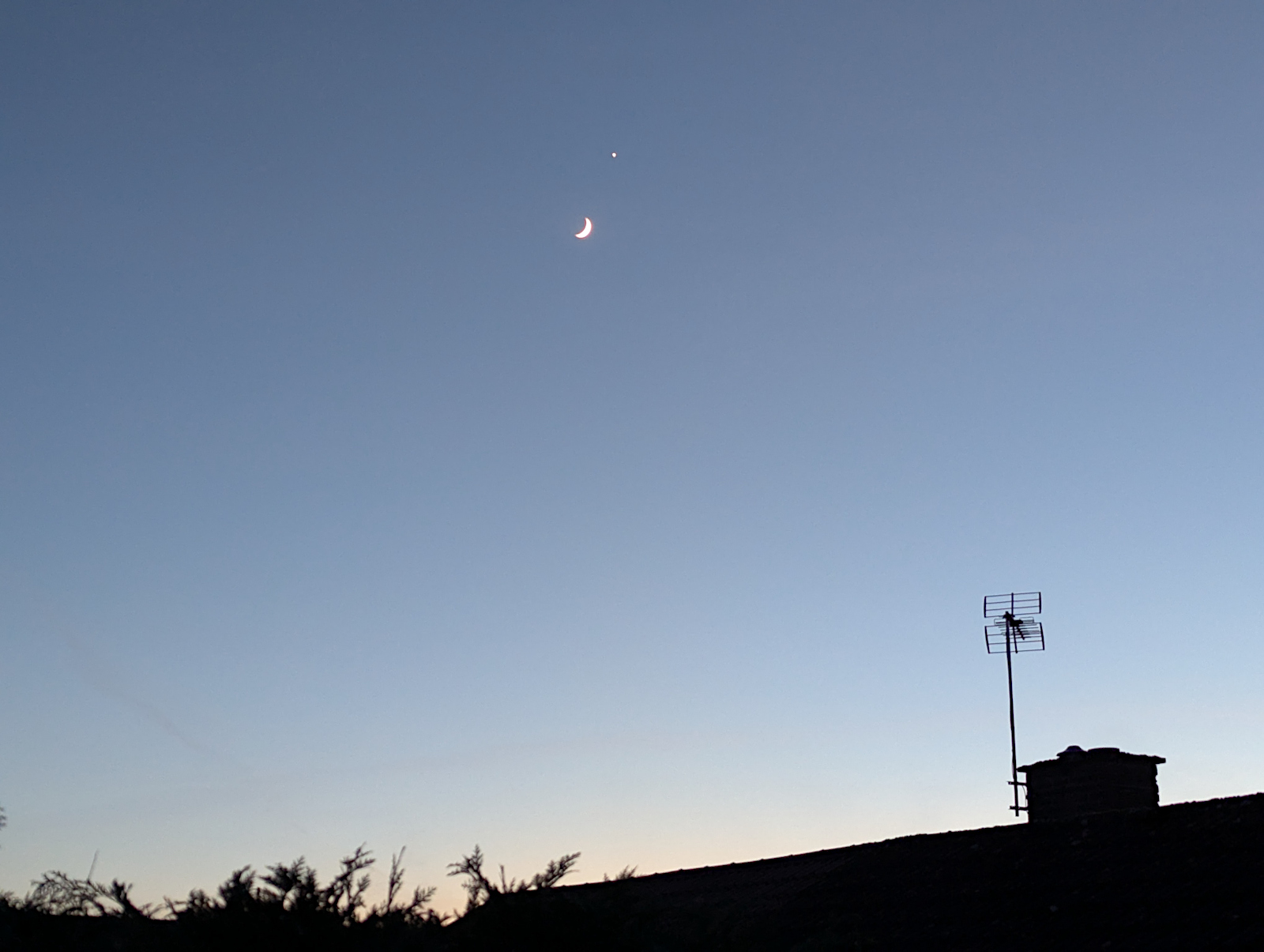
I walked out in the evening twilight and took this photo near the footbridge from The Beeches to Cricklade Road opposite Aldi. In the south-western sky you can see a waxing crescent Moon and the planet Venus near the top of the image. You may need to click the image to enlarge it to see Venus.
Moon and Venus again
Here they are again the following evening (3rd January) seen from Stratton north of Cirencester, see how far the Moon has moved along its orbit in just a little under 24 hours!
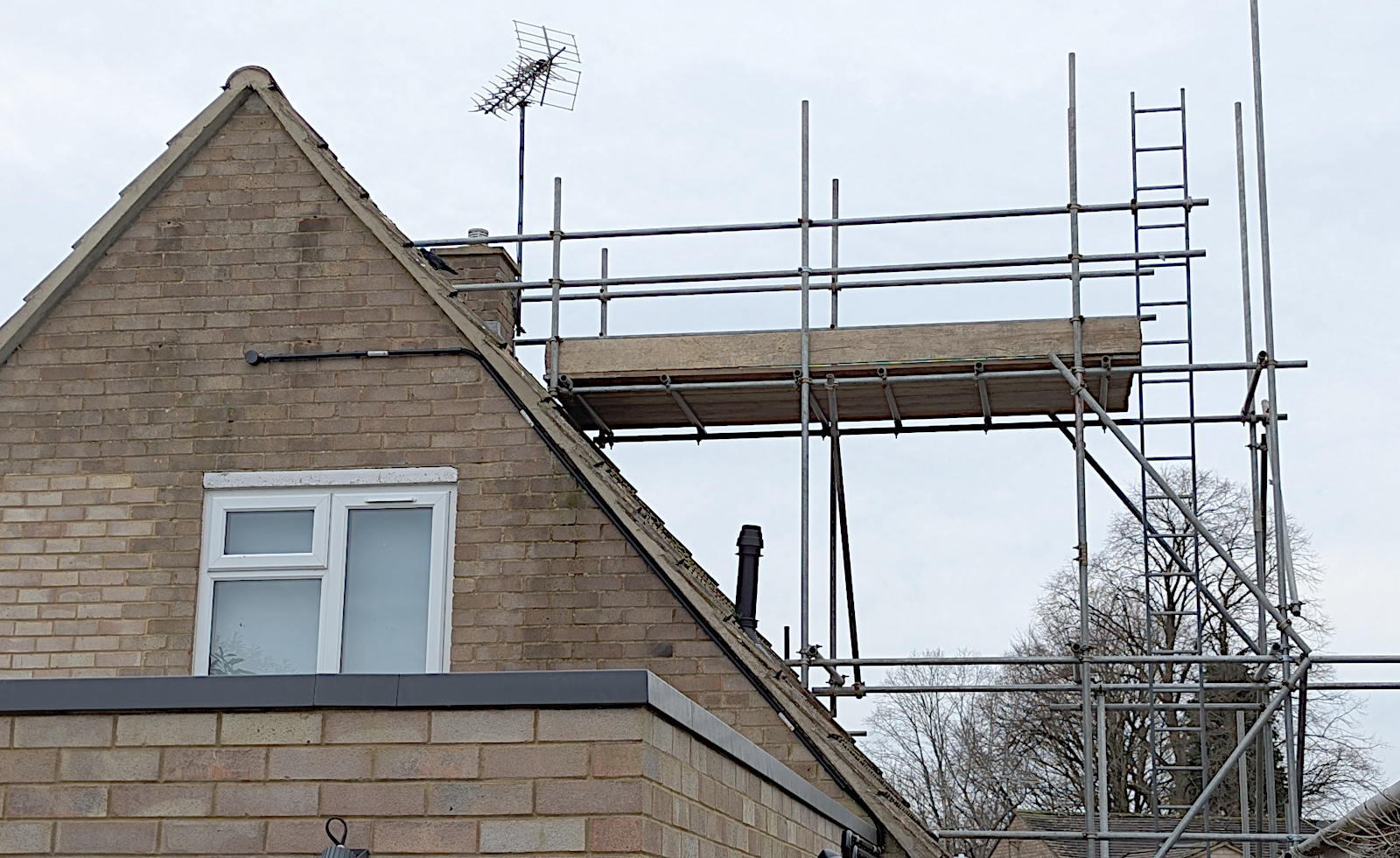
Chimney repair
The builders came to fix our leaking chimney, it was good to have that job done. In the bad old days when I was young the builders would have nonchalantly walked over the roof as if it was at ground level. But these days scaffolding is a must as the safety standards have been changed. It costs a little more, but it reduces the risks considerably.
JHM: I wrote about Knightstone Causeway; and my breakfast. World events: Bulgaria and Romania removed their EU land border controls having joined the Schengen Area; while Ukraine halted the flow of Russian gas following the expiration of a five-year transit deal and became a state party in the International Criminal Court.
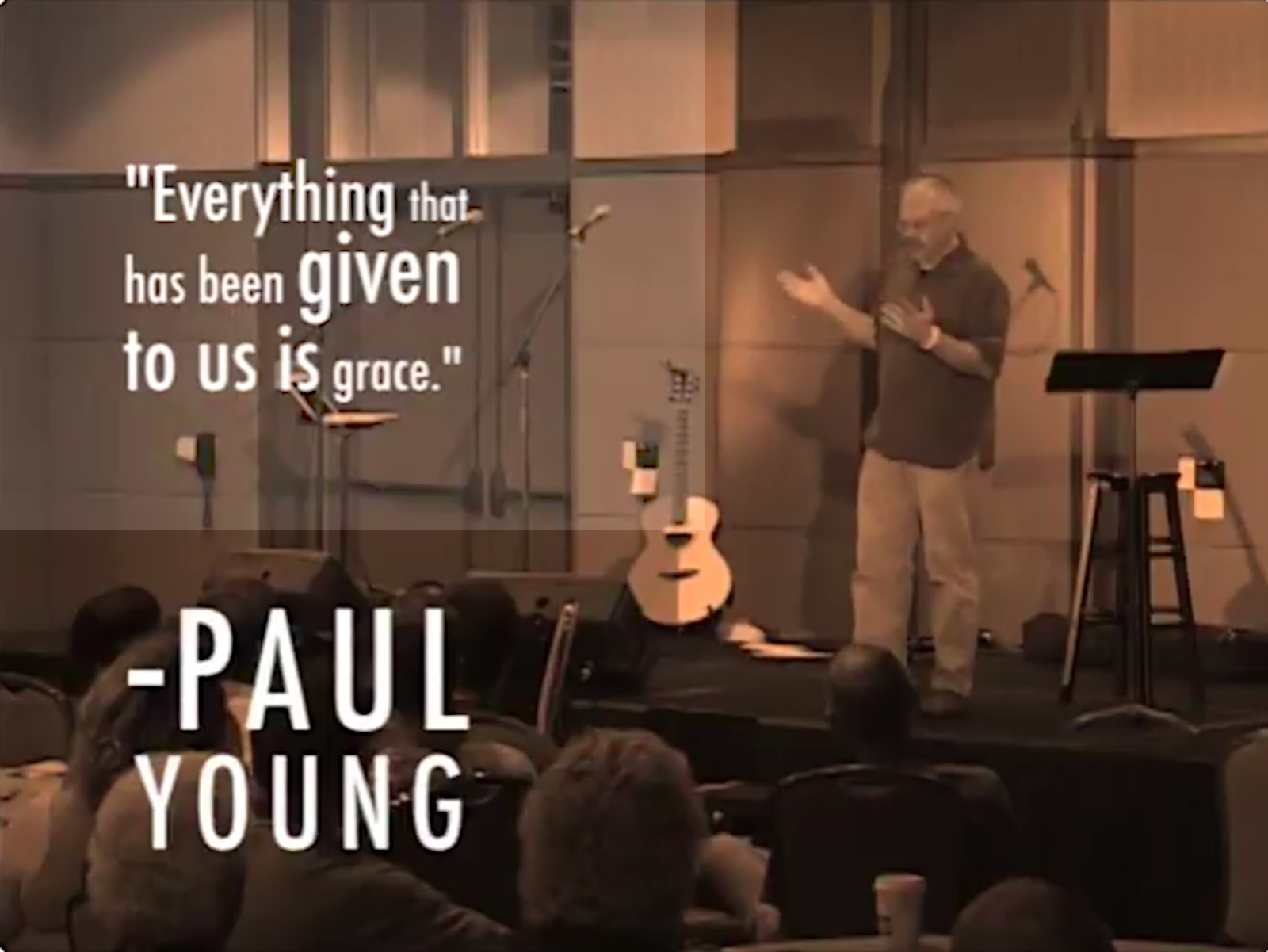
After a great deal of effort and trying several different ways, I was finally able to get the Paul Young videos live on YouTube from the House2House meetings CDs. I then wrote to my friends, the Dales, who hold the copyright to the recorded sessions from the meetings back in 2008.
Having got that task done I was then able to group them into a playlist and anyone can now watch them online. The video titles are Grace, Tradition and Soul; together they explain how Paul came to write The Shack, how he came to understand the grace of God working in people’s lives including his own, and the shame-based fear so many people face in our Western culture and just how crippling it can be. Paul wrote the book for his children and its amazing success as a book in 2007 and as a film in 2017 has changed the trajectories of so many lives ever since. The book remains available as a paperback and an ebook from Google Play, Amazon, and others, and the film is still available to view on YouTube, Amazon and elsewhere (here’s the trailer). The three talks Paul Young gave at the House2House conference must have been one of the first times he spoke about it publicly to a large audience, and they’re still well worth watching.
Two of them have been seen by the Small Group that I meet with most weeks, we really should try to see the third one too in the coming year.
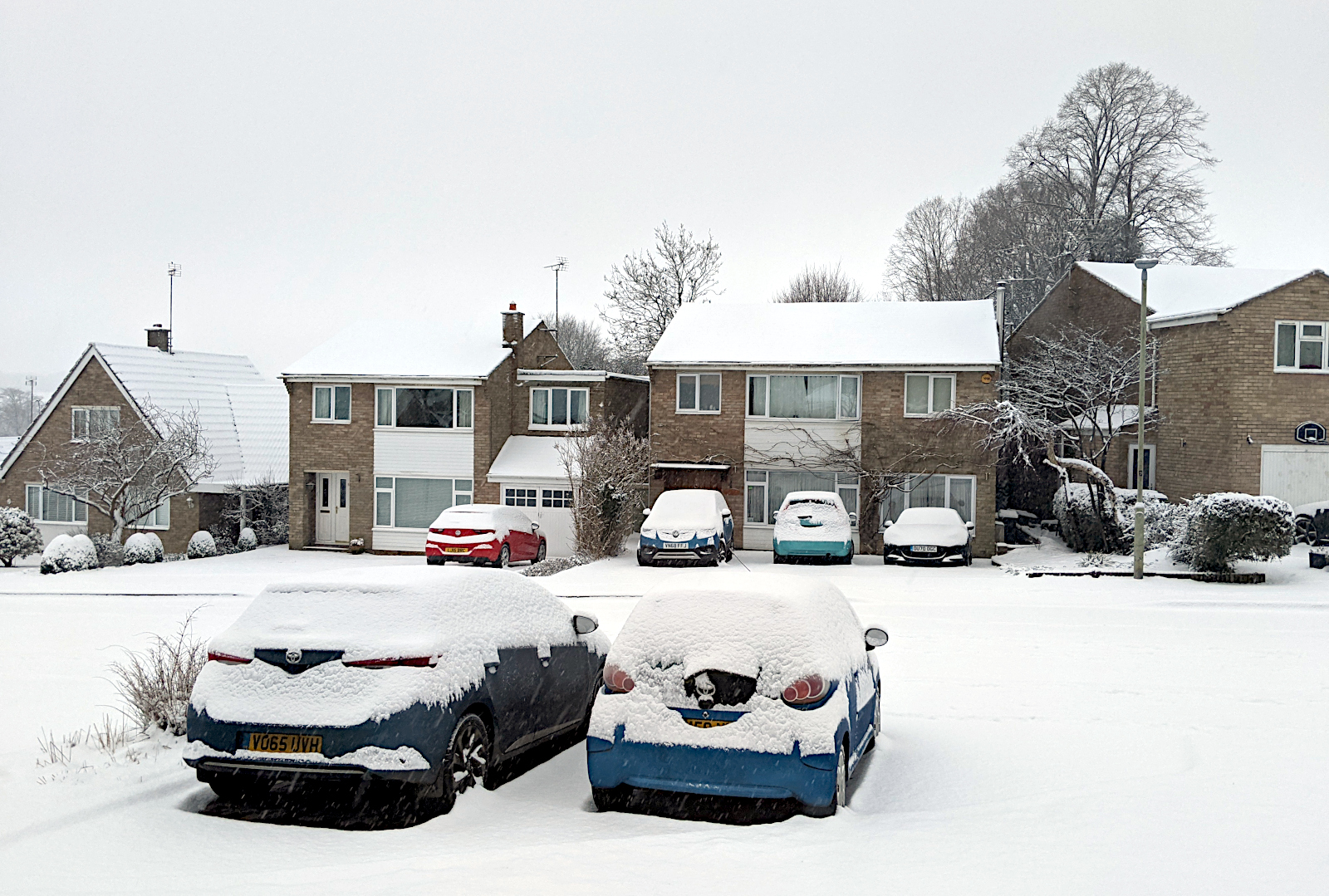
This was the view from our window on 24th January! A relatively heavy fall of snow and still coming down when I took the photo.
A newish Moon
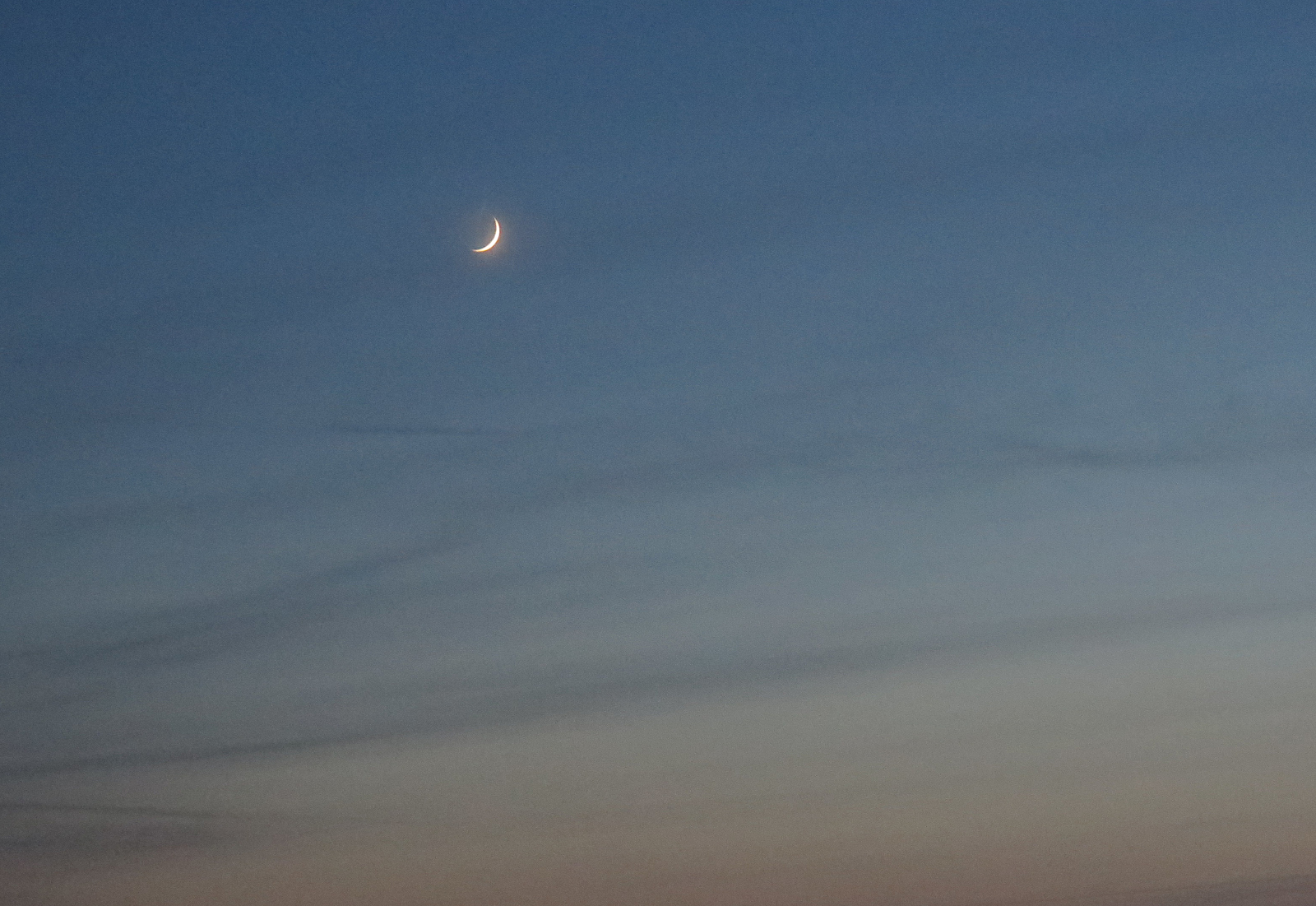
Earlier in the month, on 15th, I was able to get a lovely photo of the crescent Moon, just a day or two after New Moon. The sun had recently set below and to the right of this image. There was still enough light in the sky to prevent the sunlit side of the Moon from flaring and there’s enough contrast to just see the nightime part of the Moon, sometimes poetically described as ‘the old Moon in the New Moon’s arms’.
Stratton Meadows
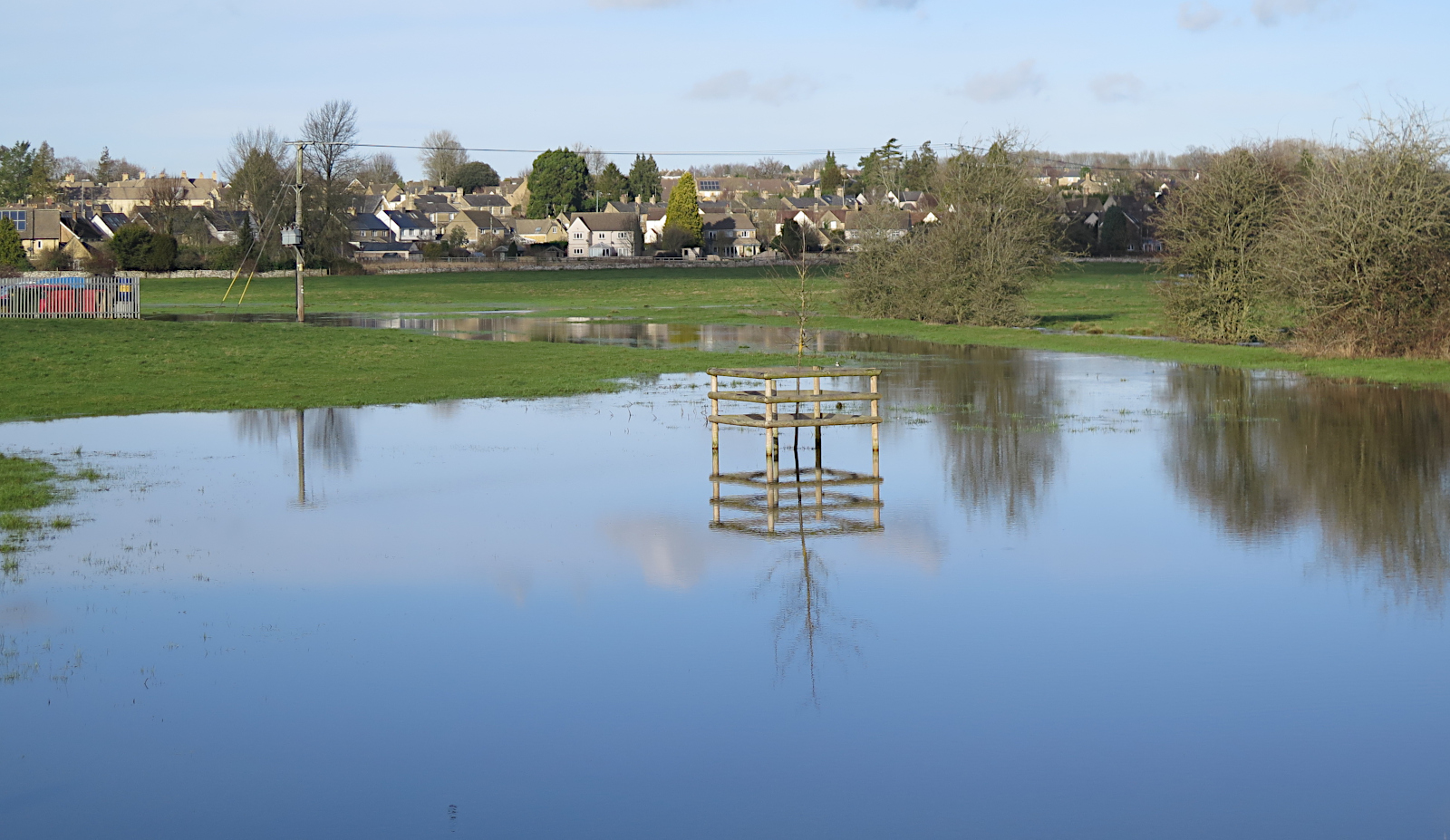
The later part of the month was wet and the River Churn broke its banks and flooded fields and meadows in low lying areas. the final image for this month shows Stratton meadows inundated. The village of Stratton is on the higher ground beyond the flooded area. This land, now used to graze cattle in the summer was used to grow willow rods 150 years ago. They would have been harvested in the autumn and bound into bundles for local basket making businesses.
World events: Supporters of US President Donald Trump attacked the US Capitol; and the global death toll from COVID-19 passed 2 million.
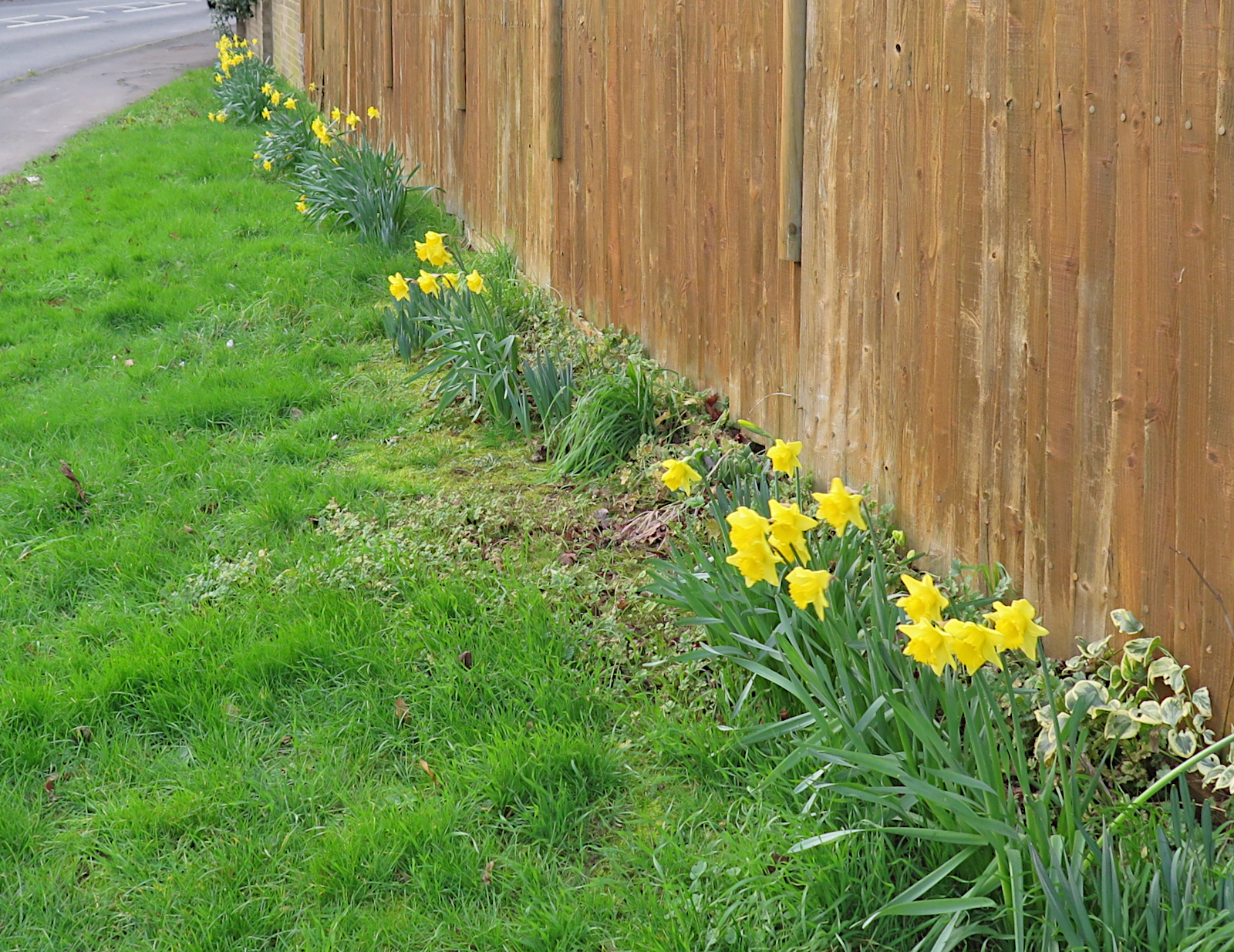
We had daffodils in flower by the end of January, surprisingly early and evidence that global warming was already beginning to have practical effects. The photo shows a row of them along the roadside in St Neots. We welcome them in springtime, but in January I’m not sure they are quite as welcome, though very lovely.
One of my friends from the coffee shop Bible study group, Kevin, was suicidal, I took him to A&E at the hospital in Huntingdon and stayed with him until he could be seen. It seemed a wise and necessary precaution.
We had Peter and Dadka staying with us as they were unable to afford anywhere of their own. They were both from Slovakia. Peter received a message on 9th to say that his parents had been involved in a road accident and his father had died in the collision. He flew back home to be with the family for a week or two and help make the necessary arrangements. This must have been a terrible shock for him.
On 30th I enjoyed a coffee and a great chat with a friend, David Pacini.
World events: The IAEA announced that Iran has adequately dismantled its nuclear weapons program, allowing the UN to lift sanctions; and the WHO announced an outbreak of the Zika virus.
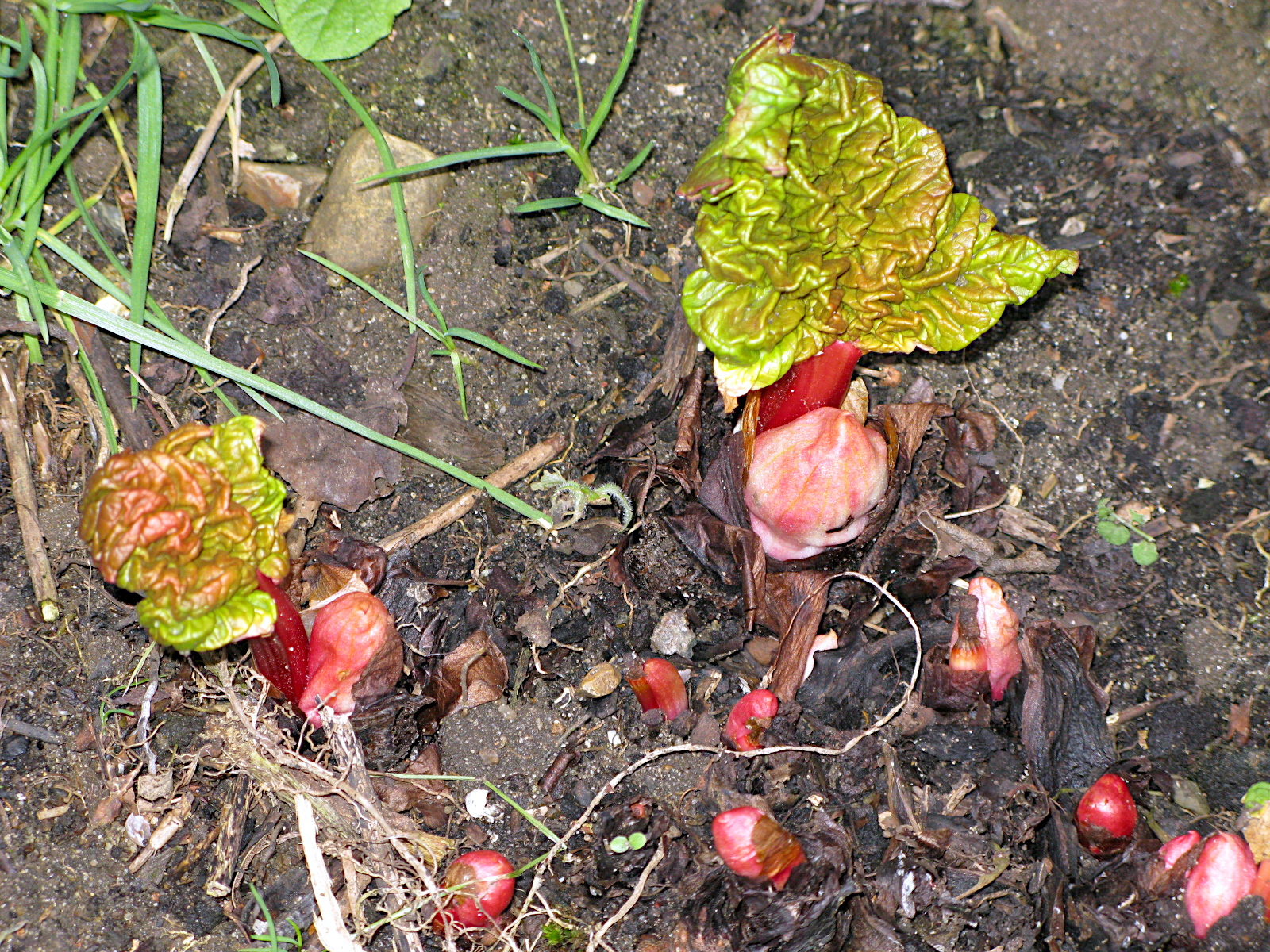
In the garden the snowdrops were in flower and our rhubarb was beginning to grow with buds bursting and the first, crinkled leaves beginning to unfold. We bought a new HP LaserJet colour printer to replace our old Samsung laser printer.
I was involved in several different meetings at this time. There was the Open Door Small Group once a week on Tuesdays, I was meeting with the coffee shop crew at least once a week and quite separately with Jim, Sean and Kevin on Thursday evenings. On Thursday mornings I met with Roger and Ruth at their home in Offord d’Arcy. With the coffee shop group we discussed ideas around not going to church because we are the church, and how our focus should be to plant Jesus, plant disciples, and plant the gospel.
On 7th we had a sixth Cornerstone Meeting, not just directors this time, but staff as well. Paul has written off the setup costs of £81k and planned to run on a break-even basis in future. He also thought he might move to fried food and reduced prices. Paul declared that there would be no directors from now on, just a management team. Some of us foresaw problems, mainly because Paul wanted things all his own way and some of his ideas were somewhat controversial; but he was putting up all the money, and if he didn’t want ideas and thoughts from others, that was, of course, his choice to make.
Following Mum’s death at Cheltenham General Hospital on 1st January, Dad was pretty busy getting the news out to friends and relatives and making initial arrangements for the funeral. I worked up an initial draft for the service sheet, and I discussed it with Dad and my three sisters before revising it.
Debbie sent me a scan of her unborn baby, and I felt sad that Mum would not see the birth of two great-grandchildren (Beth was also expecting a baby, probably a little before her sister, Debbie).
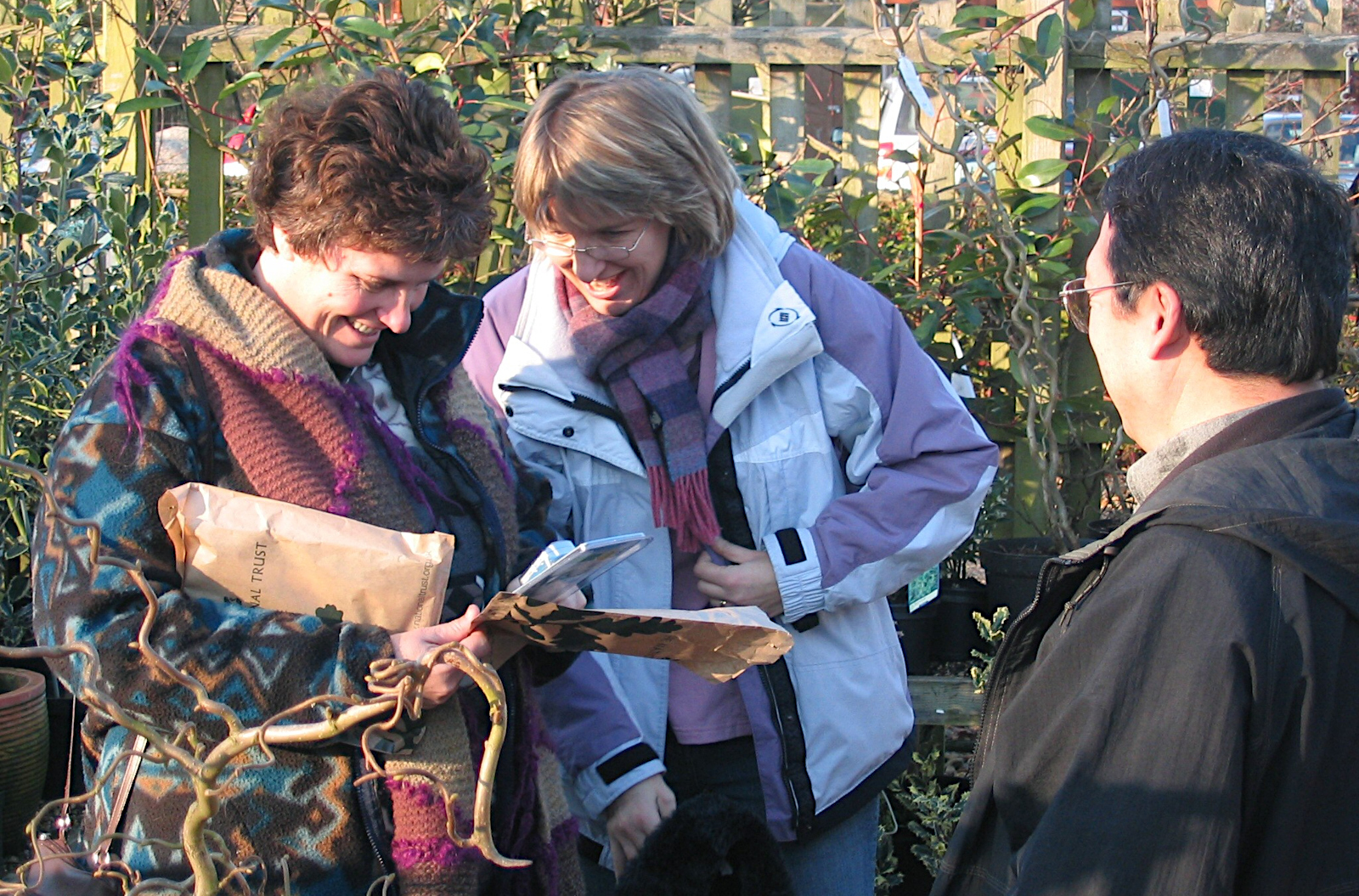
Gayna, Donna and Ken
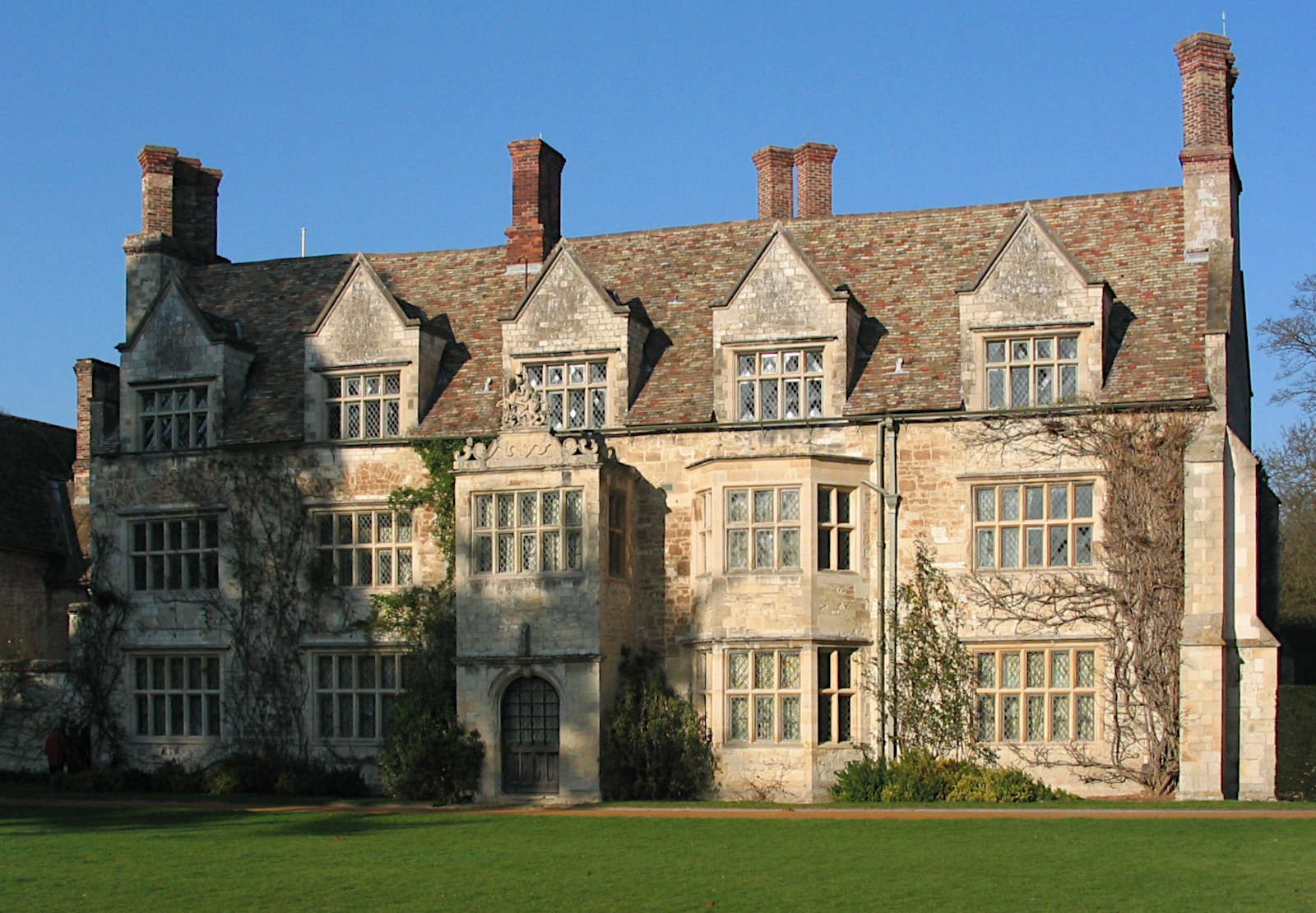
Towards the end of the month, we enjoyed visiting the National Trust’s Anglesey Abbey with our friends Ken and Gayna. It was a lovely, sunny day and the gardens at Anglesey are always a delight at any time of the year.
World events:A panicking crowd during the Stoning of the Devil ritual on the last day of the Hajj in Saudi Arabia, killed at least 362 pilgrims; and NASA launched the first interplanetary spacecraft to Pluto, New Horizons.
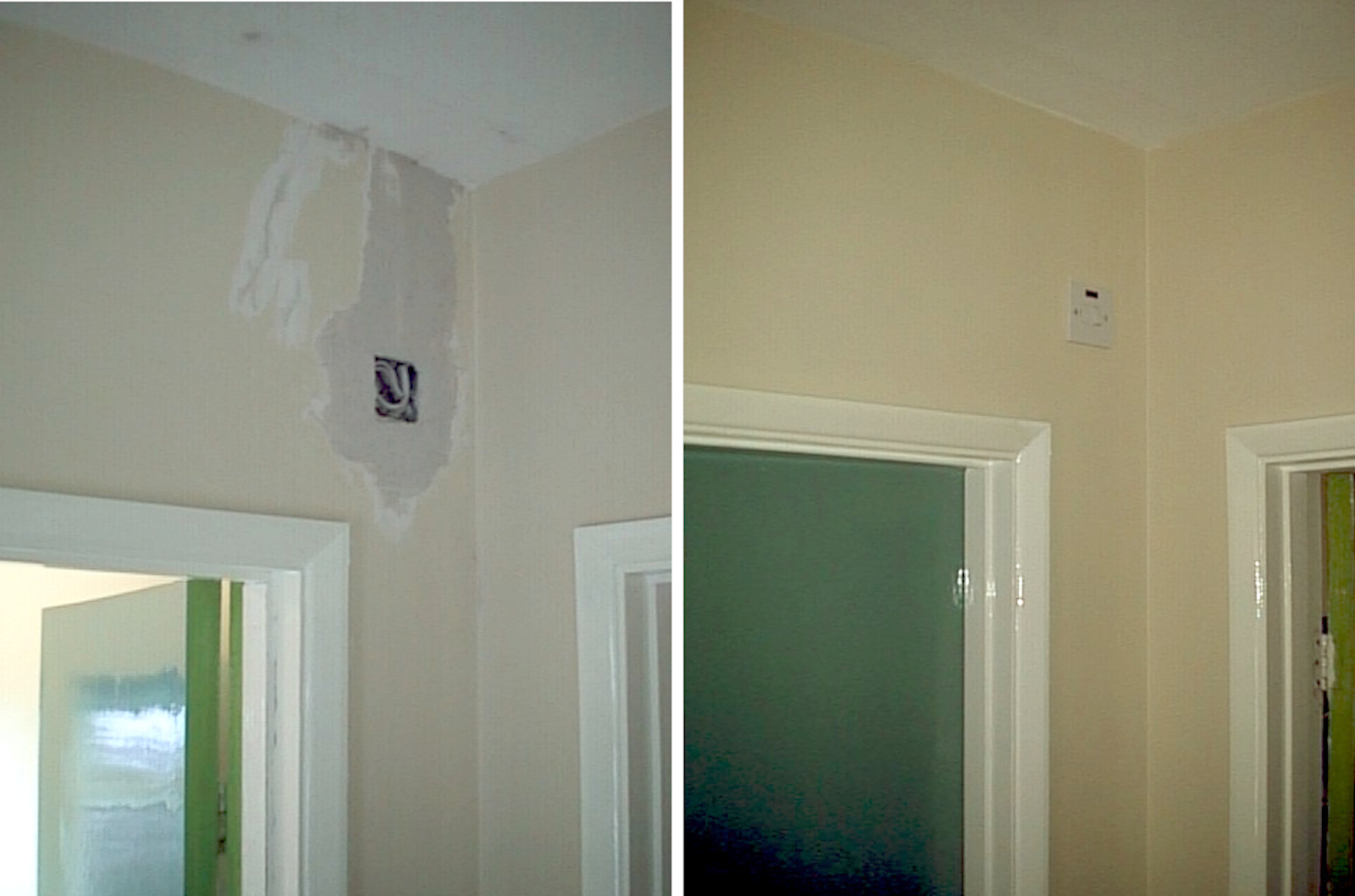
I began redecorating the stairs, hall, and landing. I fitted an electrical box with wiring for an extractor fan in the bathroom, repaired the plasterwork where necessary, and painted emulsion on the walls and gloss on the woodwork. It was quite a long job, but we got it completed in the end.
Conservatory
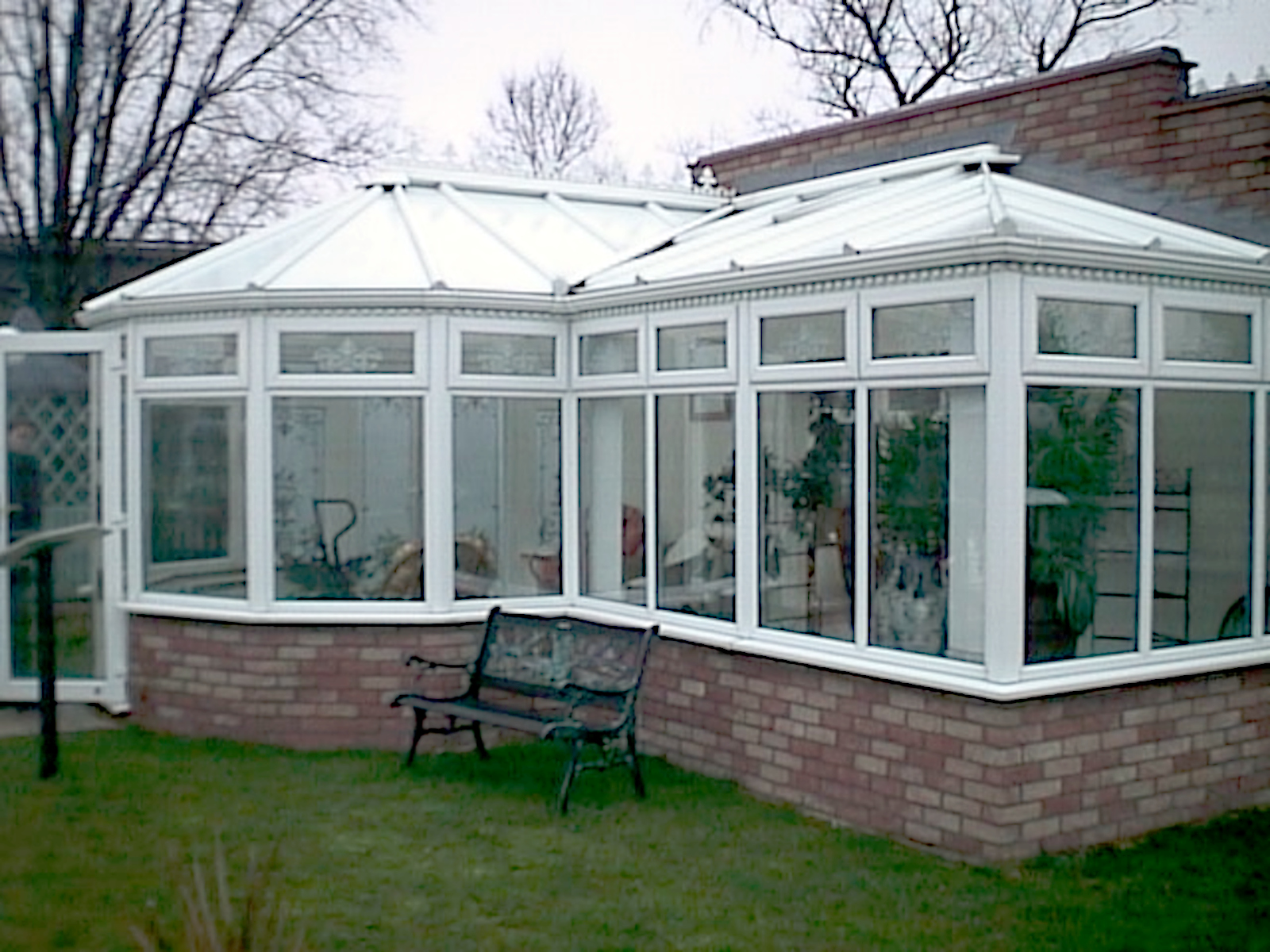
We decided to buy a conservatory, our garden was large enough to take one and it would extend our living space quite a bit. Also, we thought it would fit well against the long brick wall of the kitchen, airing cupboard and the old laundry room and we could easily replace the dining room window with a small bi-fold opening using the existing lintel; so just a matter of cutting through the lower brickwork, making good, a bit of plastering and decorating.
We began visiting conservatory suppliers to look at what they had to offer and get some idea of price. The one in the photo was the sort of shape and size we thought might work well for us.
A further improvement at home was the removal of the very old bathroon suite and its replacement with a new bath, shower, loo and sink in white to replace the worn out avocado bath, loo and sink. Times had moved on with bathroom colours!
Colworth badge
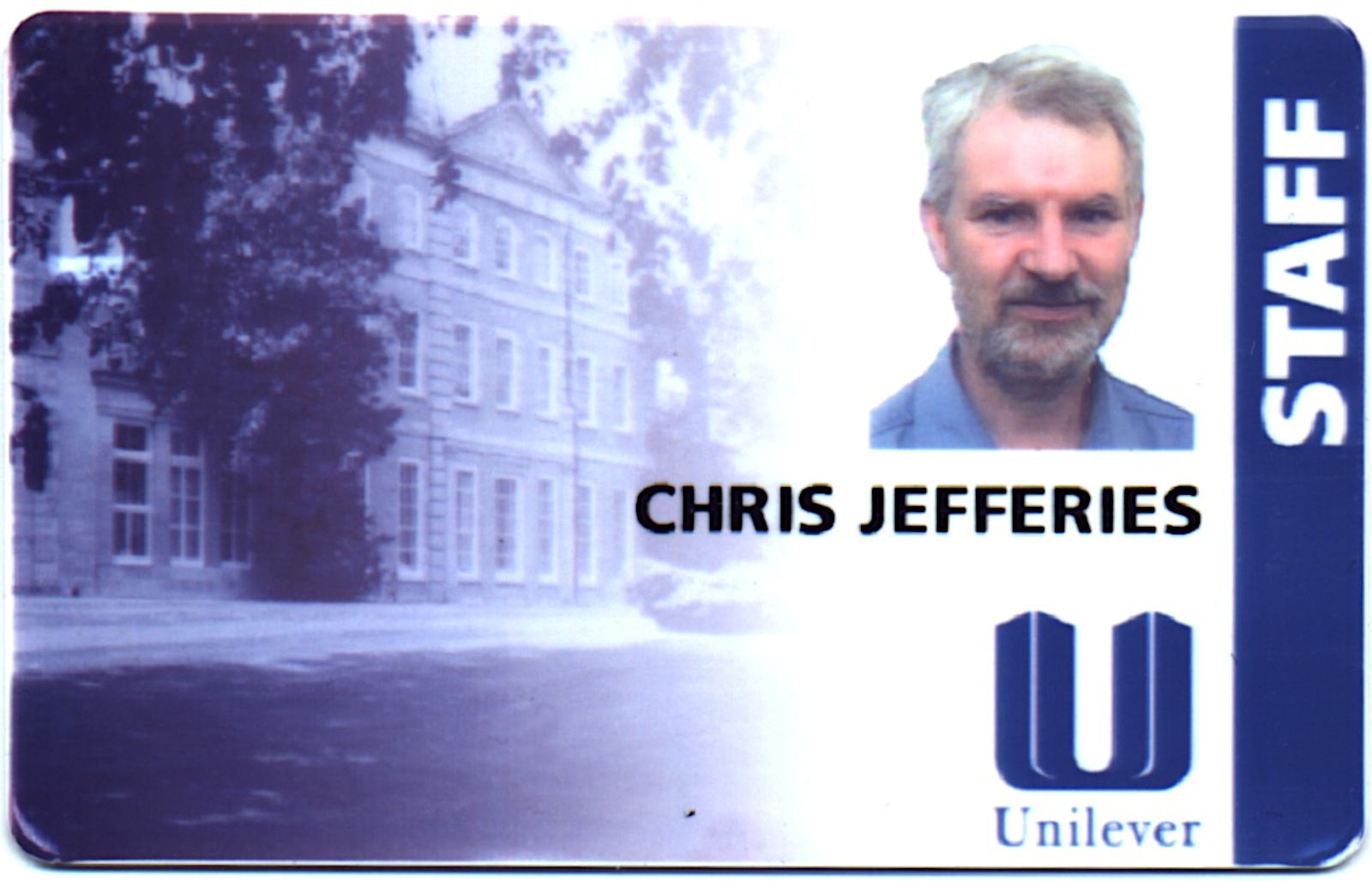
And finally at Unilever Research Colworth, we all received brand new security badges which opened gates and doors automatically for all the areas each member of staff had access to.
World events: Greece became the 12th country to join the Eurozone; and Apple launched iTunes, software that acted as both a media player and a media library.
on 1st January Beth, Paul, Jenny and I went to see Apollo 13 at the cinema in Weston-super-Mare. It seems a strange thing to have done just after losing Judy, but at the time it seemed to make perfect sense. Debbie, would, I think have been preparing to go back to study for her teaching qualification at Newport in south Wales. I certainly enjoyed watching the film.
I returned to work at Long Ashton on 3rd and started to pick up the threads that had been temporarily abandoned, or taken over by Pete Moody or Mike Truman while I’d been away. Peter Shewry invited me to join the Computing Strategy Review Meeting, and I continued developing the Microscopy web pages in the evenings at home.
Judy’s funeral was on 5th January and the day did not begin well. I woke up in the morning to the sound of dripping water and found it coming through the top of the bedroom doorframe. An emergency plumber came out and soon got things sorted for me. When the house was built, the overflow pipe was never connected so instead of a pipe dripping outside the house, the system was dripping inside! That lost me two hours at the start of a rather busy day, but everything else went well.
About 160 turned up which was astonishing, Judy was much loved not only by the extended family but by her pupils and colleagues at Cotham Grammar School, and many LARS staff had come along too. Bev was great, he said all the right things and was appreciated by everyone, I think. But only around 80 to 90 came to the buffet afterwards at Horsecastle chapel, so we had far too much food and donated what was left to the Horsecastle youth groups.
Rachael and Neil witnessed a horrendous event on their way back to Rugby later that day. A man jumped from a motorway bridge just as Rachael was approaching it. She had managed to swerve and miss him, but two cars behind her were unable to avoid him and caught him full on. Neil and another man had made their way back to the area of the incident and saw what happened.
World events: Serious fighting broke out on 9th January between Russian soldiers and rebel fighters in Chechnya; and France undertook its last nuclear weapons test.
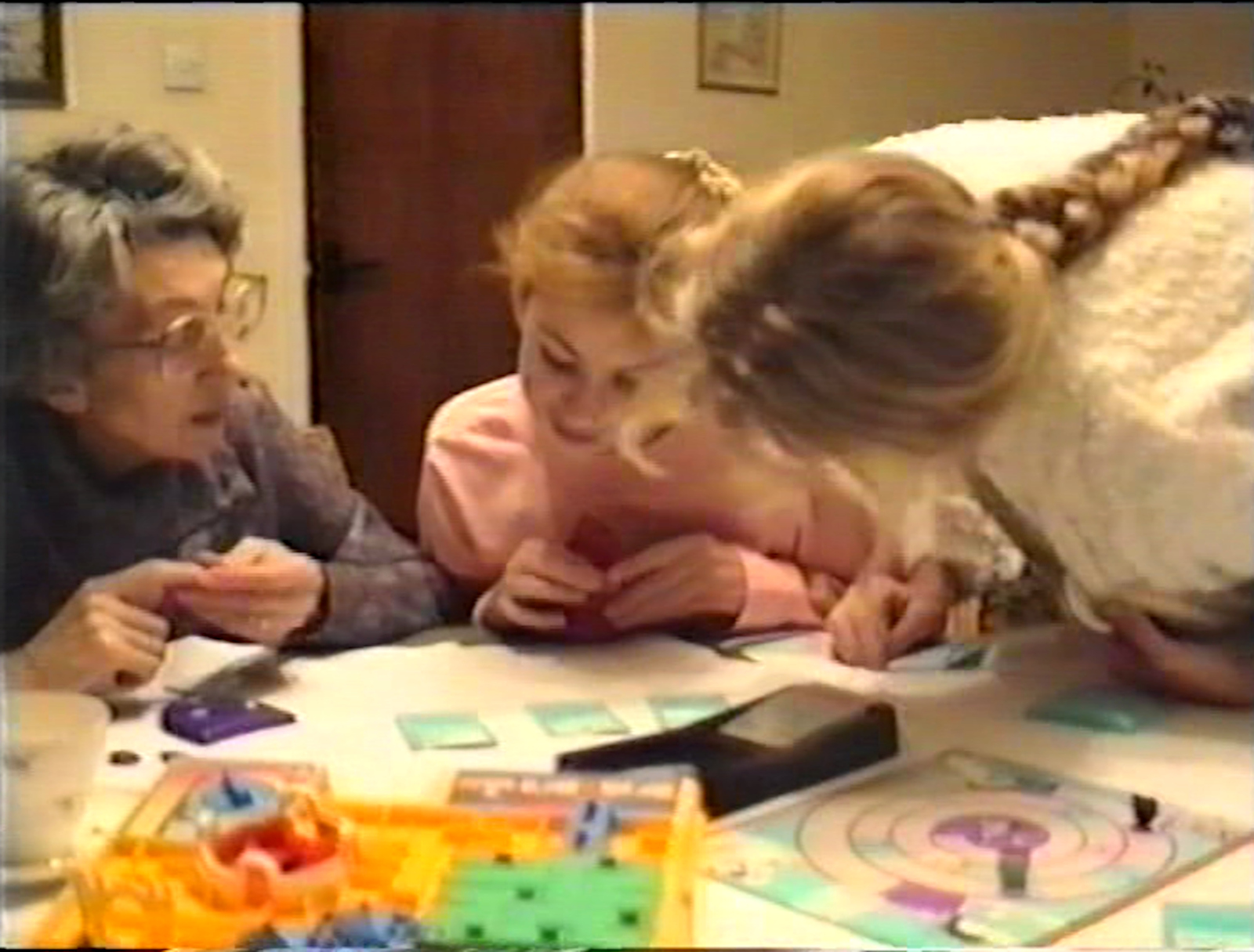
We visited Nana and Grandad (Judy’s parents) at their home at 14 Belland Drive, Charlton Kings, Cheltenham. The photo shows Nana, Beth and Debbie playing a game on the dining table, perhaps one of Beth’s Christmas presents.
Cleaning the guinea pig run
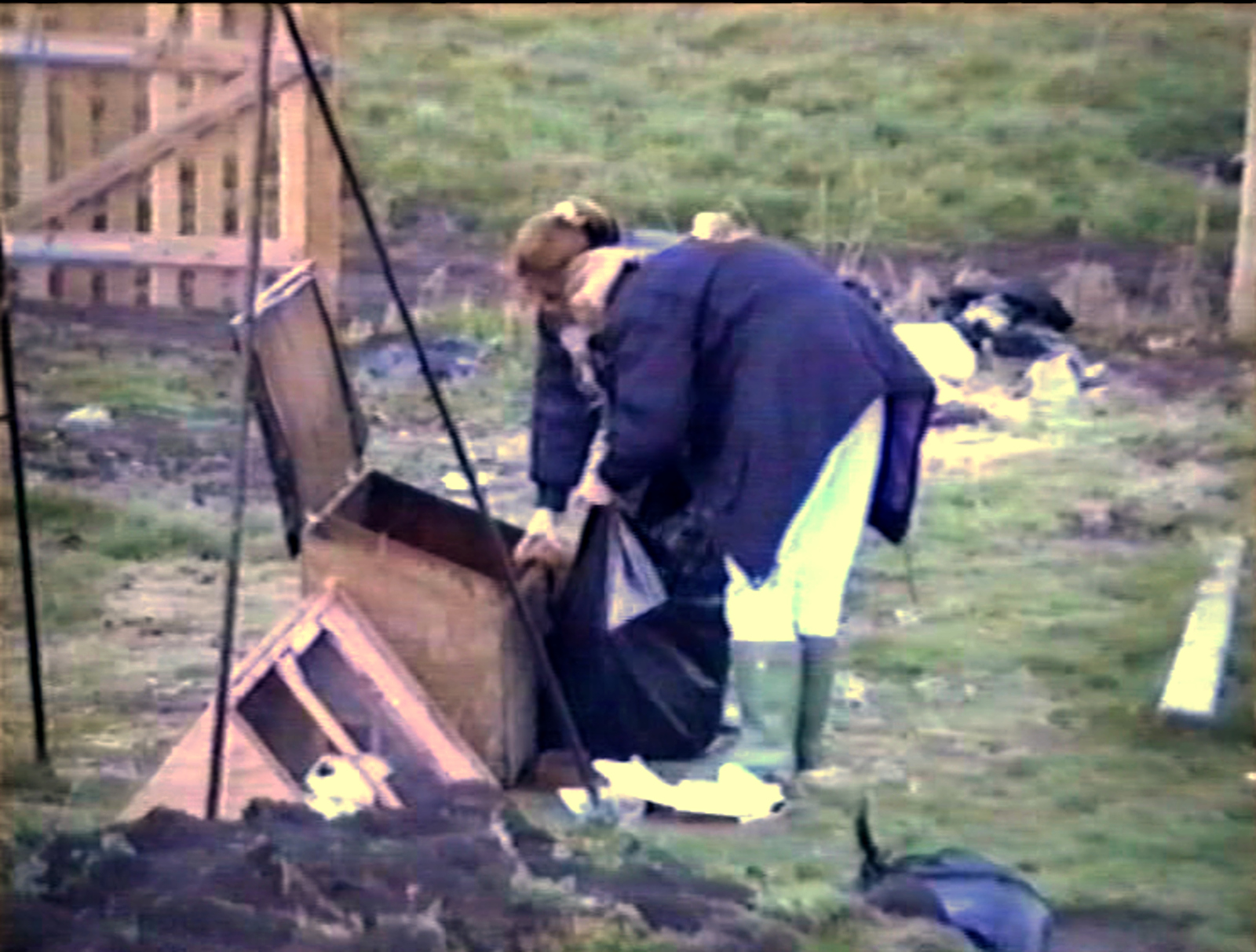
On 13th we were back at home in Yatton, Debbie and Beth were out in the cold cleaning out the guinea pig run. When it was particularly cold we used to bring the guinea pigs into the house for protection, but they were quite good at managing cold days, the three of them would huddle together to keep warm.
World events: The US Congress authorised the use of force to expel Iraqi forces from Kuwait; and in South Africa, Nelson Mandela and Mangosuthu Buthelezi agreed to end the violence between the ANC and Inkatha.
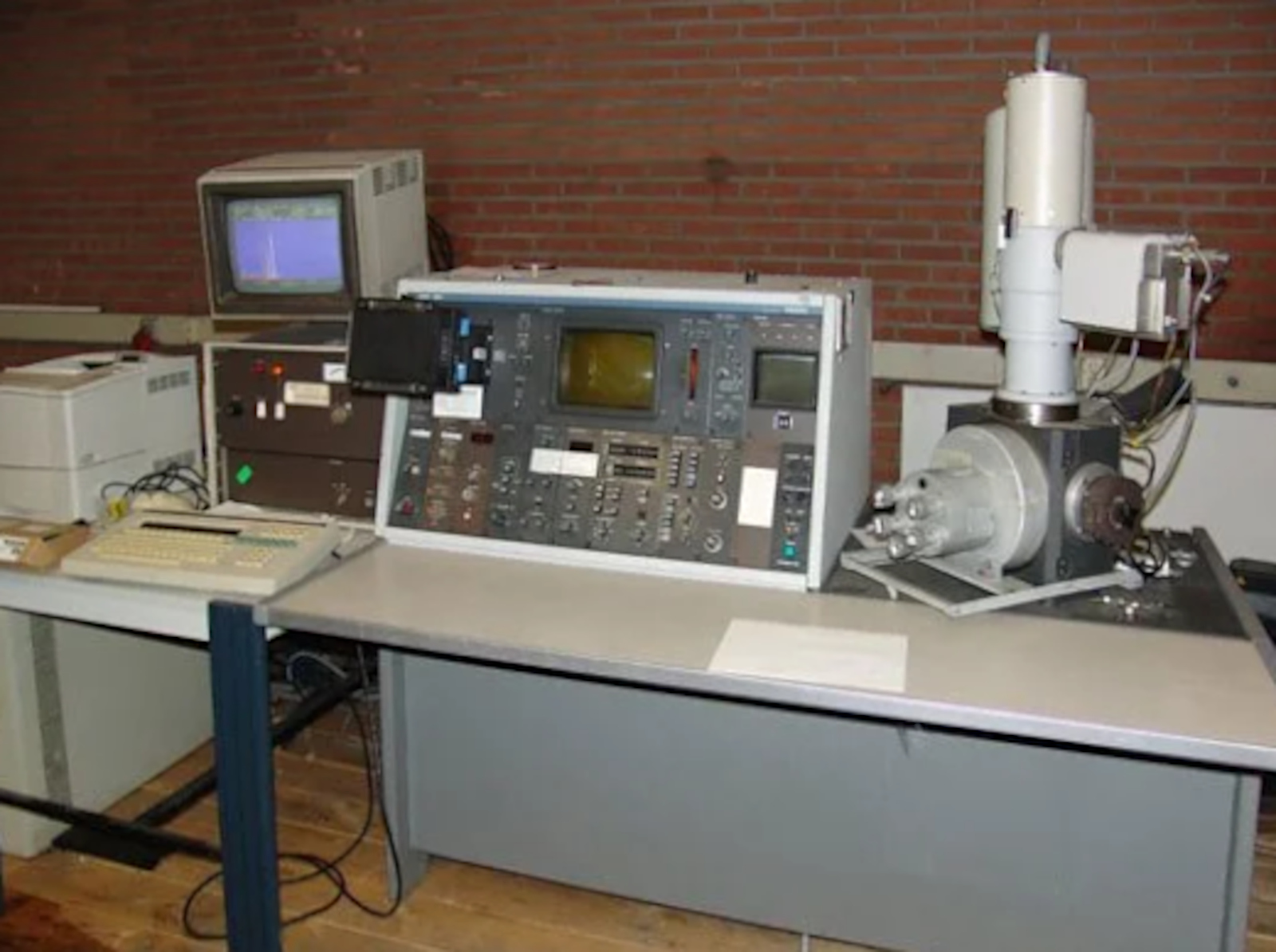
I was busy at LARS constructing a user-friendly menu system for the EDAX X-ray microanalysis software on the scanning electron microscope (SEM). I also produced a series of step-by-step instructions for using the SEM. The instrument in the photo is similar to the one we had at Long Ashton, but with a different X-ray microanalysis system.
Debbie and Beth remained at school in Yatton and we were living at 80 Stowey Road.
World events: Spain and Portugal joined the European Community; while the United Kingdom and France announced plans to construct the Channel Tunnel.
I couldn’t find anything for January 1981. Debbie would have been five-years-old, turning six in March. Beth was two and would become three in May.
John Jefferies and Son would have been clearing surplus stock from the shop in the January sales but would also have been starting to consider how best to dispose of the business since the four brothers were approaching or beyond retiring age. My cousin, Tim, was young enough to carry on for some time but it was far too much for one person to manage. My Dad would be able to help out a lot but for relatively few years. The options would have been to shrink the business very considerably by selling off much of the land, or finding a buyer to continue it as a going concern. I suspect a decision was made to sell and hope to keep Tim employed by the new owners. There would have been no great urgency at this stage, but the clock was certainly ticking and something would need to be done.
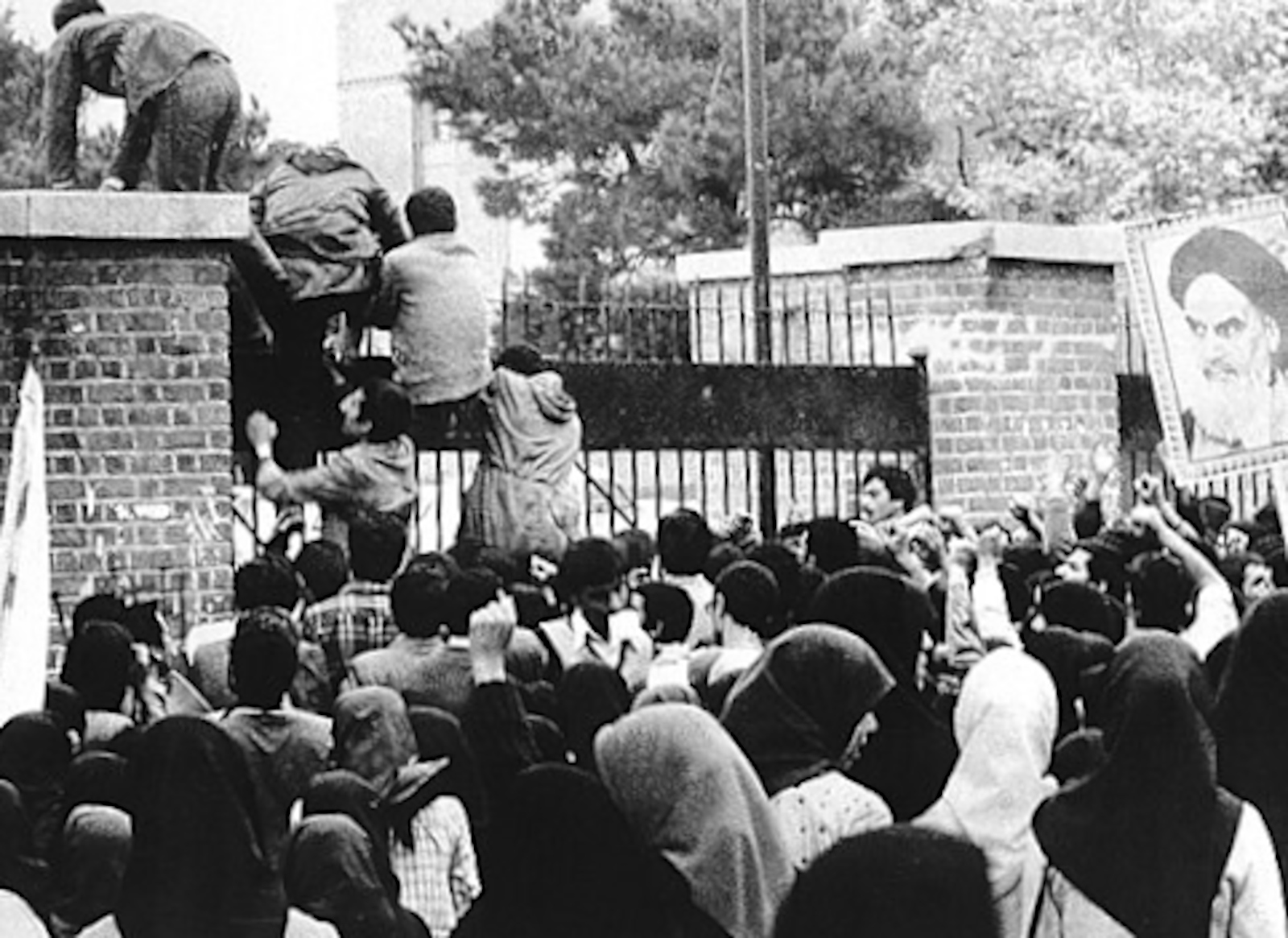
World events: Greece joined the European Economic Community; and Iran released the remaining 52 American hostages, minutes after Ronald Reagan was sworn in as President, ending the Iran hostage crisis.
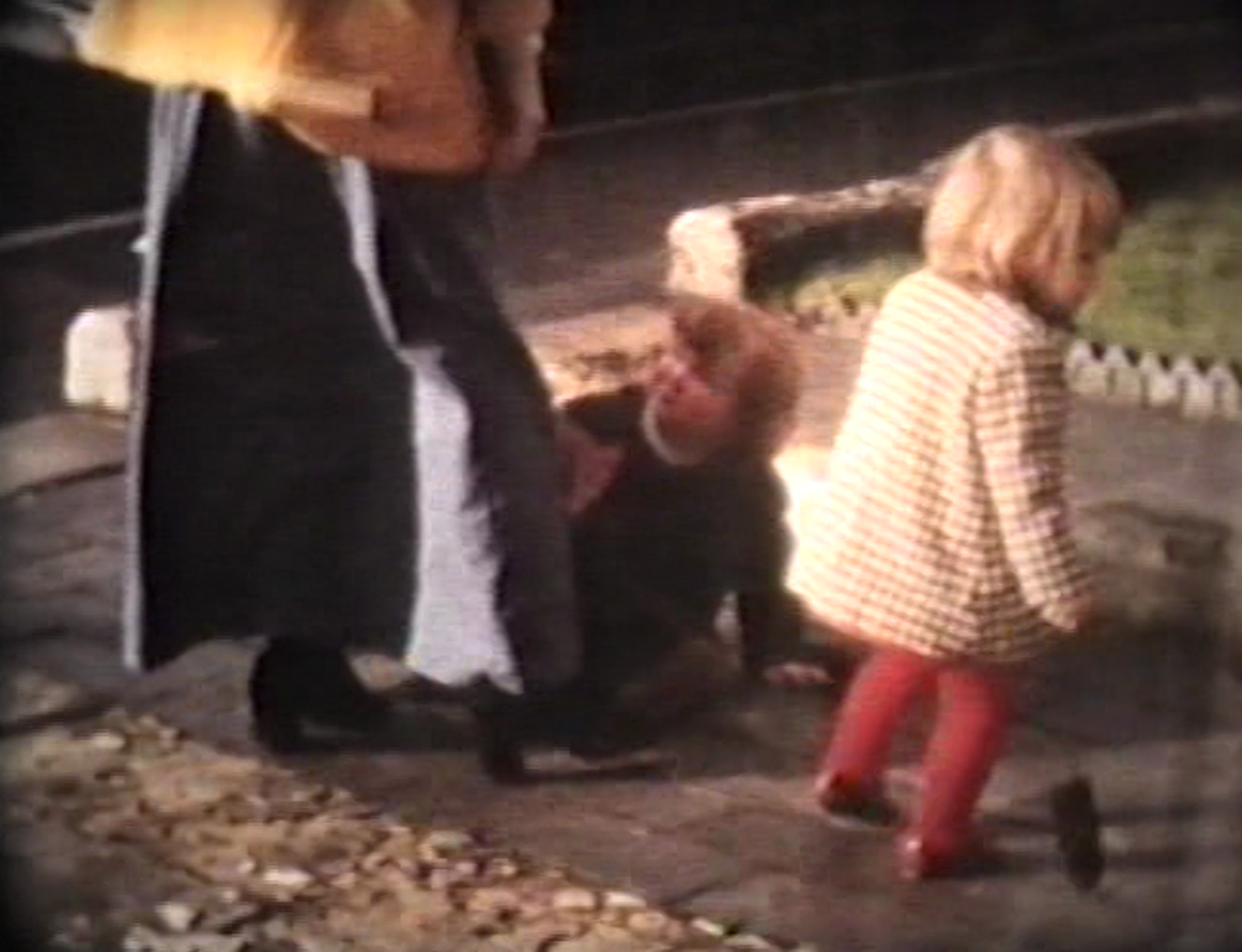
The photo is from February 1976 as I could find nothing for January. It shows Cindy with Gavin and Rebecca walking towards the front door at Churnside.
Debbie was 10 months old in January and we were regularly meeting our friends Tony and Faith for prayer and to explore ways to go deeper in our knowledge and experience of meeting and living non-denominationally. Others were beginning to join us too, but just in ones and twos at this stage. Judy and I were still regularly at Horsecastle Chapel on Sundays too. There was a certain tension about this as the Horsecastle elders worried that we might come off the rails meeting without oversight with all these other odd people (from their point of view).
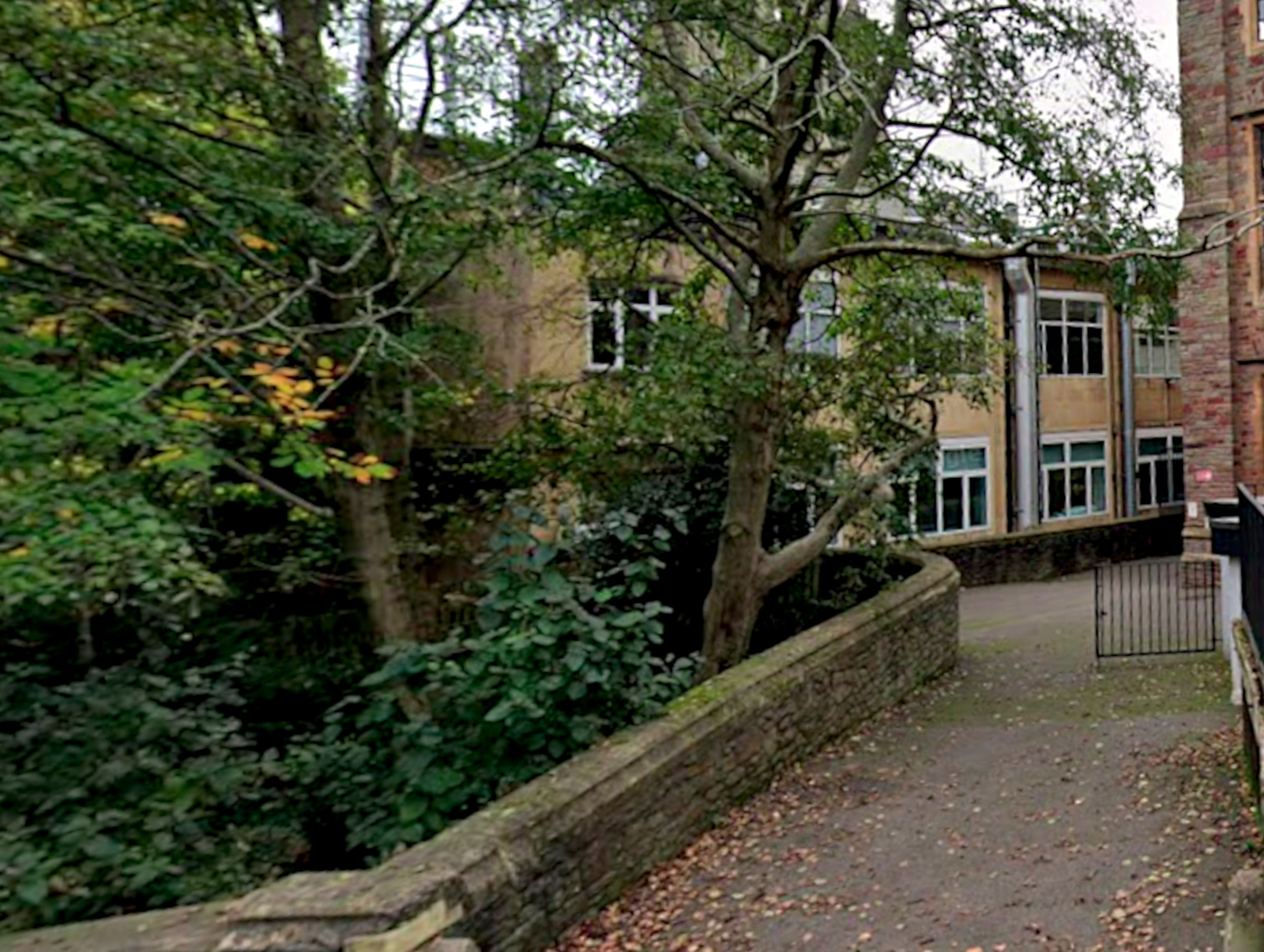
Judy’s temporary Christmas job at a Bristol department store came to an end once the January sales finished. She began her new job as a lab assistant in the Woodland Road Biochemistry Lab at Bristol University. I think the photo shows the same building in 2008, though I can’t be certain. She worked for Dr Mike Tanner who was doing research on a human erythrocyte membrane protein. They used out of date donated blood from Bristol Royal Infirmary, prepared erythrocyte ghosts (empty cell membranes) and extracted the proteins. I think they were studying Protein D as it was then called, and assembling amino acid sequences. It involved a lot of acrylamide gel chromatography although the lab was the proud owner of an early amino acid sequencer that could analyse short peptides automatically. The short sequences had to be manually matched and assembled into longer sequence maps.
Our bed-sit was cramped and very basic, but it was home. We still had our first car, ‘Pumpkin’, a Ford 100E sidevalve engine with a 3-speed gearbox. In the mornings I’d drive to the top of Park Street and drop Judy off near the Wills Building, then drive to Long Ashton. I forget what the evening arrangement was, probably I parked on Woodland Road and we drove from there to the bed-sit at 59 Linden Road. We were saving money now and starting to look at the possibility of an unfurnished flat and we might have made the move later in the year.
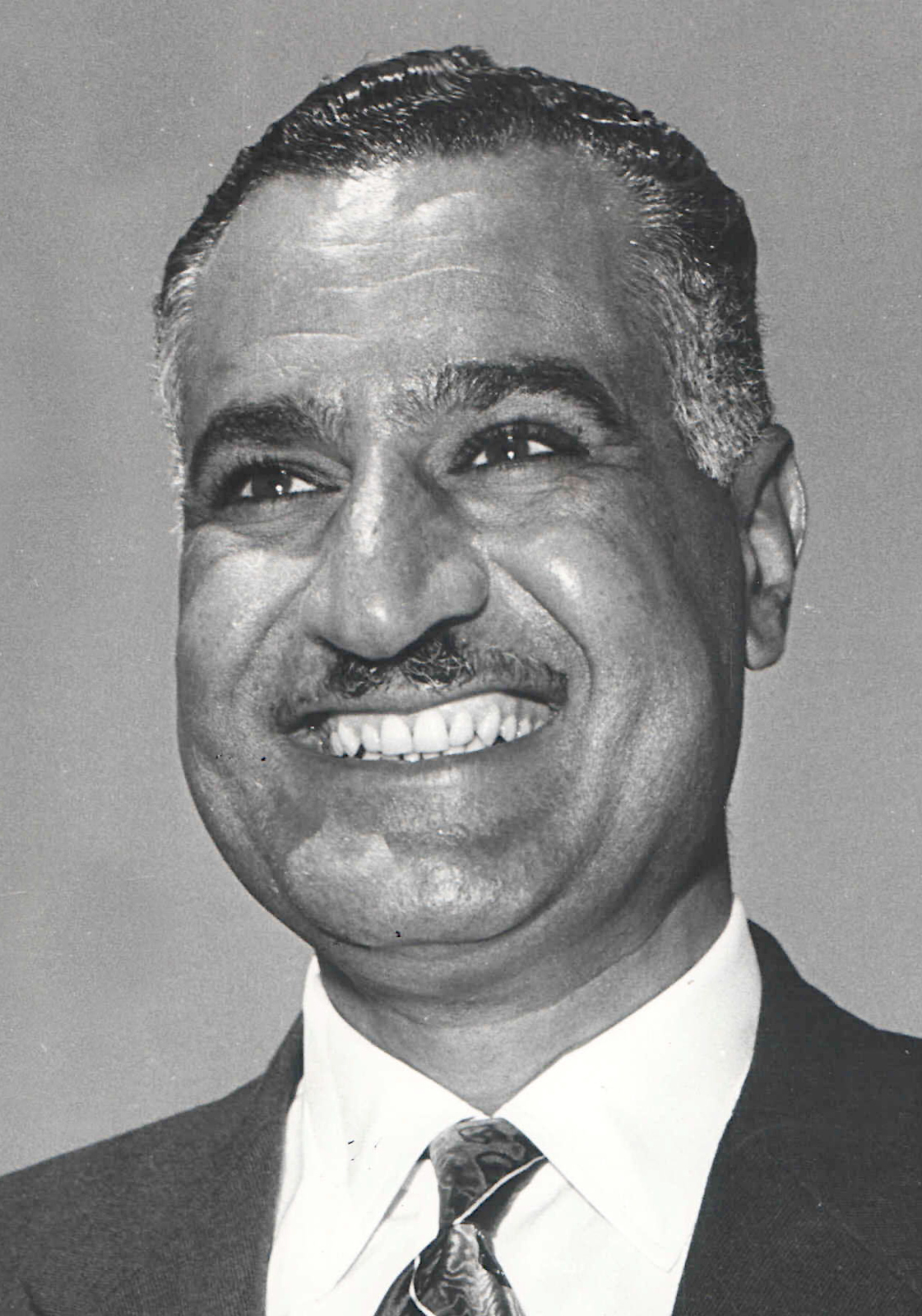
World events: In the Ibrox disaster, 66 people died and over 200 were injured in Glasgow during a spectator crush at a football match; and the Aswan High Dam was officially opened in Egypt.
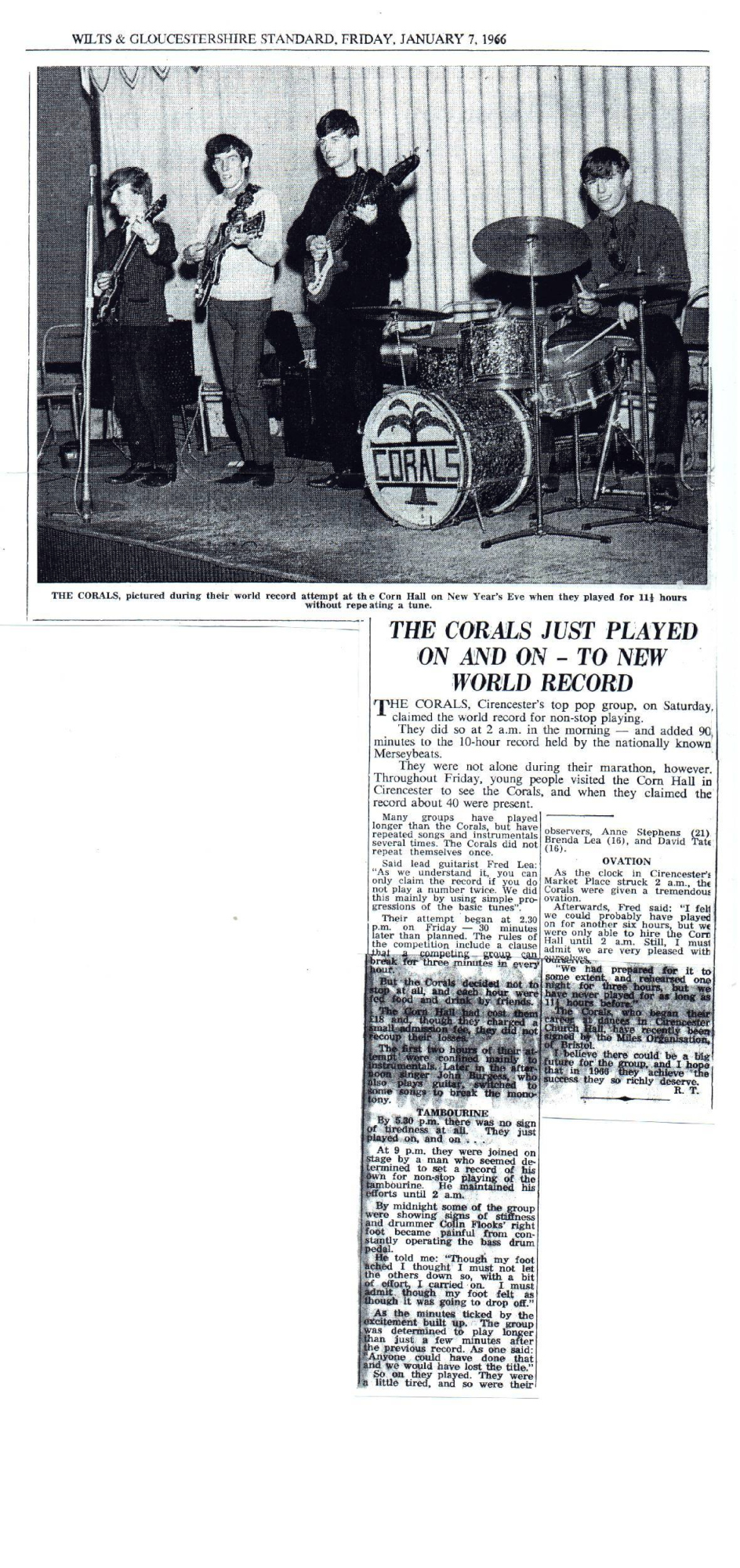
The Wilts and Gloucestershire Standard, one of the local newpapers in the area, published a story on 7th January about The Corals, a local pop group who hired Cirencester’s Corn Hall on New Year’s Eve to attempt a world record of playing popular music without repeating a tune. They played for 11½ hours so did indeed smash the previous record of 10 hours.
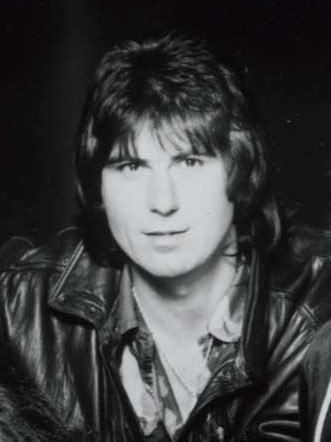
What was not reported (because nobody knew) was that the drummer, Colin Flooks, would later become world famous as Cozy Powell, playing with bands like Black Sabbath as well as with Brian May and other famous performers. Colin was in my class (1B) when we started at Cirencester Grammar School in 1959.
World events:Indira Gandhi was elected Prime Minister of India and was sworn in on January 24; and the Radio Caroline ship Mi Amigo ran aground on the beach at Frinton-on-Sea.
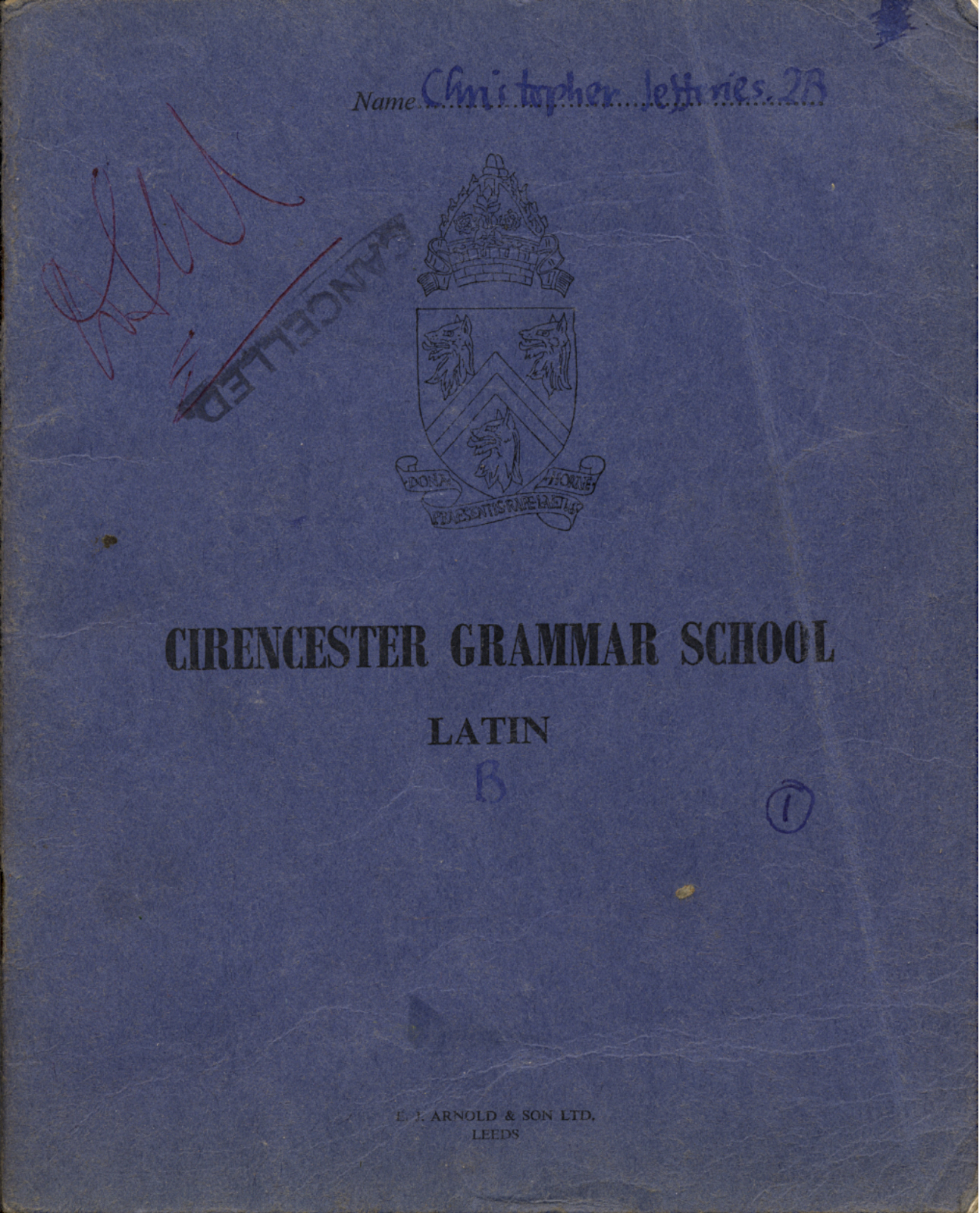
I was studying a range of subjects in Class 2B, including Latin for a second year. The photo shows the cover of one of my exercise books. We began in years 1 and 2 with a wide range of subjects, but these changed after the second year, I was not doing well with Latin so discontinued it at the end of the summer term in 1962.
The third year of my time at Querns School continued into its second term. Christmas and New year were already done and we were starting to look forward to Easter, and beyond it the long summer holiday.
I was in the third year at Querns School (my junior school). I was excited as I was seven-years-old now and feeling much more confident with school work, the environment and my fellow pupils. But it was still good to go home at the end of the school day to eat a meal with Mum, Dad and Cindy (we called it tea, dinner was the midday meal). Sometimes before bedtime we’d have a cup of hot chocolate or Ovaltine as a bit of a treat. If you had something to eat in the evening it would be supper. Perhaps if we’d been out all day we might have fish and chips in newspaper. Now that was a treat!
Whirlybirds
Fridays were special because they were followed by Saturday and Sunday when there was no school at all. All day to play in the garden with Linda and Graham Watts from next door, or walk to the little shop near the Golden Farmer pub to buy bacon or a loaf of bread for Mum and perhaps some sweets. Mr and Mrs Watts had a TV and often we’d go round to watch Whirlybirds or The Lone Ranger. Click on the link, choose an episode, and watch!
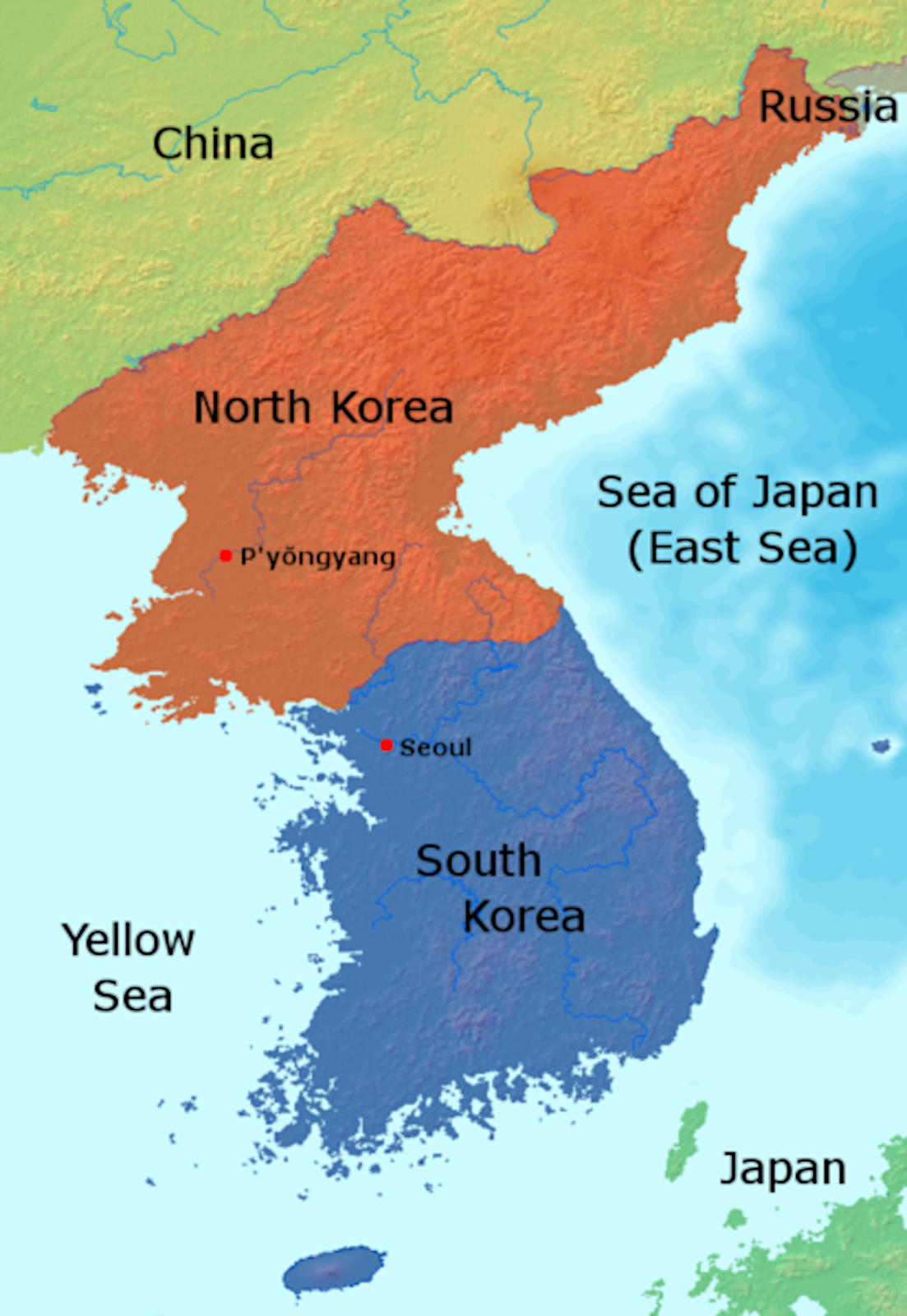
The Korean War was in full swing, and I remember Dad getting his RAF kitbag out of the loft and going away to Kent for a week or two to train on the latest Radar systems. I don’t know when this happened, of course or even if it was in 1951. The Korean War ran from June 1950 to July 1953 and it seems to me that Dad’s absence for training was before Cindy was born in October 1951. It makes sense that if they were going to retrain people they’d have done it early during the war.
In January, Dad was receiving tobacco from Lilias as well as from Bob and Betty (Mike’s brother and sister-in-law). His Uncle Herbert (his Father’s brother) had left him a £50 legacy in his will. He had a bad dream about Lilias on 3rd/4th.
On 7th he had a second flight in the Avro Anson and photographed the runways from the air. By 10th he was worried because he’d had no recent letters from Lilias, a letter came on 11th to say she’d been ill. He had a further hour in the Anson and this time was given a chance to try the controls (he would have so loved that!) On 16th he heard that his friends Joe and Dorothy were engaged to be married. He watched quite a few films during January as well. Mike also took photos of the Anson, a Stirling, and his garry (lorry).
World events: The first meeting of the United Nations was held, at Methodist Central Hall Westminster in London; and Project Diana bounced radar waves off the Moon, measuring the exact distance between the Earth and the Moon, and proving that communication is possible between Earth and outer space.
There’s not enough information to write something for every month in the 1940s. Mike’s diaries start in January 1943, so for January 1940 to December 1942 I’ll write about things I know, or draw on dated photos and documents. Sometimes I might use a photo or document with a guessed date.
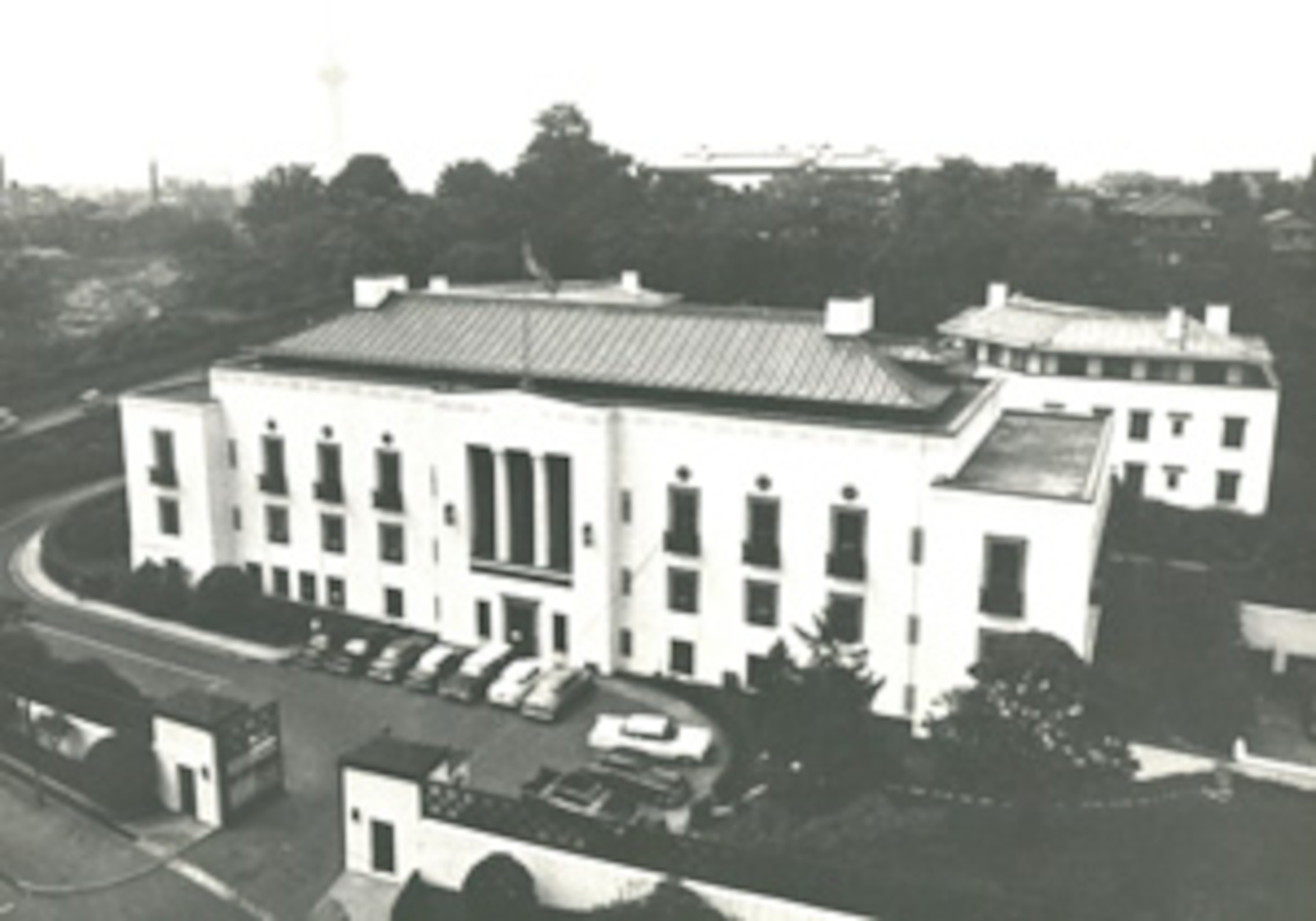
US Embassy in Japan, 1931
Mike would have been 15 and still at school, possibly at Cirencester Grammar School or perhaps already at Rendcomb College just north of Cirencester. His older brothers were all serving with British forces in the Second World War. His father was managing the family business (John Jefferies & Son Ltd) on his own with help from some paid staff, but even these would have been in short supply due to the need for fighting men. It must have been a difficult time.
World events: Australian and British troops defeated Italian forces at the Battle of Bardia in Libya; and the US ambassador to Japan, reported to Washington a rumour overheard at a diplomatic reception, concerning a planned surprise attack on Pearl Harbor, Hawaii.
Anything that appears in this section will have some connection with the 1930’s but may extend beyond the decade to follow a meaningful topic more fully.
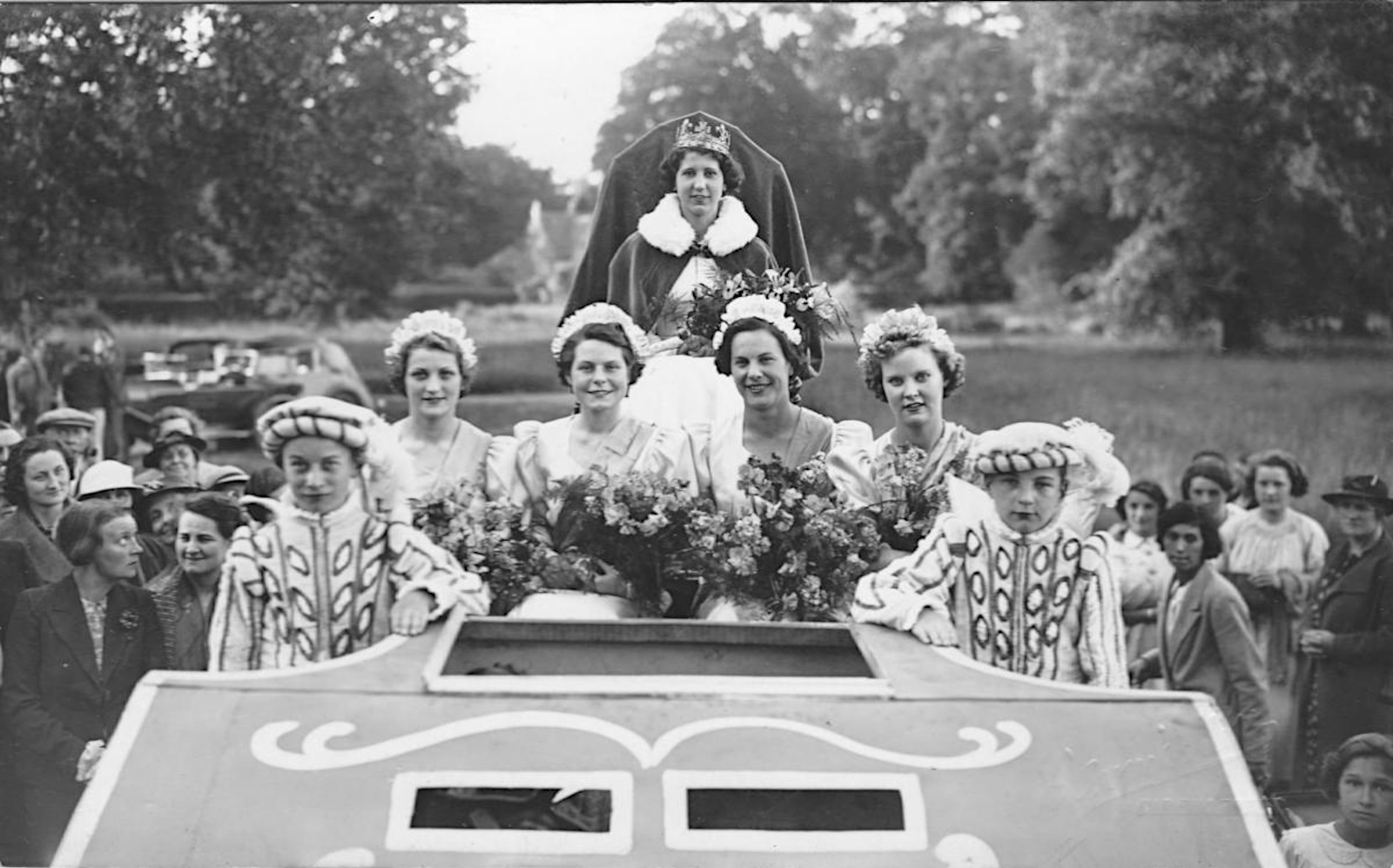
Cirencester traditionally had a town carnival every August. These petered out and were discontinued, I think in the 1970s. The photo shows the Carnival Queen and her attendants in the 1939 Carnival.
The Carnival procession made its way through the Market Place and along Dyer Street and then Victoria Road to a field at Watermoor where there would be tents, amusements and fairground rides.
This photo taken 95 years later in December 2025 is seen from the same angle. I thought there’d have been no mill here in the 1930s, but the photo was made from a footbridge that’s still there and is in daily use as part of Riverside Walk. There is no mill here today, though, so there’s a fuller story to discover if and when anyone has the time and inclination to dig a bit deeper.
World events (January 1931): The cyclotron was invented (used to accelerate sub-atomic particles to study nuclear physics). (January 1936):Radium E (bismuth-210) became the first radioactive element to be made synthetically.
As with the 1930s material, everything in this section will have a connection of some kind with these two decades.
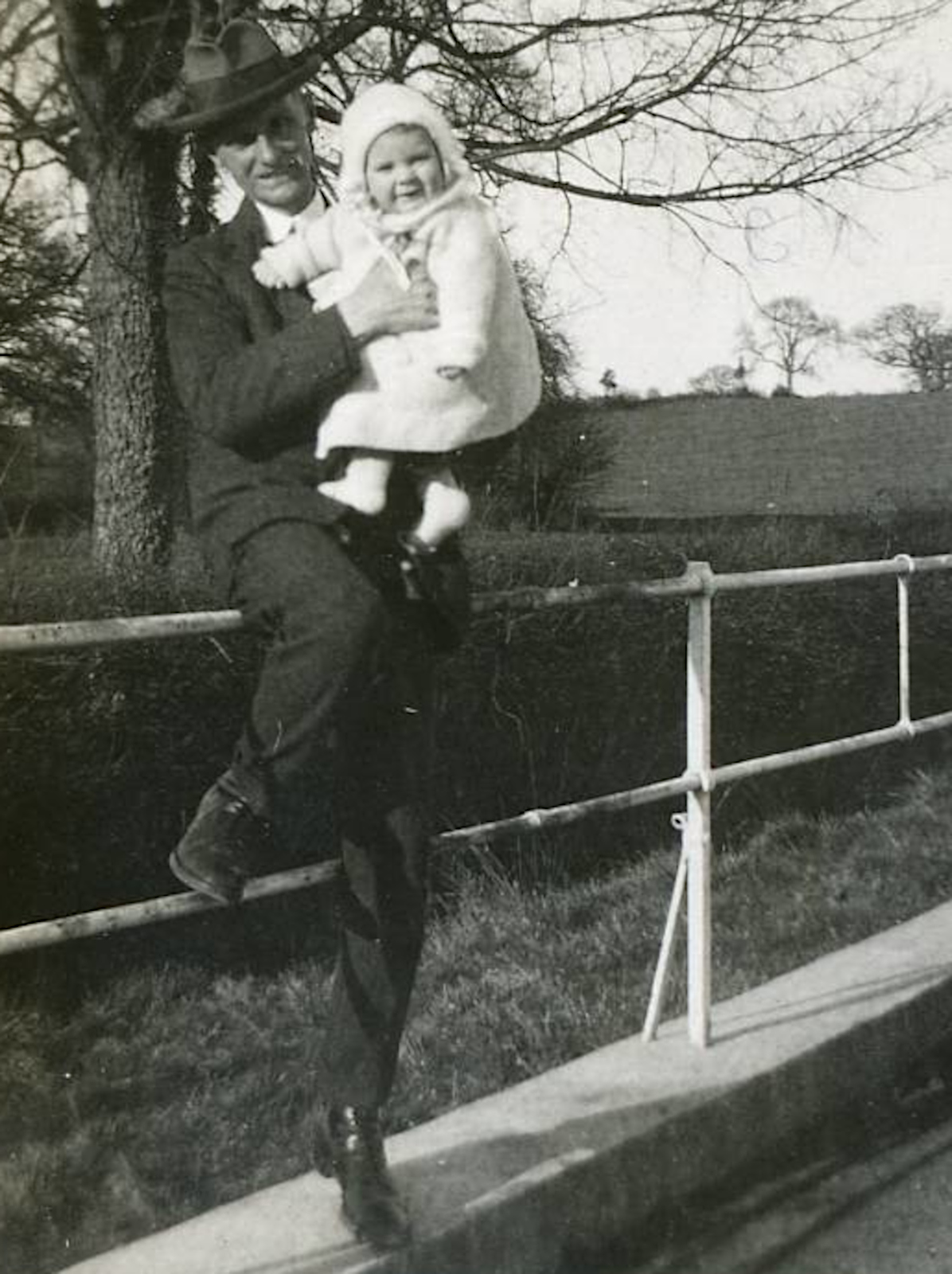
Ted and Mike
Mike (my father) was born on 4th June 1926. The photo shows him with his father, my grandpa, Ted. The album holding this photo probably belonged to Mike’s older brother, Dick and this page is clearly marked 1927. The trees in the photo are leafless, so we can date the photo to wintertime which would put Mike at around 18 months old.
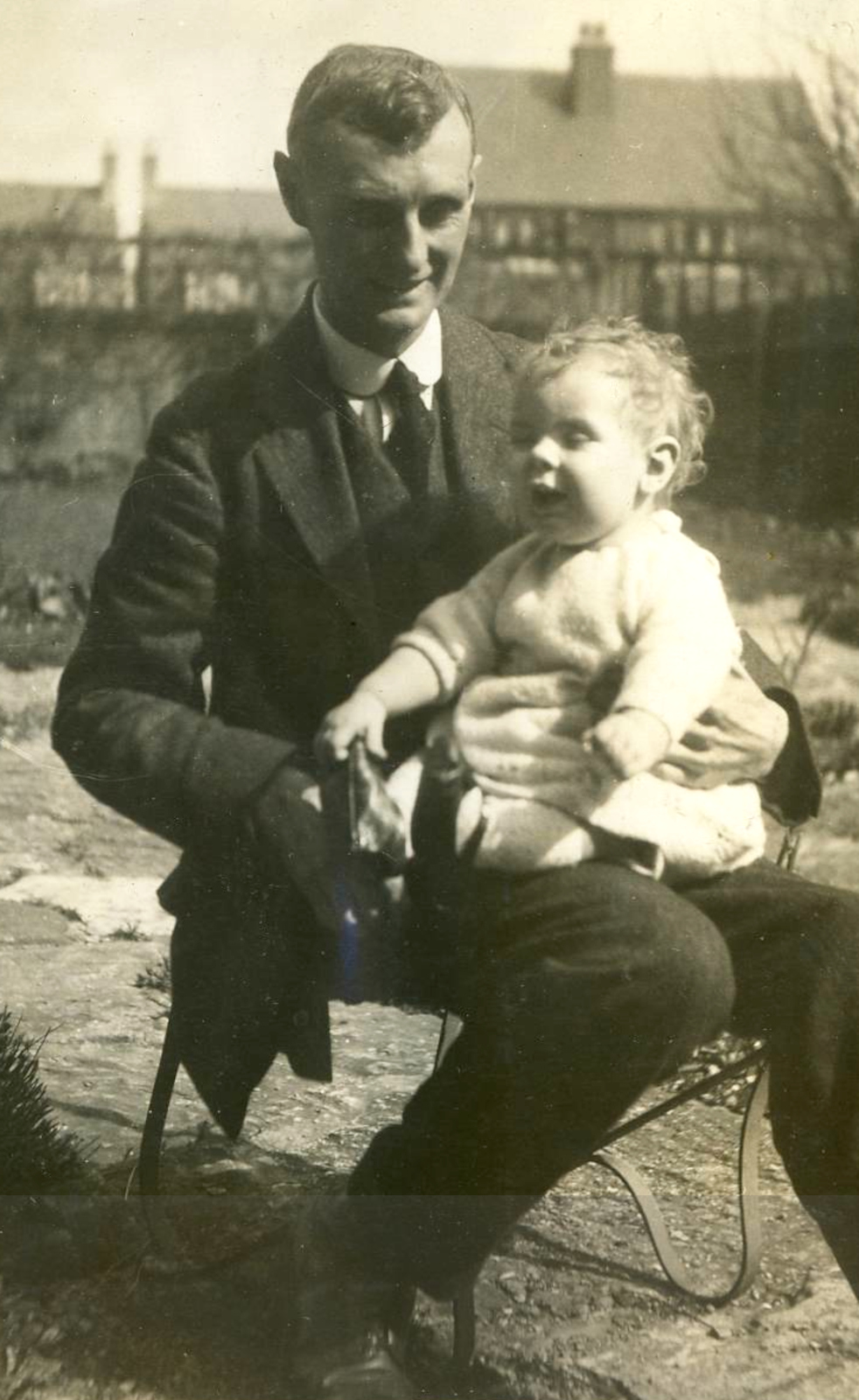
At Churnside
The second photo was on the same page so is also from 1927. It might have been a warm day in October, perhaps, and was taken in the back garden of Churnside, 37 Victoria Road.
This month I thought I’d provide a pen picture of Alice Freeth (later Jefferies) who married John Jefferies . Alice was born in 1810 in the village of Minety and baptised on 5th August 1810, her parents were Robert and Elizabeth Freeth. I do have some photos of her, but can’t find them right at this moment. I’ll add one later as and when.
Family connections
Parents – Robert and Elizabeth Freeth of Minety
Born – July/August 1810 (baptised 12th Aug 1810)
Died – 29th December 1893
Married, around 1842 or 1843) – John Jefferies of Somerford Keynes
Siblings – Unknown
Children – William John (1844), John Edwin (1845), Alice Mary (1847), Edward (1849), Julia Anne (1851), Henrietta (1854), Agnes Henrietta (1855)
John and Alice moved to Cirencester, perhaps when John took over the Gregory Nursery business or maybe before that while he was still employed by Richard Gregory. In any case, the census for 1881 records them as living at Minerva Villa in Cirencester. Although we don’t have a marriage date, Alice and John’s first child was born in June 1844 so it’s likely they married in 1842 or 1843 when Alice was in her early thirties and John about 30. Henrietta died as an infant aged just one month, so that would have been a time of great difficulty and sadness for them both.
If you enjoyed this or found it useful, please like, comment, and share below. (If you don’t see those links, click the article’s title above the main photo and they will appear.) Send a link to friends who might enjoy the article or benefit from it – Thanks! My material is free to reuse (see conditions), but a coffee is always welcome and encourages me to write more often!
You see the lights and you might hear the engine or the sound of the tyres on the road surface. But there’s no way you could tell the make and model of the car. The details are hidden.
What’s in an image? Sometimes quite a lot, more than meets the eye. I’m posting an image every few days.
Click images to enlarge
Sometimes it’s foggy in Cirencester. The Cotswolds is in the south-west of England and the prevailing winds come from the south-west and are laden with water vapour after crossing the Atlantic. As the air rises over the Cotswolds and other hilly country, some of that water vapour condenses as rain and some as fog. Once the sun appears, any mist or fog clears away with the rising temperature.
It’s all in the detail
As you look at the scene in the photo, you’ll notice right away that the fog obscures details on the church tower while the details on the nearer, and much less tall buildings in the foreground are quite sharp. This is always the way of things in foggy conditions. Nearby objects reveal more detail than those further away. If you stood near the base of the tower and looked towards the top you’d see the same thing. Stonework at the same level as your head would be clear, but raise your gaze to the top of the tower and you’d see few details. In heavy fog you might not see the top of the tower at all.
This is a great illustrative parallel of our ability to see spiritual details too. Look at the people around you and you see a lot of detail – hair colour, eye colour, style of hair, details of clothing , now look up and the detail seems to vanish. The Bible tells us that the Creator is hidden in dark clouds. The English words dark and darkness didn’t traditionally mean an absence of light, the sense was of something hidden from view. When you look into the headlights of a car coming towards you at night you see the lights and you might hear the engine or the sound of the tyres on the road surface. But there’s no way you could tell the make and model of the car. The details are hidden although (or even because) there’s so much light.
Yahweh (God) is like that too, as you get to know him the first thing you’ll understand is the simplest thing of all – he is there! Just an indistinct outline in the distance. As you draw closer, gradually you’ll begin to see how brightly he shines, but spend some time with him and more detail will appear, not what he looks like because he’s not a physical object in our universe, but you’ll start to see that he consists of a pure love, you’ll notice that he cares deeply about everyone, not just his followers, that he is the source of such things as peace, and grace, and joy, and that he knows you better than you know yourself. This experience feels very like walking towards an object almost invisible in the fog and discovering it to be a beautiful tree or an an amazing building. And the closer you get, the more detail you can distinguish – the veins on the leaves or the surface details in the stone.
Making a start
But how can you begin to know him? Where do you start? The answer is simple, begin right where you are right now. Start by noticing that the people you know (and you yourself) have a threefold nature. You are physical, like a stone or a puddle of water, but you also have a mind – utterly unlike a stone or a puddle! Is it so surprising, then, that there’s a third dimension to your existence and nature? These dimensions overlap yet they are distinct.
Your physical presence can be measured just like that of a stone, you have a certain size, shape, and mass, if you’re in motion you have measurable velocity, direction of movement, momentum and so forth. You possess colour and reflectivity. But overlapping with this physical presence are your senses of touch, sight, hearing and the rest.
The stone lacks these abilities. You have a brain that constantly evaluates the information coming from your senses and combines them into knowledge of your environment. This makes you aware of other objects (don’t trip over that stone, don’t step in that puddle), other lifeforms (chase away the fly that has landed on your arm, don’t step on that frog on the footpath), other people (talk to your neighbour, pay for the item you just bought, wave to your friend across the road, ask for directions).
Pushing through the fog
And that third dimension? Most of the overlap here is with your emotions, the love you feel for family and close friends, the fears you entertain (fear of death, fear of injury, fear of loss). There’s a spiritual element to your nature that overlaps mere emotion and goes way beyond feelings. This is another dimension that you can explore and it’s part of our nature that we sometimes fail to consider and rarely, if ever, visit.
So go there, move towards that somewhat foggy zone and the further you go, the more you will see. And I can assure you, the more you see the more you’ll be drawn along to explore further because what you find will be delightful, encouraging and fulfilling. And remember, in the fog, the further and higher you look the less you will see. But go closer and the details will become clearer. Drawing close is the only way to deal with fog.
And there’s a huge additional advantage, the physical and the mental aspects of your existence will pass away, the atoms of your body will be recycled, dispersed, and used to construct other things. But the overlapping spiritual aspects remain, because they are not dependent on the physical world in any way, they remain.
If you enjoyed this or found it useful, please like, comment, and share below. (If you don’t see those links, click the article’s title above the main photo and they will appear.) Send a link to friends who might enjoy the article or benefit from it – Thanks! My material is free to reuse (see conditions), but a coffee is always welcome and encourages me to write more often!
How extraordinary to see both lava and snow close together, lava inside the volcano and snow on the slopes outside. Truly, the natural world is completely amazing.
What’s in an image? Sometimes quite a lot, more than meets the eye. I’m posting an image every few days.
Click images to enlarge
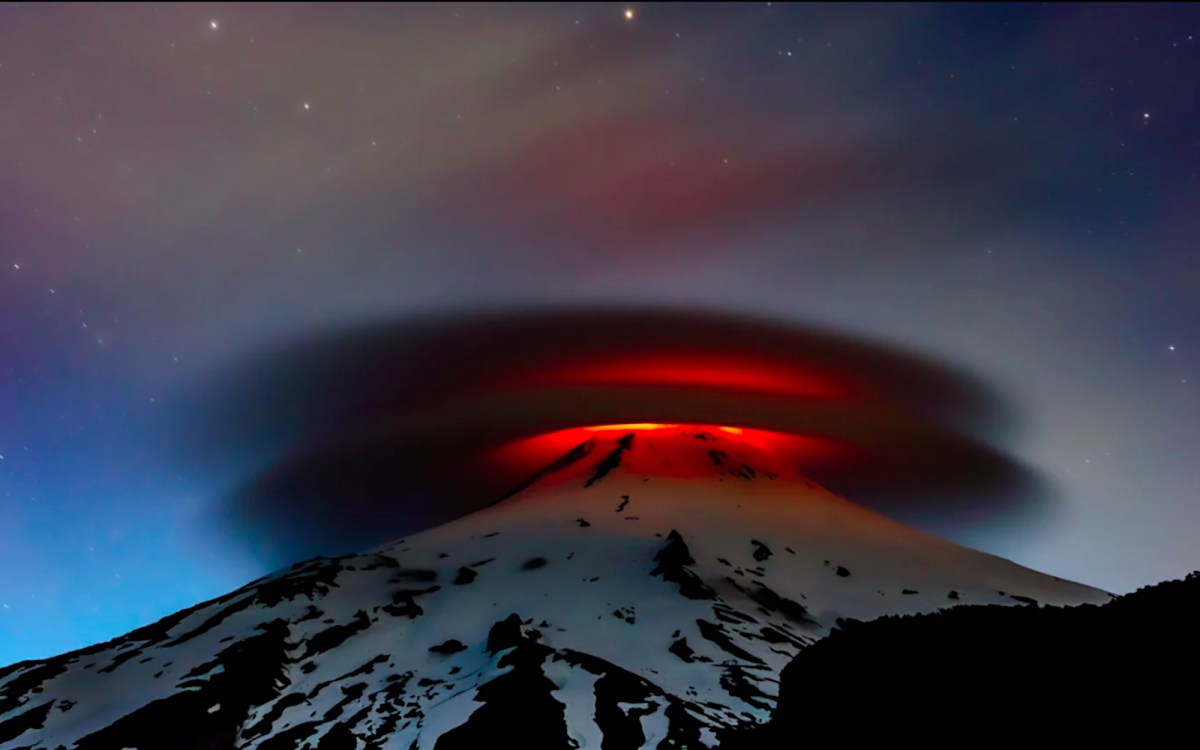
This photo really is extraordinary. Take a guess at what might be going on here first. Then I’ll tell you all about it.
Needless to say, I did not take this photo. It was in Nature Briefing, anyone can sign up free of charge for science news and photos from the prestigious scientific journal, Nature. The signup link is in the upper, right of the Nature home page.
The image was made by the photographer Francisco Negroni and shows Villarrica, described as the most dangerous volcano in Chile. (You can buy a much more detailed version of this image online.)
Two heavy, dark clouds have formed over the volcanic caldera, illuminated by the lava. The heat of the lava below has evaporated the central part of both these clouds, forming them into perfect rings. The sky was already dark enough for stars to be visible. How extraordinary to see both lava and snow close together, lava inside the volcano and snow on the slopes outside. Truly, the natural world is completely amazing.
Think about that last point, lava is literally red hot, around a thousand degrees C, snow is made of water ice, it can’t exist above 0 C at atmospheric pressure. The volcanic rock between the lava and the ice provides sufficient thermal insulation to allow these incompatible materials to survive inside and outside the volcanic cone at the same time!
People of faith may say that God made it that way, people of science will provide a physical explanation. Many people, perhaps even most, might argue these two views are incompatible. But that’s not necessarily the case; there are many people who are both good Christians (or Muslims, Jews, Buddhists or Hindus) and also good scientists. Very often faith communities have enabled and supported great advances in science and technology, enabling us to understand and explain all sorts of phenomena in mechanistic ways that sometimes seem not to require any kind of faith at all. It’s a conundrum that philosophers sometimes explore and discuss.
If you enjoyed this or found it useful, please like, comment, and share below. (If you don’t see those links, click the article’s title above the main photo and they will appear.) Send a link to friends who might enjoy the article or benefit from it – Thanks! My material is free to reuse (see conditions), but a coffee is always welcome and encourages me to write more often!





 Journeys of Heart and Mind

.svg)


