Advent Market

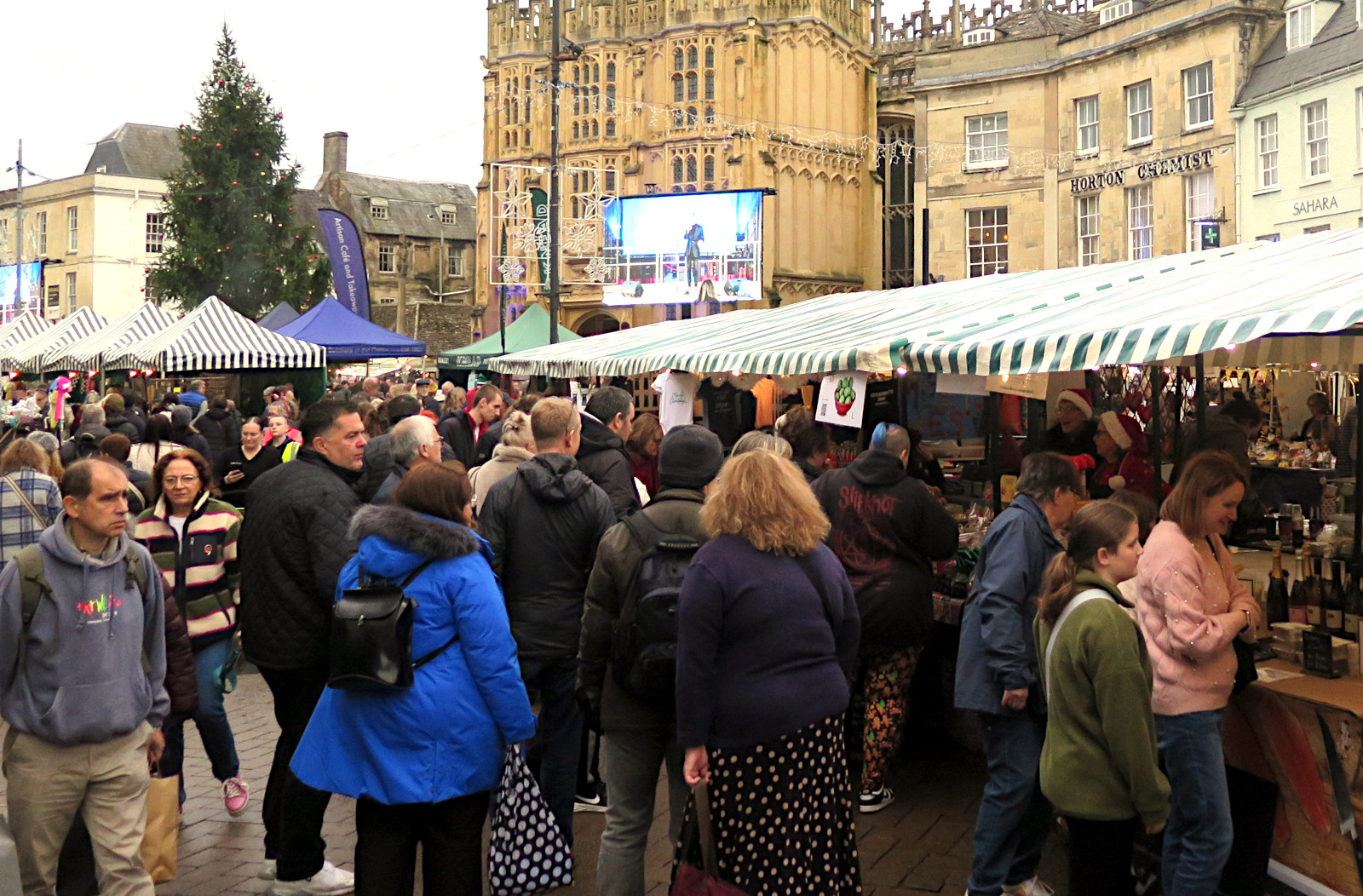
Everything imaginable is on sale, delicious foods, jigsaws, Cotswold beers, British and French cheeses, hand-crafted items from socks to coasters, picture frames, baskets, and much, much more.

< Previous | Index | Next >

Click to enlarge

Image 97 – What’s in an image? Sometimes quite a lot, more than meets the eye. I’m posting an image every day or so.

This is Cirencester’s annual Advent Market, when streets in the centre of the town are closed to traffic for two days and market stalls appear in place of the traffic. Everything imaginable is on sale, delicious foods, jigsaws, Cotswold beers, British and French cheeses, hand-crafted items from socks to coasters, picture frames, baskets, and much, much more. There’s live music and it’s the time of year when the town’s Christmas lights are turned on for the first time.

Donna and I walked into town to see what was happening, we had sausage sandwiches and coffees for lunch at Hugh’s first, then walked around to check out the market stalls.

People love events like this, clearly. It was heaving with far more people than we usually see in town. All ages were represented, people came in from the local villages as well and it was so packed that it was sometimes difficult to see what was on display.

Here’s a short video clip to give you a sense of the atmosphere at the Advent Market. I had to hunt out a less crowded area on the fringe to record this!

When: 30th November 2024
Where: Cirencester Market Place

See also:
Cirencester

For convenience, here’s a list of all the Cirencester area images:

A417 roadworks, Advent Market, Bishops Walk, Baunton, Canal 1, 2, Castle Street, Christmas lights 1, 2, Church 1, 2, 3, 4, 5, 6, Churn flood, Countryside, Fallen tree, Fleece, Gasworks, Gloucester Street, Hare 1, 2, Hospital, Market Place 1, Phoenix Fest, Riverside Walk, Stone plaque, Stratton Meadow, Tank traps, View, Wonky 1, 2, Yellow Iris

Themed image collections

The links below will take you to the first post in each collection

Cirencester, Favourites, Irish holiday 2024, Roman villa

< Previous | Index | Next >

Useful? Interesting?

If you enjoyed this or found it useful, please like, comment, and share below. (If you don’t see those links, click the article’s title above the main photo and they will appear.) Send a link to friends who might enjoy the article or benefit from it – Thanks! My material is free to reuse (see conditions), but a coffee is always welcome and encourages me to write more often!

Photos in Nature

Scientific images are always informative if you are a specialist in that particular discipline, but they are often very attractive in their own right too.

Here’s a fine selection of amazing images, beautifully presented by the journal Nature.

The photos were included in their latest alerts email, you can sign up for free if you want to (link near the top-right of their home page). You won’t always receive a collection of images like these, but you will see science news stories with interesting individual photos included.

Scientific images are always informative if you are a specialist in that particular discipline, but they are often very attractive in their own right too. I’m sure you’ll agree if you look through the selection presented here.

Useful? Interesting?

If you enjoyed this or found it useful, please like, comment, and share below. (If you don’t see those links, click the article’s title above the main photo and they will appear.) Send a link to friends who might enjoy the article or benefit from it – Thanks! My material is free to reuse (see conditions), but a coffee is always welcome and encourages me to write more often!

A rose in the rain

Is a rose with raindrops on its petals any less beautiful than a rose with dry petals? No, in fact many would say it looks even better with a few raindrops on it.

< Previous | Index | Next >

Image 96 – What’s in an image? Sometimes quite a lot, more than meets the eye. I’m posting an image every day or so.

Click to enlarge

What’s in a name? That which we call a rose,
By any other name would smell as sweet

William Shakespeare, Romeo and Juliet

Juliet spoke these words of Romeo, his surname was a practical issue between rival families, but she loved him regardless.

Is a rose with raindrops on its petals any less beautiful than a rose with dry petals? No, in fact many would say it looks even better with a few raindrops on it. They emphasise its freshness, and they highlight its apparent fragility while revealing an unexpected robustness.

A rose in the rain is a lovely thing! I hope you like this one; I just had to take a photo. The cultivar is ‘Queen of Sweden’ and it was released in 2004 by David Austin.

When: 8th September 2024
Where: Anglesey Abbey, Cambridgeshire, England

See also:
Favourites

For convenience, here’s a list of my favourite images:

Anemone, Cloud, Honeybee, Hydrangea, Kiftsgate1, Kiftsgate2, Large White, Mugshot, Nelson, Robin, Rose, Spilhaus, Sunset1, Weston beach

Themed image collections

The links below will take you to the first post in each collection

Cirencester, Favourites, Irish holiday 2024, Roman villa

< Previous | Index | Next >

Useful? Interesting?

If you enjoyed this or found it useful, please like, comment, and share below. (If you don’t see those links, click the article’s title above the main photo and they will appear.) Send a link to friends who might enjoy the article or benefit from it – Thanks! My material is free to reuse (see conditions), but a coffee is always welcome and encourages me to write more often!
Spilhaus projection

Quite beautiful in it’s own right, it provides a holistic view rather than focusing on one ocean at a time

< Previous | Index | Next >

Image 95 – What’s in an image? Sometimes quite a lot, more than meets the eye. I’m posting an image every day or so.

Click to enlarge
(Wikimedia)

Sometimes, looking at things in a different way makes a world of difference (pun slightly intended).

This is a map projection much loved by oceanographers and other scientists researching related subjects such as marine life. It makes the world’s oceans the entire focus. Clever!

Athelstan Spilhaus invented this map projection; he was born in Cape Town in 1911 and worked at Woods Hole, Massachusetts, from 1936. In 1942 he began developing ways of mapping that would focus attention on the world’s oceans. This Spilhouse Projection is not the only result of his mapping work by any means, but it’s arguably the most impressive. Quite beautiful in it’s own right, it provides a holistic view rather than focusing on one ocean at a time.

When: 16th June 2023
From: NASA’s Scientific Visualization Studio

See also:
Favourites

For convenience, here’s a list of my favourite images:

Anemone, Cloud, Honeybee, Hydrangea, Kiftsgate1, Kiftsgate2, Large White, Mugshot, Nelson, Robin, Rose, Spilhaus, Sunset1, Weston beach

Themed image collections

The links below will take you to the first post in each collection

Cirencester, Favourites, Irish holiday 2024, Roman villa

< Previous | Index | Next >

Useful? Interesting?

If you enjoyed this or found it useful, please like, comment, and share below. (If you don’t see those links, click the article’s title above the main photo and they will appear.) Send a link to friends who might enjoy the article or benefit from it – Thanks! My material is free to reuse (see conditions), but a coffee is always welcome and encourages me to write more often!

Large White

The adult in the photo is feeding on nectar from a Buddleia inflorescence. Butterflies and bees home in on these.

< Previous | Index | Next >

Image 94 – What’s in an image? Sometimes quite a lot, more than meets the eye. I’m posting an image every day or so.

Announcement – I’m making a few more changes, The image number is moving down so the title can be more relevant to the content, and I’m adding date and place for the image source.

Click to enlarge

The large white butterfly is the bane of vegetable gardeners. The adult females lay their eggs under the leaves of brassica crops – cabbages, cauliflowers, brussels sprouts and more. The caterpillars that hatch out feed voraciously on the plants, and as they grow larger they consume the leaves faster and faster, sometimes leaving just a stalk and nothing for the gardener to harvest.

The adult in the photo is feeding on nectar from a Buddleia inflorescence. Butterflies and bees home in on these. Although the photo’s one of my favourites, it’s technically poor as it’s enlarged from a small part of a shot taken back in September. Still – I like it and I want to share it.

When: 16th September 2024
Where: Hidcote Garden, Gloucestershire, England

See also:
Favourites

For convenience, here’s a list of my favourite images:

Anemone, Cloud, Honeybee, Hydrangea, Kiftsgate1, Kiftsgate2, Large White, Mugshot, Nelson, Robin, Rose, Spilhaus, Sunset1, Weston beach

Themed image collections

The links below will take you to the first post in each collection

Cirencester, Favourites, Irish holiday 2024, Roman villa

< Previous | Index | Next >

Useful? Interesting?

If you enjoyed this or found it useful, please like, comment, and share below. (If you don’t see those links, click the article’s title above the main photo and they will appear.) Send a link to friends who might enjoy the article or benefit from it – Thanks! My material is free to reuse (see conditions), but a coffee is always welcome and encourages me to write more often!

Image of the day – 93

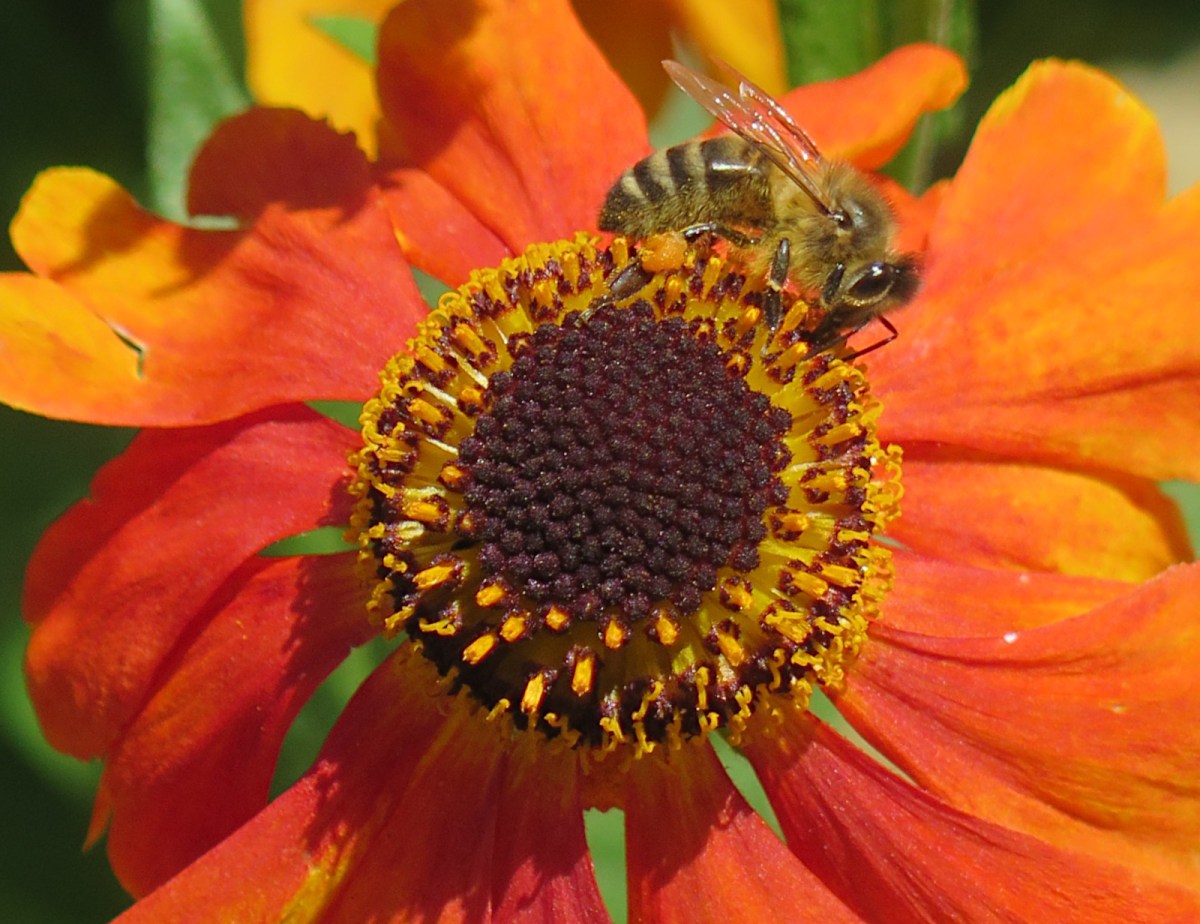
The worker honeybee in the photo is collecting pollen. Insect-pollinated plants have slightly sticky pollen that lodges on the bee’s hairy body. Bees visit flowers to collect nectar from the base of the petals, but get dusted with sticky pollen in the process.

< Previous | Index | Next >

What’s in an image? Sometimes quite a lot, more than meets the eye. I’m posting an image every two days or so.

Click to enlarge

Like all plants and animals, bees are pretty well suited to the actions they need to perform to live and reproduce. That’s what evolution does, it homes in on the best shape and size of wings, the optimum size for flight muscles, best arrangement of hairs on the legs to brush loose pollen towards the pollen sac for collection and transport, the best mouthparts for collecting nectar and so forth.

Quite a challenge, and an astounding achievement, but entirely doable by making small, random changes and selecting the best.

Here’s an example to make that bold claim clearer. If a random change enables the worker bees to carry on just a few days longer in the autumn, the hive will have slightly larger stores of honey for the coming winter. That hive will survive when a hive with less capable workers might not. And that’s enough. The new queens from the surviving hive will carry the altered gene and it’ll be present in the workers of the new colonies those queens create. The altered colonies will also survive in slightly colder places than before so will succeed at slightly higher altitudes and in slightly cooler climates.

The worker honeybee in the photo is collecting pollen. Insect-pollinated plants have slightly sticky pollen that lodges on the bee’s hairy body. Bees visit flowers to collect nectar from the base of the petals, but get dusted with sticky pollen in the process. Bees clean themselves like most insects (you’ve probably seen houseflies doing it, sweeping off particles of dust with one leg while standing on the others). When bees clean themselves, most of the pollen end up stuck together as a lump and lodges on a series of special hairs on the hind legs. Look closely and you can see this bee’s pollen load on its rear leg; an orange/yellow colour. Pollen is protein rich and the bees feed it to the bee pupae in the hive.

The plant feeds the bees nectar for energy and pollen for growing young bees; while the bees move pollen from flower to flower, and often from plant to plant over quite long distances, sometimes a mile or more. So the bees and the plants both benefit, it’s a useful co-operative effort.

Favourites

For convenience, here’s a list of my favourite images:

Anemone, Cloud, Honeybee, Hydrangea, Kiftsgate1, Kiftsgate2, Large White, Mugshot, Nelson, Robin, Rose, Spilhaus, Sunset1, Weston beach

Themed image collections

The links below will take you to the first post in each collection

Cirencester, Favourites, Irish holiday 2024, Roman villa

< Previous | Index | Next >

Useful? Interesting?

If you enjoyed this or found it useful, please like, comment, and share below. (If you don’t see those links, click the article’s title above the main photo and they will appear.) Send a link to friends who might enjoy the article or benefit from it – Thanks! My material is free to reuse (see conditions), but a coffee is always welcome and encourages me to write more often!

Image of the day – 92

If the Universe did not include time, nothing would change and there would be no patterns, no life, just stasis.

< Previous | Index | Next >

What’s in an image? Sometimes quite a lot, more than meets the eye. I’m posting an image every two days or so.

Click to enlarge

Anemones are simple flowers, but beautiful! I have strong childhood memories of the white version of these growing in my grandfather’s garden in Cirencester. They managed to grow in small cracks between the bottom of the house wall and the stone paving. The flowers stood nearly as tall as me so I suppose I might have been between five and seven years old at the time.

The flowers in the photo are at various stages of development:

  • On the stem just right of the centre you can see a few tiny leaves and a little, pale-green flower bud.
  • In the centre, near the top, is a much larger bud, about to open.
  • Right down at the bottom, a flower has opened but the petals are not yet full size and have not developed their final colour.
  • The flower on the left and just below the centre is fully open. There’s a little insect sitting on its centre.
  • Below and right of it is a more mature flower, the yellow anthers have shed their pollen and have shrivelled.
  • A little above and right again is an even older flower, the anthers are in worse condition and some of the petals are damaged around their margins.
  • The flower in the upper left has lost most of the anthers and the petals look tired and old.
  • In the upper-right you can see a flower with only two petals remaining.
  • And just above, the yellow globe is the remains of a flower that has lost all of its petals.

Although they look like pink petals, and I’ve called them that here, botanically speaking these are actually modified sepals. On most flowering plants, the sepals are small and green, normally hidden by the petals.

Patterns of development

The flowers on this Anemone are just one example of the kinds of patterns that come from anything that grows. We’re all familiar with the pattern in humans – fertilised egg, foetus, baby, toddler, pre-teen, young teen, adolescent, young adult, mature adult, early middle age, late middle age, elderly.

And you can trace stages of growth in cities, technology, philosophy, civilisation, language families, culture, stars, wars, galaxies, you name it. Such patterns of development are a fundamental part of the way things are in our universe. Time ticks by relentlessly, and all these patterns are patterns of change, in other words evidence of the passage of time.

If the Universe did not include time, nothing would change and there would be no patterns, no life, just stasis.

Favourites

For convenience, here’s a list of my favourite images:

Anemone, Cloud, Honeybee, Hydrangea, Kiftsgate1, Kiftsgate2, Large White, Mugshot, Nelson, Robin, Rose, Spilhaus, Sunset1, Weston beach

Themed image collections

The links below will take you to the first post in each collection

Cirencester, Favourites, Irish holiday 2024, Roman villa

< Previous | Index | Next >

Useful? Interesting?

If you enjoyed this or found it useful, please like, comment, and share below. (If you don’t see those links, click the article’s title above the main photo and they will appear.) Send a link to friends who might enjoy the article or benefit from it – Thanks! My material is free to reuse (see conditions), but a coffee is always welcome and encourages me to write more often!

A living organism-2

You will need good character, deep relationships, respect for others and appreciation for what they are and do. Do whatever you can to help others succeed in mission.

< Previous | Index | Next >

This article is an updated extract from my short book, Jesus, Disciple, Mission, Church (JDMC). The bite-sized piece below is roughly two percent of the book. This is the first part of the fifth forgotten way.

Connect and communicate

Churches on mission usually connect with one another to form networks. Read Acts and the New Testament letters and you will see this everywhere, for example Acts 11:20-23, 21:3-4, 1 Corinthians 16:19-20. These networks may be formal or very informal, but where there is no network, encourage people to talk and swap ideas. Adapt what others have done rather than developing it again from scratch, and work together, especially for training. Host workshops, share books, DVDs and digital resources, go on retreats with other groups, share meals, share bread and wine together.

Don’t keep things to yourself (Colossians 4:16). Let others learn from your mistakes and tell them about successes. Share newsletters and calendars. Set aside time in meetings for people to share, use email and the web to send out materials and stories. Promote good books, provide lists of email addresses, perhaps set up a social network group.

Try to dream and plan with other groups. People with strong APEST gifts will wake everyone up and get them dreaming, thinking and planning. Ask questions like, “What is Jesus preparing for us?”, “Where is Papa already at work in the community?”, “What does good news look like for the people around us?” Make alliances.

You will need good character, deep relationships, respect for others and appreciation for what they are and do. Do whatever you can to help others succeed in mission. Identify the essential issues and choose to understand more than to be understood. Be willing to listen.

Discuss or consider – What have you already done as a group that you could share more widely? Even very early in your shared lives there will be good things to offer others; make a list of them. Can you think of other people or groups that would benefit from hearing some of your stories? How will you
contact them? Don’t just talk about this, but begin doing it.

Sneeze the gospel

The gospel will spread easily and widely if the conditions are right, just as it did in the first few centuries in the Roman world and beyond (Acts 2:36-41). Part of our task as Jesus’ followers is to match the message to the society and culture we are part of. Read Acts together and list the ways the early church did this.

Simple, deep, meaningful messages work best; “Jesus is Lord” is a really great example because it captures a central and essential truth in just three words. The message and the people who carry it need to be very easily and quickly transferable. Distil the essence of the gospel and make church as simple and reproducible you can. At the very least, avoid unnecessary complications in both the message and the messengers.

Experiment right away without waiting until you have a perfect approach, but learn from your mistakes. Look for new ideas, new people and shared learning. Value and celebrate anyone who pioneers new ways of thinking about mission and church life. Let new believers develop their own forms of church as you pass on the basics about gospel and community. Use the passions, gifts and lifestyles you find in groups of people.

The gospel should be really simple to catch and very infectious. But progress may seem slow so you will need to be quite persistent and very, very patient. Pray often and with great hope and expectation; think carefully and sympathetically about the host community but keep church as simple as you can, small and really easy for others to copy. Pray especially for more workers to gather in the harvest (Luke 10:2).

Discuss or consider – You are already far enough along to begin spreading the good news far and wide. I’m telling you – you are! Talk about how this process is going. Think together about better ways to work in the future. Can you simplify things? Pray for specific people you know who need to hear and see the truth. How will you demonstrate Jesus to them?

Facilitating growth and change

Think deeply and talk together about what you are doing; pray about how you might reach those around you (Ephesians 6:18-20). Ask the Holy Spirit to speak to you and guide you (as he did Peter in Acts 10:9-23). Consider re-reading this part of JDMC later and revising your approach as necessary.

Do your best to be practical but try to understand the underlying reasons for what you are doing. Bounce ideas off one another and keep thinking about how living things grow and reproduce – that is how church will grow and reproduce too. Something big can grow from the tiniest seed. Try to work out where you are weak and where you are strong. The objective is to keep moving forwards and trying new things. Think in terms of new ways and old ways, going forward but also reflecting on where you have come from, focussing on Jesus but not for one moment forgetting the people living all around you. Remember the seeds but don’t forget the tree, remember the tree but don’t forget the forest!

Discuss or consider – You decide to plant a daffodil in your garden. Would it be better to buy a plastic flower for immediate effect, or plant a bulb, water it, keep the weeds away, and wait for it to grow? How many daffodils will you have in ten years time? Did you make them grow?

More sections of JDMC

IntroductionJDMC, what does it contain?Using JDMC – how to approach it

Working together in six waysIntro and Way 1Ways 2, 3 and 4Ways 5 and 6, six ways

Way One, Jesus at the centreJesus at centre 1Jesus at centre 2Jesus at centre 3

Way Two, Becoming disciplesDisciples 1Disciples 2Disciples 3

Way Three, Outward and integratedOutAndInt1, OutAndInt2

Way Four, Gifts for buildingGiftsForBuilding1, GiftsForBuilding2

Way Five, A living organismLivingOrg1, LivingOrg2

More sections will appear here…

The work of the SpiritIntroJesus, disciples, outwardGifts, living, community, help

Other church leadersIntro, bishops, eldersDeacons, pastors, priests

Last wordsThe end can also be the beginning

< Previous | Index | Next >

Read the book

This was extracted from Jesus, Disciple, Mission, Church (JDMC), pages 17 and 18. Download the whole thing or read it online – GetJDMC.scilla.org.uk

Useful? Interesting?

If you enjoyed this or found it useful, please like, comment, and share below. (If you don’t see those links, click the article’s title above the main photo and they will appear.) Send a link to friends who might enjoy the article or benefit from it – Thanks! My material is free to reuse (see conditions), but a coffee is always welcome and encourages me to write more often!

Image of the day – 91

Only a minority of people have views from their back garden like this one. But we can all enjoy the photo.

< Previous | Index | Next >

What’s in an image? Sometimes quite a lot, more than meets the eye. I’m posting an image every two days or so.

Announcement – I need to reduce the time I’m spending writing JHM posts. To make this possible I plan to post images more often as they are quick to do, and I’ll put the time saved into fewer but hopefully better posts on other topics.

Click to enlarge

This is the view across the valley from Kiftsgate Court that I mentioned yesterday. You can see it from the swimming pool – what an amazing backdrop for a relaxing dip!

Only a minority of people have views from their back garden like this one. But we can all enjoy the photo, or visit Kiftsgate Court Gardens to admire it first hand.

See also:
Favourites

For convenience, here’s a list of my favourite images:

Anemone, Cloud, Honeybee, Hydrangea, Kiftsgate1, Kiftsgate2, Large White, Mugshot, Nelson, Robin, Rose, Spilhaus, Sunset1, Weston beach

Themed image collections

The links below will take you to the first post in each collection

Cirencester, Favourites, Irish holiday 2024, Roman villa

< Previous | Index | Next >

Useful? Interesting?

If you enjoyed this or found it useful, please like, comment, and share below. (If you don’t see those links, click the article’s title above the main photo and they will appear.) Send a link to friends who might enjoy the article or benefit from it – Thanks! My material is free to reuse (see conditions), but a coffee is always welcome and encourages me to write more often!

Image of the day – 90

Hidcote is an informally formal garden, if I can put it that way, while Kiftsgate is not formal at all. Both are full of surprises and delights at almost every turn.

< Previous | Index | Next >

What’s in an image? Sometimes quite a lot, more than meets the eye. I’m posting an image every two days or so.

Click to enlarge

Today’s photo was taken at Kiftsgate Court Gardens in the far north of Gloucestershire. The pool was designed for swimming, though today it’s just ornamental. Kiftsgate Court is a large house on the top of a local hill; the pool is below the house and has an amazing view across the valley to further hills beyond.

The people who lived here knew a thing or two about designing a wonderful garden. It’s right next to Hidcote, another marvellous garden and perhaps better known, but if you’re visiting one of them and have the time, try to see them both. They are both great but designed very differently, Hidcote is an informally formal garden, if I can put it that way, while Kiftsgate is not formal at all. Both are full of surprises and delights at almost every turn.

See also:
Favourites

For convenience, here’s a list of my favourite images:

Anemone, Cloud, Honeybee, Hydrangea, Kiftsgate1, Kiftsgate2, Large White, Mugshot, Nelson, Robin, Rose, Spilhaus, Sunset1, Weston beach

Themed image collections

The links below will take you to the first post in each collection

Cirencester, Favourites, Irish holiday 2024, Roman villa

< Previous | Index | Next >

Useful? Interesting?

If you enjoyed this or found it useful, please like, comment, and share below. (If you don’t see those links, click the article’s title above the main photo and they will appear.) Send a link to friends who might enjoy the article or benefit from it – Thanks! My material is free to reuse (see conditions), but a coffee is always welcome and encourages me to write more often!