The abbey’s construction was a huge project continuing throughout the 12th century. To fund the ambitious project, Henry I and his successors, Henry II and Richard I, granted the abbey revenues and privileges, such as exemption from tolls, access to commerce, and timber and stone for construction.
What’s in an image? Sometimes quite a lot, more than meets the eye. I’m posting an image every few days.
Click images to enlarge
In medieval times there was an Augustinian Abbey in Cirencester. Like so many abbeys and monasteries in the United Kingdom it was dissolved during the reign of King Henry VIII and afterwards demolished. The outline of the walls is marked in the Abbey Grounds with small, square paving slabs, and a few of the column bases are visible too, but that is all that remains above ground where the Abbey once stood. There are some additional carved stones and other items in the Corinium Museum.
The photo shows a Lego model of the Abbey, currently on display in the Parish Church. You can see a Lego tree in the garden within the cloisters, and part of the nave of the Abbey church. The model is complete with its tower although this doesn’t appear in the main photo, but it’s there in the image below.
Construction and history
The Abbey and tower
Some of the political and practical history of the founding and later dissolution of the abbey are well described in blog articles published by the Corinium Museum. These articles, and the Wikipedia article are well worth reading. They are linked below.
Long before the Abbey was built the land where it later stood was part of the Roman City of Corinium Dobunnorum; the River Churn (in those times named Kern, Kerin or Corin) had been divided into two, one part outside the city walls as a defensive feature, the other part within the city as a source of water for drinking, washing, for industry, building and so forth. The Saxons, moving West into the still Romano-British part of what is now South-West England, took control of the area, but had no use for a derelict Roman city. However, there was a Roman church building in the area where the abbey would later be founded, and a Saxon church was built over the Roman church.
Early in the 12th century, King Henry I founded St Mary’s Abbey, building the chancel on the site of the Roman and Saxon churches. About 1130, Abbot Serlo arrived with a community of canons to set up residence .
The abbey’s construction was a massive project continuing throughout the 12th century. To fund the ambitious undertaking, Henry I and his successors, Henry II and Richard I, granted the abbey revenues and privileges, such as exemption from tolls, access to commerce, and timber and stone for construction. Henry II allowed the abbey the revenues and control of the town (or ‘vill’) of Cirencester around 1155, initiating centuries of friction with the local townspeople. The abbey church was consecrated in 1176 in the presence of King Henry II and several bishops, but building work on the cloisters, refectory, dormitories, and the abbot’s house continued for many more years.
The result of all this effort was the most wealthy and influential Augustinian abbey in the Kingdom. The abbey flourished through its ownership of very large estates in the Cotswolds and an important role in the very profitable medieval wool trade.
Dissolution
The townspeople repeatedly asked the Crown to grant them a borough charter, but this was consistently and strongly opposed by the abbots. In the end, Henry VIII’s dissolution of the monasteries ended with the destruction of the abbey and the confiscation of much of its wealth and property. A Royal Commisioner, Robert Southwell arrived in the town on 19th December 1539 to receive the surrender from the last abbot, John Blake. There was no resistance, and the abbot and monks received pensions, but the buildings were torn down and everything of value was sold off.
Religion or faith?
As with so many JHM articles, as I write I am deeply struck by the huge gulf between religion (usually a very worldly affair as in the history of Cirencester Abbey) and faith (with its basis not so much in what we think as in who we are and how we live.) The distinction is essential if we are to live full lives, discovering who Jesus is and why he matters so much.
If you enjoyed this or found it useful, please like, comment, and share below. (If you don’t see those links, click the article’s title above the main photo and they will appear.) Send a link to friends who might enjoy the article or benefit from it – Thanks! My material is free to reuse (see conditions), but a coffee is always welcome and encourages me to write more often!
All the booster engines lit correctly and stage separation was successful. The boostback burn was good too, but the landing burn failed and Superheavy was lost.
SpaceX’s Starship programme is an attempt to build space launch and transport equipment to open up the Solar System for travel and cargo delivery at greatly reduced cost, and increased capacity and frequency. It seems a good time to collect the details together in one place because SpaceX is now almost ready to put Starship into orbit and launch Starlink satellites from it. That’s a very significant development.
Progress so far can be divided into three major phases that SpaceX terms ‘Blocks’. Think of them as versions. Block Zero began the development of early forms of hardware, Block One continued this to test all aspects of flight and landing, and Block Two has just ended with the very successful Flight 11, and now Block Three has begun. Three kinds of hardware are being developed for each block- Stage Zero is the ground launch equipment, the launch mounts, fuel storage and loading facilities, and the launch control and monitoring equipment. Stage One is the Superheavy Booster that places the Starship orbital vehicle into flight above the bulk of the atmosphere, while Stage Two is Starship itself which accelerates to orbital velocity or beyond. Specialised versions of Stage Two will act as orbital fuel tankers, and eventually land on the Moon, Mars and perhaps other destinations. I list below, only flights regarded as at least partially successful. Let’s step though them in sequence. It’s also well worth watching Scott Manley’s video overview of the entire Starship test program.
Block Zero
Flight0A (3rd April 2019) (There are no videos) – The first flight used Starhopper, a reduced size, single-engined, test vehicle with an early version of the Raptor engine burning liquid methane and liquid oxygen. It was a tethered hop and reached the giddy height of 0.3 m. But this was enough to prove the engine and its control systems were performing correctly.
Flight 0B (5th April 2019) (There are no videos) -Starhopper’s second flight, tethered again and reaching a height of 1 m. SpaceX had no Flight number designations for these tethered hops.
Flight 1 (25th July 2019) (There are no videos)- This time Starhopper flew untethered, reached a height of 20 m, and landed safely. This proved engine gimballing was adequate for a controlled ascent and descent.
Flight 2 (27th August 2019) (Video) – This was Starhopper’s final flight, reaching 150 m and travelling horizontally before safely landing proving horizontal movements could be well-controlled. It was retired after this flight.
Flight 3 (4th August 2020) (Video) – The first flight of a full size Starship (SN5), another 150 m hop, the payload section was absent and a steel mass simulator was carried instead, still using just a single Raptor engine. Once again, the proven flight envelope was increased, this time with a vehicle of similar size and weight to a Starship returning from orbit.
Flight 4 (3rd September 2020) (Video) – 150 m hop, Starship (SN6), a similar flight to SN5.
Flight 5 (9th December 2020) (Video) – 12.5 km, Starship (SN8) had a successful launch and flight but failed landing. The mass simulator was replaced by a nose cone and control flaps this time, and three Raptor engines were installed. The new belly flop and flip manoevres succeeded on their first attempt, but the landing failed. This flight climbed to the same altitude as the highest passenger planes.
Flight 6 (3rd March 2021) (Video) – 10 km, Starship (SN9) Similar success and failure to Flight 5.
Flight 7 (3rd March 2021) (Video) – 10 km, Starship (SN10). This was the first successful landing, though it was a very heavy landing and the damaged ship exploded soon after landing.
Flight 8 (30th March 2021) (Video) – 10 km, Starship (SN11). The vehicle exploded during descent.
Flight 9 (5th May 2021) (Video) – 10 km Starship (SN15). This was the first completely successful flight and landing. There was a fire in the engine compartment after landing, but this was eventually extinguished and the landed Starship survived. So now SpaceX had a design that could could complete the horizontal descent, flip to a vertical position at low altitude, and land.
Block One
Block One flights began in April 2023, the objective was to move to flying both the Superheavy booster and the Starship orbital vehicle together, having already mastered the horizontal fall of Starship and the flip manoevre needed to bring it back for a landing. It’s worth looking at Scott Manley’s excellent video summary of the Block One series of flights.
Integrated Flight Test 1 (20th April 2023) (Video) (Scott Manley’s analysis) – Orbital test fight, the combined craft managed to take off with twice the thrust of the Saturn 5 Moon rocket, though five of the thirty-three booster engines failed and the Starship failed to separate from the booster. So most of the flight objectives were met. This represented a huge step forward for Starship; SpaceX now had a system that could lift off and reach the upper atmosphere. Unfortunately the launch all but destroyed the launch pad (stage 0).
Integrated Flight Test 2 (18th November 2023) (Video) – This time all the booster engines lit correctly and stage separation was successful. But both stages were lost. Stage separation was another large step forward for Starship.
Integrated Flight Test 3 (14th March 2024) (Video) – This time all the booster engines lit correctly and fired for the full intended flight duration. Stage separation was successful too and Starship could have achieved orbit had its six engines been allowed to fire just a little longer. However, the ship failed during its brutal re-entry.
Integrated Flight Test 4 (18th November 2023) (Video) – This time all the booster engines lit correctly and stage separation was successful. The boostback burn was good too, but the landing burn failed and Superheavy was lost shortly before it was expected to land. Meanwhile, Starship fired all six engines for stage separation and the boost to almost orbital velocity. For safety reasons there was again no attempt to reach full orbit on this flight. but the Starship started to re-enter the atmosphere over the Indian Ocean before reaching Australia. The Pez dispenser cargo door opened, but failed to close fully. Starship re-entered under control of the flaps but didn’t attempt a landing burn. This flight took the project forward just as far as intended, so a good result and an excellent preparation for following flights. SpaceX had demonstrated atmospheric re-entry under flap control.
Flight Test 5 (13th October 2024) (Video) (Scott Manley’s analysis) – The Superheavy Booster delivered Starship to the upper atmosphere correctly, returned to the launch site, and was successfully caught for the first time, another huge step forward. Starship made a safe atmospheric re-entry and splash down in the Indian Ocean on target and under control. This was the first time both the booster and Starship completed a full mission.
Flight Test 6 (19th November 2024) (Video) – The Superheavy Booster was diverted from a catch attempt and landed in the ocean because the catch mechanism on the tower signalled it was unready. Starship re-lit one of its Raptor engines in flight and splashed down successfully and on target in the Indian Ocean. The re-light is important because it builds confidence that a fully orbital Starship would be able to deorbit in a properly planned way and not come down unpredictably, endangering people and property on the ground.
Block Two
Block Two flights began with flight test 7. The Block Two Superheavy Booster and Block Two Starship are redesigns based on lessons learned from flying the Block One versions.
Flight Test 7 (16th January 2025) (Video) (Scott Manley’s analysis) – The Superheavy Booster flew nearly perfectly and was caught successfully by the arms on the launch tower as with Flight Test 5. However, Starship suffered some engine failures and was destroyed before performing the engine relight and other tests it was flown to perform.
Flight Test 8 (6th March 2025) (Video) (Scott Manley’s analysis) – The Superheavy Booster performed well again and was caught by the tower arms. But Starship lost control and was destroyed again. At this point SpaceX have a successful booster design but the ship is still not reliable.
Flight Test 9 (27th May 2025) (Video) (Scott Manley’s analysis) – This time, the Superheavy Booster flew flawlessly but was deliberately not caught on this flight. It was brought back at an experimentally higher angle of attack. Starship fired all six engines for the full time expected and then shut them down cleanly.
Flight Test 10 (26th August 2025) (Video) (Scott Manley’s analysis)- One of Superheavy’s centre engines was deliberately disabled and it used an off-centre to complete a successful landing burn over the Gulf of Mexico. There was no attempt to catch Superheavy, but the test showed that it could have been caught even using the off-centre engine. Starship fired a single engine briefly to demonstrate it could have been safely de-orbited if required, and some dummy Starlink satellites were deployed successfully as well. Despite an unexpected explosion during re-entry, the vehicle survived, performed the landing flip manoevre and touched down successfully and on target in the Indian Ocean.
Flight Test 11 (13th October 2025) (Video) (Scott Manley’s analysis)- This was the most successful test flight so far. Both the Booster and the Ship performed flawlessly and met all objectives. The dummy satellites were released, an engine was re-lit in space and the ocean landing was perfect as well.
Block three
The first Block Three flight is expected early in 2026. Stages 0, 1 and 2 will all be fresh designs and we expect further advances including orbital flights releasing a new version of the Starlink satellites, more booster catches, and the first Starship catches as well. There may be tests of fuel transfer between ships, tests of Moon landing hardware, and the first launches of Starships to Mars, possibly with a crew of robots. Get ready for an exciting time.
If you enjoyed this or found it useful, please like, comment, and share below. (If you don’t see those links, click the article’s title above the main photo and they will appear.) Send a link to friends who might enjoy the article or benefit from it – Thanks! My material is free to reuse (see conditions), but a coffee is always welcome and encourages me to write more often!
I was admitted and given a CT scan of my head. This seemed to show a very small, superficial bleed in the brain, but the detail was not well resolved so an MRI scan was also ordered.
Last Thursday, I was at home and Donna was at work tutoring maths GCSE or A level (she teaches both). I had the strangest experience. First, my left leg became weak and limp, then shortly afterwards I suffered numbness in parts of my left leg and left side of my head. It was a sensation exactly like the novocaine numbing induced by the dentist when they need to drill your teeth. Both the weakness and the numbness disappeared again after a few minutes and everything seemed normal again. About an hour later the weakness and numbness returned and resolved, once again within a few minutes. At this point I dialled 111 and after answering some questions they called an ambulance for me, thinking I might have had a temporary ischaemic attack (TIA). There were few ambulances available and the wait would be very long, so when Donna arrived home she drove to Gloucestershire Royal Hospital (GRH) and we went into A&E. After some basic tests – blood pressure, ECG, and answering some questions about my symptoms, I was admitted and given a CT scan of my head. This seemed to show a very small, superficial bleed in the brain, but the detail was not well resolved so an MRI scan was also ordered. I remained in hospital for further tests and a lot more thinking by the team looking after me.
An astonishing revelation
I was amazed to learn from the hospital specialists that I’d had an earlier, much more significant stroke on the left side of my brain, they pointed it out to me on the CT scan and it was clearly there. It might have occurred years or even decades ago and I’d known nothing about it! There was a significant region of damage but it had clearly had no effect that I was aware of at the time or since. The team also consider that I may have a couple of other, underlying conditions.
So now we know that my strange symptoms had something to do with a rather small bleed on the right side of my brain. The symptoms appeared in the left side of my body because of the curious fact that the right brain manages the left side of the body while the left brain manages the right side of the body. But the symptoms are not typical for this type of brain damage; nausea, vomiting and very painful headache are common, but I’ve had none of these effects, with sometimes a temporary, very mild headache after some (but not all) of the events so far. It seems that large strokes cause the classic symptoms, while tiny ones may result in episodic but minor issues like mine.
A knowledgable and helpful daughter
My daughter, Beth, just happens to be a Professor of Psychology at York University. Both she and the medical team here at GRH independently considered that my symptoms are atypical, but that small bleeds like mine cause episodic electrical activity that might explain my situation. The returning muscle weakness and the numbness are probably caused by the electrical activity, not by repeated subarachnoid haemorrhages. This makes a lot of sense to me. The consultant suggested that anti epilepsy drugs might suppress my symptoms as well, so we’re giving that a try. I had a small dose the evening and following morning before discharge from hospital with possible signs that it might be helping. They gave me a month’s supply to take home and after two weeks I can double the dose.
I’m home again now and starting to live a more normal life, though there are some things I can’t do now, like walking steadily for long periods of time, and driving the car.
Gallery Ward 1
I can’t finish without a word about the ward I am in and the other patients and the staff. Everyone has been so kind and helpful. The ward staff are kept very busy, taking regular blood pressure readings and responding to calls from the patients. There are only four beds in this bay of the ward, but lots of time spent on us every day.
The food is adequate, not cordon bleu, more like school meals I’d say, but hospital budgets are limited and the cloth has to be cut accordingly. I have no complaints whatsoever.
My three room mates are a mixed bag. R is in his nineties but the years rest lightly on him, he soldiers on and is really friendly, E across the other side of the ward, is hard to understand when he speaks, but is a really nice guy, incredibly fond of his daughter and grandson. They are regular visitors, his daughter is visibly distressed at times and clearly really fond of her Dad. It seems to me to be a great privilege to see these interactions. D is feeling sorry for himself and tends to become anxious and sometimes agitated if he doesn’t get the attention he thinks he needs. Like any community we’re a mixed bag, but it’s clear that we want the best for one another and want to be as encouraging as possible.
And finally, what a blessing the NHS is, one of the advantages of living in the UK, expert help when and where it’s needed, and paid for by the government through National Insurance payments and taxation.
If you enjoyed this or found it useful, please like, comment, and share below. (If you don’t see those links, click the article’s title above the main photo and they will appear.) Send a link to friends who might enjoy the article or benefit from it – Thanks! My material is free to reuse (see conditions), but a coffee is always welcome and encourages me to write more often!
Put an upturned bucket over a patch of grass in your garden. Lift the bucket every day and take a look, then re-cover the patch… How long does it take for the grass to die?
What’s in an image? Sometimes quite a lot, more than meets the eye. I’m posting an image every few days.
Click to enlarge
Trees provide shade, most welcome on a hot day, and they provide shelter when it rains (though this may be unwise during thunderstorms).
But notice the absence of grass beneath these conifers. Shade and shelter are exactly what other plants don’t need; they depend on plenty of light and water to enable them to grow. Light is essential as it provides the energy to split water into hydrogen and oxygen, and water is essential as the raw material for this process. The oxygen is released into the atmosphere, while the hydrogen is bonded with carbon dioxide from the atmosphere to make energy-storing sugars for use at night and to build cellulose, the main support molecule that gives stems, branches and tree trunks their strength.
The lack of light and water under tree canopies creates a kind of local desert. You can see this clearly in the photo from the presence and absence of grass. So how do the trees survive? That’s a great question! Their roots spread out widely and deep, far enough to reach moist soil and deep ground water. In persistent rain, water drips from the drenched leaves above. And root, trunk and branch all contain stores of water so a tree can cope with a long, dry summer far better than the grass can.
Light
Here’s an experiment anyone can do. Put an upturned bucket over a patch of grass in your garden. Lift the bucket every day and take a look, then re-cover the patch. See how long it takes for the grass to turn yellow. How long does it take for the grass to die?
For plants, light is essential. There are some animals that live in dark caves or underground, with no light. Earthworms are a good example, but like all animals they get their food by consuming plants and other animals. But for most creatures, including us humans, light is essential nonetheless. Whether we are plant eaters (like cows and sheep) or meat eaters (like lions and wolves) or omnivores eating either or both (like humans and rats) we still need light to see in order to find and identify the things we must eat to stay alive.
Water
For plants, water is part of their ‘food’, it’s needed to make sugars. For animals water is of no value as food, but it’s essential to prevent dangerous dehydration. All animals know when they’re thirsty and they’ll find water and drink to keep themselves alive. Think of a man lost in a desert, the cartoons have him croaking out, ‘Water.. Water..’ Imagine someone unable to find water, they’d die of thirst long, long before they died of hunger. Most of us would be in danger after a few days without drinking, but we could live for several weeks with nothing to eat. And of course, if you are a fish too little water would mean you couldn’t breathe, and if you were a land animal too much would mean you would drown.
Spiritual (not religious)
The idea of essentials has been carried over into spiritual ideas too. Light and water (and food) are so clearly necessary for life that they make good analogies and illustrations. What did Jesus mean when he said, ‘I am the way, the truth and the life’? Or when he explained to the Samaritan woman at the well that he would provide water that never runs out, or when he told his followers, ‘I am the bread of life’ or ‘I am the light of the world’?
He was simply saying, I am essential, you can’t live without me. I’m necessary for life. Just as in the physical world, how would it feel to live in the dark, without water and without sustenance? How long would you last? How long would I last?
Many people today feel sure there is no spiritual aspect to life at all, it’s just about living your life in the here and now and then dying from accident, illness, or just old age. Others think there’s much more to life than that. At the very least there are moral and philosophical truths to consider. We should care for one another, help one another, and cooperate in helpful and kind ways.
Food for thought. Let me know below how you think about the essentials of life. Do you have any thoughts to share on this?
If you enjoyed this or found it useful, please like, comment, and share below. (If you don’t see those links, click the article’s title above the main photo and they will appear.) Send a link to friends who might enjoy the article or benefit from it – Thanks! My material is free to reuse (see conditions), but a coffee is always welcome and encourages me to write more often!
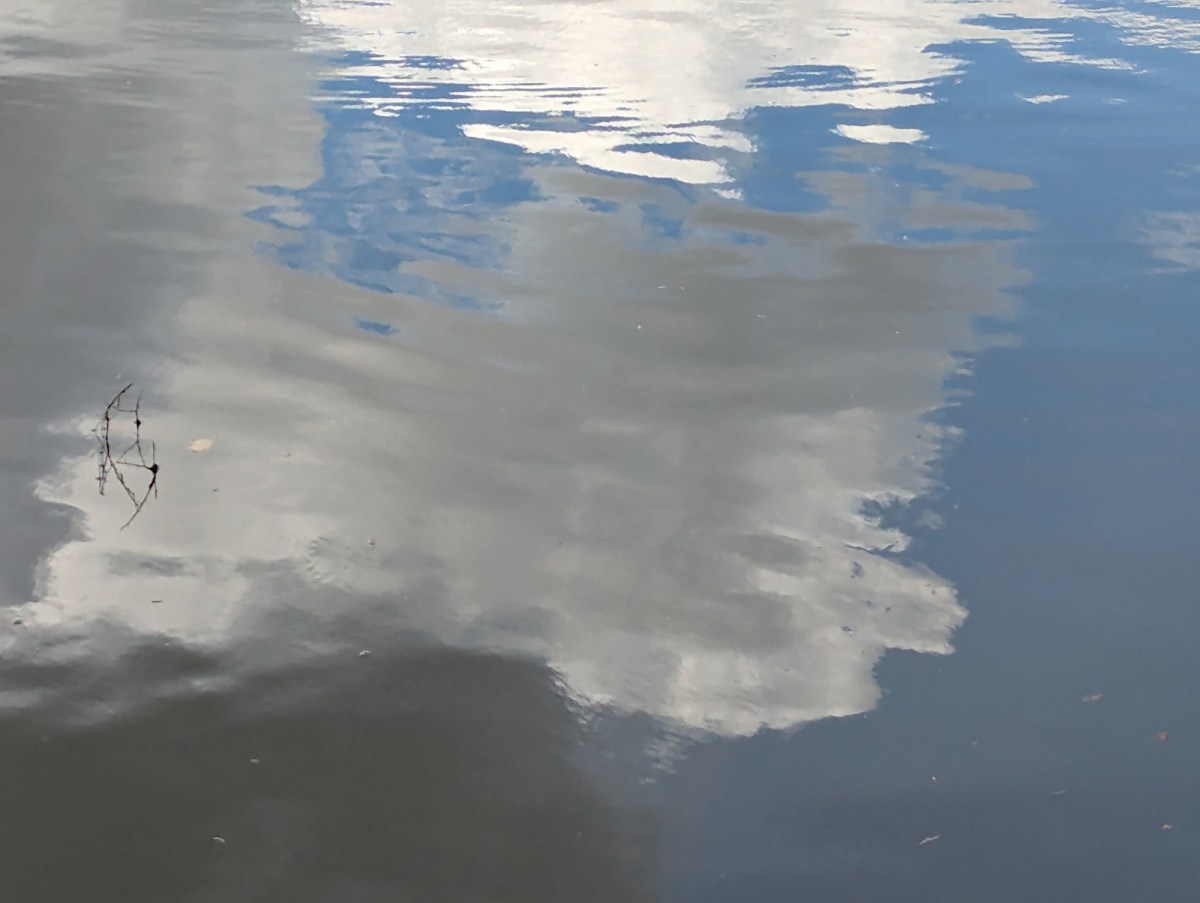
Just from this image the brain understands there are ripples on the surface of the water and from past experience will also know that these ripples will be moving.
What’s in an image? Sometimes quite a lot, more than meets the eye. I’m posting an image every few days.
Click to enlarge
Sometimes we see things indirectly, and our brains are capable of retrieving far more information than you might at first think. It’s true of all our senses – hearing, touch, taste, smell and all the rest. The senses provide information but the brain makes much more of it all.
What do we see in this image? It’s just a pattern of coloured patches reflected from a water surface. That’s what the eye sees. But the brain tells us there are clouds in the sky above and there are ripples on the water. Then the brain compares this basic information with what it recalls from past experience and it can construct two narratives, one for the clouds and another for the water.
The clouds
There is a dark cloud and it’s the closest one to us, it threatens a shower of rain. A second image taken a few seconds later would be enough for the brain to decide the direction of movement of the cloud and predict whether the rain might fall here or somewhere else. Paler clouds, white clouds and blue sky suggest there’s some sunshine around as well so although there might be a brief shower, it won’t turn into ongoing steady rain. All of that from from a few colour patches.
The water
Because of the way the cloud reflections are distorted, the brain can infer the water is neither heavily disturbed not completely calm. Just from this image the brain understands there are ripples on the surface of the water and from past experience will also know that these ripples will be moving. The same brain will realise that there are two likely causes; either there is a light breeze blowing or perhaps a boat has passed recently. Once again, past knowledge in memory is necessary to arrive at these conclusions. There are some large ripples and, near the top of the image, some much smaller ones too. There was a small disturbance in the water further away as these small ripples seem to form an expanding circle of which we see only a small part.
Here and there things are floating on the water, small leaves, perhaps? If so, there must be trees nearby, perhaps with branches overhead. What a lot the brain can reconstruct on the basis of prior knowledge! And all of these conclusions come from some patches of colour in a still image. And what about the little sticks emerging from the water on the left-hand side? It’s the remains of vegetation of some kind. Was there a plant growing in the water? Did a strong wind break twigs off an overhead tree branch?
And one last point – it was not raining at the moment the photo was taken. The water would have been covered with dozens of circular disturbances if rain was falling. That’s a lot of information that your eyes and brain can glean from a single fragment of time trapped by my camera!
We are, as the Bible expresses it, fearfully and wonderfully made (Psalm 139:14).
If you enjoyed this or found it useful, please like, comment, and share below. (If you don’t see those links, click the article’s title above the main photo and they will appear.) Send a link to friends who might enjoy the article or benefit from it – Thanks! My material is free to reuse (see conditions), but a coffee is always welcome and encourages me to write more often!