Latest news on the Lion

I was able to put the puzzle together during a recent holiday in the Lake District. A jigsaw is a family tradition for us every year, we usually do a 1000-piece, commercial cardboard puzzle but I’d say the lion was rather more difficult.

< Previous | Index | Next >

Image of the day – 175

What’s in an image? Sometimes quite a lot, more than meets the eye. I’m posting an image every few days.

Click to enlarge

My Sister, Rachael decided she wanted to learn to make traditional wooden jigsaws and bought a power scroll saw to learn the skills and processes involved. Having mastered the process she asked me for a clear photo of the lion picture I made in 1969. I had to take the picture out of the frame to avoid reflections in the image. I also had to adjust the image shape in GIMP to correct the geometry, and I increased the contrast to bring the black and white parts of the image closer to the way they originally appeared. Rachael used my image file to get the lion picture printed on plywood ready for cutting. She didn’t tell me she was making the jigsaw as a gift for me, so it was a lovely surprise when she handed the pieces over in a decorative container. I’m so impressed that Rachael has learned to design and cut jigsaws. She is also restoring old jigsaws, cutting replacement pieces if they are missing and lost. She even paints the new pieces to match the rest of the puzzle when necessary. So clever!

With the help of my wife, daughters and grandchildren, I was able to put the puzzle together during a recent holiday in the Lake District. A jigsaw is a family tradition for us every year, we usually do a 1000-piece, commercial cardboard puzzle but I’d say the lion was rather more difficult. Today’s image shows the completed jigsaw.

The jigsaw of life

Life is sometimes a bit like doing a jigsaw. Nothing seems to fit at first, but once you have some pieces in place it begins to get easier as you recognise more pieces with just that shade of colour or a similar texture. It takes a long time, but you get there in the end. Perseverance is necessary to complete a jigsaw, that’s another thing that’s true in life, you have to persevere; giving up is not an option. Attention to detail is crucial for a successful outcome.

Can you think of other parallels between jigsaw building and life? If so, drop me a line in the comments section below.

Two short videos about cutting the jigsaw

The two videos below show my very clever sister, Rachael, working on the jigsaw. In the first one she talks briefly about the cutouts and little lion shapes (or ‘whimsies’ to use the proper jigsaw terminology). You can see these clearly if you look at the photo at the top of the article. The second video shows a small extract of the cutting process.

Techie video

A techie maths video all about jigsaws and the number of pieces in each, picture shape ratios, piece shape ratios, probably far more than you want to know. None of it applies to the Lion jigsaw as that’s hand cut, each piece is unique and there are no rows or columns.

See also:

< Previous | Index | Next >

Useful? Interesting?

If you enjoyed this or found it useful, please like, comment, and share below. (If you don’t see those links, click the article’s title above the main photo and they will appear.) Send a link to friends who might enjoy the article or benefit from it – Thanks! My material is free to reuse (see conditions), but a coffee is always welcome and encourages me to write more often!

You might also like:

The Sopwith Pup

The navy and the army (the Royal Flying Corp was part of the army) ordered numbers of the planes and they served well until superseded.

< Previous | Index | Next >

Image of the day – 151

What’s in an image? Sometimes quite a lot, more than meets the eye. I’m posting an image every few days.

Click to enlarge

This lovely old aeroplane is a Sopwith Pup, as used by the Royal Flying Corp during the First World War. Sopwith was a major British aircraft manufacturer of the day. This aircraft is still flying from time to time in England where it’s based at Old Warden Airfield, itself a survivor of the First World War. This particular aircraft was built after the war and modified back to the fighter configuration.

In the photo the engine is being tested after maintenance, so a couple of side panels have been removed for inspection. The propeller was spinning, you can see the motion blur in the image.

Here’s the same aircraft in action.

Design and construction

Based on a smaller, earlier aircraft, Sopwith designed the larger Pup as a fighter in 1915 with the first prototype appearing in 1916. Both the navy and the army (the Royal Flying Corp was part of the army) ordered numbers of the planes and they served well until superseded and transferred for training purposes as newer, more effective fighting planes rapidly evolved.

This aircraft was much lighter than its German counterparts. It could take off and land on grass surfaces, in quite short distances. The Pup was very manoeuvrable, had a tight turning circle, and a high service ceiling for those times.

The Pups were replaced with Sopwith Camels during 1917.

Old Warden Aerodrome

Old Warden was a First World War air station, as already mentioned. It lies just north of Shefford and south-east of Bedford. Today it’s the home of the Shuttleworth collection of old aircraft and motor vehicles, a very fine and famous collection with a long history, originally as a private collection, but now open to the public. The old aircraft are frequently rolled out, and often one or more are performing in the air.

Everything that’s not active on a particular day is stored in a series of First World War hangers and those are all open to visit as a museum with informative explanatory material on display as well. There is active maintenance and restoration going on, and some of that may be on display too.

If you’re interested in this sort of thing, and are in the area, I highly recommend popping over for a visit.

See also:

< Previous | Index | Next >

Useful? Interesting?

If you enjoyed this or found it useful, please like, comment, and share below. (If you don’t see those links, click the article’s title above the main photo and they will appear.) Send a link to friends who might enjoy the article or benefit from it – Thanks! My material is free to reuse (see conditions), but a coffee is always welcome and encourages me to write more often!

You might also like:

Nearly a year ago now…

Installing our heatpump

It all took longer than we expected and some changes had to be made to the design as events unfolded, but by the beginning of February the new system was in and working.

< Previous | Index | Next >

Image of the day – 144

What’s in an image? Sometimes quite a lot, more than meets the eye. I’m posting an image every day or so.

Click to enlarge

At the end of January our heat pump was installed, and before long we had warm radiators and underfloor heating, something we’d missed since our gas boiler developed a fault in October. At the time our first thought was to get the boiler repaired, the part would cost £500 and the labour would be a similar amount and at the end of the process we’d still have a seven-year-old boiler and we’d still be burning gas. We wanted to avoid using gas if possible because we want to reduce the amount of carbon-dioxide we produce.

There is a substantial government grant to make heat pumps a more attractive idea, so we thought it made sense to take advantage of it. After discussing it with our energy supplier, Octopus Energy, one of their surveyors visited, made a plan of the rooms, specified the required changes to our radiators, planned for pipe runs and siting of equipment, and we were ready to roll.

It all took longer than we expected and some changes had to be made to the design as events unfolded, but by the beginning of February the new system was in and working.

A different kind of heat

Our old heating system used a gas boiler, it could produce a lot of heat quickly on demand, so we had a series of thermostats to turn radiators and heated floors on and off as required to keep rooms at the right temperature. At night and during the middle of the day a time clock turned the system off entirely to save money, then came back on half an hour before we arrived home after work and half an hour before we woke up in the morning.

The new system is on all the time. A room thermostat increases or reduces the flow rate to keep the house at whatever temperature we set, and starting from cold it can take several days to achieve the set temperature. We’re beginning to like this way of working; the house stays at the temperature we prefer, around 19 C, and it only rises higher if the outside temperature is high. In that case the heat pump stops heating the house and just provides hot water.

Energy bills

It’s still early days to assess how our heating bill will change. The heat pump is an electrical system so our electricity bill will rise, but our gas bill will now be zero. The heat pump cools down outside air by extracting energy from it, and pushes that energy into our radiators and hot water tank. One kilowatt of electricity can push about four kilowatts of heat into our home, and as we have solar panels on our roof and a storage battery, some of that energy can come from the roof even at night. There is no environmental effect, we’re not producing carbon dioxide and the heat we steal from outside leaks back out again over time. The better our house is insulated, the slower it will leak and the less electricity we will need to maintain the temperature difference between the cold outside and the warm inside.

When we buy electrical power from the grid to pump heat (mainly in midwinter), that grid power is more than 50% green as well; so even that is far better than burning gas to keep warm.

Image of the day 144

This is the 144th ‘Image of the day’ I’ve posted. That is what we’d have called a gross when I was a child. Ten eggs in a box was ten, but twelve eggs in a box was a dozen and six was half a dozen. We still use those terms. A baker’s dozen was thirteen, a dozen with one extra for good measure. And a dozen dozen also had a special name – a gross. 12 x 12 = 144. So today there is a gross of ‘Images of the day’ on the Journeys of Heart and Mind website!

I wonder if I’ll ever reach a great gross, ie a dozen gross, or 1728 ‘Images of the day’?

See also:

< Previous | Index | Next >

Useful? Interesting?

If you enjoyed this or found it useful, please like, comment, and share below. (If you don’t see those links, click the article’s title above the main photo and they will appear.) Send a link to friends who might enjoy the article or benefit from it – Thanks! My material is free to reuse (see conditions), but a coffee is always welcome and encourages me to write more often!

Time for a new paradigm

Times change and businesses and organisations have to change too. You see the same situation in ecosystems: weather patterns change, or a new species of plant or animal moves in, and the balance shifts.

Wikipedia’s entry on Patreon

Thinking out loud – 4

Patreon on Wikipedia

Times change and businesses and organisations have to change too. You see the same situation in ecosystems: weather patterns change, or a new species of plant or animal moves in, and the balance shifts. Plants and animals that used to thrive begin to struggle or even die out, others prosper.

Internet conditions have been changing, and continue to do so. YouTube, pressured by the popularity of Tik-Tok style short video clips is bringing YouTube ‘shorts’ front and centre, and longer, more serious videos are both more expensive to host (because they are longer, slower to upload, and need more storage), and less popular with younger audiences (a recently growing sector.) Blogs have become less popular for the same reasons. Print media have been suffering too, everyone wants video reports on current events. Even TV channels are suffering, seen as boring and not for the current generation.

So what to do when the old models fail? That was the issue Fraser Cain faced.

Here’s a story of frustration and hard work when a website failed, revenues had been trending downwards for some time and the YouTube part of the operation proved problematic for a different reason. The solution? Patreon, and a new (old) approach to funding. Watch Fraser Cain’s video below where he shares the full story of the website failure and reconstruction, the problem with YouTube, and the new emphasis on Patreon going forward.

Patreon

The answer, as you have seen, was to find a new model; or perhaps it’s just an even older model come back in disguise! Provide material, perhaps in large part for free, but then charge a weekly or monthly subscription for extras. These might be coverage in greater depth, providing additional topics, giving an opportunity to provide feedback, or win prizes, or sell ‘merch’, or whatever other benefits you might think of.

Patreon is becoming more and more popular with creators, and for very good reason – the model is extremely successful. It works well for creators, and it works well for viewers who can enjoy an ad-free experience. Not everyone will be willing to pay for the extras, but that doesn’t matter. As long as the income exceeds the costs of production it’s a success. so the more people a creator can sign up, the lower the fee can become. It’s a great idea, it works for everyone.

See also:

Here are some further links to Fraser’s material, as well as a few other content creators using Patreon very effectively:

Useful? Interesting?

If you enjoyed this or found it useful, please like, comment, and share below. (If you don’t see those links, click the article’s title above the main photo and they will appear.) Send a link to friends who might enjoy the article or benefit from it – Thanks! My material is free to reuse (see conditions), but a coffee is always welcome and encourages me to write more often!

From the Stone Age

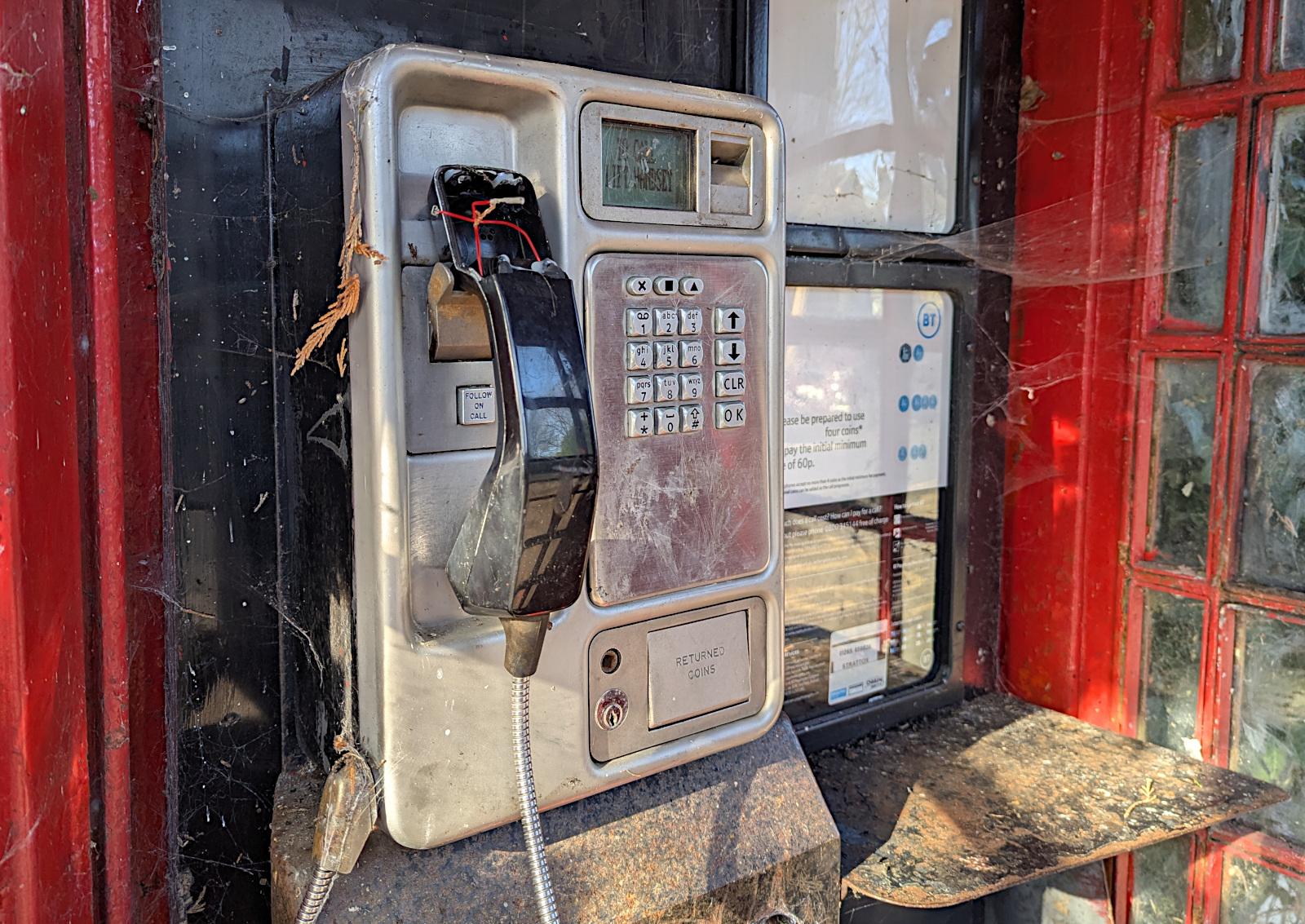
As mobile phones became more affordable and widely available the need for phone boxes vanished. This one was never removed and stands forgotten by the pavement, more or less unnoticed, draped in cobwebs, laden with layers of dust.

< Previous | Index | Next >

Image 136 – What’s in an image? Sometimes quite a lot, more than meets the eye. I’m posting an image every day or so.

Click to enlarge

Stone Age?

Well – Stone Age in terms of communications technology! A long time ago, way, way back in the 1980s, telephone kiosks like this one were widespread in the UK. You can see the red paint for which these phone boxes were so famous.

This particular box stands at the junction of the Gloucester Road and the Cheltenham Road in Stratton, where we live. It must have been quite busy when it was first installed. I well remember standing waiting at a box like this, sometimes there might even have been a queue of three or four people waiting to make a call.

And I remember the standard phone box smell as well. There was always a certain degree of dampness about them, often mixed with stale tobacco smoke. There was a little shelf containing a local residential directory and a yellow pages with business numbers and adverts.

This example of the British Telecom (BT) phone box has seen better days. It was converted with up-to-date equipment that must have replaced the original, black, bakelite handset with its black, enamelled, steel coin-box with Button A and Button B. But as mobile phones became more affordable and widely available the need for phone boxes vanished. This one was never removed and stands forgotten by the pavement, more or less unnoticed, draped in cobwebs, laden with layers of dust.

See also:

< Previous | Index | Next >

Useful? Interesting?

If you enjoyed this or found it useful, please like, comment, and share below. (If you don’t see those links, click the article’s title above the main photo and they will appear.) Send a link to friends who might enjoy the article or benefit from it – Thanks! My material is free to reuse (see conditions), but a coffee is always welcome and encourages me to write more often!