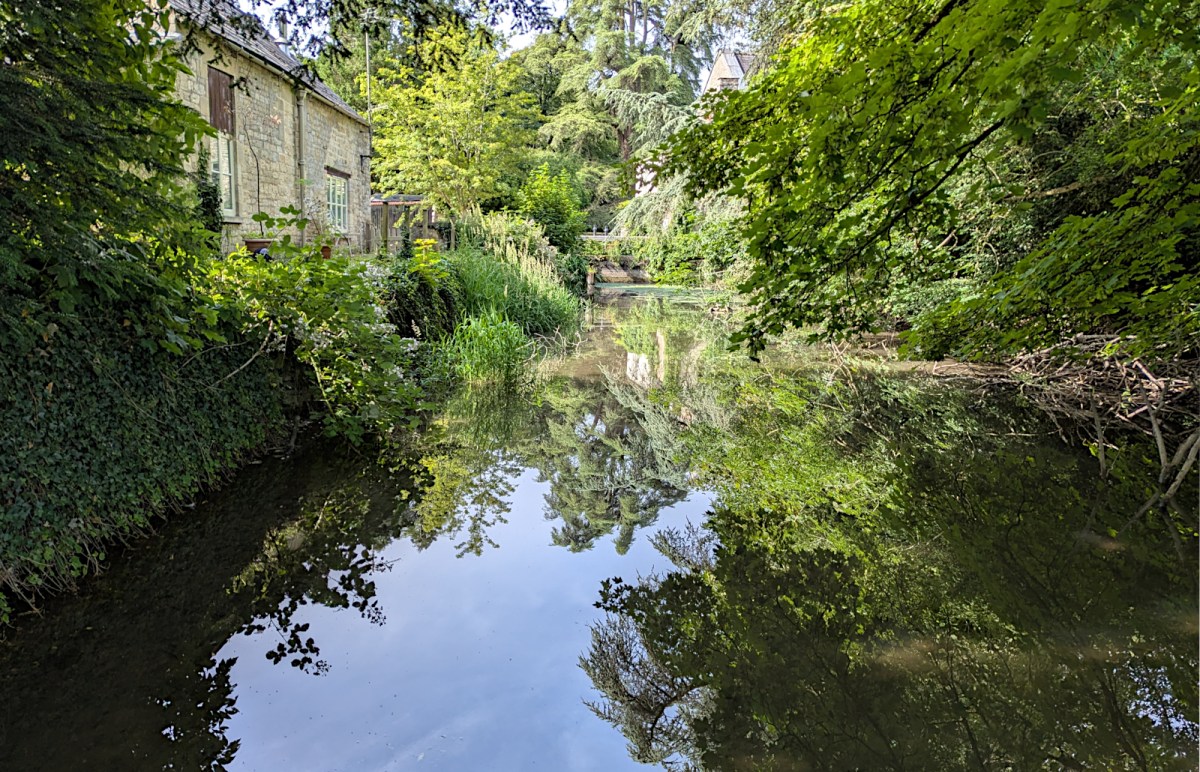
Reflections on Barton Mill Pond
< Previous | Index | Next >
Image of the day – 197
What’s in an image? Sometimes quite a lot, more than meets the eye. I’m posting an image whenever I can.

This is one of my favourite places in Cirencester; on a calm, sunny day wind doesn’t ruffle the surface of the old mill pond and the reflections are correspondingly bright and still. A bridge crosses the water here and crouching down it’s difficult to take a bad photo, or easy to take a good one. (Depends on your mode of thinking.)
The mill burned down in an unfortunate fire in 1926 and was never rebuilt. Watermills (and windmills) were going out of business at that time as most industries were running on steam power generated by burning coal, or by electrical energy, also usually from coal-fired power stations. Water power and wind power, now seen as green and therefore desirable, were seen in 1926 as ineffective and unable to compete with the more efficient alternatives. This was long before the downsides of fossil fuels were understood.
A place for wildlife
100 years after the fire, in 2026, the mill pond still exists, fed by a sluice gate taking water from the River Churn. The part of the pond in the photo is usually in water all year round, though other parts dry up in many summers, partly because of some silting up near the sluice and partly because the bed of the pond has silted up too, so now the water is shallow enough for yellow flag Iris and other plants to flourish.
There are many birds to be seen in this area too. Mallard ducks breed every spring, there are minnows and probably stickleback in the water and from time to time a kingfisher hunts along the water channels and the pond. Often all you see of the kingfisher is a darting flash of vivid blue. There used to be (and may still be) a pike. A single but very shy little egret hunted around here for the last few years, but this year I’ve seen two of them, probably a breeding pair. And their larger cousin, the grey heron also puts in an appearance now and then.
All life needs is an opportunity
Take any piece of ground, anywhere on Earth, and just leave it alone, life will move in, even if you choose a patch in the Sahara or Antarctica. If you clear a piece of ground somewhere with a reasonable climate and leave it alone, in just a human lifetime you’ll have thriving woodland with a full selection of insects, birds and mammals, and probably reptiles and amphibians too. The experiment has been made many times, sometimes deliberately, sometimes accidentally. If you choose the Sahara or Antarctica you might have to wait a bit longer, but the life forms that are adapted to those extreme conditions will move in eventually. Let’s look at some examples.
Broadbalk wilderness (UK)
A wheat field was deliberately left to revert to a natural state at Rothamsted Research Station in 1882. The land was left unmanaged where before it would have been ploughed and harrowed after harvesting the wheat in late summer and drilled with seed again in the autumn. This field had produced winter wheat every year since 1843, but now the scientists wanted to see what would happen if it was left uncultivated; for the first four years volunteer wheat grew, sparser and weaker year on year and after four years completely choked by weeds.
In 1900 the site was divided into three. One part was left deliberately untouched and gradually reverted to natural woodland; another third was mown annually and maintained as grassland; while the third section had all woody plants removed annually so the land became a natural, open mix of herbaceous plants.
The results have been very interesting and the experiment continues today. Levels of captured carbon are still rising in the soils of the site, nitrogen levels have risen as well. The samples and data are available for study and reanalysis.
Chornobyl (Ukraine)
The Chornobyl nuclear power station accident in 1986 rendered the city and a large area around it unusable. People were evacuated and the most contaminated areas became a restricted zone. Since the accident, time and rainfall have reduced the surface radioactivity considerably and it’s now possible to visit the area. In fact, wildlife has moved into the area from the very beginning and the changing conditions and environment have been studied in depth.
Almost 120 000 people were evacuated following the accident, so activities like farming, hunting, logging, and development ceased over an area of 4,200 km². Forests, wetlands and grasslands have reclaimed abandoned farms and villages; and vegetation grows freely through derelict buildings and former settlements. The pine woodland killed outright by the initial high-dose fallout remains one of the most nuclear-contaminated places on Earth, but even there substantial regrowth has happened. The loss of managed agriculture actually increased habitat diversity, reconnecting landscapes previously fragmented by farmland.
Large mammals rebounded strongly. Long-term census data show abundances of deer, elk, roe deer and wild boar comparable to those in uncontaminated regional nature reserves. Wolves are notably abundant, roughly seven times as common as in comparable reserves. Reintroductions have taken hold including endangered Przewalski’s horses, released in the late 1990s and now ranging freely and breeding. European bison have also been established, while beavers have recolonised rivers, canals and the cooling ponds, in places reversing Soviet-era drainage systems. Lynx, foxes and hundreds of bird species are present too.
However, there’s a mixed message – the abundant populations are due to the absence of humans, yet there remains clear evidence of radiation-induced harm to individuals. Some species are adapting and changing, showing signs of radiation resistance, for example.
Returning woodland (Scotland)
It seems that all that is required to restore native woodland in Scotland is to remove or significantly reduce the presence of Red Deer and sheep. Grazing species eat the young seedlings of trees and strip leaves from saplings. Where deer-fencing is erected to protect an area the tree seedlings survive and soon grow too high for sheep (or even deer) to reach. Birch, rowan, willow, Scots pine and juniper rapidly recolonise in fenced areas.
Other cases are numerous
Similar cases of large scale change include:
- The reintroduction of wolves to Yellowstone Park in 1995 suppressed the elk population, allowing willow and aspen to return to riverbanks bringing back beavers and many other species including fish, moose and songbirds.
- Oostvaardersplassen in the Netherlands where introducing large grazing animals brought back white-tailed eagles and other species.
- Marine protected zones where closing areas to commercial fishing have seen biomass rebound. Examples include cod recovery on the Grand Banks off the east coast of Canada.
- Whale recovery following moratoria on whaling.
- The gradual recovery of birds of prey since the banning of DDT in the 1970s.
- Beavers reintroduced in the UK have resulted in wetland improvements and flooding reduction.
- Reintroducing pine martens in parts of England shows promise in allowing native red squirrel populations to recover as the introduced grey squirrel population is suppressed.
Identifying common factors
A rule to cover all these examples will be useful. If the limiting, interfering factor(s) can be identified and removed life will usually return naturally – in any situation. Identifying the limiting factor(s) is the key to success. Reintroduction of missing species can also be a helpful part of the process but is often not necessary.
See also:
- The long term experiments – Rothamsted Research Station
- The wilder Blean project – Website
- Wildlife is thriving around Chernobyl since the people left – New Scientist
< Previous | Index | Next >
You might also like:
Useful? Interesting?
If you enjoyed this or found it useful, please like, comment, and share below. (If you don’t see those links, click the article’s title above the main photo and they will appear.) Send a link to friends who might enjoy the article or benefit from it – Thanks! My material is free to reuse (see conditions), but a coffee is always welcome and encourages me to write more often! 
Share this:


