
Becoming like the foundation

In the process of standing on Christ we will see a revelation of who we are because who we are matters, far more than we sometimes think … There are no ifs and buts here. We live because he lives, we love because he first loved us.

Rubble foundation (Wikimedia)

< Previous – Index – Next >

2 – activating church

Rubble foundation (Click images to enlarge)

Six months ago I wrote about the apostolic gift and how one of the main giftings of an apostle was to go out into the world to tell people about Jesus, teach them about his nature and character, call them to follow Jesus, and show them how to meet together as a church and how to relate to church in other places. It’s a call to create networks of people following Jesus and communicating from group to group within the network. Paul is one of the finest examples we have of an apostle at work in this way, but the best example of all is, of course, Jesus himself. He travelled much further than Paul to start his building work. He came all the way from sitting beside his Father in heaven, to call, teach and eventually die here on this little planet called Earth. Then he returned in order to send his spirit, his Holy Spirit, back here to be with his followers. The Holy Spirit began working in and through the disciples in Jerusalem, and a little later made himself known to Paul as he was travelling to Damascus. He called Paul as an apostle to go on spreading the message about Jesus further and further around the Mediterranean.

Paul not only took out the message about Jesus, he also understood much about being an apostle and how apostolic people are all called to continue this work. And Paul also understood a lot more about church life and the gifts of prophet, evangelist, shepherd and teacher and how these different giftings work together. He also understood clearly that the first part of building something involves foundations. A lot of his letters are about this work of church building, guiding people in the difficult work of getting along together, discovering their giftings, and allowing the Holy Spirit to draw them deeper and further in works of service. All of this was important then – but it’s just as important today in the places we live our lives.

I want to look at this process in much more detail. We are not Jesus, we are not even Paul, is this something we dare to attempt? Is there any chance of success for you or me if we’re called to embark on this process? If you are called to reveal people to Christ, then yes, there’s every chance of success, if you are called to some other ministry gift then you’d be barking up the wrong tree! We must all do whatever we are called to do. But there is not one single Christian alive today who has no work to do and not a single one of us lacking the gifting with which to do it. Unfortunately, because of the way we tend to build church today, we rarely think about foundations and it’s not hard to find people who do not feel or act as if they have work to do and the gifting necessary to accomplish it. For such people, church may feel like a social group, a place for study, or a weekly sing-along. But it’s not supposed to be like that. It is supposed to be a building site where something very special is being raised up on an even more special foundation. It should be a place busy with cement mixers, cranes for heavy lifting, and skilled workers well practised in all the necessary skills.

I might come back to the topic of callings and giftings later, but I feel I should address the idea of foundations first, so the rest of this post will be devoted to that topic. So what is a foundation for?

The purpose of foundations

When we talk about foundations, we are talking about digging holes in the ground and filling them with somethig solid and capable of bearing a heavy load without shifting or giving way.

Modern foundations are dug by a powered excavator and filled with freshly mixed concrete. But in Roman times, the trenches were dug by hand and for massive structures like temples and amphitheatres large blocks of stone were placed in the trench to support the structure that would be built on top. For smaller houses and shops, rubble foundations would suffice (like those in the photo). The foundation stones were normally larger than the stones that would be used for the building as it rose above the ground surface. It wasn’t much of an issue if the walls were built of smaller material, but if the foundation layer shifted during or after construction the building might collapse. A foundation needs to be seriously strong, deep and firm – unyielding.

There’s an old hymn that I remember from childhood, it was sometimes used during school assembly, but was also used on Sunday services at church. Here’s the first verse.

The church's one foundation
Is Jesus Christ her Lord;
She is his new creation
By water and the Word:
From heav'n he came and sought her
To be his holy bride;
With his own blood he bought her,
And for her life he died.

You can hear this grand old hymn sung with all the words on YouTube if you wish:

The first two lines are straight from Paul.

In 1 Corinthians 3:10-11 he tells us clearly that the only foundation is Jesus and in verses 12 to 14 he warns us to use only the best materials if we are called to build. The build quality will be tested by fire. And in verses 16 and 17 he says we ourselves are Yahweh’s Temple, a holy place. Another way to put this is that we ourselves are the church, it’s not a structure of mere bricks, but a structure of living stones – his people. We are bonded together like the stonework of any strong building and we stand together on the strong foundation of Christ himself. Read the whole chapter (it’s quite short), try to apply what Paul is saying to your own life, imagine sitting down with him over a coffee and discussing it.

We are to be built up together in love for we are to be like Jesus who is in turn like the Father. What is the substance of the church? It is love. the Father is love at its source, at its root. Jesus is love sent from heaven and expressed in his life. Read any of the gospels and you’ll find him loving his followers and the crowds who gathered in very real and practical ways. We are to continue his work, building in love, loving one another and loving the other people around us in this world. Nothing else matters more than this!

Another way of saying that we are living stones would be to say we are loving stones. We should be fervent lovers of Papa, of Jesus, of one another, of the worldly people around us, and even fervent lovers of our enemies. That is the only way of sharing Jesus; to be taken seriously we must be like him in every way. I, you, we, must all become accurate impersonators of Jesus. If we have no love, we have…nothing!

Until we begin living this new life we’ve been granted, loving everyone we meet, we’ll remain failed imitators of Christ and church will remain just an inorganic structure – rigid, cold, hard, unyielding and utterly unattractive to people in our communities who need to be loved. So let’s get to it! What are we waiting for?

But remember, it starts with the foundation of a loving Saviour, Jesus himself. Let’s stand on him, feel his love for us individually and together, and share his love for the confused, the unloved and the unlovable. Then, and only then, will we begin to see real growth. This will be growth of our own character, growth of the living stones around us, and growth of the church as others are drawn in by a love they have never previously seen or expected.

Do you see why foundations are so important? We become like the foundation we stand upon. If we don’t stand on Jesus we cannot expect to stand at all. In the process of standing on Christ we will see a revelation of who we are because who we are matters, far more than we sometimes think. If you’re a chip off the block of Jesus you’ll find yourself loving as he loves, building as he builds, dying as he died, yet living eternally as he lives. There are no ifs and buts here. We live because he lives, we love because he first loved us.

Who are you? Who am I? We are little pieces of him – that’s what ‘Christian’ means; it was a derogatory term applied to followers of Christ by the Greek and Roman pagans in the early years of the church. We are ‘little Christs’, no more, no less. This is our future, our inheritance, to be like the Master. Everything else comes out of who I am, who you are.

See also:

< Previous – Index – Instructions – Next>


Useful? Interesting?

If you enjoyed this or found it useful, please like, comment, and share below. (If you don’t see those links, click the article’s title above the main photo and they will appear.) Send a link to friends who might enjoy the article or benefit from it – Thanks! My material is free to reuse (see conditions), but a coffee is always welcome and encourages me to write more often!

You might also like:

What does Jesus mean to me and how do I respond to him?

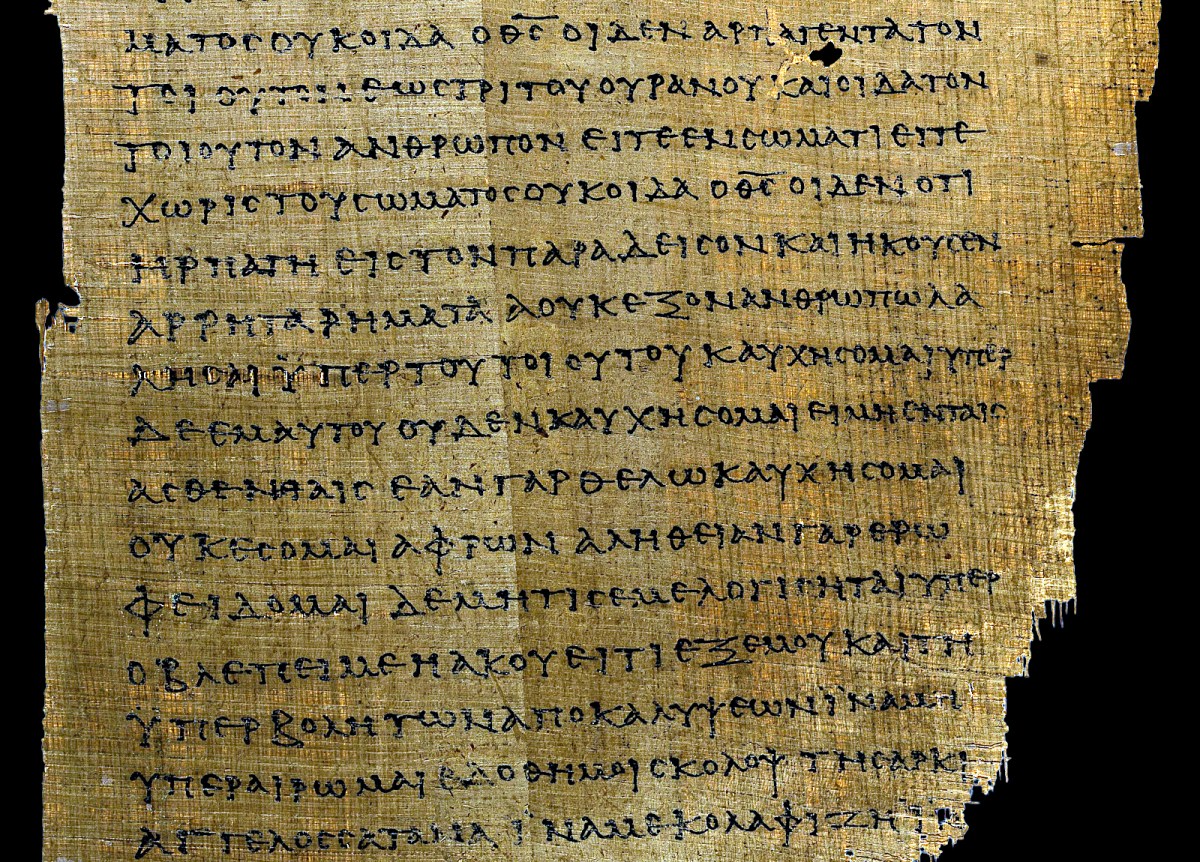
Text of an early Greek New Testament (Wikimedia)


< No earlier posts – Index – Next >

1 – activating church

To answer those two simple questions I need to be be honest with myself and also be honest with you, my readers.

What does Jesus mean to me?

He means the world to me. In all seriousness I have to say he is my source, my inspiration, my guide and teacher, and the essence of all I want to be. Jesus once said, ‘I am the Way, the Truth, and the Life’; for me that sums him up extremely well.

Text of an early Greek New Testament (Wikimedia)

Jesus is someone we must all make up our own minds about. He’s an historical person, not only is his life and death described in the four gospels in all versions of the Bible, and by his teachings presented throughout the New Testament, he is attested by Roman, Jewish, and Muslim authors as well. Josephus writes about him in his famous history of the Roman war against Judea and the destruction of the Jerusalem Temple in 70 AD. The apostle Paul writes about him too and was mightily influenced by him although they never met, though Paul did experience Jesus in spiritual ways. And the Roman authors Tacitus, Suetonius, and Pliny the Younger all wrote about him; so did Mohammed, and Jesus (Isa) is mentioned in the Koran and in other Muslim books and teachings and is regarded as an important prophet.

But for me, and many other followers of Jesus, he is far more than a figure from history and far more than an apostle, a prophet, an evangelist, a shepherd, and a teacher (though he is all of those things). Jesus taught his followers about his spiritual Father, Yahweh, the God of Israel, about the Holy Spirit who would come and rest upon them and live within them, the Spirit he would send to guide them after he, the Son, returned to be with the Father again. I have received this Holy Spirit, the Spirit of Christ, myself. I’ve been changed, I cannot deny that.

How do I respond to him?

In the late 1960s and early 1970s I began following him as best I could, learning more and more about him and what he wanted of me along the way. I’m writing about this in another series of articles that is not yet finished.

I’ve gradually discovered along the way that he wants me to follow him, to grow in my understanding of how foundational he is, who he is and how he leads and guides me. So my response is as full and complete as I can manage. I make mistakes along the way, I’m still learning at 77-years-old, I’ll never know him fully in this life, but I am still making progress. One of the things I do is write articles like this one, hoping a little of his light will shine out in my life and help to reach those around me every day. I try to listen, both in my reading of the Bible and many other books written about Jesus down the ages. I can see glimpses of him in other people who followed him in past times (St Patrick, for example).

In the time remaining to me (it will be far shorter than the 77 years I’ve already had, unless I make it to 155-years-old which seems highly implausible. Ha!) In those final years of my life on this planet I want to get to know him even better and learn to serve and follow him ever more fully. Jesus is love in person, so the better I get at loving those around me, the more like him I will become. So that is my ultimate goal – to serve him by becoming more and more like him. That, I think, is the only sensible way to respond to him.

I could go into the practicalities in endless detail, but I could never do better (or even half as well) as Henry Drummond. Do leave your thoughts below, and any questions you might have. I’ll try to respond to all your reactions in my replies.


< No earlier posts – Index – Next >

Arresting Jesus

John knew Peter well, they’d been around the entire time of Jesus’ teaching of the twelve, and perhaps they’d known one another for years before Jesus came on the scene, both families lived by fishing on Galilee, they were both called by Jesus to follow.

Greek commentary on John’s gospel dated 1190-1200 (Bodleian Library)

< Previous | Index | Next >

Cruising the gospel – John 18:1-40

Bible text – Read it yourself (opens in a new tab)

Arresting Jesus

A fragment of John’s gospel
(Wikimedia)

18:1-14 – Jesus and his disciples left the upper room and walked out of the city, presumably by a southern gate. They crossed the Kidron Valley and entered the garden of Gethsemene (from ‘gath’ meaning a press, and ‘Shemanim’ meaning oils). It was a place where olive trees grew and where the harvested olives were pressed to release the oil. ‘Garden’ does not imply decorative plants and flowers as we would think of a garden today. It was just the term for an enclosed agricultural space, a ‘garth’ or ‘gard’ with a wall around it to ‘guard’ it. Jesus and his followers often met here, and Judas was well aware of that fact.

Judas arrived outside the enclosure, followed by a group of soldiers (presumably Romans) as well as a group of Pharisees and some staff of the High Priest. Jesus left the walled enclosure and asked them who they were looking for, and they answered ‘Jesus of Nazareth’.

Jesus told them, ‘I am he’. And they stepped back and fell to the ground. ‘I am’ in Hebrew and in Aramaic sounds rather like ‘Yahweh’, the Holy Name that nobody was allowed to utter. This would have profoundly shocked the Pharisees and the High Priest’s staff. He asked them again, ‘Who are you looking for?’ Again they answered, ‘Jesus of Nazareth’. And he told them again, ‘I am he, so let these others leave’. Peter had a sword and struck out at Malthus, the High Priest’s servant, cutting off his ear lobe. Jesus told Peter to put the sword away. The Roman soldiers under their commander, and the Jewish officials accompanying them, arrested Jesus and tied his arms, probably behind his back, then took him to Annas, once High Priest, father-in-law of Caiaphas, the current High Priest. Annas asked questions about Jesus’ followers and about doctrinal matters and then sent him on to Caiaphas.

Peter’s denials

18:15-26 – Peter and one other disciple followed Jesus and the group who’d arrested him (bravely under the circumstances). There’s been some debate about the ‘other’ disciple. It might have been John, or Nicodemus, or Joseph of Arimathea, or possibly even the traitor, Judas. (Read some aspects of the debate for yourself.)

This other disciple made it possible for Peter to enter the home of Annas where there were some questions being asked of Jesus. So which of those characters mentioned above would most want Peter to hear that questioning and Jesus’ answers? Think about that for a moment. John knew Peter well, they’d been around the entire time of Jesus’ teaching of the twelve, and perhaps they’d known one another for years before Jesus came on the scene, both families lived by fishing on Galilee, they were both called by Jesus to follow. Peter was a man of action, he’d proved it once again by using his sword that very evening!

Annas questioned Jesus about his disciples and about his teaching (verse 19). Jesus often taught to crowds (you can’t get more public than that) and replied that he always taught in public in synagogues, or even the Temple courts. He didn’t teach in secret. Annas could learn about Jesus’ teaching from any of his many listeners. That remark drew an abusive slap in the face from one of the Jewish officials. Peter and the other disciple heard and saw all this. At this point Annas sent Jesus, still tied up, to Caiaphas.

And Peter denied being one of Jesus’ disciples for the second and third times. How did all this affect Peter? I’d suggest seeing and hearing the interrogation and the angry slap and recognising his own failure in denying he was a disciple all helped to stir Peter up and ready him for action. Frustration, helplessness, anger and guilt are a heady mix for anyone with a habit of activity. And I submit that John, knowing Peter as he did, would have expected that. I think John also understood that a time for action was coming very soon.

With Caiaphas

Although John doesn’t record the interaction between Jesus and Caiaphas, we can fill the gap a little from other sources, read Matthew 26 for example.

After the resurrection of Lazarus, Caiaphas had told the Sanhedrin that it would be better for one man to die for the people, than that the whole nation should perish. He was worried that the Romans would lose patience and intervene militarily.

And during Jesus trial before the Sanhedrin, Caiaphas directly questioned Jesus, demanding a clear answer on his identity: ‘I demand you tell us whether you are the Christ, the Son of God’. Jesus did not give a direct answer, but what he said was regarded as blasphemy and the Sanhedrin condemned him.

The Roman governor, Marcus Pontius Pilatus

Caiaphas and the Sanhedrin wanted the death penalty for Jesus, but only the Roman governor could provide such a sentence, so Caiaphas sent him on for a third hearing.

Pilate was not interested in religion, only in politics, so his first question was about Jesus’ kingship. Jesus explained that he hadn’t come to rule, but to testify to the truth. Pilate’s concern was not truth, either, but still only politics, so he went back outside to the waiting Jewish delegation and told them he didn’t find Jesus guilty of anything. But the custom is that at Passover time I release someone from captivity for you. I can release Jesus for you if you wish. ‘No’, they shouted back, ‘Not Jesus, release the agitator and rebel, Bar Abbas. This Aramaic name means, quite literally, ‘Son of the father’. This is striking indeed as Jesus is the true ‘Son of the Father’. Jesus was known in Galilee as ‘Yeshua bar Yoseph’, Jesus son of Joseph, but he was truly ‘Yeshua bar Abba’, Jesus son of the Father. The Jewish leaders were choosing the wrong man, but also the Wrong Father!

See also:

< Previous | Index | Next >

Useful? Interesting?

If you enjoyed this or found it useful, please like, comment, and share below. (If you don’t see those links, click the article’s title above the main photo and they will appear.) Send a link to friends who might enjoy the article or benefit from it – Thanks! My material is free to reuse (see conditions), but a coffee is always welcome and encourages me to write more often!
You might also like:

Praying for the glory

If Jesus is in John and is glorified, John shares in that glory too! Even if John doesn’t fully grasp what exactly the glory is, he certainly grasps that through Jesus that glory is already in him.

Greek commentary on John’s gospel dated 1190-1200 (Bodleian Library)

< Previous | Index | Next >

Cruising the gospel – John 17:24-26

Bible text – Read it yourself (opens in a new tab)

Sharing what he wants

A fragment of John’s gospel
(Wikimedia)

17:24-26 – If these verses do not astound you, you need to pay closer attention to what Jesus is saying. Let’s break the material down to consider it carefully. The first thing to note is that Jesus is not conversing with his followers here, he’s speaking with his Father. He’s not asking for strength during his coming ordeal on the cross, instead he’s just telling his heavenly Dad what he wants. And the first thing that comes to mind is that he wants his followers to be with him where he is and to see his glory. Well, they are with him, he’s in the upper room in Jerusalem and so are they.

Seeing the glory

But do they see his glory? No, I don’t think they do – not yet, not fully. Peter, James and John had been with Jesus on the mountain and had seen and heard what happened there. But they didn’t understand what was really going on. Peter, always the practical doer, was going to build three shelters. James might have had more intuition about it, but I imagine John would have got closer than the other two. John was the disciple ‘Jesus loved’, he viewed things from a more spiritual dimension, it was his nature to dwell on spiritual truth and look for hidden depths of meaning.

I think John is already aware that Jesus thinks of himself as Yahweh’s Son, he’s referred to himself as the Son, and he often talks about ‘My Father’. And I suspect John understood that was an eternal relationship. Jesus spells it out again here in the Garden as he prays to his Father. The Father loved him before the world was created and loves him still. And I imagine for John it was not too great a leap to see that this love is eternal and will remain even after the end of time itself. And in verse 26 Jesus says to his Father that he has made his followers aware that the Father has sent him (Jesus), that he’ll continue to show them that so the Father’s love will be in them and so that Jesus himself will be in them too.

Does this take us back to Jesus in glory on the mountain? Yes, I think it does! And John must have understood that if Jesus is in him, that he too must have been gloriously transformed on the mountain, so that he, John, can also talk freely with Moses concerning law and with Elijah concerning prophecy. If Jesus is in John and is glorified, John shares in that glory too! Even if John doesn’t fully grasp what exactly the glory is, he certainly grasps that through Jesus that glory is already in him and raises him to the giddy heights of the law and the prophetic.

And this is where we all stand if Christ is in us. We just need to see, as John did, that the glory arrives when Jesus does, that we share in him and in his glory permanently. So when my body dies (as it must) I continue to live gloriously because Jesus is in me. I’m sure Peter and James came to understand this too, certainly at Pentecost if not before. That was the moment when Jesus’ glory was fully revealed to the entire church, not just in theory but in full experience.

This was a moment they had been told to wait for, but when it came it was far beyond what they had imagined or expected.

See also:

< Previous | Index | Next >

Useful? Interesting?

If you enjoyed this or found it useful, please like, comment, and share below. (If you don’t see those links, click the article’s title above the main photo and they will appear.) Send a link to friends who might enjoy the article or benefit from it – Thanks! My material is free to reuse (see conditions), but a coffee is always welcome and encourages me to write more often!

You might also like: