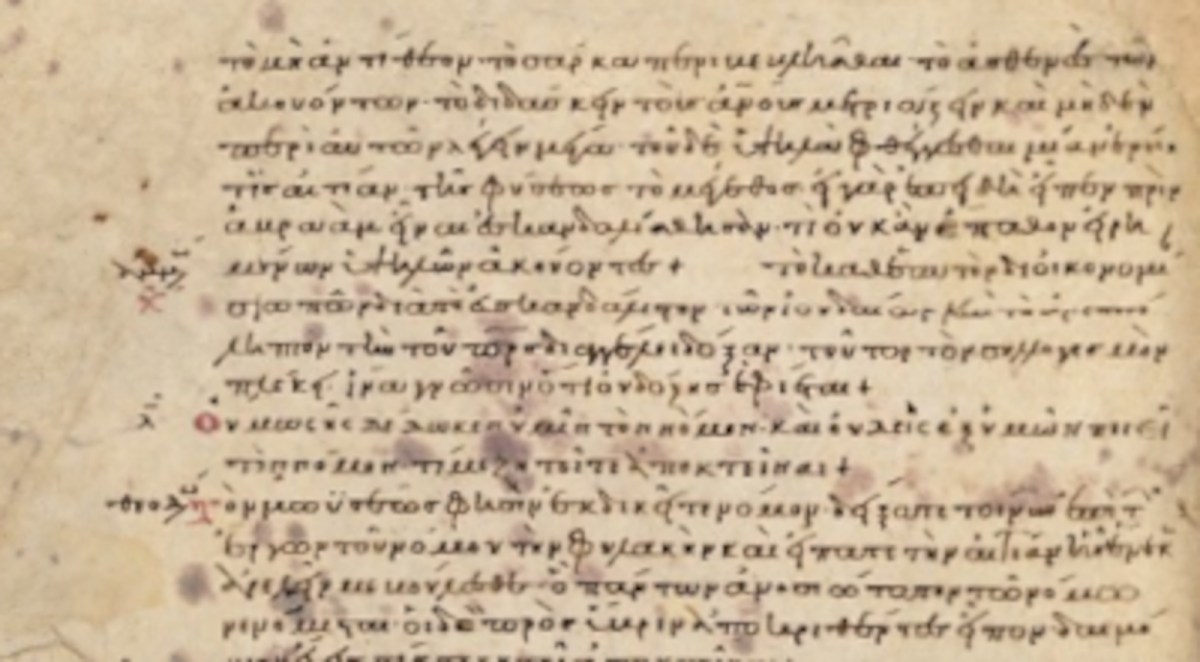
Greek commentary on John’s gospel dated 1190-1200 (Bodleian Library)
Accompanies my gospel commentaries
Why a dictionary of names?
(Wikimedia)
We’re used to reading Bibles with familiar English names for people and places, names like Jesus, David, Herod, Jerusalem and Nazareth. But none of those names existed in that form 2000 years ago when Jesus taught his disciples, let alone the early to mid bronze age when the patriarchs like Abraham were alive
So we don’t get a proper sense of history when we read the Bible, nor do we get a sense of foreignness. This makes it harder for us to imagine the people and places in the eras and environments they would have been familiar with.
As an experiment to help with this, I decided to use the original names in writing my commentary posts, as an example we’ll take a look at the English name ‘Jesus’. Here’s how the entry for ‘Jesus’ will appear.
Jesus / Aram(Galilee) Ye-soo, Yesoo / Aram(Judea) Ye-soo-a, Yesooa / Heb Ye-ho-shoo-a, Yehoshua OR Ye-shoo-a, Yeshua.
Here’s how to interpret that entry above. First comes the English version, then Aramaic as spoken in Galilee (how his friends and family would have known him), then the Judean dialect of Aramaic, and finally the Hebrew form of the name (two options here).
Note: I often write ‘Yahshua’ instead of ‘Yeshua’ as a reminder to myself and others that the name means ‘Yahweh saves’.
Use Ctrl/F to search for any text on this page.
The dictionary covers Luke 3:1-20 so far
A –
Abraham / Heb Ub-ra-am, Ubra’am.
Adam / Heb ah-thahm, Atham.
H –
Herod the Tetrarch / Heb Heh-roh-dehs mal-kah, Herodehs malkah.
Herodias / Aram Heh-ro-dee-ahs, Herodiahs.
Holy Spirit / Heb roo-hah d-qood-shah, Rooha d’qoodsha.
J –
Jehovah – see Yahweh.
Jesus / Aram(Galilee) Ye-soo, Yesoo / Aram(Judea) Ye-soo-a, Yesooa / Heb Ye-ho-shoo-a, Yehoshua OR Ye-shoo-a, Yeshua.
John / Aram (Galilee) Yo-ha-nahn, Johanan / Aram (Judea) Yo-kha-nahn, Jokanan.
Jordan / Aram Yar-den, Yarden.
Judea / Aram Ye-hood, Yehood.
M –
Messiah, The / Heb Ma-shi-ach, Ha.
S –
Sanhedrin / Heb San-he-drin, Sanhedrin.
T –
Tiberius, the emperor / Ti-ber-ri-us, Tiberius.
Y –
Yahweh (sometimes Jehovah / Heb Yar-way (ie The Father, often ‘the LORD’ in biblical English Old Testaments). Conventionally replaced in spoken Hebrew with Ha-shem, literally ‘The name’, and in written Hebrew by YHWH (ie Yahweh with the vowels removed).
See also:
Useful? Interesting?
If you enjoyed this or found it useful, please like, comment, and share below. (If you don’t see those links, click the article’s title above the main photo and they will appear.) Send a link to friends who might enjoy the article or benefit from it – Thanks! My material is free to reuse (see conditions), but a coffee is always welcome and encourages me to write more often! 
You might also like:
Cruising the gospel – Matthew 3:1-12
Cruising the gospel – Mark 1:1-20
Cruising the gospel – John 1:1-18
Share this:


