What’s in an image? Sometimes quite a lot, more than meets the eye.
I’m posting an image every day (or as often as I can). A photo, an image from the internet, a diagram or a map. Whatever takes my fancy.
The Master’s office
The villa was a place where the master of the house continued his business while away from the cities. He would have had a small office for working on documents and meeting visiting colleagues and officials; he would also use the office when dealing with estate staff concerning the farming work.
Notice the fairly cluttered desk, the comfortable working chair, and two seats across the desk for visitors. There are cupboards for storage, and even a waste bin. We’ll take a closer look at what’s on the desk in the next Image of the day.
In some ways, Roman life would have seemed quite familiar to us, at least the life led by people of reasonable means. In Saxon and medieval times it’s almost as if the calendar has been turned back, not forwards!
Images of the Roman villa
For convenience, here’s a list of all the Roman villa images:
If you enjoyed this or found it useful, please like, comment, and share below. (If you don’t see those links, click the article’s title above the main photo and they will appear.) Send a link to friends who might enjoy the article or benefit from it – Thanks! My material is free to reuse (see conditions), but a coffee is always welcome and encourages me to write more often!
Good and bad habits alike result from repeated behaviour, and the sessions aim to get you behaving in ways that will form good habits as Jesus’ disciples.
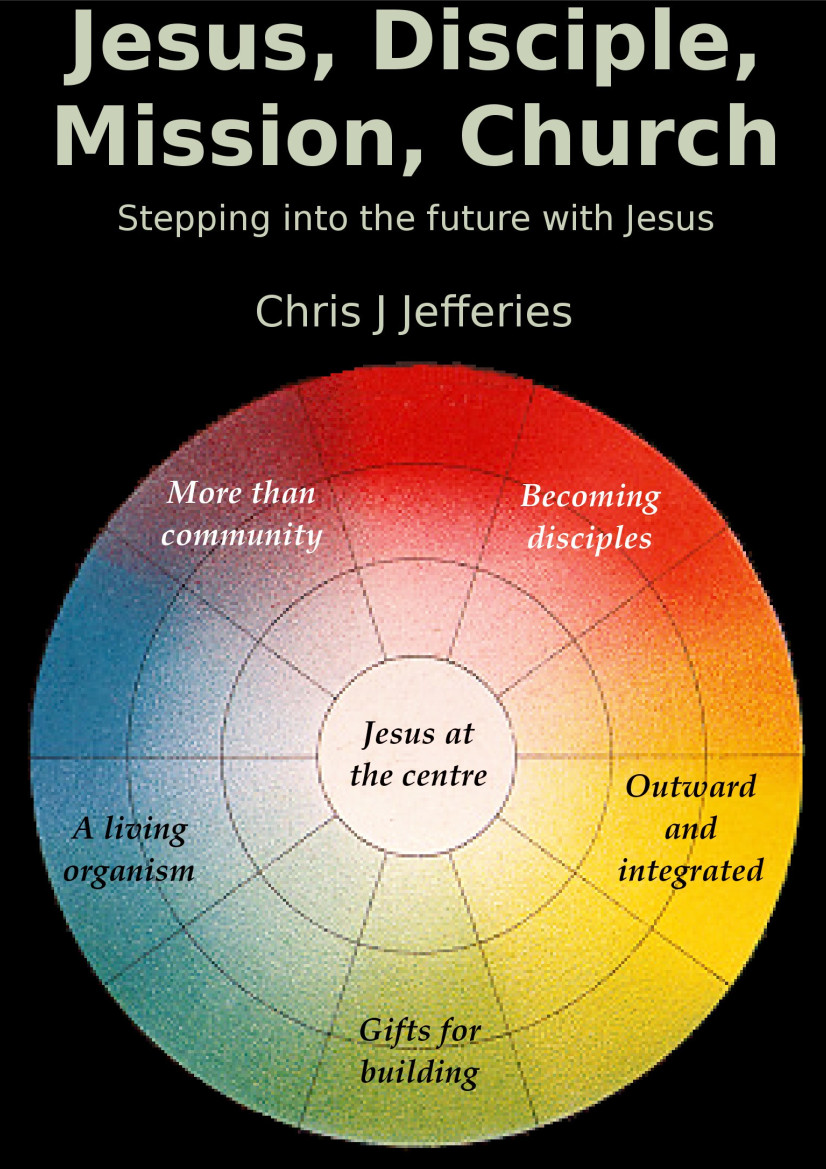
This article is an extract from my short book, Jesus, Disciple, Mission, Church (JDMC). The bite-sized piece below is roughly two percent of the book. It’s the very first section so is a bit different from the rest: there are no questions for readers to ponder, it sets the scene and explains how JDMC might be used.
JDMC cover
This twelve-part guide will help you explore some key ideas from The Forgotten Ways by Alan Hirsch (all of his books are available via this link). Of course, one way to grapple with the material is simply to read Alan’s book, and I highly recommend doing so. And if your church or group wants to discuss and learn together there’s The Forgotten Ways Handbook, also highly recommended, but it’s long and detailed. Another way to start is to read The Shaping of Things to Come, a book that provides a lot of useful background.
But if you need an introductory guide you have come to the right place. JDMC is suitable for individual use, but better for up to six to ten people working together. The guide explains the main points to get you thinking and exploring; if you find it interesting you’ll want to go further so I’ll point out the main sources as we go along. For more information visit Jesus, Disciple, Mission, Church.
I became aware of The Forgotten Ways when Alan spoke at a conference. I read some of his books, began working through the Handbook on my own, and then tried it with others. I wrote JDMC because I sensed the need for something short and simple, and I’m using it very effectively with groups of people I know.
Where might you use this guide?
It works well for groups of interested friends, it could be used by a Christian Union at a workplace or college, or it might suit a home group or small group forming part of a local church. Also, it might serve to inject fresh thinking into any church or denomination, perhaps being worked through by a group of church leaders. But please remember that JDMC only skims the surface. If you like what you find here, please consider going deeper and further using the sources mentioned above and throughout the guide.
What it contains
JDMC consists of the introduction you’re reading right now, a first section to outline the thinking behind The Forgotten Ways, six further parts (one for each forgotten way), three supplements to answer questions readers have asked (not based on Alan Hirsch’s work), and a conclusion. The sessions contain simple, introductory material with questions to get you thinking for yourself. The six forgotten ways can be seen as distinct, but also have a way of weaving themselves together in practice. You may notice this as you work through the guide; take it as evidence that the six ways are inextricably linked and interdependent.
We learn by doing. Good and bad habits alike result from repeated behaviour, and the sessions aim to get you behaving in ways that will form good habits as Jesus’ disciples. Over time, I hope and expect that you will behave yourselves into habits and thinking that will take you further in the journey with Jesus than you may have thought possible or necessary.
Don’t skip the questions, they’re an essential part of the discovery process. Take time to process the material and come up with your own ideas and conclusions. It’s not possible to offer exhaustive Bible references in a short guide. The Bible references I’ve included are merely starting points for exploration. As you read your Bible (and especially the gospels) you are likely to find that other relevant verses and paragraphs leap off the page.
The sessions include related online material including text, audio and video. You can click through to these resources in the version of the discussion guide at jdmc.scilla.org.uk. The guide is free to use so download it, print it, modify it, or give it away; all I ask is that if you distribute it you provide attribution by including the link GetJDMC.scilla.org.uk and apply the same copyright conditions that I do.
This was extracted from Jesus, Disciple, Mission, Church (JDMC), pages 7 and 8. Download the whole thing or read it online – GetJDMC.scilla.org.uk
Useful? Interesting?
If you enjoyed this or found it useful, please like, comment, and share below. (If you don’t see those links, click the article’s title above the main photo and they will appear.) Send a link to friends who might enjoy the article or benefit from it – Thanks! My material is free to reuse (see conditions), but a coffee is always welcome and encourages me to write more often!
What’s in an image? Sometimes quite a lot, more than meets the eye.
I’m posting an image every day (or as often as I can). A photo, an image from the internet, a diagram or a map. Whatever takes my fancy.
The Roman villa in its surroundings
Here’s another view of the villa, you can see one of the farm outbuildings on the left, and a newly planted vineyard in front of the villa. An access road of pounded stone passes this side of a wooden fence, note the avenue of young trees growing on both sides of this road.
It looks very much the way the original villa would have done in Roman times. Two things really give the game away, though. The young vines have modern protection tubes around them to prevent animal damage (these will be removed onece the vines are three or four years old). And the pattern of modern agriculture in the background is entirely wrong. Roman fields would have been much, much smaller and would not have extended far from the villa. Instead, the more distant parts of this view would have been much more heavily wooded.
Today’s conservationists would love to see parts of our landscape return to the way it was in Roman times. A lot of mature forest was cut down during the days of the British Empire to supply timber for the Royal Navy’s ships, as well as for fuel and the growth of towns and cities. The ancient forests that were lost would have supported populations of wild boar, wolves would have roamed the forests too and would have kept the deer population density lower than it is today. This in turn would have made it more likely that tree and wild flower seeds would have survived and spread more abundantly.
Beavers would have created localised ponds and small lakes that would have naturally regulated water flow, and the natural vegetation would have trapped heavy rainfall and released if gradually, reducing flooding. Almost all the British landscape today is far from it’s natural climax state.
So the view beyond the villa would have been altogether different from the modern landscape in the photo.
Images of the Roman villa
For convenience, here’s a list of all the Roman villa images:
If you enjoyed this or found it useful, please like, comment, and share below. (If you don’t see those links, click the article’s title above the main photo and they will appear.) Send a link to friends who might enjoy the article or benefit from it – Thanks! My material is free to reuse (see conditions), but a coffee is always welcome and encourages me to write more often!
It would have been a delight to walk on a floor of this sort, especially with the underfloor heating that wealthy Romans had in their villas and town houses.
What’s in an image? Sometimes quite a lot, more than meets the eye.
I’m posting an image every day (or as often as I can). A photo, an image from the internet, a diagram or a map. Whatever takes my fancy.
A new mosaic floor
Although most of us will have seen Roman tessellated pavements in museums or at excavation sites, few people will have seen a recently laid floor of this kind. What did a new mosaic floor look like? It looked like this one at The Newt in Somerset!
It would have been a delight to walk on a floor of this sort, especially with the underfloor heating that wealthy Romans had in their villas and town houses. Cool in hot weather, but luxuriously warm in a British winter when the furnace outside had been lit and was being tended by a slave or servant, a warm floor was a wonderful thing indeed.
In the upper left, you will notice some musical instruments placed on stools, when the musicians return in a moment they’ll pick up the instruments, sit on the stools, and begin playing. And then the Master and his dinner guests will arrive to enjoy music until they go through to the triclinium for the meal to be served.
Images of the Roman villa
For convenience, here’s a list of all the Roman villa images:
If you enjoyed this or found it useful, please like, comment, and share below. (If you don’t see those links, click the article’s title above the main photo and they will appear.) Send a link to friends who might enjoy the article or benefit from it – Thanks! My material is free to reuse (see conditions), but a coffee is always welcome and encourages me to write more often!
What’s in an image? Sometimes quite a lot, more than meets the eye.
I’m posting an image every day (or as often as I can). A photo, an image from the internet, a diagram or a map. Whatever takes my fancy.
Today’s photo shows the River Liffey in the centre of Dublin. I liked the contrast between the old sailing ship and the modern buildings along the waterfront. There’s a sense of history, of the long passage of time beyond an individual human life.
Two hundred years ago, in 1824, the city was here, the river was here, sailing ships of various sizes would have been jostling together along the quayside, but the buildings have changed dramatically. In 1824 there was no photography, no computing, no motor vehicles, no EU, no electricity supply. There were no railways; coastal vessels and canal barges were the main system for transporting heavy goods, while horse drawn vehicles on generally poor roads were used for passenger travel and light goods.
Over many thousands of years, science and technology working together have taken us from the use of stone, wild plants and animals in the prehistoric past to all the conveniences of modern living. And those changes continue, faster now than ever. Imagining the past is at least possible, imagining the future much less so. There are too many unknowns.
Images from our Irish holiday 2024
For convenience, here’s a list of all the Irish holiday images:
If you enjoyed this or found it useful, please like, comment, and share below. (If you don’t see those links, click the article’s title above the main photo and they will appear.) Send a link to friends who might enjoy the article or benefit from it – Thanks! My material is free to reuse (see conditions), but a coffee is always welcome and encourages me to write more often!