Ways five and six, and six ways

Different things may stand out for different people; tell one another what seems important and why.

< Previous | Index | Next >

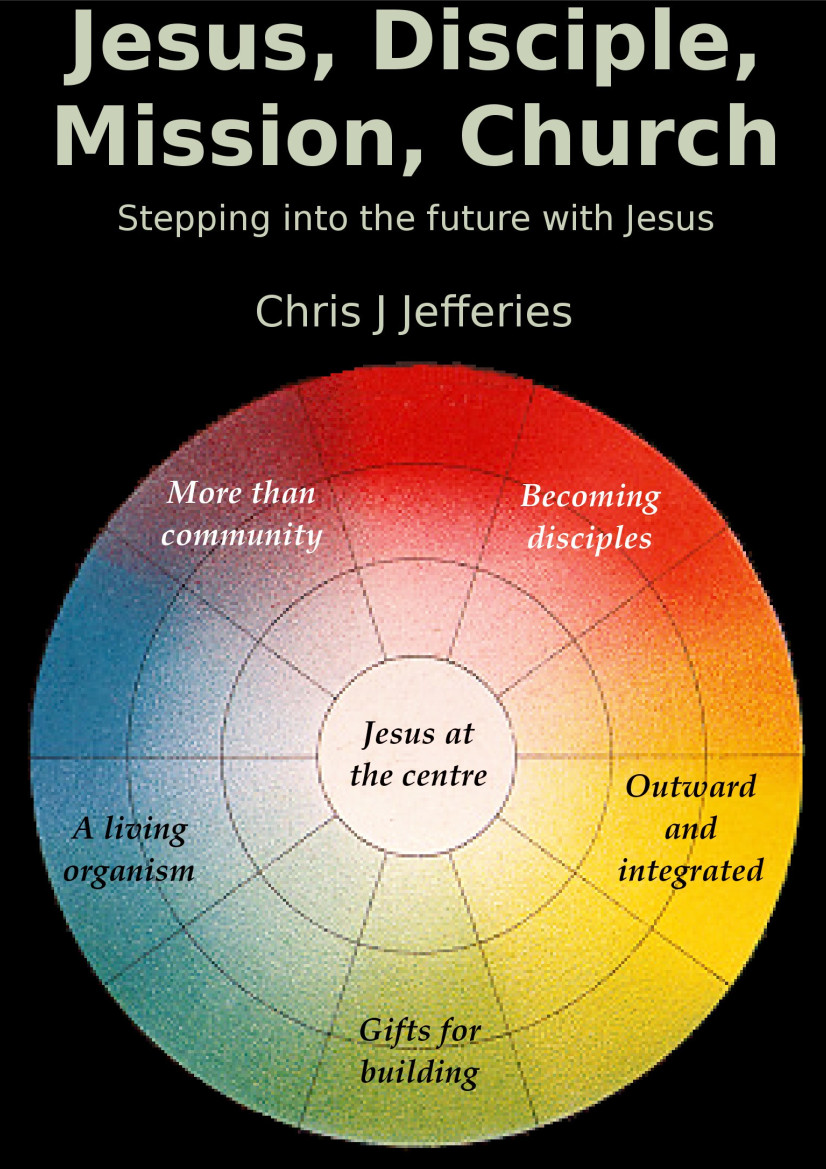
JDMC cover

This article is an extract from my short book, Jesus, Disciple, Mission, Church (JDMC). The bite-sized piece below is roughly two percent of the book. This completes the first chapter entitled Working together in six ways.

5 – A living organism

This session looks at some important differences between organisations and organisms, particularly as they involve movements, networks and growth. As the body of Christ we are an embodiment of Jesus’ life and resurrection.

Is the church alive or is it an institution? How can we even begin to answer a question like this? Does the Bible contain anything to help us? As a clue, does Jesus speak more positively about organisations (Matthew 12:5-8, Matthew 23:1-12) or about living things (Matthew 13:18-23, Matthew 13:31-33)? This is another long forgotten road we need to travel together, a forgotten way.

Discuss – Talk about the differences between organisms (animals, plants, people) and organisations (businesses, governments, schools). Who creates plants? Who creates schools? Who creates church?

6 – More than community

Strong and vibrant communities develop where there is a shared ordeal. We need to be on a risky journey together; we need to be drawn out of our comfort zones. It’s not necessary to be persecuted, but it is necessary to be stretched in significant ways in our lives together.

This is the sixth forgotten way, something we are inclined to stop doing when we are comfortable and unchallenged. Read Acts 4:1-7, Acts 5:17-20 and Acts 8:1-3 for some examples of how the early church lived a risky journey. Even better, read the whole of Acts and note how the early church lived and behaved.

Discuss – Is it natural for people to go beyond a place of comfort and safety? So why do we go on roller coasters? Where would you expect the strongest bonds to form, in an army detachment under fire or at a tea party? Why?

Six parts of a connected whole

The six forgotten ways are utterly dependent on one another. Think about a tree. Trees have four principle parts – roots, trunks, branches and leaves. But if any part is missing the rest of the tree will die. Without roots the tree has no supply of water. Without the trunk the root won’t receive food from the leaves, the branches would have no support and the leaves would lack water and wither. Without branches the leaves would not spread wide in the sunlight. Without leaves there would be no food supply and the tree would starve.

When all six elements of the forgotten ways are active, explosive growth is possible. And this is the key take-home message. Improvement in any one way is useful, but only when all six are active will the full benefit become clear. Like the parts of the tree, the six ways depend on one another and work together.

Think of Jesus in the centre surrounded by and intimately involved in each of the other concepts – becoming disciples, outward and integrated, gifts for building, a living organism and more than community. Imagine all six elements at work together. Nothing will be impossible.

That is the dream; it’s an awesome revelation. Let’s watch Jesus turn that dream into reality in our lives together.

Discuss – What is the most important thing you have discovered during this part of the guide? Different things may stand out for different people; tell one another what seems important and why.

More sections of JDMC

Introduction – JDMC, what does it contain? – Using JDMC – how to approach it

Working together in six ways – Intro and Way 1 – Ways 2, 3 and 4 – Ways 5 and 6, six ways

Way One, Jesus at the centre – Jesus at centre 1 – Jesus at centre 2 – Jesus at centre 3

Way Two, Becoming disciples – Disciples 1 – Disciples 2 – Disciples 3

Way Three, Outward and integrated – OutAndInt1, OutAndInt2

Way Four, Gifts for building – GiftsForBuilding1, GiftsForBuilding2

Way Five, A living organism – LivingOrg1, LivingOrg2

More sections will appear here…

The work of the Spirit – Intro – Jesus, disciples, outward – Gifts, living, community, help

Other church leaders – Intro, bishops, elders – Deacons, pastors, priests

Last words – The end can also be the beginning

< Previous | Index | Next >

Read the book

This was extracted from Jesus, Disciple, Mission, Church (JDMC), pages 11 and 12. Download the whole thing or read it online – GetJDMC.scilla.org.uk

Useful? Interesting?

If you enjoyed this or found it useful, please like, comment, and share below. (If you don’t see those links, click the article’s title above the main photo and they will appear.) Send a link to friends who might enjoy the article or benefit from it – Thanks! My material is free to reuse (see conditions), but a coffee is always welcome and encourages me to write more often!

Image of the day – 54

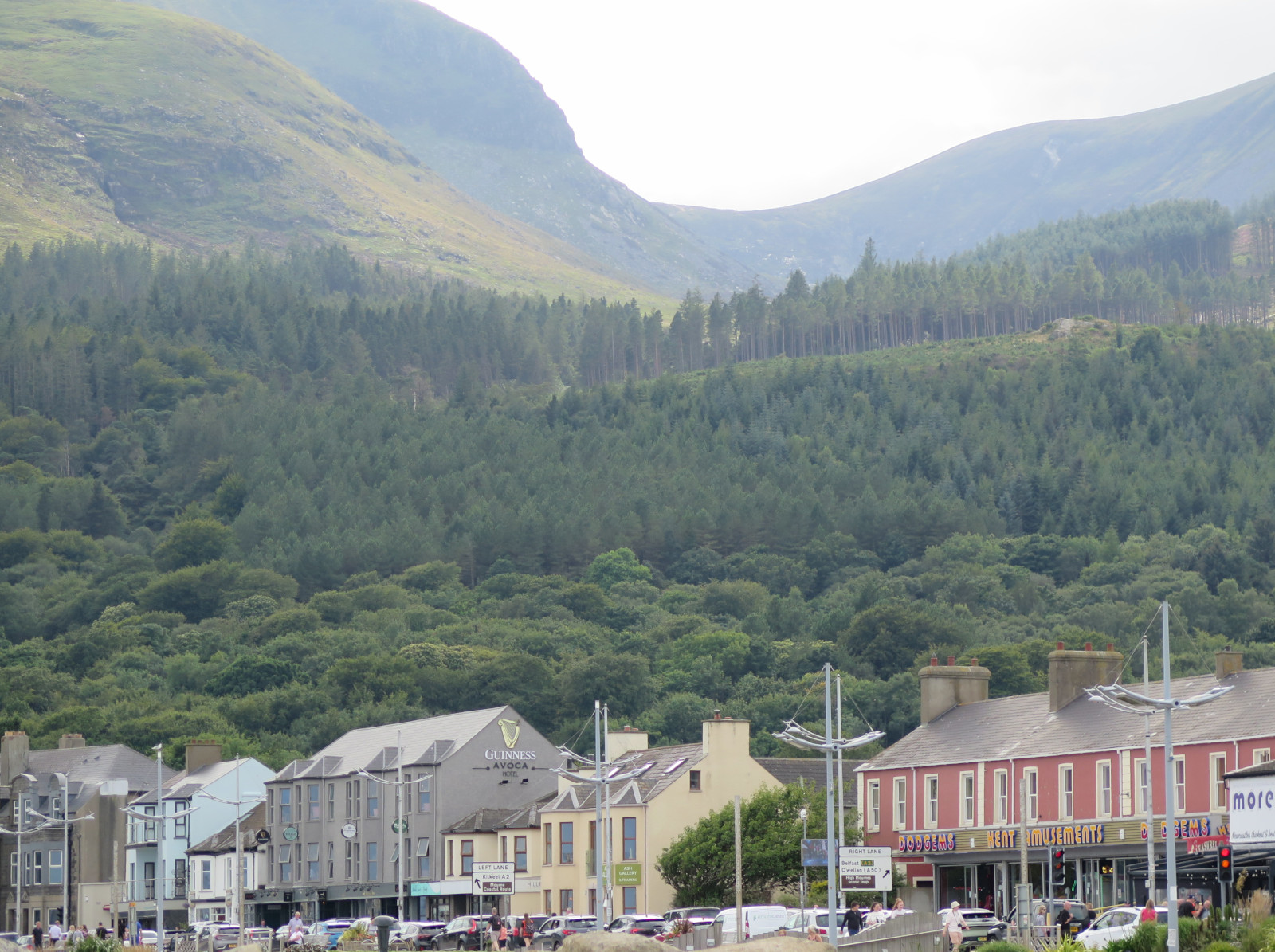
The town nestles beneath these mountains in a way that reminded us of Aviemore in Scotland, but Aviemore has no beach.

< Previous | Index | Next >

What’s in an image? Sometimes quite a lot, more than meets the eye.

I’m posting an image every two days (or as often as I can). A photo, an image from the internet, a diagram or a map. Whatever takes my fancy.

Mountains of Mourne at Newcastle

We visited Newcastle in County Down, this is the town where my parents spent their honeymoon in 1947. It’s the place where ‘the Mountains of Mourne sweep down to the sea’.

The photo shows the properties on Main Street with the fine beach behind me. The town nestles beneath these mountains in a way that reminded us of Aviemore in Scotland, but Aviemore has no beach so Newcastle wins the beauty contest!

The name of these beautiful mountains also reminds me of a song, ‘Mountains o’ Mourne’, so here it is sung by Don McLean.


Images from our Irish holiday 2024

For convenience, here’s a list of all the Irish holiday images:

28th Jul – Welsh Botanic Garden, Robin, Fishguard
29th Jul – Wicklow Mts, Glendalough, Powerscourt, Rose, Greystones
30th Jul – Liffey, Temple Bar, St Patrick’s Cathedral
31st Jul – Newgrange, Battle of the Boyne
1st Aug – Monasterboice, Mourne, Thrift, Window
2nd Aug – Spelga Dam, Hydrangea, Pipework, Lough Neagh
3rd Aug – Coagh, Springhill, Portrush
4th Aug – Beach at Portrush
5th Aug – Giant’s Causeway, Carrick-a-Rede, Portrush

Themed image collections

The links below will take you to the first post in each collection

Cirencester, Favourites, Irish holiday 2024, Roman villa

< Previous | Index | Next >

Useful? Interesting?

If you enjoyed this or found it useful, please like, comment, and share below. (If you don’t see those links, click the article’s title above the main photo and they will appear.) Send a link to friends who might enjoy the article or benefit from it – Thanks! My material is free to reuse (see conditions), but a coffee is always welcome and encourages me to write more often!
I will build my church

If Jesus builds something, then he may ask us to help – but he will be in charge. He will teach us how to build, he will give us tasks he knows we can do.

A gathering (Wikimedia)

What did Jesus mean when he said, ‘I will build my church’? And what are the implications for us in our attempts to follow him? Here are some thoughts on the word ‘church’ and the action of building.

A gathering
(Wikimedia)

Aramaic is similar to Hebrew and was probably spoken at home and in the villages in Galilee in Jesus’ day, it was a widely used language in the region and even today is still used in a few areas of, for example, Syria. Jesus would have been taught Hebrew, as all Jewish boys were; this was the language of the Old Testament and was used in the Synagogues. There were some Greek towns and villages in the region, as there were throughout the Mediterranean more generally, so Jesus likely understood Greek. He might have known some Latin as well because that would have been spoken in imperial government and military circles.

In a conversation with his follower, Peter, he may have used an Aramaic word or possibly the Greek equivalent, ekklesia (church); and that’s how it’s recorded in the New Testament (Matthew 16:13-20). As a word it seems to have its roots in daily life; the village or town elders would have gathered as a local council to discuss and manage local affairs. As people meeting together more or less regularly, groups of people following Jesus may have been been given the same label – a gathering, therefore an ekklesia.

In the conversation described by Matthew, Jesus asks his followers, ‘Who do people say the Son of Man is?’ Of all of them, Peter was the most outspoken and would offer an opinion when the more cautious held back. Peter didn’t seem to worry about the risk of giving a wrong answer and looking foolish. So several of them gave the answer to the easy question – ‘Who do people say I am?’. But it was Peter who responded to the much more tricky question – ‘Who do you say I am?’

What Jesus says next seems ambiguous, at any rate the way Matthew describes it is ambiguous. Some people think he’s saying that Peter is the rock that he’ll build his church on. Others think the rock is the truth Peter expressed, the truth that Jesus is the Messiah, the Son of the Most High. Personally, I take the second view.

Jesus says that he will build his ekklesia, his church.

If Jesus builds something, then he may ask us to help – but he will be in charge. He will teach us how to build, he will give us tasks he knows we can do, but he remains the top man, the boss, the giver of instructions. We can’t just build what we want in the way that we want, call it church, and expect him to approve!

So let’s start by asking Jesus to show us what he wants us to do. And then when we each do our part, let’s keep checking with him that what we’re doing or saying is in line with his design. And then, as the job progresses, we’ll be able to gasp with astonishment saying, ‘Wow! This is far more amazing than anything I’d dreamed or imagined!’

It all starts with Jesus. The next step is that we have to learn to follow, to be Disciples. That will will steer us into Mission. And out of the results of mission we will see Church appear and grow.

Jesus, then Disciple, then Mission, then Church.

JDMC!

Useful? Interesting?

If you enjoyed this or found it useful, please like, comment, and share below. (If you don’t see those links, click the article’s title above the main photo and they will appear.) Send a link to friends who might enjoy the article or benefit from it – Thanks! My material is free to reuse (see conditions), but a coffee is always welcome and encourages me to write more often!

Image of the day – 53

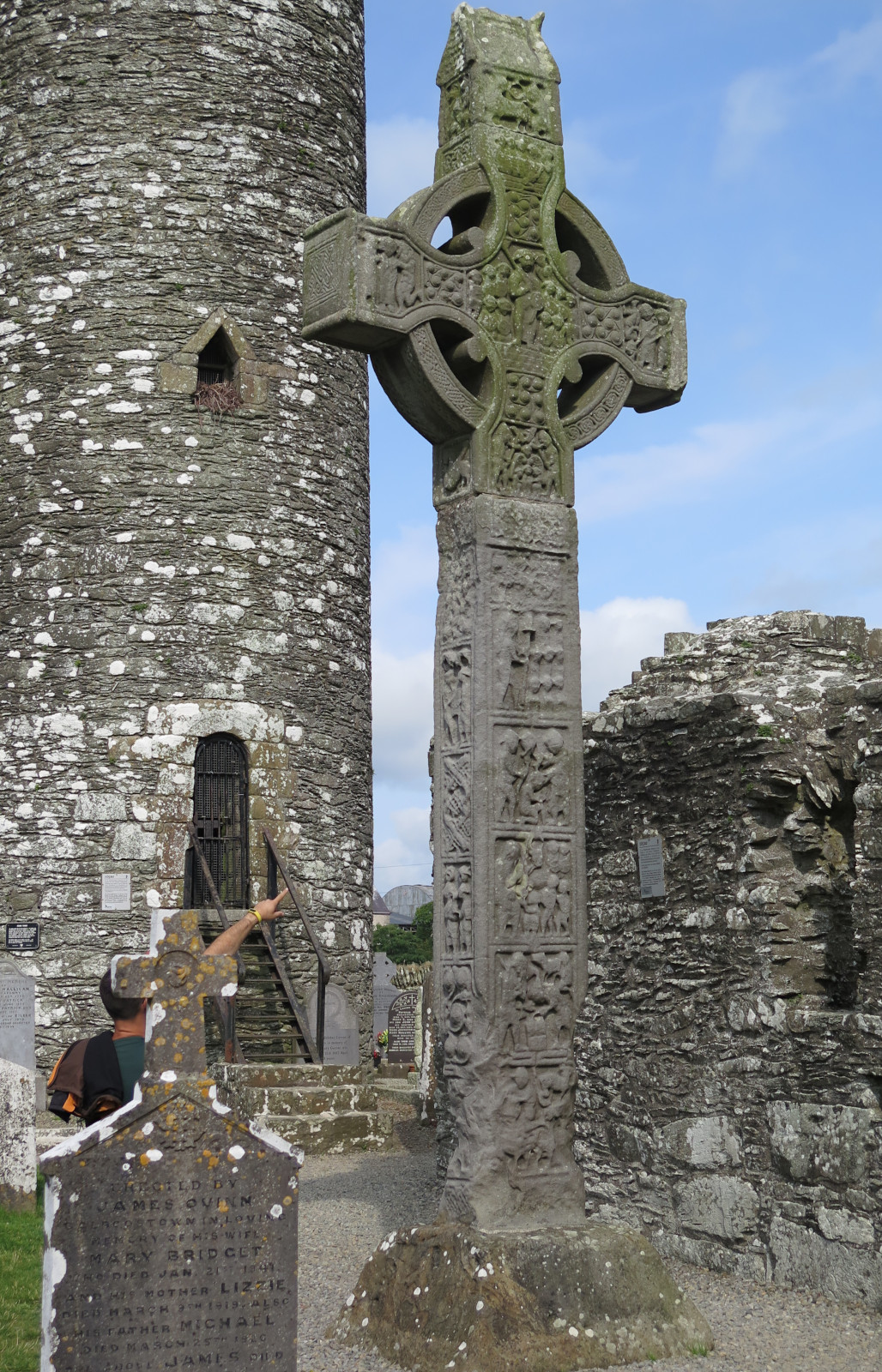
The crosses are usually carved with traditional Celtic patterns, but often they have panels containing carved pictures that illustrate a story.

< Previous | Index | Next >

What’s in an image? Sometimes quite a lot, more than meets the eye.

I’m posting an image every two days (or as often as I can). A photo, an image from the internet, a diagram or a map. Whatever takes my fancy.

Stone high cross at Monasterboice

Irish monasteries had a number of features not found (or rarely found) in other parts of the British Isles. The round towers are one example, there are one or two in Scotland and the Isle of Man, but nowhere else outside Ireland. Stone high crosses are another example. These are found throughout the British Isles and parts of France. The ruined monastery of Monasterboice has a round tower similar to the one at Glendalough, but is particularly noted for several outstanding high crosses, one of these features in my photo.

The crosses are usually carved with traditional Celtic patterns, but often they have panels containing carved pictures that illustrate a story, perhaps a Bible story. They were clearly important to the people and communities that took so much care and effort to create them, and they are one of many strong reminders of the Celtic, and particularly the Irish Christian traditions that were significantly different in many ways from the later, Catholic traditions coming into south-eastern England in Saxon times.

The Catholic Church brought initially to Kent from the Continent introduced a hierarchical style, with church officials under the Pope, and fixed orders of service. The Celtic church that had developed from early, pre-Catholic traditions in Roman Britain, was based more on travelling teachers (often missionary monks) who were more flexible in style, without strict rules. They often took little with them but their learning, and depended on the people they taught to support them on their journeys.

Which of these two styles do you think followed the teachings of Jesus most closely?


Images from our Irish holiday 2024

For convenience, here’s a list of all the Irish holiday images:

28th Jul – Welsh Botanic Garden, Robin, Fishguard
29th Jul – Wicklow Mts, Glendalough, Powerscourt, Rose, Greystones
30th Jul – Liffey, Temple Bar, St Patrick’s Cathedral
31st Jul – Newgrange, Battle of the Boyne
1st Aug – Monasterboice, Mourne, Thrift, Window
2nd Aug – Spelga Dam, Hydrangea, Pipework, Lough Neagh
3rd Aug – Coagh, Springhill, Portrush
4th Aug – Beach at Portrush
5th Aug – Giant’s Causeway, Carrick-a-Rede, Portrush

Themed image collections

The links below will take you to the first post in each collection

Cirencester, Favourites, Irish holiday 2024, Roman villa

< Previous | Index | Next >

Useful? Interesting?

If you enjoyed this or found it useful, please like, comment, and share below. (If you don’t see those links, click the article’s title above the main photo and they will appear.) Send a link to friends who might enjoy the article or benefit from it – Thanks! My material is free to reuse (see conditions), but a coffee is always welcome and encourages me to write more often!

Why I finally ditched X

Bluesky … reminds me of Twitter in those early days, with quite polite conversation on all sorts of topics that interest me.

X (used to be Twitter) is no longer one of the sites I use. Not only have I stopped using it, but I also closed down my account. I joined Twitter in 2008 and for more than 15 years it served me very well indeed. But since Elon Musk bought it, the service it offers has become less and less what I want or need.

Bluesky logo
(Mediawiki)

There are a number of alternatives, and I’ve chosen Bluesky. It reminds me of Twitter in those early days, with quite polite conversation on all sorts of topics that interest me. The major drawback currently is that there are only 6 million or so users, but the numbers are growing quickly now, especially here in the UK. In July 2023 there were 200 thousand users, twelve moths later in July 2024 this had grown to 5.9 million, an increase of nearly thirty times. It’s a long, long way short of X’s 192.5 million. Another increase of thirty times this year would put Bluesky on almost the same number of users as X; that’s not going to happen, but realistically it might grow by another 3, 4, or 5 times. And who knows what will happen in 2026, 2027…

So what, in the end, made me leave?

There are several factors.

  • I used Twitter as a very up-to-the-minute news source. Type in the name of any town, for example, and up would pop the latest posts by anyone there at the time. This was also great for learning about ongoing events – the Olympics, Cricket, the Russo-Ukrainian war. That no longer works on X, the news function is cluttered up with so much nonsense and opinion that it’s no longer useful in that way – at least, not to me.
  • Arrogant rudeness, sometimes of the most extreme kind. It’s everywhere on X but very rare on Bluesky. Often, on X, posts like this are targeted spam (see the next item).
  • Spam, sometimes targeted to a receptive group of some kind, sometimes just random. There seems to be a lot of this on X these days. I don’t know about you, but I can do without spam!
  • Misinformation and disinformation is problematic on X. So anything you read may or may not be true.
  • I like watching YouTube videos and I dare say you do too. SpaceX used to post their rocket launches in high definition on YouTube, but now they’ve moved to X, initially in lower quality. SpaceX’s progress is something I want to keep track of, but from now on I’ll be watching these developments on third-party YouTube channels like Everyday Astronaut, Marcus House, NASA Spaceflight, WAI, and others.

Bluesky and other social networks suffer from the same issues to varying degrees. But Bluesky has strong policies and controls in place, they seem to me to be far more effective than any such controls in X. For more information on how Bluesky is designed and managed, read the Wikipedia article about it.

Useful? Interesting?

If you enjoyed this or found it useful, please like, comment, and share below. (If you don’t see those links, click the article’s title above the main photo and they will appear.) Send a link to friends who might enjoy the article or benefit from it – Thanks! My material is free to reuse (see conditions), but a coffee is always welcome and encourages me to write more often!