Cirencester Wharf

There would have been bargaining and haggling, tobacco smoked and ale downed

Modern residents of Cirencester may not know that the town once had a wharf where canal boats tied up to load and unload goods of all kinds, including coal, manufactured goods, and timber. There were small hand-operated cranes on the quayside to help with handling heavy items.

The canal was a branch from the main Thames & Severn Canal that ran through Siddington and is currently being restored by the Cotswold Canals Trust.

So where was the wharf?

The wharf lay at the bottom of what is now Querns Hill, less than half a mile south of where Cricklade Street meets the Market Place. It was an easy trip by horse and cart for any of the businesses in the town in the late 18th and early 19th centuries, and would have been a bustling hub of activity. The area was large enough to turn arriving barges for the trip back to Siddington; imagine the sounds and smells as horses were harnessed and roped for departure or released to rest and graze after arrival. Money would have changed hands as goods were loaded or unloaded from carts and dreys. There would have been bargaining and haggling, tobacco smoked and ale downed, jokes and banter and laughter, bread, cheese and meat passed around. People would have greeted one another and said their goodbyes because barges were used to carry passengers as well as goods.

Does anything remain?

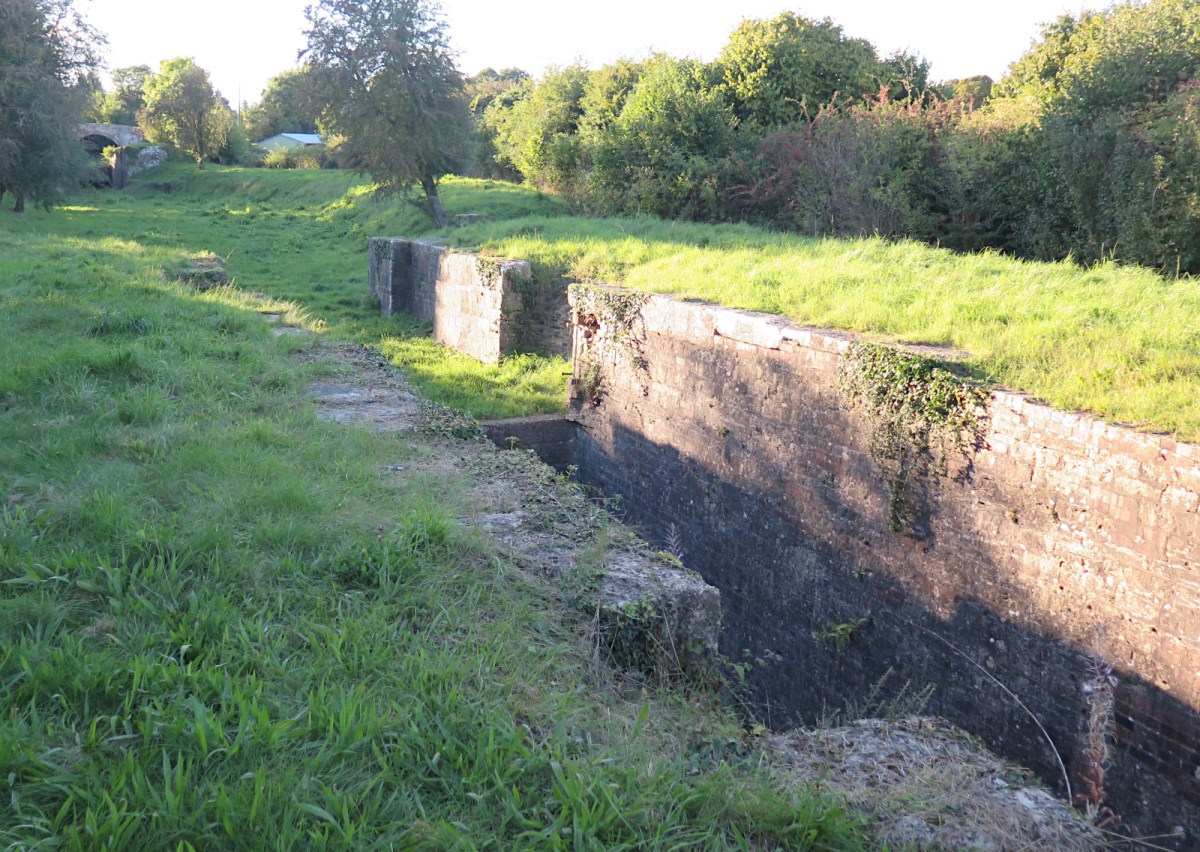
Surprisingly, yes! Parts of the towpath remain as footpaths and can still be walked, though the canal has been filled in and there’s no sign of it in the area near the wharf. There are dry stone walls that were once the boundary walls of the canal; you can see these when you know what to look for. And it’s not hard to trace the route of the canal on foot.

Begin near the bottom of Querns Hill, where it meets Querns Lane and Sheep Street, find the view in the location photo below.

Location of the wharf

You are now looking at the site of the old wharf. It stretched from close to the building on the left (beyond the parked cars and the wall) across to the right hand edge of the photo. The canal leading from the wharf headed directly through the building in the centre of the photo and on through the trees in the centre.

The trees follow the line of the old canal

The photo above shows the same trees but looks back towards the wharf; the buildings on the left are close to those in the first photo. The canal would have more or less followed the line of trees from the buildings on the left right up to the yellow vehicle, and the course of the towpath remains along the garden boundaries hidden by the parked cars. Turning 180° from this view there is a house built over the route of the canal, but walking around it and crossing the road, the footpath between the houses is again the old towpath. What’s more, a dry stone wall on the left hand side of this path is almost certainly the old boundary wall that ran along both sides of the canal. The wall is high here, about 2 m, but beyond the town and in farmland the wall was only 1 m or so. It’s easy to visualise the canal here, mentally remove the tree, imagine water where the grass is, and you have it!

The old towpath and boundary wall, the canal was where the grass is

I was quite surprised to find so much remaining and still identifiable. Local history can be very fascinating and sometimes the detective work is easier than expected. It would be nice to have some of these remains marked and explained on noticeboards.

If anyone reading this is interested in helping to research the Cirencester Branch of the canal, please leave a comment below and I’ll make contact.

Related material

(Article updated 20th July 2020)

John Jefferies & Son Ltd – Index

The family business prospered for many years

(See indexes on other topics)

This was the family business, founded in 1795. It prospered for many years, growing and selling nursery stock to other businesses, the government, and to the general public. It ceased trading in 1984 and the garden centre business was sold to Country Gardens PLC, although the company was not officially dissolved until 1994.

  1. The old florist’s shop – the shop had a wonderful cellar

I plan to write a series of articles about John Jefferies & Son and will list them on this index page.

Company details from a 1950 catalogue

Spiritual melody

Everyone present should be free to begin a song

Part 6 of a series – Spiritual melody

Eat together | Index | No later posts >

When we think about church music, we usually think in terms of something that’s organised in advance and is played by a band of some kind. Often there’s a worship leader. Over the centuries church music has developed in parallel with the changes in secular music, some examples include Gregorian Plainsong, the chanting of psalms, hymns from hymnbooks accompanied by an organ, informal choruses in house meetings, and more recently bands playing in styles drawn from modern secular music and sometimes of excellent professional standard.

How does that compare with music in the early church? We do have some clues; for example, Paul writes about it briefly in Ephesians 5. In verse 18 he tells us

[Be] filled with the Spirit as you sing psalms and hymns and spiritual songs among yourselves, singing and making melody to the Lord in your hearts.

So it seems likely that singing involves inspiration, literally singing as and when and how the Holy Spirit leads. And that would be the very opposite of what we find in many church meetings where the music is led by a person and/or a band at the front and the congregation joins in. It is sometimes the case that people may, in the process, be caught up emotionally and, perhaps, spiritually. But this is never guaranteed and there’s limited freedom to initiate a new song, sing in the Spirit, or be fully free in praise and worship.

Informal and spiritual worship

So what is Victor Choudhrie suggesting? (See the quote below.) Quite simply he is saying that when we meet, at home, in small groups, after sharing a meal, we should forget organised, planned in advance music with a band. Instead, as we pray and worship and teach one another, everyone present should be free to begin a song if they feel led by the Holy Spirit to do so. Not only that, they should feel free to sing in a tongue, or use their voice with no words at all, sing alone or together, pouring out their hearts to the Lord and to one another. As with everything else – complete freedom in music!

Who is it for? Why are we singing? I’m sure you already know the answer! It’s for the Father, Papa, Abba, Daddy, Yahweh, the Mighty One, Elohim – sing to him in praise and worship. And it’s for the Son, Jesus, Yeshua, Yahshua, the Messiah, Christ, our King, our Redeemer and our Rescuer – sing to him in praise and worship. And it’s for his Spirit, the Spirit of Christ, the Holy Spirit, our Comforter, our Guide, our Cousellor and Advocate, the One who prompts us to sing – sing to him in praise and worship. Sing to the Three in One, the Everlasting Mystery! He is with us, and in us, and amongst us. How could we not sing?

Here’s what Victor Choudhrie has to say about it:

Replace professional music with believers speaking to each other in psalms and spiritual songs, making melody in their hearts to the Lord. OT worship required the sacrifice of four-footed beasts; the NT celebrates by offering two-legged Gentiles as a living sacrifice. The meta-church is a discipling hub and not a singing club. Eph 5:19; Col 3:16; Rom. 15:16

Questions:

  • How can we best give the Holy Spirit freedom in our singing?
  • Is it helpful or unhelpful to restrict singing to a particular slot in a meeting?
  • If our hearts are full of praise, are we more or less likely to sing?
  • If we sing, are our hearts more or less likely to become full of praise?

See also:

Eat together | Index | No later posts >

Hand, foot and eye

At a time when the disciples are well aware of Jesus’ glory, power, transcendence, and authority, they ask, ‘Who’s the greatest in the kingdom of heaven?’

I was reading Matthew 18 this morning, and thought that there are depths in this chapter that can only be grasped when we see things from a kingdom perspective.

In chapter 17, Yahshua reveals his glory to Peter, James and John; deals with the disciples’ lack of faith; speaks of his death and resurrection; and explains that he and his followers are not subject to the demands of religion because they are already part of his holy kingdom. The scene is set, Jesus has demonstrated that he has all the glory, all the power, transcends death, and is subject to no human authority. These factors are all relevant to our understanding of chapter 18, which begins with the words ‘At that time’.

A three-year-old child (Wikipedia)

So, at a time when the disciples are well aware of Jesus’ glory, power, transcendence, and authority, they ask, ‘Who’s the greatest in the kingdom of heaven?’ As he often does, Jesus answers indirectly. He calls over a small child to place amongst them, and tells them clearly that they need to be childlike or they won’t make it into the kingdom of heaven at all. Only the humblest adult can be great in the kingdom, and welcoming such a person is, in reality, welcoming Christ himself.

Furthermore, even being drowned is better for me than putting obstacles in the way of a humble believer; Yahshua isn’t saying I must be put to death, he’s saying I’m already worse than dead! If I cause such stumbling I’m not really one of his followers at all. In verses 8 and 9 Yahshua describes how my hand, my foot, or my eye might cause me to stumble. So it’s what I choose to do, where I decide to go, and what I pay attention to that puts me at risk. There’s a challenge here for all of us: don’t do, go to or look at anything that might cause us to fall. Avoid actions, circumstances and sights that are unhelpful. Stay humble, remain in his presence, and we will share in his glory, power, life and authority. Now that’s good news!

Season’s Greetings

Fresh grace and peace in your life every day

It’s that time of year again, cards have gone out and others have arrived on our doormat. I’d really like to include my blog readers. So, whoever you are, wherever you live, here’s the image that was on this year’s card:

ChJe20120114c-mod01

And what I’d like to pray for everyone reading this is that you would find fresh grace and peace in your life every day and be blessed throughout the coming year. May 2019 be the year you meet Jesus as your friend and guide. And for those who already know him, may your journey find you going deeper and further with him than ever before, in increasing faith and obedience.

Happy New Year 2019 everyone!

The photo shows Cotoneaster berries covered with hoar frost, the photo was taken in 2012 in our old front garden before we moved to Cirencester.

Other years

2025, 2024, 2023202220212020
2019201820172016

Life together

Only living things can form a murmuration. Not only that, the individuals must all be alive with the same kind of life, don’t expect to see seagulls and starlings together in the same formation.

A murmuration of starlings

This morning, swilling out the cafetiere, watching the dark coffee grounds fan out and spiral down the drain, a word popped into my mind – ‘murmuration’. This word is used for a flock of birds flying together, swirling hither and thither, flying together as one yet moving independently and in smaller groups within that one flock. Starlings are particularly known for this behaviour as they go to roost in the evening light, and the dark specks of coffee reminded me of a murmuration of these birds.

Murmuration of starlings

But looking at those coffee grounds made it very clear to me that only living things can form a murmuration. Not only that, the individuals must all be alive with the same kind of life, don’t expect to see seagulls and starlings together in the same formation. The living entities must also be in a fluid environment (air or water, large shoals of fish can exhibit the same phenomenon). And they must be aware of one another and able to respond rapidly to one another’s movements.

Take a look at this video of a starling murmuration. It’s stunning!

So it should be with the church. A formation of individuals all alive with the same life, the life of Christ, all filled with his Spirit. Church should be a fluid environment, the individuals free to move in every dimension, yet always aware of one another and responding to one another.

When the church flows like a murmuration, individually alive with Christ, individually free to move yet mutually aware, responding to one another’s presence and movement, unconstrained except in obedience to Christ, then, my friends, we will see her transcendent glory revealed and the whole world will gasp. People will say, ‘Oh wow, how can this collection of individuals flow together with such transcendent beauty and grace?’

If not, we are little better than coffee grounds swirling into the drain. Not alive at all, merely acted on by random currents as gravity draws us ever downwards. Paul expressed this when he wrote to the church in Ephesus,

We must no longer be children, tossed to and fro and blown about by every wind of doctrine, by people’s trickery, by their craftiness in deceitful scheming. But speaking the truth in love, we must grow up in every way into him who is the head, into Christ, from whom the whole body, joined and knit together by every ligament with which it is equipped, as each part is working properly, promotes the body’s growth in building itself up in love.

An old school friend

Friends are important, we humans are fundamentally social beings

At my sister’s recent book launch, I was delighted to meet an old friend from school days, Nick Henderson. Although he looks older – as, of course, I do too – his personality is entirely as I remember from the mid 1960s. We agreed to meet again this morning at the Golden Cross in Cirencester, and it was a delight.

Nick and I last met when we were both living at home and very probably still at school. For a year or two we used to hang out quite a bit. I remember going with Nick to see a local band called The Corals during a record-breaking attempt at playing non-stop without repeating any songs; the drummer, one Colin Flooks, another lad from our school year, later became famous as Cozy Powell. And yes, they did break that record – in fact they smashed it by playing for 11½ hours.

TheCorals
The Corals during their record-breaking session, photo from The Wilts and Glos.

Nick and I talked about many things, catching up on our personal journeys over the last half century, recalling the cross-country runs that were compulsory on Wednesday afternoons at school, and thinking about Daglingworth Brook, the River Churn and how the water is channelled in and around the town. The drainage courses have changed over the years, altered for many reasons, beginning in Roman times when the town was young, and continuing right down to the present.

Friends are important, we humans are fundamentally social beings; renewing a connection after such a long gap has been a very special thing for me. More so than I had expected or imagined.

For more about Nick, take a look at his website and/or a site he edits, Anglicanism.org .

Going out on a limb?

I’m looking forward to seeing the book in due course

This is a ‘must post’, I think.

The History Girls blog

My sister, Cynthia Jefferies, has been a successful children’s author for some time; now, heading in a slightly different direction, she is about to publish her first book for adults. It’s an historical novel, The Outrageous Fortune of Abel Morgan, set in the period after the Civil War. Cindy provides some background  in a post on The History Girls blog – you might like to swing by and read what she has to say.

I’m looking forward to seeing the book in due course, meanwhile I wish her every success with the launch.

And ‘going out on a limb’? You’ll need to check out those History Girls to find out what that refers to.

Part of the Grand Canyon is in Australia

Way back  a thousand million years ago when the super-continent Rodinia existed

Well, OK, it’s not that the canyon itself is partly in Australia, but the rock formations through which the canyon was formed are partly in Australia.

How do we know? Many of those rock layers with their very distinctive and unique sequences and chemical compositions have also now been found in Tasmania, the large island just south of the Australian state of New South Wales. It’s the oldest rocks of the Grand Canyon series that have been discovered in Tasmania. The rocks have always seemed unrelated to other rocks in the same part of the island, but they look like the oldest canyon rocks in many of their details and make-up.

Rodinia
Rodina, a super-continent with Australia adjoining Laurentia.

The solution to this puzzle can only be that part of Australia was once a single piece of continental crust with the rocks of the Grand Canyon. That would have been way back  a thousand million years ago when the super-continent Rodinia existed. Since then, the continents have broken apart, moved around, run into one another, and broken apart again. The breakup of Rodinia separated the early rock grouping into pieces that became part of modern North America and Australia.

This is not a new theme in the history of the continents. In a much more recent episode (the opening of the Atlantic Ocean) an ancient mountain chain was torn in two; the parts now form the Appalachians in North America and the Scottish Highlands on the edge of Europe.

But this new discovery helps scientists put more detail into the very early story of continental crustal movement and break up. Thanks to Jack Mulder and others for publishing the discovery and New Scientist for sharing the story more widely.