John 15:9-17 – Love and fruit

This joyful, loving relationship we have with Jesus is so important. In these verses Jesus stresses it by repetition. He wants to see joyfulness in our lives, he wants his joy to find a welcome in our lives.

< Previous | Index | Next >

Bible text – Read it yourself (opens in a new tab)

A fragment of John’s gospel
(Wikimedia)

At this point Jesus begins talking about love. It always helps, when explaining something, to have an illustration or example; Jesus needs an example of his love for his followers, so he says, ‘I’ve loved you the same way the Father has loved me’. There’s such a lot in that simple statement!

But the disciples had evidence of the Father’s love for the Son going far beyond words alone; the love was affirmed by powerful action. They had seen the sick being healed, the dead raised to life and evil spirits thrown out. Oh yes, he had the affection of the Father, and now Jesus tells them that he loves them like that, too! Notice how remaining in the love depends on obeying the commands. It’s not that the love is taken away in the absence of obedience, but the absence of obedience is the same thing as walking away from the source of the love. So his followers have a part to play as well, they are to ‘Stay in his love’. They are to stay close, not wander off but to stay in that place of affection.

It begins and ends with love

This joyful, loving relationship we have with Jesus is so important. In these verses Jesus stresses it by repetition. He wants to see joyfulness in our lives, he wants his joy to find a welcome in our lives. He’s explained this clearly and now, in verse 12 he shows how simple it is. The command that must be obeyed if we are to remain in him and his joy in us is not hard and it’s not complicated or demanding – just love one another, please!

And the greatest and fullest love imaginable is to be more concerned for one another than for our own existence! In verses 14 and 15 Jesus brings us right back to the need for obedience yet again, and it’s not an obedience like that of servants or slaves. We are fully informed, he calls the disciples (and us) his friends, not his servants. Our place is not to serve Christ, but to be his friends. I’m sure you appreciate the difference. We’re helping out one of our mates, not scraping and bowing to an imperial boss!

Getting the job done

Sometimes we are told that people in the world need to ‘choose Christ’, that they need to ‘make a decision for Christ’. Yet Jesus clearly sees it very differently, he tells us here that he chooses us, not the other way around. We are right to share the good news about Jesus, to explain to people that peace and joy and freedom are found in him. But we don’t need to persuade people to make a choice. Jesus makes the choice. We never, never need to browbeat anyone, our task is just to introduce one of our friends. Hey, this is Jesus, say ‘Hi’ to the best friend I have, he’d like to get to know you better.

We do have a job though, and introducing Jesus might well be an important part of it. We were chosen to bear lasting fruit, and if we ask Papa for something, he’ll provide it. He’s always willing because he sees us as one of his Son’s friends – he loves the Son and he loves his Son’s willing mates and helpers. It’s all about relationship, is it not? What we do counts for little, who we are counts for everything! Without Jesus I can do – nothing! But I can do everything in Christ.

And finally, Jesus reminds them one more time, ‘Love one another’. He knows how easily we forget!

< Previous | Index | Next >

Useful? Interesting?

If you enjoyed this or found it useful, please like, comment, and share below. My material is free to reuse (see conditions), but a coffee is always welcome!

Every chapter is necessary

There is a synergy, a sparking of abundant life that comes from the interdependence of the parts.

A page from the book

This is a slightly modified copy of an article I wrote in 2014. I’m republishing it because I think it is still useful and deserves another airing. Perhaps it hints at some things we are liable to forget.

The book, Simple Church: Unity Within Diversity, contains twenty-four chapters. Each one discusses a positive aspect of church, something that is an essential part of the whole. Reading from the book I was deeply impacted by Chapter 22 from Kathy Escobar; the chapter is entitled A church that restores dignity where it’s been lost.

She writes:

Jesus calls [Lazarus] out of the tomb, but then he looks to the people around him – his community, friends, and advocates – and says to them ‘unbind him’. Unbind him. Unwrap him. Take off his graveclothes.

I think God calls us to participate in this uncovering-unwrapping-unbinding with each other through healing community.

And it struck me that although church is much more than the sum of its parts, all of the parts need to be actively present. There is a synergy, a sparking of abundant life that comes from the interdependence of the parts. Church is a person, the Bride of Christ.

Like all people, you and I are much more than the sum of hands, ears, spleen, heart, lungs and all the rest. But if any of these were missing we would either die or be unable to fully function. And it’s just the same with the church.

Just consider some of the other chapter themes. The church cherishes Jesus Christ, exhibits personal holiness, counts every member as key, assembles for mutual edification, and knows eternal life is free. Imagine all of those being true in a church that fails to restore dignity where it’s been lost. It would be a church without the active compassion necessary to unbind those who so desperately need it.

Or consider a church that clings to scriptural truth, is most notable for its love and is united in Christ but doesn’t follow the lead of the Holy Spirit. This would be a church that failed to hear where to go and what to do and did everything in its own strength.

Or what about a church that was composed of peacemakers, viewed itself as a people, restored dignity but failed to proclaim the gospel clearly?

The chapters of this book all stand alone and can be read alone. But they often overlap so that there are echoes and glimpses of them in one another. Yet taken together, with no part missing or inactive, they describe a holistic church, a wholesome church and a church that is alive and active and effective in the world. There are other aspects that are not explicitly covered in the book, prayer for example. But these are implied throughout in a variety of ways.

Church is as complex as any living organism, and just like a living organism it is not only complex but also multi-faceted, and astonishingly well constructed. The church is also alive with the life of Christ. And every part contributes!

Find the book on Google Play Books and on Amazon Books.

Useful? Interesting?

If you enjoyed this or found it useful, please like, comment, and share below. My material is free to reuse (see conditions), but a coffee is always welcome!

John 15:1-8 – Vine and branches

If you prune a vine wisely it becomes more vigorous and more fruitful; that’s true of all kinds of fruit tree too.

< Previous | Index | Next >

Bible text – Read it yourself (opens in a new tab)

A fragment of John’s gospel (Wikimedia)

Jesus has been talking to his closest followers, the small group of twelve who were travelling with him. Now he begins to use the idea of a vine. Remember that everyone in Israel would have known what a grapevine is like, they were widely grown and wine was an important item in ceremonies as well as in ordinary life. It was essential in weddings, in the passover meal and so forth.

He now makes a strange claim, he says that he himself is a vine. Not only that, but he is the true vine. And he mentions that his Father is the gardener, though we shouldn’t think in terms of someone who looks after fruit, flowers and vegetables in the way we would today. Israel is the old vineyard, and Father is much more than just an employed labourer, he is the vineyard owner. The old vineyard (Israel) has not been fruitful. Jesus is a new vine and his Father will prune the branches to make him more fruitful. If you prune a vine wisely it becomes more vigorous and more fruitful; that’s true of all kinds of fruit tree too, anyone who manages an orchard will tell you that ageing trees fruit less but can be reinvigorated by good pruning. Old or diseased branches need to be removed and the others cut back to a strong, healthy bud.

And Jesus goes on to tell his followers, ‘You are the branches’! Who are his followers? Two thousand years ago they were the twelve disciples who followed him everywhere and were hungry to hear whatever he had to say. Today the things that he said to them, apply to us also. We are his branches, we are attached to him.

A two-way relationship

Notice that this is a two-way relationship. Jesus says we’ll be very fruitful if we remain in him and he remains in us. And notice too that it’s an all or nothing relationship; we’ll either be very fruitful or we can do nothing. There’s no option that makes us partly fruitful, or reasonably fruitful, fruitful in some things but not in others. We are fully in; or we are fully out. You will be precious and treasured, or you will be trash. So which will you choose? Will you be attached to the one true vine, or will you be disconnected?

And in verse seven we learn that if we remain in him and his words remain in us, we can ask anything we wish and it will be done for us! We need to be careful here, though. Jesus is not telling us that we can ask for things that are not in his will and purpose. He expects us to know we can ask anything in his Name and receive it. There’s no point in asking for something that will harm or destroy your enemies, for example, because Jesus made it clear that we are to love our enemy. If I ask for wrong things, I am not remaining in him and his word is not remaining in me.

While the nails were being driven through him into the cross, Jesus asked for something. He said, ‘Father forgive them, they have no idea what they’re doing’. Was that prayer answered? You bet it was. It’s a tremendous example of loving your enemy, isn’t it! Maybe one of those Romans was the one who later said, ‘Truly this man was the Son of God’.

Glorifying the Father

Finally, in verse eight we see the purpose of it all. It’s not about us at all. It’s not even about Jesus. It’s about the Father! Being very fruitful, and showing ourselves to be followers of Jesus, simply brings glory to the person who truly deserves it and should always receive it – the Father.

Our Father, who is far beyond our reach, let your Name be utterly holy, may Your will and purpose be done here on Earth, just as it is in Your dwelling place.

< Previous | Index | Next >

Useful? Interesting?

If you enjoyed this or found it useful, please like, comment, and share below. My material is free to reuse (see conditions), but a coffee is always welcome!

John 14:22-31 – Not to the world?

[Jesus] took on our limitations so that he could reach us on our level, in ways we can understand.

< Previous | Index | Next >

Bible text – Read it yourself (opens in a new tab)

A fragment of John’s gospel (Wikimedia)

‘Why are you showing yourself to us, but not to the world?’ This is such an interesting question, it’s also a natural question. Judas (not Iscariot) wants to know why Jesus shows himself to the twelve, but not to the world. The question suggests it’s Jesus’ choice to hide himself from most people but show himself to a few. Judas is right to find this strange! But it’s not what Jesus has in mind.

In verse 23, he responds by saying that for everyone who loves him, he and the Father will come and make their home in that person. In other words, it’s not just for the twelve, but for anyone in the world who loves Jesus. Or to put it another way, the answer is that he will reveal himself to anyone – if they love him. He doesn’t hide from anybody, but those who don’t love him can never truly see him.

Short of time

Jesus needs to wind the conversation up because he knows what will happen next. He reminds them again of the promised Spirit and tells them that he and his Father will live within them; and the Spirit will teach them and remind them of everything they need to know. He also promises to leave his peace with them, and tells them not to worry or be afraid. This seems to me particularly striking when you consider what Jesus is about to go through at the hands of the Sanhedrin and the Roman governor.

And finally, in verses 28 to 31, he reminds them that he’s going to the Father who is greater than he is, and they will be glad (once they understand the significance of this). So, in what way is the Father greater than the Son? Does this idea even make any sense when we know that Father, Son and Spirit are co-equal within the structure we call ‘trinity’, the three in oneness that they share together? Perhaps the answer is simply that Jesus has limited himself within a human body in order to reach us in this world. For more than 30 years he has remained limited, but in returning to the Father he will regain the ability to be present everywhere at every moment of time with all of his people. In his human body he is inevitably less powerful than the Father, only able to act in the one place and time where he finds himself. He took on our limitations so that he could reach us on our level, in ways we can understand. That time is coming to an end as he returns to the Father.

Time’s up

And then they leave, and the final act will open.

< Previous | Index | Next >

Useful? Interesting?

If you enjoyed this or found it useful, please like, comment, and share below. My material is free to reuse (see conditions), but a coffee is always welcome!

John 14:15-21 – Promising the Spirit

If Jesus is in us and he is also in the Father, then we too are somehow part of their oneness!

< Previous | Index | Next >

Bible text – Read it yourself (opens in a new tab)

Verse 15 is a big ‘if’. Jesus doesn’t ask us to do what he tells us; he simply points out that, if we love him, we will do what he says. So we are faced with the reality of what is in our hearts where Jesus is concerned. Do I love him, or don’t I? How far will I go in following him? Some of the way? All of the way?

The Spirit of Truth

The Holy Spirit comes as a gift from the Father in answer to a request from Jesus. And the Spirit is pretty special because he speaks for us, helps us, and will always stay with us. Read this personally – The Spirit of Christ, sent by the Father, speaks for you, helps you, and will always stay with you. Has this been your experience? If not, perhaps you need to get to know Jesus even better and make sure that you truly love him and therefore keep his commands. Look deeper into your own heart and pay more attention to your daily experience on this journey with Jesus. (If you’re still in doubt, press the ‘Previous’ link twice and re-read the notes on verses 1-7.) The Spirit of Christ cannot be anything but the Spirit of Truth, because Jesus declared himself to be ‘the Way, the Truth, and the Life’.

Pity the poor world!

‘The world’ is a way of saying ‘worldly people’ – in other words people who know the world, but have little or no clue about Jesus. Knowing the world is our default position, as we grow and experience life, we get to know the world and its ways better and better. That’s life! But this knowing provides no way to become familiar with the Spirit of Truth.

But if you are following Jesus, you will see and know his Spirit because the Spirit lives with you – inside you.

Leaving us?

The disciples didn’t yet fully understand what was happening. Jesus is going to leave them, but not like children without parents. Verse 18 is very clear, Jesus absolutely and explicitly tells them that he, the Son, and the Spirit (his Spirit) are one. They are not quite the same, but they cannot be separated. Jesus has a human bodily form and therefore lives with, but outside, the disciples; the Spirit has no bodily form and will live inside the disciples. Not only that: they will realise that Jesus is in his Father, and he is also in them. If Jesus is in us and he is also in the Father, then we too are somehow part of their oneness!

Back to verse 15

Verse 15 is reiterated in verse 21. If we have and keep Jesus’ commands, then we love him. And if we love Jesus, the Father will love us, Jesus will love us, and he’ll show himself to us. We are in such a safe place! All our lives we existed in a physical reality, but now we live in a spiritual reality as well!

< Previous | Index | Next >

Blast from the past… 2

In January 2013 there was a hard frost in St Neots

< Previous | Index | Next >

Here’s another blast from the past. What can we find as we look through earlier January posts?

Five years ago

In January 2018 I wrote about eating together and how the early church had no ceremony like our communion service. And I quoted from Victor Choudherie who urges us to ‘promote breaking of bread with simple Agape meals (love feasts) from house to house, that believers take with glad hearts’.

Eating together

Read the old post – Eat together

Ten years ago

In January 2013 there was a hard frost in St Neots where I lived at the time. Within four days, the ice and snow had gone and early hints of the coming spring had appeared. How fast things can change!

Read the old post – Icy pond in St Neots – IMAGE

Twenty years ago

In January 2003 I described the essence of a meeting at my home in which we were reminded that we are just to love, not to manipulate.

Read the old post – Eaton Ford – Walk with the King

< Previous | Index | Next >

Ingredients of kindness

It’s so important to wait for the right moment, to be sensitive to the feelings of other people.

Let’s analyse the idea of kindness – being kind to people.

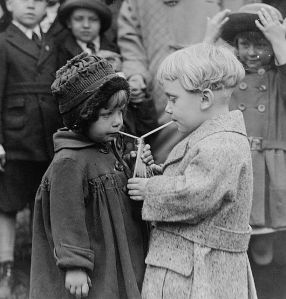
Sharing a drink – Wikimedia image

First, it’s worth noting that the spring that feeds a flow of kindness is love. The reason a person acts in a kind way towards others is that there is love in that person’s heart. A loving attitude impels us towards kind thoughts, words and actions. Where there is a loving heart, kind things will pour out – always fresh, never running low. The stream of kindness flows because of the rising spring of love. But there also needs to be a measure of self control. Sometimes the instinct to be kind can result in thoughtless acts that embarrass or distress; kindness must be appropriate and considered.

Kindness is fundamentally a thing of great joy. If we are kind out of a sense of duty or if we have a grudging attitude, there will an absence of that wonderful enabler – a joyful heart. A kind act without joy may be useful and of great benefit, but it will never be a pretty thing. Even worse is kindness with a hidden motive. If I want something in return, my kind behaviour is no more than a calculated trade; there’s an expectation. This is kindness used as a wrapper to hide something else. The missing ingredient here is gentleness. Kindness must be a gentle thing, demanding nothing in return, offering benefit at no cost.

And kindness is always a thing of peace, without this essential element it may involve serious danger. Maybe you find it hard to imagine kindness without peace; but what happens when we want to be kind to an enemy? There are plenty of stories of wartime situations where a noble act of kindness has bridged the gulf between those on opposite sides of the battle. The counterfoil here is faithfulness. If we are to be kind in the middle of an argument, or much more a war, we will need to be faithful. But faithful to what? Faithful at the very least to strength of character and to courage and to the deep wisdom that even my enemy is a fellow human being, that there is a bond deeper even than existential danger.

Finally, kindness requires patience. It’s so important to wait for the right moment, to be sensitive to the feelings of other people. Nothing is more damaging to an attempt to be kind than the haste that overlooks the nuances of the situation. And what does patience need as a companion? Goodness. So how do we define that? It’s the thing that distinguishes what is right and what is not, a bit like conscience I suppose. Goodness is hard to define because it’s internal and may not be detectable from the outside. Goodness is about motivation, it’s allied to gentleness.

Let’s lay these concepts out, with kindness at the centre. We have:

Love, joy, peace, patience

Kindness

Goodness, faithfulness, gentleness, self control

When Paul wrote his letter to the Galatians, one of the things he told them was this.

The fruit of the Spirit is love, joy, peace, patience, kindness, goodness, faithfulness, gentleness and self control

Galatians 5:22

So be kind whenever and wherever you can. There are plenty of opportunities in the world. Be kind to friends and family, be kind to the people you work with, be kind to your neighbours, to strangers, and yes – be kind to those people who are not kind to you, those who behave like enemies. Kindness never does any harm, and sometimes it can be quite disarming.

A political post?

What are your hopes, what are your needs, and what can you contribute?

You won’t often see me post on political topics. This is not the first time I’ve done so, but it’s been something of a rarity.

Today I feel compelled to share a Liberal Democrat story, a short video presented by their new party leader, Ed Davey. Take a look and think about the people he talks to and the reasons he visited them.

You can read the article, or you can just watch the video below.

So – what are your hopes, what are your needs, and what can you contribute? How can you co-operate with friends and neighbours, meet needs, calm nerves, comfort hurting people? And, whatever your politics, how can you influence your chosen party to listen, hear, understand, and promote fairness, kindness, and the common good?

Burning coals

FaithOrKnowledge3

Reading Romans 12:20, I was struck by the idea of ‘heaping burning coals’ on your enemies’ heads. On the face of it, this doesn’t sound very loving! But burning coals come from the altar in the Temple; they are pure, holy, cleansing, and consume the sacrifice placed on the altar. Food and drink for a hungry, thirsty enemy are like the fire from the altar. They are pure, holy, cleansing things.

Sin is covered by sacrifice. This is at the heart of what Yahshua did for us, he offered a sacrifice for sin – his own body – while we were still against him and the cause of his grief and suffering. By his love, he bought not only our lives but our love. And by love we must buy our enemy’s love in the same way. We don’t give our enemies the necessities of life in order to hurt them, but because of love and in order to provide an opportunity for them to change. That’s why Paul writes, ‘Don’t be overcome by evil, but overcome evil with good’.