Who innovates, and who reacts?

By an astonishing combination of determination and resolve, shrewd and innovative military action … the government in Kyiv not only hung on, but pushed the Russian Army back in disarray.

Russia invaded Ukraine two years ago, and everyone (including the Russian leadership) has been surprised at Ukraine’s success and ability to continue for so long. Right at the start of this war, as Russian columns crossed the international borders from both Russia and Belarus, few of us could have predicted that Ukraine would do so well and for so long. Many of us expected it would all be over in two or three days, yet two years later Ukraine still holds out. How?

Outline map of Ukraine – Open Streetmap

Let’s think this through, breaking the topic down to war on land, at sea and in the air. First though, here’s a brief note on the historical background.

Ukraine has a long history and was instrumental in founding Moscow way back in early mediaeval times, but Ukraine was subsequently overrun (along with many other lands) by the Mongol empire in the 13th century. Much more recently, after a long period as a republic within the Soviet Union, Ukraine along with several other republics gained its independence when the Soviet Union collapsed in 1991. At that time Ukraine was recognised world-wide, including by the Russian Federation, as an independent state with its boundaries clearly defined and agreed.

Ukraine is a founding member of the United Nations, entering that body in 1945. On 24th February 2022, when Russian forces invaded Ukraine, they broke international law.

On land

Most people, including many military analysts, assumed that within a few days of the invasion President Zelensky would have fled the country, been captured, or would be dead. Instead he made the now famous announcement that he needed ammunition, not a ride. And by an astonishing combination of determination and resolve, shrewd and innovative military action, and rapid assistance and weapons supply by the West, the government in Kyiv not only hung on, but pushed the Russian Army back in disarray.

This initial action was followed throughout the rest of the year by further advances against Russian forces and a Russian withdrawal from Kherson. In 2023, a western-style counteroffensive was launched without the air support western military doctrine would have required. Although some ground was gained, it was costly in troops and materiel. More recently, because of greatly reduced arms and ammunition supply by the West, despite promises to provide it, the tide seems to be turning in Russia’s favour in the land war.

Appearances can be deceptive, however. Russia’s land war has been glacially slow and every gain has come at enormous cost in Russian lives, equipment and expenditure. Although Russia is slowly gaining ground at the moment, Ukraine has shown they can take on a powerful invading force and significantly weaken it. This has been a war unlike any previous one. The Ukrainian use of drones has surprised the world’s military experts. First Person View (FPV) drones in particular have brought the demise of very large numbers of Russian armoured vehicles, aided and abetted it must be said by wave after wave of troops and equipment providing a constant supply of targets.

There are many other ways in which Ukraine is developing new tactics and weapons. This isn’t the place to go into details but as a single example, they have focussed on damaging transport hubs, bridges, radar installations, ammunition depots, oil production, arms and munitions factories, steel plants, storage facilities and military headquarters buildings. Why? Because doing so deprives Russian forces of the sustaining facilities they need to continue fighting. Ukraine’s military planners are shrewd and innovative.

At sea

Ukraine has sunk a significant portion of Russia’s Black Sea Fleet and the remaining ships are at serious risk if they put to sea (or even if they don’t). Port infrastructure in Crimea has been seriously damaged, so ports like Sevastopol are no longer suitable places for repairing or storing vessels. They are not safe places to rearm ships, re-provision them, refuel them, or exchange crews.

And Ukraine’s ability to do this has depended on a number of things. They have developed sea drones that are both stealthy and effective. They have used Storm Shadow and Scalp missiles supplied by Britain and France but they have also carefully prepared the conditions to give them the best chances of success. They have been inventive and have used a range of countermeasures to make it much harder for Russia to detect and counter the incoming missiles.

In the air

Recently, Ukrainian forces have brought down a number of Russian aircraft, from the Su 35 fighters and Su34 multirole planes to the largest and most capable radar aircraft, the A-50s. Just recently, they have been making an almost daily habit of this, making it difficult for Russia to risk flying anywhere near the front line areas. Russia had been using glide bombs allowing them to attack ground forces and civilian targets without coming too close. Now they are having to stay even further back. Estimates are that Ukraine has downed over 600 Russian aircraft over the two years of the conflict so far, roughly half fixed-wing and half helicopters.

Future developments

Ukraine’s ability to innovate at a rapid pace is highly significant in this war. Being outnumbered and with less equipment and ammunition than Russia, with a smaller industrial base and arms industry, places Ukraine at a huge disadvantage. The support they have received from the West has helped enormously of course, by providing them with more advanced weapons systems than the Russians have available. But without the necessary ammunition for these weapons, Ukraine knows she cannot entirely depend on the West.

And that’s why innovation is so important. I’ve already mentioned aerial and sea drones. These are not just capable attack weapons against army and naval targets, but they can provide useful intelligence as well. Drones can return detailed images of battlefields, harbours, dockyards, airfields, movements of troops and equipment. As a result, military planners and troops on the ground are better informed and can make better decisions. Ukraine is good at this. They have also proved effective in limiting Russia’s ability, for example by downing the A-50 aircraft mentioned earlier. In war, as in business, government, science and almost every area of human endeavour, knowing the situation is an essential ingredient in planning and decision making.

Ukraine has not settled for what is already available or what her allies are able and willing to provide. There’s a long history of engineering excellence in Ukraine. In Soviet times they played a major role in developing aircraft, rockets, spacecraft and more.

So who has been most innovative in this war so far? Ukraine, without a shadow of doubt. And who has been most reactive so far? Most certainly that’s Russia. Two years in, the pattern is very clear. From the first days when Ukraine defeated Russian forces at Hostomel Airfield and destroyed a traffic-jam of tanks and supply vehicles heading towards Kiev, Ukraine has wrong-footed Russia again and again. The sinking of the flagship ‘Moskva’; the rapid advances east from Kharkiv; the dislodging of Russian forces from Kherson; damaging the Kerch Bridge (twice); the attacks on naval and air bases in Crimea; freeing the western Black Sea from Russian control; restarting grain shipments by a safe route; repeatedly destroying infrastructure in Russia; developing aerial, land and naval drones. Russia has been wrong-footed over and over again, having to react to Ukrainian innovations every time.

And finally, here are my longer term guesses. Ukraine will continue to innovate while Russia will continue to react. Ukraine will win this war, though it may take a lot more time, and will involve much more pain and sacrifice before victory is secured; the Kerch Bridge will be destroyed; Russia will be forced to leave Crimea, much as they had to leave Kherson and the western Black Sea; eventually, Ukraine will join both the EU and NATO; the Russian Federation will collapse militarily, economically and politically and may break up into a series of independent nations; and Vladimir Putin (if he survives) will end up as a captive, either held prisoner by his own people, or in the Hague.

See also:
  • Shooting Down 11 Jets In 11 Days – Forbes
  • That dreadful war in Ukraine – JHM
  • Ukraine’s Long-Term Path to Success – Critical Threats

That dreadful war in Ukraine

There is cause for concern, but there is also cause for hope.

The war in Ukraine (and increasingly in Russia now as well) is on everyone’s minds – or certainly should be.

Part of an image from ISW

Below, I present a quote from today’s ISW report on the Russian attempt to conquer Ukraine. ISW is the ‘Institute for the Study of War’, an independent and influential American think-tank reporting every day as events unfold. But today they began their report with an overall assessment following two years of the war. Here’s the extract, with links to today’s full article and more at the bottom. There is cause for concern, but there is also cause for hope.

Ukraine continues to defend against Russian aggression and the Kremlin’s attempt to destroy Ukrainian statehood and identity despite growing difficulties two years after the start of Russia’s
full-scale invasion. Two years ago Russia launched a full-scale war of conquest to overthrow the Ukrainian government and forcibly install a pro-Russian regime firmly under Moscow’s control. Russian forces drove on Kyiv from several directions and struck at Kharkiv, Kherson, Mariupol, and other Ukrainian cities. Russian
President Vladimir Putin expected Ukrainians to welcome his forces or flee. Instead, Ukrainians fought for their freedom. They stopped the Russian drives on Kyiv and Kharkiv cities, stopped the Russian advance on Mykolayiv and Odesa cities, and fought Putin’s troops to a standstill along the rest of the line. Then, armed with experience,
courage, determination, and growing Western aid, Ukraine struck back. Ukrainian forces drove the Russians from Kyiv and away from Kharkiv and liberated large swathes of territory in northeastern Ukraine. They liberated Kherson City and forced Russian forces off the west (right) bank of the Dnipro River. They ended the
threat to Ukraine’s existence for the time.

But the Russians did not abandon their war aims or slacken their military operations. They remained in control of areas strategically and economically vital to Ukraine’s survival and of millions of Ukrainians whom they are subjecting to brutal Russification campaigns and deportation schemes. The Russians launched a missile and drone campaign against Ukraine’s energy infrastructure and cities that continues to this day. The Russians then ground through the eastern city of Bakhmut, taking losses so devastating that they prompted an armed rebellion against Moscow. The Russians also prepared themselves for the expected Ukrainian 2023
counteroffensive. The excessive hopes for that counteroffensive were not met. The war assumed a positional character, and the expected US assistance has been held up.

The situation today is grave, but it is far from hopeless. Russian forces have regained the initiative across the theater and are attacking and making gains. Those gains thus far are very limited and extremely costly. More Russian soldiers have likely died to seize Avdiivka than died in the entire Soviet-Afghan war. Ukrainians are weary and worried that American military assistance will cease, but they continue to fight with determination, ingenuity, and skill. Ukraine’s air defenders are dropping Russian planes from the sky while Ukrainian drone-and missile operators sink Russian ships. And Ukrainian soldiers are fighting for their positions against
Russian “meat assaults” using drones in novel ways as well as the artillery, tanks, and traditional weapons of war available to them. The Ukrainian Air Force will receive its first F-16s in the coming months, and Ukraine’s European allies are racing to make good deficiencies in other war materiel. American military assistance
remains essential—only the United States has the resources to give Ukraine right now what Ukraine most needs. If the United States, in the end, withholds that aid, then the situation can become very grave indeed.

But the war is far from over. Ukraine has not lost and there is no reason for Ukraine to lose. Russians are adapting for a long war effort in Ukraine, but they are not the Red Army hordes wrapped in the triumphant banners of World War II victories that Putin and his propagandists pretend them to be. The Russian military suffers from many flaws that Ukraine has learned to exploit. And the combined economic power of Ukraine’s allies is many times that of Russia.

Putin remains a deadly threat to NATO as well as to Ukraine, however. The Kremlin has been setting conditions to conduct hybrid warfare operations in the Baltic States and Finland for months and is currently engaged in such operations against Moldova. Putin’s aims remain the destruction of NATO as an effective alliance, the breaking of the tie between the United States and Europe, and the construction of a new global order in which Russia’s voice and power are dominant. The interests of America, Europe, and America’s allies in Asia and around the world are inextricably tied with helping Ukraine defeat Russia.

I hope those words from ISW encourage you, they certainly should. Ukraine had done astonishingly well in this horrible war so far, and will continue to do well providing she continues to receive sufficient help from her allies.

Tomorrow I plan to post again, this time with some of my own thoughts about the state of affairs in the war and the likely outcome. Meanwhile, here are some links to ISW and relevant pages.

Blast from the past… 15

We had a great weekend together, perhaps the highlight was visiting Bourton-on-the-Water and its model village.


< Previous
 | Index | Next >

Notes from bygone years – Many bygone Februaries
Hint: Click on the thumbnails for larger images.

February 2023 (1 year before publishing this article)
The town hall, Marlborough

My shingles rash cleared up. On 16th, three of our grandchildren took part in a school production of the ‘Beauty and the Beast’ musical; they all did extremely well and the whole family was proud of them. I had a discussion with a friend about Gumstool Brook issues and then we chatted about possible changes to British parliamentary processes. Encouraged by the conversation, I wrote an article about my my ideas for change.

We explored (and enjoyed) the centre of Marlborough on 19th. It’s a lovely little town, full of interesting shops, cafes and restaurants. We walked into small courtyards off the long, wide Market Place in beautiful sunshine, quite unusual at this time of year.

JHM: I wrote about groundbreaking. – World events: – There was a huge earthquake causing damage and loss of life in parts of Turkey and Syria.

< Jan 2023 – Mar 2023 >

February 2022 (2 years before publishing)

The Rococo Gardens

We visited the Rococo Gardens in Painswick, renowned for its abundance of snowdrops.

Also this month, Donna resigned as a school teacher; when she left after completing the school year, she focussed fully on maths tutoring instead.

World events: Queen Elizabeth II celebrated her Platinum Jubilee; Russia invaded Ukraine.

< Jan 2022Mar 2022 >

February 2019 (5 years before)
Visiting friends

Our friend Kevin and his daughters visited us from Gamlingay in Cambridgeshire. We had a great weekend together, perhaps the highlight was visiting Bourton-on-the-Water and its model village. We also showed them round Cirencester and spent time at home chatting.

World events: A US/North Korea Summit was held in Vietnam.

< Jan 2019Mar 2019 >

February 2014 (10 years)
On the Thames

Debbie, Aidan and Sara came to stay for a weekend and we did a day trip to London on the train (an easy journey from St Neots). We packed a lot in, and one of the highlights was a boat trip on the Thames with a visit to Hamley’s toy shop and an open-top bus over Tower Bridge.

A few day’s later Donna and I flew to Madeira for a week’s holiday in a much warmer climate than the one in London!

JHM: I posted ‘Fail to succeed‘ about the value of taking risks. – World events: The Maidan Revolution took place in Ukraine.

< Jan 2014Mar 2014 >

February 2009 (15 years)
In Chepstow

I went to a meeting in Chepstow to share experiences and discuss house church. It was a friendly and enjoyable session with a small group, mostly from places around South Wales. I was the only person who’d travelled from the East of England and I was made very welcome.

JHM: I wrote about the summer kids’ camp being planned. – World events: 1234567890 seconds of Unix time was celebrated (mostly by geeks and nerds).

< Jan 2009Mar 2009 >

February 2004 (20 years)
Ken and Ruth

We visited Anglesey Abbey with some friends. The new winter walk planted by the National Trust was quite new in 2004, but it’s nicely matured by now and is spectacular in February. The old house is interesting too, but the walled garden is one of our favourite places. It was an easy trip from St Neots but a long journey from Cirencester!

World events: Mark Zuckerberg launched Facebook for Harvard students, and there was a coup in Haiti.

< Jan 2004Mar 2004 >

February 1999 (25 years)

This web page (click the image to enlarge it) was downloaded in February 1999 on my Unilever PC. It was part of Long Ashton Research Station’s website. I set up the web server and created the website in 1996 or thereabouts – very trendy in those days! The ‘Last changed’ date on the page shows it had not been edited since May ’97.

World events: An attempt to impeach US President Bill Clinton failed; and Galtür, an Austrian village, was destroyed by an avalanche.

< Jan 1999Mar 1999 >

Febuary 1994 (30 years)
Netware advice

This is a little piece of advice I offered on a mailing list for Novell Netware managers. It’s about a utility I’d found useful while setting up and running Long Ashton‘s Netware 3.11 server. (The server allowed users to login to access file space over the local network from their PCs.)

World events: Edvard Munch‘s painting The Scream was stolen in Oslo; a  Hubble Space Telescope photo of Pluto and its moon Charon was released.

< Jan 1994Mar 1994 >

February 1989 (35 years)
Beth and Macaw

Here’s our daughter Beth feeding a Macaw during a family visit to the Rode Bird Gardens in Somerset, an easy day trip from Yatton where we lived at the time.

Sadly, the Bird Gardens closed in 2001.

World events: The Soviet invasion of Afghanistan ended; and the first GPS satellite was launched.

< Jan 1989Mar 1989 >

February 1984 (40 years)

We were living at 22 Rectory Drive in Yatton, between Bristol and Weston-super-Mare. Debbie was almost nine at the time, and Beth was four. Judy might already have been teaching biology at Cotham Grammar School by this time and would have started a new term. I was working at Long Ashton Research Station.

World events: The 10th Space Shuttle mission took place; and the very first TED conference was held.

< Jan 1984Mar 1984 >

February 1979 (45 years)
Oil palm study

Our daughters were growing – Debbie was almost four, and Beth turned nine months. At Long Ashton Research Station I was working on oil palm pollination, training and supporting a biologist before he left for Papua New Guinea, as well as continuing research into pollination of temperate fruit crops.

World events: The Islamic Revolution was underway in Iran; and a shipwrecked Soviet tanker caused a huge oil spill in the Baltic Sea.

< Jan 1979Mar 1979 >

February 1974 (50 years)

This was a time when Judy and I were living in our flat at 20 Belmont Road, Bristol, collecting together whatever bits of furniture we could find. My grandmother had given us £60 and told us to buy a really good bed (in those days that was perfectly feasible). Judy’s parents gave us their old 3-piece suite, we bought a second hand dining table and chairs, and two new bar stools to use in the kitchen. It was a big step-up from our previous, furnished bed-sit!

World events: The crew of Skylab 4 returned to Earth after 84 days; the UK General Election ended in a hung parliament.

< Jan 1974Mar 1974 >

February 1969 (55 years)
Crazy paper!

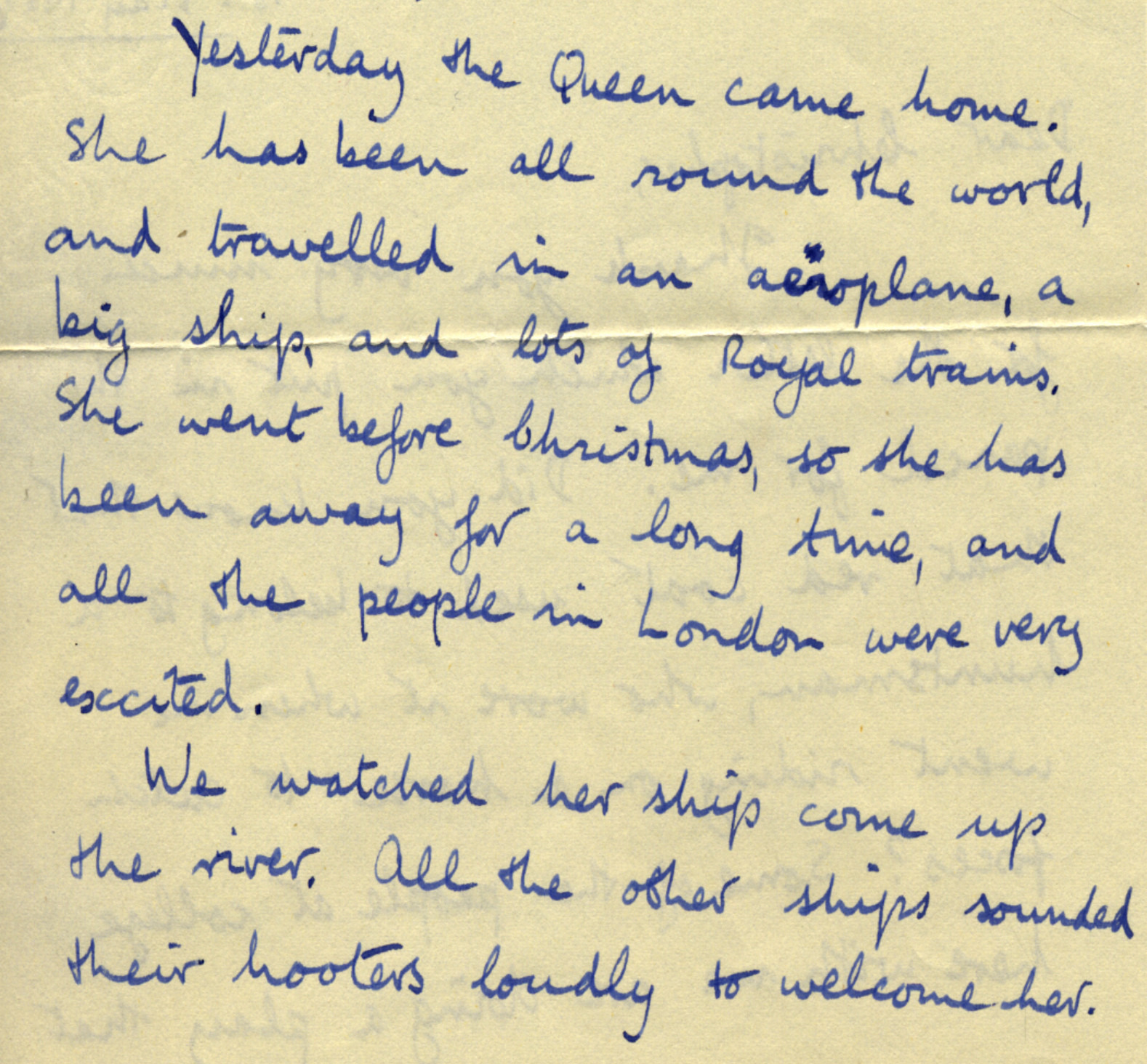
I had a letter from Judy, back at university in Aberystwyth while I was at Bath. We were newly engaged, and in the early stages of trying to fix a possible wedding date; from our point of view the sooner the date the better. But practical considerations introduced a lot of delays; at the very least we needed to be able to live in the same town!

This time, the letter was on the craziest paper I’ve ever seen. It must have been difficult to write on, and it was certainly difficult to read!

World events: The Boeing 747 ‘Jumbo Jet’ flew for the first time; and the Mariner 6 Mars probe was launched by NASA.

< Jan 1969Mar 1969>

February 1964 (60 years)
Travel report

This is not strictly about my life, it’s about Judy, later my first wife. She and a friend were in the Guides in February 1964, and were planning a trip to Cardiff, this is the first page of Judy’s report on the trip.

She lived in Filton, north of Bristol, at the time. Most of their friends chose Bath as an easy option, but Judy and Val decided on the more adventurous journey to Cardiff.

World events: Fighting broke out in Cyprus between Greeks and Turks; Cassius Clay beat Sonny Liston to become the World Heavyweight Champion.

< Jan 1964Mar 1964>

February 1959 (65 years)

I was given a Premium Bond on 24th, here’s a picture of it. I still have it somewhere (not sure where it is, though). As far as I know it hasn’t won me a prize yet, but perhaps I should check! I don’t plan to sell it back, it’s worth far more to me as a memento than the £1 face value. In 1959 £1 would have had the purchasing power of nearly £30 today.

World events: There were two plane crashes in the USA on 3rd, Buddy Holly died in one of them. The first weather satellite, Vanguard 2, was launched from Cape Canaveral.

< Jan 1959Mar 1959>

February 1954 (70 years)

My second term at junior school continued uneventfully as far as I remember it. The daily pattern began with taking off hats, scarves and coats and putting them away on hooks before making our way to the classroom to begin the day. Then our teacher, Mrs Hourihane, would call out our names and we each had to raise an arm when our name was called. The upstairs classroom had a large window overlooking the back garden and play area.

World events: President Eisenhower warned against USA involvement in Vietnam. Crimea was transferred from Russia to Ukraine, both part of the Soviet Union at the time.

< Jan 1954Mar 1954>

February 1949 (75 years)

We were still living with my grandparents while Mum and Dad waited for a council house on the Beeches Estate. It was stormy, wet and cold, with snow around the 20th February. I was 7 months old at the end of February.

World events: President Truman announced that he would only meet Stalin if he visited Washington as a personal guest. The Soviet Union offered Norway a non-aggression pact and warned them not to join NATO.

< Jan 1949Mar 1949>

February 1944 (80 years)

Dad was busy in February and had many interests. There was the Boogie Woogie music world (he bought several more records this month), driving for his parents, the birth of a niece (Susan), the Air Training Corps (ATC), playing football, watching films at the cinema, working on the nurseries (the family business) and card games with friends and family, often Newmarket and usually for small amounts of money.

World events: The Battle of Monte Cassino destroyed the famous, old monastery. A shipment of heavy water is sabotaged in Norway.

< Jan 1944Mar 1944>

< Previous | Index | Next >

What’s going on in Russia?

How can we get to the reality of life in Russia, when news channels just repeat what the leadership orders or allows?

We are all aware, of course, that there is a war going on between Russia and Ukraine. Russia staged an unprovoked invasion of Ukraine in February 2022; and news of events as they unfold have been presented on TV, radio, newspapers, magazines, and online channels.

We know something about Ukraine, but what do we know about events inside Russia itself? People are aware that Vladimir Putin rules with almost absolute power. He controls the government, the armed forces, and the security organisations. The police and the FSB (just like the Soviet Union’s KGB before them) control almost every aspect of society. Faced with this situation, how can we get to the reality of life in Russia, when news channels just repeat what the leadership orders or allows?

I invite you to look at the Silicon Curtain video below. This particular interview with a Russian expat living in Uzbekistan uncovers some of the internal difficulties currently faced by the Russian people and their government.

Silicon Curtain provides interviews that go deeper than most Western news sources, investigating topics that are not always available by other means. The channel is run by Jonathan Fink who lives in Oxford and read Russian Studies at Edinburgh University. If you find this interview informative and interesting, take a look at the other videos on the Silicon Curtain channel.

What is the greatest priority?

I have given them the glory that you gave me, that they may be one as we are one – I in them and you in me – so that they may be brought to complete unity.

We consider priorities expressed by three church personalities and ask, ‘What is the most important objective for the church? What will most please Papa? What is the Spirit urging? How does Jesus want us to respond?’

A polychotomy?
Shattered glass

We are being tugged in many directions in our lives as believers, we have become a polychotomy. The word literally means ‘many cut apart’. The church looks like shattered glass; oneness turned into shards. There are voices telling us to believe the right things, say the right things, do the right things. Let’s take a look at some of them and ask ourselves the question, ‘What is the greatest priority?’

An article by Sam Hailes (no longer available) started me thinking about this. Sam interviewed Peter Farmer from Nottingham, Tony Goddard from Peterborough, and Beresford Job from Chigwell. These three men have different ideas on the main priority – mission and multiplication (Peter), making an impact and caring (Tony), following Biblical principles (Beresford). If we cast the net wider we will find many more groups with other insights and emphases. Every denomination and group has its own ideas about what is most important.

So who is right?

To answer this question we need to turn to the Bible. But where should we look?

Guidance from the Source

I suggest that the most important and fundamental guidance will come from carefully hearing what Jesus said. In particular, his prayer just before his arrest must be the best of all sources for what is essential.

Think about it for a moment. Yahshua knows that his whole life has brought him to this place of sacrifice. The burden upon him is enormous, his heart is heavy and he cries out to the Father. Surely what he asks at this moment will be the most important thing of all. So what does he say?

In John 17; Yahshua prays for his disciples, and there is much here that we need to take on board. But then he prays explicitly for you and me. And this is what he asks. Read it carefully – this is Jesus praying for you!

My prayer is not for [my disciples] alone. I pray also for those who will believe in me through their message, that all of them may be one, Father, just as you are in me and I am in you. May they also be in us so that the world may believe that you have sent me.

I have given them the glory that you gave me, that they may be one as we are one – I in them and you in me – so that they may be brought to complete unity. Then the world will know that you sent me and have loved them even as you have loved me.

Father, I want those you have given me to be with me where I am, and to see my glory, the glory you have given me because you loved me before the creation of the world. ‘Righteous Father, though the world does not know you, I know you, and they know that you have sent me. I have made you known to them, and will continue to make you known in order that the love you have for me may be in them and that I myself may be in them. (John 17:20-26)

He wants us to be one, united, not split apart. The Messiah himself prays to the Father that we may be one ‘just as you are in me and I am in you’. He wants us all to be ‘in us’ (the Father and the Son) so that the world may believe the Father has sent the Son.

More than that, Jesus has given us (you and me) the glory that the Father gave him. What?! Read that again. He’s given you and me his glory! Why? So that we may be one. Then the world will know.

And he prays that we may be where he is and see his glory.

There’s just no escaping this fundamental truth, that when the chips are down Jesus prays his heart out to his Father and asks that we may be one so that the world may believe.

What is the most striking thing about the church in our day? What does the world see when it looks at church? It sees multiple organisations, church is divided into myriad groups and denominations, often seeming to point to different things as being the most important. We are a broken, shattered people and the heart of Christ is broken when he sees us in this state. His heart is for us to be one just as he and the Father are one. And he wants to include us in their oneness and community.

Peter Farmer is not wrong about mutiplication and mission. Tony Goddard is not wrong about making an impact and caring for people. And Beresford Job is not wrong about following Biblical principles. But those are not the main things.

Becoming and remaining one

Above all, we now need to learn to be one. We need to accept we have differences, learn from one another. There is no single right belief, right speech, or right action. His children all shine with the light of his presence. If we are to be part of the answer to his prayer we need to learn from one another and grow together in love, building one another up, encouraging one another, helping one another to focus on every good thing. We need to grow up into Christ. Paul understood this well, see what he wrote to the Ephesian church.

As a prisoner for the Lord, then, I urge you to live a life worthy of the calling you have received. Be completely humble and gentle; be patient, bearing with one another in love. Make every effort to keep the unity of the Spirit through the bond of peace.

There is one body and one Spirit, just as you were called to one hope when you were called; one Lord, one faith, one baptism; one God and Father of all, who is over all and through all and in all.

Christ himself gave the apostles, the prophets, the evangelists, the pastors and teachers, to equip his people for works of service, so that the body of Christ may be built up until we all reach unity in the faith and in the knowledge of the Son of God and become mature, attaining to the whole measure of the fullness of Christ.

Then we will no longer be infants, tossed back and forth by the waves, and blown here and there by every wind of teaching and by the cunning and craftiness of people in their deceitful scheming. Instead, speaking the truth in love, we will grow to become in every respect the mature body of him who is the head, that is, Christ. From him the whole body, joined and held together by every supporting ligament, grows and builds itself up in love, as each part does its work. (Ephesians 4:1-6 and 11:16)

I am not suggesting that anyone is wrong, or that some are more right than others. I am simply observing that we remain shattered and that we are not yet perfectly formed into the one bride for whom Christ died and will return. Let us all strive to forge fresh bonds of peace. Paul called the Ephesians to keep the unity of the Spirit. Today we need to do more than that, we need to regain the unity of the Spirit.

Addendum

The above is a repost, only slightly changed, of an article I wrote way back in 2012. After 12 years, I think it’s worth repeating. If church has any purpose, any value, it springs from Jesus’ prayer for you and for me. Will I let him place the little fragment that I am into a shared oneness with my brothers and sisters? Will you? Last night I was privileged to be part of a Small Group meeting with friends in one of our homes – and this oneness, and sharing, and presence of the Spirit of Christ, and care for one another and the wider world was tangible amongst us. That is so refreshing, so encouraging, so good!

Blast from the past… 14

I looked around the Abbey Nursery where there still remains some evidence of John Jefferies & Son, the old family business.


< Previous
 | Index | Next >

Notes from bygone years – Some more Januarys
Hint: Click on the thumbnails for larger images.

January 2023 (1 year before publishing this article)
Flooding from the Churn

The River Churn burst its banks, most of the inundation was restricted to the flood plain, but some properties suffered a bit of damage. We were OK as we live on a hill, but anywhere down in the flood plain and most of central Cirencester is quite low lying.

Towards the end of the month I developed shingles. Although I had a rash on my left shoulder and upper chest, I had no discomfort with it other than a very slight itch. Eventually it faded away gradually and with no drama, and I’ve now been vaccinated.

JHM: I posted about a short walk in Cirencester. – World events:Croatia adopted the Euro and joined the Schengen Area in January.

< Dec 2022 – Feb 2023 >

January 2022 (2 years before publishing)
The old Abbey Nursery

In January 2022 I looked around the Abbey Nursery where there still remains some evidence of John Jefferies & Son, the old family business. It’s now a small park and wildlife reserve – City Bank Park. The concrete surface and the block built bins for sand, gravel and other materials can still be seen in the photo. Tidy up and sweep away the leaves and it would look much as it did when I was a child and the site was still in use producing the town’s supply of Christmas trees.

JHM: I wrote about three objects in the evening sky, not all of them easy to see. – World events: The number of COVID cases worldwide passed 300 million and more than 10 billion doses of vaccine had been given.

< Dec 2021Feb 2022 >

January 2019 (5 years before)
Bennett’s Garage

In January 2019 it was the end of the road for Bennett’s Garage in Victoria Road, Cirencester. Dad always filled his car at Bennett’s as John Jefferies & Son had an account here. I once borrowed a ladder from Brian Bennett when I locked myself out of Churnside. The business continues at another site, but Victoria Road will never seem quite the same.

JHM: I posted a video of the Earth rising over the Moon. – World events: The Orthodox Church of Ukraine was granted independence from the Russian Orthodox Church.

< Dec 2018Feb 2019 >

January 2014 (10 years)
Cambridge

In January 2014 Paul and Vanessa visited us and we drove over to Cambridge and spent part of the day there, enjoying the sights and the bustle of the crowds. Cambridge has such a great atmosphere and energy! However, we got caught in a torrential downpour waiting for the Park and Ride bus to get home.

JHM: I posted about meeting Gerald who was in his wheelchair all alone in the middle of Huntingdon. – World events: Latvia adopted the Euro, the 18th member of the Eurozone.

< Dec 2013Feb 2014 >

January 2009 (15 years)
A new cooker

In January 2009 Meredith took delivery of a new cooker. We drove up to York for New Year so the Christmas presents arrived a week late; it’s almost like having Christmas twice! We always look forward to our winter trip to York.

JHM: I wrote about the journey and how we know the way. – World events: The cryptocurrency Bitcoin was created.

< Dec 2008Feb 2009 >

January 2004 (20 years)
Mum and Beth

We visited my Mum and Dad in Cirencester for New Year; this was about two years before Mum died, though of course we didn’t know that. Treasure people while you can! Mum always laid a fine spread on the table and you can see some of it in the photo.

World events: NASA landed two rovers on Mars, Spirit and Opportunity.

< Dec 2003Feb 2004 >

January 1999 (25 years)

I made some progress with WebForum, an information website for Unilever‘s research labs around the globe; there were two of these in the UK, one in the Netherlands, and another in the USA. I think by this time the software had been rolled out to all sites except for the Netherlands where they decided to create their own version. Attention was turning instead to Y2K testing.

World events: The new Euro currency was introduced on 1st January.

< Dec 1998Feb 1999 >

January 1994 (30 years)
Transport Museum

Dan visited us and we looked at some of the sights in Bristol, including the Observatory up at Clifton near the famous Suspension Bridge, and later the Industrial Museum down in the docks area. The photo shows Dan, Beth and Judy in the museum.

World events: The Northridge Earthquake struck the San Fernando Valley in Los Angeles on 17th. Parts of a raised freeway collapsed and 60 or 70 people died.

< Dec 1993Feb 1994 >

January 1989 (35 years)
Debbie and Beth play draughts

We had a quieter New Year’s Day after a fairly full-on Christmas the previous month. Debbie and Beth played draughts while half-watching ‘Neighbours’ on TV.

World events: The European Single Market was created; and Czechoslovakia divided itself into independent nations, the Czech Republic (later Czechia) and Slovakia.

< Dec 1988Feb 1989 >

January 1984 (40 years)

We were living at 22 Rectory Drive in Yatton, between Bristol and Weston-super-Mare. Debbie was nine at the time, and Beth was six. Judy might already have been teaching biology at Cotham Grammar School by this time and would have started a new term. I was working at Long Ashton Research Station.

World events: The Apple Macintosh went on sale in the USA, and President Reagan announced that a space station would be developed.

< Dec 1983Feb 1984 >

January 1979 (45 years)
Postcard from London

My Mum sent this postcard 0n 17th January to her mother (my Granny-in-Ireland) in the village of Coagh. She wrote, ‘We went to the theatre with Ruth and Martin, her boyfriend, and his parents. It was fun walking round Piccadilly Circus and Leicester Square with all the lights on. Ruth sends her love to you both.

World events: The USA severed diplomatic relations with Taiwan and established diplomatic relations with the People’s Republic of China.

< Dec 1978Feb 1979 >

January 1974 (50 years)
Bristol

Judy and I were living in our flat at 20 Belmont Road in St Andrews, Bristol. She was newly trained as a teacher, I was completing research towards my MSc thesis. The photo shows a view of Berkeley Square and the Wills Memorial Building (part of Bristol University) beyond it, taken from the top of nearby Brandon Hill. Comet Kohoutek was visible in the evening skies and we managed to spot it from the bay window in our flat.

World events: The F-16 fighter flew for the first time, and sextuplets were born in Cape Town with all surviving.

< Dec 1973Feb 1974 >

January 1969 (55 years)
Engaged!

I began the second term of my third year at Bath University, Judy returned to Aberystwyth to continue her second year there. This was, as always, an unwelcome time of separation; but as compensation our engagement was announced in the Gloucestershire Echo. (It’s very tiny, click the image to enlarge it and you still might not see it at first.)

World events: The Beatles played live for the last time, and Richard Nixon was sworn in as President of the USA.

< Dec 1968Feb 1969>

January 1964 (60 years)

I was living at Churnside (37 Victoria Road) in Cirencester, with my Mum and Dad and three sisters. I was in the Fifth Form (now Year 11) at Cirencester Grammar School and just starting the second term in January.

World events: The US Government reported that smoking might be a health risk, and plans to build the World Trade Center in New York were announced.

< Dec 1963Feb 1964>

January 1959 (65 years)

I was 10½ years old at the end of January, and in my final year of Junior School. This was the year in which we would take our eleven-plus exams; the results decided which of us would go to the Grammar School, and which to the Secondary Modern; so the emphasis in this final year was partly to familiarise us with the style of questions typical of the eleven-plus. (Today these schools are combined.)

World events: The Soviet spacecreft, Luna 1, was the first to break free of Earth orbit, and Alaska was admitted as the 49th American state.

< Dec 1958Feb 1959>

January 1954 (70 years)

This was my second term at Querns School in Cirencester. It was a far happier experience for me than starting my first term: I knew my way around, I’d made some friends, and I had a good idea what to expect from my teacher, Mrs Hourihane; also I was more confident of spending time without Mum and Dad. I was 5½-years-old and I probably felt quite grown up! My teacher was a budding author as well!

World events: IBM demonstrated the world’s first machine translator, and a de Havilland Comet airliner disintegrated in mid-air.

< Dec 1953Feb 1954>

January 1949 (75 years)

I was 6 months old at the end of the month and we were living at Granny and Grandpa’s house (Churnside, 37 Victoria Road). I think Grandpa liked having a baby in the house again, apparently Mum found it difficult to get me back sometimes! Dad was by far their youngest child (his youngest brother, Bob, was 15 years older). Mum and Dad were on the list for a council house at the Beeches Estate, but those houses were still being built.

World events: Communist forces entered Beijing, in the USA Harry Truman was sworn in as President.

< Dec 1948Feb 1949>

January 1944 (80 years)
A similar car – from Wikipedia

Dad was now driving my grandfather’s Wolseley on errands to the nurseries and managed to reach the amazing speed of 50 mph on 5th January. His ATC uniform arrived and he had opportunities to use the Link Trainer at South Cerney Airfield as well as examine some aircraft. He passed his Morse test at the end of January.

World events: The Allies landed at Anzio in Italy and a British vessel was sunk there by an early German guided missile.

< Dec 1943Feb 1944>

< Previous | Index | Next >

The biggest Mach diamonds ever!

Together, all these engines produce 75.9 MN of thrust, much more than Saturn 5’s 34.5 MN.

The first question you might want answered as you read this title will be, ‘What on Earth is a ‘Mach diamond’?’ I’m glad you asked.

If you’re interested in rockets and spaceflight you may already know. Where there are rocket engines, there will be Mach diamonds (also known as ‘shock diamonds’). They are formed by the high velocity of the gases leaving a powerful jet or rocket engine. The shock waves created by this process interact with the ambient air around the nozzle, sculpting the exhaust into angled zones. When seen from the side, these appear as a repeated diamond pattern.

Mach diamonds from an F-16 on afterburner – Image from Wikimedia

The largest rocket ever built is SpaceX’s Super Heavy booster designed to lift Starship to a high altitude on the first part of its journey to orbital velocity. This booster is powered by 33 Raptor engines clustered closely together; they behave rather like a single engine with a 9 m diameter nozzle. When the rocket flew for the second time in 2023, giant Mach diamonds appeared, 9 m across and 6 m in length. These truly are the world’s biggest Mach diamonds ever – by a very considerable margin.

Super Heavy’s engines – SpaceX

This view shows all 33 Raptors firing shortly after liftoff on the 2nd flight test (IFT-2). Each engine bell has a diameter of 1.3 m and the rocket itself has a diameter of 9 m. Together, all these engines produce 75.9 MN of thrust, much more than Saturn 5’s 34.5 MN.

IFT-2 – BocaChicaGal

Here’s an image of the IFT-2 vehicle shortly after launch. The first Mach diamond is very sharply defined, subsequent diamonds less so as the exhaust plume slows, cools and becomes more ragged. Four can be clearly identified with some hints of a fifth and sixth.

So what is happening here? How are the diamonds generated?

Because a rocket engine is all about producing thrust, the velocity of the exhaust is paramount. Rocket engines are designed to maximise velocity and in doing so they minimise pressure. Inside the combustion chamber, pressures are extremely high; but the bell shape of a rocket nozzle expands the gases and directs them downwards. The pressure inside the exiting plume is much lower than the ambient air pressure. This pressure difference ‘squeezes’ the plume and prevents it spreading out sideways.

Higher in the atmosphere, air pressure is lower and the mach diamonds vanish; as atmospheric pressure drops away towards the vacuum of space, the exhaust plume spreads out sideways more and more because the exhaust gas is now at a higher pressure than the diminishing, surrounding air. Notice how the spacing of the diamonds decreases with distance from the rocket. This is because the exhaust velocity is falling off as the plume interacts and mixes with the air around it.

That’s the essence of the process in everyday language. Check the links below if you want more technical detail.

See also:

Congratulations, Mr Putin.

You have stirred up a hornet’s nest of criticism and anger and you are going to get badly stung.

I’m impressed. Slowly, your horrid war in Ukraine has been slowly slipping out of public attention in the West. It’s not that people don’t care (we do), but newspapers and TV channels always focus on what will best attract readers and viewers. Ukraine has been slipping onto the inside pages for months.

Now, with one night of more than 100 drones and missiles hitting Ukrainian cities (the largest strike of the war so far by all accounts) you have brought your cowardly actions back onto the front pages.

Here’s the Guardian website this morning, for example:

So – Congratulations! Your war is front and centre in everyone’s awareness again – which is where it should be. ‘Good job’ as our American friends would put it.

Take a look at social media, where people are now clamouring for their governments to do much more to help Ukraine in every way possible. Wait for the newspaper editorials and letter columns tomorrow. You have just interrupted conversations about all sorts of other issues; and all eyes are swivelling, staring, and glaring at you again.

You have miscalculated very badly with this strike, hitting a maternity hospital, apartment blocks, several schools, a shopping centre. You have stirred up a hornet’s nest of criticism and anger and you are going to get badly stung. You are losing the war; you are losing public support at home; Russians as well as Ukrainians are in pain and despair at the loss of friends and family in your unnecessary and unjustifiable act of war. You have no sound arguments to support your actions, those you offer are morally corrupt, historically inaccurate, militarily inept, politically suicidal, simple distortions, or downright lies.

See also:

Beauty

Beauty is power and elegance, right action, form fitting function, intelligence, and reasonability.

Kim Stanley Robinson, Red Mars Chapter 2 (1992)

This is a great quote. It’s true, I think, that these things are usually beautiful. But it’s worth paying attention to the times when they are not. Power, particularly can be turned to evil and then it is one of the most ugly things we can imagine. It’s quite possible to be elegantly cruel and not hard at all to be elegantly unkind. The same goes for intelligence.

For the other qualities listed here it seems much more difficult to distort them into ugliness.

What do you think? Leave a reply with some thoughts or examples.

Chastleton House Long Gallery

We enjoyed every aspect of the house … and we plan to return in the summer to view the garden as well.

We visited Chastleton House recently, it’s a Jacobean country house in the Cotswolds, between Stow-on-the-Wold and Chipping Norton. Amongst other features it has the wonderful Long Gallery with a curved, plasterwork ceiling and panelled walls. Amazing!

The Long Gallery on the top floor

The house is in the care of the National Trust and was open to the public for the period leading up to Christmas. They’d decked it out with Christmas decorations as they might have been in the 1960’s – wrapped gifts, paper chain decorations, Christmas tree lights of the period, everything.

1960s decorations

But the real gem, and what I especially wanted to see, was the Long Gallery. It was certainly not a disappointment!

We enjoyed every aspect of the house, of course, and we plan to return in the summer to view the garden as well. Living, as we do, in Cirencester it’s not a long journey so we can also visit in spring and autumn too if we wish.

I can recommend a visit to Chastleton. It’s a gem of a place.