Tree shading

Put an upturned bucket over a patch of grass in your garden. Lift the bucket every day and take a look, then re-cover the patch… How long does it take for the grass to die?

< Previous | Index | Next >

Image of the day – 178

What’s in an image? Sometimes quite a lot, more than meets the eye. I’m posting an image every few days.

Click to enlarge

Trees provide shade, most welcome on a hot day, and they provide shelter when it rains (though this may be unwise during thunderstorms).

But notice the absence of grass beneath these conifers. Shade and shelter are exactly what other plants don’t need; they depend on plenty of light and water to enable them to grow. Light is essential as it provides the energy to split water into hydrogen and oxygen, and water is essential as the raw material for this process. The oxygen is released into the atmosphere, while the hydrogen is bonded with carbon dioxide from the atmosphere to make energy-storing sugars for use at night and to build cellulose, the main support molecule that gives stems, branches and tree trunks their strength.

The lack of light and water under tree canopies creates a kind of local desert. You can see this clearly in the photo from the presence and absence of grass. So how do the trees survive? That’s a great question! Their roots spread out widely and deep, far enough to reach moist soil and deep ground water. In persistent rain, water drips from the drenched leaves above. And root, trunk and branch all contain stores of water so a tree can cope with a long, dry summer far better than the grass can.

Light

Here’s an experiment anyone can do. Put an upturned bucket over a patch of grass in your garden. Lift the bucket every day and take a look, then re-cover the patch. See how long it takes for the grass to turn yellow. How long does it take for the grass to die?

For plants, light is essential. There are some animals that live in dark caves or underground, with no light. Earthworms are a good example, but like all animals they get their food by consuming plants and other animals. But for most creatures, including us humans, light is essential nonetheless. Whether we are plant eaters (like cows and sheep) or meat eaters (like lions and wolves) or omnivores eating either or both (like humans and rats) we still need light to see in order to find and identify the things we must eat to stay alive.

Water

For plants, water is part of their ‘food’, it’s needed to make sugars. For animals water is of no value as food, but it’s essential to prevent dangerous dehydration. All animals know when they’re thirsty and they’ll find water and drink to keep themselves alive. Think of a man lost in a desert, the cartoons have him croaking out, ‘Water.. Water..’ Imagine someone unable to find water, they’d die of thirst long, long before they died of hunger. Most of us would be in danger after a few days without drinking, but we could live for several weeks with nothing to eat. And of course, if you are a fish too little water would mean you couldn’t breathe, and if you were a land animal too much would mean you would drown.

Spiritual (not religious)

The idea of essentials has been carried over into spiritual ideas too. Light and water (and food) are so clearly necessary for life that they make good analogies and illustrations. What did Jesus mean when he said, ‘I am the way, the truth and the life’? Or when he explained to the Samaritan woman at the well that he would provide water that never runs out, or when he told his followers, ‘I am the bread of life’ or ‘I am the light of the world’?

He was simply saying, I am essential, you can’t live without me. I’m necessary for life. Just as in the physical world, how would it feel to live in the dark, without water and without sustenance? How long would you last? How long would I last?

Many people today feel sure there is no spiritual aspect to life at all, it’s just about living your life in the here and now and then dying from accident, illness, or just old age. Others think there’s much more to life than that. At the very least there are moral and philosophical truths to consider. We should care for one another, help one another, and cooperate in helpful and kind ways.

Food for thought. Let me know below how you think about the essentials of life. Do you have any thoughts to share on this?

See also:

< Previous | Index | Next >

Useful? Interesting?

If you enjoyed this or found it useful, please like, comment, and share below. (If you don’t see those links, click the article’s title above the main photo and they will appear.) Send a link to friends who might enjoy the article or benefit from it – Thanks! My material is free to reuse (see conditions), but a coffee is always welcome and encourages me to write more often!

You might also like:

Cloud reflection

Just from this image the brain understands there are ripples on the surface of the water and from past experience will also know that these ripples will be moving.

< Previous | Index | Next >

Image of the day – 176

What’s in an image? Sometimes quite a lot, more than meets the eye. I’m posting an image every few days.

Click to enlarge

Sometimes we see things indirectly, and our brains are capable of retrieving far more information than you might at first think. It’s true of all our senses – hearing, touch, taste, smell and all the rest. The senses provide information but the brain makes much more of it all.

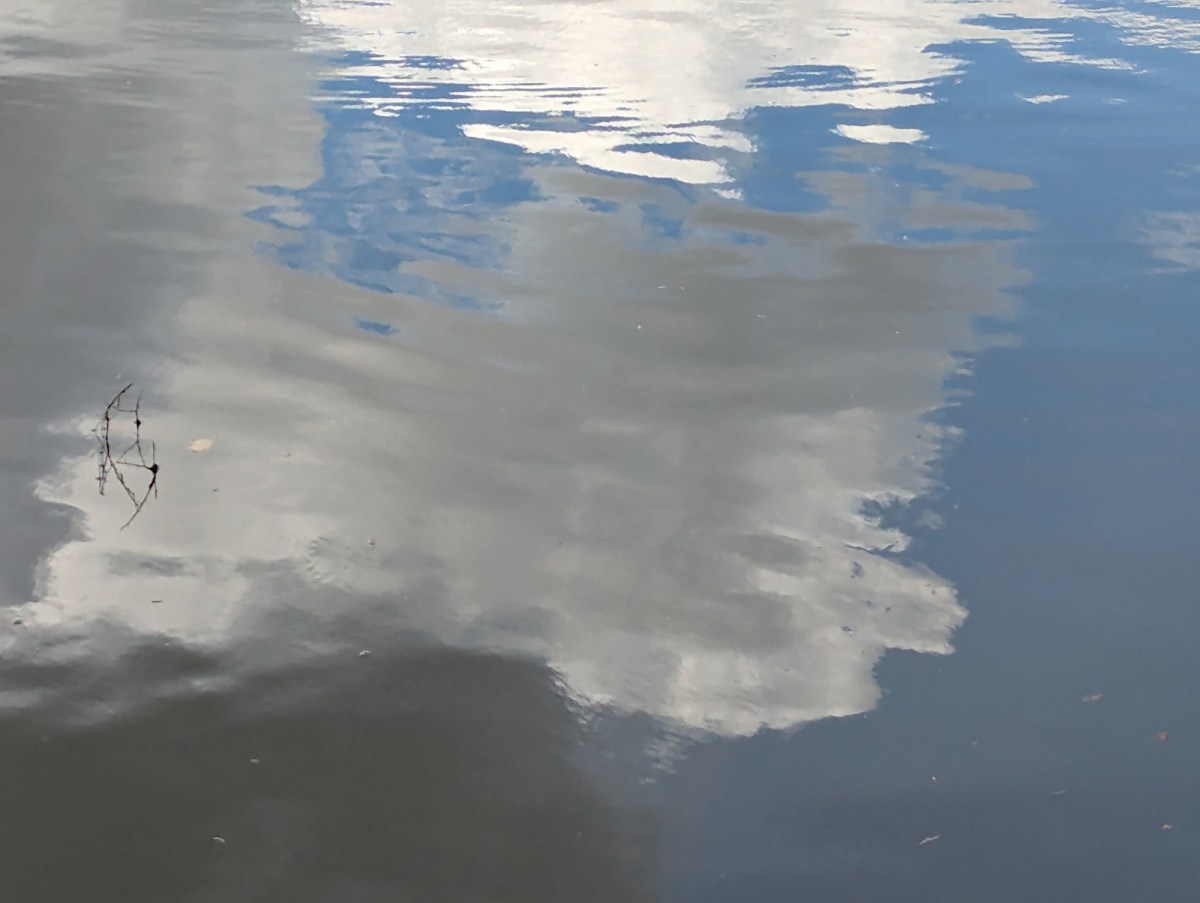
What do we see in this image? It’s just a pattern of coloured patches reflected from a water surface. That’s what the eye sees. But the brain tells us there are clouds in the sky above and there are ripples on the water. Then the brain compares this basic information with what it recalls from past experience and it can construct two narratives, one for the clouds and another for the water.

The clouds

There is a dark cloud and it’s the closest one to us, it threatens a shower of rain. A second image taken a few seconds later would be enough for the brain to decide the direction of movement of the cloud and predict whether the rain might fall here or somewhere else. Paler clouds, white clouds and blue sky suggest there’s some sunshine around as well so although there might be a brief shower, it won’t turn into ongoing steady rain. All of that from from a few colour patches.

The water

Because of the way the cloud reflections are distorted, the brain can infer the water is neither heavily disturbed not completely calm. Just from this image the brain understands there are ripples on the surface of the water and from past experience will also know that these ripples will be moving. The same brain will realise that there are two likely causes; either there is a light breeze blowing or perhaps a boat has passed recently. Once again, past knowledge in memory is necessary to arrive at these conclusions. There are some large ripples and, near the top of the image, some much smaller ones too. There was a small disturbance in the water further away as these small ripples seem to form an expanding circle of which we see only a small part.

Here and there things are floating on the water, small leaves, perhaps? If so, there must be trees nearby, perhaps with branches overhead. What a lot the brain can reconstruct on the basis of prior knowledge! And all of these conclusions come from some patches of colour in a still image. And what about the little sticks emerging from the water on the left-hand side? It’s the remains of vegetation of some kind. Was there a plant growing in the water? Did a strong wind break twigs off an overhead tree branch?

And one last point – it was not raining at the moment the photo was taken. The water would have been covered with dozens of circular disturbances if rain was falling. That’s a lot of information that your eyes and brain can glean from a single fragment of time trapped by my camera!

We are, as the Bible expresses it, fearfully and wonderfully made (Psalm 139:14).

See also:

< Previous | Index | Next >

Useful? Interesting?

If you enjoyed this or found it useful, please like, comment, and share below. (If you don’t see those links, click the article’s title above the main photo and they will appear.) Send a link to friends who might enjoy the article or benefit from it – Thanks! My material is free to reuse (see conditions), but a coffee is always welcome and encourages me to write more often!
You might also like:

Comet G3 (Atlas)

[This] image featured in NASA’s Astronomy Picture of the Day for 25th January 2025. Visit the website and have a browse around, there are so many fine images here!

< Previous | Index | Next >

Image 131 – What’s in an image? Sometimes quite a lot, more than meets the eye. I’m posting an image every day or so.

Enlarge
(NASA)

This might be the most striking photo you’ll ever see of a comet. OK, I dare say there will be better images out there, but this one is still pretty amazing.

The image featured in NASA’s Astronomy Picture of the Day for 25th January 2025. Visit the website and have a browse around, there are so many fine images here!

If you look closely (click the thumbnail and expand it as far as it will go) you’ll see plenty of stars in the image, too. Of course, they are way, way in the background far beyond the Solar System whereas the comet is right here inside the system along with the Sun, Planets, Moon, me and you.

See also:

< Previous | Index | Next >

Useful? Interesting?

If you enjoyed this or found it useful, please like, comment, and share below. (If you don’t see those links, click the article’s title above the main photo and they will appear.) Send a link to friends who might enjoy the article or benefit from it – Thanks! My material is free to reuse (see conditions), but a coffee is always welcome and encourages me to write more often!

Lichens

Lichens are the main food source for a variety of animal species from small mites and insects to the remarkably large reindeer. They tend to be protein-poor but may be rich in carbohydrates.

< Previous | Index | Next >

Image 130 – What’s in an image? Sometimes quite a lot, more than meets the eye. I’m posting an image every day or so.

Enlarge

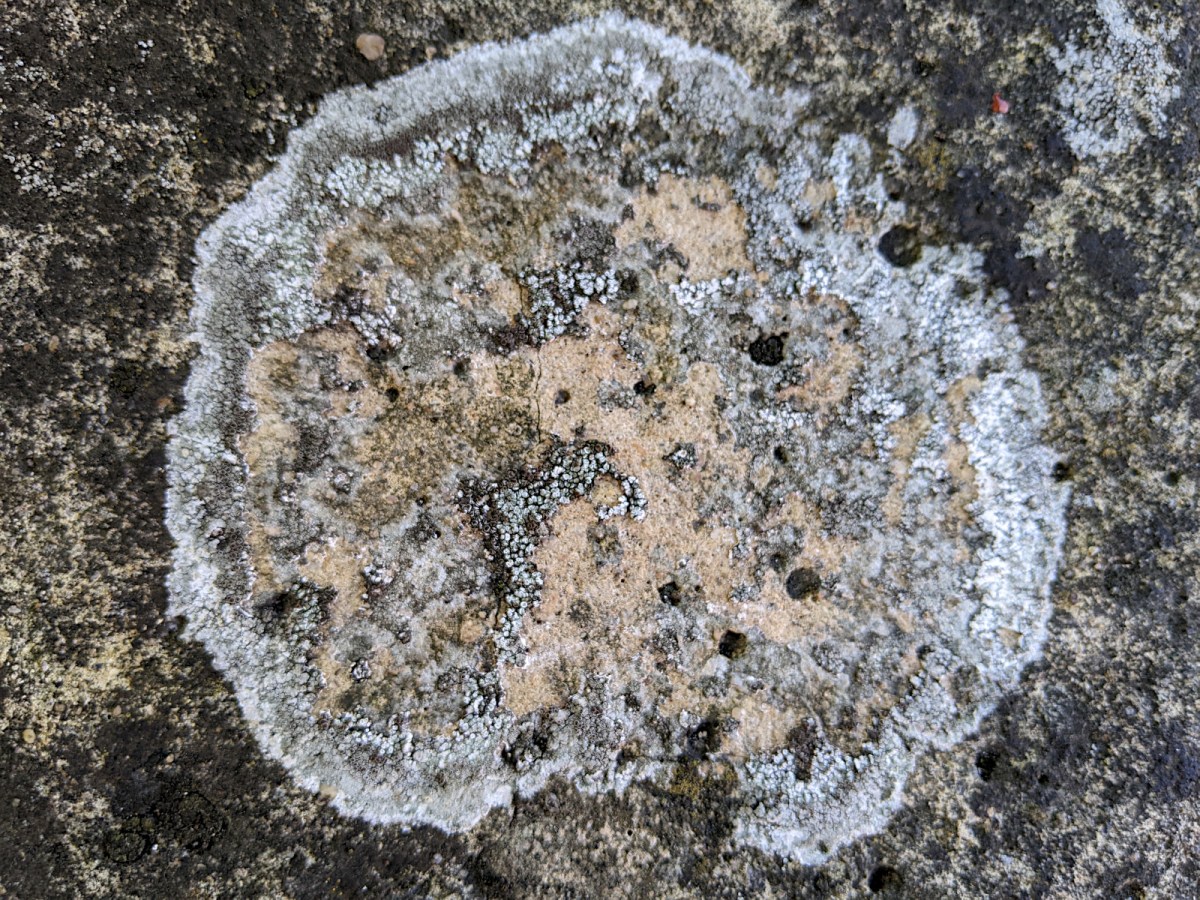
Lichens are amazing. They’re always small, they grow in slowly expanding colonies, and they consist of cooperating fungi and algae. A number of different species of fungi can grow like this, combined with various yeasts and bacteria. The assemblage often looks like a simple plant, often almost flat, but sometimes filamentous, branching or in the form of flakes. Circular forms like the one in the image are common. The Wikipedia article listed below has photos of a range of different forms.

The grey colony in the photo has grown out from the centre ‘cleaning’ other life forms from the surface of the underlying limestone and spreading out further around the perimeter. The black lichen was destroyed as the grey lichen crossed over it, but new colonies of the black lichen have established on the clean rock left behind. The situation is dynamic, but very slow. Return for another photo a month later and little will have changed.

Lichens are the main food source for a variety of animal species from small mites and insects to the remarkably large reindeer. They tend to be protein-poor but may be rich in carbohydrates.

See also:

< Previous | Index | Next >

Useful? Interesting?

If you enjoyed this or found it useful, please like, comment, and share below. (If you don’t see those links, click the article’s title above the main photo and they will appear.) Send a link to friends who might enjoy the article or benefit from it – Thanks! My material is free to reuse (see conditions), but a coffee is always welcome and encourages me to write more often!

Really?

Professor J P Hudson offered a prize to anyone who could submit a paper for publication without … a spelling mistake, or a punctuation error, or an unclear phrase. And I don’t think he ever had to pay out the prize.

< Previous | Index | Next >

Image 129 – What’s in an image? Sometimes quite a lot, more than meets the eye. I’m posting an image every day or so.

Enlarge

I was amused when I saw this in a local shop window a couple of years ago. Sometimes we’re not quite as good with words as we should be, and right at the start I admit that I’m just as bad as anyone else. But this one did give me a chuckle. It just begs the question,

‘So.. er… What would unconscious eating be, exactly?’

Just my silly sense of fun!

I think what happens, ever so easily, is that I word something in a way that’s not clear and then cannot, myself, spot the issue. It needs a fresh eye, a fresh mind to spot mistakes like this.

When I worked at Long Ashton Research Station in the 1970s, the Director, Professor J P Hudson, offered a prize to anyone who could submit a paper for publication without him spotting a spelling mistake, or a punctuation error, or an unclear phrase. And I don’t think he ever had to pay out the prize (£5 I think, quite a lot in those days).

Sometimes we need to see what we have written from a new perspective in order to fix or avoid simple mistakes. And sometimes we need the same fresh look at our habits, likes and dislikes, relationships with others, understanding of science, what we believe about the world, the people we meet, and not least, what we believe to be true about spiritual things.

It’s far too easy to go along familiar pathways in our lives without seeing the need to question what we think and say and do.

When: 25th September 2023
Where: Cirencester

See also:

< Previous | Index | Next >

Useful? Interesting?

If you enjoyed this or found it useful, please like, comment, and share below. (If you don’t see those links, click the article’s title above the main photo and they will appear.) Send a link to friends who might enjoy the article or benefit from it – Thanks! My material is free to reuse (see conditions), but a coffee is always welcome and encourages me to write more often!