Light from street, Moon and planet

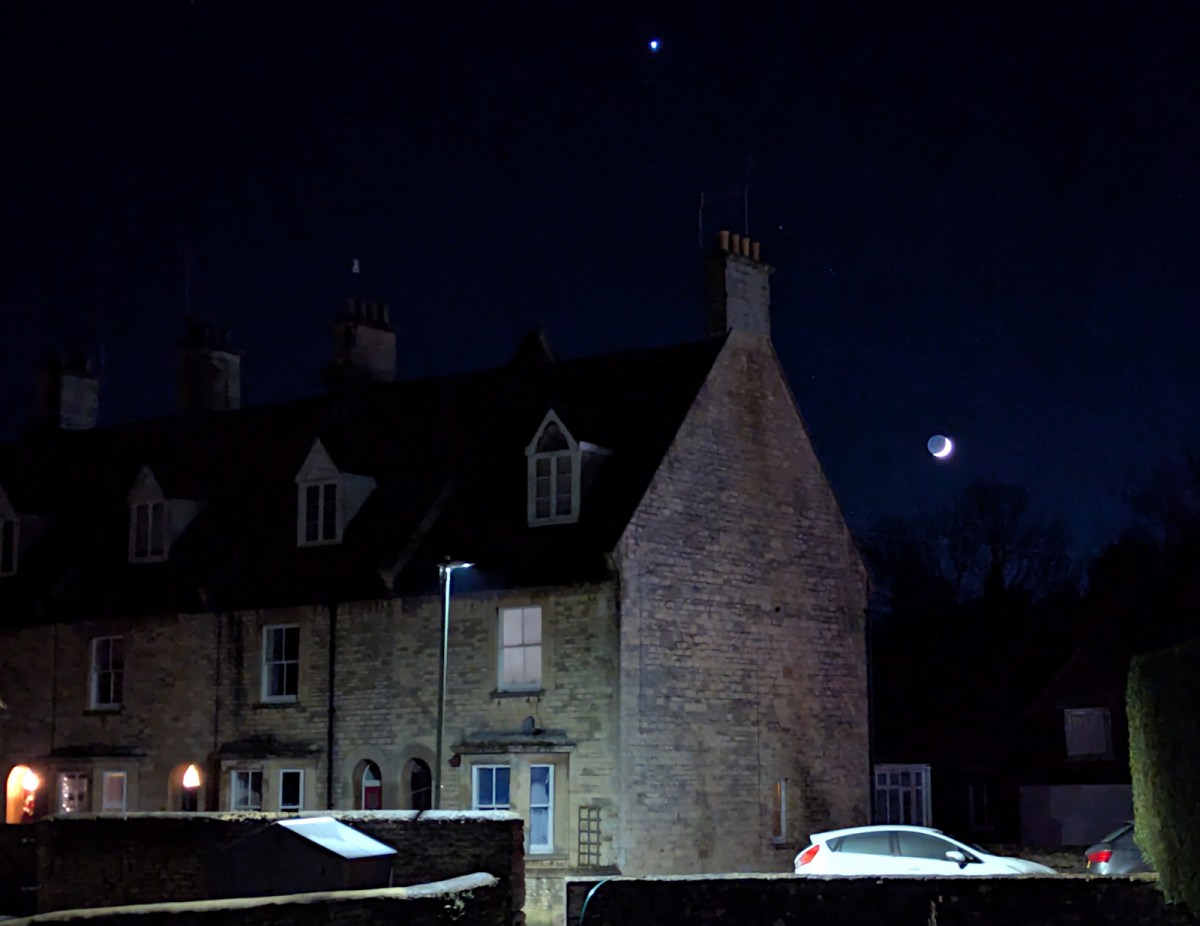
The Moon hangs in the sky to the right of the house, and it’s 390 million km away, so light takes 1.3 seconds or so to make that trip.

< Previous | Index | Next >

Image 118 – What’s in an image? Sometimes quite a lot, more than meets the eye. I’m posting an image every day or so.

Enlarge

This photo is of the northern end of Gloucester Street, seen from the eastern side of the River Churn, close to Abbey Way Services.

You’ll notice several sources of light. Light travels at a little over 1 billion km/h, 1.079 billion if you want to be a little more precise. Like anything in motion at a steady speed, you can express distances in terms of travel time. If I fly a helicopter in a straight line to London at 100 km/h and it takes me an hour, then the distance to London must have been 100 km. If it takes only 30 minutes, then the distance was 50 km. You get the idea.

The streetlight, the house and the car are all around 20 m away (or 0.020 km), and doing the arithmetic shows that light would take around 80 billionths of a sec to make that trip.

The Moon hangs in the sky to the right of the house, and it’s 390 million km away, so light takes 1.3 seconds or so to arrive from the Moon.

The planet Venus is visible near the top of the photo, and as I write Venus is about 111 million km away, a distance that light covers in just over 6 minutes.

For comparison, our nearest neighbouring star, Proxima Centauri, is so far away, that its light takes 4¼ years to reach us. Space is BIG!

When: 2nd January 2025
Where: Gloucester Street, Cirencester

< Previous | Index | Next >

Cirencester

For convenience, here’s a list of all the Cirencester area images:

A417 roadworks, Advent Market, Bishops Walk, Baunton, Canal 1, 2, Castle Street, Christmas lights 1, 2, Church 1, 2, 3, 4, 5, 6, Churn flood, Countryside, Fallen tree, Fleece, Gasworks, Gloucester Street, Hare 1, 2, Hospital, Market Place 1, Phoenix Fest, Riverside Walk, Stone plaque, Stratton Meadow, Tank traps, View, Wonky 1, 2, Yellow Iris

Themed image collections

The links below will take you to the first post in each collection

Cirencester, Favourites, Irish holiday 2024, Roman villa

Useful? Interesting?

If you enjoyed this or found it useful, please like, comment, and share below. (If you don’t see those links, click the article’s title above the main photo and they will appear.) Send a link to friends who might enjoy the article or benefit from it – Thanks! My material is free to reuse (see conditions), but a coffee is always welcome and encourages me to write more often!

Where is the sea-ice going?

The time to begin thinking about consequences and mitigation is now, not in ten or twenty years time.

Antarctic sea-ice

Larger view
(Wikimedia)

The news headlines are covering all kinds of world issues – the Russo-Ukrainian war, the revolution in Syria, Donald Trump’s coming second term in the White House, world economics, and more.

But there’s an event going on of far greater importance than any of those other issues, and that concerns the latest results of research into Antarctic sea-ice.

The problem? It’s melting much faster than we thought.

And why is that such a big deal? Because of the implications that global warming is progressing so much faster than we realised, combined with the potential loss of ice shelves, one and a half metres of sea-level rise far sooner than we expected, and the further potential for catastrophic sea level rises much, much greater than that.

That’s alarming in anyone’s book. But it’s not alarmist, it’s just stating an unpalatable truth. The time to begin thinking about consequences and mitigation is now, not in ten or twenty years time. And it’s most certainly way past time to deny that climate change is a thing at all.

I urge you to listen to the New Scientist podcast on this, episode 279 released on 6th December 2024. It has all the details.

Useful? Interesting?

If you enjoyed this or found it useful, please like, comment, and share below. (If you don’t see those links, click the article’s title above the main photo and they will appear.) Send a link to friends who might enjoy the article or benefit from it – Thanks! My material is free to reuse (see conditions), but a coffee is always welcome and encourages me to write more often!

Photos in Nature

Scientific images are always informative if you are a specialist in that particular discipline, but they are often very attractive in their own right too.

Here’s a fine selection of amazing images, beautifully presented by the journal Nature.

The photos were included in their latest alerts email, you can sign up for free if you want to (link near the top-right of their home page). You won’t always receive a collection of images like these, but you will see science news stories with interesting individual photos included.

Scientific images are always informative if you are a specialist in that particular discipline, but they are often very attractive in their own right too. I’m sure you’ll agree if you look through the selection presented here.

Useful? Interesting?

If you enjoyed this or found it useful, please like, comment, and share below. (If you don’t see those links, click the article’s title above the main photo and they will appear.) Send a link to friends who might enjoy the article or benefit from it – Thanks! My material is free to reuse (see conditions), but a coffee is always welcome and encourages me to write more often!

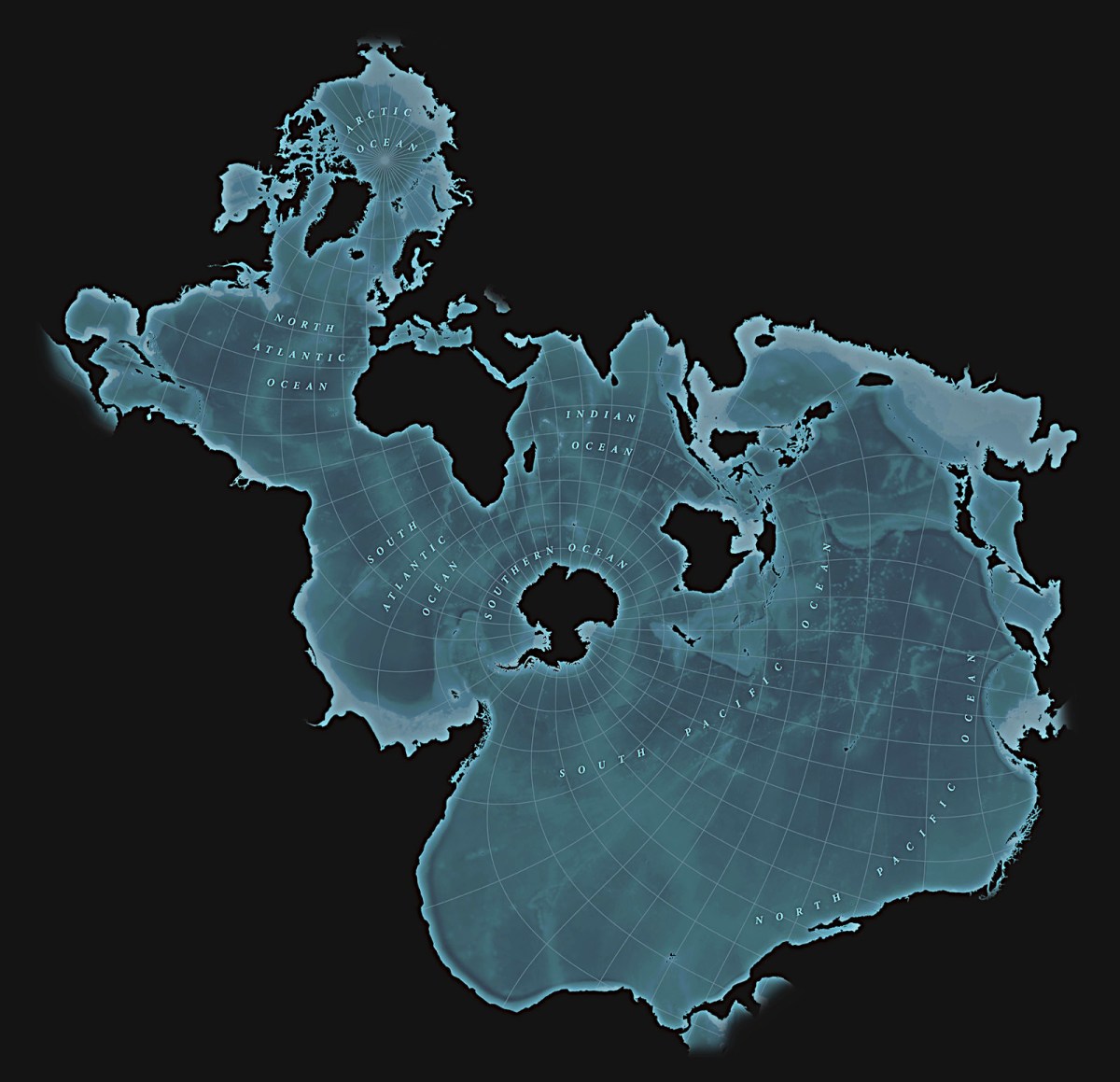
Spilhaus projection

Quite beautiful in it’s own right, it provides a holistic view rather than focusing on one ocean at a time

< Previous | Index | Next >

Image 95 – What’s in an image? Sometimes quite a lot, more than meets the eye. I’m posting an image every day or so.

Click to enlarge
(Wikimedia)

Sometimes, looking at things in a different way makes a world of difference (pun slightly intended).

This is a map projection much loved by oceanographers and other scientists researching related subjects such as marine life. It makes the world’s oceans the entire focus. Clever!

Athelstan Spilhaus invented this map projection; he was born in Cape Town in 1911 and worked at Woods Hole, Massachusetts, from 1936. In 1942 he began developing ways of mapping that would focus attention on the world’s oceans. This Spilhaus Projection is not the only result of his mapping work by any means, but it’s arguably the most impressive. Quite beautiful in it’s own right, it provides a holistic view rather than focusing on one ocean at a time.

When: 16th June 2023
From: NASA’s Scientific Visualization Studio

See also:
Favourites

For convenience, here’s a list of my favourite images:

Anemone, Cloud, Honeybee, Hydrangea, Kiftsgate1, Kiftsgate2, Large White, Mugshot, Nelson, Robin, Rose, Spilhaus, Sunset1, Weston beach

Themed image collections

The links below will take you to the first post in each collection

Cirencester, Favourites, Irish holiday 2024, Roman villa

< Previous | Index | Next >

Useful? Interesting?

If you enjoyed this or found it useful, please like, comment, and share below. (If you don’t see those links, click the article’s title above the main photo and they will appear.) Send a link to friends who might enjoy the article or benefit from it – Thanks! My material is free to reuse (see conditions), but a coffee is always welcome and encourages me to write more often!

First generation Star formation

Our Sun is a typical, smallish star, it has been around for some five billion years so far and probably has about another five billion years to go. No need to panic, the Sun is middle aged! Steady as you go.

Artist’s impression of early stars (Wikimedia)

Part 4 of a series – Emergence

< From gas and gravity to galaxies | Index | No later posts >

RequiresExtensive cold gas clouds
Results inStars producing elements up to iron, gas giant planets
EnablesNovae, Supernovae

Two features of the birth of a star system are important here, matter and energy. The first stars formed from the gradual collapse of clouds of cold gas consisting mainly of hydrogen with some helium and a trace of lithium. Gravity slowly pulls a gas cloud into an ever-shrinking volume, and slow, drifting motions lead to increasing rates of rotation as this shrinkage proceeds. Compression of gases always results in heating, so over a long period of time, a diffuse cloud of cold gas becomes a rotating mass of increasingly hot gas.

Sufficient collapse eventually causes the internal pressure and temperature to reach a critical point at which nuclear fusion becomes not just possible, but inevitable, and conditions then settle to a point where the fusion energy dramatically increases the core temperature and pressure, pushing outwards more and more strongly until the the gravitational collapse is stopped. The rotating, hot mass is a young star, converting hydrogen to helium.

Over time it settles down more and more to a stable state, though this lasts for a limited time, basically until no further hydrogen fusion is possible because there is insufficient hydrogen remaining. The length of time of that stable state is related to the mass of the star. Small, light stars process their hydrogen slowly. Large, very massive stars burn through their supply much faster. Although they have a great deal more to begin with, the temperatures and pressures at the centre are much higher so there is a faster reaction in a larger volume of core. That’s why large stars run out of fuel faster than small ones. These earliest stars are called Population III stars by astronomers, it seems they were usually very large and therefore short-lived.

Our Sun is much more recent, a typical, smallish star, it has been around for some five billion years so far and probably has about another five billion years to go. No need to panic, the Sun is middle aged! Steady as you go.

Eventually, as the hydrogen is used up, energy production falls and gravity can no longer be resisted, so the star shrinks and heats up further. As the internal temperatures and pressures increase, the star shrinks until the temperature at the core is sufficient to fuse helium. Once again, further gravitational collapse is halted by increasing core temperatures and this lasts until the helium supply is exhausted. Through a whole series of similar steps the star creates heavier and heavier elements all the way up to iron, but fusing atoms of iron absorbs energy so gravity wins out in the end. Small stars slowly cool and eventually become inactive and unchanging. Particularly large stars have a different fate.

We’ll consider those details in a future article.

See also:

< From gas and gravity to galaxies | Index | No later posts >