Another umbellifer

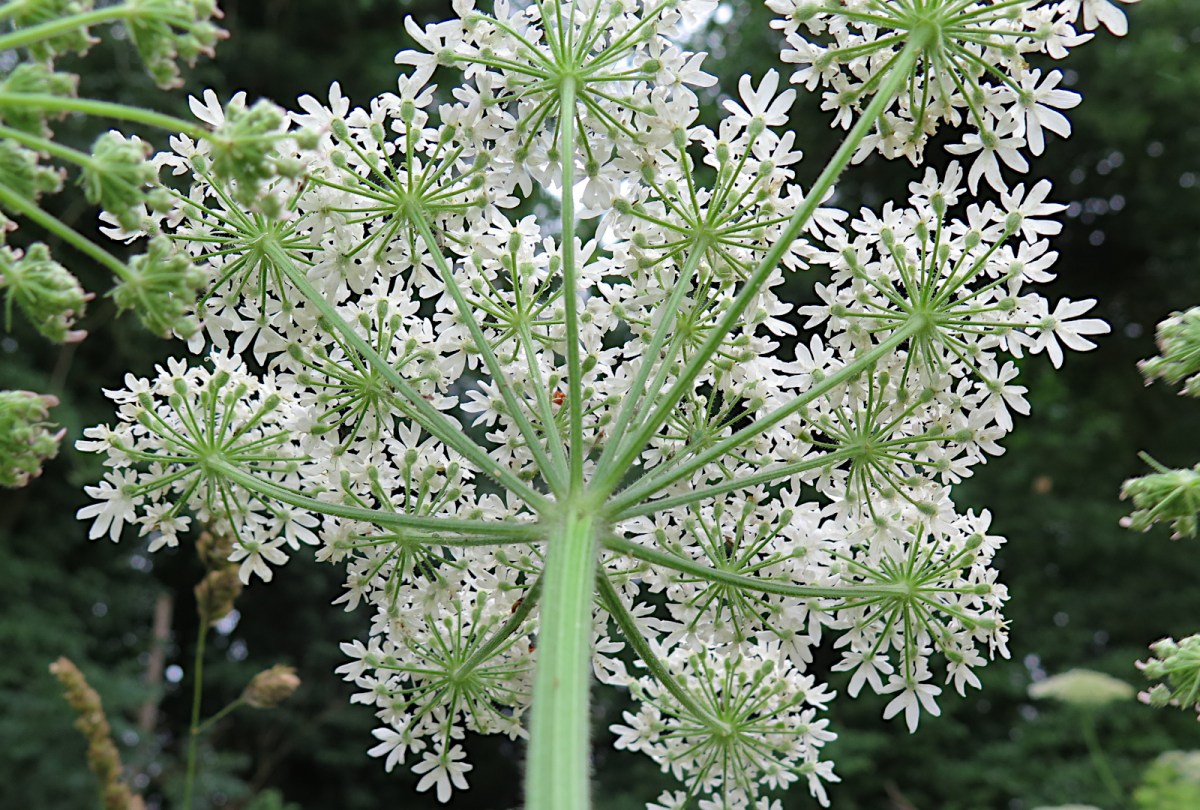
Notice how every part is sized precisely for the task it performs. The main stem is stout and sturdy, the stems that spring from it are much smaller and each one carries a number of flowers.

< Previous | Index | Next >

Image of the day – 165

What’s in an image? Sometimes quite a lot, more than meets the eye. I’m posting an image every few days.

Click to enlarge

This photo was taken at a different time and place from the previous Umbellifer image, but the structure of this flower is very similar to the previous one. The main difference is that this time we’re viewing it from below. This reveals the exquisite architecture of an umbel.

Notice how every part is sized precisely for the task it performs. The main stem is stout and sturdy, the stems that spring from it are much smaller and each one carries a number of flowers. Those flower stalks in turn are smaller yet, and each one carries a single, tiny flower. It’s exactly how an engineer might design something, each part as large and strong as it needs to be, but no more. Why and how? Well, in the case the engineer, because lightness means less material, less mass, and therefore lower cost. Failure will be unusual because the forces will have been calculated and the values increased just a little to ensure safety.

Your car is designed this way, it could be designed and built to survive a collision with little or no damage, but it would be unaffordable because of the high cost of the extra material required, and it would consume much more fuel because of its high mass. That’s why you drive a car when travelling, not a tank!

The same argument applies to plant structures. The umbel could be made to survive a hurricane, but it would demand much more photosynthesis to provide the cullulose and other materials required to make it tough enough to survive such powerful winds. That’s why coconut palms have far stronger stems than the umbellifer! Living things are not designed by engineers, they adjust to their environment little by little over many generations by a trial and error system we call evolution.

Sometimes people say, ‘It’s only a theory’, meaning that something is a bit shaky and not to be trusted. That is to misunderstand what scientists mean by the word ‘theory’. In everyday use the word has a sense of an untested idea, something you just dreamed up as a way to explain something – might be wrong, might be right. Scientists have a word for that, but the word is not ‘theory’ – it’s ‘hypothesis’. In science, a theory is something so well tested as to be essentially unrejectable. Evolution is a theory in that sense, like the theories of relativity or quantum physics or plate tectonics. Theories have almost no room left for argument.

You can’t believe in evolution, it’s not a matter of faith but of overwhelming evidence. Following Jesus, as I and many others do, is based on faith, and I write about that too on Journeys of heart and mind.

You might be surprised to learn that engineers sometimes use evolution to design things like aircraft wings. The software to do that makes a long series of small tweaks to an initial design and calculates which changes improve performance. And this process is repeated many times enabling the final result to be stronger, lighter and more effective. An aircraft wing (or other structure) created in this way is not designed with paper and pencil or with CAD in the normal way, it evolves.

See also:

< Previous | Index | Next >

Useful? Interesting?

If you enjoyed this or found it useful, please like, comment, and share below. (If you don’t see those links, click the article’s title above the main photo and they will appear.) Send a link to friends who might enjoy the article or benefit from it – Thanks! My material is free to reuse (see conditions), but a coffee is always welcome and encourages me to write more often!

You might also like:

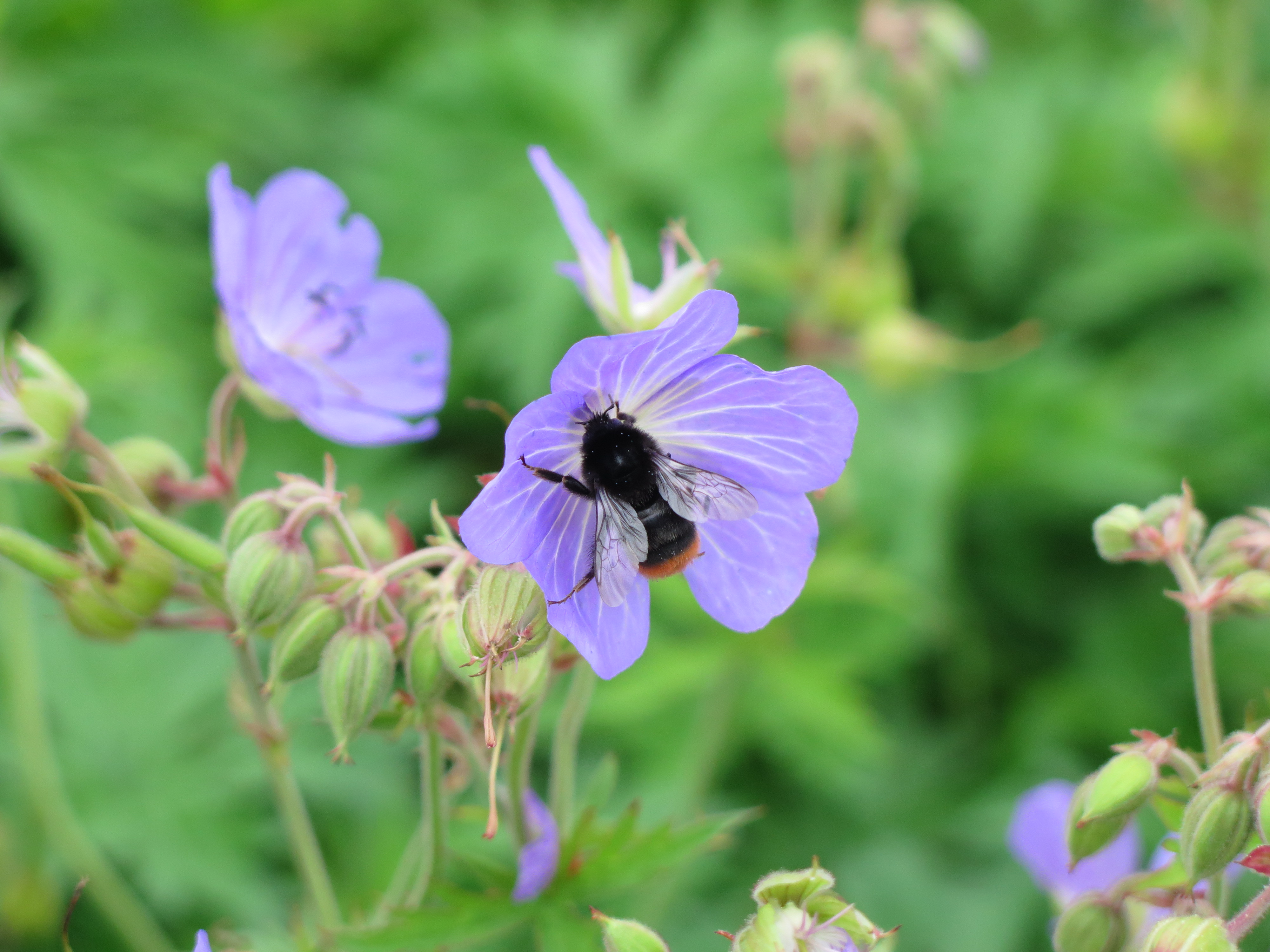
Bumble bee on meadow cranesbill

The photo is sharp enough when enlarged that you can see individual pollen grains on the bee’s black, furry body.

< Previous | Index | Next >

Image of the day – 164

What’s in an image? Sometimes quite a lot, more than meets the eye. I’m posting an image every few days.

Click to enlarge

Here’s a bumble bee busy collecting nectar from a meadow cranesbill flower in a field margin just a brief walk from my home. The cranesbills are wild geraniums, close relatives of the pelargoniums; both genera are widely grown as decorative plants in pots or garden borders.

The photo is sharp enough when enlarged that you can see individual pollen grains on the bee’s black, furry body. Click the thumbnail image and stretch it to full size, then look for little white dots on the bee, those are the pollen grains.

Mutual benefit

The bees and flowering plants co-evolved, ancestors of both succeeded best in the presence of the other. Presumably the bee ancestors fed on the pollen of wind pollinated plants, incidentally transferring pollen more efficiently than the wind. And plants that provided sugary solutions and flagged this with colourful leaves near the nectar and pollen source were more successful than those that did not. After a while the insect and plant species were locked into a mutually beneficial relationship. Flowers are wonderfully adapted to attract bees and supply them with energy and a protein source to feed to their larvae. Bees are wonderfully adapted to collect and store nectar and pollen while moving some pollen grains from one flower to another.

See also:

< Previous | Index | Next >

Useful? Interesting?

If you enjoyed this or found it useful, please like, comment, and share below. (If you don’t see those links, click the article’s title above the main photo and they will appear.) Send a link to friends who might enjoy the article or benefit from it – Thanks! My material is free to reuse (see conditions), but a coffee is always welcome and encourages me to write more often!

You might also like:

Umbellifers

The umbellifers are an interesting group of plants, including carrot, parsnip, celery, parsley, dill, fennel, coriander and many more.

< Previous | Index | Next >

Image of the day – 163

What’s in an image? Sometimes quite a lot, more than meets the eye. I’m posting an image every few days.

Click to enlarge

This is a flower head of cow parsley or one of its relatives, a wild plant that grows extensively in Britain on untrimmed grass verges, along hedgerows, and in similar places. It’s a member of the carrot family, the Apiaceae ( until 2011, Umbelliferae), the word ‘umbellifer’ is related to ‘umbrella’ and you can probably see why!

The umbellifers are an interesting group of plants, including carrot, parsnip, celery, parsley, dill, fennel, coriander and many more.  Cow parsley, like the others listed here, is safe to eat – but be very careful; hemlock looks much like cow parsley and is deadly poisonous. The infamous giant hogweed is another harmful umbellifer.

It was a hemlock extract that the Greek philosopher Socrates was required to drink following a guilty verdict in Athens.

See also:

< Previous | Index | Next >

Useful? Interesting?

If you enjoyed this or found it useful, please like, comment, and share below. (If you don’t see those links, click the article’s title above the main photo and they will appear.) Send a link to friends who might enjoy the article or benefit from it – Thanks! My material is free to reuse (see conditions), but a coffee is always welcome and encourages me to write more often!
You might also like:

Sculpted tree

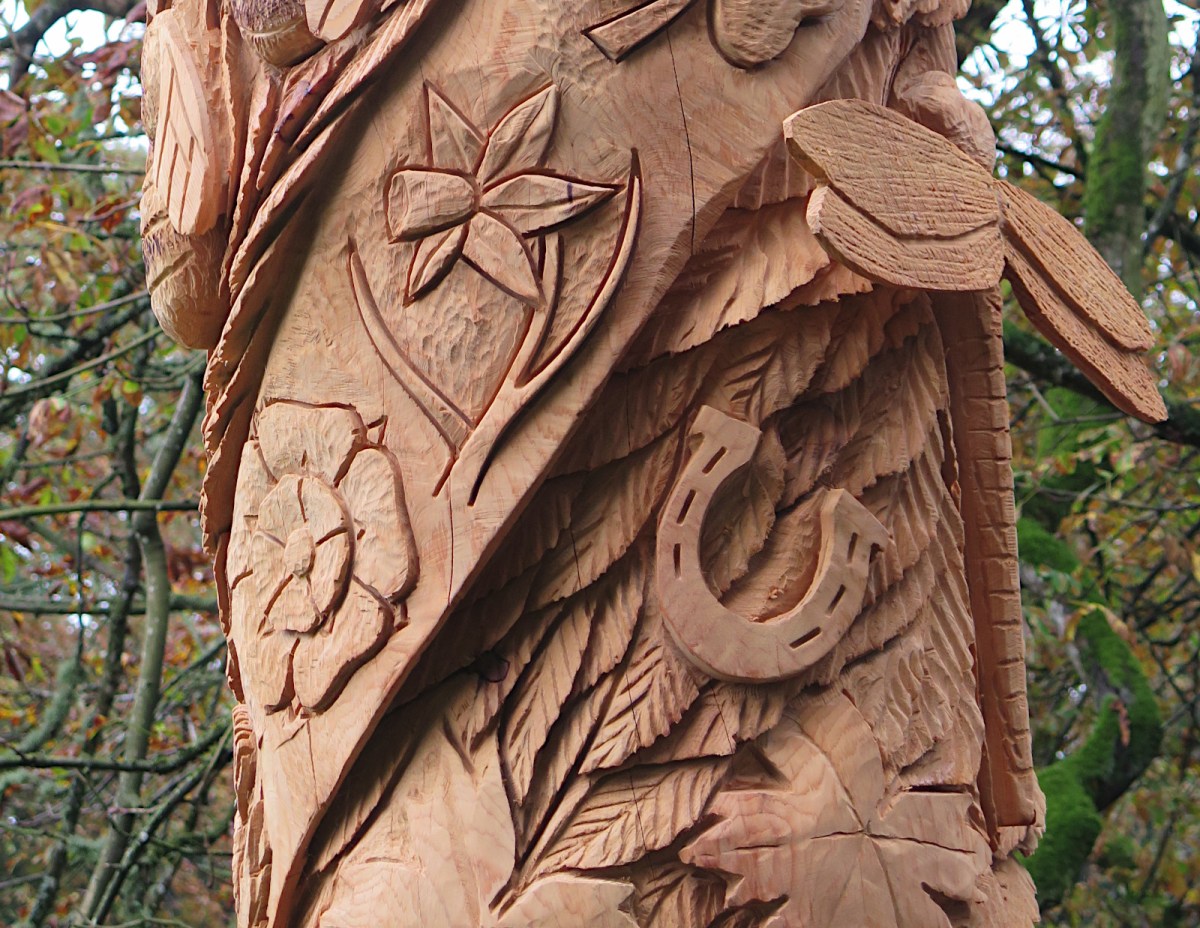
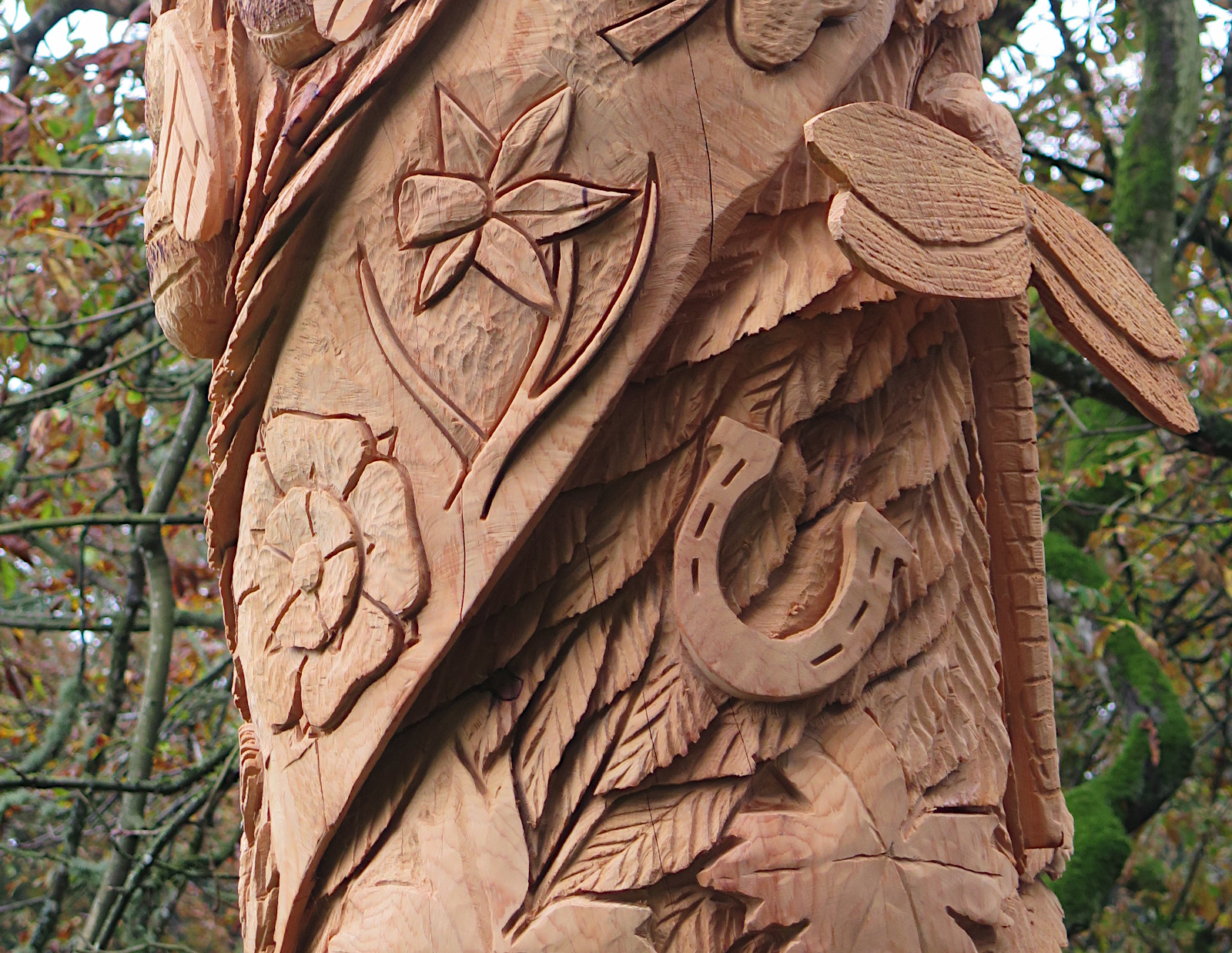
The tree was topped, the branches trimmed off, and [the sculptor] was asked to work on the standing trunk in situ. He rose to this challenge and came up trumps, the photo shows some of the detail.

< Previous | Index | Next >

Image 124 – What’s in an image? Sometimes quite a lot, more than meets the eye. I’m posting an image every day or so.

Enlarge

We have a skilled sculptor in Cirencester who specialises in carving large pieces of timber. He was called in work on a tree that had died in Cirencester Park. But instead of felling the tree and then asking him to work on the horizontal trunk (something he’s done to great effect in the past), this time the tree was topped, the branches trimmed off, and he was asked to work on the standing trunk in situ. He rose to this challenge and came up trumps, the photo shows some of the detail.

I never cease to be astonished at the way an artist can imagine a finished work before it exists and bring it to life in any medium – oil paint, watercolour, wood, stone. It’s a kind of magic. The human brain is so creative. People have been doing this kind of thing for many generations; think of Michelangelo, or the stone and bronze artists of Greece and Rome. No animal is capable of converting material into an image like this, or even imagining that such a thing is possible.

When: 12th October 2023
Where: Cirencester Park

See also:

< Previous | Index | Next >

Useful? Interesting?

If you enjoyed this or found it useful, please like, comment, and share below. (If you don’t see those links, click the article’s title above the main photo and they will appear.) Send a link to friends who might enjoy the article or benefit from it – Thanks! My material is free to reuse (see conditions), but a coffee is always welcome and encourages me to write more often!

Firethorn berries

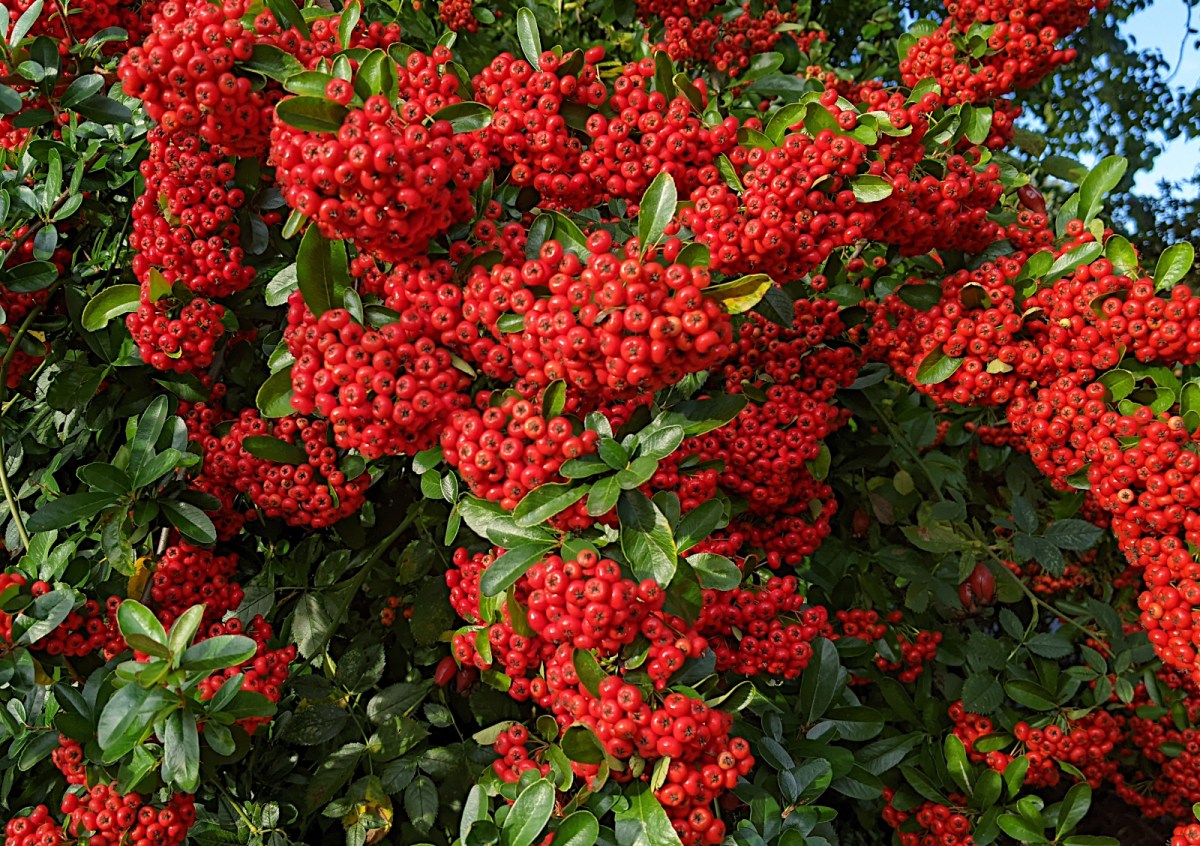
The fruit are pomes with the same structure as very tiny apples (they make excellent ‘apples’ for the fruit bowl in a dolls house).

< Previous | Index | Next >

Image 120 – What’s in an image? Sometimes quite a lot, more than meets the eye. I’m posting an image every day or so.

Enlarge

Firethorn (botanical name Pyracantha) is a widely-grown garden shrub with small white flowers in the spring and glorious, usually red or orange fruit that often persist into January or later. They are eaten by birds however, and in a hard winter the fruit may all be consumed before Christmas. The fruit are pomes with the same structure as very tiny apples (they make excellent ‘apples’ for the fruit bowl in a dolls house). The flesh is edible but is mealy and bland, the seeds are slightly poisonous though a small number are very unlikely to be harmful.

The example in the photo was growing in Waitrose car park in Cirencester, pretty much on the line of the Roman City wall. As you walk into the car park from Sheep Street, look to your right as you pass the outdoor seating and tables and you’ll spot a low, stone wall. This was built directly above the Roman wall to show where it was and its alignment, there’s a piece of Roman stone on top of it and an explanatory sign, with further historical information on the wall of the supermarket nearby.

The road to Aquae Sulis (Roman Bath) left Corinium through a gateway nearby and later became the old Tetbury Road for a couple of miles. The Roman route continues across what is now Cotswold Airport.

When: 25th October 2023
Where: Sheep Street, Cirencester

See also:

< Previous | Index | Next >

Useful? Interesting?

If you enjoyed this or found it useful, please like, comment, and share below. (If you don’t see those links, click the article’s title above the main photo and they will appear.) Send a link to friends who might enjoy the article or benefit from it – Thanks! My material is free to reuse (see conditions), but a coffee is always welcome and encourages me to write more often!