Stars dancing in the sky

There is beauty in so many natural things – a waterfall, a flower opening from a bud, the swirling patterns in a shoal of fish or a murmuration of starlings at dusk.

Cirencester’s church tower

< Previous | Index | Next >

Image of the day – 195

What’s in an image? Sometimes quite a lot, more than meets the eye. I’m posting an image whenever I can.
Cirencester’s church tower

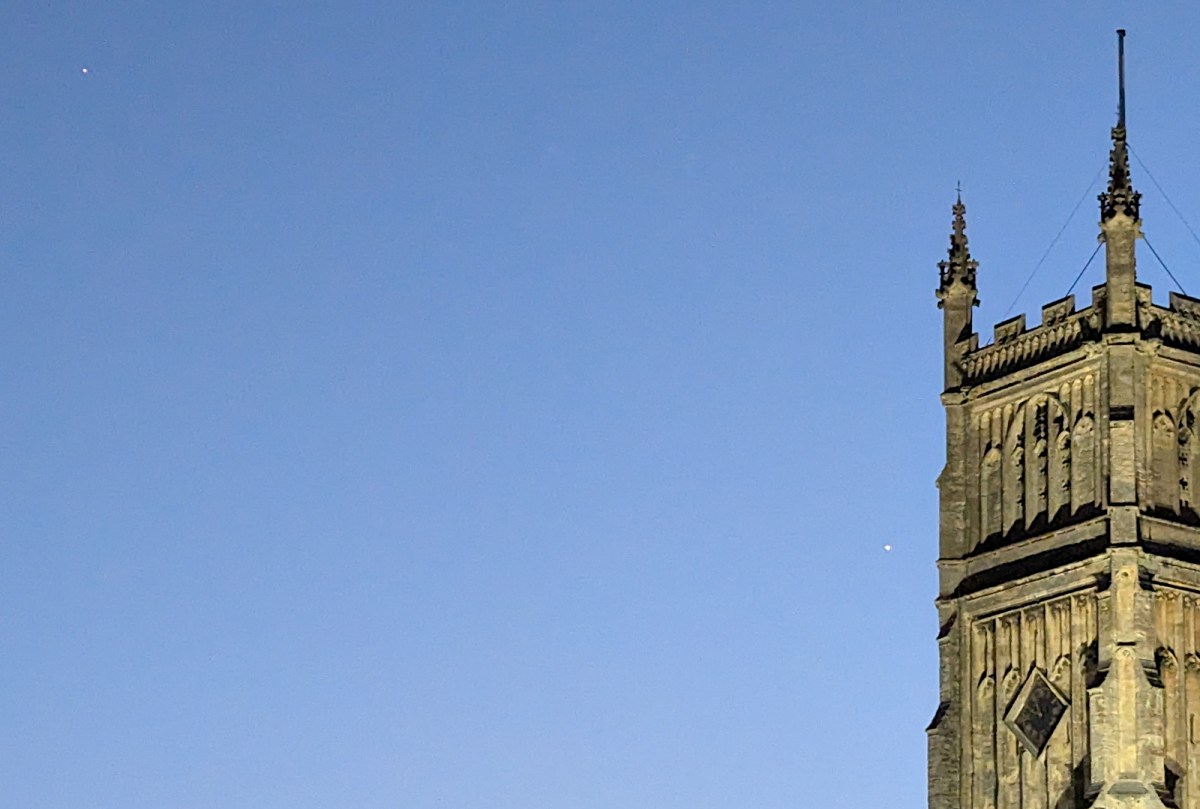
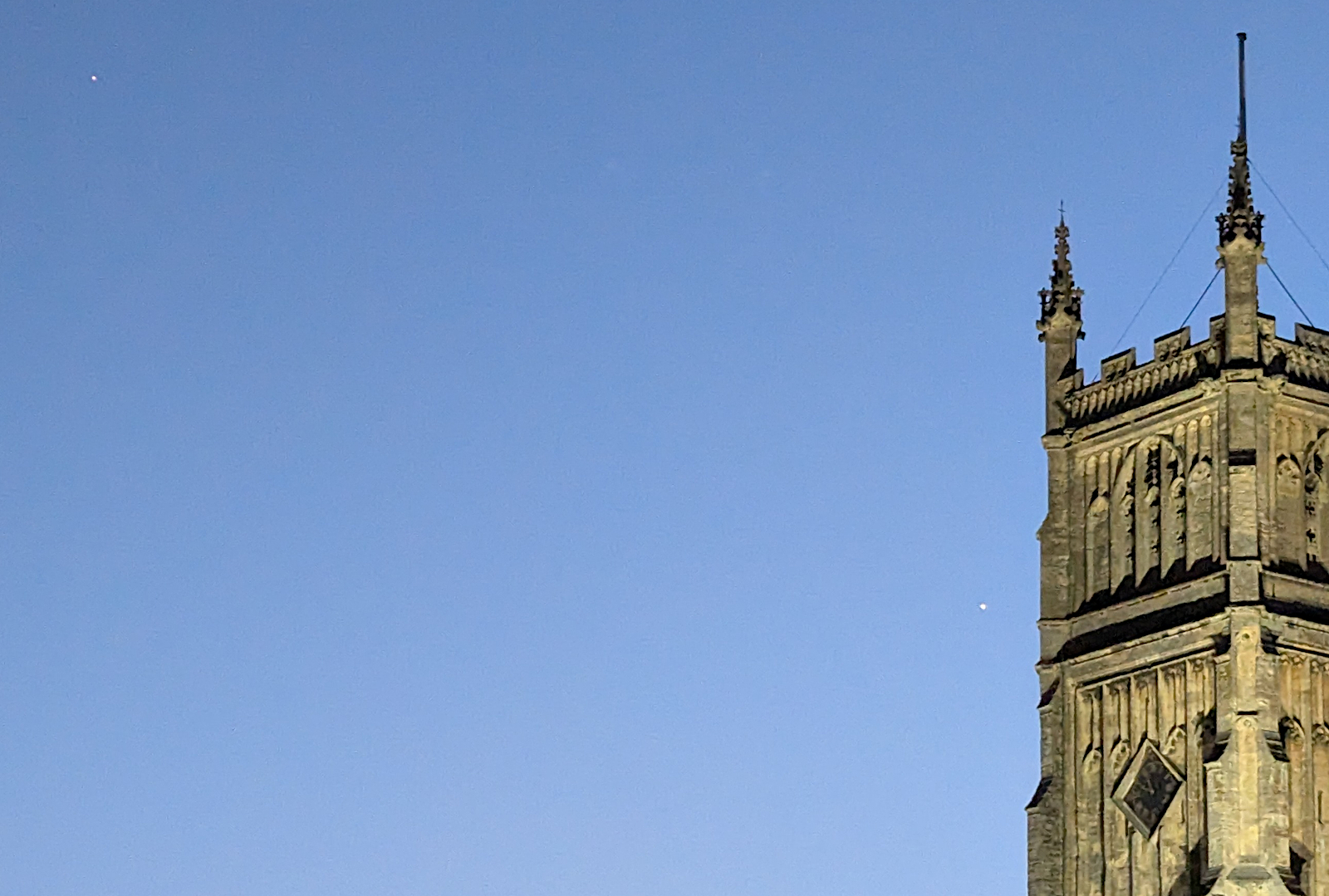
On a clear evening during late May or early June, take a look at the western sky after sunset and you’ll see two very bright stars quite close together. They’re not stars at all, in fact. They are the planets Venus and Jupiter. The brightest of the two is Venus, setting slightly earlier than Jupiter until the beginning of June. The photo was taken on 25th May while the two planets were still far apart in the sky. Venus is brighter, the same side of the sun as Earth is. It’s just to the left of Cirencester’s Church tower in the photo. Jupiter is a little fainter, up in the top-left corner. Jupiter is a larger planet than Venus (about ten times the diameter, but it’s also much further away; far, far beyond the sun from our point of view. If you’re struggling to find the planets click the thumbnail image to expand it and you’ll see them both quite easily.

Passing close

The two planets will pass very close indeed in the first week of June. As I mentioned above, it’s merely a line of sight closeness, there’s no chance of a collision. Astronomers call a coming-together in the sky a planetary conjunction. At one time people thought the star of Bethlehem might have been a close conjunction like this, but these events can be predicted accurately far into the future and we now know there are no events from 2000 years ago that would fit the idea.

Nonetheless it’s a beautiful thing to see and you don’t even need a telescope. It’s something you can watch evening by evening with the naked eye or a pair of binoculars (providing the weather cooperates). Serious warning, don’t look until the sun has set. You can damage your eyes by looking at the sun, and seeing it in binoculars is particularly dangerous. Hint: go on watching after the planets move further apart, you’ll get a continuing sense of how active our Solar System can be.

What makes something beautiful?

It’s hard to pin down, isn’t it? There is beauty in so many natural things – a waterfall, a flower opening from a bud, the swirling patterns in a shoal of fish or a murmuration of starlings at dusk. There is beauty in athletics, the perfect pole vault, a new world record, a plunging, almost splashless entry into the water from a high board after a long series of breathtaking manoeuvres on the way down. A special sunset or sunrise. A list of beautiful things could go on for ever!

There’s also beauty in human relationships, children playing together, smiling and laughing; the elderly chatting together about times past. There’s beauty in the flavours of food and drink as well, some combinations are just so special, cheese and fruit, even really simple things like a ripe apple and a chunk of mature Cheddar, or some Brie with ripe grapes and crispy crackers.

Beauty seems, at its heart, to depend on everything good and right. Kindness and gentleness are beautiful things, anger and violence are ugly.

What about me? How can I become more beautiful? Think about it from your own point of view if you are reading this; what can you do or say or think or display that will make other people catch their breath and think, ‘Ah, there’s something beautiful here, something commendable, something I can appreciate and value.

Living and behaving in beautiful ways costs nothing, and greatly benefits those around us. So what is not to like? If everyone on the planet was determined to live better and more kindly today than they did yesterday, what a wonderful world this would become!

See also:

< Previous | Index | Next >

You might also like:

Useful? Interesting?

If you enjoyed this or found it useful, please like, comment, and share below. (If you don’t see those links, click the article’s title above the main photo and they will appear.) Send a link to friends who might enjoy the article or benefit from it – Thanks! My material is free to reuse (see conditions), but a coffee is always welcome and encourages me to write more often!

Seemingly a leafy town

When I say ‘landscape’ I’m thinking here of the way the rising hills and the meandering river valley reveal a town snuggled into a cosy counterpane of woodland as in the photo.

Cirencester’s church tower

< Previous | Index | Next >

Image of the day – 194

What’s in an image? Sometimes quite a lot, more than meets the eye. I’m posting an image whenever I can.

Cirencester’s church tower

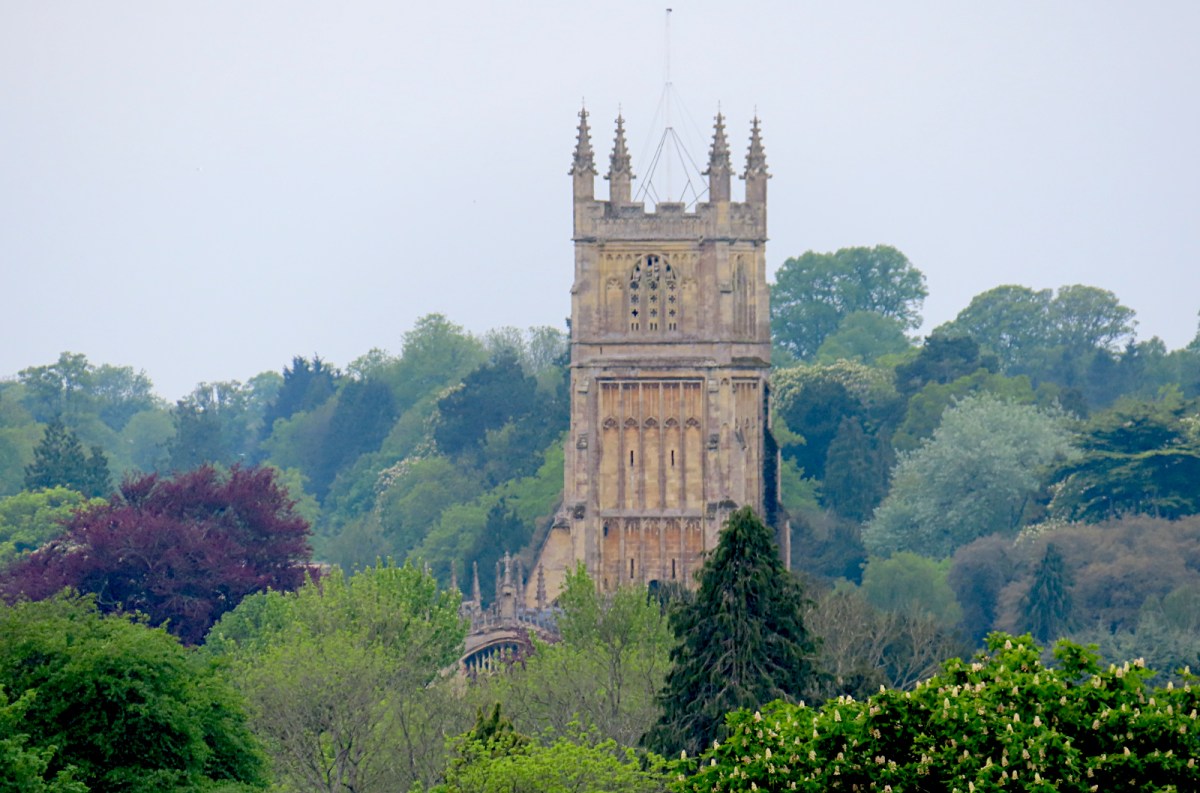
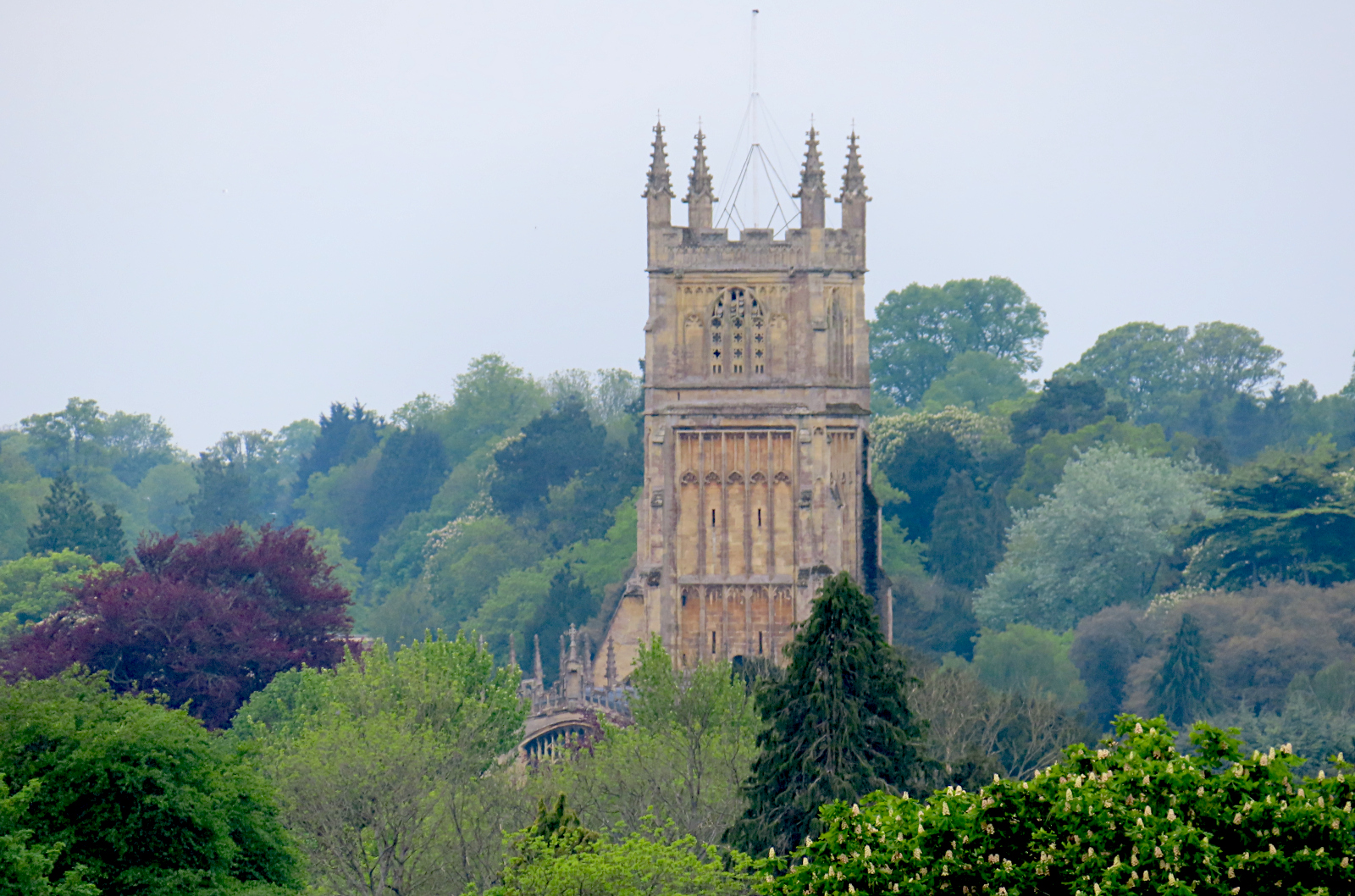
Seen at a distance from the east, Cirencester’s buildings are almost entirely hidden by trees. Only the tallest structures remain visible, mostly just the tower of the Parish Church. This telephoto shot shows it clearly; I’ve compensated for some summer haze by increasing the contrast a little.

Inside the town

It’s a very different matter when you’re in the town itself. Most of the larger buildings are in and around the Market Place. The church tower is at the western end of the Market Place and really all you can see are buildings. From the Abbey Grounds there are views over the rising land to the east across Tar Barrow Field towards the point where I took this photo (here’s the opposite view from near the tower towards the higher ground where I took today’s image). Northwards, the Cotswold Hills rise ever higher as you approach Gloucester and Cheltenham where the land falls suddenly and steeply about 300 m to the floor of the Severn Valley. In the West the hills increase towards Stroud and Tetbury as they also do to the south on the roads heading for Swindon and Marlborough.

Central Cirencester therefore lies in a hollow, part of the Churn Valley, and because the Churn meanders along its course there appear to be hills in every direction. Without the wandering of this valley, Cirencester would have hills mostly on the east and west. If it wasn’t for the church tower, Cirencester would be invisible from every direction, hidden by woodland and fields with scattered hedgerow trees, until you reach the built environment.

The old centre dates mostly to the 18th and 19th centuries with many wool merchant’s houses built of cut Cotswold stone blocks, often built in Georgian ashlar style and now converted to shops and offices. There are a few, scattered, timber-built properties remaining in some of the older streets in the town, almost entirely within 1½ km of the town centre. There are other wooden buildings now hidden, re-fronted in Georgian times with stone. Further out are Victorian and Edwardian streets, then houses from the 1920s and 30s, followed by post war housing estates from the 40s, 50s and right up to the present day. The town is still expanding.

Landscape affects the feel of a place

It’s important to notice this because the principle applies far more widely than you might, at first, think. When I say ‘landscape’ I’m thinking here of the way the rising hills and the meandering river valley reveal a town snuggled into a cosy counterpane of woodland as in the photo above. The entire feel of the town depends to a great extent on the underlying landscape features and the ten thousand years of water erosion since the end of the last ice-age. Had these events not taken place, Cirencester and its Roman predecessor, Corinium, would have been very different from the places they actually are and were.

Just consider how this applies to other aspects of life. Here’s a short list to consider. It really is a fundamental process.

  • Education – Shapes a person’s entire life.
  • Character – This affects how other people will understand you and treat you in life.
  • Genetics – Will affect everything from skin colour to health issues.
  • Wealth – Can open doors, create or close opportunities.
  • Faith – May provide strength to persevere, can bring peace and calm in difficulties.
  • Vision – Nobody can do what they cannot imagine!

Have a think about your own life. What things have been fundamental in shaping who you are and what you have achieved (or may achieve)? What has been really special so far in life? What is the ‘landscape’ underlying your life and how has it affected you and the way others perceive you?

See also:

< Previous | Index | Next >

You might also like:

Useful? Interesting?

If you enjoyed this or found it useful, please like, comment, and share below. (If you don’t see those links, click the article’s title above the main photo and they will appear.) Send a link to friends who might enjoy the article or benefit from it – Thanks! My material is free to reuse (see conditions), but a coffee is always welcome and encourages me to write more often!
Churn flooding

Some buildings, like the lovely, old Cotswold stone house in the photo, were often built quite close to the area of flooding, choosing ground just high enough to stay dry.

< Previous | Index | Next >

Image 105 – What’s in an image? Sometimes quite a lot, more than meets the eye. I’m posting an image every day or so.

Larger view

This view of the Churn flowing through the village of Baunton, a little north-east of Cirencester, shows it spilling over its banks and spreading across a field; this is normal, winter-time behaviour for the Churn for much of its length. Rising near the top of the Cotswolds at Seven Springs south of Cheltenham, it has cut a winding valley running towards Cirencester, the southern half of which is liable to flood.

Some buildings, like the lovely, old, Cotswold stone house in the photo, were often built quite close to the area of flooding, choosing ground just high enough to stay dry. Many other buildings in villages like Baunton were built a little higher still.

Historically, the regularly flooded land would serve as summer grazing and provide a hay crop in late summer. In this way, cattle could be kept on the land with a stock of hay as supplementary feed when winter grazing on the hillsides was prevented by snowfall. Higher (and drier) land could provide other crops like barley and wheat.

South of Cirencester, the Churn joins the Thames at Cricklade, and the combined flood plain is quite extensive. North Meadow on the edge of Cricklade is bordered by the converging rivers and is famous for its huge colony of snakeshead fritillaries By the time the Thames reaches Lechlade, it is navigable all the way to London and out into the North Sea.

When: 23rd December 2023
Where: Baunton, Gloucestershire

See also:
Cirencester

For convenience, here’s a list of all the Cirencester area images:

A417 roadworks, Advent Market, Bishops Walk, Baunton, Canal 1, 2, Castle Street, Christmas lights 1, 2, Church 1, 2, 3, 4, 5, 6, Churn flood, Countryside, Fallen tree, Fleece, Gasworks, Gloucester Street, Hare 1, 2, Hospital, Market Place 1, Phoenix Fest, Riverside Walk, Stone plaque, Stratton Meadow, Tank traps, View, Wonky 1, 2, Yellow Iris

Themed image collections

The links below will take you to the first post in each collection

Cirencester, Favourites, Irish holiday 2024, Roman villa

< Previous | Index | Next >

Useful? Interesting?

If you enjoyed this or found it useful, please like, comment, and share below. (If you don’t see those links, click the article’s title above the main photo and they will appear.) Send a link to friends who might enjoy the article or benefit from it – Thanks! My material is free to reuse (see conditions), but a coffee is always welcome and encourages me to write more often!
Cirencester Hospital

The old house is still interesting on the inside, at least one beautifully oak-panelled room is now a patient waiting room, and gives a hint of how the house would have appeared in its heyday.

< Previous | Index | Next >

Image 104 – What’s in an image? Sometimes quite a lot, more than meets the eye. I’m posting an image every day or so.

Larger view

Cirencester had two hospitals in the 1950s. There was the Cirencester Memorial Hospital, the main part of which was demolished recently and is now one of the town’s car parks. And in 1948, the new NHS took over a large house near the Bull Ring (the town’s Roman Amphitheatre) and converted it internally as a maternity hospital – The Querns Maternity Hospital. Later, this was repurposed again as a general hospital and modern extensions were added. The Memorial Hospital closed.

The photo shows the rear view of the old house, you can see part of a modern extension on the extreme left. The old house is still interesting on the inside, at least one beautifully oak-panelled room is now a patient waiting room, and gives a hint of how the house would have appeared in its heyday.

I was born in this building when it was a maternity hospital, I was either the first or the second baby after the hospital opened in 1948.

Today, the NHS is struggling with insufficient funding and too few staff leading to long waiting times and impacting the wellbeing of patients, I hope the present government will be able to start correcting this, bringing the service back to full strength and effectiveness. That aside, the NHS remains a wonderful service for everyone who lives in the UK, a job it’s been doing for more than 70 years.

When: 9th January 2024
Where: Cirencester, Gloucestershire

Cirencester

For convenience, here’s a list of all the Cirencester area images:

A417 roadworks, Advent Market, Bishops Walk, Baunton, Canal 1, 2, Castle Street, Christmas lights 1, 2, Church 1, 2, 3, 4, 5, 6, Churn flood, Countryside, Fallen tree, Fleece, Gasworks, Gloucester Street, Hare 1, 2, Hospital, Market Place 1, Phoenix Fest, Riverside Walk, Stone plaque, Stratton Meadow, Tank traps, View, Wonky 1, 2, Yellow Iris

Themed image collections

The links below will take you to the first post in each collection

Cirencester, Favourites, Irish holiday 2024, Roman villa

< Previous | Index | Next >

Useful? Interesting?

If you enjoyed this or found it useful, please like, comment, and share below. (If you don’t see those links, click the article’s title above the main photo and they will appear.) Send a link to friends who might enjoy the article or benefit from it – Thanks! My material is free to reuse (see conditions), but a coffee is always welcome and encourages me to write more often!

Cotswold skies

One of the joys of these walks is the sky. Sometimes it’s grey and overcast, sometimes it’s blue from horizon to horizon, but sometimes it’s full of interesting cloud formations at various heights.

< Previous | Index | Next >

Image 103 – What’s in an image? Sometimes quite a lot, more than meets the eye. I’m posting an image every day or so.

Larger view

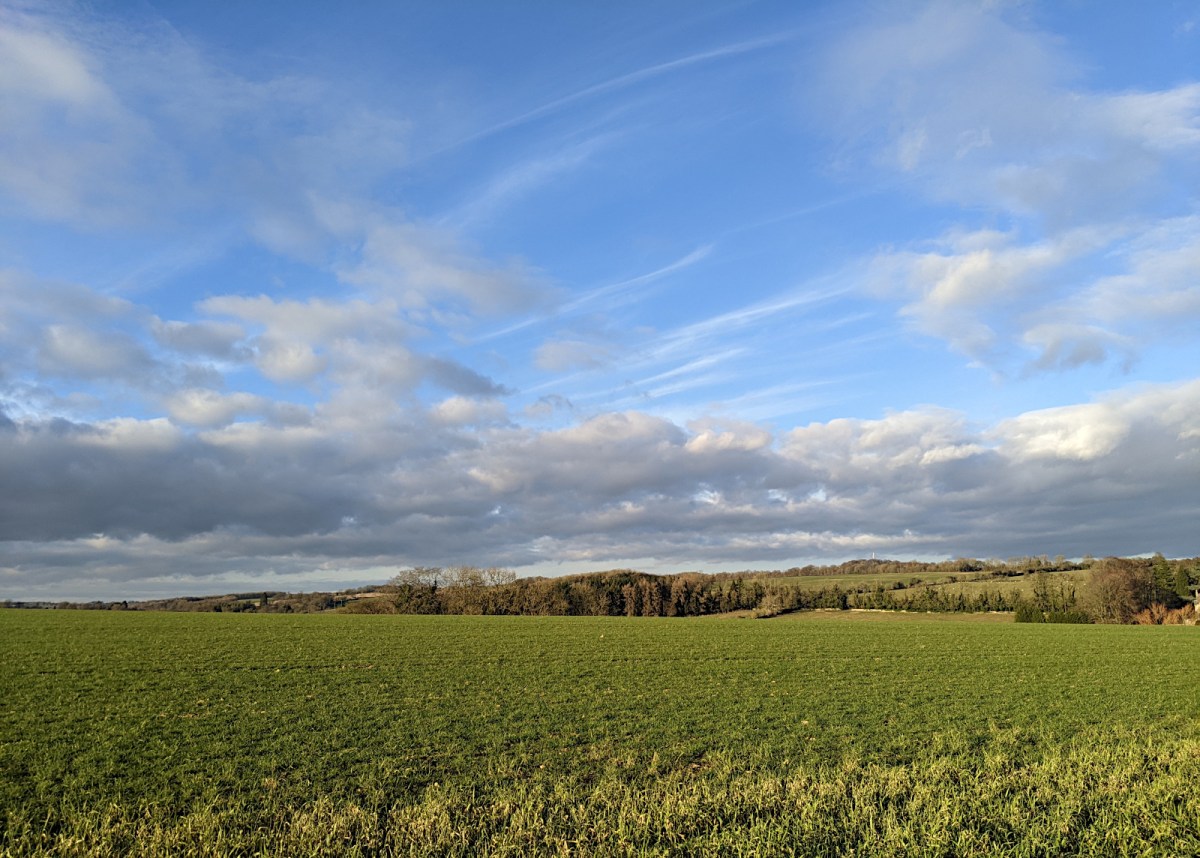
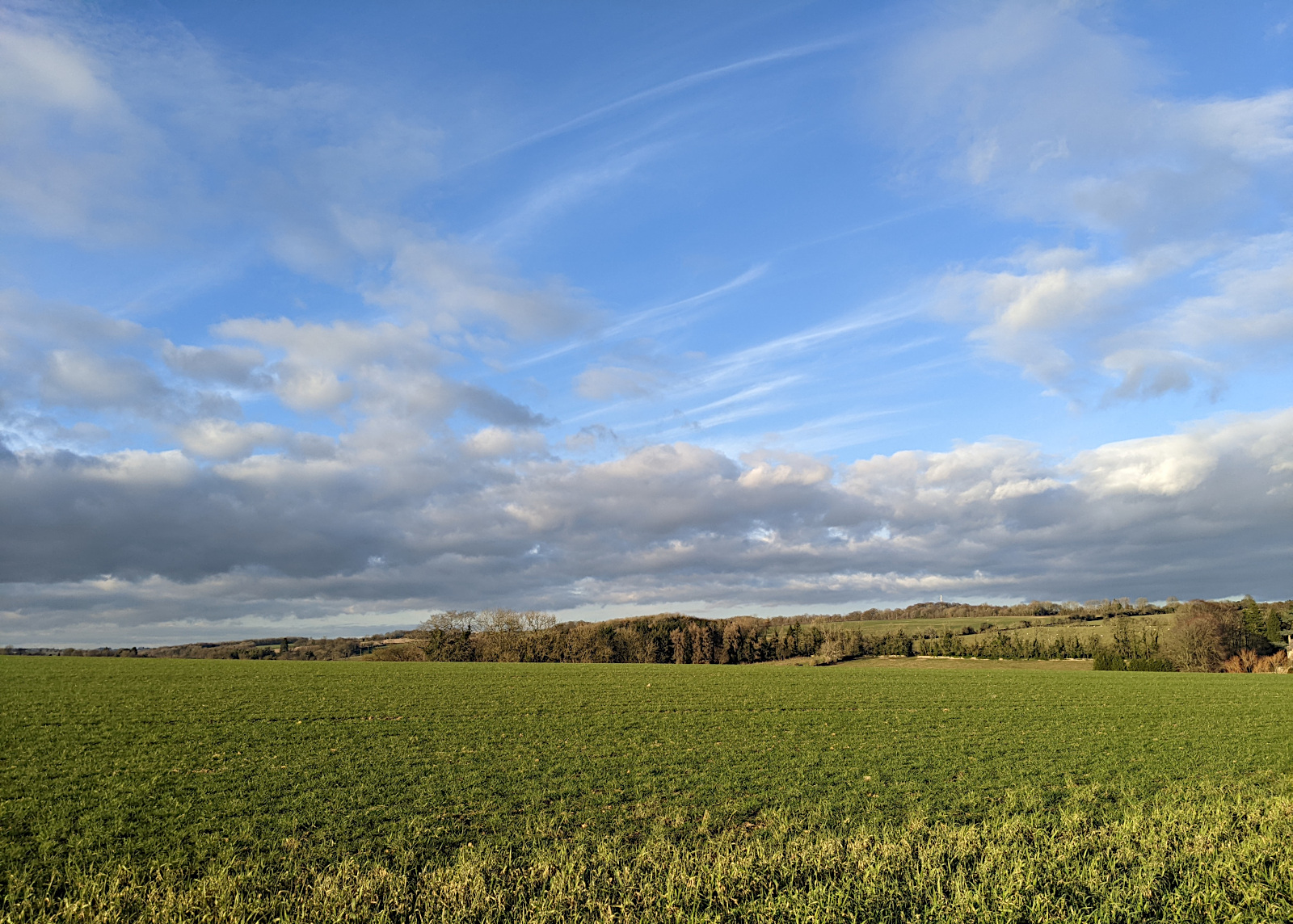
Traditional Cotswold fields were quite small, but as in many parts of the UK, farmers have removed hedgerows to combine small fields into larger ones that can be more efficiently cultivated, planted, and managed. Although this has some deleterious effects on wildlife and biodiversity, it does create some big skies. Here is an example.

This field is an easy walk west from Stratton where I live, along a permitted route along a stony track. I come out this way from time to time to enjoy the wide open spaces, to look at the nearby polo fields, to listen to the larks that nest here in considerable numbers, and to watch them rise higher and higher before plummeting down to land.

And one of the joys of these walks is the sky. Sometimes it’s grey and overcast, sometimes it’s blue from horizon to horizon, but sometimes it’s full of interesting cloud formations at various heights.

This wonderful world is full of beauty in big skies and also in tiny details. And it’s always different, no two days are alike.

When: 19th January 2024
Where: North-west of Cirencester

Favourites

For convenience, here’s a list of my favourite images:

Anemone, Cloud, Honeybee, Hydrangea, Kiftsgate1, Kiftsgate2, Large White, Mugshot, Nelson, Robin, Rose, Spilhaus, Sunset1, Weston beach

Themed image collections

The links below will take you to the first post in each collection

Cirencester, Favourites, Irish holiday 2024, Roman villa

< Previous | Index | Next >

Useful? Interesting?

If you enjoyed this or found it useful, please like, comment, and share below. (If you don’t see those links, click the article’s title above the main photo and they will appear.) Send a link to friends who might enjoy the article or benefit from it – Thanks! My material is free to reuse (see conditions), but a coffee is always welcome and encourages me to write more often!