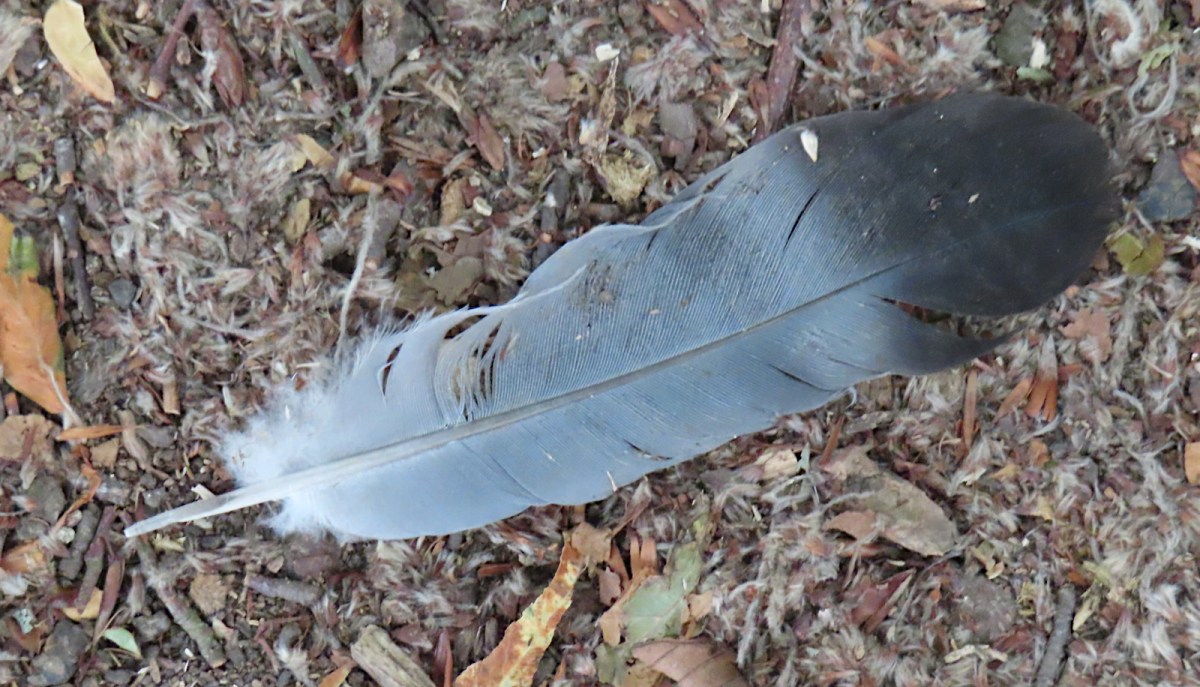
A fallen feather

There were several groups of dinosaurs that had feathers. These were probably mostly for warmth, display or camouflage rather than flight thought there were some flying dinosaurs that had flight feathers.

Reflections on Barton Mill Pond

< Previous | Index | Next >

Image of the day – 198

What’s in an image? Sometimes quite a lot, more than meets the eye. I’m posting an image whenever I can.
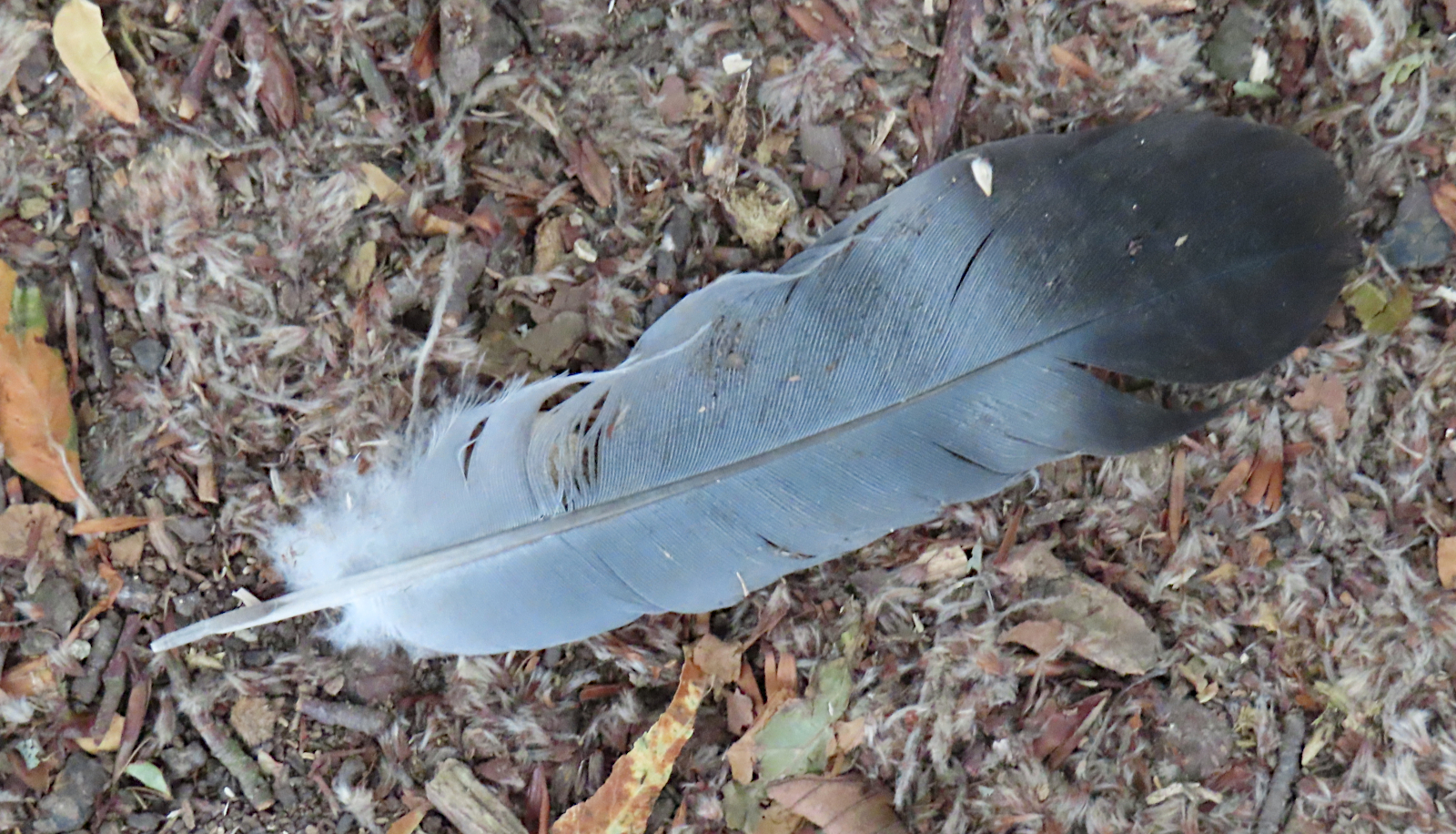
Abandoned feather

I’m sure you recognise this as a feather. But there may be quite a lot of things you don’t know about feathers too. In this post we’ll come up with as many questions and answers as we can.

What kind of bird is it from?

We all know that birds have feathers, but which species produced this particular feather, and what function did it provide? Most probably it came from a wood pigeon, according to Google’s image search.

The lowest part of the feather (bottom left) is downy and helps to keep the bird warm. The upper pale and dark grey parts have a different function altogether, they might be from the wings or tail of the bird to push the air in a downward motion to provide lift, or to guide direction of flight by manipulating the airflow in subtle ways calculated by the bird’s brain.

When a person is described as a bird-brain it may not be as derogatory as was intended! A bird’s brain is extremely well adapted to the work it has to perform. Feathers, too, are also very well adapted for the functions they provide; read more about the parts of a feather at Something over tea.

Do other animals have feathers, or is it just birds?

Mammals have hair or fur. Like feathers; skin, nails, claws, hair, fur, scales and horns are all composed of the protein keratin. It’s a tough, flexible protein with good structural strength and the ability to bend enough to resist fracturing. But among creatures living today, birds are the only group to have feathers. I wrote some other articles about birds.

Go back in time, however, and there were several groups of dinosaurs that had feathers. These were probably mostly for warmth, display or camouflage rather than flight thought there were some flying dinosaurs that had flight feathers – some of them on all four limbs so imagine a bird with four wings and teeth and you’ll get a rough idea of these creatures.

The Natural History Museum has an interesting article on its website about the origin of feathers. A lot of the detail remains to be worked out, but progress is being made.

Feathers have hidden features

A feather consists of a main central tube (the shaft) as the main support structure with a series of side branches (barbules) that can hook together. When these barbules get accidentally unhooked little gaps open up and the feathers become less affective (especially if they’re flight feathers on the wings or tail).

When birds preen, one of the things they are doing is using their beak to rezip any unhooked barbules. You can see some unzipped gaps on the feather in the photo at the top of the article.

Use of feathers by humans

Feathers are a natural resource. People have used them for centuries for clothing and display, for their insulating properties, or for artwork. Here are some specific examples, you can probably think of many more:

See also:

< Previous | Index | Next >

You might also like:

Useful? Interesting?

If you enjoyed this or found it useful, please like, comment, and share below. (If you don’t see those links, click the article’s title above the main photo and they will appear.) Send a link to friends who might enjoy the article or benefit from it – Thanks! My material is free to reuse (see conditions), but a coffee is always welcome and encourages me to write more often!

A bird called Jenny

There was a pre-decimal British coin carrying a picture of a wren on the reverse, still in use when I was a small child. There were four farthings in a penny … or 960 of them in a British pound sterling.

European wren (Wikimedia)

ad hoc post – 1

< Previous | Index | Next >

Click to enlarge (Wikimedia)

So, what bird might that be? Why, the Jenny Wren of course. If you live in Britain you’ll probably be familiar with this old term.

My son-in-law, Paz, sent me a link to a wonderful video of a Eurasian wren singing. Because the video has been slowed down, the sound is lower-pitched but also stretched out in time. As a result you can hear far more of the detail in this small bird’s singing performance. It’s truly amazing! But don’t take my word for it, watch and listen for yourself…

Paz is always amusing with his choice of titles; this time his email to me was entitled ‘Trogloclanger’. This is a portmanteau from Troglodytes (the Latin genus and species name of this wren), and The Clangers – fictitious inhabitants of space who made a whistling noise and figured in children’s stories. (You probably don’t want to watch an episode of The Clangers – but just in case, here’s one.)

It’s worth mentioning the Wikipedia article on the Eurasian wren because it provides a lot of detail about this little bird, and was also the source of the photo. Learn more about the ornithology and etymology from Wikipedia. There’s a separate article about the family Troglodytidae in general. Almost all species of wren live in the Americas, or islands in the region.

Farthing (Wikimedia)

There was a pre-decimal British coin carrying a picture of a wren on the reverse, still in use when I was a small child. There were four farthings in a penny (‘four’ and the ‘far’ in farthing are cognate) or 960 of them in a British pound sterling. So you’d need just over 9½ farthings to make a decimal penny – that’s inflation for you!

At the time many people supposed that the smallest British bird was chosen for the reverse of the smallest British coin. But that is not the case as the goldcrest is our smallest bird.

See also:

< Previous | Index | Next >

Useful? Interesting?

If you enjoyed this or found it useful, please like, comment, and share below. (If you don’t see those links, click the article’s title above the main photo and they will appear.) Send a link to friends who might enjoy the article or benefit from it – Thanks! My material is free to reuse (see conditions), but a coffee is always welcome and encourages me to write more often!

You might also like:

Is it a bird? Is it a plane?

Unlike the normal multicopter drones we’re all familiar with, this one has some mobility on the ground.

Legs and feet are important

Is it a bird? Is it a plane? No – it’s RAVEN – the Robotic Avian-inspired Vehicle for multiple ENvironments.

Larger view
(Wikimedia)

What will they think of next? The Scientific Journal Nature published an article about this amazing contraption, a fixed wing drone with legs. Like a bird it can walk, hop, and launch itself into the air with a jump. Legs and feet are important.

Unlike the normal multicopter drones we’re all familiar with, this one has some mobility on the ground and, like all fixed wing vehicles, is more energy-efficient in the air. It can’t hover, at least not yet. Hummingbirds and kestrels can hover though, so who knows what some future development of RAVEN might manage?

Visit Nature to sign up for alerts, and watch the video in their article or below.

Useful? Interesting?

If you enjoyed this or found it useful, please like, comment, and share below. (If you don’t see those links, click the article’s title above the main photo and they will appear.) Send a link to friends who might enjoy the article or benefit from it – Thanks! My material is free to reuse (see conditions), but a coffee is always welcome and encourages me to write more often!

Image of the day – 2

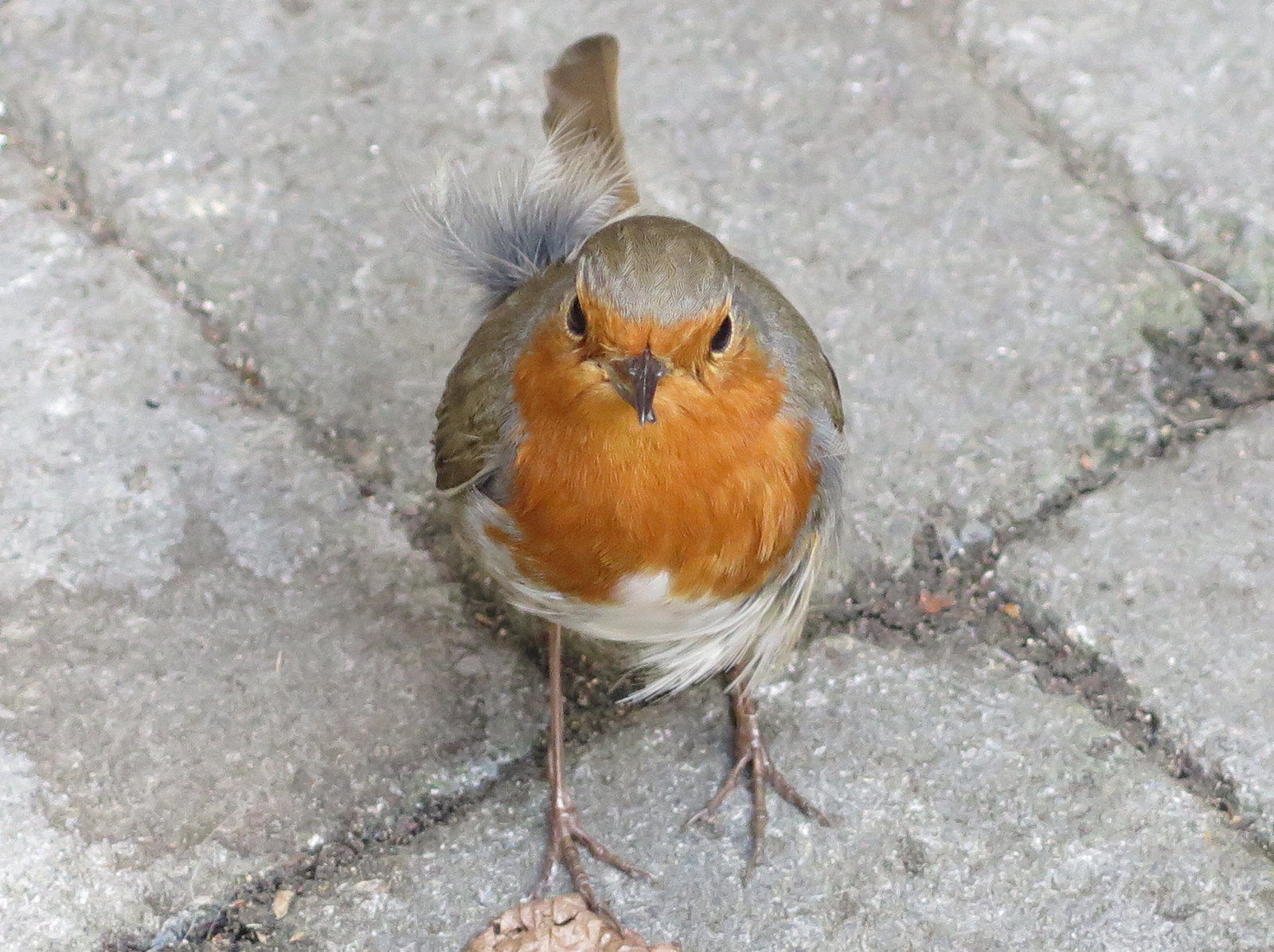
Come on mate, get preening! How do you expect to find an attractive female robin with scruffy, untidy feathers like that?

< Previous | Index | Next >

What’s in an image? Sometimes quite a lot, more than meets the eye.

I’m posting an image each day, or as often as I can; a photo I took, an image from Wikipedia, NASA, or some other open source, a diagram or a map. Whatever takes my fancy. This is the second in the series.

The robin at Pretty and Pip

Pretty & Pip is one of my favourite coffee shops in Cirencester. I wrote ‘the robin‘ because he’s always there, in their lovely courtyard. If I didn’t know the guy that owns and manages this place I might even think the robin ran it! He certainly thinks he belongs there, and he does a pretty good job of picking up cake crumbs and generally keeping the place spick and span.

But come on mate, get preening! How do you expect to find an attractive female robin with scruffy, untidy feathers like that?

Favourites

For convenience, here’s a list of my favourite images:

Anemone, Cloud, Honeybee, Hydrangea, Kiftsgate1, Kiftsgate2, Large White, Mugshot, Nelson, Robin, Rose, Spilhaus, Sunset1, Weston beach

Themed image collections

The links below will take you to the first post in each collection

Cirencester, Favourites, Irish holiday 2024, Roman villa

< Previous | Index | Next >

Useful? Interesting?

If you enjoyed this or found it useful, please like, comment, and share below. (If you don’t see those links, click the article’s title above the main photo and they will appear.) Send a link to friends who might enjoy the article or benefit from it – Thanks! My material is free to reuse (see conditions), but a coffee is always welcome and encourages me to write more often!